http://dx.doi.org/10.3988/jcn.2012.8.4.271 J Clin Neurol 2012;8:271-275
Introduction
Recent progress has been made in the molecular genetics of childhood absence epilepsy (CAE) regarding the γ-amino- butyric acid (GABA)A and GABAB receptor genes,1-9 voltage-
dependent Ca2+-channel genes,5,10-14 the epilepsy childhood ab- sence susceptibility 1 gene on chromosome 8q,5 and potassium channel genes (KCNK9 and TASK3).5,15,16 Even though some studies have found consistent results for each gene, there also have been opposing results in other studies for the same ge- nes.1-16 Therefore, these genetic findings need to be reviewed while bearing that 1) genotypic mutations should result in the phenotypic changes (e.g., neuronal hyperexcitability), 2) mu- tant forms of genetic components should be able to demon-
Mutation Screening of the γ-Aminobutyric Acid Type-A Receptor Subunit γ2 Gene in Korean Patients
with Childhood Absence Epilepsy
Young Ok Kim,a Myeong-Kyu Kim,b Tai-Seung Nam,c Shin Young Jang,b Ki Won Park,d Eun Young Kim,e Young Il Rho,f Young Jong Wooa
aDepartments of Pediatrics and bNeurology, Chonnam National University Medical School, Gwangju, Korea
cDepartment of Neurology, Chonnam National University Hwasun Hospital, Hwasun, Korea
dDepartment of Pediatrics, Mi-Rae Children’s Hospital, Gwangju, Korea
eDepartment of Pediatrics, Kwangju Christian Hospital, Gwangju, Korea
fDepartment of Pediatrics, Chosun University Hospital, Gwangju, Korea
Received July 15, 2011 Revised April 16, 2012 Accepted April 16, 2012 Correspondence Myeong-Kyu Kim, MD, PhD Department of Neurology, Chonnam National University Medical School,
42 Jebong-ro, Dong-gu, Gwangju 501-757, Korea Tel +82-62-220-6161 Fax +82-62-228-3461 E-mail [email protected]
Background and PurposezzSince the γ-aminobutyric acid type-A receptor subunit γ2 gene (GABRG2) mutation was discovered in an Australian family with childhood absence epilepsy (CAE) and febrile convulsions, a few screening studies for the GABRG2 mutation have been conducted in sporadic individuals with CAE from other ethnic groups. The aim of this study was to determine whether or not the previously reported genetic mutations and single-nucleotide polymorphisms (SNPs) of GABRG2 can be reproduced in sporadic Korean individuals with CAE, compared to healthy Korean individuals.
MethodszzThirty-five children with CAE in Chonnam National University Hospital and healthy controls (n=207) were enrolled, and the medical records of patients with CAE were re- viewed. CAE was diagnosed according to the Classification and Terminology of the Internation- al League Against Epilepsy. All nine exons of GABRG2 were directly sequenced. In addition, the two SNPs found in our CAE patients were analyzed: C315T in exon 3 (E3) and C588T in exon 5 (E5). The frequencies of the two SNPs in the CAE patients were compared with data from healthy controls (for E3 and E5) and from previously reported Korean population data (only for E3).
ResultszzNo mutation of GABRG2 was found in our CAE patients. In addition, the allele and genotype frequencies of the two polymorphisms did not differ significantly between CAE patients, healthy controls, and the Korean general population (p>0.05).
ConclusionszzOur study of sporadic Korean individuals with CAE found no evidence that GA- BRG2 contributes to the genetic basis of CAE. J Clin Neurol 2012;8:271-275 Key Wordszz GABAA receptor gamma subunit, absence epilepsy, child.
Open Access
cc This is an Open Access article distributed under the terms of the Cre- ative Commons Attribution Non-Commercial License (http://creative- commons.org/licenses/by-nc/3.0) which permits unrestricted non-com- mercial use, distribution, and reproduction in any medium, provided the ori- ginal work is properly cited.
strate the penetrance not only in specific families but also in sporadic individuals, and 3) genetic mutations or polymor- phisms should be reproducible in different racial groups.
Childhood absence epilepsy and genetic epilepsy with fe- brile seizure plus (GEFS+) are known to be associated with mutations of the GABAA receptor subunit γ2 gene (GABRG2), causing changes in electrical currents through the chan- nel1,2,17,18: R43Q in a family with CAE/febrile seizure1,2 and K289M and Q351X in a GEFS+ family.18,19 These genetic mu- tations, which were discovered in particular families, have been studied subsequently in sporadic patients.3,4 However, the genetic mutation could not be reproduced in these other eth- nic sporadic patients, and the frequency of the single nucleo- tide polymorphism (SNP) of GABRG2 did not differ between CAE patients and controls.3,4
The aim of this study was to determine whether or not the previously reported genetic mutations of GABRG21,2 discov- ered in a large Australian family with CAE and febrile convul- sions can be reproduced in Korean sporadic individuals with CAE. In addition, the allele and genotype frequencies at poly- morphic sites of GABRG2 were compared between CAE pa- tients and healthy Korean individuals.
Methods
Subjects
Patients with an established clinical diagnosis of CAE (n=35) were recruited from the epilepsy clinic of Chonnam National University Hospital, and their medical records were review- ed retrospectively by two neurologists at the Chonnam Na- tional University Hospital epilepsy clinics. Healthy volunteers (n=207) were enrolled for the control groups. The study was approved by the Institutional Review Board of the hospital, and informed consent to participate was obtained from all study subjects or their proxy. The diagnostic criteria for CAE are as follows20:
1) Typical absence seizures appearing as the initial seizure type at 3-12 years of age.
2) Electroencephalography revealing normal background activity and regular paroxysmal bilateral, symmetric generaliz- ed, and synchronous 3-Hz spike-and-wave discharges.
3) Normal findings from general physical and neurological examinations.
4) Normal neuroradiographic findings (e.g., brain computed tomography or magnetic resonance imaging).
The diagnosis of CAE followed the criteria established in the 1989 International Classification of Epileptic Syndrome.20 GABRG2 mutation analysis in CAE patients Blood samples were drawn after obtaining informed consent.
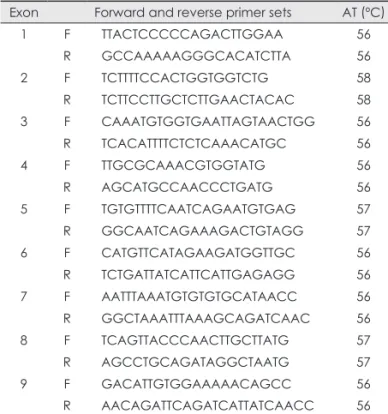
Genomic DNA was extracted from peripheral blood lympho- cytes using a standard protocol. All samples were analyzed by direct sequencing after amplification by PCR as described below. Appropriate forward and reverse primer sets for each string of exons and exon-intron boundaries of the GABRG2 cDNA sequence were prepared (Table 1) based on GenBank sequences (accession number: NM_000816.3). In addition, PCR was carried out under the following conditions. Genomic DNA (100-300 ng) was amplified in a total volume of 50 µL:
5.0 µL of 10× h-Taq storage buffer (SolGent, Daejeon, Korea), 1.0 µL of 10 mM deoxynucleotide triphosphates, 2.0 µL of each primer (at 10 pmol/mL), 0.5 µL of h-Taq DNA poly- merase (2.5 U/µL; SolGent, Daejeon, Korea), and distilled water. The amplification conditions were as follows: an ini- tial denaturation cycle at 95ºC for 15 minutes; followed by 40 amplification cycles of denaturation at 95ºC for 20 seconds, annealing at 56-58ºC for 40 seconds, and extension at 72ºC for 1 minute; and a final extension at 72ºC for 5 minutes. The PCR products were electrophoresed on a 2.0% agarose gel, and the amplified genomic DNA fragments were extracted from the gel and purified using a GeneAll Expin gel-extrac- tion kit according to the manufacturer’s instructions. Direct sequencing of both strands was performed using the BigDye terminator kit (PE Biosystems, Foster City, CA, USA). DNA sequences were obtained using an ABI 3100 Genetic Analyz- er. Electropherograms were analyzed visually using Chromas version 2.13 software (Technelysium, Queensland, Australia).
Table 1. Sequences of forward and reverse primers and anneal- ing temperatures
Exon Forward and reverse primer sets AT (ºC)
1 F TTACTCCCCCAGACTTGGAA 56
R GCCAAAAAGGGCACATCTTA 56
2 F TCTTTTCCACTGGTGGTCTG 58
R TCTTCCTTGCTCTTGAACTACAC 58
3 F CAAATGTGGTGAATTAGTAACTGG 56
R TCACATTTTCTCTCAAACATGC 56
4 F TTGCGCAAACGTGGTATG 56
R AGCATGCCAACCCTGATG 56
5 F TGTGTTTTCAATCAGAATGTGAG 57
R GGCAATCAGAAAGACTGTAGG 57
6 F CATGTTCATAGAAGATGGTTGC 56
R TCTGATTATCATTCATTGAGAGG 56
7 F AATTTAAATGTGTGTGCATAACC 56
R GGCTAAATTTAAAGCAGATCAAC 56
8 F TCAGTTACCCAACTTGCTTATG 57
R AGCCTGCAGATAGGCTAATG 57
9 F GACATTGTGGAAAAACAGCC 56
R AACAGATTCAGATCATTATCAACC 56 AT: annealing temperatures, F: forward primer, R: reverse primer.
Analyses of two candidate SNPs in healthy controls: rs11135176 (C315T in exon 3) and rs211037 (C588T in exon 5)
The two SNPs discovered in CAE patients [C315T in exon 3 (E3) and C588T in exon 5 (E5)] were analyzed in healthy and unrelated controls; this was conducted in the same manner as for the CAE patients. In addition, the previous Korean popula- tion data were collected on the Internet homepage of the Na- tional Center for Biotechnologic Information (http://www.ncbi.
nlm.nih.gov/projects/SNP/snp_ref.cgi?rs=11135176), and were available only for E3.
Statistical comparison of two SNP allele and genotype frequencies between patients and healthy individuals
Allele frequencies are expressed as a ratio of the total number of alleles. Allele and genotype frequencies for each GABRG2 polymorphism in both patient and control groups (for E3 and E5) or for the Korean population (only for E3) were compar- ed with Pearson chi-squared test analysis and Fisher’s exact test. The genotype frequencies at each SNP were assessed for deviations from the Hardy-Weinberg equilibrium. Statistical significance was accepted at p<0.05. SPSS version 18.0 (SPSS, Chicago, IL, USA) and MedCalc software (MedCalc Soft- ware, Mariakerke, Belgium) were used for these statistical analyses.
Results
Patient characteristics
The age of the patients with CAE (n=35) was 9.51±3.37 years (mean±SD; range: 5-20 years) and the gender ratio (males : fe- males) was 0.6 : 1 (Table 2). The age at the onset of absence seizures was 7.03±2.30 years. Most patients had simple CAE (31 out of 35), with the other 4 having a history of febrile con- vulsion. Among the entire cohort of patients, there were three related CAE members in a family: a pair of monozygotic
twins and one of their siblings. Four patients had a family his- tory of epilepsy (not CAE) and five patients had family mem- bers with febrile convulsion.
Mutation analysis of GABRG2
The nine exons and the exon-intron boundaries were analyz- ed thoroughly in patients with CAE, but no mutation was fo- und. Only two SNPs were discovered: rs11135176 (E3) and rs 211037 (E5).
The major (C) allele frequencies of the two SNPs (E3 and E5) discovered in CAE patients were 0.81 and 0.36. In healthy con- trols (n=207), the major C-allele frequencies in exons 3 and 5 were 0.74 and 0.57. There was no significant difference be- tween the two groups (p>0.05). Genotype frequencies for E3 in the patient group were 0.63 for CC and 0.37 for CT. The TT genotype was not found in the patient group. In healthy con- trols, the CC, CT and TT genotype frequencies were 0.54, 0.41, and 0.05, respectively. There was no significant difference between the two groups (p>0.05). Genotype frequencies for E5 in patient groups vs. healthy controls were 0.11 vs. 0.21 for the CC genotype, 0.49 vs. 0.44 for the CT genotype, and 0.40 vs. 0.35 for the TT genotype. No significant difference was observed between the two groups (p>0.05) (Table 2).
The Korean population SNP data for rs11135176 (E3) on National Center for Biotechnologic Information showed that the major allele frequency (C) was 0.75 and that the genotype frequencies for CC, CT, and TT were 0.567, 0.367, and 0.067, respectively. We found no significant difference between these data (n=90) and our patient data (n=35; p>0.05).
Discussion
γ-aminobutyric acid, the main inhibitory neurotransmitter in the brain, mediates its rapid inhibition through GABAA recep- tors.21 GABAA receptors have a pentameric structure with five subunits: 1) two of α1, α2, α3, or α5 subunits; 2) two β2 or β3 subunits (or one each); and 3) one γ2 subunit. These are ar- Table 2. Comparison of allele and genotype frequencies at polymorphic sites of GABRG2 between patients with childhood absence epilep- sy (n=35) and healthy controls (n=207)
SNP Allele frequency
p value Genotype frequency
p value
Pt Con Pt (n) Con (n)
E3* C 0.81 0.74 0.19 CC 0.63 (22) 0.54 (111) 0.41
T 0.19 0.26 CT 0.37 (13) 0.41 (85) 0.80
TT 0.00 (0) 0.05 (11) 0.34
E5† C 0.36 0.57 0.25 CC 0.11 (4) 0.21 (43) 0.29
T 0.64 0.43 CT 0.49 (17) 0.44 (92) 0.79
TT 0.40 (14) 0.35 (72) 0.69
*E3 is rs11135176 in exon3 of GABRG2. The Hardy-Weinberg equilibrium (HWE) is 1.82 in patient group (p=0.57, exact) and 1.05 in control group (p=0.31), †E5 is rs211037 in exon 5 of GABRG2. The HWE is 0.11 in patient group (p=1.00, exact) and 1.8 in control group (p=0.18).
Con: control, Pt: patient, SNP: single nucleotide polymorphism.
ranged like the spokes of a wheel with a central chloride pore.21 Mutations of the GABAA receptor subunit genes (e.g., GA- BRA1, GABRB3, and GABRG2) are thought to alter receptor function and/or impair receptor biogenesis via multiple mech- anisms, which may predispose affected patients to seizures.22,23 Some types of GABAA receptor subunit gene mutations have been associated with epilepsy, CAE, GEFS+, febrile seizures, juvenile myoclonic epilepsy, and Dravet syndrome.22
γ-aminobutyric acid type-A receptor subunit γ2 gene is one of the GABAA receptor subunit genes initially discovered to have mutations in patients with epilepsy.23 Mutations involving the γ2 subunit (GABRG2) are known to be present in absence epilepsy with or without febrile convulsions (R34Q, IVS6+2T
→ G)1-3 and GEFS+ (K289M, Q351X).18,19 R34Q mutations were found in over 4 generations of a large Australian family with 35 epilepsy patients in the early 2000s.1,2 Typical CAE was even observed in eight of them. Other seizure phenotypes were also observed: GEFS+, febrile seizure, myoclonic astatic epilepsy, generalized epilepsy with tonic/clonic seizures, and partial epilepsy.1,2 Subsequent animal studies have shown that a good animal model of familial CAE can be created with this heterozygotic mutation.24,25 Nevertheless, this mutation has not been reproduced in either unrelated sporadic individuals or in other ethnic groups.
Screening for the GABRG2 mutation in sporadic individu- als with CAE was performed in two ethnic groups: German (46 CAE and 59 juvenile absence epilepsy; 154 controls) and Chinese (68 CAE, Han ethnicity; trio).3,4 However, neither of these studies showed the previous missense mutation in GA- BRG2. Only Kananura et al.3 (German) found a point and splice donor mutation (IVS6+2T → G) leading to a nonfunc- tional protein.
Through the two aforementioned studies,3,4 SNPs of GA- BRG2 were also reported for exons 3 and 5. In the Chinese patients, Lu et al.4 identified SNPs in exon 3 with allele fre- quencies of 0.75 for G and 0.25 for A, and in exon 5 with al- lele frequencies of 0.47 for C and 0.53 for T. However, it ap- pears that both of these SNPs lead to synonymous substitu- tions in the translated protein and probably do not affect pro- tein function.4 In addition, transmission disequilibrium tests in 68 trios with CAE revealed no significant discrepancies in allele frequencies of the two SNPs between the CAE patients and the ‘internal controls’.4 The SNP in exon 5 is identical to the E5 SNP sequence that we found in our Korean group. In a German-population-based association study, a common exon 5 polymorphism (C588T) was also evaluated.3 Genotype fre- quencies of C588T in the German CAE patient group vs. con- trols were 0.615 vs. 0.675 for CC, 0.348 vs. 0.273 for CT, and 0.037 vs. 0.052 for TT3. Even though these proportions of genotypes differ from those for our Korean groups, Kanan-
ura et al.3 did not find any significant differences in the allele and genotype frequencies for C588T between patients with idiopathic absence epilepsy and controls (p=0.35); this con- curs with what we found.
As in the previous studies,3,4 we were unable to find a mut- ation at R34Q in GABRG2. Furthermore, there was no newly discovered mutation in GABRG2, and the SNPs did not differ between the CAE group and the healthy Korean controls. A limitation of this study is that we included only a small num- ber of Korean CAE patients; more patients should be recruit- ed in future studies in order to check our suggestion that GA- BRG2 contributes to the epileptogenesis of CAE. Our nega- tive results, unlike the findings for the previous family study,1,2 need to be reviewed, especially regarding the following two points: 1) a racial discrepancy can exist, and there is still a sh- ortage of data for large ethnic groups, including Koreans; and 2) the previous mutation was discovered in a family with di- verse epileptic phenotypes except for the two main pheno- types of CAE and febrile seizure, while most of the individu- al studies for GABRG2 have focused on CAE patients.
Conflicts of Interest
The authors have no financial conflicts of interest.
Acknowledgements
This study was financially supported by Chonnam National University, 2009.
REFERENCES
1. Wallace RH, Marini C, Petrou S, Harkin LA, Bowser DN, Panchal RG, et al. Mutant GABAA receptor gamma2-subunit in childhood absence epilepsy and febrile seizures. Nat Genet 2001;28:49-52.
2. Marini C, Harkin LA, Wallace RH, Mulley JC, Scheffer IE, Berkovic SF. Childhood absence epilepsy and febrile seizures: a family with a GABAA receptor mutation. Brain 2003;126:230-240.
3. Kananura C, Haug K, Sander T, Runge U, Gu W, Hallmann K, et al. A splice-site mutation in GABRG2 associated with childhood absence epilepsy and febrile convulsions. Arch Neurol 2002;59:1137-1141.
4. Lu J, Chen Y, Zhang Y, Pan H, Wu H, Xu K, et al. Mutation screen of the GABAA receptor gamma 2 subunit gene in Chinese patients with childhood absence epilepsy. Neurosci Lett 2002;332:75-78.
5. Robinson R, Taske N, Sander T, Heils A, Whitehouse W, Goutières F, et al. Linkage analysis between childhood absence epilepsy and genes encoding GABAA and GABAB receptors, voltage-dependent calcium channels, and the ECA1 region on chromosome 8q. Epilepsy Res 2002;
48:169-179.
6. Lu J, Chen Y, Pan H, Zhang Y, Wu H, Xu K, et al. The gene encoding GABBR1 is not associated with childhood absence epilepsy in the Chinese Han population. Neurosci Lett 2003;343:151-154.
7. Lu J, Pan H, Chen Y, Zhang Y, Liu X, Jiang Y, et al. Mutation screen of the gene encoding GABRB3 in Chinese patients with childhood ab- sence epilepsy. Am J Med Genet A 2003;123A:197-200.
8. Kang JQ, Macdonald RL. The GABAA receptor gamma2 subunit R43Q mutation linked to childhood absence epilepsy and febrile sei- zures causes retention of α1β2γ2S receptors in the endoplasmic reticu- lum. J Neurosci 2004;24:8672-8677.
9. Urak L, Feucht M, Fathi N, Hornik K, Fuchs K. A GABRB3 promoter
haplotype associated with childhood absence epilepsy impairs tran- scriptional activity. Hum Mol Genet 2006;15:2533-2541.
10. Chen Y, Lu J, Zhang Y, Pan H, Wu H, Xu K, et al. T-type calcium chan- nel gene alpha (1G) is not associated with childhood absence epilepsy in the Chinese Han population. Neurosci Lett 2003;341:29-32.
11. Vitko I, Chen Y, Arias JM, Shen Y, Wu XR, Perez-Reyes E. Function- al characterization and neuronal modeling of the effects of childhood absence epilepsy variants of CACNA1H, a T-type calcium channel. J Neurosci 2005;25:4844-4855.
12. Wang J, Zhang Y, Liang J, Pan H, Wu H, Xu K, et al. CACNA1I is not associated with childhood absence epilepsy in the Chinese Han popul- ation. Pediatr Neurol 2006;35:187-190.
13. Everett KV, Chioza B, Aicardi J, Aschauer H, Brouwer O, Callenbach P, et al. Linkage and association analysis of CACNG3 in childhood ab- sence epilepsy. Eur J Hum Genet 2007;15:463-472.
14. Liang J, Zhang Y, Chen Y, Wang J, Pan H, Wu H, et al. Common poly- morphisms in the CACNA1H gene associated with childhood absence epilepsy in Chinese Han population. Ann Hum Genet 2007;71:325- 15. Kananura C, Sander T, Rajan S, Preisig-Müller R, Grzeschik KH, Daut 335.
J, et al. Tandem pore domain K(+)-channel TASK-3 (KCNK9) and id- iopathic absence epilepsies. Am J Med Genet 2002;114:227-229.
16. Holter J, Carter D, Leresche N, Crunelli V, Vincent P. A TASK3 chan- nel (KCNK9) mutation in a genetic model of absence epilepsy. J Mol Neurosci 2005;25:37-51.
17. Bowser DN, Wagner DA, Czajkowski C, Cromer BA, Parker MW, Wallace RH, et al. Altered kinetics and benzodiazepine sensitivity of
a GABAA receptor subunit mutation [gamma 2(R43Q)] found in hu- man epilepsy. Proc Natl Acad Sci U S A 2002;99:15170-15175.
18. Baulac S, Huberfeld G, Gourfinkel-An I, Mitropoulou G, Beranger A, Prud’homme JF, et al. First genetic evidence of GABAA receptor dys- function in epilepsy: a mutation in the gamma2-subunit gene. Nat Ge- net 2001;28:46-48.
19. Harkin LA, Bowser DN, Dibbens LM, Singh R, Phillips F, Wallace RH, et al. Truncation of the GABAA-receptor gamma2 subunit in a fa- mily with generalized epilepsy with febrile seizures plus. Am J Hum Genet 2002;70:530-536.
20. Proposal for revised classification of epilepsies and epileptic syndr- omes. Commission on Classification and Terminology of the Interna- tional League Against Epilepsy. Epilepsia 1989;30:389-399.
21. Meldrum BS, Rogawski MA. Molecular targets for antiepileptic drug development. Neurotherapeutics 2007;4:18-61.
22. Macdonald RL, Kang JQ, Gallagher MJ. Mutations in GABAA recep- tor subunits associated with genetic epilepsies. J Physiol 2010;588:
1861-1869.
23. Macdonald RL, Gallagher MJ, Feng HJ, Kang J. GABAA receptor ep- ilepsy mutations. Biochem Pharmacol 2004;68:1497-1506.
24. Tan HO, Reid CA, Single FN, Davies PJ, Chiu C, Murphy S, et al. Re- duced cortical inhibition in a mouse model of familial childhood ab- sence epilepsy. Proc Natl Acad Sci U S A 2007;104:17536-17541.
25. Chiu C, Reid CA, Tan HO, Davies PJ, Single FN, Koukoulas I, et al.
Developmental impact of a familial GABAA receptor epilepsy muta- tion. Ann Neurol 2008;64:284-293.