Copyright © 2013 The Korean Society for Bone and Mineral Research
This is an Open Access article distributed under the terms of the Creative Commons Attribution Non-Commercial Li- cense (http://creativecommons.org/licenses/by-nc/3.0/) which permits unrestricted non-commercial use, distribu- tion, and reproduction in any medium, provided the original work is properly cited.
Effects of a ‘Drug Holiday’ on Bone Mineral Density and Bone Turnover Marker During Bisphosphonate Therapy
Sung Yeol Kong, Dae Young Kim, Eun Jin Han, So Young Park, Chang Hoon Yim, Sung Hoon Kim, Hyun Koo Yoon Department of Internal Medicine, Cheil General Hospital & Women’s Healthcare Center, Kwandong University College of Medicine, Seoul, Korea
Background: Recently long-term safety of bisphosphonate raises issues about the dura- tion of therapy. We examined the effects of a drug holiday (DH) on bone mineral density (BMD) and bone turnover markers. Methods: In Korean, 125 women of 50 years of age or older with T-score≤-3.0 of their lumbar or left femoral BMD initiated bisphosphonate from 1999 based on retrospective chart review. 125 patients who had used bisphospho- nate≥5 years started DH in 2006. Lumbar (L1-4), left femoral neck, total BMD, serum parameter (β-crossLaps [CTx], phosphorus, total calcium, total alkaline phosphatase), and urinary parameter (calcium/creatinine ratio) were measured before, the time of starting, and after DH. Results: After DH, lumbar, femoral neck and total BMD did not change significantly (0.757±0.093→0.747±0.102, P=0.135, 0.567±0.079→0.560±
0.082, P=0.351, 0.698±0.008→0.691±0.090 g/cm2, P=0.115, respectively). Serum CTx and total alkaline phosphatase were increased significantly (0.205±0.120→0.791±
0.44 ng/mL, P<0.001, 54.52±13.40→60.42±15.543 IU/L, P=0.001, respectively). Uri- nary calcium/creatinine ratio increased significantly (0.132±0.076→0.156±0.093, P=0.012). Conclusions: A DH could be cautiously considered in patients with long-term use of bisphosphonate if there is a concern about severe suppression of bone turnover with respect to long-term use because insignificant changes of BMD and significant in- crease of bone turnover markers are shown during the period.
Key Words: Bisphosphonate, Bone mineral density, Bone turnover marker, Drug holiday
INTRODUCTION
Osteoporosis is a common metabolic bone disease with spectrum ranging from asymptomatic bone loss to disabling hip fracture. The objective of osteoporosis treatment is to maintain skeletal health and prevent bone fracture.[1] Bisphos- phonate is the most commonly used medication to prevent and treat osteoporo- sis in Korea. Several studies have reported relationships between medication per- sistence and reduced fracture risk.[2-4] Highly persistent patients showed signifi- cant reduction of relative risk for all fractures, while poor compliers had higher and increased risk of fractures. Currently, bisphosphonate therapy raises issues about adverse events with many years of taking bisphosphonates — osteonecro- sis of the jaw (ONJ), severely suppressed bone turnover, atrial fibrillation, subtro- Corresponding author
Hyun Koo Yoon
Department of Internal Medicine, Cheil General Hospital & Women’s Healthcare Center, Kwandong University College of Medicine, 17 Seoae-ro 1-gil, Jung-gu, Seoul 100-380, Korea
Tel: +82-2-2000-7244 Fax: +82-2-2000-7147
E-mail: [email protected] Received: December 11, 2012 Revised: January 28, 2013 Accepted: January 28, 2013
No potential conflict of interest relevant to this article was reported.
Original Article
pISSN 2287-6375 eISSN 2287-7029
chanteric fracture, and esophageal cancer.[5-9] To avoid such adverse events of long-term treatment, stopping the medication after 5 years of usage and using anabolic agents
& other schedule and doses of bisphosphonate were sug- gested.[10] Additionally drug holiday (DH) was also sug- gested since 1 year of DH was not associated with increase in vertebral and hip fractures[11] and even with one year after discontinuation of bisphosphonate treatment, spine and femoral neck bone mineral density (BMD) remained higher that placebo group.[12] The purpose of this study is to observe the effects of a ‘DH’ on BMD and bone turnover marker during bisphosphonate therapy in Korean women with osteoporosis.
METHODS
The study was designed based on retrospective chart re- view and the study population consisted of 125 women aged 67.0 years old (50-81 years old) with osteoporosis (T- score≤-3.0 ; lumbar spine or femur of dual energy X-ray absorptiometry [DXA]) who initiated bisphosphonate be- tween 1999 and 2004. The percentage of coefficient of variation (CV) of DXA (Hologic Discovery; HOLOGIC, Inc., Bedford, MA, USA) were 0.022% at L1-4, 0.046% at femoral neck, and 0.038% at total femur. If the patients had taken bisphosphonate more than 5 years, 1 year of “DH” was started in 2006. During the DH, bisphosphonate and calci- um were at almost switched to alfacalcidol (0.5 μg) or cal- citriol (0.25 μg), and calcium (158-600 mg) at almost pa- tients. We prescribed one of three treatment regimens (daily, weekly, monthly) and divided these patients into alendronate (n=59), risedronate (n=58), and ibandronate group (n=8). And also lumbar and left femoral neck and total BMD, serum parameter (β-crossLaps [CTx; Roche Di- agnostics, Mannheim, Germany, reference range 0.13-0.58 ng/mL], albumin, phosphorus, total calcium, and total al- kaline phosphatase), and urinary parameters (fasting urine calcium, phosphorus, and creatinine) were measured 1 year before and after the DH. Non-parametric and paired T-test (Wilcoxon Signed Ranks Test) were used for compar- ing the parameters before and after the dug holiday using SPSS software version 20 (SPSS Inc., Chichago, IL, USA). Al- though the study was designed based on retrospective chart review, the study was started after the approval of Institutional Review Board (IRB).
RESUTLS
1. Baseline characteristics at the time of DH The baseline characteristics of the 125 patients are shown in Table 1. Mean age was 67.0±6.7 years, with mean BMI 23.1±2.9 kg/m2, and the duration of bisphosphonate ther- apy was average 6.1±1.3 years.
2. Changes of BMD
BMD was measured annually during bisphosphonate treatment. We compared the BMD at 1 year before starting DH, on the starting year, and 1 year after the DH for 125 patients who had taken bisphosphonate more than 5 years.
Changes of lumbar (L1-4) BMD between the time of start- ing and 1 year after the DH was insignificant (0.757±0.093
→0.747±0.102 g/cm2, P=0.135). Changes of femoral neck and total BMD were not significant (0.567±0.079 →0.560
±0.082, P=0.351, 0.698±0.008→0.691±0.090 g/cm2, P=0.115 respectively (Fig. 1, Table 2).
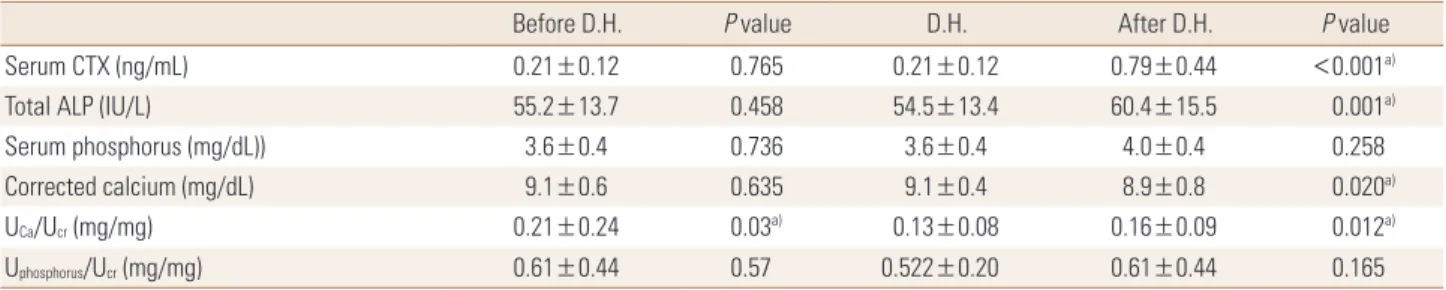
3. Changes of serum and urinary parameters After one year of DH, serum CTx and total alkaline phos- phatase were increased significantly (0.21±0.12→0.79±
0.44 ng/mL, P <0.001, 54.5±13.4→60.4±15.5 IU/L, P=0.001 respectively). Serum phosphorus was increased Table 1. Baseline characteristics of study patients
Demographies Total (n=125)
Age (yr) No. (%) Mean≥70 60≤ <70 50≤ <60
67.0±6.7 48 (38.4%) 60 (48.0%) 17 (13.6%)
Height (cm) 152.1±13.7
BMI (kg/m2) 23.1±2.9
Duration of Bisphosphonate Use (yr) 6.1±1.3 Mean BMD (g/cm2)
L2-4 Femur neck Femur total
0.757±0.093 0.567±0.079 0.698±0.008
Serum CTX (ng/mL) 0.21±0.12
Total ALP (IU/L) 54.5±13.4
Serum phosphorus (mg/dL) 3.6±0.4
Corrected calcium (mg/dL) 9.0±0.4
UCa/Ucr (mg/mg) 0.13±0.08
Uphosphorus/Ucr (mg/mg) 0.52±0.20
Data are given as mean values±SDs.
BMD, bone mineral density; ALP, alkaline phosphatase; CTX, C-terminal crosslinked telopeptides of type I collagen; SD, standard deviation.
Fig. 1. Changes of bone mineral density (BMD) in lumbar spine (1-4) and femur before and after the drug holiday (DH).
Before D.H. D.H. After D.H
0.9 0.85 0.8 0.75 0.7 0.65 0.6 0.55 0.5 0.45
Femur (total)
Before D.H. D.H. After D.H
0.9 0.85 0.8 0.75 0.7 0.65 0.6 0.55 0.5 0.45
Femur (neck) BMD (g/cm2)
Before D.H. D.H. After D.H
0.9 0.85 0.8 0.75 0.7 0.65 0.6 0.55 0.5 0.45
L1-4
Table 2. Changes of serum and urine parameters before and after the drug holiday
Before D.H. P value D.H. After D.H. P value
Serum CTX (ng/mL) 0.21±0.12 0.765 0.21±0.12 0.79±0.44 <0.001a)
Total ALP (IU/L) 55.2±13.7 0.458 54.5±13.4 60.4±15.5 0.001a)
Serum phosphorus (mg/dL)) 3.6±0.4 0.736 3.6±0.4 4.0±0.4 0.258
Corrected calcium (mg/dL) 9.1±0.6 0.635 9.1±0.4 8.9±0.8 0.020a)
UCa/Ucr (mg/mg) 0.21±0.24 0.03a) 0.13±0.08 0.16±0.09 0.012a)
Uphosphorus/Ucr (mg/mg) 0.61±0.44 0.57 0.522±0.20 0.61±0.44 0.165
Values are mean values±SDs. D.H., drug holiday.
Comparison were carried out using t test. Values are mean values±SDs.
All data were compared with those of the DH.
a)The mean difference is significant at the 0.05 level compared to DH.
insignificantly (3.6±0.4→4.0±0.4 mg/dL, P=0.258). Cor- rected serum calcium was decreased significantly (9.0±
0.4→8.9±0.8 mg/dL, P=0.02) (Table 2). Urinary calcium/
creatinine ratio was increased significantly (0.132±0.08→
0.16±0.09 mg/mg, P=0.012), but urinary phosphorus/
creatinine ratio was insignificantly changed.
DISCUSSION
Osteoporosis is a common metabolic bone disease and an important cause of fracture in postmenopausal women.
To achieve the maximum effects from bisphosphonate treatment, it is very important to keep taking medicine persistently. Compliance with bisphosphonate therapy is associated with a lower risk of osteoporotic fractures. Al- though long-term treatment with bisphosphonate has benefits on fracture reduction undoubtedly, there are some issues with respect to long-term safety. Since alendronate has received U.S. Food and Drug Administration (FDA) ap- proval for the treatment of osteoporosis in 1995, oral alen- dronate (daily and weekly formulation in 1998, 2001 re- spectively) has begun to be used in Korea. Also risedronate, ibandronate and zoledronic acid have been approved and currently used thereafter.
Since ONJ,[5] a traumatic fractures due to severe sup- pressed bone turnover (SSBT),[6] atrial fibrillation,[7] sub- trochanteric fracture,[8] and esophageal cancer,[9] were reported after the introduction of bisphosphonate for the treatment of osteoporosis, long-term safety of bisphos- phonate use has been issued. With respect to long-term safety, previous reports were not problematic except 2 rare conditions, ONJ and atypical fractures.
Because bisphosphonate are tightly bound to bone after absorption and gradually released over months or years after treatment is stopped, which raises issues about both the possibility of stopping therapy and adverse events with long-term use, a DH was suggested concerning above possibilities.[13] A DH does not mean stopping the medi- cation, but is a period between stop and restart of bispho- phonate therapy. During DH, we switched from bisphos-
phonate and calcium to alfacalcidol (0.5 μg) or calcitriol (0.25 μg) and calcium (158-600 mg) because of approved drug for osteoporosis in Korea. Nevertheless, there is no strong evidence to provide guidance regarding how long to treat with bisphosphonate or how long the DH should continue.[14]
In this study, effects of 1 year of DH on BMD and bone turnover markers in postmenopausal osteoporosis using bisphosphonate for more than five years were observed.
Our study shows spine and hip BMD changed insignifi- cantly after the DH, but serum CTx and total alkaline phos- phatase were increased significantly. Corrected calcium was decreased meaningfully, but level was within normal ranges. Urinary calcium/creatinine ratio was increased sig- nificantly. However, changes of bone turnover markers and BMD between 1 year before DH and the time of DH were observed not significantly. The results of insignificant changes of BMD and significant increase of serum CTx, to- tal alkaline phosphatase, and urinary calcium/creatinine ratio after cessation of treatment suggest that the BMD is not influenced and increased bone remodeling recovers bone suppression after 1 year of DH. It is very hard to ex- plain the decrease of urinary calcium/creatinine ratio at the time of starting DH compared with that of 1 year be- fore DH, we could speculate that long-term use of bisphos- phonate leading to bone suppression may cause reduction of calcium release from bone and decrease of urinary calci- um excretion. In the subanalysis of alendronate, risedro- nate, and ibandronate group, there were no significant dif- ferences between three groups (date not shown). We Fur- ther studies will be needed to clarify unexplained result.
Limitations of this study are; 1) there are no data compar- ing between the patients with DH and without DH, 2) bone resorption marker after the DH could not be com- pared with basal level before initiating bisphosphonate therapy, because urinary deoxypyridinoline/creatinine was only available as a bone markers when initiate treatment.
However, change of bone resorption marker after the DH could be observed using serum CTx. In this study, 1 year off the drug is expected to affect no change of BMD, in- crease bone turnover markers, and be considered to have a positive effect on bone metabolism at least recovering the suppression of bone turnover due to long-term use of bisphosphonate, 3) since number of subjects in this study were small, more subjects will be needed to clarify the ef-
fects of DH.
CONCLUSION
Since at least one year of DH did not influence lumbar and femoral BMD, but significantly increased bone turn- over markers, one year of DH could be considered cau- tiously concerning the severe suppression of bone turn- over with respect to long-term safety of bisphosphonate use. This study would suggest the possibility of the DH af- ter long period of bisphosphonate treatment.
REFERENCES
1. Gass M, Dawson-Hughes B. Preventing osteoporosis-relat- ed fractures: an overview. Am J Med 2006;119:S3-11.
2. McCombs JS, Thiebaud P, McLaughlin-Miley C, et al. Com- pliance with drug therapies for the treatment and preven- tion of osteoporosis. Maturitas 2004;48:271-87.
3. Caro JJ, Ishak KJ, Huybrechts KF, et al. The impact of com- pliance with osteoporosis therapy on fracture rates in ac- tual practice. Osteoporos Int 2004;15:1003-8.
4. Siris ES, Harris ST, Rosen CJ, et al. Adherence to bisphos- phonate therapy and fracture rates in osteoporotic wom- en: relationship to vertebral and nonvertebral fractures from 2 US claims databases. Mayo Clin Proc 2006;81:1013- 22.
5. Marx RE. Pamidronate (Aredia) and zoledronate (Zometa) induced avascular necrosis of the jaws: a growing epi- demic. J Oral Maxillofac Surg 2003;61:1115-7.
6. Odvina CV, Zerwekh JE, Rao DS, et al. Severely suppressed bone turnover: a potential complication of alendronate therapy. J Clin Endocrinol Metab 2005;90:1294-301.
7. Black DM, Delmas PD, Eastell R, et al. Once-yearly zole- dronic acid for treatment of postmenopausal osteoporo- sis. N Engl J Med 2007;356:1809-22.
8. Goh SK, Yang KY, Koh JS, et al. Subtrochanteric insufficien- cy fractures in patients on alendronate therapy: a caution.
J Bone Joint Surg Br 2007;89:349-53.
9. Wysowski DK. Reports of esophageal cancer with oral bisphosphonate use. N Engl J Med 2009;360:89-90.
10. Ott SM. Long-term safety of bisphosphonates. J Clin En- docrinol Metab 2005;90:1897-9.
11. Sebba A. Osteoporosis: how long should we treat? Curr Opin Endocrinol Diabetes Obes 2008;15:502-7.
12. Watts NB, Chines A, Olszynski WP, et al. Fracture risk re- mains reduced one year after discontinuation of risedro- nate. Osteoporos Int 2008;19:365-72.
13. Papapoulos SE, Cremers SC. Prolonged bisphosphonate release after treatment in children. N Engl J Med 2007;
356:1075-6.
14. Diab DL, Watts NB. Bisphosphonates in the treatment of osteoporosis. Endocrinol Metab Clin North Am 2012;41:
487-506.