pISSN 2288-9272 eISSN 2383-8493 J Oral Med Pain 2015;40(1):10-16 http://dx.doi.org/10.14476/jomp.2015.40.1.10
Comparison of the Effects of Pilocarpine Solution and Tablet on Salivary Flow Rate
Jo-Eun Park, Chan-Woo Song, Ki-Suk Kim, Mee-Eun Kim
Department of Oral Medicine, College of Dentistry, Dankook University, Cheonan, Korea
Received December 30, 2014 Revised January 13, 2015 Accepted January 20, 2015
Purpose: Pilocarpine has the effects on improvement of salivary flow and subjective symptoms for xerostomic patients. Because of unwanted side effects following its systemic administration, topical pilocarpine has been paid attention as an alternative. This study aimed to investigate effects of pilocarpine solution as mouthwash on salivary flow and adverse effects compared to systemic administration of 5 mg pilocarpine tablet in healthy subjects.
Methods: The study was a double blind, placebo-controlled, crossover clinical trial. Five milli- grams pilocarpine tablets, 4 mL of 2% pilocarpine solution and placebo solution were given to 12 healthy volunteers (6 males and 6 females) in a predetermined order with wash-out period of at least two days and unstimulated whole saliva was collected before and after administra- tion of each drug. Blood pressure and pulse rate was also measured and subjective effect and potential side effects were evaluated by a self-administrated questionnaire.
Results: Systemic (5 mg tablet) and topical (2% solution) use of pilocarpine significantly in- creased salivary flow rate in healthy subjects compared to placebo (p<0.001). In both the pi- locarpine solution and tablet groups, salivary flow rates at 120 minutes after administration remained increased. Subjective effect on salivation was the largest in the pilocarpine tablet group, followed by the pilocarpine solution group (p<0.05). There was no significant difference in blood pressure and pulse rate after administration of all three drugs. Fewer side effects re- ported in the pilocarpine solution group than in the tablet group.
Conclusions: Two percents pilocarpine solution as mouthwash increases salivary flow rate, definitely superior to placebo solution and comparable to pilocarpine tablet, with fewer side ef- fects in healthy subjects. It indicates a possibility of pilocarpine solution as a useful alternative of pilocarpine tablets for the xerostomic patients with systemic diseases.
Key Words: Administration, topical; Mouthwashes; Pilocarpine; Salivation
Correspondence to:
Mee-Eun Kim
Department of Oral Medicine, College of Dentistry, Dankook University, 119, Dandae-ro, Dongnam-gu, Cheonan 330-714, Korea
Tel: +82-41-550-1913 Fax: +82-505-434-7951 E-mail: [email protected]
As an ideal replacement to saliva does not exist yet,
2)sal- ivary stimulants such as oral pilocarpine have mostly been used to relieve symptoms of oral dryness for patients with xerostomia. Pilocarpine is a non-specific muscarinic ace- tylcholine receptor agonist and primarily acts to increase salivary flow through the muscarinic 3 (M3) receptors.
3)As these are expressed on smooth muscle and glandular tis- sues, pilocarpine stimulates lacrimal, gastrointestinal and respiratory mucous cells.
3)For this reason, in addition to
INTRODUCTION
Xerostomia is commonly due to alterations in salivary gland function either through a diminution of salivary flow or changes in the composition of saliva.
1)Long-standing xerostomia may cause a lot of complications such as den- tal caries, dysgeusia, burning sensation, oral mucosal sore- ness, difficulty in wearing dentures, periodontal disease and halitosis.
1)JOMP
Journal of Oral Medicine and PainCopyright Ⓒ 2015 Korean Academy of Orofacial Pain and Oral Medicine. All rights reserved.
CC This is an open-access article distributed under the terms of the Creative Commons Attribution Non-Commercial License (http://creativecommons.org/licenses/by-nc/3.0/), which permits unrestricted non-commercial use, distribution, and reproduction in any medium, provided the original work is properly cited.
enrolled in this study. Their mean age was 24.5 years (range, 23 to 26 years) and mean body weight was 61.8 kg (range, 48 to 78 kg). Exclusion criteria were those with a history of allergy to pilocarpine; in pregnancy or breast-feeding; with cardiovascular disease (uncontrolled hypertension, arrhyth- mia); with renal diseases; with acute iritis or narrow-angle (angle closure) glaucoma; with pulmonary diseases includ- ing asthma and chronic obstructive pulmonary disease.
2. Study Medication
Pilocarpine tablets (Salagen Tab.; Hyundai Pharm., Seoul, Korea) containing 5 mg pilocarpine hydrochloride were used for systemic administration. Four milliliters of 2% pi- locarpine solution was prepared by adding 2 mL of 4% pi- locarpine ophthalmic solution (Ocucarpine Eye Drops; Samil Pharm., Seoul, Korea) to 2 mL of mouthwash commercial- ly available (Caregargle Solution; Hanmi Pharm., Seoul, Korea) as carrier to make pilocarpine solution to mask the bitter taste of pilocarpine. The mouthwash was also used for placebo solutions. Pilocarpine solution and placebo was prepared and dispensed by 4 mL on the previous day before administration.
3. Study Design
The study was designed to compare the effects of pilocar- pine solution to pilocarpine tablets and placebo solution.
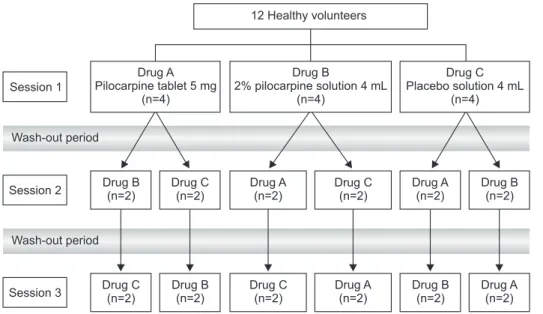
Comparison between pilocarpine and placebo solution was double-blinded. Fig. 1 represents our experiment flow. The whole experiment consisted of three experimental sessions;
i.e., each subject was administered pilocarpine tablet, pilo- carpine solution and placebo solution in the predetermined order with wash-out period of at least two days between the sessions. The volunteers were randomly allocated to 6 sex-matched groups, each consisting of 2 individuals. Prior to experiments, all subjects underwent baseline medical his- tory taking and physical examination.
All experimental sessions were conducted between 9:00 to 12:00 in the morning to minimize the effects of diur- nal variation. The subjects were instructed not to eat, drink, smoke, or perform oral hygiene, which cause the chemical or mechanical salivary stimulation, for at least 1 hour be- fore a saliva collection. For systemic administration of pi- locarpine, the subjects were asked to take the tablet with a increased salivary flow, it has a number of unwanted side
effects due to its non-specific stimulation of muscarinic re- ceptors
4)including nausea, vomiting, epigastric distress, ab- dominal cramping, diarrhea, bladder tightness, frequent uri- nation, headache, syncope, sweating, tremor, flushing, hy- potension, hypertension, bradycardia and arrhythmia.
5)To minimize side effects following systemic administration of pilocarpine, topical pilocarpine may be considered as an al- ternative. Local administration of pilocarpine offers several benefits such as mechanical salivary stimulation, prolonged and increased topical contact, and potential decrease in sys- temic effects.
5-9)A few studies have been performed on effectiveness of topical pilocarpine as mouthwash. In 1980, Mikhail
10)re- ported the topical use of pilocarpine for the first time and demonstrated that the 0.025%-1% pilocarpine mouthwash was effective for dry mouth relief. Kim et al.,
11)in their case study, reported improvement of subjective oral dryness with 0.02%-0.04% pilocarpine solution as mouthwash for xeros- tomic patients. Bernardi et al.
8)reported that mouth rinsing with 1% or 2% pilocarpine solutions for healthy subjects induced a significant objective and subjective dose-depen- dent increase in salivary flow and side effects did not differ between groups. To put these results together, though there are some studies indicating effects of topical applications of pilocarpine, the number of controlled study are small and objective effect has not been well established. Thus, this study aimed to investigate effects of 2% pilocarpine solu- tion as mouthwash on salivary flow and adverse effects compared to systemic administration of 5 mg pilocarpine tablet in healthy subjects.
MATERIALS AND METHODS
This study was approved by the institutional review board at Dankook University Dental Hospital (IRB No. H-1207- 007/002), Cheonan, Korea and all participants provided written informed consent before enrollment. The experi- ment was performed at the Department of Oral Medicine, Dankook University Dental Hospital in 2012.
1. Subjects
Twelve healthy volunteers (6 males and 6 females) were
flow rate, blood pressure and pulse rate among the three groups with time. The mean VAS scores among the groups were compared by one-way ANOVA. Multiple comparison test using Fisher’s least significant difference test was used to determine if a difference existed among the three groups.
Statistical significance was defined as p<0.05.
RESULTS
All of 12 subjects completed the whole experimental ses- sions with no drop-out. Mean wash-out periods between sessions was 4.21 days (range, 2 to 15 days).
1. Salivary Flow Rate
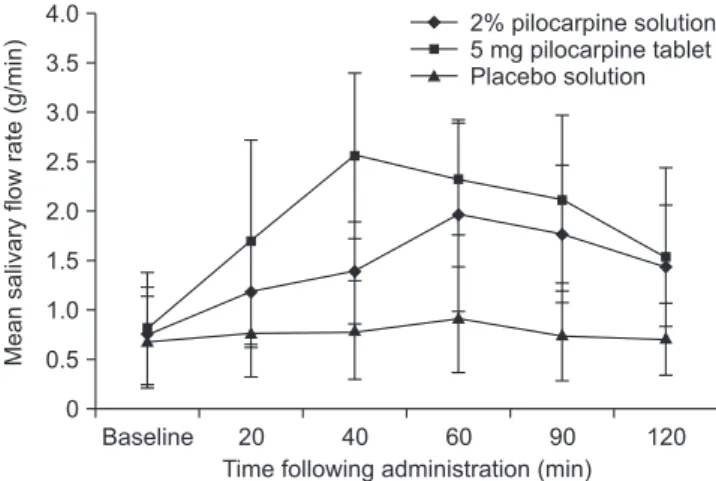
Table 1 and Fig. 2 represent change of salivary flow rate before and after administration of the study medication in- cluding pilocarpine solution and tablets and placebo so- lution. Salivary flow rate showed significant difference among time and medication groups (p<0.001) and there was positive interaction between time and groups (p=0.005).
While the three medication groups did not show significant difference of salivary flow rate at baseline level, pilocarpine solution and tablet increased significantly salivary flow rate compared with placebo solution (p<0.001). Maximal sali- vary flow rate was found between 40 and 60 minutes for pilocarpine tablet group and between 60 and 90 minutes for pilocarpine solution group, and then decreased with time. However, their salivary flow rates at 120 minutes after sip of water. For topical use, the subjects were instructed
to maintain the solution in the mouth for 5 minutes, with- out swallowing and being very careful to spit the entire volume of the solution. During each session, unstimulated whole saliva was collected 6 times including before treat- ment (baseline data) and at 20, 40, 60, 90, 120 minutes af- ter administration of drugs. Whole saliva was collected by having the subjects swallow to empty the mouth of saliva, then refraining from swallowing for 1 minute and expecto- rating into a tube. The collection volumes were determined gravimetrically: The saliva-filled tube was weighed and the weight of the tube subtracted.
After finishing a session of 120 minutes, the subjects were asked to complete a self-administrated questionnaire about subjective effectiveness on salivation and side effects experienced such as facial flushing, sweating, palpitation, nausea, dizziness, headache, increased urination and gas- trointestinal irritation. Subjective effectiveness of medica- tion tested on salivation was assessed using 10-cm visual analogue scales (VAS) (0-10): 0, no effect on salivation; 10, extreme effect on salivation. The pulse rate and blood pres- sure were measured and recorded before and after each session.
4. Statistical Analysis
Statistical analysis was performed using PASW Statistics version 18.0 (IBM Co., Armonk, NY, USA). Repeated mea- sures two-way ANOVA was used to compare of the salivary
Wash-out period
Session 3 Session 2 Session 1
Wash-out period
12 Healthy volunteers
Drug B (n=2)
Drug C (n=2)
Drug B (n=2)
Drug C (n=2)
Drug A (n=2)
Drug B (n=2)
Drug A (n=2) Drug C
(n=2)
Drug A (n=2)
Drug C (n=2)
Drug A (n=2)
Drug B (n=2) Drug A
Pilocarpine tablet 5 mg (n=4)
Drug B
2% pilocarpine solution 4 mL (n=4)
Drug C Placebo solution 4 mL
(n=4)
Fig. 1. The study flow chart.
and pulse rate was observed but the changes were negligible.
There was no significant difference in blood pressure and pulse rate before and after administration of all three drugs.
3. Side Effect of Medication
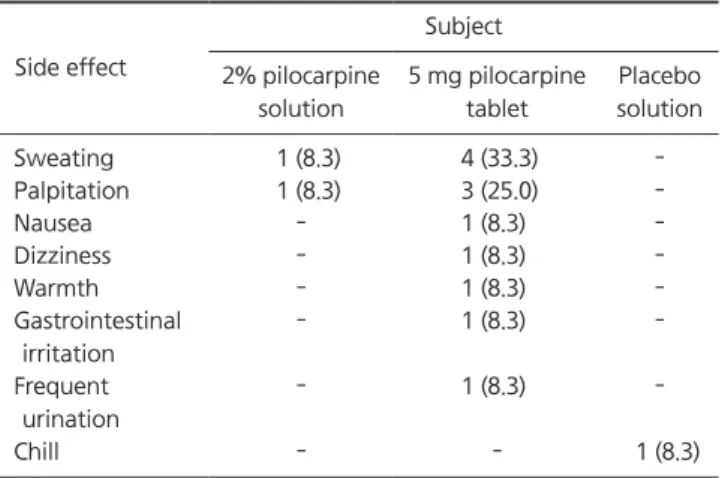
Side effect after medication was assessed through the self-administered questionnaires. Pilocarpine tablet group reported side effect the most frequently (Table 3). Nine sub- jects (75%) of pilocarpine tablet group complained of one and more side effects and the most common side effects reported was sweating (33.3%, n=4) followed by palpita- tion (25%, n=3). Two subjects of pilocarpine solution group complained sweating (n=1) and palpitation (n=1). Chill was reported for only one subject of placebo group.
administration of pilocarpine remained still higher level than those before medication. Salivary flow rate in the pilo- caprine tablet group changed more rapidly compared to pi- locarpine solution. Placebo solution did not show any sig- nificant change in salivary flow rate throughout the whole session.
Mean VAS scores for subjective assessment was shown in Fig. 3. Pilocarpine tablet group represents significantly higher score (7.4) compared to the pilocarpine solution (5.3) (p=0.019) and placebo solution group (2.1) (p<0.001). Mean VAS of pilocarpine solution group was also significantly higher than that of placebo solution group (p=0.001).
2. Blood Pressure and Pulse Rate
Table 2 shows mean blood pressure and pulse rate before and after administration of drugs. After administration of the three drugs, increment or decrement of blood pressure
Table 1. Salivary flow rate following medication
Time (min) Mean salivary flow rate
p-value 2% pilocarpine solution 5 mg pilocarpine tablet Placebo solution
Baseline 0.74±0.49 0.80±0.59 0.70±0.45
<0.001
a20 1.18±0.56 1.69±1.04 0.76±0.43
40 1.38±0.52 2.56±0.84 0.80±0.50
60 1.96±0.97 2.33±0.58 0.91±0.54
90 1.77±0.70 2.13±0.85 0.75±0.46
120 1.45±0.61 1.55±0.89 0.71±0.37
p-value <0.001
b0.005
cValues are presented as mean±standard deviation.
Repeated measures two-way ANOVA was performed.
Significant difference was found among time (
a) and medication groups (
b) and there were interaction between time and group (
c).
Fig. 2. A graph showing changes of salivary flow rate before and after medication.
4.0 3.5 3.0 2.5 2.0 1.5 1.0 0.5 0
Meansalivaryflowrate(g/min)
Baseline
Time following administration (min)
20 40 60 90 120
2% pilocarpine solution 5 mg pilocarpine tablet Placebo solution
Fig. 3. Mean visual analog scales (VAS) for subjective effectiveness on salivation (0, no effect on salivation; 10, extreme effect on salivation). There were significant differences among medication groups (one-way ANOVA, p<0.05).
10
8
6
4
2
0
MeanVAS