■이상열, 이명희, 박민철, 한진태1, 권오현2, 배성수3
■대구대학교 대학원 물리치료전공 박사과정, 1선린대학 물리치료과, 2자연요법 연구소, 3대구대학교 재활과학대학 물리치료학과
The Effects The Type of Canes-Handle Affects in Recovering-Balance of Hemiplegic patients
Sang-Yeol Lee, PT, MS; Myoung-Hee Lee, PT, MS; Min-Chull Park, PT, MS; Jin-Tae Han, PT, PhD
1; Oh-Hyun Kweon, PT, PhD
2; Sung-Soo Bae, PT, PhD
3A Physical Therapy Major, Graduate School of Rehabilitation Science, Daegu University;
1Department of Physical Therapy, Sunlin College;
2Research Institute Natural Therapy;
3Department of Physical Therapy, College of Rehabilitation Science, Daegu University
Purpose: We compared T-type and I-type canes on postural balance in 28 hemiplegic patients.
Methods: Subjects were allocated randomly into two groups: a T-shape cane group (n=14) and an I-shape cane group (n=14). Before the test, subjects were trained by a physical therapist to walk with a cane for 6 weeks. The Main Outcome Measures were measured as maximal sway velocity, sway path, sway area, and partial weight bearing using a Balance Performance Monitor (BPM) and ambulation velocity using a 'Timed up and go test'. We also measured the maximal ambulation velocity.
Results: The distribution of weight bearing on the affected side without the cane was 35% in the I-shape cane group and 36% in the T-shape cane group. After training, weight bearing on the affected side increased by 45%
in the I-shape cane group and 40% in the T-shape cane group. With the cane held in the hand, weight bearing on the affected side in the T-shape cane group decreased by 3%.
Conclusion: The I-shaped cane increased static standing balance, including hemiplegic side weight bearing.
Therefore, I-shape canes can improve the balance of hemiplegic patients.
Key Words: Cane, Hemiplegic patient, Rehabilitation, Weight bearing Received: September 11, 2008
Revised: November 8, 2008 Accepted: November 18, 2008
Corresponding author: Myoung-Hee Lee, [email protected]
미치는 영향
The Journal Korean Society of Physical Therapy
I. Introduction
Hemiplegia can lead to motor disturbances, including position asymmetry, poor body balance, defective weight transfer ability, and loss of specialized motor elements, used to perform delicate functions (Holt et al., 2000; Laufer, 2000; Rodriguez & Aruin, 2002). Hemiplegic patients have
numerous problems with posture and balance in everyday life (Shumway-Cook & Woollacott, 2001). Maintaining balance is critical for most activities, and balance problems usually occur in patients with neurologic diseases or damage (Walker et al., 2000). Likewise, unstable standing in hemiplegic patients after a stroke also produces abnormal ambulation, and improving weight bearing on the affected
leg can improve standing stability (Arcan et al., 1977;
Walker et al., 2000; Shumway-Cook et al., 1988).
According to Bohannon and Larking (1985), hemiplegic patients lean 80% of their weight on the unaffected side.
This weight distribution increases asymmetry by controlling the lower limbs on the unaffected side. Weight movement training can improve symmetric posture and gait patterns, whereas asymmetric weight bearing reduces movement and patient function (Geurts et al., 2004; Bobath, 1990; Di Fabio & Badke, 1990; Vearrier et al., 2004).
A cane can assist patients during walking training. More than 25% of adult hemiplegic patients use a walking assistance implement that is similar to a cane (Yi & Kim, 1996). When deciding cane length, Dean & Ross (1993) asserted that education training should be involved. James et al. (2005) claimed that the weight bearing rate of lower limbs on the unaffected side decreases by about 25% when the patient uses a cane, reducing imbalance on the bilateral lower limbs. According to Enrique et al. (2005), the cane negatively affects weight bearing on the unaffected side and balance during static exercise. Cane use can reduce fatigue, increase arm strength, protect the lower limbs, and increase balance, as well as widening the supporting area. Expanding the supporting area improves problems such as pain, fatigue, labyrinthine sense, stability, and over-compensation of weight (Ragnarsson, 1988).
For the balance of weight, longer cane length decreases the elbow angle to raise tension in the Lumbodorsal fascia, as the back functional line (BFL) and front functional line (FFL). This moves the center of gravity toward the non-affected side, as occurs when a player serves a ball during a tennis match. In that case, the height of the rising hand and the ipsilateral iliac crest both rise, shifting weight to the affected side (Thomas, 2001). Similarly, weight bearing on the non-affected side should increase as the cane grip is raised.
II. Methods
1. Participants
We studied 28 hemiplegic patients who consented to this research. We provided patients with detailed information
about the cane before the study. Patients were hemiplegic because of cerebral infarction or cerebral hemorrhage, able to walk with a cane, could understand and respond to instructions, and did not have orthopedic problems that could affect measurements. Subjects were allocated randomly into two groups based on handle shape: a T shape or an I shape. The T-shaped cane was a femur-high trochanter and the I shape cane was 1.5 m high, at the patients’ shoulder, and bar shaped. This custom cane shape was registered as a new design in Korea by Lee Sang-yeol (2006). Participant characteristics are summarized in Table 1.
Parameters
I-shape cane group (Mean±SD)
T-shape cane group (Mean±SD)
p Number of
individuals(male/female) 10/4 8/6 0.732 Side of hemiparesis Rt.: 2 Rt.:2
1.000 Lt.: 12 Lt.:12
Age (year) 53.42±7.65 47.42±6.13 0.132 Time since stroke (mon.) 11.85±2.54 12.00 ±2.16 0.912 BMI (kg/cm
2) 21.37±1.68 21.44±2.58 0.952
* p<0.05
Table 1. Demographic characteristics of subjects (n=28)
2. Measurement
Patient's height and weight were measured before training (with or without cane), after training (6 weeks), and at follow up (7 weeks). All measurements were repeated 3 times and then averaged.
1) Standing balance
The reliability of Balance Performance Monitor (BPM) has already been reported by Hinman(1997) in a study using 31 healthy adult subjects. And the intra-rater reliability of BPM of measurements in poststroke adults were reported by Sackley et al (2005). Between-test reliability for sitting symmetry was high(ICC(1,1)=0.93) and for weight-shift activity was also high(ICC(1,1)=0.86). We used the BPM to measure static standing balance with feet spread 4 inches apart and sight fixed to the front at a height of 15 degrees(Kerr & Eng, 2002). We measured balance with and without the cane for the 30 seconds. We recommended the subjects to focus on the fore part point. Two canes at
the same angle were used to provide an equal base of support, but grip height was at scapula level for I-shaped canes, and at the level of the patient's greater trochanter in the T-shape cane group.
Patients were instructed to use the canes during exercise time with their therapist, which involved walking and ascending stairs more than 2 hours a day for 6 weeks. We collected measurements of maximal sway velocity, sway path, sway area, and rate of weight bearing on the affected side after the 6-week training course.
2) Ambulation velocity
Timed up and Go test (TUG)
A chair with an armrest was put in the middle of the 4 x 6 m measurement area. The patient is seated in the chair with their feet in line on the floor in front of the chair.
The patient needed to walk 3 m to a sign and back to the chair as fast as possible for the stand up and go test (Podsiadlo & Richardson, 1991).
Figure 1. I-shape cane. Figure 2. T-shape cane.
Maximal ambulation velocity
The maximal ambulation velocity was measured with the most stabilized gait. Patients walked for 14 m, with the first and last 4 m excluded, and time measured from passing the start line to reaching the finish line (Steffen et al, 2002).
3. Data Analysis
Data analysis was performed with SPSS version 12.0. An independent T-test was performed to compare the I-shape and T-shape groups, with repeated-measure ANOVA used to test differences before training, after training (6 weeks), and at follow up (7 weeks), with Bonferroni post tests.
Parameters with and without canes were analyzed by a paired T-test. The threshold of significance was set at the 0.05 level.
III. Results
1. Parameters with I- and T-shape canes before training
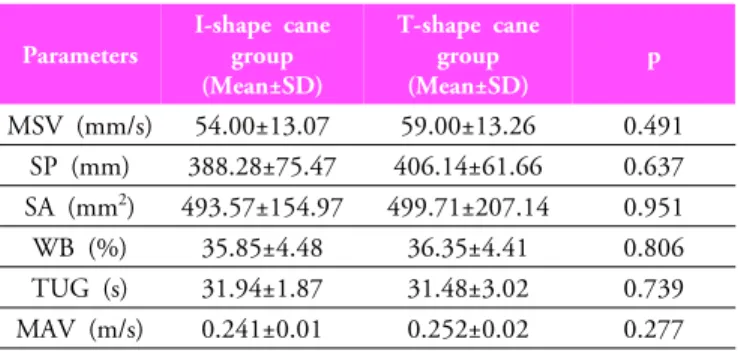
We measured postural balance between the I-and T-shape cane groups before training using maximum sway velocity, sway path, sway area, and weight bearing on the affected side. The maximum sway velocity, sway path sway area, and weight bearing on the affected side were not significantly different in the two groups. Similarly, the maximum ambulation velocity and TUG were not significantly different (Table 2).
Parameters
I-shape cane group (Mean±SD)
T-shape cane group (Mean±SD)
p MSV (mm/s) 54.00±13.07 59.00±13.26 0.491
SP (mm) 388.28±75.47 406.14±61.66 0.637 SA (mm
2) 493.57±154.97 499.71±207.14 0.951 WB (%) 35.85±4.48 36.35±4.41 0.806 TUG (s) 31.94±1.87 31.48±3.02 0.739 MAV (m/s) 0.241±0.01 0.252±0.02 0.277
* p<0.05
MSV: maximal sway velocity, SP: sway path, SA: sway area, WB: weight bearing TUG: Timed up and go test, MAV: maximal ambulation velocity
Table 2. The comparison of the measurements without cane in before training
2. Parameters with or without canes before training
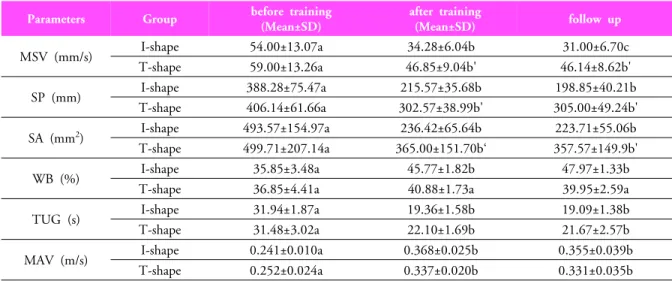
The maximum sway velocity, sway path, sway area, TUG, and maximum walking velocity were not significantly different regardless of the use of a cane. Weight bearing on the affected side in the T-shape group was not different (36.35%±4.4% versus 33.69%±4.40%), but was significantlyParameters Group before training (Mean±SD)
after training
(Mean±SD) follow up
MSV (mm/s) I-shape 54.00±13.07a 34.28±6.04b 31.00±6.70c
T-shape 59.00±13.26a 46.85±9.04b' 46.14±8.62b'
SP (mm) I-shape 388.28±75.47a 215.57±35.68b 198.85±40.21b
T-shape 406.14±61.66a 302.57±38.99b' 305.00±49.24b'
SA (mm
2) I-shape 493.57±154.97a 236.42±65.64b 223.71±55.06b
T-shape 499.71±207.14a 365.00±151.70b‘ 357.57±149.9b'
WB (%) I-shape 35.85±3.48a 45.77±1.82b 47.97±1.33b
T-shape 36.85±4.41a 40.88±1.73a 39.95±2.59a
TUG (s) I-shape 31.94±1.87a 19.36±1.58b 19.09±1.38b
T-shape 31.48±3.02a 22.10±1.69b 21.67±2.57b
MAV (m/s) I-shape 0.241±0.010a 0.368±0.025b 0.355±0.039b
T-shape 0.252±0.024a 0.337±0.020b 0.331±0.035b
Values with different superscripts in the same column are significant at the 0.05 level.
Table 5. Contrast comparison of measurements for I- and T-shape cane group on 3 occasions
higher in the I-shape cane group (45.97%±1.36% vs 35.85%±3.48%) (Table 3).
Parameters I-shape cane group (Mean±SD)
T-shape cane group (Mean±SD)
p MSV (mm/s) 44.42±9.57 46.85±8.68 0.983
SP (mm) 273.57±58.31 299.28±37.25 0.884 SA (mm
2) 331.14±119.34 350.57±141.60 0.997 WB (%) 45.97±3.36 33.69±4.40 0.000*
TUG (sec) 34.32±1.79 33.37±2.83 0.210 MAV (m/s) 0.228±0.03 0.251±0.02 0.210
* p<0.05
MSV: maximal sway velocity, SP: sway path, SA: sway area, WB: weight bearing TUG: Timed up and go test, MAV: maximal ambulation velocity
Table 3. The comparison of the measurements with cane in before training
3. Parameters with I- and T-shape canes after training
Static postural balance without a cane was measured after 6 weeks of training. There were significant differences between the I- and T-shape cane group for maximum sway velocity (I-shape cane group: 34.28±6.04 vs. T-shape cane group: 46.85±9.04), sway path (I: 215.57±35.68 vs. T:
302.57±38.99) and weight-bearing on the affected side (I:
45.77±1.82 vs. T: 40.88±1.73). However, sway area, TUG, and maximum ambulation velocity were not different (Table 4).
Parameters
I-shape cane group (Mean±SD)
T-shape cane group (Mean±SD)
p MSV (mm/s) 34.28±6.04 46.85±9.04 0.018*
SP (mm) 215.57±35.68 302.57±38.99 0.002*
SA (mm
2) 236.42±65.64 365.00±151.70 0.185 WB (%) 45.77±1.82 40.88±1.73 0.000*
TUG (s) 19.36±2.58 22.10±3.69 0.070 MAV (m/s) 0.368±0.025 0.337±0.020 0.159
* p<0.05
MSV: maximal sway velocity, SP: sway path, SA: sway area, WB: weight bearing TUG: Timed up and go test, MAV: maximal ambulation velocity
Table 4. The comparison of the I- and T-shape cane group after training
4. Comparison of cane type before training, after training, and at follow up
We measured maximum sway velocity, sway path, sway area, weight bearing on the affected side, TUG, and maximum ambulation velocity before training, after 6 weeks of training, and at 7 weeks (6 weeks using the cane and one more week without using the cane). These parameters were significantly different in the I-shape cane group at these times. (p<0.05). Although the T-shape cane group was significantly different on 3 occasions, there was no significant difference between 6 weeks of training at follow up (Table 5).
IV. Discussion
Most hemiplegic patients have problems standing and balancing that result from asymmetric weight-bearing and impaired equilibrium capacity (Geurts et al., 2004).
Asymmetric and unstable standing balance, as well as abnormal gait patterns, can appear in hemiplegic patients after brain injury and are important considerations during rehabilitation. Decreased weight bearing on the affected side can impair motor function. Moreover, in hemiplegic patients, unstable standing position and abnormal gait patterns increase the risk of falling (Cheng et al., 2001, Eng & Chu, 1993).
The use of gait-assisting instruments can prevent falling and improve gait. Many (25%) hemiplegic patients use gait-assisting instruments such as a cane (Blunt, 1956).
These instruments can improve speed, control, reduce fatigue, and increase balance and the support base (Bateni
& Maki, 2005). Moreover, these instruments improve pain, fatigue, equilibrium, and safety by expanding the base of support. The use of a cane could improve both spatial and temporal factors as well as gait patterns in hemiplegic patients (Olsson et al., 1990). However, James (2005) and colleagues reported that the common T-shaped cane decreased weight-bearing on the affected side and reduced the applied force on the hip joint, which are important for orthopedic patients but not hemiplegic patients.
Here, a T-shaped cane decreased maximal sway velocity, sway path, and sway area during static balance, but biased weight bearing to the unaffected side. Thus, the use of a T-shaped cane may reduce uneasiness, but increase dependence on the unaffected side (Deathe et al., 1993).
Alternatively, an I-shaped cane not only decreased maximal sway velocity, sway path, and sway area, but also decreased imbalances in weight bearing, especially after training, whereas training made no difference for the T-shaped cane.
These results suggest that the use of an I-shaped cane during everyday life can help train patients to bear weight on the affected side.
In fact, hemiplegic patients can physically support weight-bearing on the affected side, but often do not because of the uneasiness of falling. The T-shaped cane decreased these feelings of uneasiness, but did not
dramatically improve the balance of weight-bearing (Kuan et al., 1999).
Balanced weight-bearing is important to improve gait (Enrique et al. 2005). Patient training to improve weight balance could improve gait symmetry. However, the use of a cane also decreased gait velocity.
We found that both cane types improved postural sway immediately after use, which should increase their base of support and reduce falling risk, as indicated by Jeka (1997).
However, after 6 weeks, both cane types decreased maximum sway velocity, sway path, and sway area, with the I-shaped cane more effective for postural sway, in agreement with weight-bearing studies of Sackley (1990) and Di Fabio (1990).
Patients indicated that the I-shaped cane made wheelchair use and navigating narrow passages difficult, but that group showed improved posture and reduced dependence on the unaffected side. Thus, the I-shaped cane seems to improve posture, but further studies are needed to verify this conclusion.
V. Conclusion
An I-shape cane increases static standing balance and improves weight bearing on the affected side. Therefore, an I-shape cane could improve the balance of hemiplegic patients.
Reference
Arcan M, Brull MA, Najenson T et al. FGP assessment of postural disorders during the process of rehabilitation.
Scand J Rehabili Med. 1977;9(4):165-8.
Bateni H, Maki BE. Assistive devices for balance and mobility: benefits, demands, and adverse consequences.
Arch Phys Med Rehabil. 2005;86(1):134-45.
Bobath B. Adult Hemiplegia: Evaluation and treatment.
2nd ed. London, Heinemann Medical Books, 1990.
Bohannon RW, Larkin PA. Lower extremity weight bearing under various standing conditions in independently ambulatory patients with hemiparesis. Phys Ther.
1985;65(9):1323-5.
Cheng PT, Wu SH, Liaw MY et al. Symmetrical body-weight distribution training in stroke patients and its effect on fall prevention. Arch Phys Med Rehabil.
2001;82(12):1650-4.
Dean E, Ross J. Relationships among cane fitting, function, and falls. Phys Ther. 1993;73(8):494-500.
Deathe AB, Hayes KC, Winter DA. The biomechanic of the canes, crutches and walkers. Crit Rev Phy Rehabil Med. 1993;43:15-29.
Di Fabio RP, Badke MB. Extraneous movement associated with hemiplegic postural sway during dynamic goal-directed weight redistribution. Arch Phys Med Rehabil. 1990;71(6):365-71.
Eng JJ, Chu KS. Reliability and comparison of weight-bearing ability during standing tasks for individuals with chronic stroke. Arch Phys Med Rehabil.
2002;83(8):1138-44.
Geurts AC, de Hart M, van Nes IJ et al. A review of standing balance recovery from stroke. Gait Posture.
2005;22(3):267-81.
Hinman MR. Validity and Reliability of Measures Obtained from the Balance Performance Monitor During Quiet Standing. Physiotherapy. 1997;83(11):579-81.
Holt RR, Simpson D, Jenner JR et al. Ground reaction force after a sideways push as a measure of balance in recovery from stroke. Clin Rehabil. 2000;14(1):88-95.
Jeka JJ. Lihgt touch contact as a balance aid. Phys Ther.
1997;77(5):476-87.
Joyce BM, Kirby RL. Canes, crutches and walkers. Am Fam Physician. 1991;43(2):535-42.
Kerr JM, Eng J. Multidirectional measures of seated postural stability. Clin Biomech (Bristol, Avon).
2002;17(7):555-7.
Kuan T, Tsou JY, Su FC. Hemiplegic gait of stroke patients: the effect of using a cane. Arch Phys Med Rehabil. 1999;80(7):777-84.
Laufer Y, Dickstein R, Resnik S et al. Weight-bearing shifts of hemiparetic and healthy adults upon stepping on stairs of various heights. Clin rehabil. 2000;14(2):125-9.
Olsson EC, Smidt GL. Assistive devices. In: Smidt GL, eds, Gait in Rehabilitation, New York, Churchill Livingstone, 1990.
Podsiadlo D, Richardson S. The timed "Up & Go": a test
of basic functional mobility for frail elderly persons. J Am Geriatr Soc. 1991;39(2):142-8.
Ragnarsson KT. Orthotics and shoes. In: De Lisa JA eds, Rehabilitation Medicine, Pennsylvania, JB. Lippincott Co, 1988.
Rodriguez GM, Aruin AS. The effect of shoe wedges and lifts on symmetry of stance and weight bearing in hemiparetic individuals. Arch Phys Med Rehabil. 2002;
83(4):478-82.
Sackley CM, Hill HJ, Pound K et al. The intra-rater reliability of the Balance Performance Monitor when measuring sitting symmetry and weight-shift activity after stroke in a community setting. Clin Rehabil.
2005;19(7):746-50.
Sackley CM. The relationship between weight-bearing asymmetry after stroke, motor function and activities of daily living. Physiother theory Pract. 1990;6(4):179-185.
Shumway-Cook A, Anson D, Haller S. Postural sway biofeedback: its effect on reestablishing stance stability in hemiplegic patients. Arch Phys Med Rehabil. 1988;
69(6):395-400.
Shumway-Cook A, Wollacott MH. Motor control: Theory and practical application. 2ed ed. Boltimore, Lippincott Williams & Wilkins, 2001.
Steffen TM, Hacker TA, Mollinger L. Age- and gender-related test performance in community-dwelling elderly people:
Six-Minute Walk Test, Berg Balance Scale, Timed Up
& Go Test, and gait speeds. Phys Ther. 2002;82(2):
128-37.
Thomas WM. Anatomy Trains Myofascial Meridians for Manual and Movement Therapists. New York, Churchill livingstone, 2001.
Vearrier LA, Langan J, Shumway-Cook A et al. An intensive massed practice approach to retraining balance post-stroke. Gait Posture. 2005;22(2):154-63.
Viosca E, Lafuente R, Martinez JL et al. Walking recovery after an acute stroke: assessment with a new functional classification and the Barthel Index. Arch Phys Med Rehabil. 2005;86(6):1239-44.
Walker C, Brouwer BJ, Culham EG. Use of visual feedback in retraining balance following acute stroke. Phys Ther.
2000;80(9):886-95.
Yi CH, Kim JM. A Comparison of Methods Estimating the
Proper Cane Length for Hemiplegic Patients. Korean Academy of University Trained Physical Therapists.
1996;3(2):1-7.
Youdas JW, Kotajarvi BJ, Padgett DJ et al. Partial weight-bearing gait using conventional assistive devices.
Arch Phys Med Rehabil. 2005;86(3):394-8.