• 검색 결과가 없습니다.

Pathologic Correlation of Serum Carcinoembryonic Antigen and Cytokeratin 19 Fragment in Resected Nonsmall Cell Lung Cancer

N/A
N/A
Protected

Academic year: 2021

Share "Pathologic Correlation of Serum Carcinoembryonic Antigen and Cytokeratin 19 Fragment in Resected Nonsmall Cell Lung Cancer"

Copied!
5
0
0

로드 중.... (전체 텍스트 보기)

전체 글

(1)

http://dx.doi.org/10.5090/kjtcs.2013.46.3.192 ISSN: 2233-601X (Print) ISSN: 2093-6516 (Online)

Department of Thoracic and Cardiovascular Surgery, Yonsei University College of Medicine Received: November 7, 2012, Revised: November 14, 2012, Accepted: November 14, 2012

Corresponding author: Jin Gu Lee, Department of Thoracic and Cardiovascular Surgery, Yonsei University College of Medicine, 50 Yonsei-ro, Seodaemun-gu, Seoul 120-749, Korea

(Tel) 82-2-2228-2140 (Fax) 82-2-393-6012 (E-mail) [email protected]

C

The Korean Society for Thoracic and Cardiovascular Surgery. 2013. All right reserved.

CC

This is an open access article distributed under the terms of the Creative Commons Attribution Non-Commercial License (http://creative- commons.org/licenses/by-nc/3.0) which permits unrestricted non-commercial use, distribution, and reproduction in any medium, provided the original work is properly cited.

Pathologic Correlation of Serum Carcinoembryonic Antigen and Cytokeratin 19 Fragment in Resected Nonsmall Cell Lung Cancer

Seokkee Lee, M.D., Chang Young Lee, M.D., Dae Joon Kim, M.D., Dae Jin Hong, M.D., Jin Gu Lee, M.D., Kyung Young Chung, M.D.

Background: This study focused on the association between preoperative serum carcinoembryonic antigen (CEA) and cytokeratin 19 fragment (Cyfra 21-1) levels and pathologic parameters in patients with resected non-small-cell lung cancer (NSCLC). Materials and Methods: The records of 527 patients who underwent pulmonary resection of NSCLC were reviewed. The association between preoperative serum CEA and Cyfra 21-1 levels and variables that had p-values of less than 0.05 in a t-test or one-way analyses of variance was analyzed by multiple linear regression. Results: The mean serum CEA and Cyfra 21-1 levels prior to surgery were 6.8±23.1 mg/dL (range, 0.01 to 390.8 mg/dL) and 5.4±12.3 mg/dL (range, 0.65 to 140.2 mg/dL). The serum CEA levels were associated with tumor (T) and lymph node (N) stage and histology. The serum Cyfra 21-1 levels were associated with T stage, tumor size, and histology. Multiple linear regression indicated that serum CEA levels were associated with T (T3/4 vs. T1: β=8.463, p=0.010) and N stage (N2/3 vs. N0: β=9.208, p<0.001) and histology (adenocarcinoma vs.

squamous cell: β=6.838, p=0.001), and serum Cyfra 21-1 levels were associated with tumor size (β=2.579, p

<0.001) and histology (squamous cell vs. adenocarcinoma: β=4.420, p=0.020). Conclusion: Serum CEA level was correlated with T and N stage, and Cyfra 21-1 with tumor size. CEA and Cyfra 21-1 showed histologic correlation.

CEA is mainly elevated in adenocarcinoma and Cyfra 21-1 in squamous cell carcinoma. These results might be helpful for predicting pathologic status in preoperative NSCLC.

Key words: 1. Carcinoma, non-small cell, lung 2. Neoplasm biology

3. Carcinoembryonic antigen (CEA) 4. Cytokeratin 19 fragment (Cyfra 21-1)

INTRODUCTION

Carcinoembryonic antigen (CEA) and cytokeratin 19 frag- ments (Cyfra 21-1) are the most commonly investigated tu- mor markers in non-small-cell lung cancer (NSCLC). They have been investigated for the purpose of early detection, prognosis stratification, treatment monitoring and selection,

and recurrence monitoring. In NSCLC, adjuvant plati-

num-based chemotherapy is considered the standard treatment

for stage II and III. A potential benefit of adjuvant chemo-

therapy for stage Ib has not yet been determined. Therefore,

a current challenge in NSCLC is to identify patients that

might benefit from adjuvant treatment [1,2]. Several studies

have suggested that CEA and Cyfra 21-1 were independent

(2)

prognostic factors and good tools for choosing candidates for adjuvant chemotherapy [3-10]. However, contrasting recom- mendations have also been reported [11-13]. We postulated that CEA and Cyfra 21-1, which seem to be associated with patient prognosis, might be related to pathologic factors. This study focused on the association between preoperative serum CEA and Cyfra 21-1 levels and pathologic parameters in re- lation to prognosis in patients with resected NSCLC.

MATERIALS AND METHODS 1) Patients

The records of 982 patients who underwent pulmonary re- section of NSCLC between January 1999 and December 2006 were reviewed. Patients with pathologic stage I-IIIa were in- cluded in this study. Patients who received preoperative in- duction therapy and those with histology other than squamous cell, adenocarcinoma, and large cell lung cancer were ex- cluded for the purpose of exact pathologic and histologic correlation. A final total of 527 patients were entered into the current retrospective study. The serum CEA level was meas- ured from 1999 and Cyfra 21-1 was measured from 2004 at Severance Hospital.

The group contained 142 females and 385 males with a median age of 64.0 years (range, 36 to 82 years). The pre- operative serum level was measured in 526 patients for CEA and 162 for Cyfra 21-1. Patient evaluation before surgery in- cluded medical history, physical examination, chest radiog- raphy, and blood tests. Computed tomography scans of the chest and upper abdomen, abdominal sonography, and bone scintigraphy were routinely performed. Cervical mediastino- scopy was performed in patients with suspected N2/3 disease.

The extent of the primary lesion was carefully assessed, and systematic dissection of all hilar and mediastinal lymph nodes was performed in each case. All pathologic and clinical pa- rameters were recorded in a prospective manner. Tumors were staged according to the International Staging System for Lung Cancer [14].

The institutional review board (IRB) of the Yonsei Univer- sity College of Medicine approved this retrospective study.

The need for subsequent individual consent of patients whose

not identified in this study.

2) CEA and Cyfra21-1 measurement

Blood samples were obtained by peripheral venous punc- ture on admission to the unit prior to any staging or resection. Serum CEA or Cyfra 21-1 levels were measured as part of routine clinical examination. CEA was assessed by UniCel DxI 800 Immunoassay (Beckman Coulter, Brea, CA, USA), and Cyfra 21-1 by Elecsys 2010 system (Boehringer Mannheim, Mannheim, Germany) according to the manu- facturer’s instructions. Serum levels <5.0 ng/mL were de- fined as normal for CEA and <3.3 ng/mL for Cyfra21-1.

3) Statistical analysis

Statistical analysis was performed using SPSS ver. 13.0 (SPSS Inc., Chicago, IL, USA). The mean serum CEA and Cyfra21-1 levels for each variable were compared using a t-test or one-way analyses of variance (ANOVA). The associ- ation between serum CEA and Cyfra 21-1 levels was exam- ined for variables that had p-values of less than 0.05 in a t-test or one-way ANOVA using multiple linear regression analysis. The tumor size and Cyfra 21-1 level were analyzed as continuous variables in multiple linear regression analysis.

A p-value of less than 0.05 was considered significant.

RESULTS

1) Pathologic correlation with CEA and Cyfra21-1

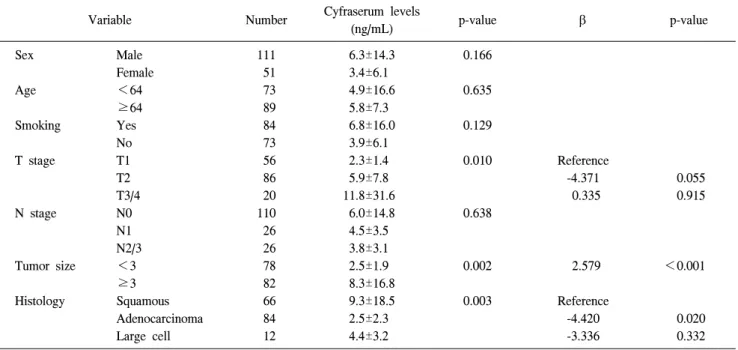
The mean serum CEA and Cyfra 21-1 levels prior to sur- gery were 6.8±23.1 mg/dL (range, 0.01 to 390.8 mg/dL) and 5.4±12.3 mg/dL (range, 0.65 to 140.2 mg/dL). The serum CEA and Cyfra 21-1 levels were broken down according to clinicopathologic parameters in Tables 1 and 2.

Serum CEA levels were associated with tumor (T) stage (T1 vs. T2 vs. T3/4, p=0.032) and N stage (N0 vs. N1 vs.

N2/3, p<0.001) and histology (adenocarcinoma vs. squamous

cell vs. large cell, p=0.032) but not with sex, age, smoking

status, or tumor size. T and N stage and histology were ana-

lyzed by multivariate analysis to further assess their associa-

tion with preoperative serum CEA levels. Multiple linear re-

gression analysis indicated that T (T3/4 vs. T1: β=8.463,

(3)

Table 1. Mean (standard deviation) CEA serum levels by clinicopathologic parameters and multiple linear regression analysis

Variable Number CEA serum levels

(ng/mL) p-value β p-value

Sex Age Smoking T stage N stage

Tumor size

Histology

Male Female <64 ≥64 Yes No T1 T2 T3/4 N0 N1 N2/3 <3 ≥3

Adenocarcinoma Squamous Large cell

385 141 262 264 239 287 137 306 83 337 74 115 231 289 257 235 33

6.9±25.7 6.6±13.5 5.8±25.0 7.8±20.9 8.3±30.9 5.6±13.3 4.2±9.9 6.4±16.2 12.5±47.2 4.2±7.1 6.6±18.9 14.4±44.7 5.3±12.8 7.9±28.8 9.5±31.7 4.1±8.4 5.1±8.4

0.885

0.316

0.186

0.032

<0.001

0.196

0.032

Reference 2.705 8.463 Reference

3.337 9.208

Reference -6.838 -4.565

0.257 0.010

0.259

<0.001

0.001 0.275 Values are presented as mean±standard deviation. Adjusted R square=0.047, β indicates regression coefficient in multiple linear regression.

CEA, carcinoembryonic antigen; T, tumor; N, lymph node.

Table 2. Mean (standard deviation) Cyfra 21-1 serum by clinicopathologic parameters and multiple linear regression analysis

Variable Number Cyfraserum levels

(ng/mL) p-value β p-value

Sex

Age

Smoking

T stage

N stage

Tumor size

Histology

Male Female

<64

≥64 Yes No T1 T2 T3/4 N0 N1 N2/3

<3

≥3 Squamous Adenocarcinoma Large cell

111 51 73 89 84 73 56 86 20 110 26 26 78 82 66 84 12

6.3±14.3 3.4±6.1 4.9±16.6 5.8±7.3 6.8±16.0 3.9±6.1 2.3±1.4 5.9±7.8 11.8±31.6 6.0±14.8 4.5±3.5 3.8±3.1 2.5±1.9 8.3±16.8 9.3±18.5 2.5±2.3 4.4±3.2

0.166

0.635

0.129

0.010

0.638

0.002

0.003

Reference -4.371 0.335

2.579

Reference -4.420 -3.336

0.055 0.915

<0.001

0.020 0.332 Values are presented as mean±standard deviation. Adjusted R square=0.233, β indicates regression coefficient. Tumor size was ana- lyzed as a continuous variable in multiple linear regression.

Cyfra 21-1, cytokeratin 19 fragment; T, tumor; N, lymph node.

(4)

histology (adenocarcinoma vs. squamous cell: β=6.838, p=0.001) were correlated with preoperative CEA levels (Table 1).

Serum Cyfra 21-1 levels were associated with T stage (T1 vs. T2 vs. T3/4, p=0.010), tumor size (<3 vs. ≥3, p

<0.002), and histology (adenocarcinoma vs. squamous cell vs. large cell, p=0.003). These factors were analyzed by mul- tivariate analysis to further assess their association with pre- operative serum Cyfra 21-1 levels. Multiple linear regression analysis indicated that tumor size (β=2.579, p<0.001) and histology (squamous cell vs. adenocarcinoma: β=4.420, p=0.020) were correlated with preoperative Cyfra 21-1 levels (Table 2).

DISCUSSION

The serum CEA level was correlated with T and N stage.

Cyfra 21-1 was correlated with tumor size. CEA and Cyfra 21-1 also showed histologic correlation. CEA was mainly ele- vated in adenocarcinoma and Cyfra 21-1 in squamous cell carcinoma.

Tumor markers such as CEA and Cyfra 21-1 have been studied for the purpose of early cancer detection, prognostic stratification, and monitoring of the treatment response and cancer recurrence, although the use of these markers for lung cancer detection or monitoring is not currently recommended or encouraged [15]. The guidelines of the National Comprehensive Cancer Network on NSCLC do not include preoperative CEA or Cyfra 21-1 in pretreatment evaluation [16].

Adjuvant chemotherapy might be considered the standard treatment in stage II and III lung cancer with the evidence that it improves patient survival. The greatest benefit was seen in stage II patients. In stage Ib patients, the benefit is still questionable. Stratifying patients who will benefit from adjuvant treatment for stage Ib is the current issue. The pos- sible roles of CEA and Cyfra 21-1 in NSCLC are expected to stratify the prognosis. Several studies have reported that patients with elevated preoperative serum levels of CEA and Cyfra 21-1 had a shorter overall survival compared to those with normal marker concentrations [3-10]. Even more tumor

marker index (the square root of Cyfra 21-1 concentration/3.3 ng/mL×CEA concentration/5.0 ng/mL) based on Cyfra 21-1 and CEA was suggested as a prognostic factor in NSCLC [10]. However, other studies have found that elevated pre- operative serum levels of CEA and Cyfra 21-1 were com- pletely lacking in prognostic value [11-13].

According to our data, elevated CEA and Cyfra 21-1 levels both showed poor prognosis. However, in multivariate analy- sis, neither had any significance. Only well-known prognostic factors such as T and N stage and tumor size were sig- nificant (data not shown). Based on these findings, we be- lieved that serum levels of CEA and Cyfra 21-1 might be closely correlated with pathologic parameters, which could explain the poor prognosis of elevated CEA and Cyfra 21-1.

We found that the serum CEA level was correlated with the T and N stage and Cyfra 21-1 with tumor size. Although it is generally accepted that serum CEA and Cyfra 21-1 levels are associated with more advanced stage [6,17-20], some studies have suggested that these levels are not always related to TNM stage and their prognostic significance might be due to different mechanisms; accordingly CEA and Cyfra 21-1 were independent prognostic factors and could be used to stratify prognosis [21-23]. However, the present results dis- prove their suggestion.

CONCLUSION

In summary, our results indicate that preoperative serum levels of CEA and Cyfra 21-1 seem to be associated with pathologic parameters. The serum CEA level was correlated with T and N stage. Cyfra 21-1 was correlated with tumor size. CEA and Cyfra 21-1 showed histologic correlation.

CEA was mainly elevated in adenocarcinoma and Cyfra 21-1 in squamous cell carcinoma. These findings might be helpful in predicting pathologic status in preoperative NSCLC but could not provide additional information to predict patient prognosis and develop a treatment plan.

CONFLICT OF INTEREST

No potential conflict of interest relevant to this article was

(5)

reported.

REFERENCES

1. Winton T, Livingston R, Johnson D, et al. Vinorelbine plus cisplatin vs. observation in resected non-small-cell lung cancer. N Engl J Med 2005;352:2589-97.

2. Horn L, Sandler AB, Putnam JB Jr, Johnson DH. The ra- tionale for adjuvant chemotherapy in stage I non-small cell lung cancer. J Thorac Oncol 2007;2:377-83.

3. Pujol JL, Molinier O, Ebert W, et al. CYFRA 21-1 is a prognostic determinant in non-small-cell lung cancer: results of a meta-analysis in 2063 patients. Br J Cancer 2004;90:

2097-105.

4. Reinmuth N, Brandt B, Semik M, et al. Prognostic impact of Cyfra21-1 and other serum markers in completely re- sected non-small cell lung cancer. Lung Cancer 2002;36:

265-70.

5. Niklinski J, Burzykowski T, Niklinska W, et al. Preoperative CYFRA 21-1 level as a prognostic indicator in resected non- small cell lung cancer. Eur Respir J 1998;12:1424-8.

6. Pujol JL, Boher JM, Grenier J, Quantin X. Cyfra 21-1, neu- ron specific enolase and prognosis of non-small cell lung cancer: prospective study in 621 patients. Lung Cancer 2001;31:221-31.

7. Suzuki K, Nagai K, Yoshida J, et al. Prognostic factors in clinical stage I non-small cell lung cancer. Ann Thorac Surg 1999;67:927-32.

8. Muley T, Dienemann H, Ebert W. Increased CYFRA 21-1 and CEA levels are negative predictors of outcome in p-stage I NSCLC. Anticancer Res 2003;23:4085-93.

9. Kulpa J, Wojcik E, Reinfuss M, Kolodziejski L. Carcinoem- bryonic antigen, squamous cell carcinoma antigen, CYFRA 21-1, and neuron-specific enolase in squamous cell lung cancer patients. Clin Chem 2002;48:1931-7.

10. Muley T, Fetz TH, Dienemann H, et al. Tumor volume and tumor marker index based on CYFRA 21-1 and CEA are strong prognostic factors in operated early stage NSCLC.

Lung Cancer 2008;60:408-15.

11. Blankenburg F, Hatz R, Nagel D, et al. Preoperative CYFRA 21-1 and CEA as prognostic factors in patients with stage I non-small cell lung cancer: external validation of a prog- nostic score. Tumour Biol 2008;29:272-7.

12. Nisman B, Lafair J, Heching N, et al. Evaluation of tissue polypeptide specific antigen, CYFRA 21-1, and carcinoem- bryonic antigen in nonsmall cell lung carcinoma: does the

combined use of cytokeratin markers give any additional in- formation? Cancer 1998;82:1850-9.

13. Matsuoka K, Sumitomo S, Nakashima N, Nakajima D, Misaki N. Prognostic value of carcinoembryonic antigen and CYFRA21-1 in patients with pathological stage I non-small cell lung cancer. Eur J Cardiothorac Surg 2007;32:435-9.

14. Goldstraw P, Crowley J, Chansky K, et al. The IASLC Lung Cancer Staging Project: proposals for the revision of the TNM stage groupings in the forthcoming (seventh) edition of the TNM Classification of malignant tumours. J Thorac Oncol 2007;2:706-14.

15. American Thoracic Society, European Respiratory Society.

Pretreatment evaluation of non-small-cell lung cancer. Am J Respir Crit Care Med 1997;156:320-32.

16. National Comprehensive Cancer Network. Clinical practice guidelines in oncology: non-small cell lung cancer-v.3 [Internet]. Fort Washington: National Comprehensive Cancer Network; 2012 [cited 2011 Mar 16]. Available from: http://

www.nccn.org/.

17. Ford CH, Stokes HJ, Newman CE. Carcinoembryonic anti- gen and prognosis after radical surgery for lung cancer: im- munocytochemical localization and serum levels. Br J Cancer 1981;44:145-53.

18. Vincent RG, Chu TM, Fergen TB, Ostrander M. Carcinoem- bryonic antigen in 228 patients with carcinoma of the lung.

Cancer 1975;36:2069-76.

19. Icard P, Regnard JF, Essomba A, Panebianco V, Magdeleinat P, Levasseur P. Preoperative carcinoembryonic antigen level as a prognostic indicator in resected primary lung cancer.

Ann Thorac Surg 1994;58:811-4.

20. Schneider J, Velcovsky HG, Morr H, Katz N, Neu K, Eigenbrodt E. Comparison of the tumor markers tumor M2-PK, CEA, CYFRA 21-1, NSE and SCC in the diagnosis of lung cancer. Anticancer Res 2000;20:5053-8.

21. Rubins JB, Dunitz J, Rubins HB, Maddaus MA, Niewoehner DE. Serum carcinoembryonic antigen as an adjunct to pre- operative staging of lung cancer. J Thorac Cardiovasc Surg 1998;116:412-6.

22. Tomita M, Matsuzaki Y, Edagawa M, Shimizu T, Hara M, Onitsuka T. Prognostic significance of preoperative serum carcinoembryonic antigen level in lung adenocarcinoma but not squamous cell carcinoma. Ann Thorac Cardiovasc Surg 2004;10:76-80.

23. Suzuki H, Ishikawa S, Satoh H, et al. Preoperative CYFRA

21-1 levels as a prognostic factor in c-stage I non-small cell

lung cancer. Eur J Cardiothorac Surg 2007;32:648-52.

수치

Table 2. Mean (standard deviation)  Cyfra 21-1 serum by clinicopathologic parameters and multiple linear regression analysis

참조

관련 문서

Objective: This study aims to identify the levels of anxiety and depression of the medical institution workers regarding COVID-19, and to provide the database for the

Differential Expression of Desmoglein1, Desmoglein3, Epithelial Membrane Antigen, Ber-EP4 and CD10 in Basal Cell Carcinoma and Squamous Cell Carcinoma

Cooper, M.D.et el Revised American Thyroid Association Management Guidelines for Patients with Thyroid Nodules and Differentiated Thyroid Cancer THYROID Volume

The aim of this study was to determine the serum levels of the prohormone form of hepcidin, pro-hepcidin, and its relations with iron status and its

Anderson, M. The influence of exercise on serum enzyme levels in the horse. Haematological and biochemical changes in horses competing in a 3 day

Linear correlations of T-amp, T-right slope, and their normalized feature (T-norm) with serum potassium levels were evaluated using Pearson correlation coefficient

The most distinct cytological feature of DSRCT compared to the other small round cell tumors, is its stromal fi- brillary fragment, which is not a commonly found in body flu-

Age at diagnosis after 30 years, baseline serum creatinine levels, and cyst infection are the independent risk factors for kidney failure, as found in this