Eating a Balanced Diet: A Healthy Life through a Balanced Diet in the Age of Longevity
Soo Lim*
Department of Internal Medicine, Seoul National University Bundang Hospital, Seoul National University College of Medicine, Seongnam, Korea
Recently, trends in the Korean diet have favored westernized and unbalanced meals that mainly provide a single nutrient. To stop this unfavorable trend, the Committee of the Ten Guidelines for a Health Life: Korean Medical Association released three best practices to follow for the healthy and balanced diet in 2017. The purpose of these guidelines is to encourage people to eat a balanced diet that meets the recommended caloric intake, thereby reducing the risk of obesity and obesity-related diseases. First, eat a carbohydrate:protein:fat ratio of 55:20:25. Middle-aged and elderly Koreans consume a high proportion of carbohydrates as part of their total ca- loric intake, and those ≥65 years consume a low proportion of fat as part of the total caloric intake. Second, re- duce consumption of soda and sugar-sweetened beverages. The recent World Health Organization recommen- dation for added sugar is less than 10% of a person’s total daily energy intake (<50 g/day). Koreans currently consume 72.1 g of added sugar per day. Koreans between the ages of 6 and 29 years consume sugar mostly through sodas, and those ≥30 years consume sugar mostly through coffee. Third, maintain the recommended caloric intake for a healthy diet. Rapid weight gain increases blood sugar levels and blood pressure, which can lead to diabetes and hypertension, as well as increasing the risk of cardiovascular disease, stroke, and colorectal cancer. To help prevent these conditions, people should maintain a healthy weight by avoiding overeating and being physically active starting at a young age.
Key words: Beverage, Obesity, Metabolic syndrome, Body weight
* Corresponding author Soo Lim
https://orcid.org/0000-0002-4137-1671 Department of Internal Medicine, Seoul National University Bundang Hospital, Seoul National University College of Medicine, 82 Gumi-ro 173beon-gil, Bundang-gu, Seongnam 13620, Korea Tel: +82-31-787-7035
Fax: +82-31-787-4051 E-mail: [email protected]
INTRODUCTION
The Korean Medical Association (KMA) is South Korea’s larg- est and most-trusted decision-making organization, made up of Korean physicians. The 35th KMA Congress in 2017 set its focus as “Future Medicine and Healthy Aging.” With the goal of estab- lishing a new medical paradigm that advocates for the public inter- ests and fosters social awareness. To achieve this goal, a plan was made to publish “Ten Guidelines for a Healthy Life: Korean Medi- cal Association statement (2017).” These guidelines are: (1) quit- ting smoking, (2) drinking in moderation, (3) eating a balanced diet, (4) being physically active, (5) having a regular sleep schedule,
(6) thinking positively, (7) receiving routine health screenings and immunizations, (8) managing stress, (9) paying attention to partic- ulate matter and emerging infectious disease, and (10) avoiding ex- cessive exposure to mobile devices.
This manuscript has been pressed as the chapter 3: Eating a Bal- anced Diet from Ten Guidelines for a Healthy Life published by KMA in 2017. It has been modified for the format of Journal of Obesity & Metabolic Syndrome. The TFT Committee of the Ten Guidelines for a Healthy Life: Korean Medical Association state- ment (2017) and Korean Society for the Study of Obesity ap- proved this publication to advocate public awareness and educa- tion.
Copyright © 2018 Korean Society for the Study of Obesity
This is an Open Access article distributed under the terms of the Creative Commons Attribution Non-Commercial License (http://creativecommons.org/licenses/by-nc/4.0/) which per- mits unrestricted non-commercial use, distribution, and reproduction in any medium, provided the original work is properly cited.
2017-03-16 https://crossmark-cdn.crossref.org/widget/v2.0/logos/CROSSMARK_Color_square.svg
EAT A CARBOHYDRATE:PROTEIN:FAT RATIO OF 55:20:25
Consume meals that satisfy the ideal carbohydrate, protein, and fat ratio
A balanced diet following the recommended energy and nutrient intake range is desirable for chronic disease prevention and man- agement. According to the Dietary Reference Intakes values for Koreans (a report on recommended energy and nutrient intake for improving health and preventing disease in the Korean population) reported by the Ministry of Health and Welfare and the Korean Nutrition Society, a healthy diet should consist of 55%–65% carbo- hydrates, 7%–20% protein, and 15%–30% fat (for individuals 3 years old and older).
1,2Especially in Korea, the middle-aged and el- derly over 50 years old have too high a rate of carbohydrate intake and those over 65 years old have too low a rate of fat intake. These dietary habits underscore the need for a balanced diet.
1According- ly, this publication, Ten Guidelines for a Healthy Life: Korean Medical Association statement (2017), proposes a nutrient intake ratio in which carbohydrate intake would be reduced and protein in- take would be increased.
The food balance wheels of the Korean Dietary Reference In- takes (Fig. 1) emphasize the importance of a balanced diet, suffi- cient fluid intake, and regular physical activity for maintaining health. In short, regularly following the recommended caloric in- take, consuming a balanced distribution of nutrients, and engaging in an adequate amount of physical activity can prevent obesity and lifestyle-related diseases.
2Avoid diet plans which are not supported by scientific evidence, such as the low-carb high-fat diet
People have shown great interest in the low-carb high-fat (LCHF) diet, which was recently introduced and promoted in newspapers and media as having excellent weight loss results. However, this trend has caused controversy and led to a shortage of butter and in- creased consumer consumption of pork belly in Korea. The LCHF diet reduces carbohydrate intake to 5%–10% of the recommended total caloric intake, while increasing fat intake to 70% or more. This diet plan is too extreme and is an abnormal way to eat.
3The purported effectiveness of this extreme form of LCHF diet that spread throughout media outlets everywhere has not clearly been proven. Moreover, health problems can occur if a person fol-
Figure 1. Food balance wheels. Adapted from Ministry of Health and Welfare and the Korean Nutrition Society.2
lows this diet for a prolonged period. For example, excessive intake of food products high in fat, especially saturated fat, can increase the levels of low-density lipoprotein (LDL)-cholesterol (bad cho- lesterol) in the blood, thereby increasing the risk of cardiovascular disease. When following an abnormally high-fat diet, it becomes difficult to consume an appropriate variety of foods, resulting in an imbalance of micronutrients and decreased fiber intake, which in turn changes the intestinal microbial flora in ways that cause oxida- tive stress and an increased inflammatory response. Extreme re- striction of carbohydrates, meanwhile, increases ketone body syn- thesis, which negatively affects muscles and bones and reduces glu- cose levels, causing side effects such as decline in concentration.
3Patients with diabetes, hypertension, or cardiovascular disease need to discuss their diet with a physician
Patients being treated for diabetes, hypertension, and cardiovas- cular disease need to pay extra attention to their dietary choices.
Single-nutrient diets such as the LCHF diet can have harmful ef- fects on disease management in patients with uncontrolled diabe- tes or with heart or kidney problems. Furthermore, if a patient tak- ing diabetes medication suddenly reduces his or her carbohydrate intake, it may cause hypoglycemia, or even worse, ketosis. These diseases could also be exacerbated if the blood LDL cholesterol level increases due to a LCHF diet. Thus, the ground rule is to have these patients maintain a balanced diet as part of an individually customized diet therapy plan that has been discussed with their physicians.
3Consume balanced meals with various foods
Consuming a diet with balanced nutrient intake is not only nec- essary to prevent and manage chronic diseases, but also essential for children and adolescents to ensure their healthy development.
It is crucial to eat an appropriate—neither excessive nor defi- cient—amount from each food group. For this reason, the Ministry of Health and Welfare recently announced dietary guidelines to help manage obesity, hypertension, and dyslipidemia in Korea. The guidelines suggest eating balanced meals, including a variety of foods such as rice, grains, vegetables, fruits, milk and other dairy products, meats, fish, eggs, and beans.
1According to the Korea National Health and Nutrition Examina-
tion Survey, calcium intake, the main source of which is milk or dairy products, continues to be insufficient, with individuals con- suming only two-thirds of the current 2015 recommended intake amount. More serious intake deficiencies were prevalent in people with lower socioeconomic status, suggesting that more attention should be paid to this demographic. In contrast, the amount of so- dium intake was 2.2 times higher than the recommended daily al- lowance (2,000 mg) in men and 1.6 times higher in women. It is estimated that four out of five people consume more sodium than recommended. An additional investigation of the intake of various food groups revealed that, until 2014, individuals’ daily intake of grains gradually decreased, while daily meat consumption rose steadily. Vegetable and fruit intake, in comparison, was still inade- quate, with only 38.3% of people eating more than 500 g of vegeta- bles and fruits daily (based on data in 2014). This percentage was even lower in people with lower socioeconomic status, meaning that a systematic investigation is needed.
1,4Regarding the excessive or insufficient intake of various nutrients and food groups in Korea, consumption practices on the individual level should be changed first; in addition, strategies for improving nutrition management are needed and can be developed using di- etary policies that support the centralized management of nutrients and food groups. The Health Plan 2020 (2016–2020) set the nu- trition-specific objective of increasing the percentage of the popula- tion with healthy dietary habits, including the consumption of ap- propriate amounts of dietary fat and sodium, fruits and vegetables, calcium, and vitamin A, and the outcomes of this strategy are ea- gerly anticipated.
5REDUCE CONSUMPTION OF SODA AND SUGAR-SWEETENED BEVERAGES
Recently, the World Health Organization recommended that
added sugar should account for less than 10% of total daily energy
intake, and that the intake level should be lower than 5% in some
circumstances, depending on the conditions of member states. As
the recommended daily caloric intake of an average adult is 2,000
kcal, the daily amount of added sugar recommended by the World
Health Organization is estimated to be 50 g or less. Based on these
guidelines, Korea recommends that the total sugar intake should be
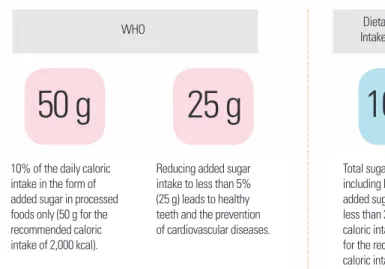
10%–20% of the total daily energy intake, and that added sugar should be less than 10% (Fig. 2).
2,6Added sugars are monosaccha- rides, disaccharides, and syrups that are added to foods when they are processed or prepared. The main sources of added sugar are sugar, high-fructose corn syrup, starch syrup, molasses, honey, syr- up, and fruit juice concentrate (Fig. 3).
7The Ministry of Food and Drug Safety reported that the total sugar intake for Koreans was 72.1 g (less than 20% of the recom- mended daily caloric intake for a 2,000 kcal diet), which is current- ly not a level of huge concern; however, there was a 3.5% yearly av- erage increase between 2007 to 2013, and the amount of sugar in-
take from processed foods is currently 44.7 g (2013), reflecting a yearly average increase of 5.8% compared to 2007.
1Accordingly, the Ministry of Food and Drug Safety has proposed sugar-related recommendations, such as “Eat less sugar” and “Drink plenty of water instead of sweetened drinks” (Fig. 4).
1Considering the in- crease in sugar intake, along with the rapid increase in beverage consumption, it is time to take preemptive and systematic actions to encourage appropriate levels of sugar intake by encouraging Ko- reans to change their dietary habits. Additionally, according to an investigation conducted by the Ministry of Food and Drug Safety, people between the ages of 3 and 29 years old exceeded the recom-
Figure 2. Daily intake recommendations for adults.2,6 WHO, World Health Organization.Dietary Reference Intakes for Koreans WHO
10% of the daily caloric intake in the form of added sugar in processed foods only (50 g for the recommended caloric intake of 2,000 kcal).
Reducing added sugar intake to less than 5%
(25 g) leads to healthy teeth and the prevention of cardiovascular diseases.
Total sugar intake, including both natural and added sugar, should be less than 20% of the daily caloric intake (100 g for the recommended caloric intake of 2,000 kcal).
50 g 25 g 100 g
Figure 3. (A) Amount of sugar intake through processed foods by age group. (B) Distribution of main sources of sugar in beverages.7 A 1–2
3–5 6–11 12–18 19–29 30–49 50–64
≥ 65
Sugar intake (g)
Beverages/
processed foods 23.4
38.0 50.9
58.7 59.0 47.6 35.6 26.9
B ≥ 65
50–64 30–49 19–29 12–18
6–11 3–5 1–2
Main source of sugar in beverages
0 10 20 30 40 50 60 70 80 90 100 (%) Tea Coffee Fruit/vegetable juice Soda Other drinks, including soymilk 0.7
0.7 0.8 0.5 0.4 0.2 0.5 0.1
2.6 3.8 5.0 2.1 0.3
5.4 3.9
3.0
1.7 2.8 3.6 4.3
5.5
5.6 2.7 0.8
0.4 1.2 4.3 13.1
9.8
1.5 1.2
1.3 1.6 2.8 2.2
1.0 1.1
Year Year
mended amount of sugar intake through processed foods in 2013, and the number of people from other age groups who exceeded this amount was on the rise. Presumably, added sugar intake through beverages or processed food was the cause for this in- crease. Those aged 6 years and older mostly consumed sugar from processed foods through beverages. The investigation reported that 1- to 5-year-olds mostly consumed sugar through fruit and vegeta- ble juices, 6- to 29-year-olds through soda, and those 30 years old and over through coffee, especially coffee with added sugar, such as coffee mixes and canned coffee.
1Sugar-sweetened beverages are quite diverse, including drinks such as soda, vitamin drinks, energy drinks, and coffee, and these drinks account for a large part of the daily sugar intake of teenagers.
Teenagers have a particularly high sugar intake compared to other age groups; therefore, continuous monitoring and management of their sugar consumption are necessary. We need to provide con- sumer education to raise awareness of the significant amounts of added sugar present in children’s food, such as juice, processed milk such as chocolate milk, yogurt, and snacks.
MAINTAIN THE RECOMMENDED CALORIC INTAKE FOR A HEALTHY DIET
Keep watching your weight
The prevalence of adult obesity in Korea in 2015 is two in five
men and one in four women, as defined by a body mass index of 25 kg/m
2or higher. For women, statistics show that the rate is higher in people with lower socioeconomic status.
8Obesity has a strong association with cardiovascular disease and stroke, which in- creases the risk of mortality, as well as with other causes of death, including cancer. Therefore, obesity should be regarded as an im- portant public health and socioeconomic issue. In particular, ab- dominal fat accumulation is associated with glucose intolerance, and increased body fat reduces insulin sensitivity. Furthermore, the fact that hypertension is more common in centrally obese people than peripherally obese people indicates that the distribution of body fat is more important than simply measuring obesity. Ab- dominal obesity is associated with higher serum triglyceride and LDL-cholesterol levels, lower high-density lipoprotein (HDL)- cholesterol levels, and a higher frequency of accompanying hyper- insulinemia.
9The rapid increase in obesity rates in Korea was caused by the shift to westernized dietary habits and decreased physical activity due to advances in transportation methods. These causes led to an imbalance between energy intake and metabolism, which ultimate- ly caused a rapid increase in obesity, cardiovascular disease, diabe- tes, and obesity-related cancer (for example, colorectal cancer).
Therefore, to reduce the obesity rate, national education programs and government policies that encourage people to consistently maintain the recommended caloric intake and to increase their physical activity level are vital.
10According to the 2014 Korea Health Statistics, the energy intake rate steadily increased starting in 2004, while the walking rate gradually decreased, meaning that an action plan is needed.
4Additionally, being aware of one’s own weight and examining one’s own behaviors related to obesity can help fight obesity.
11Maintain a healthy weight from childhood onward
Obesity is the main factor that causes metabolic syndrome, which is a common health issue. When children and teenagers have metabolic syndrome, they are likely to develop diabetes, hy- perlipidemia, and cardiovascular disease. Since these diseases re- quire long-term treatment and management, they can lead to other health concerns and increased medical expenditures. Therefore, the increase of metabolic syndrome in teenagers could become a
Figure 4. Drink plenty of water instead of sweetened drinks.Amount of daily sugar intake through beverages: 8.7 g (2007) → 13.9 g (2013)
critical public health and socioeconomic issue affecting the future of Korea. In particular, among the five components of metabolic syndrome (high glucose, high blood pressure, high triglycerides, low HDL-cholesterol, and abdominal obesity), there was a de- crease in HDL-cholesterol levels (10.5%) and increases in triglyc- eride levels (6.2%) and abdominal obesity (2.9%), which indicates that the lack of physical activity and excessive nutrient intake can be considered the main causes of the increase in metabolic syn- drome among children and teenagers.
12In fact, it is important to note that over the past 10 years, Korean teenagers have been engag- ing in less exercise and consuming more fat.
1A comparative analysis of National Health and Nutrition Exami- nation Survey data from the United States and Korea in the past 10 years showed a decrease in the prevalence of metabolic syndrome among teenagers in the United States, while the rate doubled for Korean teenagers.
12If the prevalence of metabolic syndrome among Korean teenagers continues to rise, it is predicted that meta- bolic syndrome will increase by 0.4% every year, resulting in 22,000 new cases annually among teenagers. To prevent this, schools and households should provide balanced meals, increase the number of physical education classes, and provide after-school programs that allow teenagers to voluntarily engage in more physical activity, all of which require parents to change their perceptions of their children’s health and for a different governmental policy approach to be im- plemented.
12Slow down weight gain when overweight or obese
According to a recent study, the larger and faster the weight gain compared to one’s weight at the age of 20, the higher the risk of de- veloping cardiovascular disease (Fig. 5). Thus, attention should
also be paid to obesity early in life and to the rate and speed of weight gain.
13Rapid weight gain causes insulin resistance, increases inflammatory responses, and raises blood sugar and blood pressure, fundamentally damaging intravascular endothelial cells, which could cause coronary artery disease. In other words, the snowball effect of rapid and significant weight gain increases the risks of car- diovascular disease; therefore, it is important for people in their 20s and 30s to control their weight.
Currently, the prevalence of diabetes and cardiovascular disease is continuously increasing in Korea. This could lead to major issues on the individual and social levels. It is important to implement preventive strategies, such as reducing westernized, high-fat, and high-calorie dietary habits, increasing physical activity, and main- taining a healthy weight early in life. Unless behavioral changes are made regarding westernized dietary habits and decreased physical activity, medical costs will rise.
CONCLUSION
Recently, trends in the Korean diet have favored westernized and unbalanced meals. To stop this unfavorable trend, the Committee of the Ten Guidelines for a Health Life: Korean Medical Associa- tion released three best practices to follow for the healthy and bal- anced diet in 2017. (1) Eat a carbohydrate:protein:fat ratio of 55:20:25. (2) Reduce consumption of soda and sugar-sweetened beverages. (3) Maintain the recommended caloric intake for a healthy diet. The purpose of these guidelines is to encourage peo- ple to eat a balanced diet that meets the recommended caloric in- take, thereby reducing the risk of obesity and obesity-related dis- eases.
CONFLICTS OF INTEREST
The author declares no conflict of interest.
ACKNOWLEDGMENTS
We thank Yu Jin Paek, Department of Family Medicine, Hallym University Sacred Heart Hospital; Mi-Kyung Sung, Department of Food and Nutrition, Sookmyung Women’s University; Hye Ran
Figure 5. Conditions of weight gain and risks of cardiovascular disease: the snow-ball effect.
Absolute quantity
Large weight gain Speed
Rapid weight gain
Snowball effect Development
of cardiovascular disease