A Simplified Formula Using Early Blood Gas Analysis Can Predict Survival Outcomes and the Requirements for Extracorporeal
Membrane Oxygenation in Congenital Diaphragmatic Hernia
The aims of this study were to investigate whether early arterial blood gas analysis (ABGA) could define the severity of disease in infants with congenital diaphragmatic hernia (CDH).
We conducted a retrospective study over a 21-yr period of infants diagnosed with CDH.
Outcomes were defined as death before discharge, and extracorporeal membrane
oxygenation requirements (ECMO) or death. A total 114 infants were included in this study.
We investigated whether simplified prediction formula [PO2-PCO2] values at 0, 4, 8, and 12 hr after birth were associated with mortality, and ECMO or death. The area under curve (AUC) of receiver operating characteristic curve was used to determine the optimum ABGA values for predicting outcomes. The value of [PO2-PCO2] at birth was the best predictor of mortality (AUC 0.803, P < 0.001) and at 4 hr after birth was the most reliable predictor of ECMO or death (AUC 0.777, P < 0.001). The value of [PO2-PCO2] from ABGA early period after birth can reliably predict outcomes in infants with CDH.
Key Words: Congenital Diaphragmatic Hernia; Mortality; Extracorporeal Membrane Oxygenation; Infant, Newborn
Hye Won Park,1 Byong Sop Lee,2 Gina Lim,3 Yong-Sung Choi,4 Ellen Ai-Rhan Kim,2 and Ki-Soo Kim2
1Department of Pediatrics, Division of Neonatology, Konkuk University Medical Center, Konkuk University School of Medicine, Seoul; 2Department of Pediatrics, Division of Neonatology, Asan Medical Center Children’s Hospital, University of Ulsan College of Medicine, Seoul; 3Department of Pediatrics, Division of Neonatology, Ulsan University Hospital, Ulsan; 4Department of Pediatrics, Division of Neonatology, Kyung Hee University Medical Center, Seoul, Korea
Received: 24 February 2013 Accepted: 8 April 2013 Address for Correspondence:
Ki-Soo Kim, MD
Department of Pediatrics, Division of Neonatology, Asan Medical Center Children’s Hospital, University of Ulsan College of Medicine, 88 Olympic-ro 43-gil, Songpa-gu, Seoul 138-736, Korea
Tel: +82.2-3010-3390, Fax: +82.2-3010-6978 E-mail: [email protected]
http://dx.doi.org/10.3346/jkms.2013.28.6.924 • J Korean Med Sci 2013; 28: 924-928
INTRODUCTION
Congenital diaphragmatic hernia (CDH) is an uncommon con- dition and occurs in 1 in 2,500 to 5,000 live births (1-4). Despite advances in prenatal diagnosis and neonatal intensive care, the mortality rates from CDH remains high, ranging from 20% to 75% with great variability between centers (5-8). In addition, abnormal pulmonary development results in lung hypoplasia, and several factors including persistent pulmonary hyperten- sion (1, 2, 4) and combined anomalies are associated with high mortality and morbidity in CDH cases. The mortality risk from CDH is high when the patient is symptomatic within the first few hours after birth (9). Several parameters have been pro- posed to define the severity of this disease and to predict pre- and post-birth outcomes in affected cases. Prenatal ultrasound findings (4, 10-14), postnatal clinical findings (5, 9, 15-18), and ventilation, oxygenation parameters and arterial blood gas val- ues (3, 5, 15-21) have been described in previous reports of CDH.
However, Datin-Dorriere et al. (14) previously reported that prenatal factors alone could not predict neonatal outcomes ac-
curately in CDH patients. Thus, the relationship between arteri- al blood gas analysis (ABGA) values as indicators of inadequate lung development in CDH patients has been suggested as pre- dictors for outcomes (5, 15-17, 21-24).
We here conducted a retrospective study of CDH patients in the neonatal intensive care unit (NICU) of a single center to in- vestigate whether early blood gas analysis could predict mortal- ity, extracorporeal membrane oxygenation (ECMO) require- ments or death in infants with CDH.
MATERIALS AND METHODS Study population and data selection
From 1990 to 2010, 141 patients with CDH were admitted to the NICU of the Asan Medical Center. Among these cases, 114 in- born infants were enrolled in the study. The remaining 27 infant patients who had been transferred from other hospitals were excluded. The medical records were reviewed retrospectively for demographic and clinical data including gender, birth wei- ght, gestational age at birth, Apgar score, delivery mode, results
of ABGA at 0, 4, 8, and 12 hr after birth, duration of mechanical ventilation, requirement for ECMO, and the day of admission and discharge. Outcomes were defined as death before dischar- ge, requirement for ECMO therapy or death (ECMO/death), and duration of mechanical ventilation.
Management protocols for infants with CDH
All infants who were prenatally diagnosed with CDH were intu- bated at birth and given ventilation support. These patients were sedated with continuous fentanyl infusion and/or a mus- cle relaxant. However, muscle relaxants were used only in se- lected cases at the discretion of attending physician. We applied high frequency oscillatory ventilation (HFOV) when CO2 reten- tion or hypoxemia was persistent, despite a high conventional ventilator setting (peak inspiratory pressure > 25 cm H2O). We considered the use of inhaled nitric oxide (NO) when the oxy- gen index (OI) was > 25, and administering ECMO when the OI was > 40, despite the maximal support with HFOV and ino- tropics. An ABGA was performed at admission in all cases ( < 1 hr after birth) and at least every 4 hr up to the first 24 hr of life.
ECMO treatments commenced at our institution in 2008.
Data analysis and statistics
A simplified prediction formula using early ABGA was devel- oped based on our clinical experience and other prediction for- mulas reported in previous studies (3, 5, 25). Likely outcomes were assessed using a simplified prediction formula, [PO2-PCO2], at 0 ( < 1 hr after birth), 4, 8, and 12 hr after birth. Postductal ar- terial blood samples were obtained mostly via an umbilical ar- tery catheter but infrequently via a peripheral arterial line. We used ABGA results within one hour before or after the 4, 8, 12 hr timepoints after admission. Our hypothesis was that a [PO2- PCO2] value > 0 was a predictor of a good clinical outcome in CDH patients.
Death before hospital discharge was a primary outcome vari- able. The ECMO requirements or death, and duration of me- chanical ventilation were secondary outcomes. We compared the accuracy of our simplified prediction formula in predicting mortality in CDH patients using The Congenital Diaphragmatic Hernia Study Group (CDHSG) prediction formula: 1-1/(1+e-x);
-x = -5.024+0.9165*(birth weight in kilograms) +0.4512*5-min Apgar score (5). The Fisher’s exact test and two-sample t-test were used to test the correlation between the simplified predic- tion formula values and the primary and secondary outcomes.
The area under curve (AUC) of receiver operating characteristic curve was used to determine the optimum ABGA values for pre- dicting outcomes. An AUC of 0.5 is completely random whereas an AUC of 1.0 indicates perfect discrimination. Values between 0.7 and 0.8 are considered acceptable, and values greater than 0.8 are considered excellent. All analyses were performed using SPSS 17.0 software (Chicago, IL, USA).
Ethics statement
We did not obtain institutional review board (IRB) approval be- cause this study was included in the exemptions to IRB approv- al based on the provisions of articles 16 of standard operating procedure for IRB of Korea Centers for Disease Control and Prevention (2011).
RESULTS
Characteristics of study population
A total of 114 CDH patients were enrolled as the study popula- tion. The baseline characteristics and postnatal management of survivor and non-survivor groups within this cohort are indi- cated in Table 1. Thirty-five (30.7%) of these 114 patients died and 11 (9.6%) cases required ECMO therapy. Fourteen (12.3%) babies were preterm (with the lowest gestational age at 28+6
Table 1. Differences in the perinatal clinical characteristics between survivors and non-survivors in the congenital diaphragmatic hernia study cohort
Characteristics Survivors (n = 79) Non-survivors (n = 35) Total (n = 114) P value
Mean gestational age at delivery (wk) 38.4 ± 1.1 37.5 ± 2.2 38.1 ± 1.6 0.035
Birth weight (g) 3061.9 ± 419.9 2831 ± 729.8 2991.3 ± 541.6 0.089
Sex (male) 48 (60.8%) 21 (60%) 69 (60.5%) 0.939
Delivery mode (vaginal delivery) 38 (48.1%) 22 (62.9%) 60 (52.6%) 0.146
Mean Apgar score at 1 min 5.8 ± 1.7 4.2 ± 2.1 5.3 ± 2.0 < 0.001
Mean Apgar score at 5 min 7.9 ± 1.1 6.2 ± 1.9 7.4 ± 1.6 < 0.001
Initial pH of ABGA 7.2 ± 0.1 7.1 ± 0.2 7.2 ± 0.2 < 0.001
Initial PCO2 of ABGA 53.5 ± 15.0 76.4 ± 26.6 60.5 ± 22.0 < 0.001
Initial PaO2 of ABGA 104.5 ± 73.3 64.7 ± 63.5 92.3 ± 72.6 0.006
Use of HFOV 30 (38.0%) 24 (68.6%) 54 (47.4%) 0.003
Use of nitric oxide 13 (16.5%) 24 (68.6%) 37 (32.5%) < 0.001
Use of surfactant 2 (2.5%) 8 (22.9%) 10 (8.8%) 0.001
Use of inotropics 46 (58.2%) 29 (82.9%) 75 (65.8%) 0.011
Presence of pneumothorax 3 (3.8%) 13 (37.1%) 16 (14.0%) < 0.001
ECMO 3 (3.8%) 8 (22.9%) 11 (9.6%) 0.003
ABGA, arterial blood gas analysis; HFOV, high frequency oscillatory ventilation; ECMO, extracorporeal membrane oxygenation.
weeks). Survivors and non-survivors were similar in birth weight, gender, and delivery mode. However, survivors showed higher gestational age at birth, higher 1 min and 5 min Apgar scores, and higher pH, lower PCO2, and higher PO2 in initial ABGA, and a lower incidence of pneumothorax. In addition, a smaller proportion of surviving patients required HFOV, NO, surfactant, inotropics support, and ECMO compared with the non-survi- vor group.
The overall survival rate in our cohort was 69.3% during the study period. The survival rates every five years during the study period were 20% early in this period (4 deaths among 5 patients, 1990-1995), and then measured at 71.4% (4 deaths among 14 patients, 1996-2000), 60.9% (9 deaths among 23 patients, 2001- 2005), and 75% (18 deaths among 72 patients, 2006-2010). Over- all, 79 neonates in our retrospective cohort survived to discharge with the median length of hospital stay of 21.0 days (range, 7 to 363 days). The mean duration of assisted ventilation was 9.5 days (range, 0 to 371 days). All of our CDH patients underwent ABGA initially after birth but 13 patients did not have ABGA data at 4 hr, 15 patients did not have these data at 8 hr, and 11 patients did not have a record of these results at 12 hr post-birth.
Prediction of mortality outcome
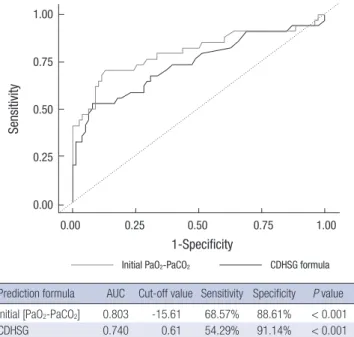
The values of our simplified prediction formula [PO2-PCO2] at 0, 4, 8, and 12 hr after birth were found to be associated with mor- tality (P < 0.001 at 0 hr, P = 0.005 at 4 hr, P = 0.008 at 8 hr, and P < 0.001 at 12 hr). A [PO2-PCO2] value of less than 0 (negative value) (P < 0.001 at 0, 4, 8, and 12 hr) and the [PO2-PCO2] value itself could also predict mortality. On ROC curve analysis to predict mortality, the initial [PaO2-PaCO2] (AUC = 0.803) show ed better discrimination than the CDHSG formula (AUC = 0.740) (Fig. 1). The initial [PaO2-PaCO2] had the highest AUC (0.803) compare to those of other timepoints, at 4 hr (AUC = 0.757), at 8 hr (AUC = 0.787), and at 12 hr (AUC = 0.737). We obtained the best cut-off values to predict mortality with the simplified prediction formula; initial [PO2-PCO2] from the ROC curve (Fig.
1). In addition, the simplified prediction formula showed statis- tical significance (P < 0.001), and a cut-off value of ≤ [-15.61]
showed a 68.6% sensitivity and 88.6% specificity for predicting mortality. The mortality rate was measured at 55.3% (26 of 47) among patients in a group with an initial [PO2-PCO2] value of
< 0, and 72.7% (24 of 33) for patients in a group with an initial [PO2-PCO2] value of ≤ [-15.61].
Prediction of secondary outcomes
With regard to ECMO requirement or death outcomes in pa- tients with CDH, the [PO2-PCO2] values at 0 hr (P = 0.003), 4 hr (P < 0.001), 8 hr (P = 0.003), and 12 hr (P < 0.001) after birth were found to be statistically reliable, and the CDHSG formula also showed statistical significance (P < 0.001). The [PO2-PCO2] value at 4 hr post-birth was found to be the most reliable pre-
dictor of ECMO requirement or death (Fig. 2). On ROC curve analysis, [PaO2-PaCO2] at 4 hr had the highest AUC (0.777), and AUC at initial was 0.774, at 8 hr was 0.770, and at 12 hr was 0.768.
Therefore, AUC of CDHSG formula for ECMO requirement or death was 0.759.
We did not find any association in our current analyses be- tween the duration of mechanical ventilation and the [PO2-PCO2] values at 0 hr (P = 0.232), 4 hr (P = 0.408), 8 hr (P = 0.371), and 12 hr (P = 0.279) after birth.
DISCUSSION
Various studies have previously examined the relationship be- tween ABGA values as ventilation/oxygenation parameters and survival outcomes in CDH patients (5, 15-17, 21-25). However, pulmonary hypertension, a variable ventilator setting, an endo- tracheal tube position, and other lung conditions, including combined respiratory distress syndrome, can also affect arterial blood gas values as well as lung hypoplasia. Therefore, Num- anoglu et al. (10) have emphasized that the inspired concentra- tion of oxygen and PaO2 are closely associated with the VI and PaCO2. Among various parameters, postductal PaO2 has been reported to reflect the degree of pulmonary perfusion and pul- monary vascular size (22) and Bohn et al. (19, 24) have con- firmed the relationship between the PaCO2 level and a diagno- sis of pulmonary hypoplasia, with postmortem lung measure- ments. We found that the PaO2 and PaCO2 values from same Prediction formula AUC Cut-off value Sensitivity Specificity P value Initial [PaO2-PaCO2] 0.803 -15.61 68.57% 88.61% < 0.001
CDHSG 0.740 0.61 54.29% 91.14% < 0.001
Sensitivity
1-Specificity
0.00 0.25 0.50 0.75 1.00
1.00
0.75
0.50
0.25
0.00
Initial PaO2-PaCO2 CDHSG formula
Fig. 1. Comparison of receiver operating characteristic (ROC) curves the simplified prediction formula at birth with the CDHSG formula in the prediction of mortality out- comes in congenital diaphragmatic hernia. The simplified prediction formula at birth (initial [PaO2-PaCO2], AUC 0.803) showed better discrimination than the CDHSG for- mula (AUC 0.740) in the prediction of mortality outcomes with higher area under curve (AUC) value of ROC curve.
blood sample reflect the degree of pulmonary hypoplasia in patients with CDH without the interfering effects of other con- ditions or the ventilator settings. In the case of the previously reported the Wilford Hall/Santa Rosa clinical prediction formu- la (WHSR[PF]) (3), the PaO2 and PaCO2 values used were from ABGA measurements of different samples during the initial 24 hr of life. Hence, the WHSR(PF) uses the highest PaO2 and PaCO2
blood gas values during the initial 24 hr post-birth and would not enable to predict survival soon after birth. The CDH study group (5) has previously reported a CDHSG prediction formula by which clinicians can assess risk in CDH infants using birth weights and 5-min Apgar scores soon after birth. However, be- cause the CDHSG formula is quite complex to use in a bedside setting and does not reflect the clinical status of the infant after birth, including the presence of respiratory failure, we devel- oped a simplified formula to predict mortality in infants with CDH immediately after birth.
Schultz et al. (3) have reported that a reversed arterial level of PCO2 and PO2 reflects compromised gas exchange in patients with critical pulmonary hypoplasia. They proposed a WHSR (PF) cut-off value of greater than 0 as a predictor of survival. We
first identified the relationship between a negative [PO2-PCO2] value within one hour of birth and mortality outcomes (P <
0.001). Moreover, the [PO2-PCO2] value as a continuous vari- able also was found to be a statistically significant predictor of mortality in our current analysis (P < 0.001). Using ROC curve analysis (Fig. 1), an optimal cut-off value of initial [PO2-PCO2] value for differentiating survivor from non-survivors with CDH was (-15.61). We initially expected that a [PO2-PCO2] value great- er than 0 would predict survival, but found that an initial [PO2- PCO2] after birth reading of less than [-15.61] (72.7% mortality) showed a better discriminatory ability to predict death or sur- vival than an initial [PO2-PCO2] of less than 0 (55.3% mortality).
In comparison with the previously reported CDHSG predic- tion formula (AUC = 0.740, P < 0.001) with a cut-off value of 0.61, our current simple prediction formula was found to be more effective in predicting the survival of CDH infants (AUC = 0.803, P < 0.001) (Fig. 1). Both the previously reported CDHSG prediction formula and the simple prediction formula we de- veloped in our current study can be used to predict clinical out- comes of CDH cases immediately after birth. However, the Ap- gar score used in the CDHSG formula is affected by operator subjectivity (3) and the degree of pulmonary hypoplasia cannot be determined with only the Apgar score and birth weight (25).
In predicting the likelihood of an ECMO requirement or death, the [PaO2-PaCO2] value at 4 hr (AUC = 0.777) was found to be the most reliable predictor (Fig. 2). Although the [PaO2-PaCO2] value at 4 hr (AUC = 0.777) was better predictor than the initial [PaO2-PaCO2] for ECMO requirement or death in CDH infants, but the initial [PaO2-PaCO2] also has high AUC (0.774). Frenck- ner et al. (9) and Bohn (20) have previously reported that both the onset of symptoms and the A-aDO2 levels within 6 hr of birth could help to discriminate between survivors and non- survivors. However, patients with CDH could have various de- grees of pulmonary hypoplasia from the fetal period and ABGA measurements immediately after birth also could reflect lung hypoplasia and be used as a predictor of mortality, consistent with our current findings.
This study has some limitations. First, this study was conduct- ed retrospectively, thus some of the results of ABGA at certain timepoint were not collected. Second, the number of study po- pulation and the patients who were dead or underwent ECMO were small. Although this study has some limitations, this study was the single institution report of the largest population with CDH in Korea (26, 27). We assume that the physician could predict the outcomes or requirement of ECMO with this for- mula in patients with CDH soon after birth. Our simplified pre- diction formula requires further validation but might prove to be a useful tool and an easily applicable predictor of outcomes in patients with CDH.
In conclusion, we propose a simple mathematical equation, [PaO2-PaCO2], using initial ABGA values to reliably predict mor- Fig. 2. Comparison of receiver operating characteristic (ROC) curves for the CDHSG
formula with those for the simplified prediction formula at 4, 8, and 12 hr post-birth in predicting extracorporeal membrane oxygenation (ECMO) or death outcome in congenital diaphragmatic hernia. Based on ROC curve, the [PaO2-PaCO2] at 4 hr had the highest area under curve (AUC) (0.777) and Congenital Diaphragmatic Hernia Study Group (CDHSG) prediction formula had the lowest AUC (0.759) in predicting ECMO or death outcome.
[PaO2-PaCO2] at initial (0.7742) [PaO2-PaCO2] at 4 hr (0.7774) [PaO2-PaCO2] at 8 hr (0.7946) [PaO2-PaCO2] at 12 hr (0.7676) CDHSG formula (0.7589)
Sensitivity
1-Specificity
0.00 0.25 0.50 0.75 1.00
1.00
0.75
0.50
0.25
0.00
Prediction formula AUC Cut-off value Sensitivity Specificity P value [PaO2-PaCO2] initial 0.774 -11.12 68.42% 85.53% 0.003 [PaO2-PaCO2] at 4 hr 0.777 12.55 84.21% 61.84% < 0.001 [PaO2-PaCO2] at 8 hr 0.770 0.04 73.68% 73.68% 0.003 [PaO2-PaCO2] at 12 hr 0.768 -3 63.16% 73.32% < 0.001
CDHSG 0.759 0.61 50% 90.78% < 0.001
tality, and the risk of ECMO or death in CDH patients.
ACKNOWLEDGMENTS
The authors would like to thank Hyo Jin Min for advice on sta- tistical analyses.
DISCLOSURE
The authors have no conflicts of interest to disclose.
REFERENCES
1. Van Loenhout RB, Tibboel D, Post M, Keijzer R. Congenital diaphrag- matic hernia: comparison of animal models and relevance to the human situation. Neonatology 2009; 96: 137-49.
2. De Buys Roessingh AS, Dinh-Xuan AT. Congenital diaphragmatic her- nia: current status and review of the literature. Eur J Pediatr 2009; 168:
393-406.
3. Schultz CM, DiGeronimo RJ, Yoder BA; Congenital Diaphragmatic Her nia Study Group. Congenital diaphragmatic hernia: a simplified postnatal predictor of outcome. J Pediatr Surg 2007; 42: 510-6.
4. Thébaud B, Azancot A, de Lagausie P, Vuillard E, Ferkadji L, Benali K, Beaufils F. Congenital diaphragmatic hernia: antenatal prognostic fac- tors: does cardiac ventricular disproportion in utero predict outcome and pulmonary hypoplasia? Intensive Care Med 1997; 23: 10062-9.
5. Estimating disease severity of congenital diaphragmatic hernia in the first 5 minutes of life: the Congenital Diaphragmatic Hernia Study Group.
J Pediatr Surg 2001; 36: 141-5.
6. Downard CD, Jaksic T, Garza JJ, Dzakovic A, Nemes L, Jennings RW, Wilson JM. Analysis of an improved survival rate for congenital dia- phragmatic hernia. J Pediatr Surg 2003; 38: 729-32.
7. Javid PJ, Jaksic T, Skarsgard ED, Lee S; Canadian Neonatal Network.
Survival rate in congenital diaphragmatic hernia: the experience of the Canadian Neonatal Network. J Pediatr Surg 2004; 39: 657-60.
8. Migliazza L, Bellan C, Alberti D, Auriemma A, Burgio G, Locatelli G, Colombo A. Retrospective study of 111 cases of congenital diaphragmat- ic hernia treated with early high-frequency oscillatory ventilation and presurgical stabilization. J Pediatr Surg 2007; 42: 1526-32.
9. Frenckner B, Ehrén H, Granholm T, Lindén V, Palmér K. Improved re- sults in patients who have congenital diaphragmatic hernia using pre- operative stabilization, extracorporeal membrane oxygenation, and de- layed surgery. J Pediatr Surg 1997; 32: 1185-9.
10. Numanoglu A, Morrison C, Rode H. Prediction of outcome in congeni- tal diaphragmatic hernia. Pediatr Surg Int 1998; 13: 564-8.
11. Deprest J, Jani J, Van Schoubroeck D, Cannie M, Gallot D, Dymarkowski S, Fryns JP, Naulaers G, Gratacos E, Nicolaides K. Current consequences of prenatal diagnosis of congenital diaphragmatic hernia. J Pediatr Surg 2006; 41: 423-30.
12. Okuyama H, Kubota A, Oue T, Kuroda S, Ikegami R, Kamiyama M, Kita- yama Y, Yagi M. Inhaled nitric oxide with early surgery improves the out-
come of antenatally diagnosed congenital diaphragmatic hernia. J Pedi- atr Surg 2002; 37: 1188-90.
13. Beck C, Alkasi O, Nikischin W, Engler S, Caliebe A, Leuschner I, von Kaisenberg CS. Congenital diaphragmatic hernia, etiology and man- agement, a 10-year analysis of a single center. Arch Gynecol Obstet 2008;
277: 55-63.
14. Datin-Dorriere V, Rouzies S, Taupin P, Walter-Nicolet E, Benachi A, So- nigo P, Mitanchez D. Prenatal prognosis in isolated congenital diaphrag- matic hernia. Am J Obstet Gynecol 2008; 198: 80.e1-5.
15. Skari H, Bjornland K, Frenckner B, Friberg LG, Heikkinen M, Hurme T, Loe B, Mollerlokken G, Nielsen OH, Qvist N, et al. Congenital diaphrag- matic hernia in Scandinavia from 1995 to 1998: predictors of mortality.
J Pediatr Surg 2002; 37: 1269-75.
16. Datin-Dorriere V, Walter-Nicolet E, Rousseau V, Taupin P, Benachi A, Parat S, Hubert P, Revillon Y, Mitanchez D. Experience in the manage- ment of eighty-two newborns with congenital diaphragmatic hernia treated with high-frequency oscillatory ventilation and delayed surgery without the use of extracorporeal membrane oxygenation. J Intensive Care Med 2008; 23: 128-35.
17. Shanbhogue LK, Tam PK, Ninan G, Lloyd DA. Preoperative stabilisation in congenital diaphragmatic hernia. Arch Dis Child 1990; 65: 1043-4.
18. Fumino S, Shimotake T, Kume Y, Tsuda T, Aoi S, Kimura O, Deguchi E, Iwai N. A clinical analysis of prognostic parameters of survival in chil- dren with congenital diaphragmatic hernia. Eur J Pediatr Surg 2005; 15:
399-403.
19. Bohn D, Tamura M, Perrin D, Barker G, Rabinovitch M. Ventilatory pre- dictors of pulmonary hypoplasia in congenital diaphragmatic hernia, confirmed by morphologic assessment. J Pediatr 1987; 111: 423-31.
20. Bohn D. Blood gas and ventilatory parameters in predicting survival in congenital diaphragmatic hernia. Pediatr Surg Int 1987; 2: 336-40.
21. Norden MA, Butt W, McDougall P. Predictors of survival for infants with congenital diaphragmatic hernia. J Pediatr Surg 1994; 29: 1442-6.
22. O’Rourke PP, Vacanti JP, Crone RK, Fellows K, Lillehei C, Hougen TJ.
Use of the postductal PaO2 as a predictor of pulmonary vascular hypo- plasia in infants with congenital diaphragmatic hernia. J Pediatr Surg 1988; 23: 904-7.
23. Casaccia G, Ravà L, Bagolan P, di Ciommo VM. Predictors and statisti- cal models in congenital diaphragmatic hernia. Pediatr Surg Int 2008;
24: 411-4.
24. Bohn DJ, James I, Filler RM, Ein SH, Wesson DE, Shandling B, Stephens C, Barker GA. The relationship between PaCO2 and ventilation param- eters in predicting survival in congenital diaphragmatic hernia. J Pedi- atr Surg 1984; 19: 666-71.
25. Hoffman SB, Massaro AN, Gingalewski C, Short BL. Survival in con- genital diaphragmatic hernia: use of predictive equations in the ECMO population. Neonatology 2011; 99: 258-65.
26. Kim DH, Park JD, Kim HS, Shim SY, Kim EK, Kim BI, Choi JH, Park GW.
Survival rate changes in neonates with congenital diaphragmatic her- nia and its contributing factors. J Korean Med Sci 2007; 22: 687-92.
27. Kim SH, Cho YH, Ryu JH. Clinical study of congenital diaphragmatic diseases in neonates and infants. J Korean Assoc Pediatr Surg 2010; 16:
143-53.