Two Siblings with Adolescent/Adult Onset Niemann-Pick Disease Type C in Korea
Niemann-Pick disease, type C (NP-C), is caused by NPC1 or NPC2 gene mutations.
Progressive neurological, psychiatric, and visceral symptoms are characteristic. Here, we present cases of a brother (Case 1) and sister (Case 2) in their mid-20s with gait disturbance and psychosis. For the Case 1, neurological examination revealed dystonia, ataxia, vertical supranuclear-gaze palsy (VSGP), and global cognitive impairment. Case 2 showed milder, but similar symptoms, with cortical atrophy. Abdominal computed tomography showed hepatosplenomegaly in both cases. NPC1 gene sequencing revealed compound
heterozygote for exon 9 (c.1552C>T [R518W]) and exon 18 (c.2780C>T [A927V]). Filipin- staining tests were also positive. When a young patient with ataxia or dystonia shows VSGP, NP-C should be considered.
Keywords: Niemann-Pick Disease, Type C; Dystonia; Ataxia; Oculomotor Paralysis;
Psychosis; Hepatosplenomegaly Su-Yun Lee,1 Hyung Jin Lee,1
Seong Hwan Kim,2 Young Jin Jeong,3 Hee Kyung Jin,4 Jae-sung Bae,5 Sang-Myung Cheon,1 and Jae Woo Kim1
1Department of Neurology, Dong-A University College of Medicine, Busan, Korea; 2Department of Psychiatry, Dong-A University College of Medicine, Busan, Korea; 3Department of Nuclear Medicine, Dong-A University College of Medicine, Busan, Korea; 4Department of Laboratory Animal Medicine, College of Veterinary Medicine, Kyungpook National University, Daegu, Korea; 5Department of Physiology, School of Medicine, Kyungpook National University, Daegu, Korea
Received: 3 June 2015 Accepted: 17 August 2015 Address for Correspondence:
Jae Woo Kim, MD
Department of Neurology, Dong-A University College of Medicine, 26 Daesingongwon-ro, Seo-gu, Busan 49201, Korea E-mail: [email protected]
http://dx.doi.org/10.3346/jkms.2016.31.7.1168 • J Korean Med Sci 2016; 31: 1168-1172
INTRODUCTION
Niemann-Pick disease, type C (NP-C), is a rare autosomal re- cessive lysosomal storage disorder characterized by progressive neurological symptoms and various degrees of visceral involve- ment (1,2). NP-C is caused by mutations in the genes NPC1 or NPC2, with approximately 95% of patients showing mutations in NPC1. The protein encoded by the NPC1 gene is predomi- nantly localized in late endosomes; thus, NPC1 gene mutations lead to late endosome trafficking defects. Esterification is es- sential for successful cholesterol secretion from cells, which re- quires transport of endocytosed cholesterol from late endosomes to the Golgi apparatus and endoplasmic reticulum. NPC1 gene mutations therefore lead to intracellular accumulation of un- esterified cholesterol and several glycosphingolipids (3-5). Pa- tients with NP-C show a few common characteristic symptoms and signs, including vertical supranuclear gaze palsy (VSGP), dystonia, ataxia, psychosis, and hepatosplenomegaly. However, clinical presentation and progression of NP-C varies greatly, and is mainly influenced by the age of neurological symptom onset (6,7). Here, we present the first reported Korean cases of adolescent- and adult-onset NP-C in two siblings.
CASE DESCRIPTION Case 1
Our first patient was a 24-year-old man, who presented with psychosis, abnormal posturing, and gait disturbance. The condi- tions surrounding his birth and course of development had been unremarkable. At the age of 18, he started to develop delusions and abnormal posturing in both hands. At age 21, he was hospi- talized at our Department of Psychiatry for psychotic symptoms, including visual and auditory hallucinations, aggressiveness, and impulsive behavior. Around this time, he also developed gait disturbance and cognitive impairment. Despite treatment, all symptoms gradually worsened. By age 24, he was completely dependent on caregivers and was confined to a wheel chair. An evaluation of family history revealed that his younger sister (Case 2) had similar symptoms. In November 2014 at the age of 24, neurological examination revealed generalized dystonia promi- nent in both upper limbs, severe ataxic gait, VSGP, severe dysar- thria, and a mini mental status examination (MMSE) score of 18.
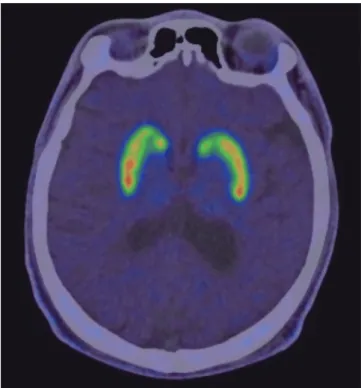
Brain magnetic resonance imaging (MRI) showed no definitive signal change; however, mild atrophy of posterior brain regions was observed. A positron emission tomography (PET) scan us- ing the radioligand 18F-FP-CIT showed mildly decreased uptake
in both caudate and right anterior putamen compared to the posterior putamen (Fig. 1). An abdominal computed tomogra- phy (CT) scan revealed hepatosplenomegaly, which was unde- tected during a routine physical examination (Fig. 2). No ab- normalities were found in routine laboratory tests or nerve con- duction studies. Evaluations for Wilson’s disease were performed, including the Kayser-Fleischer ring, 24-hour urine copper, se- rum copper and ceruloplasmin tests; however, all results were
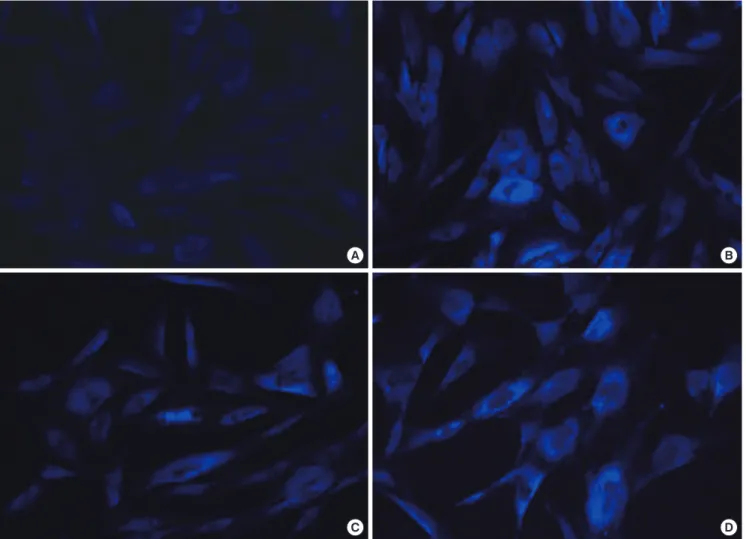
negative. Genetic tests for spinocerebellar ataxia 1,2,3,6,7,17, pantothenate kinase-associated neurodegeneration, dentato- rubral-pallidoluysian atrophy, DYT-1, and Huntington’s disease were all negative. NPC1 gene sequencing revealed a compound, heterozygous mutation, with aberrations in exon 9 (c.1552C>T [R518W]) and exon 18 (c.2780C>T [A927V]), which were previ- ously identified as a genetic cause of NP-C (8). We additionally evaluated cultured skin fibroblasts for filipin staining, another diagnostic test for NP-C; patient results were positive (Fig. 3).
Case 2
Our second patient was a 23-year-old woman, who was the younger sister of patient 1. She visited our clinic in November 2014 for the first time. The patient had no other siblings, and there was no further notable family history. Her symptoms be- gan with clumsiness in the right hand at age 19. Initial symptoms were followed by psychosis, cognitive impairment, and gait dis- turbance, which gradually worsened over the next 4 years. On examination, she had similar symptoms to her older brother (including VSGP). However, symptoms appeared to be milder;
she was able to walk unassisted and independently perform daily living activities. Cognitive impairment (with an MMSE score of 23) was also less severe than that in her older brother.
An abdominal CT scan revealed hepatosplenomegaly (Fig. 2), and a brain MRI showed diffuse brain atrophy. Sequencing anal- ysis revealed a genetic mutation identical to that of her brother, and filipin staining results were positive (Fig. 3). Based on the evaluations, this patient was also diagnosed with NP-C. We have initiated miglustat therapy in our patients, with careful observa- tion for common side effects, such as diarrhea and other gas- trointestinal symptoms.
Fig. 1. 18F-FP-CIT PET scan of Case 1. Image shows mildly decreased 18F-FP-CIT up- take in the right putamen.
A B
Fig. 2. Abdominal CT scan. (A) Case 1. (B) Case 2. Hepatosplenomegaly is shown in both cases, with greater prominence in Case 2.
DISCUSSION
There are approximately 500 NP-C cases diagnosed worldwide;
however, the actual number of patients with NP-C is believed to be much higher (9). This is the first adolescent- or adult-onset NP-C case report in Korea. Although the estimated incidence of NP-C is 1 in 120,000-150,000 live births, there has been only one previous case of perinatal-onset NP-C reported in Korea (diag- nosed by genetic analysis), presenting with neonatal cholesta- sis, hepatosplenomegaly, and no neurological symptoms (6,10).
A highly probable reason that NP-C has been underdiagnosed in Korea is that there is extreme heterogeneity in disease-relat- ed symptoms and signs (11,12).
Symptoms are greatly influenced by age of onset; therefore, NP-C is grouped into the following categories, based on onset time: perinatal, early and late infantile, juvenile, and adolescent or adult (1,2,6). The most representative systemic NP-C sign is hepatosplenomegaly. However, patients with adolescent- or adult-onset disease forms, as our patients, are often asymptom-
atic; thus, abdominal imaging studies are useful diagnostic tools in all suspected cases (13).
Among the various symptoms, VSGP should be considered a highly important sign for NP-C diagnosis. VSGP is present in between 66% and 81% of NP-C cases (1,7,14,15). Although pa- tients with diseases other than NP-C may present with VSGP (16), the majority of these conditions are adult-onset neurode- generative disorders, including progressive supranuclear palsy, corticobasal syndrome, Huntington’s disease, and Creutzfeldt- Jacob disease. VSGP is relatively very uncommon in all of these conditions, with the exception of progressive supranuclear pal- sy. Thus, the presence of VSGP in a young patient is a strong in- dicator of possible NP-C. Moreover, because genetic disorders showing both hepatosplenomegaly (the most representative systemic NP-C sign) and VSGP are rare (other than NP-C) de- tecting these two signs together narrows possible diagnoses significantly. Thus, detailed neurological and physical exami- nations that test for VSGP and hepatosplenomegaly are highly important to improve diagnostic accuracy.
A
C
B
D
Fig. 3. Unesterified cellular cholesterol fluorescence microscopy after filipin staining. Images are shown for: normal control subject (A), typical patient with NP-C (B), Case 1 (C), and Case 2 (D). Compared with controls, both cases show distinct cholesterol accumulation. Human NPC1-mutant and control fibroblasts (GM03123 and GM05399, respec- tively) were acquired from the Coriell Institute.
There have been few neuroimaging studies in NP-C cases, and MRI findings are often normal early during the disease.
However, as NP-C progresses, there is a strong correlation be- tween common clinical signs and cortical atrophy, predomi- nantly in the frontal lobes, brainstem, or cerebellum (13). In contrast, Case 1 had posterior brain atrophy. The significance of this differential atrophy pattern is unknown, meriting further clinicopathological studies.
There has been no systematic neuroimaging report assessing substantia nigra dopaminergic neuronal loss in patients with NP-C. Although Case 1 showed no obvious clinical features of parkinsonism, decreased dopaminergic uptake was detected using 18F-FP-CIT. The dysfunction pattern, however, appeared to be different from that in neurodegenerative parkinsonism and there has been no report of dopaminergic neuroimaging on NP-C. Further studies are therefore needed to determine whether dopaminergic dysfunction and its distinct pattern are another feature of NP-C.
Two important tools used in NP-C diagnosis are the genetic and filipin tests. The filipin test detects unesterified cholesterol in cultured skin fibroblasts stained with filipin, a fluorescent chemical compound. The hallmark storage pattern (an increas- ed number of filipin-stained vesicles) can be identified in 80%- 85% of cases (3).
NP-C became among a minority of treatable genetic diseases with the development of miglustat, a competitive inhibitor of glucosylceramide synthase (17). Patients who begin treatment early in the disease course show improved responses, highlight- ing the need for rapid diagnosis. When a patient with relevant familial background presents with idiosyncratic NP-C features, diagnosis is straightforward. However, in cases with atypical symptomology, a careful examination for VSGP is critical to en- hance diagnostic accuracy in potential NP-C cases.
ACKNOWLEDGMENT
The authors thank Dr. Han-Wook Yoo, of the Asan Medical Cen- ter, Seoul Korea, for help with genetic testing.
DISCLOSURE
The authors have no potential conflicts of interest to disclose.
AUTHOR CONTRIBUTION
Conception and coordination of the study: Lee SY, Kim SH, Kim JW. Writing: Lee SY, Lee HJ, Kim JW. Review and revision: Lee SY, Cheon SM, Kim JW. Conduct and interpretation of filipin test: Jin HK, Bae JS. Interpretation of 18F-FP-CIT PET imaging:
Jeong YJ. Manuscript approval: all authors.
ORCID
Su-Yun Lee http://orcid.org/0000-0003-1072-8452 Hyung Jin Lee http://orcid.org/0000-0002-2697-7560 Seong Hwan Kim http://orcid.org/0000-0001-5707-5917 Young Jin Jeong http://orcid.org/0000-0001-7611-8185 Hee Kyung Jin http://orcid.org/0000-0001-6403-008X Jae-sung Bae http://orcid.org/0000-0002-8270-0072 Sang-Myung Cheon http://orcid.org/0000-0001-5905-2188 Jae Woo Kim http://orcid.org/0000-0003-3054-6306 REFERENCES
1. Garver WS, Francis GA, Jelinek D, Shepherd G, Flynn J, Castro G, Walsh Vockley C, Coppock DL, Pettit KM, Heidenreich RA, et al. The National Niemann-Pick C1 disease database: report of clinical features and health problems. Am J Med Genet A 2007; 143A: 1204-11.
2. Imrie J, Dasgupta S, Besley GT, Harris C, Heptinstall L, Knight S, Vanier MT, Fensom AH, Ward C, Jacklin E, et al. The natural history of Niemann- Pick disease type C in the UK. J Inherit Metab Dis 2007; 30: 51-9.
3. McKay Bounford K, Gissen P. Genetic and laboratory diagnostic approach in Niemann Pick disease type C. J Neurol 2014; 261 Suppl 2: S569-75.
4. Chang TY, Reid PC, Sugii S, Ohgami N, Cruz JC, Chang CC. Niemann-Pick type C disease and intracellular cholesterol trafficking. J Biol Chem 2005;
280: 20917-20.
5. Vanier MT. Lipid changes in Niemann-Pick disease type C brain: person- al experience and review of the literature. Neurochem Res 1999; 24: 481-9.
6. Vanier MT. Niemann-Pick disease type C. Orphanet J Rare Dis 2010; 5:
16.
7. Patterson MC, Hendriksz CJ, Walterfang M, Sedel F, Vanier MT, Wijburg F;
NP-C Guidelines Working Group. Recommendations for the diagnosis and management of Niemann-Pick disease type C: an update. Mol Genet Metab 2012; 106: 330-44.
8. Scott C, Ioannou YA. The NPC1 protein: structure implies function. Bio- chim Biophys Acta 2004; 1685: 8-13.
9. Gartin BC, Murdick NL, Cooley J, Barnett S. Teaching children with Nie- mann-Pick disease. Phys Disabil 2013; 32: 30-42, i-iii.
10. Jeong MH, Ko JM, Kim GH, Yoo HW. Molecular diagnosis of Niemann- Pick type C presenting with neonatal cholestasis and hepatosplenomeg- aly. J Genet Med 2007; 4: 200-3.
11. Vanier MT. Phenotypic and genetic heterogeneity in Niemann-Pick dis- ease type C: current knowledge and practical implications. Wien Klin Wochenschr 1997; 109: 68-73.
12. Patterson MC. A riddle wrapped in a mystery: understanding Niemann- Pick disease, type C. Neurologist 2003; 9: 301-10.
13. Sévin M, Lesca G, Baumann N, Millat G, Lyon-Caen O, Vanier MT, Sedel F.
The adult form of Niemann-Pick disease type C. Brain 2007; 130: 120-33.
14. Salsano E, Umeh C, Rufa A, Pareyson D, Zee DS. Vertical supranuclear gaze palsy in Niemann-Pick type C disease. Neurol Sci 2012; 33: 1225-32.
15. Wijburg FA, Sedel F, Pineda M, Hendriksz CJ, Fahey M, Walterfang M, Pat- terson MC, Wraith JE, Kolb SA. Development of a suspicion index to aid diagnosis of Niemann-Pick disease type C. Neurology 2012; 78: 1560-7.
16. Stamelou M, Quinn NP, Bhatia KP. “Atypical” atypical parkinsonism: new genetic conditions presenting with features of progressive supranuclear
palsy, corticobasal degeneration, or multiple system atrophy-a diagnos- tic guide. Mov Disord 2013; 28: 1184-99.
17. Butters TD, Dwek RA, Platt FM. Inhibition of glycosphingolipid biosyn-
thesis: application to lysosomal storage disorders. Chem Rev 2000; 100:
4683-96.