1. INTRODUCTION
With the explosive growing of mobile data traf- fic because of the emergence of fourth-generation (4G) mobile networks [1], Device-to-Device (D2D) communication has been considered as an effective feature for next generation cellular networks in or- der to cope with this situation [2]. D2D communi- cation allows two physical nearby located users to transmit data directly without relaying the signal through the Base Station (BS). Therefore, D2D communication can enhance the system through- put, reduce the end-to-end delay and obtain better resource utilization [2]. In cellular networks with D2D enabled, the radio resources can be either al- located orthogonally to Cellular Users (CUs) and D2D pair, or shared between them [3]. The former can simplify the interference management, how- ever the resource utilization is very poor and not
flexible. To improve the resource utilization, we consider D2D communications underlaying cellular networks, i.e., D2D pairs share the same radio re- sources with CUs.
In general, the downlink often becomes the bot- tle-neck and the uplink is usually under-utilized, hence the resource utilization can be improved if the uplink is reused [4]. In addition, if the uplink is reused, the victim of the interference brought by D2D transmissions is the BS, which is typically more capable of dealing with co-channel interfer- ence than user equipments. Therefore, we focus on the scenario when CUs and D2D pairs share the same uplink spectrum.
Since the CUs and D2D pairs share the same radio resources, any resource allocation scheme must guarantee: (1) the Quality-of-Service (QoS) of CUs, and (2) improving the performance of the system. In this paper, we propose a simple yet effi-
Resource Allocation for Device-to-Device Communications Reusing Uplink in Cellular Networks
Amr Radwan
†ABSTRACT
Efficient spectrum sharing is an important issue in Device-to-Device (D2D) communications underlaying cellular networks as it can mitigate the interference to cellular users and improve the performance of the systems. In this paper, we formulate the radio resource allocation in D2D communications as a mixed nonlinear integer programing. We show the formulated problem is NP-hard and thus a polynomial time algorithm to solve is not possible. Since such a problem is very hard to obtain the optimal solution within a short running time, we instead propose a fast heuristic suboptimal algorithm to mitigate the interference caused to cellular users and improve the performance of the systems.
Simulation results are provided to evaluate the performance of the proposed algorithm.
Key words: Resource Allocation, D2D Communications, Cellular Networks, Spectrum Sharing, Nonlinear Integer Programing.
※ Corresponding Author : Amr Radwan, Address : (621-749) Obangdong, Gimhae, Gyeongnam, Korea, TEL
: +82-55-320-3847, FAX : +82-55-322-6275, E-mail : [email protected]
Receipt date : Aug. 31, 2015, Revision date : Oct. 14, 2015 Approval date : Oct. 16, 2015
†
Dept. of Information and Communication System, Inje University, Gimhae, Gyeongnam, Korea
※ This research was supported by the Inje University.
cient spectrum sharing to fulfil those tasks. We formulate the problem of allocating resources for D2D communication as a mixed integer nonlinear programing. Such an optimization problem is very hard to obtain the optimal solution within a fast transmission interval of practical networks such as LTE, WiMAX. We instead propose a fast yet effi- cient heuristic suboptimal algorithm to mitigate the interference caused to cellular users and improve the performance of the systems. The proposed al- gorithm does not require any modification to the scheduling of the primary cellular networks. The contributions of the paper can be summarized as follows.
∙ We model the system and formulate the prob- lem of resource allocation as a mixed integer non- linear programing, we then show its NP hardness and thus a polynomial time algorithm to solve is not possible.
∙ We propose a fast yet efficient heuristic sub- optimal algorithm to mitigate the interference caused to cellular users and improve the perform- ance of the systems.
∙ We evaluate the proposed algorithm with nu- merical analysis.
The remainder of this paper is organized as follows. We present related works in section II. In section III, we describe our system model, the problem formulation. Section IV presents our pro- posed algorithm. Section V gives the evaluation of the proposed algorithm and section VI eventually concludes the paper.
2. RELATED WORKS
Resource allocation for D2D communications in cellular networks can be found in [5]-[9]. [5] sug- gests that the network throughput can be sig- nificantly improved when users make use of un- occupied uplink resources. The authors in [6] pro- pose an algorithm based on the statistics of the signal to interference plus noise ratio (SINR) of all
users, however the SINR behavior is formulated based on the position of the D2D pair while in prac- tice such an location information is not easy to obtained. In [7], the authors investigate D2D com- munications in Wi-Fi ad hoc mode in the un- licensed band, however the cellular operators are more likely to use licensed band for the easy of signal controlling. In [8], an other algorithm is de- rived under the framework of game theory for cog- nitive radio networks (we note that D2D communi- cations is a kind of cognitive radio networks), however the obtained solution is inefficient duo to the selfness of each transmitter. In addition, cogni- tive users have to sense the surrounding environ- ment to detect the temporal and spatial "holes" in the spectrum and thereby avoid interference with the primary users, however the sensing ability de- mands high level of complexity to detect the weak signal of primary users. In [9], a simple resource allocation scheme is proposed for D2D communi- cations in underlaying LTE networks, the algo- rithm is simple and easy to implement in practice, however this algorithm place concentration on the data rate of cellular users, hence the throughput of the whole network including cellular and D2D users is not significantly improved.
3. SYSTEM MODEL AND PROBLEM FORM- ULATION
3.1 System model
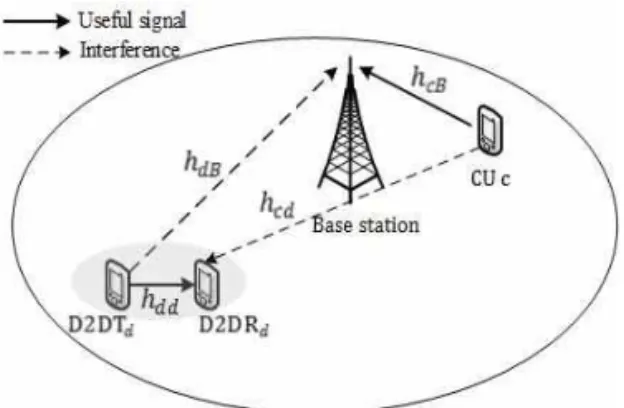
Fig. 1. Single cell with assisted D2D communications.
In this paper, we consider a single cell system as depicted in Fig. 1. Let and are the set of CUs and D2D pairs respectively, and where denotes the cardinality of a set. We as- sume an infinite backlogged model where network users always have data in their queues to transmit, in addition, all channel gains are fixed during the time of interest (e.g., in slow mobility scenario).
There are orthogonal channels in the system and each CU is exclusively assigned one channel for transmission. Let CU
cis CU , DD
dis D2D , DDT
dand DDR
dare the transmitter and receiver of D2D pair respectively. Let
be the indicator variable which the value is specified as follow
if DD
dreuses resource of CU c
otherwise .
The signal to interference plus noise ratio (SINR) of CU
cat the BS is given as
(1)
where
and
are the transmit powers of CU and DD
drespectively,
is the channel gains from CU
cto the BS and
is the channel gains from and DDT
dto the BS on the radio resource of CU
c,
is the noise at CU
c. The SINR of DD
dis given as
(2)
where
is the channel gains between DDT
dto DDR
don the radio resource of CU
c,
is the chan- nel gain of CU
cto DDR
d. The throughput of CU
cand DD
dare given according to Shannon capacity model, i.e.,
log
log
(3)
3.2 Problem formulation
The problem here is: how to allocate the radio
resources of CUs for D2D pairs and what is the corresponding transmit power to maximize the system throughput while guarantee the QoS of CUs. Mathematically, we have to solve the follow- ing optimization problem
max
≥ ≥
≥
m i n
≤
≤
(4)
Where
m i nis the minimum data rate require- ment of CU
cfor The second constraint is to guarantee that each CU is allowed to share the radio resource with at most one D2D pair while the third constraint guarantees that each D2D pair is allowed to reuse only one resource of CU.
Remark: Problem (4) is a mixed integer non- liner programming. From the proof of Theorem 1 in [10], it can be seen that even with binary power control for a given radio resource scheme is NP-hard. Therefore, we conclude that problem (4) with integer variable
and continuous transmit power
is also NP-hard. As a result, a polynomial time algorithm to determine that optimal solution is not possible. Although that problem can be solved via exhaustive search approach. However such approach requires to collect all channel gains between all transmitters and receivers, as well as evaluate all possible spectrum sharing schemes and power allocation, which results in hugh signal- ling overhead and computational complexity.
Therefore, in the next section, we propose a sub- optimal yet fast and efficient algorithm to solve this problem.
4. D2D RESOURCE ALLOCATION (D2DRA)
We first make some observations from the deri-
vation of the data rate of CUs and D2D pairs, i.e.,
equation (1), (2) and (3). It should be noticed that
on one hand, D2D pair should reuse the radio
resource of CU
cwhich has the largest channel gain
so DD
dwill have the best SINR. On the other hand, CU
cshould allow D2D pair who has the smallest channel gain
to reuse its radio re- source so the SINR of CU
cat the base station is maximized. However, since in practice, the dis- tance between the transmitter and receiver of any D2D pair is much smaller than the distance be- tween CU and BS, which means that the data rate of each D2D pair generally grater than that of each CU. Therefore we concentrate on the date rate of D2D pairs rather than that of each CU. With this intuition, each DD
dshould be matched with CU
cusing the following rule:
if c arg max
otherwise .
This matching rule simply means that DD
dshould reuse the radio resource of CU
cif it has the best data rate on that resource. Now we have to specify the transmit power of DD
dso that the QoS constraint of CU
cwho shares the same resource with DD
dis not violated. From (1) and (3) we have that
m i n≤
⇔
m i n≤ log
⇔
m i n≤ log
arg max
⇔
≤
min
m ax (5)
From the analysis above, the QoS of CU
cis not violated as long as the transmit power of D2D pair
lies in the interval
m ax , since the data rate of DD
dis an increasing function in
, then it is easy to verify that the optimal transmit power of DD
dis given by
m ax
m ax
min
Note that if
m ax≤ , then
, in other words, we have
max
m ax .
The D2DRA is given by the following algorithm.
Remark: In order to perform this algorithm, the BS which is the controller has to collect the channel gains
m i nfor . These channel gains can be obtained by having each receiver measure the channel condition and feed back to the controller. The complexity of this algorithm can be evaluated as follows. First, we have to sort the channel gains
in de- creasing order, using the sorting algorithm in [11], the complexity of the sorting process is
log . Performing the calculation of the transmit power in (5) needs calculations.
Collecting the following information
m i nfor and re- quires . Therefore, the overall compu- tational complexity of the D2DRA is
log which is polynomial in time.
5. NUMERICAL ANALYSIS
In this section, we evaluate the performance of Table 1. The D2DRA algorithm
1: Collecting the channel gains
m i nfor .
2: Sort the channel gain
in decreasing order.
3: Begin 4: While
5: Match the resource of CU
cwith D2D pair using the rule
if c arg min
otherwise .
6: Calculate the transmit power of DD
dby using
max
m ax
m ax
min
7: set .
8: Set .
9: end
10: end
the proposed D2DRA using simulation using Matlab.
We set up a single cell system with the cell radi- us is 500 m. Cellular users and D2D pair are ran- domly distributed in an area in which the minimum distance to the base station is 150 m. The distance between the transmitter and receiver of any D2D pair is randomly distributed between 15 and 30 m.
Fig. 2 depicts a snapshot of the topology used for simulation. The path loss is modeled as
log where (meters) is the distance from the transmitter to the receiver, the shadowing is modeled as log-normal random number with zero mean and standard deviation 4 dB [12]. The noise variance is assumed as -120 dBm. The number of resources (radio channels) are equal to the number of CUs , these resources are allocated to CUs us- ing a Round-Robin scheme, i.e., in the first round, the channel is assigned to the CU who has the best channel gain, then this CU is excluded and the sec- ond round is repeated to allocate the channel to the next CU. This process is repeated until all CUs are assigned radio resources. Finally the maximum transmit powers of BS and D2DTs are normalized as 1, i.e.,
m ax
m ax .
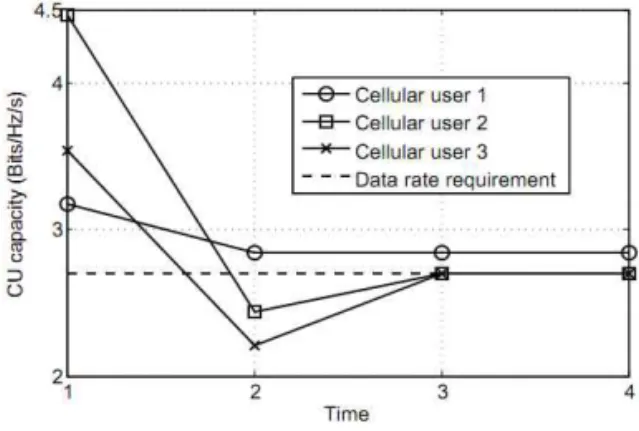
In Fig. 3, we plot the data rate of three CUs ob- tained by the proposed algorithm with
m i n
Bits/s/Hz. It can be observed that, in the first time (i.e., ) the data rates of CUs are obtained with-
out D2D transmissions. After this time, the D2D transmissions are started, causing co-channel in- terference to the CU receivers, thus the data rates of CUs decrease dramatically and some fall bellow the minimum data rate requirement. At this point, the transmit powers of D2DTs which cause ex- cessive interference to those CUs need to be ad- justed as in (5), and the data rates of CUs monot- onically increase and satisfy the minimum data rate requirement.
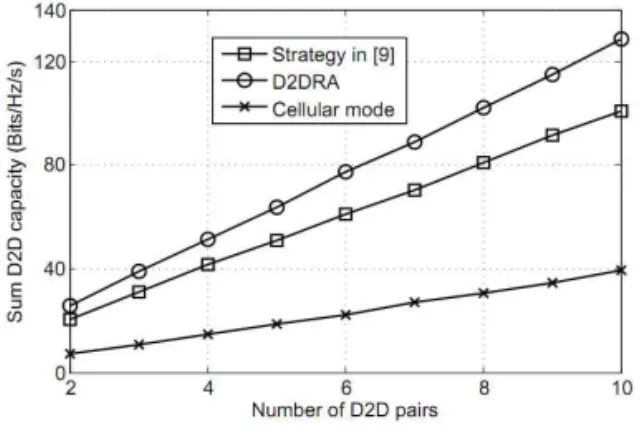
In Fig. 4, 5 and 6, we plot the sum capacity of D2D pairs, CUs and the total capacity of the system respectively. Each plot is average over 200 in- dependent channel realizations, in each realization, the location of CUs and D2D pairs are kept fixed while the shadowing is average over 25 times. We compare the sum capacity obtained by the pro- posed D2DRA with the Heuristic strategy in [9]
and the cellular mode (i.e., when the transmitter
Fig. 2. An example of topology.
Fig. 3. Data rate of CUs.
Fig. 4. Sum D2D capacity versus the number of D2D
pairs.
and receiver of a D2D pair communicates with each other via the base station). The reason we compare with the algorithm in [9] is that it does not require any modification to the scheduling of CUs and complex computations, which is also one of our goal, also for running, the DDRA needs to collect the same amount of information as in [9]. We ob- serve that the D2DRA outperform the strategy in [9] and the cellular mode in term of sum D2D ca- pacity (Fig. 4). Note that in the D2DRA, the chan- nel of CU is assigned to the D2D pair which has the best channel gain (i.e.,
i f arg max
) while in [9] the resource of CU is assigned to the D2D pair which has the smallest channel gain to the CU (i.e.,
i f arg min
). The results are tow folds, first the CU sum capacity obtained by the strategy in [9] is higher than the D2DRA (Fig. 5) because the D2DT is chosen such that it
cause less interference to the CU. However, the D2D sum capacity obtained by the D2DRA is much higher than the one obtained by the scheme in [9]
since the channel gain