The Effects of the Specific Attitudes toward the Fourth Industrial Revolution and Job
Satisfaction
함 상 우
1*
1)SangWoo Hahm
ABSTRACT
The period of the Fourth Industrial Revolution is our near future and the ongoing changes in this age. We need to strive to adapt to this changes and also try to create new values. This study focuses on workers' perceptions and attitudes (self-efficacy, expectancy, and acceptance of change) toward the Fourth Industrial Revolution. These positive attitudes toward the upcoming future and the Fourth Industrial Revolution will influence on both the future and the current attitude, behavior and performance of employees. People have certain attitudes to the future, and these attitudes have an impact on current behavior. This paper tries to examine the positive attitudes toward the Fourth Industrial Revolution era and the influence of positive attitudes toward this new age on the current job satisfaction. Through this process, this paper explains what kinds of attitudes the workers should have in the Fourth Industrial Revolution era, and also sheds light on significance and purpose of this paper to explain how these specific attitudes toward the future influence the present performance such as job satisfaction.
☞ Keywords: The Fourth Industrial Revolution, self-efficacy, expectancy, acceptance of change, job satisfaction
1. Introduction
In the new digital, society structures, technologies and environment are rapidly changed. Companies and people should acknowledge this change and also they need to try to accept it. The most representative aspect of this change is the era of the Fourth Industrial Revolution. The Fourth Industrial Revolution is the close future and the ongoing changes in the present time [1-2]. We need to strive to adapt to this innovative changes and try to create new values in the Fourth Industrial Revolution. The technical consequences of the Fourth Industrial Revolution have enabled us to leverage a diverse of innovative technologies such as, AI, IoT, Big Data, and Cloud Computing [3-5]. Learning and using these skills are critical to adapting and generating results in the age of the Fourth Industrial Revolution.
1 Semyung univ. 65 Semyung-ro, Jecheon-si, Chungcheongbuk-do, 27136 Korea
* Corresponding author ([email protected])
[Received 19 February 2020, Reviewed 26 February 2020(R2 20 April 2020), Accepted 6 May 2020]
☆ A preliminary version of this paper was presented at APIC-IST 2019.
This study focuses on workers' cognition and attitudes to these new changes and innovative technologies. Having a specific attitude or perception of workers can affect behavior and thus improve or decrease their performance. When workers have positive expectancy about new technologies of the Fourth Industrial Revolution era, employees could prepare more actively in the future [6]. This mechanism will also apply if workers have self-efficacy and acceptance of changes toward the Fourth Industrial Revolution. These variables are also closely related to motivation, performance and change.
In addition, this paper demonstrates that attitudes toward the future, such as the Fourth Industrial Revolution, can influence on current performance. For instance, positive expectancy for the upcoming future and the Fourth Industrial Revolution, will effect on not only the future but also the current behavior, attitude and performance of the workers. People have certain and subjective expectation about the future, and this expectancy has a great impact on current behavior [7].
Hence, workers can anticipate what the future will be happen if they do in the current time. Workers who are well accommodating change to the future and who have high self-efficacy might be more likely to be satisfied with their current work and to achieve high performance [7-8].
ISSN 1598-0170 (Print) / ISSN 2287-1136 (Online) http://www.jics.or.kr
Copyright ⓒ 2020 KSII
This paper tries to examine the positive attitudes to basis technologies of the Fourth Industrial Revolution era and their effects. These attitudes such as self-efficacy, expectancy, and acceptance of change would help workers to produce higher performance in the Fourth Industrial Revolution. In addition, these attitudes would influence on present job satisfaction of employees. Through this process, this paper tries to explain what kinds of positive attitudes of workers should have in the Fourth Industrial Revolution, Also, it sheds lights on the significance and the purpose the article to demonstrate the specific attitudes to the future effect the present performance such as job satisfaction.
2. Literature review
2.1 Self-efficacy toward the Fourth Industrial Revolution
Self-efficacy is the one of the self-concepts, which refers to the expectation of an individual's ability to perform a specific task [9]. Workers with higher self-efficacy are more confident, motivated and committed to work. Furthermore, self-efficacy us associated to attitudes, learning and behavior toward work. Thus, workers with higher self-efficacy are able to produce high performance [10].
The self-efficacy toward the Fourth Industrial Revolution is a belief in themselves that people have the capacity to work out the tasks their workers have done in the Fourth Industrial Revolution [6]. Workers with self-efficacy will be better able to accept changes in the future and achieve better results in the Fourth Industrial Revolution
2.2 Expectancy toward the Fourth Industrial Revolution
People have the ability to make some predictions about the future. Predictions for the future are not always right, but people predict the future and choose the present behavior. For example, a healthy person is currently insured, or an athlete is currently trained for a future race. These people are not immediately rewarded in the present, but they anticipate the future and do certain actions in the present to do this. This anticipation of the future influences current behavior, because
people have certain expectations in the future [7]. This expectancy of the future influences on specific behavior at the present. Expectancy is the subjective probability of what will happen in the future [11].
If workers have positive expectancy about the Fourth Industrial Revolution, they will be affected by current behavior and will be more proactive in embracing this new change. Furthermore, workers with positive expectancy for the Fourth Industrial Revolution will be able to achieve more motivation and higher performance in the Fourth Industrial Revolution era. Expectancy for the Fourth Industrial Revolution is a subjective probability that positive results will be formed for the Fourth Industrial Revolution, and a positive attitude to change into this era [6].
2.3 Acceptance of change toward the Fourth Industrial Revolution
Change means moving to a different form or having a different property from the current state. Not all members will accept organization or society changes. There is resistance in the process of change. If the force of resistance is greater, no change is made. The less force of resistance and the greater the force of members to accept change, the organization and society can change. A very important factor in organizational and social change is people. Changes in members ensure organizational change. Thus, in order for organization and society to change, members' attitudes toward change and acceptance are needed [12-13].
Acceptance of change is an individual's attitude to accept this change. Acceptance of change for the Fourth Industrial Revolution means an individual's attitude to strive to more actively embrace and adapt to the Fourth Industrial Revolution. Our society is rapidly changing to the Fourth Industrial Revolution. Companies and workers need to adapt to this new era. Thus, if members of the organization strive to accept and adapt to changes in the Fourth Industrial Revolution, they will be able to generate high performance in a new era.
2.4 Job satisfaction
Ordinary variables measuring organizational performance
involves organizational citizenship behavior, job satisfaction, work engagement, organizational commitment, turnover intention. This paper utilizes these variables, which are commonly used in organizational behavior study and business administration. These variables have been studied by lots of scholars from various definitions and perspectives. Among these variables, job satisfaction refers to the attitude that a worker has about the job as a form of attitude. This attitude toward the job is a state of good or pleasantness emotion, which is obtained by an individual evaluating own job or specific experience gained through work [14].
In addition, job satisfaction can be defined as an emotional response of workers resulting from the comparison between actual and expected results [15]. Although the operational definition of job satisfaction is somewhat different by scholars, in summary, job satisfaction means emotional preference as to how workers like their job as one of the attitudes they have about the job. Job satisfaction is the attitude toward the current job. Thus, it relates to the current state of motivation and performance of workers.
2.5 Self-efficacy, expectancy, acceptance of change, and job satisfaction
Self-efficacy is the attitude that workers perceive of their work. Workers who believe they will be able to perform their jobs well are more likely to be satisfied with their jobs. Since the performance of high self-efficacy workers can be improved, they can be more positive about work that can produce high performance. Previous studies have demonstrated that self-efficacy is a leading variable of job satisfaction [9], [16-17]. Thus, workers with higher self-efficacy toward the Fourth Industrial Revolution will be more positive about their current job and situation. Based on this relevance, the following hypothesis was established.
H1. Self-efficacy toward the Fourth Industrial Revolution would have a positive relationship with job satisfaction (current performance).
Self-efficacy toward the Fourth Industrial Revolution implies the belief that people will be able to achieve high performance in new changes. These workers look to the
future more positively. Workers who are dissatisfied with the present will not be optimistic about the future. In contrast, workers with positive expectations for the future will be more positive in the current situation. Expectation for the future explains the degree of current motivation. Because expectations affect current behavior, expectancy is closely related to current performance such as job satisfaction [18-19]. In addition, self-efficacy is internal expectancy, and this expectation is related to external factors [7], [9]. Hence, self-efficacy and expectancy toward the Fourth Industrial Revolution both can influence on job satisfaction. Based on these theoretical studies, the following hypothesis was established.
H2. Expectancy toward the Fourth Industrial Revolution would have a positive relationship with job satisfaction (current performance).
Previous studies have shown that there is a close correlation between acceptance of change and job satisfaction [20-21]. Although empirical studies have shown that people with job satisfaction are more immersed in organizations and more receptive to organizational change, the correlation between these two variables requires a distinction between current and future focus. Those who are currently satisfied with their work will not welcome the change in their work.
However, this connection does not explain that workers are dissatisfied with their current job because they prefer to make changes in their organization. Rather, workers who are satisfied with their current job will have higher commitment to the organization and better able to accommodate change for the development of the organization. In addition, workers who are willing to embrace new changes and contribute to the development of their organizations are more likely to be satisfied with their current jobs. Furthermore, workers who are more receptive to new challenges, such as the Fourth Industrial Revolution, will be able to take more risks, become more challenging and generate higher performance. Therefore, acceptance of change and current performance will be closely related.
Based on this relationship, the following hypothesis was
set.
H3. Acceptance of change toward the Fourth Industrial Revolution would have a positive relationship with job satisfaction (current performance).
(그림 1) 연구모형 (Figure 1) Research model
3. Measurement and participants
3.1 Measurement
This paper uses statistical techniques to test the hypothesis of the study. First, a survey was conducted to measure the statistics. The information on the survey items is as follows.
First, the self-efficacy toward the Fourth Industrial Revolution was measured as 5 items by modifying the existing item measuring general self-efficacy. The example questions for self-efficacy toward the Fourth Industrial Revolution are “I feel certain I can perform my job well in the Fourth Industrial Revolution era”, and “I will have confidence in my ability to solve problems in the Fourth Industrial Revolution era” [6], [22-23].
Second, expectancy toward the Fourth Industrial Revolution used seven items by modifying the items for measuring expectancy in previous studies. For example, “I will get more compensation and bonus in the Fourth Industrial Revolution era” and “I will have ability skill development opportunity in the Fourth Industrial Revolution era” [6], [11], [24].
Third, acceptance of change toward the Fourth Industrial Revolution was modified to measure acceptance of change by measuring four items. For instance, “I have become more enthusiastic since moving to FIR era”, and “I see FIR as a challenge and an opportunity for the most part rather than
hang on to notions of the past”. [6], [25-26].
Job satisfaction is an indicator of current performance and measured by the following three questions. 1) All in all, I am satisfied with my job, 2) In general, I don't like my job (R), 3) In general, I like working here [27].
3.2 Participants
This study surveyed the IT workers who were more closely related to the Fourth Industrial Revolution.
Demographic information of the 191 participants who responded to the survey is shown in Table 1 below.
(표 1) 인구통계학 (Table 1) Demographic
frequency %
gender male 140 73.3
female 51 26.7
industry IT 156 81.7
Other 35 18.3
age
20y 34 17.8
30y 64 33.5
40y 65 34.0
50y+ 28 14.7
service year
1y 14 7.3
1-5y 62 32.5
5-10y 59 30.9
10y+ 56 29.3
school
high school 10 5.2
undergraduate 149 78.0
graduated 32 16.8
4. Analysis
For empirical analysis, exploratory factor analysis, reliability analysis (Cronbach ’α), descriptive statistics, correlation analysis, and regression analysis were conducted.
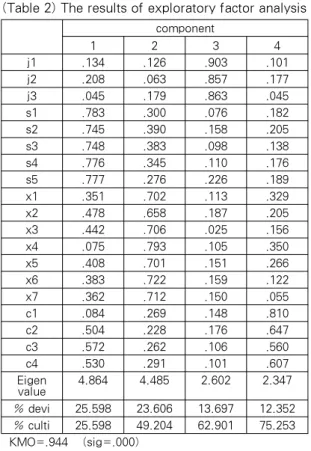
Exploratory factor analysis used vari-max rotation, and the results of the analysis are presented in Table 2. According to Table 2, each variable is shown to have a significant validity.
(0.4 standard, Eigen value 1 or higher, KMO = .944)
Table 3 shows Cronbach ’α to prove reliability. Each
variable has a Cronbach 'α value of 0.8 or more, which
ensures sufficient reliability.
(표 2) 탐색적 요인 분석 결과
(Table 2) The results of exploratory factor analysis component
1 2 3 4
j1 .134 .126 .903 .101
j2 .208 .063 .857 .177
j3 .045 .179 .863 .045
s1 .783 .300 .076 .182
s2 .745 .390 .158 .205
s3 .748 .383 .098 .138
s4 .776 .345 .110 .176
s5 .777 .276 .226 .189
x1 .351 .702 .113 .329
x2 .478 .658 .187 .205
x3 .442 .706 .025 .156
x4 .075 .793 .105 .350
x5 .408 .701 .151 .266
x6 .383 .722 .159 .122
x7 .362 .712 .150 .055
c1 .084 .269 .148 .810
c2 .504 .228 .176 .647
c3 .572 .262 .106 .560
c4 .530 .291 .101 .607
Eigen
value 4.864 4.485 2.602 2.347
% devi 25.598 23.606 13.697 12.352
% culti 25.598 49.204 62.901 75.253 KMO=.944 (sig=.000)
(표 3) 신뢰도 분석 결과
(Table 3) The results of reliability
Cronbach’ items
job satisfaction .881 3
self-efficacy .926 5
expectancy .928 7
acceptance of
change .859 4
Table 4 is a descriptive statistic that shows the mean and standard deviation of each variable.
(표 4) 기술통계
(Table 4) The results of Descriptive Statistics
mean Std.
Deviation job satisfaction 4.717 1.222
Self-efficacy 4.976 .989
expectancy 4.705 1.037
acceptance 4.851 .962
Table 5 indicates the correlations among the variables.
Correlation results show that each variable has a positive relationship at a significant level. Therefore, self-efficacy toward the Fourth Industrial Revolution, expectancy toward the Fourth Industrial Revolution, and acceptance of change toward the Fourth Industrial Revolution all have a significant effect on job satisfaction.
(표 5) 상관관계 분석 결과
(Table 5) The results of correlation analysis
1 2 3 4
1 -
2 .347** -
3 .355** .765** -
4 .359** .725** .705** -
1: job satisfaction, 2: self-efficacy toward the Fourth Industrial Revolution, 3: expectancy toward the Fourth Industrial Revolution, 4: acceptance of change toward the Fourth Industrial Revolution
**
: p <.001,
*: p <.01
Table 6 shows the results of further verifying which variables most influence job satisfaction through regression analysis. According to the analysis results, acceptance of change toward the Fourth Industrial Revolution has the greatest impact on improving job satisfaction. In the correlation of Table 5, acceptance of change toward the Fourth Industrial Revolution had the largest correlation, and expectancy toward the Fourth Industrial Revolution was closely related to job satisfaction. According to these results, hypotheses 1, 2, and 3 were all supported.
(표 6) 회귀분석 결과
(Table 6) The results of Regression analysis dependent : job satisfaction
sig
self-efficacy .103 .897 .371
expectancy .150 1.349 .179
acceptance of change .180 1.729 .085 R
2(Adjusted R
2) .153(.140)
11.280**
**