Improvement in Thermomechanical Reliability of Power Conversion Modules Using SiC Power Semiconductors: A Comparison of SiC and Si via FEM Simulation
Cheolgyu Kim
1, Chulmin Oh
2, Yunhwa Choi
3, Kyung-Oun Jang
4, and Taek-Soo Kim
1,†1
Department of Mechanical Engineering, Korea Advanced Institute of Science and Technology (KAIST), 291, Daehak-ro, Yuseong-gu, Daejeon 34141, Korea
2
Electronic Convergence Material & Device Research Center, Korea Electronic Technology Institute, Saenari-ro, Bundang-gu, Seongnam-si, Gyeonggi-do 13509, Korea
3
JMJ Korea Co., Ltd., 102, Gilju-ro 425beon-gil, Bucheon-si, Gyeonggi-do 14487, Korea
4
Power conversion, Fairchild Semiconductor Ltd., 55, Pyeongcheon-ro 850beon-gil, Bucheon-si, Gyeonggi-do 14487, Korea (Received July 24, 2018: Corrected September 17, 2018: Accepted September 20, 2018)
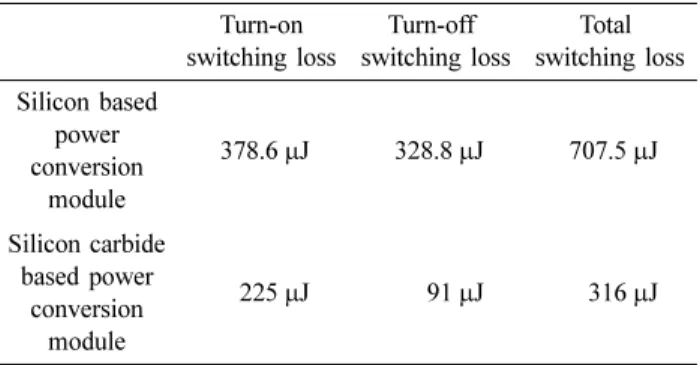
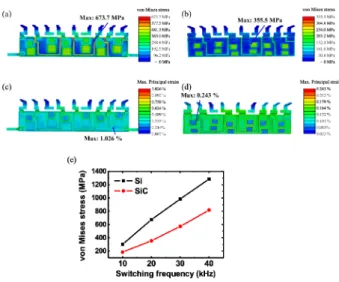
Abstract: Driven by the recent energy saving trend, conventional silicon based power conversion modules are being replaced by modules using silicon carbide. Previous papers have focused mainly on the electrical advantages of silicon carbide semiconductors that can be used to design switching devices with much lower losses than conventional silicon based devices. However, no systematic study of their thermomechanical reliability in power conversion modules using finite element method (FEM) simulation has been presented. In this paper, silicon and silicon carbide based power devices with three-phase switching were designed and compared from the viewpoint of thermomechanical reliability. The switching loss of power conversion module was measured by the switching loss evaluation system and measured switching loss data was used for the thermal FEM simulation. Temperature and stress/strain distributions were analyzed. Finally, a thermal fatigue simulation was conducted to analyze the creep phenomenon of the joining materials. It was shown that at the working frequency of 20 kHz, the maximum temperature and stress of the power conversion module with SiC chips were reduced by 56% and 47%, respectively, compared with Si chips. In addition, the creep equivalent strain of joining material in SiC chip was reduced by 53% after thermal cycle, compared with the joining material in Si chip.
Keywords: Power conversion module, silicon carbide (SiC), switching loss, thermal FEM simulation, thermomechanical reliability
1. Introduction
A power conversion module is a module in which two or more power devices and control ICs are packaged. Power devices are semiconductor devices used for power conver- sion and power control, and consist of diodes, power transis- tors, MOSFETs, IGBTs, and thyristors. They are typically classified as either switching elements, which are capable of on-off operation, or rectifiers, which provide rectification.
Power conversion modules are commonly used in air con- ditioners, refrigerators, washing machines and other energy consuming home appliances. Recent concerns for energy saving and conservation, CO
2regulation, and protection of the environment have stimulated the development of higher efficiency and more environmentally friendly power semiconductor devices, and research is being actively car-
ried out in the field to improve performance. Among the types of energy losses that occur in power conversion devices, switching losses and conduction losses tend to be the largest.
1)Switching losses occur when the device is transitioning from the blocking state to the conducting state and vice-versa. This interval is characterized by a signifi- cant voltage across the switch’s terminals and a significant current through it. To determine the switching losses of a device, the energy dissipated in each transition needs to be multiplied by the switching frequency. Conduction losses occur when the device is operating and current is flowing.
Those losses are in direct relation to the duty cycle.
The silicon-based power conversion module, which has been in operation for more than 40 years, has now reached its theoretical performance limit, and to improve power conversion efficiency, power conversion modules based on
†