1. INTRODUCTION
Drones are a type of unmanned aerial vehicle ca- pable of flying and being remotely controlled by radio. The drone market has grown rapidly as drones are used for a variety of purposes such as disaster safety, broadcasting, transportation, and leisure sports. This is particularly true in the public sector where they serve a variety of uses for the public interest, such as military reconnaissance, disaster information and relief, lifesaving, traffic concerns, crop growth, environmental protection, geographic information acquisition, and logistics [1]. In most of these drone applications, accurately recognizing the target is one of the most important tasks of the drone. Especially in disaster scenes and accident situations, it is important to discern the target precisely because it is directly connected
with human life [2-3]. The probability of a drone's successful target search depends on the its search environment, There are various factors that may impact the drone's search environment. When a drone searches for a target on the ground, the search altitude, the search angle, and the camera sensor performance are major factors that influ- ence its perception of the surrounding environment [4]. Of these, the search altitude and the search an- gle have the most affect the search performance.
Because the search altitude and the search angle are changing during flight, the success probability of the target search can vary greatly.
Therefore, we analyze a drone's target search success according to various search altitudes and search angles through experiments and study the optimal drone flight environment. In this study, we used the human recognition module of the OpenCV
Analysis of Drone Target Search Performance According to Environment Change
Jong-Bin Lim
†, Il-Kyu Ha
††ABSTRACT
In recent years, interest in drones has grown, and many countries are developing them into a strategic industry of the future. Drones are not only used in industries such as logistics and agriculture but also in various public sectors such as life rescue, disaster investigation, traffic control, and firefighting. One of the most important tasks of a drone is to accurately identify targets in these applications. Target recognition may vary depending on the search environment of the drone. Therefore, this study tests and analyzes the drone’s target recognition performance according to changes in the search environment such as the search altitude and the search angle. In addition, we propose a new algorithm that improves upon the disadvantages of the Haar cascade method, which is the existing algorithm that recognizes the target by analyzing a captured image.
Key words: Drone Altitude, Drone Search, Target Detection, Unmanned Aerial Vehicles.
※ Corresponding Author : Il-Kyu Ha, Address: (38428) Hayang-eup Gamasil-gil 50, Gyeongsan, Gyeongbuk, Korea, TEL : +82-53-600-5564, FAX : +82-53-600-5579, E-mail : [email protected]
Receipt date : Aug. 26, 2019, Revision date : Sep. 23, 2019 Approval date : Oct. 4, 2019
††
Dept. of Computer Engineering, Kyungil University (E-mail : [email protected])
††
Dept. of Computer Engineering, Kyungil University
※ This research was supported by the Basic Science
Research Program of the National Research Foundation
of Korea (NRF) funded by the Ministry of Education
(2017R1D1A1B03029895)
library as a method to analyze the existence of the target by processing the images acquired by the drone. In particular, we explore ways to improve the use of the high-altitude aerial reconnaissance cascades (known as Haar cascades) module which is known for its superior performance, to increase the likelihood of a target search success.
This paper is organized as follows: In Section II we investigate related research and analyze the relevant literature to extract the features of this study. In Section III we describe the environment of the experiment conducted in this study and ex- amine the theoretical background of the experiment.
In Section IV we explain the experiment conducted to examine recognition performance of the drone according to the environmental changes and ana- lyze the results. Finally, in Section V, we discuss the contributions and conclusions of this study.
2. RELATED WORKS
Target search methods for drones include image processing, communication signal processing, and probability-based target search [5]. Liu [6], Wang [7], and Mejias [8] are representative studies of im- age processing-based object search methods. In these methods, the drones detect the target through the camera sensor and store the detected image data in an on-board storage device. The acquired image is transmitted to the base station through wireless networks and the transmitted image is analyzed using an image processing algorithm.
The existence of the target is then examined and discriminated.
Arora [9], Costa [10], and Jawhar [11] examine representative signal processing-based target search methods. In these methods, the drones search for a signal to detect the presence of the target. However, in most cases, the targets are generally not producing signals. An example of such a case is a person hurt at a disaster site – it is likely that there is no electronic signal being
emitted by the victim.
The technique of probing the target by proba- bilistic methods is a useful approach in the autono- mous flight of the drone. In this method, when a drone cannot transmit a sensed image data to a re- mote site, the drone automatically discovers the target. In this method, the drone narrows the area where the target is likely to exist based on the ini- tial information about the search area, thereby in- creasing the possibility of finding the target.
Studies on this method include Ha [5], Chung [12], Waharte [13], and Symington [14].
There are few studies dealing with environ- mental factors to increase the likelihood of drones finding the targets including, that by Ha [5,15] and Symington [14]. The subject of [5] is collaboration of drones to increase the likelihood of success of the drone’s target search, and [15] investigates the search altitude control of drones to improve the search performance.
On the other hand, in finding the target by the drones, it is important to process the image in- formation acquired from the search area. The algo- rithm for recognizing the object in the captured im- age is similar to the conventional image processing technique. If the target is a person, an image proc- essing library such as OpenCV (Open Source Computer Vision) can be used. OpenCV is an im- age processing library focused on real-time image processing [16]. In addition, the image processing algorithms can extract or process information in a target image to be recognized by using an exist- ing picture or a photograph. OpenCV is used in many computer vision applications, including face detection and recognition and object recognition. In this study, the OpenCV library is used in an algo- rithm to process images acquired from a search area and recognize objects. Specifically, we use OpenCV's cv2 library for image processing. The algorithms used in this study, Haar cascade [17]
and histograms of oriented gradient (HOG) cas-
cade [18], use learned data to increase object rec-
ognition probability. The Haar cascade module provides high-speed detection but with a relatively low recognition success rate. On the other hand, HOG cascade is advantageous in that, while the object detection speed is low, the recognition suc- cess rate is relatively high. In this study, we use the Haar cascade method to detect the target (person). In particular, we improve the Haar cas- cade method of applying the algorithm to the entire body of a person, and reduce the false recognition rate of the target by applying the image processing algorithm separately to the upper body and the lower body.
Therefore, the contributions and features of our study are as follows. First, the experiment con- firms that the target discovery probability varies according to changes of the drone's target search environment, given by the search altitude and search angle. Second, we use an improved Haar cascade method for recognizing the target by proc- essing the image acquired through the camera sen- sor by the drones.
3. TARGET SEARCH PERFORMANCE ACCORDING TO ENVIRONMENTAL CHANGE
The target search performance of a drone can vary depending on changes in environmental
factors. Of these factors, this study focuses on the search altitude and the search angle and observes the associated changes in search performance. In this section, we describe our experiment and de- termine the drone’s target search performance as a function of the environmental changes, and then we explain the image processing algorithm used to determine the existence of the target.
3.1 Experiment to Determine Target Search Performance
In this experiment, we observed changes in the success rate of the target search by changing the search altitude and the search angle of the drone.
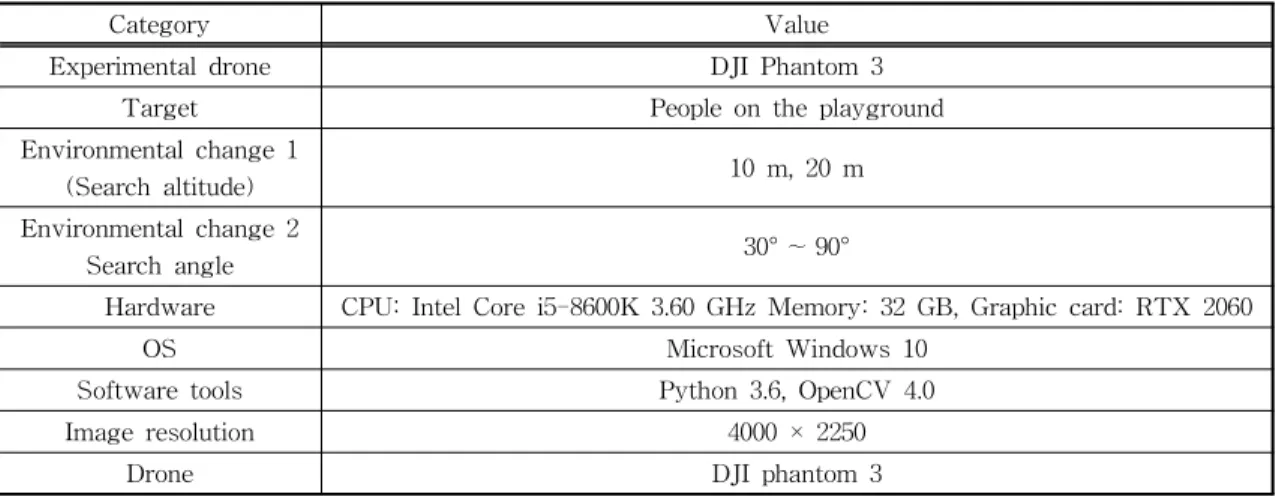
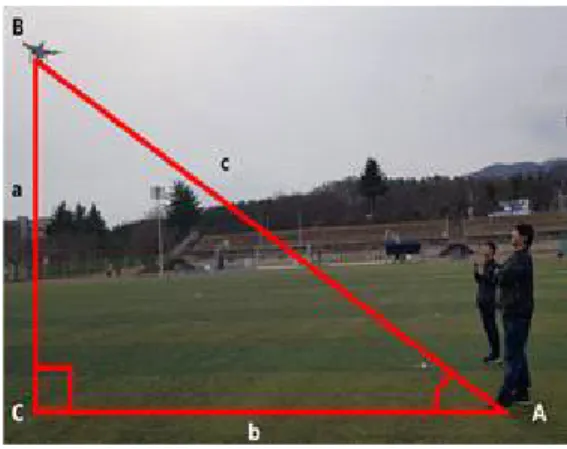
Table 1 shows the experimental environment for the target search performance test. The ex- perimental drone used is the DJI Phantom 3 model, and the experiment was conducted on the athletic field as shown in Fig. 1. The targets in this experi- ment are three people located on the playground.
We experimented by changing the distance and angle from the target to the drone. Experiments were performed with the straight-line distance from the target to the drone (c) set at 10 and 20 m, and experiments are performed at an angle (θ) of 30, 45, 60, 75 and 90° for each distance. Let 'A' be the target and 'B' be the drone as shown in Fig. 1; 'c' is the straight-line distance from the
Table 1. Environment of the target search experiment
Category Value
Experimental drone DJI Phantom 3
Target People on the playground
Environmental change 1
(Search altitude) 10 m, 20 m
Environmental change 2
Search angle 30° ∼ 90°
Hardware CPU: Intel Core i5-8600K 3.60 GHz Memory: 32 GB, Graphic card: RTX 2060
OS Microsoft Windows 10
Software tools Python 3.6, OpenCV 4.0
Image resolution 4000 × 2250
Drone DJI phantom 3
target to the drone and ∠A is the angle (θ) to be tested. Therefore, the search height (a) of the drone can be obtained as shown from Eq. (1). In practice, since the drone used in the experiment provides the vertical distance ‘a’ and ground distance ‘b’, we use this data to find the distance ‘c’ between the drone and the measurer. The search angle can be ob- tained according to Eq. (1).
Search altitude (a) can be found using the Pythagorean identity:
×sin (1)
3.2 Image Processing Algorithm for Target Recognition
In Analyzing the data our drone collected re- quires image processing. For this study, our tar- gets were human and there are extensive products for human target recognition. We used the exist- ing algorithms to available from the cv2 library provided by OpenCV. The cv2 library can be used to easily apply data that has been learned in ad- vance and it provides classification algorithms for human recognition, namely, the Haar cascade and HOG cascade classifiers. The Harr cascade is the most traditional and representative object recog- nition algorithm. This algorithm recognizes objects by sequentially applying several detectors, and is relatively fast because image processing for the fi- nal detection is performed only on images filtered
by a detector [19]. On the other hand, the HOG cas- cade technique uses the cascade technique to gen- erate the histogram [20]. It sets various blocks for object recognition, calculates the HOG, and boosts meaningful blocks. This method has a relatively high recognition rate while the detection speed is slow [21,22].
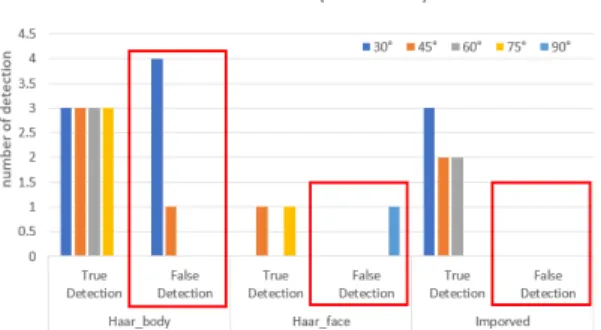
The speed of the drone’s search for targets is important; i.e., it is important to analyze the images captured by the drone quickly and judge the ex- istence of the target. Therefore, in this study, we choose the Haar cascade algorithm which has the advantage of rapidity analyzing the image. The Haar cascade algorithm included in the existing OpenCV library is an algorithm that recognizes the entire human body. When this algorithm is applied to a drone’s target search experiment, the false de- tection rate for perceiving people as human beings is high. Therefore, we intend to reduce this high false detection rate as follows. When the Haar cas- cade algorithm is applied to the experiment image, if it is recognized as a human object, it is divided into an upper body and a lower body, and another classifier is applied to each of them to recognize a person. If either is recognized as a person, the image is recognized as a human object. Fig. 2 com- pares the three algorithms used in the experiments in this study. As shown in the figure, the ‘Haar_
body’ method is a method of recognizing an object Fig. 1. A drone performance test scene.
Input of experiment image
Object recognition based on face
Classification of objects
Counting of Known Objects Input of experiment
image
Object recognition for the whole body
Classification of objects
Counting of recognized bjects
Input of experiment image
Object recognition by separating the
upper body and lower body of the
body
Classification of objects
Counting of Known Objects
Haar_body Haar_face Improved