DOI : http://dx.doi.org/10.5394/KINPR.2017.41.2.39
Fundamental Research for Escape Guidance System Development of Passenger Ship
Eun-Gyeong Ryu
*․†Chan-Su Yang․Jang-Won Choi
**
*,†Marine Safety Research Center, Korea Institution of Ocean Science and Technology(KIOST), Ansan 15627, Korea
*,†Integrated Ocean Sciences, Korea University of Science and Technology(UST), Daejeon 34113, Korea
†Department of Convergence Study on the Ocean Science and Technology, Ocean Science and Technology School(OST), Busan
49112, Korea
**Cornerstones Technology, Seoul 06335, Korea
Abstract: This study represents a fundamental research for a passenger-ship escape guidance system that is a ship-borne agent, and it
is for the support of escape decision-making by providing accurate maritime safety information in real time. We conducted a passenger
escaping experiment on a training ship, SAEYUDAL, using the situation-aware escape guidance system, which has been developed for
on-board application based on products for buildings. It is shown that the system contributes to the shortening of the escape duration and
the dispersion of the escaping persons by generating and guiding the safe escape routes which dangerous areas are considered. From the
experiment on ship's heeling condition, it is revealed that the heeling angle is linearly related to the escape duration. Therefore, this study
shows that the shortening of the escape duration enables a safe and rapid mustering that is the most important process under emergency
and appropriate incident responses to minimize loss of lives.
Key words: Passenger Ship, Escape Guidance System, Heeling Angle, Situation-aware, Escape Duration
†Corresponding author : 종신회원, [email protected] 031)400-7769
* [email protected] 031)400-7678
** [email protected] 02)518-1047
1. Introduction
The number of passengers each year has increased steadily from 11.6 million in 2006 to 15.4 million in 2015.
Also the average increasing rate is 1.4% for the recent 5 years (Korean Shipping Association, 2016).
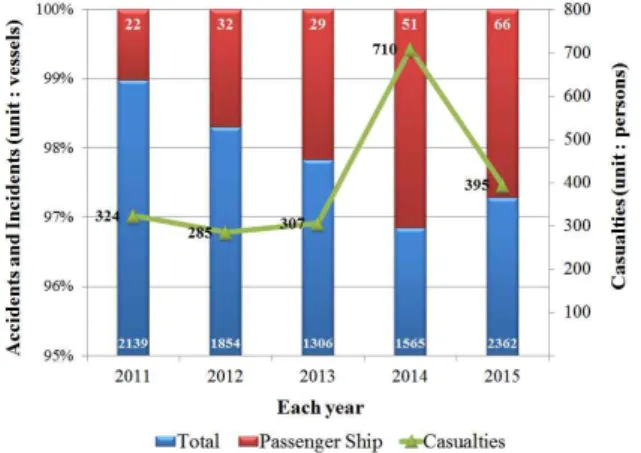
With increasing passenger transportation, the number of incidents has increased as well. Incidents in passenger ship have increased three times for the recent 5 years as shown in Fig. 1 (Korea Maritime Safety Tribunal, 2015).
Fig. 1 Current state of incidents(Total/Passenger ship) and
casualties by Korea Maritime Safety Tribunal Although the proportion is low as 200 cases of total 9,226 cases for the recent 5 years, the incidents are directly connected with casualties. So, it is needed to pay attention to incident response to minimize casualties.
Under the passenger ship incidents, if some factors are not understood immediately such as cause of an incident, vessel’s condition, marine weather, vessels in the vicinity, etc., it is difficult to take immediate and proper actions during golden time. The incomplete response actions make extensive loss of lives and property. Also, safe and rapid mustering is important as guiding passengers with safe and accurate escape routes under emergency situations. But it is difficult due to complicated own structure, shortage of crew members, panic for passengers and crew members, etc.
Passenger ship SEWOL is an example which sank in the
coastal area around ByeongPung island, Jindo-gun,
Jeollanam-do on Apr. 16th 2014. Due to delayed evacuation
judgement, crew members’ shortage, etc., the incident had
many casualties(172 rescued passengers and 302 dead or
missing passengers). To relieve the above mentioned
problem, escaping guidance system for Passenger ship has
been developing by Maritime Safety Research Center,
Korea Institution of Ocean Science and Technology. It is