http://dx.doi.org/10.7585/kjps.2015.19.3.255 Open Access
255
유기농업자재 고삼, 님 및 데리스 추출물의 어류에 대한 독성과 위해성 평가
박경훈*·오진아·백민경·손미연·임정택·진정화·홍순성·조남준·한상균1·김병석1
국립농업과학원 농산물안전성부, 1농촌진흥청 연구정책국
Evaluation of Fish Acute Toxicity and Preliminary Risk Assessment of Plant Extracts, Sophora, Neem and Derris
Kyung-Hun Park*, Jin-A Oh, Min-Kyoung Paik, Mi-Yeon Son, Joung-Taek Lim, Jung-hwa Jin, Soonsung Hong, Nam-jun Cho, Sang-Gyun Han1 and Byung-Seok Kim1
Department of Agro-Food Safety, National Academy of Agricultural Science
1Research Policy Bureau, Rural Development Administration, Wanju, Jeonbuk 565-851, Korea (Received on July 20, 2015. Revised on August 27, 2015. Accepted on August 31, 2015)
Abstract Promoting the organic farming, much of the plant extracts used for controlling pests and fungi have been imported from China, India and Myanmar. But, it is so worrisome that aquatic animals such as muddy loach inhabiting in paddy field and common carps in river exposed to the pests and fungi likely be harmed. This study was conducted in order to evaluate the risks of aquatic animals influenced by the three plant extracts, i.e. Sophora flavescens, Azadirachta indica and Derris elliptica. The toxicities of common carp (Cyprinus Carpio), muddy loach (Misgurnus anguillicaudatus) and PEC (Predicted environmental concentration) exposed to the three plant extracts were estimated by the typical spray volume method. Risks were determined by the toxicity value as 48-hr LC50 (Lethal concentration, median) or NOEC (No observed effect concentration) into PEC. 48-hr LC50of Common carp and NOEC by Sophora flavescens extracts was 7.9 and 6.2 mg/L, 26.8 and 21.8 mg/L by Azadirachta indica extracts and 47.0 and < 24.0 mg/L by Derris elliptica extracts, respectively. 48-hr LC50of Muddy loach and NOEC by Sophora flavescens extracts was 16.9 and 10.0 mg/L, 35.6 and 30.0 mg/L by Azadirachta indica extracts, and 73.9 and < 40 mg/L by Derris elliptica extracts, respectively. Therefore, acute toxicities of the three plant extracts for aquatic animals were proved to be very low level. PEC of Sophora flavescens extracts in paddy, drainage and river water was 68.0~3.0, 11.33~0.50 and 3.0~0.0018 mg/L, respectively. TER of Sophora flavescens extracts in the three water was 0.2~5.6, 1.5~33.8 and 2.6~4388.9, respectively. PEC of Azadirachta indica extracts in paddy, drainage and river water was 90.9~1.2, 15.2~0.2 and 4.8~0.00075 mg/L, respectively. TER of Azadirachta indica extracts in the three water was 0.4~29.7, 2.3~178.0 and 4.5~35733.3, respectively. PEC of Derris elliptica extracts in river water was 0.0063 mg/L. TER of Derris elliptica extracts in river water was 5222~15667.
Key words Sophora flavescens, Azadirachta indica, Derris elliptica, Common carp, Muddy loach, LC50, NOEC, PEC, TER
서 론
유기농업자재는 유기식품이나 무농약 농산물 또는 유기농 업자재를 생산, 제조·가공 또는 취급하는 과정에서 사용 가
능한 물질이다. 유기농업자재 중 병해충 방제용 자재를 공 시 또는 인증을 받으려면 환경독성시험성적(2015 농약관리 법령 및 고시훈령집)으로 어류, 물벼룩(논벼에 사용할 경우 에만 제출)과 꿀벌 독성시험성적서를 제출하고 독성과 위해 성을 해당제품별로 평가하도록 되어 있다(2015 유기농업자 재 공시 및 품질인증 기준).
*Corresponding author E-mail: [email protected]
ORIGINAL ARTICLES / TOXICITY
그 동안 정부의 친환경농업정책 지원에 따라 유기농업 자재가 많이 사용됨에 따라 해충관리용 자재에서 고삼, 님 및 데리스추출물이 차지하는 비중은 71%에 이른다(Rural Develop-ment Administration, 2012). 2014년 현재 유기농 업자재 1200 자재 중 병해충관리용으로 346자재가 공시되 었고, 품질인증자재는 33개 자재가 인증된 상태로 사용되고 있다. 친환경농업의 적극적 육성으로 고삼추출물, 님추출물 및 데리스추출물 등이 함유된 유기농업자재의 방대한 사용 은 농업지역의 수질을 악화시킬 수 있으며 또한 수서 환경 생물에 유해한 영향을 미칠 가능성이 있을 것으로 우려하고 있다.
고삼 추출물의 주성분은 뿌리에 주로 들어있는 alkaloid류 인 matrine, oxymatrine 등으로(Lee 등, 2010), 해충의 신경 계를 마비시켜 독성을 나타내며(Yu 등, 2011; Chen and Huang, 2012), 진딧물 등에 살충효과를 나타낸다(Kang, 2012). 님 추출물의 주성분은 azadirachtin은 해충방제용으 로 많이 사용되고(Mordue 등, 1998), 해충의 생육과 성장에 영향을 준다(Kang, 2012). 데리스 추출물의 주성분은 뿌리 에서 추출한 rotenone으로서 해충의 미토콘드리아 전자전달 계를 교란시켜 ATP 합성을 저해함으로서 살충효과를 나타 내며(Rich, 1996), 주로 진딧물 방제용으로 많이 사용된다 (Kim 등, 2009).
유기농업자재는 사용방법이 구체적이지 못하여 농약과 같 이 구제적인 작물이 정해져 있지 못하고 희석배수도 명확하 지 않아 실제 사용에 따른 환경생물에 대한 위해정도가 평 가되기에는 불분명한 점이 많다. 국립농업과학원에서는 유 기농업자재의 사용에 따른 환경생물에 대한 위해성을 합리 적으로 평가하기 위하여 잉어, 물벼룩과 꿀벌에 대한 제품 의 독성성적을 기준으로 위해성 평가를 하였다(2015 유기농 업자재 공시 및 품질인증 기준). 현재 국내에서 사용되고 있 는 유기농자재 중 병해충관리용 자재의 주요 재료인 고삼, 님과 데리스 추출물은 모두 인도, 미얀마, 베트남, 중국에서 추출물을 수입해서 사용하고 있다.
이번 연구는 우리나라에 공시된 병해충관리용 자재인 님, 고삼, 데리스 등 식물추출물물을 이용하여 잉어와 미꾸리에 대한 급성독성을 평가하였고, 사용방법을 고려하여 환경 중 추정농도를 산출하였으며, 독성과 노출을 비교한 위해성 평 가를 하여 합리적인 유기농업자재의 관리에 활용하고자 수 행하였다.
시험방법
시험물질
본 시험에서는 시중에서 유기농업자재 제품의 재료로 사 용하고 있는 추출물로서 님 추출물 2종(M, I), 고삼 추출물 2종(C1, C2) 및 데리스 추출물 2종(M1, M2)을 시험물질로
사용하였으며, 각각 ㈜그린포커스(M, C1, M1)와 ㈜고려바 이오(I, C2, M2)에서 구입하여 사용하였다.
시험생물
어류 급성독성 평가에 사용된 어류는 국립농업과학원 화학 물질안전과에서 사육하고 있는 것으로 잉어(Cyprinus carpio) 는 3~5 cm, 미꾸리(Misgurnus anguillicaudatus)는 5~10 cm 의 건강하고 균일한 개체를 시험하기 하루 전부터 먹이를 주지 않고 사용하였다.
어류 급성독성시험
식물추출물의 어류에 대한 급성독성시험은 우리나라의 농 약 등록시험 기준과 방법(농촌진흥청, 2015)과 OECD의 화 학물질 시험가이드라인 203(OECD, 1992)에 준하여 시험하 였다. 10 L 원형 유리수조(직경 20 × 높이 26 cm)에 농도별 로 시험용액 5 L를 채우고 시험기간 동안 시험용액을 교체 하지 않는 지수식(static)으로 시험하였다. 시험기간 동안 먹 이와 산소는 공급하지 않았으며, 온도는 25 ± 2oC, 광조건 16시간, 암조건 8시간으로 유지하였다. 시험농도는 5단계 이상으로 설정하여 농도수준당 어류 10마리로 시험하였다.
시험시작 후 4시간 및 24시간 마다 치사어 및 독성증상을 관찰하여 기록하였고 치사한 개체는 발견 즉시 제거하였다.
시험기간 동안 시험용액의 pH는 24시간마다 모든 농도에서 측정하였으며 수온은 대조군에서만 측정하였다.
통계처리
시험결과는 probit(EPA version 1.5)법을 이용하여 LC50값 과 95% 신뢰한계를 구하였다.
어류의 위해평가를 위한 환경 중 추정농도
환경 중 추정농도는 어류가 서식하는 논물, 배수로와 강 물에서의 추정농도로 유기농업자재를 사용하는 작물별 살포 물량, 희석배수와 사용량으로 계산하였다. 작물별 1 ha당 살 포물량은 Table 1과 같이 농약의 살포물량(농진청고시 ‘농 약의 등록기준’)을 기준으로 하였는데, 실제 농가에서 사용 하는 작물은 여러 가지 작물에 사용하고 있으므로 Table 1 에 포함되어 있는 작물을 기준으로 살포물량을 설정하여 계 산했다.
환경 중 추정농도는 자재가 벼에 사용될 경우에는 논물 의 수심이 5 cm라고 가정하고 사용한 자재가 모두 논물에 고르게 분산되었다고 설정하여 1000 m3 (10a) 논물의 량을 50,000 L로 계산했고, 배수로의 경우에는 수심을 30 cm라고 가정하고 10a당 배수로물량을 300,000 L로 계산했다. 밭이 나 과수원에서 사용하는 자재의 경우에는 강물에서의 환경 중 추정농도를 설정했는데 하천의 수심을 30 cm라고 가정 하고 10a당 강물량을 배수로물량과 동일하게 300,000 L로
설정하고 사용한 자재의 0.6% 만이 농약을 살포할 때 바람 에 날려 강물로 비산된다고 가정하여 계산하였다.
어류 위해성 평가
어류 위해성 평가는 농진청 고시 농약의 등록기준 중 환 경생물독성과 환경 중 농도를 고려한 위해성 평가기준을 참 고하여 위해성 평가에 사용할 독성값으로는 48시간 반수치 사농도(48 hr-LC50)와 무영향농도(48 hr-NOEC) 값 중에서 가장 낮은 것을 이용하였다. 자재가 논에 사용될 경우에는 논물과 배수로에서는 미꾸리의 독성성적을 사용하였고, 그 렇지 않을 경우에는 잉어의 독성성적을 사용했고, 논과 밭 등에서 동시에 사용할 경우에는 둘다 계산했다. 제품의 사 용정보를 관련 부서에서 협조 받아 농약의 환경 중 추정농 도(PEC, Predicted Environmental Concentration) 산출방법 으로 산출하였다. 위해성 평가는 독성성적(48hr-LC50)과 무 영향농도(48 hr-NOEC)를 환경 중 추정농도로 나눈 독성노 출비(TER, Toxicity Exposure Ratios)로 평가하였다.
결과 및 고찰
잉어 급성독성
식물추출물 고삼, 님 및 데리스추출물의 잉어 급성독성은 Table 2와 같이 독성정도는 고삼추출물이 가장 높았고, 님추 출물, 데리스추출물의 순서로 독성이 높았다. 잉어 48시간 반수치사농도는 고삼추출물은 7.9~8.2, 님추출물은 26.8~
38.3, 데리스추출물은 47.0~162.7 mg/L로 모두 어독성 Ⅲ급 으로 독성이 낮았다. 세 가지 추출물의 48시간과 96시간의 독성차이는 크게 차이가 나지 않았다. 고삼, 님 및 데리스 추출물의 잉어 48 시간의 무영향농도는 각각 6.0, 21.8,
< 24.0 mg/L이었다.
미꾸리 급성독성
식물추출물 고삼, 님 및 데리스추출물의 미꾸리 급성독성 은 Table 3과 같이 독성정도는 잉어와 같이 고삼추출물, 님 추출물, 데리스추출물의 순서로 독성이 높았다. 미꾸리 48 시간 반수치사농도와 무영향농도는 고삼추출물은 16.9, 10.0, Table 1. Pesticide spray volume of crops
Crops Spray volume (L/ha)
rice 1,600
apple, pear, mandarin, peach, persimmon 4,500
grape 3,000
mulberry 2,000
cucumber, watermelon 1,800
bean, red pepper, tobacco, peanut, garlic, leek, anion, radish, tomato, potato, herb, maize, sesame 1,500
strawberry 1,200
other crops based on standard cultivation
Table 2. Common carp (Cyprinus carpio) acute toxicity of plant extracts Plant extracts 48hr-LC50
(mg/L)
48hr-NOEC (mg/L)
96hr-LC50 (mg/L)
96hr-NOEC (mg/L) Sophora flavescens (C1) 8.2
(7.2~9.3) 6.0 7.7
(6.2~8.9) <6.0 Sophora flavescens (C2) 7.9
(7.3~8.6) 6.2 6.4
(5.8~7.0) <5.2 Azadirachta indica (M) 26.8
(25.3~39.3) 21.8 26.8
(25.3~39.3) 21.8
Azadirachta indica (I) 38.3
(36.2~42.2) 28.0 38.3
(36.2~42.2) 28.0
Derris elliptica (M1) 47.0
(36.7~72.0) <24.0 35.3
(29.7~40.9) <24.0 Derris elliptica (M2) 162.7
(143.3~180.9) <125.0 157.0
(140.4~172.7) <125.0 M, I, C: Crude plant extract imported from Myanmar (M1, M2), India (I) and Chnia (C1, C2)
Table 3. Loach(Misgurnus anguillicaudatus) acute toxicity of plant extracts
Plant extracts 48hr- LC50 (mg/L) 48hr-NOEC (mg/L) 96hr LC50 (mg/L) 96hr-NOEC (mg/L) Sophora flavescens(C1) 16.9
(15.1~19.6) 10.0 16.9
(15.1~19.6) 10.0 Sophora flavescens(C2) 18.2
(17.1~20.5) 14.5 17.8
(16.8~19.5) 14.5
Azadirachta indica(M) 35.6
(32.9~38.5) 30.0 35.6
(32.9~38.5) 30.0
Azadirachta indica(I) 48.7
(44.6~53.1) 35.0 48.7
(44.6~53.1) 35.0
Derris elliptica (M1) 73.9 <40.0 52.7
(33.6~65.6) <40.0
Derris elliptica (M2) 426.4 112 323.2
(247.1~1027.0) 112
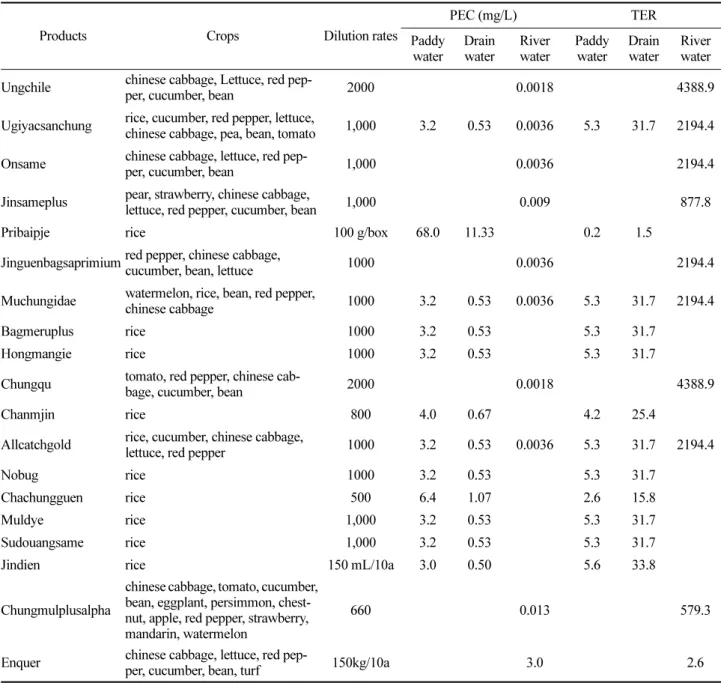
Table 4. PEC in surface water and TER for initial exposure when sophora extract products
Products Crops Dilution rates
PEC (mg/L) TER
Paddy water
Drain water
River water
Paddy water
Drain water
River water Ungchile chinese cabbage, Lettuce, red pep-
per, cucumber, bean 2000 0.0018 4388.9
Ugiyacsanchung rice, cucumber, red pepper, lettuce,
chinese cabbage, pea, bean, tomato 1,000 3.2 0.53 0.0036 5.3 31.7 2194.4 Onsame chinese cabbage, lettuce, red pep-
per, cucumber, bean 1,000 0.0036 2194.4
Jinsameplus pear, strawberry, chinese cabbage,
lettuce, red pepper, cucumber, bean 1,000 0.009 877.8
Pribaipje rice 100 g/box 68.0 11.33 0.2 1.5
Jinguenbagsaprimiumred pepper, chinese cabbage,
cucumber, bean, lettuce 1000 0.0036 2194.4
Muchungidae watermelon, rice, bean, red pepper,
chinese cabbage 1000 3.2 0.53 0.0036 5.3 31.7 2194.4
Bagmeruplus rice 1000 3.2 0.53 5.3 31.7
Hongmangie rice 1000 3.2 0.53 5.3 31.7
Chungqu tomato, red pepper, chinese cab-
bage, cucumber, bean 2000 0.0018 4388.9
Chanmjin rice 800 4.0 0.67 4.2 25.4
Allcatchgold rice, cucumber, chinese cabbage,
lettuce, red pepper 1000 3.2 0.53 0.0036 5.3 31.7 2194.4
Nobug rice 1000 3.2 0.53 5.3 31.7
Chachungguen rice 500 6.4 1.07 2.6 15.8
Muldye rice 1,000 3.2 0.53 5.3 31.7
Sudouangsame rice 1,000 3.2 0.53 5.3 31.7
Jindien rice 150 mL/10a 3.0 0.50 5.6 33.8
Chungmulplusalpha
chinese cabbage, tomato, cucumber, bean, eggplant, persimmon, chest- nut, apple, red pepper, strawberry, mandarin, watermelon
660 0.013 579.3
Enquer chinese cabbage, lettuce, red pep-
per, cucumber, bean, turf 150kg/10a 3.0 2.6
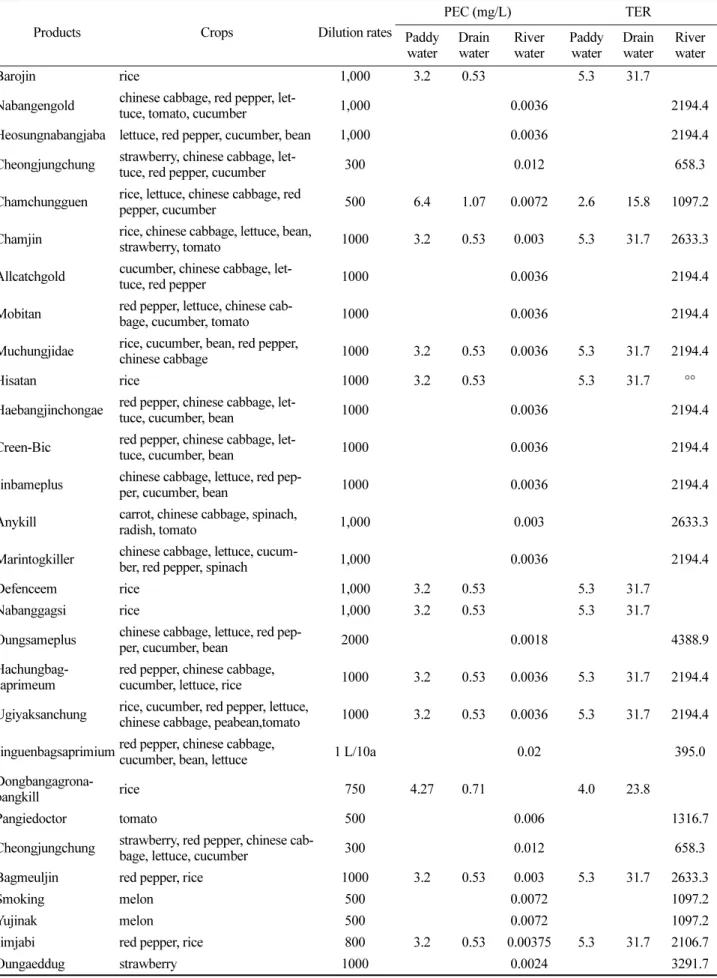
Table 4. PEC in surface water and TER for initial exposure when sophora extract products (continued)
Products Crops Dilution rates
PEC (mg/L) TER
Paddy water
Drain water
River water
Paddy water
Drain water
River water
Barojin rice 1,000 3.2 0.53 5.3 31.7
Nabangengold chinese cabbage, red pepper, let-
tuce, tomato, cucumber 1,000 0.0036 2194.4
Heosungnabangjaba lettuce, red pepper, cucumber, bean 1,000 0.0036 2194.4 Cheongjungchung strawberry, chinese cabbage, let-
tuce, red pepper, cucumber 300 0.012 658.3
Chamchungguen rice, lettuce, chinese cabbage, red
pepper, cucumber 500 6.4 1.07 0.0072 2.6 15.8 1097.2
Chamjin rice, chinese cabbage, lettuce, bean,
strawberry, tomato 1000 3.2 0.53 0.003 5.3 31.7 2633.3 Allcatchgold cucumber, chinese cabbage, let-
tuce, red pepper 1000 0.0036 2194.4
Mobitan red pepper, lettuce, chinese cab-
bage, cucumber, tomato 1000 0.0036 2194.4
Muchungjidae rice, cucumber, bean, red pepper,
chinese cabbage 1000 3.2 0.53 0.0036 5.3 31.7 2194.4
Hisatan rice 1000 3.2 0.53 5.3 31.7 °°
Haebangjinchongae red pepper, chinese cabbage, let-
tuce, cucumber, bean 1000 0.0036 2194.4
Creen-Bic red pepper, chinese cabbage, let-
tuce, cucumber, bean 1000 0.0036 2194.4
Jinbameplus chinese cabbage, lettuce, red pep-
per, cucumber, bean 1000 0.0036 2194.4
Anykill carrot, chinese cabbage, spinach,
radish, tomato 1,000 0.003 2633.3
Marintogkiller chinese cabbage, lettuce, cucum-
ber, red pepper, spinach 1,000 0.0036 2194.4
Defenceem rice 1,000 3.2 0.53 5.3 31.7
Nabanggagsi rice 1,000 3.2 0.53 5.3 31.7
Oungsameplus chinese cabbage, lettuce, red pep-
per, cucumber, bean 2000 0.0018 4388.9
Hachungbag- saprimeum
red pepper, chinese cabbage,
cucumber, lettuce, rice 1000 3.2 0.53 0.0036 5.3 31.7 2194.4 Ugiyaksanchung rice, cucumber, red pepper, lettuce,
chinese cabbage, peabean,tomato 1000 3.2 0.53 0.0036 5.3 31.7 2194.4 Jinguenbagsaprimiumred pepper, chinese cabbage,
cucumber, bean, lettuce 1 L/10a 0.02 395.0
Dongbangagrona-
bangkill rice 750 4.27 0.71 4.0 23.8
Pangiedoctor tomato 500 0.006 1316.7
Cheongjungchung strawberry, red pepper, chinese cab-
bage, lettuce, cucumber 300 0.012 658.3
Bagmeuljin red pepper, rice 1000 3.2 0.53 0.003 5.3 31.7 2633.3
Smoking melon 500 0.0072 1097.2
Yujinak melon 500 0.0072 1097.2
Jimjabi red pepper, rice 800 3.2 0.53 0.00375 5.3 31.7 2106.7
Oungaeddug strawberry 1000 0.0024 3291.7
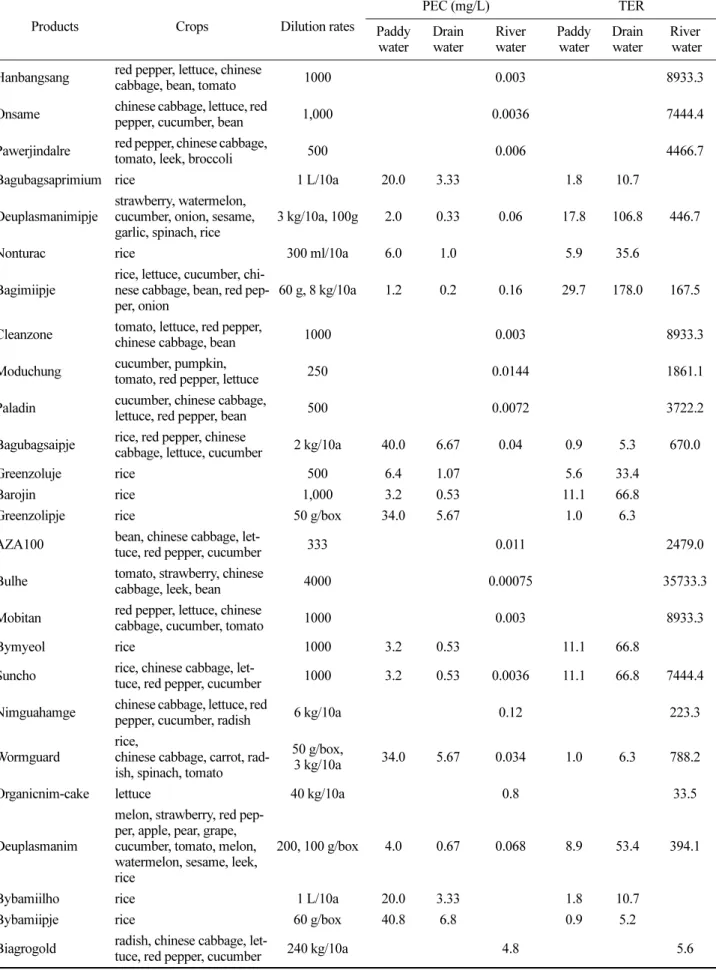
Table 5. PEC in surface water and TER for initial exposure when neem extract products sprayed
Products Crops Dilution rates
PEC (mg/L) TER
Paddy water
Drain water
River water
Paddy water
Drain water
River water Hanbangsang red pepper, lettuce, chinese
cabbage, bean, tomato 1000 0.003 8933.3
Onsame chinese cabbage, lettuce, red
pepper, cucumber, bean 1,000 0.0036 7444.4
Pawerjindalre red pepper, chinese cabbage,
tomato, leek, broccoli 500 0.006 4466.7
Bagubagsaprimium rice 1 L/10a 20.0 3.33 1.8 10.7
Deuplasmanimipje
strawberry, watermelon, cucumber, onion, sesame, garlic, spinach, rice
3 kg/10a, 100g 2.0 0.33 0.06 17.8 106.8 446.7
Nonturac rice 300 ml/10a 6.0 1.0 5.9 35.6
Bagimiipje
rice, lettuce, cucumber, chi- nese cabbage, bean, red pep- per, onion
60 g, 8 kg/10a 1.2 0.2 0.16 29.7 178.0 167.5
Cleanzone tomato, lettuce, red pepper,
chinese cabbage, bean 1000 0.003 8933.3
Moduchung cucumber, pumpkin,
tomato, red pepper, lettuce 250 0.0144 1861.1
Paladin cucumber, chinese cabbage,
lettuce, red pepper, bean 500 0.0072 3722.2
Bagubagsaipje rice, red pepper, chinese
cabbage, lettuce, cucumber 2 kg/10a 40.0 6.67 0.04 0.9 5.3 670.0
Greenzoluje rice 500 6.4 1.07 5.6 33.4
Barojin rice 1,000 3.2 0.53 11.1 66.8
Greenzolipje rice 50 g/box 34.0 5.67 1.0 6.3
AZA100 bean, chinese cabbage, let-
tuce, red pepper, cucumber 333 0.011 2479.0
Bulhe tomato, strawberry, chinese
cabbage, leek, bean 4000 0.00075 35733.3
Mobitan red pepper, lettuce, chinese
cabbage, cucumber, tomato 1000 0.003 8933.3
Bymyeol rice 1000 3.2 0.53 11.1 66.8
Suncho rice, chinese cabbage, let-
tuce, red pepper, cucumber 1000 3.2 0.53 0.0036 11.1 66.8 7444.4 Nimguahamge chinese cabbage, lettuce, red
pepper, cucumber, radish 6 kg/10a 0.12 223.3
Wormguard
rice,
chinese cabbage, carrot, rad- ish, spinach, tomato
50 g/box,
3 kg/10a 34.0 5.67 0.034 1.0 6.3 788.2
Organicnim-cake lettuce 40 kg/10a 0.8 33.5
Deuplasmanim
melon, strawberry, red pep- per, apple, pear, grape, cucumber, tomato, melon, watermelon, sesame, leek, rice
200, 100 g/box 4.0 0.67 0.068 8.9 53.4 394.1
Bybamiilho rice 1 L/10a 20.0 3.33 1.8 10.7
Bybamiipje rice 60 g/box 40.8 6.8 0.9 5.2
Biagrogold radish, chinese cabbage, let-
tuce, red pepper, cucumber 240 kg/10a 4.8 5.6
님추출물은 35.6, 30.0, 데리스추출물은 73.9, < 40 mg/L로 독성이 낮은 수준이었다.
잉어와 미꾸리 어종간 독성차이는 잉어는 미꾸리 보다 1.1배에서 2.3배로 독성이 높았다.
식물추출물의 환경 중 추정농도와 위해성
48종의 고삼추출물 자재를 대상으로 작물별 살포물량과 희석배수에 따른 논물, 배수로물과 강물 중 추정농도를 계산 한 결과 Table 4에서와 같이 논물에서의 추정농도는 68.0~
3.0 mg/L이었고, 배수로물의 추정농도는 11.33~0.50 mg/L이 었고, 강물에서의 추정농도는 3.0~0.0018 mg/L이었다.
환경 중 추정농도는 측정하지 않은 단순계산에 의한 농도 로서 식물추출물로 만든 자재를 희석하여 논에 살포했을 때 대부분은 논물에 희석되어 남아 있겠지만 일부는 벼에 묻고 일부는 논바닥에 가라앉거나 지하로 이동하기 때문에 실제 논물에 잔류하는 자재의 농도는 낮다고 할 수 있다. 또한 살 포한 자재가 논물에 희석되면서 가수분해나 미생물분해, 광 분해 등으로 분해되기 때문에 환경 중 추정농도는 실제 측 정한 농도보다 훨씬 높은 농도라고 판단할 수 있다. 특히 육 묘상에 처리할 경우에는 모판 상자에 직접 뿌리고 난후 벼 를 모내기하면 뿌리에 흡수되거나 이앙할 때 토양에 묻히게 되면 실제 논물에 용출되는 양은 매우 적다. 이러한 이유로 농약 평가에서 육묘상에 처리하는 경우에는 독성노출비 평 가를 생략한다.
독성노출비를 계산하기 위한 독성값은 48시간 반수치사 농도를 사용하였고, 논물과 배수로물의 경우는 미꾸리의 독 성성적을 사용하고 강물은 잉어의 독성성적을 사용하였다.
Table 4에서와 같이 고삼추출물 사용에 따른 논물에서 미꾸 리를 대상으로 했을 때 독성노출비는 0.2~5.6이었다. 논에 사용하는 24자재 중 독성노출비가 2이하가 1종이었다. 육묘 할 때 사용한 자재를 제외하고 가장 독성노출비가 낮은 자 재의 독성노출비는 2.6이었는데, 이때 독성값을 반수치사농 도 대신에 무영향농도인 10 mg/L을 논물추정농도 6.4 mg/L 와 비교해보면 논에서 미꾸리에 대한 영향은 매우 낮다고 판단된다. 배수로물과 강물에서의 독성노출비는 각각 1.5~
33.8, 2.6~4388.9로 잉어나 미꾸리에 미치는 영향은 낮을 것 으로 판단된다.
37종의 병해충관리용 님추출물 제품 사용에 따른 논물, 배수로물 및 강물 중 추정농도는 각각 90.9~1.2, 15.2~0.2, 4.8~0.00075 mg/L이었다(Table 5). 논에 사용하는 님추출물 17종의 미꾸리에 대한 독성노출비는 0.4~29.7이었고, 독성 노출비가 10보다 작은 경우는 11종이었다. 육묘상을 제외한 자재 중 독성노출비가 2이하인 자재가 4종이었는데 이들의 독성노출비가 높은 이유는 사용량이 많았기 때문이다. 배수로 물과 강물에서의 독성노출비는 각각 2.3~178.0, 4.5~35733.3 으로 잉어나 미꾸리에 영향이 없을 것으로 판단되었다.
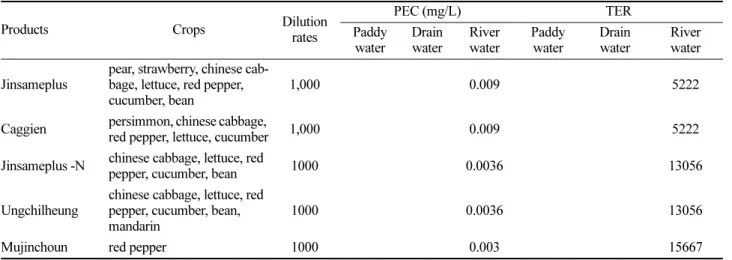
데리스추출물 5종은 모두 밭이나 과수원에서 사용하므로 논이나 배수로에 노출되는 양이 매우 적기 때문에 미꾸리에 Table 5. PEC in surface water and TER for initial exposure when neem extract products sprayed (continued)
Products Crops Dilution rates
PEC (mg/L) TER
Paddy water
Drain water
River water
Paddy water
Drain water
River water gibiro radish, chinese cabbage, let-
tuce, red pepper, cucumber 240 kg/10a 4.8 5.6
Jibiwon rice 1,000 3.2 0.53 11.1 66.8
Chungidoctor maize 500 0.006 4466.7
Pachungtan apple 500 0.018 1488.9
Mupan mulbagu-
mikiller rice 4 kg/10a 80.0 13.3 0.4 2.7
Econurian
chinese cabbage, lettuce, cucumber, tomato, red pep- per
10 kg/10a 0.2 134.0
Sangmangiehug broccoli, chinese cabbage,
leek, tomato, red pepper 300 kg/10a 6.0 4.5
Nimagro chinese cabbage, red pepper,
lettuce, cucumber, bean 120 kg/10a 2.4 11.2
Bestgibi chinese cabbage, red pepper,
lettuce, cucumber, bean 120 kg/11a 2.4 11.2
Lonmil cucumber, lettuce, chinese
cabbage, red pepper, bean 150 kg/10a 3.0 8.9
Cheonggung cucumber, tomato, lettuce, rice
3 kg/660 m2,
60 g/seedbed 90.9 15.2 0.09 0.4 2.3 294.8
대한 위해성 평가는 생략하고 강물에서 잉어에 대한 위해평 가만 수행하였다. 강물 중 추정농도는 0.009~0.003 mg/L이 었고, 독성노출비는 5222~15667로서 위해성이 매우 낮았다 (Table 6).
감사의 글
본 연구는 국립농업과학원 기관고유 연구사업 ‘식물추출 해충관리용 친환경유기농자재의 환경생물 영향평가(과제번 호: PJ009501)에 의해 수행되었으며, 이에 감사드립니다
Literature Cited
Chen, F. and K. Huang (2011) Effects of the Chinese medicine matrine on experimental C. parvum infection in BALB/c mice and MDBK cells. Parasitology research 111(4):1827- 1832.
Kang, W. T. (2012) A study on the Insecticidal Effect and Biological Safety of Plant Extracts. Kyungnam University.
Kim, S. K., J. H. Jin, C. K. Lim, J. H. Hur and S. Cho (2009)
Evaluation of insecticidal efficacy of plant extracts against major insect pests. Journal of the Korean Society of Pesticide Science 13:165-170.
Mordue, A. J., M. S. L. Simmonds, S. V. Ley, W. M. Blaney, W. Mordue, M. Nasiruddin and A. J. Nisbet (1998) Actions of azadirachtin, a plant allelochemical, against insects.
Journal of Pesticide Science 54:277-284.
Rich, R. P. (1996) Quinone binding sites of membrane proteins as targets for inhibitors, Journal of Pesticide Science 47:
287-296.
Rural Development Administration (2012).
Yu, H. B., H. F. Zhang, D. Y. Li, X. Zhang, H. Z. Xue and S. H.
Zhao (2011) Matrine inhibits matrix metalloproteinase-9 expression and invasion of human hepatocellular carcinoma cells. Journal of Asian Natural Products Research 13(3):
242-250.
2015 농약관리법령 및 고시훈령집(발간등록번호11-1390000- 002807-01). 환경생물 독성 시험기준과 방법. pp. 387-390.
농촌진흥청. 대한민국.
2015 유기농업자재 공시 및 품질인증 기준(농촌진흥청 고시 제 2015-11 호.
별표 1 유기농업자재 공시 및 품질인증 기준 중 마. 독성에 대 한 시험성적서.
Table 6. PEC in surface water and TER for initial exposure when derris extract products
Products Crops Dilution
rates
PEC (mg/L) TER
Paddy water
Drain water
River water
Paddy water
Drain water
River water Jinsameplus
pear, strawberry, chinese cab- bage, lettuce, red pepper, cucumber, bean
1,000 0.009 5222
Caggien persimmon, chinese cabbage,
red pepper, lettuce, cucumber 1,000 0.009 5222
Jinsameplus -N chinese cabbage, lettuce, red
pepper, cucumber, bean 1000 0.0036 13056
Ungchilheung
chinese cabbage, lettuce, red pepper, cucumber, bean, mandarin
1000 0.0036 13056
Mujinchoun red pepper 1000 0.003 15667
⊙ ··· ⊙
유기농업자재 고삼, 님 및 데리스 추출물의 어류에 대한 독성과 위해성 평가
박경훈*·오진아·백민경·손미연·임정택·진정화·홍순성·조남준·한상균1·김병석1
국립농업과학원 농산물안전성부, 1농촌진흥청 연구정책국
요 약 최근 유기농업자재의 주요 원재료인 고삼, 님, 데리스 등의 식물추출물은 중국, 미얀마, 인도 등 외국에서 수입하여 해충방제용으로 많이 사용하고 있는데, 본 논문은 이들 세가지 식물추출물에 대한 독성과 위해성을 평가하 여 유기농업자재의 관리와 환경생물보호에 활용하고자 하였다. 잉어 48시간 반수치사농도와 무영향농도는 고삼추출 물은 7.9, 6.2 mg/L, 님추출물은 26.8, 21.8 mg/L, 데리스추출물은 47.0, < 24.0 mg/L으로 독성이 낮았다. 미꾸리 48시 간 반수치사농도와 무영향농도는 고삼추출물은 16.9, 10.0 mg/L, 님추출물은 35.6, 30.0 mg/L, 데리스추출물은 73.9,
< 40 mg/L로 독성이 낮은 수준이었다. 고삼추출물 자재의 논, 배수로 및 강에서의 물중 추정농도는 각각 68.0~3.0, 11.33~0.50 3.0~0.0018 mg/L이었고, 독성노출비는 논, 배수로 및 강물에서 각각 0.2~5.6, 1.5~33.8, 2.6~4388.9이었다.
논이나 배수로에서의 미꾸리에 대한 위해성과 강에서의 잉어에 대한 위해성은 낮은 것으로 평가되었다. 님추출물의 논물, 배수로물 및 강물 중 추정농도는 각각 90.9~1.2, 15.2~0.2, 4.8~0.00075 mg/L이었고 독성노출비는 각각 0.4~29.7, 2.3~178.0, 4.5~35733.3이었다. 논에 사용하는 님추출물 중 독성노출비로 평가하였을 때 미꾸리에 위해가 능성이 있는 자재가 있었으나 사용량이 많은 것이 원인으로 추가적인 연구가 필요하였고, 배수로나 하천에서는 어류 에 대한 위해성이 낮았다. 데리스추출물 5종의 경우 독성노출비가 5222~15667로서 위해성이 매우 낮았다.
색인어 고삼추출물, 님추출물, 데리스추출물, 잉어, 미꾸리, 반수치사농도, 무영향농도, 환경 중 추정농도, 독성노출
⊙ ··· ⊙