http://dx.doi.org/10.7585/kjps.2014.18.1.8 Open Access
8
어류급성독성시험 대체법으로서 잉어표피세포를 이용한 Neutral Red Uptake 분석법 적용
서지현·박준우·이성규·김우근*
안전성평가연구소 경남환경독성본부 미래환경연구센터
Application of Neutral Red Uptake Assay Using EPC Cells as an Alternative to the Fish Acute Toxicity Test for Pesticide
Ji-Hyun Seo, June-Woo Park, Sung-Kyu Lee and Woo-Keun Kim*
Future Environmental Research Center, Gyeongnam Department of Environmental Toxicology and Chemistry, Korea Institute of Toxicology, 17, Jegok-gil, Munsan-eup, Jinju-si, Gyeongsangnam-do, 660-844, Republic of Korea
(Received on November 7, 2013. Revised on November 20, 2013. Accepted on January 16, 2014)
Abstract This study evaluated in vitro cytotoxicity of 5 pesticides, including 2 herbicides, 2 germicides, and an insecticide, as an alternative to the fish acute toxicity test. The in vitro cytotoxicity was tested using a neutral red uptake (NRU) assay with epithelioma papulosum cyprini (EPC) cells that originated from the epidermal tissue of Cyprinus carpio (common carp). An in vivo fish acute toxicity test was conducted according to OECD Test Guideline No. 203 using Aphyocypris chinensis (Chinese bleak), Oryzias latipes (Japanese medaka), and C. carpio. The results showed that the sensitivity of the cell viability assay for the pesticides was similar to the fish acute test in ranking order despite having approximately 10 times less absolute sensitivity. The r2 correlation values were calculated as 0.38 (p = 0.26), 0.76 (p = 0.05) and 0.90 (p = 0.01) for A. chinensis, O. latipes, and C. carpio, respectively. These results suggested that the potential of EPC cell viability assay as an alternative to the fish acute toxicity test due to their good correlation and NRU assay is expected to serve as a useful tool for predicting acute fish lethality for pesticides if further studies with a large set of pesticides are conducted
Key words cytotoxicity, EPC cells, fish acute test, NRU assay, pesticides
Introduction
As the use of pesticides has made a stable food supply and an alternative to labor shortages possible, they are regarded as the most economic and effective agricultural materials in modern agriculture development (Ramsmussen et al., 1998).
According to the Rural Development Administration (RDA) in South Korea, 24,000 tons of pesticides have been steadily consumed in South Korea since 2004. In addition, RDA also showed the number of pesticide had increased twice from
1152 in 2004 to 2265 in 2009 (RDA, 2013). In the near future, as demands for the development of more effective and safer pesticides continue, the number of pesticides in use is expected to grow.
At the same time, the fish acute toxicity test to obtain information about the toxic potential of these pesticides is globally required in the registration process of pesticides, including in Korea. However, under the new European chemicals policy, Registration, Evaluation and Authorisation of Chemicals (REACH), the fish acute toxicity test (as a vertebrate animal test with mortality) will be reduced or even replaced by alternative methods. Because conducting this test is costly and time-consuming and requires a considerable
*Corresponding author
Tel: +82-55-750-3832, Fax: +82-55-750-3849 E-mail: [email protected]
ORIGINAL ARTICLES / TOXICOLOGY
number of animals, it raises ethical issues and prompts the 3 Rs of animal use: reduction, replacement, and refinement (Kilkenny et al., 2010). Thus, the development of an alternative to the fish acute toxicity test is needed (Van Dartel et al., 2011; Lammer et al., 2009). In vitro assays based on mammalian and fish cells have been proposed to address these concerns (Lammer et al., 2009).
The neutral red uptake (NRU) assay, based on the ability of viable cells to incorporate and bind neutral red dye, is widely used as a cell survival/viability assay (Lee et al., 2008). There are several advantages to the NRU assay in comparison with other assays such as the 3-(4,5-dimethylthiazol-2-yl)-2,5 diphenyl tetrazolium bromide (MTT) assay, which requires unstable reagents (Repetto et al., 2008). In addition, the NRU assay is at least two times cheaper and simpler because it detects only viable cells, and it is even possible to assay the total protein content using the same culture (Repetto et al., 2008). To date, few studies have attempted to replace the fish acute toxicity test with an NRU assay, but a validation study for the NRU assay was implemented in South Korea as an in vitro alternative to the Draize test to test eye irritation by chemicals (Lee et al., 2008).
Therefore, this study was conducted to evaluate the sensitivity of the correlation between the NRU assay and fish acute toxicity tests. To accomplish this, the NRU assay used an EPC cell line that is commonly used and has a high sensitivity. A total of 3 kinds of fish, Aphyocypris chinensis (A. chinensis), Oryzias latipes (O. latipes), and Cyprinus carpio (C. carpio), were tested with 5 pesticides.
Materials and Methods
Chemicals
The 5 pesticides (an herbicide, germicide A, germicide B, insecticide A, and insecticide B) used in this study were purchased from pesticide companies. These pesticides are chosen randomly among relatively recently developed pesticides which are expected to be used more gradually. The active ingredients for each pesticide were shown in Table 1.
Neutral red was purchased from Sigma (St. Louis, MO, USA), and the cell culture media and all of the supplements were purchased from Gibco (Paisley, Scotland, UK). Trypsin powder was purchased from Amresco (Solon, Ohio, USA).
Cell culture
Epithelioma papulosum cyprini (EPC) cells from carp (C.
carpio) epithelium, which is an established monolayer-type cultured fish cell line, were used. The EPC cells were distributed by Chonnam National University (Department of Aqualife Medicine). The cells were maintained at 20oC in Dulbecco’s Modified Eagle’s Medium (DMEM) with 10%
fetal bovine serum (FBS) and 1% penicillin-streptomycin.
When needed, the cells were trypsinized with a solution containing 8 g of NaCl, 0.2 g of KH2PO4, 0.2 g of KCl, 1.15 g of NaHPO4, 0.2 g of EDTA, and 1.2 g of trypsin powder in 1 L of deionzed, distilled water.
Neutral red uptake assay
We seeded 1× 10⁶ cells in 100 uL of DMEM in 96-well tissue culture microtiter plates. After incubating for 24 hrs, the medium was removed, and the cells were treated with varied concentrations (0.1, 1, 10, 100 mg/L) of the test chemicals, including a control. After another 24 hrs of incubation, the medium was removed and replaced with 200 uL of DMEM and 3 uL of neutral red dye and incubated for 2 hrs. The cells were washed once with PBS, and then 100 uL of 1% acetic acid in 50% ethanol was added to the wells.
The plate was incubated for 10 min at 20oC, and then the absorbance was read at 540 and 690 nm. The viability percentage (%) was calculated as follows:
× 100
Fish
The A. chinensis, O. latipes, and C. carpio used in this study were obtained from the Korea Institute of Toxicology (Daejeon, Korea). The fish were maintained in dechlorinated tap water at 22± 1oC with a photoperiod of 16:8 hrs (light:dark). All of the fish were fed twice a day with flake food (TetraMin, Tetra Corp., Melle, Germany) for A. chinensis and O. latipes and top meal (Tabia Corp., Korea) for C. carpio.
Fish acute toxicity test
The fish acute toxicity tests were conducted according to the OECD Test Guideline No. 203 (OECD, 1992). Briefly, fish which were corresponded with length suggested in OECD test guideline for O. latipes and C. carpio and 5~6 cm for A. chinensis were selected for the test. The tests lasted for 96 hrs in static systems without medium changes. Each
% Viability =
(Absorbance540nm test material) – (Absorbance690nm test material) (Absorbance540nm control) – (Absorbance690nm control)
test unit contained 7 fish, both male and female, in 5 liters of test media, and the test was performed with no replicates.
Statistics and data analysis
All of the statistical analyses were conducted using the Statistical Package for the Social Sciences (SPSS) 20 (IBM, United States), and all of the data were plotted using Sigma Plot 10.0 (Systat Software Inc., Germany). Probit analysis was used for calculation the IC50 and LC50 values.
Results and Discussion
The apparent difference in the loss of the cell monolayer integrity and changes in the cell shape could be observed for all of the pesticides. Figs. 1B, C, and D show the changes in cell density, breaks in the cell monolayer (arrows), and alterations in cell shape and cell detachment, respectively, while no morphological changes were observed in control cells in Fig. 1A. Cell growth, division, death and changes in cell shape are important for tissue morphogenesis during development. Cell shape is controlled by the regulation of intra-cellular mechanisms and the cell’s physical interaction with its environment. Cell shape changes generate disturbances
in cell migration and contribute to heterologies of tissue morphogenesis such as ventral furrow formation, dorsal closure, and convergent extension at the development level (Paluch and Heigenberg, 2009). In the present study, the 5 pesticides all showed changes in cell shape and density similar to Fig. 1. The light microscopy appearance of germicide B is shown as a representative.
The in vitro IC50 values for the different pesticides with the EPC cells were rank ordered from the most toxic to the least toxic as follows: Insecticide B (0.10 mg/L) > Germicide B (0.58 mg/L) > Herbicide (1.25 mg/L) > Insecticide A (7.27 mg/L) > Germicide A (42.4 mg/L). The in vivo LC50 values for the 3 species of fish had a similar rank order as the IC50 values in A. chinensis and O. latipes: Insecticide B (0.01 and 0.09 mg/L, respectively) > Germicide B (0.07 and 0.13 mg/
L, respectively) > Insecticide A (0.16 and 1.05 mg/L, respec- tively) > Herbicide (3.54 and 1.27 mg/L, respectively) >
Germicide A (3.81 and 2.43 mg/L, respectively). In C. carpio was shown as Germicide B (0.08 mg/L) > Insecticide B (0.12 mg/L) > insecticide A (0.11 mg/L) > Herbicide (0.8. mg/L) >
Germicide A (3.07 mg/L). Although there were some differences in order, more than 2 steps were not exceeded.
Previous study demonstrated cell line tests could be used as
Fig. 1. Representative light microscopy appearance of EPC cells following 24 hrs of exposure to pesticides. (A) Control cells maintained in DMEM displaying an intact, fully confluent monolayer. (B) Cells exposed to 0.1 mg/L germicide B showing a discernible change in the density of the monolayer. (C) Cells exposed to 1 mg/L germicide B displaying a clear loss of cell monolayer integrity. (D) Cells exposed to 10 mg/L germicide B illustrating clear changes in cell shape and density. Magnification: 100 X.
Arrows indicate the loss of cell monolayer integrity.
screening tools because of their different sensitivities (Ni Shuilleabhain et al., 2004). We also show the potential of EPC cell line as a screening tool in comparison ranking.
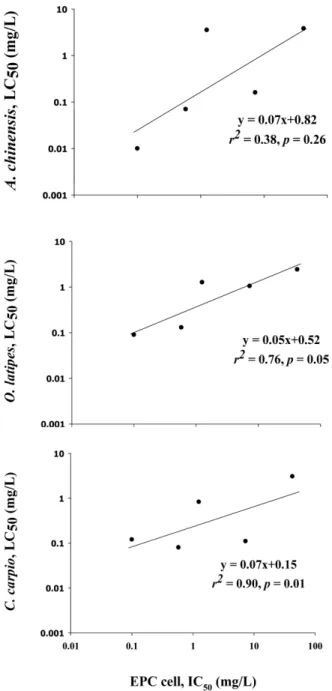
Linear correlations between the in vitro IC50 values and each in vivo LC50 value were also determined. The results revealed that a linear correlation between the in vitro IC50 for the EPC cells and the in vivo LC50 for C. carpio were the most highly significant (p = 0.01 with r2= 0.90) followed by O. latipes (p = 0.05 with r2= 0.76). For A. chinensis, no linear correlation was observed (p = 0.26 with r2= 0.38) (Fig. 2). The respective IC50 values for the EPC cells and the LC50 values for A. chinensis, O. latipes, and C. carpio are shown in Table 1. The results showed that the IC50 values were closely correlated with the whole fish LC50 values and those highly significant linear correlations between the in vitro and in vivo values were found for C. carpio and O.
latipes. However, A. chinensis had no correlation for the pesticides comparing the in vitro cytotoxicity to the in vivo lethality and showed approximately 10 times less sensitivity.
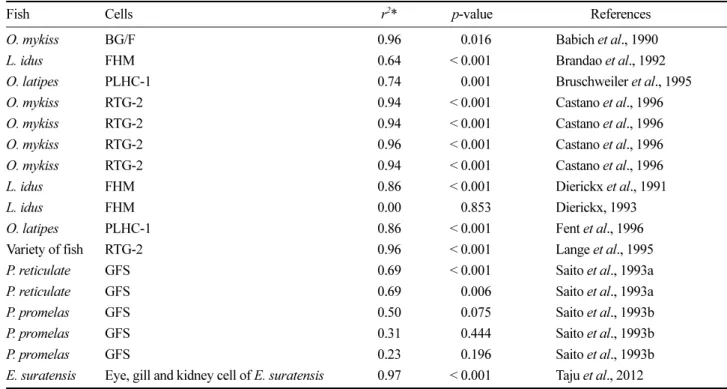
Table 2 shows the correlations between the LC50 values from fish acute toxicity testing and the E/IC50 ratios from cell viability testing in previous studies. Such results demonstra- ting that the sensitivity to lethal effects in fish may appear differently depending on the type of fish support the lack of a correlation for A. chinensis in the present study. In addition, Castano et al. (2003) and Segner (2004) have also pointed out that the sensitivity of cells toward individual chemicals appears to be less than that of whole fish, and therefore, the lower sensitivity of the cell culture assay is a major stumbling block to be overcome in the regulatory testing of chemicals. Nonetheless, because the ranking order of cell viability for the 5 pesticides was similar to whole fish and the correlations between the in vitro and in vivo test results for C. carpio and O. latipes were significant, ranking Fig. 2. Relationships between IC50 values for EPC cells and
LC50 values for A. chinensis, O. latipes, and C. carpio.
Table 1. Comparison between in vitro (IC50) and in vivo (LC50) toxicity IC50 mg/L (95% C.I.1)
LC50 mg/L (95% C.I.)
Pesticides Active ingredient of pesticide EPC A. chinensis O. latipes C. carpio Herbicide Oxadiargyl EC 1.25 (0.57-2.14) 3.54 (2.11-5.92) 1.27 (1.06-1.61) 0.83 (0.71-0.95) Germicide A Tebuconazole + Prochloraz EC 42.4 (25.8-55.2) 3.81 (3.45-4.26) 2.43 (2.02-3.01) 3.07 (2.80-3.37) Germicide B Cyazofamid + Chlorotharonil SC 0.58 (0.09-2.57) 0.07 (0.07-0.08) 0.13 (0.10-0.16) 0.08 (0.06-0.09) Insecticide A Imidacloprid + Bifienthrin WP 7.27 (4.16-8.74) 0.16 (0.15-0.18) 1.05 (0.89-1.26) 0.11 (0.08-0.13) Insecticide B Fenbutatin oxide EC 0.10 (0.09-0.23) 0.01 (0.01-0.09) 0.09 (0.01-0.01) 0.12 (0.01-0.01) Coefficient of determination(r2) and p-value between IC50 and LC50 value r2= 0.38, p = 0.26 r2= 0.76, p = 0.05 r2= 0.90, p = 0.01
195% Confidence Interval
pesticides in order of toxic status on cell viability assay could be suggested as a screening tool and alternative to the fish acute toxicity test.
In conclusion, the NRU assay using EPC cell was well correlated with acute toxicity of C. carpio and O. latipes.
Therefore, it will serve a potential tool as an alternative to the fish acute toxicity test. However, further studies with a larger set of pesticides are needed to strengthen the reliability of the assays and to validate the correlation with in vivo data.
Acknowledgment
This research was funded by the Korea Institute of Toxicology.
Literature Cited
Babich, H., S. H. Goldstein and E. Borenfreund (1990) In vitro cyto- and genotoxicty of organomercurials to cells in culture. Toxicology Letters. 50:143-149.
Brandao, J. C., H. H. L. Bohets, I. E. van de Vyver and P. J.
Dierickx (1992) Correlation between the in vitro cytotoxicity to cultured fathead minnow fish cells and fish lethality data for 50 chemicals. Chemosphere. 25:553-562.
Bruschweiler, B. J., F. E. Wurgler and K. Fent (1995) Cytotoxicity in vitro of organotin compounds in fish
hepatoma cells PLHC-1 (Poeciliopsis lucida). Aquatic Toxicology. 32:143-160.
Castano, A., M. J. Cantarino, P. Castillo and J. V. Tarazona (1996) Correlations between the RTG-2 cytotoxicity test EC50andin vivo LC50 rainbow trout bioassay. Chemosphere.
32:2141-2157.
Castano, A., N. Bols, T. Braunbeck, P. Dierickx, M. Halder, B.
Isomaa, K. Kawahara, L. E. J. Lee, C. Mothersill, P. Part, G.
Repetto, J. R. Sintes, H. Rufli, R. Smith, C. Wood and H.
Segner (2003) The use of fish cells in ecotoxicology. The report and recommendations of ECVAM workshop 47.
Alternatives to Laboratory Animals. 31:317-351.
Dierickx, P. J. and I. E. van de Vyver (1991) Correlation of the neutral red uptake inhibition assay of cultured fathead minnow fish cells with fish lethality tests. Bull.
Environmental Contamination and Toxicology. 46:649- 653.
Dierickx, P. J. (1993) Comparison between fish lethality data and the in vitro cytotoxicity of lipophilic solvents to cultured fish cells in a two-compartment model. Chemosphere.
27:1511-1518.
Fent, K. and J. Hunn (1996) Cytotoxicity of organic environmental chemicals to fish liver cells (PLHC-1).
Marine Environmental Research. 42:377-382.
Kilkenny, C., W. J. Browne, I. C. Cuthill, M. Emerson, D. G.
Altman (2010) Improving bioscience research reporting:
The ARRIVE Guidelines for reporting animal research.
British Journal of Pharmacology. 160(7):1577-1579.
Lammer, E., G. J. Carr, K. Wendler, J. M. Rawlings, S. E.
Table 2. Comparison of correlation determinants for fish acute test and cell viability data
Fish Cells r2* p-value References
O. mykiss BG/F 0.96 0.016 Babich et al., 1990
L. idus FHM 0.64 < 0.001 Brandao et al., 1992
O. latipes PLHC-1 0.74 0.001 Bruschweiler et al., 1995
O. mykiss RTG-2 0.94 < 0.001 Castano et al., 1996
O. mykiss RTG-2 0.94 < 0.001 Castano et al., 1996
O. mykiss RTG-2 0.96 < 0.001 Castano et al., 1996
O. mykiss RTG-2 0.94 < 0.001 Castano et al., 1996
L. idus FHM 0.86 < 0.001 Dierickx et al., 1991
L. idus FHM 0.00 0.853 Dierickx, 1993
O. latipes PLHC-1 0.86 < 0.001 Fent et al., 1996
Variety of fish RTG-2 0.96 < 0.001 Lange et al., 1995
P. reticulate GFS 0.69 < 0.001 Saito et al., 1993a
P. reticulate GFS 0.69 0.006 Saito et al., 1993a
P. promelas GFS 0.50 0.075 Saito et al., 1993b
P. promelas GFS 0.31 0.444 Saito et al., 1993b
P. promelas GFS 0.23 0.196 Saito et al., 1993b
E. suratensis Eye, gill and kidney cell of E. suratensis 0.97 < 0.001 Taju et al., 2012
*r2 was calculated using correlation analysis.
Belanger and Th. Braunbeck (2009) Is the fish embryo toxicity test (FET) with the zebrafish (Danio rerio) a potential alternative for the fish acute toxicity test?
Comparative Biochemistry and Physiology, Part C. 149:
196-209.
Lange, M., W. Gebauer, J. Markl and R. Nagel (1995) Comparison of testing acute toxicity on embryo of zebrafish, Brachydanio rerio and RTG-2 cytotoxicity as possible alternatives to the acute fish test. Chemosphere.
30:2087-2102.
Lee, H., K. Noh, S. Seok, M. Baek, H. Lee, D. Kim, Y. Na, S.
Park, B. Kim, G. Park, J. Lee and J. Park (2008) Establishment of the neutral red uptake assay as alternatives to the Draize test and its validation. Journal of Alternatives to Animal Experiments 2:5-9.
Ní Shúilleabháin, S., C. Mothersill, D. Sheehan, N. M. O’Brien, J. O’ Halloran, F. N. A. M. Van Pelt, M/ Davoren (2003) In vitro cytotoxicity testing of three zinc metal salts using established fish cell lines. Toxicology in Vitro. 18:365-376.
Organization of Economic Co-operation and Development (1992) Guideline for the testing of cheminals, Test No. 203;
Fish acute toxicity test, Paris, France.
Paluch, E. and C. Heisenberg (2009) Biology and physics of cell shape changes in development. Current Biology. 19:
790-799.
Rasmussen, P. E., K. W. T. Goulding, J. R. Brown, P. R. Grace, H. H. Janzen and M. Korschens (1998) Long-term agroecosystem experiments: Assessing agricultural sustai-
nability and global change. Science. 282:893-896.
Repetto, G., A. Del Peso and J. Zurita (2008) Neutral red uptake assay for the estimation of cell viability/cytotoxicity. Nature Protocols. 3:1125-1131.
Rural Development Administration (2013) 13-1-1. Freshwater fish acute toxicity test. Public notice no. 2013-21, standards of registration for agricultural chemicals and pesticides.
Rural Development Administration, Korea.
Saito, H., T. Koyasu and T. Shigeoka (1993a) Cytotoxicity of anilines and aldehydes to goldfish GFS cells and relationships with 1-octanol/water partition coefficients. Chemosphere.
27:1553-1560.
Saito, H., J. Koyasu, K. Yoshida, T. Shigeoka and S. Koike (1993b) Cytotoxicity of 109 chemicals to goldfish GSF cells and relationships with 1-octanol/water partition coefficients. Chemosphere. 26:1015-1028.
Segner, H. (2004) Cytotoxicity assays with fish cells as an alternative to the acute lethality test with fish. Alternatives to Laboratory Animals. 32:375-382.
Taju, G., S. Maheed, K. Nambi, V. Babu, S. Vimal, S.
Kamatchiammal and A. Sahul (2012) Comparison of in vitro and in vivo acute toxicity assays in Etroplus suratensis (Bloch, 1790) and its three cell lines in relation to tannery effluent. Chemosphere. 87:55-61.
Van Dartel, D. A. M. and A. H. Piersma (2011) The embryonic stem cell test combined with toxicogenomics as an alternative testing model for the assessment of developmental toxicity. Reproductive Toxicology 32:235-244.
⊙ ··· ⊙
어류급성독성시험 대체법으로서 잉어표피세포를 이용한 Neutral Red Uptake 분석법 적용
서지현·박준우·이성규·김우근*
안전성평가연구소 경남환경독성본부 미래환경연구센터
요 약 본 연구는 5가지 제품농약을 이용하여 어류 급성독성시험 결과 (반수치사농도)와 잉어의 표피에서 유래된 EPC 세포를 이용한 neutral red uptake 결과 (반수저해농도)를 비교함으로써 동물 실험의 대체 가능성을 평가하기 위 하여 수행되었다. 어류 급성 독성시험은 왜몰개 (Aphyocypris chinensis)를 포함하여 OECD와 농촌진흥청의 농약에 대한 독성시험기준에서 추천하는 어종인 송사리 (Oryzias latipes)와 잉어 (Cyprinus carpio)를 이용하여 수행하였다.
5가지 제품 농약에 대한 민감도는 어류에 비하여 세포에서 약 10배 더 낮게 확인되었지만, 독성을 서열화 하였을 때 나타나는 순서는 두 가지 방식에서 모두 비슷하게 나타났다. 5가지 제품 농약에 대한 세포와 어류 독성값의 상관성 을 분석한 결과는 A. chinensis, O. latipes와 C. carpio에서 각각 r2= 0.38 (p = 0.26), r2= 0.76 (p = 0.05), r2= 0.90 (p = 0.01)을 나타내었다. 본 시험의 결과, EPC 세포를 이용한 NRU 시험은 O. latipes와 C. carpio에 대한 어류 독성 시험 결과와 상관성이 높으므로 향후 더 많은 약제시험을 통해 어류 급성독성시험의 대체시험법으로서의 가능성이 기대된다.
색인어 세포독성시험, 어류급성독성시험, EPC 세포, NRU 분석, 제품 농약
⊙ ··· ⊙