Vol. 14, No. 3, pp. 103-108, September 2009
백내장과 대사증후군의 관련성
- 2005, 2007년 국민건강영양조사 이용
박상신*
,
**·이은희****서울대학교 보건대학원 역학교실, **동국대학교 일산병원 비만대사 영양센터, ***극동대학교 안경광학과 투고일(2009년 7월 27일), 수정일(2009년 8월 26일), 게재확정일(2009년 9월 8일)
···
목적: 백내장에 대사증후군 및 그 구성요소가 어떠한 영향을 미치는지 알아보고자 본 연구를 수행하였다. 방법:
2005, 2007년의 국민건강영양조사 자료를 이용하여 대사증후군 및 구성요소와 백내장과의 관계를 분석하였다. 이를 위해 본 연구에서는, 60세 이상의 성인 2,120 명을 대상으로 대사증후군 이상인자의 수(≤1, 2, 3, ≥4) 에 따른 백 내장 발생의 위험도(Odds ratio: OR)를 살펴보고, 대사증후군 관련치료제가 백내장에 미치는 영향 또한 다중 로지 스틱 회귀분석으로 분석하였다. 결과: 대사증후군의 구성요소를 하나도 가지지 않은 대상자를 기준으로 하고, 성, 연 령, 생활습관변수 및 사회경제적 변수를 보정했을 때 보유하고 있는 대사증후군의 구성요소가 늘어날수록 백내장의 위험도는 더욱 커지는 경향을 보였다(p for trend < 0.0001). 또한, 대사증후군 요소 중 혈압(OR(95% Confidence Interval): 1.32(1.05,1.65))과 공복혈당(1.35(1.09,1.67))에 이상이 있는 경우는 성과 연령을 보정한 후에도 백내장의 위험을 유의하게 증가시키는 것으로 나타났다. 그 중 공복혈당장애의 경우는 앞서 보정한 변수에 사회경제적 변수 를 함께 보정하여도 백내장 발생에 유의미한 위험도(1.35(1.09,1.67))를 나타내었다. 대사증후군이 있는 경우에도 동 일한 보정 후에 백내장에 대한 유의한 위험도(1.26(1.01,1.58))를 보였다. 마지막으로 높은 혈압이 있는 대상자들을 대상으로 시행된 분석에서, 고혈압 치료제의 경우 백내장의 위험도(1.49(1.14,1.96))를 증가시키는 것으로 나타났다.
결론: 대사증후군 및 그 구성요소는 백내장 발생의 위험을 높이는 것으로 확인되었고, 고혈압 치료제의 경우도 백 내장의 위험도를 높이는 것으로 추정된다.
주제어: 백내장, 대사증후군, 혈압, 혈당, 비만
···
서 론
만성질환이 증가하는 것은 한국에서 뿐만 아니라 세계 적인 추세이며, 보건학적 관심이 이에 집중되고 있다. 특 히 만성질환 중의 하나인 백내장의 경우 연령 증가에 따 라 그 유병률 역시 증가하며[1], 한국 사회에서 인구고령화 가 진행되면서 백내장의 유병률은 점차 증가할 것으로 예 측된다.
한편, 만성질환 중 보건학적으로 가장 많은 관심을 받고 있는 것 중 하나가 대사증후군이다. 대사증후군은 일반적 으로 복부비만, 이상지질혈증, 공복혈당장애, 높은혈압 등 위험인자의 조합으로 정의되며, 그 위험성만큼 보건학 분 야에서 많은 관심을 받고 있다[2,3]. 현재 백내장과 대사증 후군 각 구성요인과의 상관관계가 학계에 많이 보고되고
있으나[4-12], 대사증후군 그 자체가 백내장에 미치는 영향
에 대해서는 스웨덴, 오스트레일리아, 리투아니아 인의 일
부 인구집단을 대상으로 단 세 건의 연구[4,6,7,13]만이 진행 되었을 뿐 동양인을 대상으로 하거나 국가 단위의 대표성 있는 데이터를 이용하여 연구가 진행된 일은 없다.
이에 본 연구에서는 국민건강영양조사 결과를 바탕으로 대사증후군 및 그 구성요소와 백내장 유병과의 관계를 살 펴보고자 하였다.
대상 및 방법
본 연구를 위해서 지금까지 시행된 국민건강영양조사 중 “백내장을 지금까지 한번이라도 앓은 적이 있습니까?”
라는 설문 문항이 포함된 2005, 2007년도 국민건강영양조 사 자료를 통합하여 분석하였다. 국민건강영양조사의 기 본 대상자는 인구주택총조사 조사구를 모집단으로 하여 전국단위로 추출된 표본인구집단이다[14,15]. 2005년과 2007 년도 국민건강영양조사에 응한 총 대상자는 34,152명과
교신저자연락처: 이은희, 369-700 충북음성군감곡면왕장리 극동대학교안경광학과
TEL: 043-879-3701, FAX: 043-879-3730, E-mail: [email protected]
4,594
명이었고,
이중 안질환관련 변수가포함된 보건의식행태조사에 참여하고
,
대사증후군 관련검진항목이 모두 측정된 만
60
세 이상의 성인 남,
녀2,120
명(2005
년:
1,234
명, 2007
년: 886
명)
을 대상으로 본 연구를 수행하였다
.
지금까지 백내장을앓은 적이 있느냐는 설문중
“
의사로부터 진단
”
받은경우에 한하여백내장 경험자로인정하였다
.
또한,
대사증후군의진단기준은가장 보편적으로사용되고 있는
The National Cholesterol Education Program-Adult Treatment Panel III (NCEP-ATP III)
에서대사증후군으로 정의한 기준[16]에한국인허리둘레기준[17]
을적용하여사용하였다
.
따라서,
본연구에서대사증후군으로 진단되는 기준은 다음과 같다
. 1)
복부비만(Ab-
dominal obesity):
허리둘레 ≥(
남) 90 cm, (
여) 85 cm, 2)
낮은
HDL-
콜레스테롤(Low High-density lipoprotein chole- sterol): HDL-
콜레스테롤< (
남) 40 mg/dL, (
여) 50 mg/dL
및관련치료제를 사용하는경우
3)
고중성지방혈증(High triglyceride):
중성지방≥150 mg/dL
및관련치료제를 사용하는경우
, 4)
높은혈압(High blood pressure):
혈압 ≥130/85 mmHg
및관련치료제를사용하는경우, 5)
공복혈당장애
(Impaired fasting glucose):
공복혈당≥100 mg/dL
혹은당뇨병치료를받는 경우
.
위의 다섯가지대사증후군구성요소 중 세가지이상이 위의기준에 부합되는 대 상자에한하여대사증후군으로진단하였다
.
Body mass index(BMI)
는 체중(kg)
을키(m)
의 제곱근으로나누어계산하였다
.
흡연의경우평생5
갑이상을피운경우에한하여현재및과거흡연자로구분하였고
,
그미만일경우비흡연자로하였다
.
현음주여부상태는음주자와비음주자로 분류하였고
,
주3
회,
매회20
분 이상 격렬한신체활동을하는 대상자에한해서 규칙적인운동을 하는 것으로 판단하였다
.
교육수준은 무학 및의무교육(
초,
중학교
),
고등학교이상의교육으로,
결혼여부는기혼,
미혼이혼사별 등으로 나누어 분류하였으며
,
대상자들이 노인인것을감안하여직업에따라서는분류하지않았다
.
소득의경우는가구소득이 아닌가구소득에가구원수의효과
를 보정한등가소득
(equivalent income:
월가구소득/
가구원수0.5
)
을 이용하였다.
대상자들이보유하고있는대사증후군의이상구성요소
수를대상자 수에따라적절하게분류
(1
이하, 2, 3, 4
이상
)
하고 변수의특성을 고려하여 백분율과 평균 및표준편차로그분포를기술하였고
, test for linear trend
를통해서인구집단 특성의경향성을 알아보았다
.
또한,
동일 분류에따라
3
개의모델을 적용한다중로지스틱회귀분석을 시행하여백내장발생의위험도(Odds Ratio: OR)
및95%
Confidence Interval (95%CI)
를 측정하였고 증가 추세를분석하기 위하여
likelihood ratio test (
Pfor trend)
를사용하였다
.
모델을 적용한 로지스틱회귀분석모형은보정 전(Model 1),
성별및연령 보정후(Model 2)
와성별,
연령,
흡연
,
음주,
규칙적운동여부,
교육수준,
결혼여부,
등가소득 보정후
(Model 3)
등이었다.
그리고 대사증후군구성요소의 이상 및대사증후군 유 병에 따른 백내장발생의 위험도를 위와 동일한모델을 적용하여 분석하였다
.
또한,
백내장의 발생에이상지질혈증
,
높은혈압,
공복혈당장애 치료제가미치는영향을 살펴보기위하여
,
각대사증후군 구성요소에대해서치료제사용여부에따라두집단으로 나누어치료제미사용군을 기준으로 사용군의 백내장위험도를 산출하였다
.
모든 자료는
SAS 9.1 (SAS institute Inc, NC, USA)
를이용하여 분석하였고
,
유의성은 P<0.05
수준에서검증하였다
. 결 과
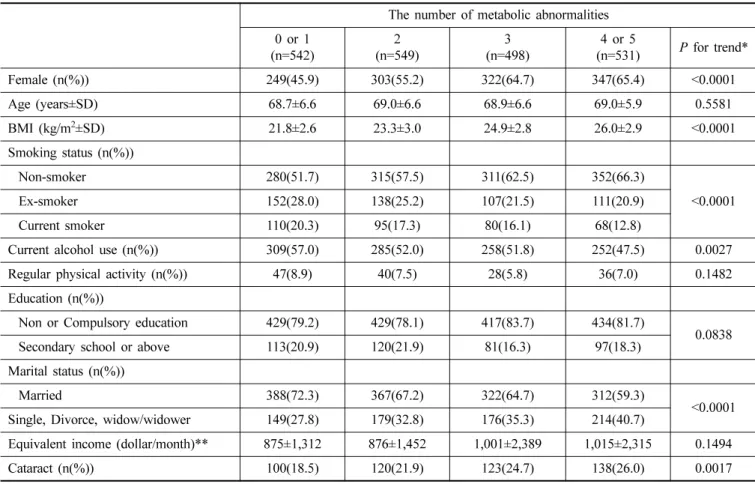
대상자들의 평균연령은
68.9
세였으며연령분포는60
세에서
103
세까지다양하였다(Table 1).
이중여성대상자는
57.6%
였다.
대상자들이보유하고 있는대사증후군 이상요소가증가함에따라여성
, BMI,
미혼이거나이혼및사별한자
,
백내장유병률은유의하게 증가하는 경향을보인 반면
,
현 음주자의 비율은 유의하게 감소하는 경향을보였다
.
이상이있는대사증후군구성요소 수에따른백내장 발 생의 위험도를 보았을때
,
이상요소수1
가지이하를가지고 있는 집단을기준으로 보유요소 수가증가함에 따 라서위험도는점차증가하는 추세를보이는것으로나타 났다
(Table 2,
Pfor trend=0.0038).
또한,
성별과 연령으로보정하였을 때
(Model 2)
와그에더하여생활습관및사회경제적 수준등을보정하였을 때의추세성은 더욱강하게 나타났다
(P for trend: <0.0001).
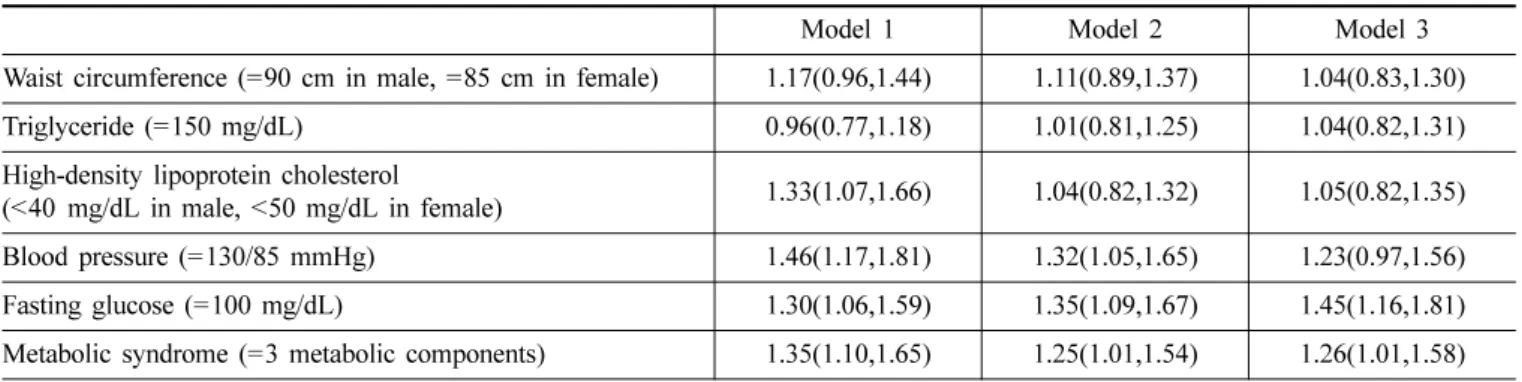
대사증후군 각구성요소의 이상유무및대사증후군유
병에따른백내장발생의위험도는
Table 3
에기술되어있다
.
아무런 보정을 취하지 않았을 때HDL-
콜레스테롤(OR(95% CI): 1.33(1.07,1.66)),
혈압1.46(1.17,1.81),
공복혈당
1.30(1.06,1.59)
등의이상은백내장발생의위험도를유의하게 증가시켰지만
,
그러한 유의성은 공복혈당 이상1.45(1.16,1.81)
에서만생활습관및인구사회경제적변수를보정하였을 때에도남아있었다
.
한편,
대사증후군으로진단되지 않은 대상자를기준으로 대사증후군으로진단된 대상자의 백내장위험도는 모든경우에 유의하게증가하 는 것으로나타났고
,
생활습관 및인구사회경제적변수를보정하였을때의
OR(95% CI)
은1.26(1.01, 1.58)
인것으로나타났다.
또한 Table 4 통해 대상자들을 이상지질혈증, 높은 혈압, 공복혈당장애의 치료제사용 여부에 관해 치료제 미사용군 을 기준으로 사용군의 백내장 위험도를 분석한 결과를 서 술하였다. 그 결과에 따르면, 모든 치료제 사용군에서 백 내장의 위험도가 의미 있게 증가하는 것으로 나타났다.
고 찰
백내장과 대사증후군 구성요소와의 관계에 대한 연구는
주로 당뇨병[5,11,18], 고혈압[5,10,19], 비만[10,12] 위주로 이루어 져왔다. 특히, 많은 연구에서 백내장의 세부 분류에 따라 위험요인과의 관련성[4,5,10,12]을 제시하였으며, 대부분의 경 우 백내장의 종류에 따라 위험도가 다르지만 대체적으로 백내장의 이환과 대사증후군의 구성요소와 관계가 있
다[4,6,7,12,13]고 인정하고 있다. 그러나 그러한 연구들은 위
험요인과 백내장간의 보다 직접적인 관계에만 집중하게 되면서 위험 요인들 간의 유기 적인 관계를 간과한 측면 이 있었다.
현재 대사증후군의 병태생리는 아직까지 정확하게 밝혀
Table 1. Baseline characteristics according to the number of metabolic abnormalities
The number of metabolic abnormalities 0 or 1
(n=542) 2
(n=549) 3
(n=498) 4 or 5
(n=531)
Pfor trend*
Female (n(%)) 249(45.9) 303(55.2) 322(64.7) 347(65.4) <0.0001
Age (years±SD) 68.7±6.6 69.0±6.6 68.9±6.6 69.0±5.9 0.5581
BMI (kg/m
2±SD) 21.8±2.6 23.3±3.0 24.9±2.8 26.0±2.9 <0.0001
Smoking status (n(%))
Non-smoker 280(51.7) 315(57.5) 311(62.5) 352(66.3)
<0.0001
Ex-smoker 152(28.0) 138(25.2) 107(21.5) 111(20.9)
Current smoker 110(20.3) 95(17.3) 80(16.1) 68(12.8)
Current alcohol use (n(%)) 309(57.0) 285(52.0) 258(51.8) 252(47.5) 0.0027
Regular physical activity (n(%)) 47(8.9) 40(7.5) 28(5.8) 36(7.0) 0.1482
Education (n(%))
Non or Compulsory education 429(79.2) 429(78.1) 417(83.7) 434(81.7) 0.0838
Secondary school or above 113(20.9) 120(21.9) 81(16.3) 97(18.3)
Marital status (n(%))
Married 388(72.3) 367(67.2) 322(64.7) 312(59.3) <0.0001
Single, Divorce, widow/widower 149(27.8) 179(32.8) 176(35.3) 214(40.7)
Equivalent income (dollar/month)** 875±1,312 876±1,452 1,001±2,389 1,015±2,315 0.1494
Cataract (n(%)) 100(18.5) 120(21.9) 123(24.7) 138(26.0) 0.0017
*Chi-square analyses was performed for smoking status, education, and marital status variables
**Equivalent income was calculated as family income per month divided by squared family members. 1 dollar=1,000 won
Table 2. Odds ratio and 95% confidence interval for cataract according to the number of metabolic abnormalitiesThe number of metabolic abnormalities 0 or 1
(n=542) 2
(n=549) 3
(n=498) 4 or 5
(n=531)
Pfor trend
Model 1 Reference 1.19(0.88,1.61) 1.43(1.06,1.94) 1.49(1.11,2.01) 0.0038
Model 2 Reference 1.13(0.83,1.55) 1.30(0.95,1.78) 1.38(1.01,1.87) <0.0001 Model 3 Reference 1.11(0.80,1.53) 1.32(0.95,1.82) 1.35(0.98,1.85) <0.0001 Model 1 was not adjusted for any variables.
Model 2 was adjusted for age and sex.
Model 3 was additionally adjusted for smoking status, current alcohol use, regular physical activity, education, marital status, and
equivalent income.
져있지는 않지만인슐린저항성을 가장중요한 병인으로 인정하고
,
그 구성요소간의상호작용에 의해질병이발생하는것으로 알려져있다[2]
.
대사증후군이백내장의 이환에영향을미치는기전으로는 염증반응이있다
.
대사증후군은만성염증과 밀접한관련을보여주며
,
여기서의 염증은일종의만성적이고 지속적인대사결함에의해서발생 하는 특징을 가지고있다
.
지방세포에서 분비되는inter- leukin-6, tumor necrosis factor-
α 등의pro-inflammatory cytokines
과 그로 인해 간에서 생산되는C-reactive pro-
tein
[20]의일부가백내장 발생에영향을미치게되는 것이다[6,21,22]
.
산화스트레스역시대사증후군으로인한백내장발생에 직간접적인 영향을 미치게 되는데
,
대사증후군에의해혈당과유리지방산수준이높아지면미토콘드리아에 서의 활성산소가 발생되어[23] 수정체 단백질을 카바밀화
(carbamylation)
함으로써 백내장 발생이 유발되는 것이다[24]
.
본연구에서 성과연령을보정하여 대사증후군각구성
요소의 백내장에 대한 위험도를 분석한 결과
, HDL-
콜레스테롤 이상
,
높은혈압,
공복혈당장애가있을경우백내장의 위험도가유의하게 증가하는 것으로나타났다
.
이러한 결과는기존의연구결과[8]와 일치하는것으로
,
신체의대사이상이 백내장의발생 위험을증가시킨다는 것을보 여준다
.
이미많은연구에서공복혈당및당뇨와백내장과의 상관관계가밝혀졌고[5,11,13,18]
,
본연구에서도대사증후군구성요소중가장백내장발생의위험과유의한관계 가 있다고 분석되었다
.
이는 수정체의 과잉당으로 인해aldose reductase
가 당뇨병 환자의 렌즈에서glucose
를sorbitol
로 전환시키면서sorbitol
의축적으로 삼투압이 증가되고
,
렌즈섬유세포의 종창과파열을일으키게되면서백내장이 유발되는 것으로알려져 있다[4]
.
또한,
혈압 및 Table 3. Odds ratios and 95% confidence interval for cataract prevalence by the metabolic componentsModel 1 Model 2 Model 3
Waist circumference (=90 cm in male, =85 cm in female) 1.17(0.96,1.44) 1.11(0.89,1.37) 1.04(0.83,1.30)
Triglyceride (=150 mg/dL) 0.96(0.77,1.18) 1.01(0.81,1.25) 1.04(0.82,1.31)
High-density lipoprotein cholesterol
(<40 mg/dL in male, <50 mg/dL in female) 1.33(1.07,1.66) 1.04(0.82,1.32) 1.05(0.82,1.35)
Blood pressure (=130/85 mmHg) 1.46(1.17,1.81) 1.32(1.05,1.65) 1.23(0.97,1.56)
Fasting glucose (=100 mg/dL) 1.30(1.06,1.59) 1.35(1.09,1.67) 1.45(1.16,1.81)
Metabolic syndrome (=3 metabolic components) 1.35(1.10,1.65) 1.25(1.01,1.54) 1.26(1.01,1.58) Model 1 was not adjusted for any variables.
Model 2 was adjusted for age and sex.
Model 3 was additionally adjusted for smoking status, current alcohol use, regular physical activity, education, marital status, and equivalent income.
Metabolic syndrome: baseline was non-metabolic syndrome.
Table 4. Odds ratios and 95% confidence interval for cataract prevalence by using medication*
Non-medication use Medication use Dyslipidemia
Odds ratio Reference 1.73(0.98,3.05)
High-density lipoprotein cholesterol (mg/dL) 37.9±7.1 41.3±9.2
Triglyceride (mg/dL) 163.8±95.5 179.6±187.2
High blood pressure
Odds ratio Reference 1.49(1.14,1.96)
Systolic blood pressure (mmHg) 143.4±14.9 136.1±18.7
Diastolic blood pressure (mmHg) 83.5±10.1 79.4±9.9
Impaired fasting glucose
Odds ratio Reference 1.13(0.69,1.85)
Fasting glucose (mg/dL) 100.7±21.0 139.1±47.7
*Multivariate logistic analyses was performed after adjusting for age, sex, smoking status, current alcohol use, regular physical activity,
education, marital status, and equivalent income.
HDL
콜레스테롤수치역시백내장의발생과유의한관계가있다고보고된바있다[5,6,8,9]
.
그러나 생활습관및인구사회경제적 변수를보정하였을때
,
대사증후군의구성 요소중에서공복혈당 장애에따른백내장발생의위험도만 이유의미한 결과를보이는 것은공복혈당장애가 대사증 후군의주요 병인인인슐린 저항성의대표적인 임상증상 이기때문으로 보인다
.
NCEP-ATP
Ⅲ기준[16]에 의해 이상지질혈증,
높은혈압,
공복혈당장애로진단된대상자의일부는치료제를복용하 고있으므로치료제이용에대한백내장의위험도에 대해 서 분석하였다
(Table 4).
그결과 높은 혈압을 가진 집단중치료제를사용하고 있는사람들의 백내장에대한위험 도가높은 것으로나타났다
.
또한,
치료제사용군에서 수축기
,
이완기혈압의평균이치료제를 사용하지 않는군에비해서모두 낮으므로치료제 사용이백내장의 위험도를 증가시킬 수도있다고생각되었다
.
이미고혈압치료제가백내장의위험도를높인다는연구가진행된일이있다
.
오히려고혈압의 경우에는고혈압 자체보다치료제에 의해 서 백내장이유발된다는 의견[10]도 있고
,
고혈압과 그 치료제가 백내장에미치는 영향을따로 볼수 없다는 의견
도 있다[4]
.
그러나 최근에 정리된 연구에 의하면beta-
blockers
와Angiotensin-Converting Enzyme inhibitor
등의고혈압 치료제가백내장 발생에영향을 줄수 있다고 하 지만 여기에 대한 연구 결과가 일정한것은 아니므로[25]
좀더 많은연구가진행되어야할것으로보인다
.
본연구는 단면연구로써 원인과결과의 선후관계를 판 단하기어렵고
,
백내장의 유형이구분되지 않았으므로 그원인이다를수있는부분을정확히다룰수없었다는 연 구의한계가 있다
.
하지만,
표본인구를 대상으로한 국민건강영양조사
2
개년의데이터를이용함으로써그 표본의대표성과객관성을 근거로했다는점이이연구의강점이 다
.
더욱이최근의보건학적관심을받고있는대사증후군및그구성요소와백내장과의관계에 대해동양인을 대상 으로한최초의연구라는 데그 의의가있다
.
결 론
20
세기후반이후급격히늘고있는대사증후군의증가와 평균수명의 증가는 백내장의발병 위험을높이고 있 다
.
본연구 결과에의하면,
대사증후군뿐만아니라 그것의일부구성요소가백내장의발병위험을높이는위험인 자인것으로확인되었다
.
그와함께고혈압치료제의사용역시 백내장을 간접적으로 유발시킬것이라고 추측되었 다
.
따라서백내장을 예방하는측면에서 대사증후군의 관리가꼭필요할것이다
.
참고문헌
[1] Kahn H. A., Leibowitz H. M., Ganley J. P., Kini M. M., Colton T., Nickerson R. S., and Dawber T. R., “The Framingham Eye Study. II. Association of ophthalmic pathology with single variables previously measured in the Framingham Heart Study”,Am. J. Epidemiol., 106(1):
33-41(1977).
[2] Meigs J. B., “Invited commentary: insulin resistance syn- drome? Syndrome X? Multiple metabolic syndrome? A syndrome at all? Factor analysis reveals patterns in the fabric of correlated metabolic risk factors”,Am. J. Epide- miol., 152(10):908-911;discussion912(2000).
[3] Meigs J. B., “Definitions and mechanisms of the meta- bolic syndrome”,Current Opinionin Endocrinology, Dia- betes and Obesity, 13(2):103(2006).
[4] Tan J. S., Wang J. J., and Mitchell P., “Influence of diabe- tes and cardiovascular disease on the long-term incidence of cataract: the Blue Mountains eye study”, Ophthalmic Epidemiol., 15(5):317-327(2008).
[5] Leske M. C., Wu S. Y., Hennis A., Connell A. M., Hyman L., and Schachat A., “Diabetes, hypertension, and central obesity as cataract risk factors in a black population. The Barbados Eye Study”,Ophthalmology, 106(1): 35-41(1999).
[6] Lindblad B. E., Hakansson N., Philipson B., and Wolk A.,
“Metabolic syndrome components in relation to risk of cataract extraction: a prospective cohort study of women”, Ophthalmology, 115(10):1687-1692(2008).
[7] Bojarskiene F., Cerniauskiene L. R., Paunksnis A., and Luksiene D. I., “Association of metabolic syndrome com- ponents with cataract”, Medicina (Kaunas), 42(2):115-122 (2006).
[8] Hiller R., Sperduto R. D., Reed G. F., D'Agostino R. B., and Wilson P. W., “Serum lipids and age-related lens opacities: a longitudinal investigation: the Framingham Studies”,Ophthalmology, 110(3):578-583(2003).
[9] Goodrich M. E., Cumming R. G., Mitchell P., Koutts J., and Burnett L., “Plasma fibrinogen and other cardiovas- cular disease risk factors and cataract”, Ophthalmic Epi- demiol, 6(4):279-290(1999).
[10] Younan C., Mitchell P., Cumming R., Rochtchina E., Pan- chapakesan J., and Tumuluri K., “Cardiovascular disease, vascular risk factors and the incidence of cataract and cat- aract surgery: the Blue Mountains Eye Study”, Oph- thalmic Epidemiol. 10(4):227-240(2003).
[11] Janghorbani M. and Amini M., “Cataract in type 2 diabe- tes mellitus in Isfahan, Iran: incidence and risk factors”, Ophthalmic Epidemiol., 11(5):347-358(2004).
[12] Schaumberg D. A., Glynn R. J., Christen W. G., Hankin- son S. E., and Hennekens C. H., “Relations of body fat distribution and height with cataract in men”,Am. J. Clin.
Nutr., 72(6):1495-1502(2000).
[13] Paunksnis A., Bojarskiene F., Cimbalas A., Cerniauski- ene L. R., Luksiene D. I., and Tamosiunas A., “Relation
between cataract and metabolic syndrome and its compo- nents”,Eur. J. Ophthalmol., 17(4):605-614(2007).
[14] The Third Korea National Health and Nutrition Examina- tion Survey (KNHANES III) Seoul: Korea Centers for Disease Control and Prevention; 2005.
[15] The Third Korea National Health and Nutrition Examina- tion Survey (KNHANES IV) Seoul: Korea Centers for Disease Control and Prevention; 2007.
[16] Antonopoulos S., “Third Report of the National Choles- terol Education Program (NCEP) Expert Panel on Detec- tion, Evaluation, and Treatment of High Blood Cholesterol in Adults (Adult Treatment Panel III) final report”,Circu- lation. 106:3143-3421(2002).
[17] Lee S. Y., Park H. S., Kim D. J., Han J. H., Kim S. M., Cho G. J., Kim D. Y., Kwon H. S., Kim S. R., Lee C. B., Oh S. J., Park C. Y., and Yoo H. J., “Appropriate waist circumference cutoff points for central obesity in Korean adults”,Diabetes Res. Clin. Pract., 75(1):72-80(2007).
[18] Szmyd L., Jr. and Schwartz B., “Association of systemic hypertension and diabetes mellitus with cataract extrac- tion. A case-control study”, Ophthalmology, 96(8):1248- 1252(1989).
[19] Schaumberg D. A., Glynn R. J., Christen W. G., Ajani U.
A., Sturmer T., and Hennekens C. H., “A prospective
study of blood pressure and risk of cataract in men”,Ann.
Epidemiol., 11(2):104-110(2001).
[20] de Luca, C. and Olefsky J. M., “Inflammation and insulin resistance”,FEBSLett. 582(1):97-105(2008).
[21] Schaumberg D. A., Ridker P. M., Glynn R. J., Christen W.
G., Dana M. R., and Hennekens C. H., “High levels of plasma C-reactive protein and future risk of age-related cataract”,Ann. Epidemiol., 9(3):166-171(1999).
[22] Klein B. E., Klein R., Lee K. E., Knudtson M. D., and Tsai M. Y., “Markers of inflammation, vascular endothe- lial dysfunction, and age-related cataract”, Am. J. Oph- thalmol., 141(1):116-122(2006).
[23] Evans J. L., Goldfine I. D., Maddux B. A., and Grodsky G. M., “Are oxidative stress-activated signaling pathways mediators of insulin resistance and beta-cell dysfunc- tion?”,Diabetes, 52(1):1-8(2003).
[24] Klein B. E., Knudtson M. D., Brazy P., Lee K. E., and Klein R., “Cystatin C, other markers of kidney disease, and incidence of age-related cataract”,Arch. Ophthalmol., 126(12):1724-1730(2008).
[25] Kanthan G. L., Wang J. J., Rochtchina E., and Mitchell P.,
“Use of antihypertensive medications and topical beta- blockers and the long-term incidence of cataract and cata- ract surgery”,Br. J. Ophthalmol., 93(9):1210-1214(2009).
Relations of Cataract to Metabolic Syndrome and its Components
- Based on the KNHANES 2005, 2007
Sang-Shin Park*
,
** and Eun-Hee Lee****Department of Epidemiology, School of Public Health, Seoul National University
**Center for Obesity, Nutrition, and Metabolism, Dongguk University Ilsan Hospital
***Department of Visual Optics, Far East University
(Received July 27, 2009: Revised August 26, 2009: Accepted September 8, 2009)
Purpose: This study was performed to assess the effects of metabolic syndrome and its components to cataract.
Methods: We investigated the relation of metabolic syndrome and its components to cataract using data for 2,120 adults, aged 60 years or older, from the Korean National Health and Nutrition Examination Survey 2005, 2007.
Using multiple logistic regression analysis, we presented significant odds ratio (OR) increase of cataract according to the number of metabolic abnormalities (≤1, 2, 3, ≥4). We also analyzed OR by the prevalence of metabolic components, and analyzed the effects of metabolic medication intakes to cataract prevalence using multiple logistic regression analysis. Results: The risk of cataract development was significantly increased according to the number of metabolic abnormalities, after adjusting for age, sex, life style, and social economic status variables (p for trend
< 0.0001). In metabolic components, the disturbances of blood pressure (OR(95% Confidence Interval):
1.32(1.05,1.65)) and fasting glucose (1.35(1.09,1.67)) significantly increased the prevalence of cataract after adjusting for age and sex. Among these metabolic components, the significance of fasting glucose (1.26(1.01, 1.58)) was remained after adjusting for the other variables. Medication intake of hypertensive also increased the risk of cataract (1.49(1.14,1.96)). Conclusions: Metabolic syndrome and its components increased the risk of cataract, and some medication for treating hypertension was also associated with the cataract incidence.
Key words: Cataract, Metabolic syndrome, Blood pressure, Glucose, Obesity