• 검색 결과가 없습니다.

A Study of the relationship between Chronic Pain and Quality of Life for Elderly in Long-term Care Service -Focused on the Mediating Effect of Depression-

N/A
N/A
Protected

Academic year: 2021

Share "A Study of the relationship between Chronic Pain and Quality of Life for Elderly in Long-term Care Service -Focused on the Mediating Effect of Depression-"

Copied!
9
0
0

로드 중.... (전체 텍스트 보기)

전체 글

(1)

1. Introduction

1.1 Necessity of Research

In the year 2000, the population of the elderly aged

65 and older in South Korea was 7% of the total population. This figure rose to 13.1% in 2015 and is expected to reach 14.3% by 2018 and 40% by 2060.

Considering that the elderly population of Jeollanam-do

*Corresponding Author : Jeoung-nam Yang([email protected]) Received February 20, 2018

Accepted April 20, 2018

Revised April 2, 2018 Published April 28, 2018

A Study of the relationship between Chronic Pain and Quality of Life for Elderly in Long-term Care Service

-Focused on the Mediating Effect of Depression- Yu-me No 1 , Jeoung-nam Yang 2*

1

Dept. of Social Work Ph. D. Course, Dongshin University,

2

Dept. of Social Work, Dongshin University

장기요양 재가서비스이용 노인의 만성통증과 삶의 질 관계연구

-우울의 매개효과를 중심으로-

노유미

1

, 양정남

2*

1

동신대학교 사회복자학과 박사과정,

2

동신대학교 사회복지학과

Abstract In this study, the effect of chronic pain on the lives of elderly people in long-term care service was analyzed based on the mediated effect of depression. The research data was sampled from elderly people in long-term care services, 204 people participated. From mediated regression analysis, depression was the most relevant factor on the quality of life, followed by chronic pain. With chronic pain and depression as independent variables and quality of life as a dependent variable, depression was proved to have had a fully mediated effect on quality of life.

The result of this study suggested that convergence of various support systems should be implemented for the elderly in long-term care services.

Key Words : Elderly, Depression, Quality of life, Chronic pain, Elderly people in long-term care service, Mental health, Convergence.

요 약 본 연구는 장기요양 재가서비스 이용 노인의 만성통증이 삶의 질에 미치는 영향에서 우울의 매개효과를 검증하는 데 목적을 두었다. 이를 위해 장기요양 재가서비스를 이용하고 있는 노인 204을 대상으로 조사를 실시하였다. 본 연구의 주요 분석결과는 변수간의 상관관계에서 만성통증과 우울은 정적관계, 만성통증과 삶의 질과의 관계에서는 부적 상관관계 로 분석되었다. 또한, 만성통증과 우울이 삶의 질에 미치는 영향에 있어서 우울은 완전한 매개효과를 보이는 것으로 검증되 었다. 이 결과를 통해 장기요양 재가서비스를 이용하는 노인의 다양한 융합적인 정신건강서비스를 위한 프로그램 개발 필요성에 대해 논의하였다.

주제어 : 노인, 우울, 삶의 질, 만성통증, 노인장기요양서비스, 정신건강

(2)

reached 22.4% of its population in 2015, there is a need to develop various policies and programs to improve the quality of life of the elderly living in rural areas [1].

The Long-Term Care Programs for the Elderly, which has been implemented since 2008, aims to improve the quality of life of the elderly and their family members by reducing medical expense burdens of elderly and their family members [2]. Although evaluations of the program revealed the positive economic effects in terms of reducing the burden of support for family members, the effects of the program on the life satisfaction of the elderly were found to be minimal due to a lack of coordinated links between public health services, including mental health service [3].

The elderly face a number of mental, physical, and social challenges associated with the ageing process and require continuing support with their quality of life [4]. The concept of quality of life is defined as, “a concept regarding the physical, emotional, and social aspects associated with quality of life affected by disease or treatment.” [5]

Chronic pain is increasingly gaining attention as an important factor that affects the quality of life of the elderly. Chronic pain is defined as any pain lasting more than 6 months that repeatedly occurs throughout a patient’s life. Various characteristics concerning chronic pain are known to exist [6]. Most elderly individuals are reported to be at high risk for pain associated with chronic illnesses and health issues associated with the aging process [7].

Previous studies on chronic illnesses and quality of life indicated that the perceived quality of life among elderly individuals with arthritis was low at 47% [8], whereas elderly individuals living in rural areas were especially found to experience improvements in quality of life when levels of chronic pain and depression were reduced [9].

On the other hand, chronic pain is increasingly becoming considered an important factor that has an effect on depression. A study by J. Y. Lee [7] reported

that elderly individuals experience mental depression due to chronic pain and chronic physical illnesses, which subsequently lowers quality of life. In addition to this, chronic pain is known to lower self-esteem and increase incidences of depression. In consideration of the negative effects of depression on quality of life, depression is increasingly becoming more significant with respect to the mental health of elderly individuals [10]. A study by K. H. Jo and Y. K. Kim [10] reported that levels of depression among elderly individuals increased as their health worsened. E. Y. Yuk [11] also asserted that measures need to be taken to reduce factors, such as pain and depression, that negatively affect quality of life, in light of the fact that higher levels of pain and depression result in lower levels of quality of life.

Depression among elderly individuals is reported to be an important factor that affects the quality of life of an elderly individual. Previous studies on quality of life and depression among elderly individuals indicate that among home-care elderly individuals, those who are physically weak are subject to higher levels of depression as their physical functions become weaker.

In addition, the studies also proved a correlation in cases where social support increases and depression decreases [12]. According to the studies, negligence of depression among those receiving long-term care can result in negative effects such as an overall loss in quality of life [13]; and depression is also considered an important factor that lowers levels of happiness and quality of life among elderly individuals [14].

In addition, some studies state that quality of life should be improved to lower mortality rates by applying appropriate methods of managing elderly individuals living in solitude, who experience lower levels of quality of life as their levels of depression increase.

According to U. S. Park’s study [16], stress, chronic

pain, discomfort, and depression are factors that have a

negative effect on quality of life, and quality of life is

lowered more so due to depression if health issues are

(3)

not resolved. In light of this, it is considered important to develop various mental health-related programs that aim to improve quality of life by lowering levels of discomfort, chronic pain, loneliness, and depression [17].

As indicated in the previous studies mentioned above regarding factors that affect the quality of life of elderly individuals, chronic pain and depression were commonly noted as important factors that have a negative effect on quality of life. Thus, worsening levels of chronic pain among elderly individuals, who live in rural areas and currently are receiving long term care, can be expected to result in depression and lower levels of quality of life.

Although services currently available provide some degree of relief from chronic pain, there are no interventions to deal with the issue of depression. Some relevant previous studies analyze correlations between chronic pain and quality of life; however research on elderly individuals in long-term care and research regarding the relations between factors including the mediating effect of depression is currently lacking. The significance of this study is to emphasis mental health services in order to increase quality of life for the elderly in long term care.

For these reasons, this study aimed to analyze the effects of chronic pain on the quality of life of elderly individuals receiving long-term home care services and reveal the structural relations regarding the effects of depression on chronic pain and quality of life. The results of this study are expected to establish a need for services that respond to depression among elderly individuals who use long-term care services and also to provide basic research materials used to develop local community mental health services programs.

1.2 Purpose of Research

The purpose of this study was to identify and validate the mediating effects of depression with regards to quality of life and chronic pain among elderly individuals using long-term home care services.

The specific issues addressed in this research were as

follows: what differences exist chronic pain, depression, and quality of life of elderly individuals using long-term home care services?

Second, does depression among elderly individuals using long-term home care services have a mediating effect on chronic pain and quality of life?

2. Research Method

2.1 Research Design

This study explored the effects of chronic pain mediated by depression on the quality of life of elderly individuals using long-term home care services. The detailed design of the study is as follows.

2.2 Study Subjects

The subjects of this study were elderly individuals living in 00 City, 00 Province as of October 2016, who were designated in need of long-term care (grades 1~5) and had received home care services over 1 month.

They were subjected to surveys conducted in 10 welfare centers. Two hundred and ten individuals participated in the surveys; a total of 204 samples were collected. Data collection was undertaken between October 2016 and November 2016 by a social welfare worker who received education and training regarding the study prior to directly interviewing the subjects.

2.3 Research Tools

2.3.1 Tools used to Measure Pain among the Elderly

The degree of pain felt by the subjects during

(4)

everyday life was measured using the VAS-Visual Analog Scale developed by Sartain & Barry (1999) [18]

in which perceived levels of pain were marked along a 0 ~ 10cm line (H. J. Kim, 2013) [19]. Markings can be made from 0cm (no pain) to 10cm (excruciating pain that is intolerable); higher numbers indicated greater pain [10].

2.3.2 Tools to Measure Depression among the Elderly

The Korean version of the CES-D Scale (Center for Epidemiologic Studies Depression Scale) developed by G.G. Jeon (2001) [20] was applied as the depression scale. Three types of Korean CES-D Scales were developed for use in Korea; in this study, the Korean CES-D Scale [20] that integrated all three scales was selected as the depression scale [21].

A total of 16 questions were used to measure quality of life in this study, and the total Cronbach's α value of the depression scale was measured as.919, which was extremely high.

2.3.3 Tools used to Measure Quality of Life Quality of life was measured using a structural quality of life measurement tool developed by K. S.

Ann [22]. This tool is composed of 18 questions across 4 categories including physical (7 questions), psychological (5 questions), economic (3 questions), and social (3 questions) categories.

All questions were developed on a 5-point Likert scale in which all questions were assigned points based on answer choices of ‘strongly agree’ (5 points), ‘agree’

(4 points), ‘neutral’ (3 points), ‘disagree’ (2 points), and

‘strongly disagree’ (1 point).

Higher point scores indicated higher quality of life.

In this study, a total of 16 questions were used to measure quality of life; the reliability of the Cronbach's α value was found to be .837 from a physical standpoint, .894 from a psychological standpoint, 910 from an economic standpoint, and .970 from a social standpoint. The total Cronbach's α value of quality of

life was .866, which was considered high.

2.4 Data Analysis

The collected data was statistically analyzed using SPSS / WIN 20.0. Skewness and kurtosis values were given to find the averages, standard deviations, and normality distributions of the key variables composing the model of this study.

Differential analyses were undertaken to identify differences in the averages of the key variables of this study according to the characteristics of the studied subjects. Independent sample t-tests and ANOVA were applied to the differential analyses. T-tests were applied for independent variables having 2 levels, and ANOVA was applied to independent variables having 3 levels or more. Post validation was performed by applying the Scheffe method when assuming homogeneity of variance, and the Dunnett T3 method was applied when not assuming homogeneity of variance. The correlations between chronic pain, depression, and quality of life were analyzed using the Pearson Correlation Coefficient. To examine the mediating effect of depression, a mediation regression analysis was carried out and the significance of the indirect effects was validated by conducting a Sobel test. The reciprocal effects of depression on chronic pain and quality of life of the subjects were analyzed through regression analysis.

3. Research Results

3.1 General Characteristics of the Subjects The breakdown of gender of the subjects studied in this research included 38 males (18.6%) and 166 females (81.4%). The ages of subjects consisted of 2 subjects under 60 (1.0%), 10 subjects between 60 and 69 (4.9%), 43 subjects between 70 and 79 (21.1%), 118 subjects between 80 and 89 (57.8%), and 31 subjects over 90 (15.2%).

The designated long-term care grade levels of the

(5)

subjects included 0 grade-1 subjects (0.0%), 12 grade-2 subjects (5.9%), 52 grade-3 subjects (25.5%), 139 grade-4 subjects (68.1%), and 1 grade-5 subject (0.5%), indicating subjects in the grade-4 group were the largest.

In terms of the overall period of using home care services, 19 subjects (9.3%) responded to having used services for less than 6 months, 21 subjects (10.3%) between 6 months and 1 year, 78 subjects (38.2%) between 1 and 2 years, 64 subjects (31.4%) between 3 to 4 years, and 22 (10.5%) subjects for 5 years or more.

Table 1. General Characteristics of the Subjects

3.2 Differential Analysis of Depression and Quality of Life According to General Characteristics of the Subjects

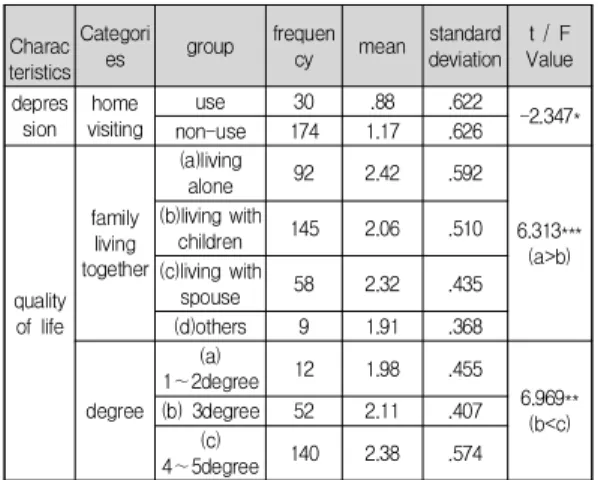
The averages of variables regarding those receiving visited nursing care, status of residence with family members, and designated long-term care grades were compared. The results of the differential analysis on depression indicated a statistical significance of p<.05 for those who receive visiting nursing care.

The results of the differential analysis on quality of life showed statistical significances of p<.001 and p<.01 regarding the status of residence with family members and designated long-term care grades, respectively. In other words, the results of the differential analysis on quality of life according to the status of residence with

family members confirmed that quality of life among elderly individuals living alone was higher than those living with their children.

3.3 Correlations between Depression and Quality of Life of the Subjects

The correlations among key variables were as follows.

First, chronic pain was found to have a positive correlation with depression and a negative correlation with quality of life. Greater levels of chronic pain were associated with increased levels of depression and lower quality of life.

In addition, depression was found to have a negative correlation with quality of life. Greater levels of depression and greater frequency of depression were both found to be associated with lower quality of life.

Table 2. Correlation Coefficients among Variables categories chronic pain depression quality of life

chronic pain 1

depression .264*** 1

quality of life -.209** -.335*** 1

** p<.01, *** p<.001

3.3 The Effects of Chronic Pain and Depression on the Quality of Life of the Subjects Prior to examining the effects of chronic pain and depression on quality of life, this study conducted multicollinearity, independence, normality, and homogeneity of variance analyses. The results of multicollinearity analysis presented that tolerance limits were all larger than 0.1 and variance influence factors (VIF) was 10 or less for all variables. The Durbin Watson value was found to be 1.471, which was close to the standard value of 2 and not close to 0 or 4. This indicated there were no correlations between the remainders. Further, the normality and goodness of fit of the model were checked (F=14.743, p<.000).

As indicated in STEP 1, chronic pain and higher perceived levels of chronic pain were found to result in

Charac teristics

Categori

es group frequen

cy mean standard

deviation t / F Value depres

sion home visiting

use 30 .88 .622

-2.347*

non-use 174 1.17 .626

quality of life

family living together

(a)living

alone 92 2.42 .592

6.313***

(a>b) (b)living with

children 145 2.06 .510

(c)living with

spouse 58 2.32 .435

(d)others 9 1.91 .368

degree (a)

1∼2degree 12 1.98 .455

6.969**

(b<c)

(b) 3degree 52 2.11 .407

(c)

4∼5degree 140 2.38 .574

(6)

lower levels of quality of life (t=-3.031, p=.000). STEP 2 presents the results of an additional regression of depression on STEP 1; the results.

In addition, it was found that depression (t=-4.412, p=.000) had a negative effect on quality of life and chronic pain (t=-1.890, p=.060) had a statistically significant effect.

Based on the regression analysis of independent variables that affect the dependent variable, this study adopted STEP 2, to which regression analysis of depression was added.

3.4 Validation of the Mediating Effects of Depression

To examine the mediating effects of depression with respect to the effect of chronic pain on quality of life, a three-stage process of validation as outlined in [23]

was implemented.

First, the question of whether the independent variable significantly predicts the mediating variable was validated. The regression analysis on chronic pain as the independent variable and depression as the dependent variable indicated that chronic pain was able to predict depression in a statistically significant manner (β=.264, <.001). This satisfied the first condition of validating the mediating effect.

Second, the question of whether the independent variable significantly predicts the dependent variable was validated. To this end, a regression analysis with chronic pain as the independent variable and quality of life as the dependent variable was performed. The analysis results showed that chronic pain had a

significant effect on quality of life (β=-.209, <.01). This satisfied the second condition of validating the mediating effect. The results, however, showed slightly less of an effect compared with the first stage.

Third, the independent variable and mediating variable were both applied to validate their effect on the dependent variables. To this end, a regression analysis that included both chronic pain and depression as the independent variables and quality of life as the dependent variable was carried out.

Although the analysis results showed no statistical significance in terms of the effect of chronic pain on quality of life (β=-.129, =.060), the effect of depression on quality of life (β=-.301, <.001) was statistically significant, which were greater than in stage 2.

These findings indicated that in terms of the effect of chronic pain on quality of life, depression had a complete mediation effect.

Table 3. Factors Influencing Variables of quality of life

Charact eristics

Categori

es group frequen

cy mean standard

deviation t / F Value depressi

on home visiting

use 30 .88 .622

-2.347*

non-use 174 1.17 .626

quality of life

family living together

(a)living

alone 92 2.42 .592

6.313***

(a>b) (b)living

with children

145 2.06 .510

(c)living with

spouse 58 2.32 .435

(d)others 9 1.91 .368

degree (a)

1∼2degree 12 1.98 .455

6.969**

(b<c)

(b) 3degree 52 2.11 .407

(c)

4∼5degree 140 2.38 .574

step independent variable

dependent

variable (B) (SE) (β) t(p) F(p) R

2

1 chronic pain depression .082 .021 .264 3.888

(.000)

15.116

(.000) .070

2 chronic pain quality of life -.056 .018 -.209 -3.031

(.003)

9.185

(.003) .043

3

chronic pain

quality of life

-.034 .018 -.129 -1.890

(.060) 14.743

(.000) .128

depression -.260 .059 -.301 -4.412

(.000)

Table 4. Structure Model’s Goodness-of-Fit

(7)

In addition, a Sobel test was performed to validate the significance of the mediation pathway via depression with regards to the relation between the effects of chronic pain and quality of life. Results of a Sobel test larger than +1.96 or less than -1.96 is considered to indicate the significance of a mediating effect.

In addition, with regards to the mediation effect of depression, the direct and indirect effects for the outcome and causal variables and the total value of the effects were as follows.

4. Study Implications and Conclusions

The implications and conclusions derived based on the results of this study are as follows.

Upon examining the differences between the key variables, depression was found to be statistically significant in home nursing visits. It was also confirmed that quality of life was statistically significant in terms of the status of residence with family members and the level of health associated with lower designated grades of long-term care.

Second, as indicated in the variable-to-variable correlation analysis, higher chronic pain was associated with higher levels of depression, which indicated a positive correlation. On the contrary, greater chronic pain was associated with lower quality of life, which indicated a negative correlation.

Third, the regression analysis results regarding factors that had an effect on quality of life revealed that higher perceived levels of chronic pain were associated with lower quality of life. In addition, when performing an additional regression analysis of depression, the presence or increase in levels of depression (t=-4.412, p=.000) was found to negatively affect quality of life. In this case, chronic pain (t=-1.890, p=.060) was not found to have a statistically significant effect. This result is considered to support the findings of previous studies

[24].

Fourth, when having both chronic pain and depression as independent variables and quality of life as an dependent variable, depression was confirmed to have a complete mediation effect (t=-4.412, p=.003) with regards to its effect on quality of life. Although some previous studies suggested depression was the largest factor that impacted the quality of life of elderly individuals suffering from degenerative arthritis, the subjects of such studies were different and degrees of pain were not surveyed [8]. In addition, most previous studies proved a correlation between chronic pain and quality of life as well as depression and quality of life [7]; however, no previous study investigated the mediating effect of depression. The complete mediation effect of depression that was revealed in this study, the means of reducing depression among elderly individuals who have chronic pain and use long-term care services are deemed practical solutions to improve quality of life.

The following recommendations were made based on the results of this study.

First, active intervention and management of means to reduce levels of chronic pain are needed to improve the quality of life of elderly individuals on long-term care. To this end, the resources of public health services should be more actively linked together, and various services and programs aimed at managing pain and promoting health should be implemented.

Second, in light of the fact that the results of this

study proved the mediating effect of depression of

home-care elderly individuals in local communities on

quality of life, service systems and programs to

safeguard the mental health of elderly individuals at a

local community level and reduce depression should be

immediately established. According to the governments

plan on long term care for the elderly 2018-2022,

welfare and health care services will be integrated but

there is no specific mental health care plan for the

elderly[25]. Therefore, various local community experts,

such as visiting nurses, mental health agents, and

(8)

social welfare workers need to perform regular mental health-related evaluations of depression among the elderly, and continued discussion and obtaining feedback regarding various convergence service programs are necessary.

Third, professional training programs to respond to chronic pain and depression should be developed for specialists who are involve in direct care of elderly individuals using long-term care services. The number of mental health workers in South Korea is approximately 1/7 of the UK, 1/3 of the US [26]. Due to even greater difficulties of securing dedicated personnel in rural areas, early prevention and treatment interventions are not reaching people in time, which in some cases, has resulted in suicide. In light of this, further means of training professional specialists to tackle the mental health issues of elderly individuals should be established for each region and expert institution within local communities.

REFERENCES

[1] National Statistics. (2015). Seoul.

[2] http://www.longtermcare.or.kr/npbs/

[3] S. B. Kang. (2014). The relationship between the use of long-term care home-visit nursing service and health service utilization, Seoul Univ, Seoul.

[4] H. K. Choi. (2012). A Study on the Eco-systemic Factors Influencing the Quality of Life of Elderly Women Living Alone, Chungju Univ, Chungju.

[5] M. J. Calvert & N. Freemantle. (2003). Use of health-related quality of life in prescribing research. Part 1: why evaluate health-related quality of life, J. Clinical Pharm Therapy, 28: 513-21.

[6] S. H. Lee & S.O. Yang. (2010). The Effects of Chronic Musculoskeletal Pain and Depression on Health-related Quality of Life by Gender in Community-dwelling Older Adults, Journal of Korean Academy of Community Health Nursing, 21(1): 21-30.

[7] J. Y. Lee. (2015). Effects of Chronic pain and Social support on Depression and Suicide in the Elderly, Konyang Univ. Deajun.

[8] J. H. Oh. (2013). Structural equation modeling on quality

of life in older adults with osteoarthritis, Seoul Univ.

Seoul.

[9] J. T. Son & S. L. Seo. (2002). Factors Influencing on Quality of Life in Aged Women with Chronic Pain Journal of Korean Academy of Nursing, 32(5): 735-742.

[10] K. H. Jo & Y. K. Kim. (2008). Influencing Factors on Depression, Suicidal Thought, and Life Satisfaction of Korean Elders, The Journal of Korean academic society of nursing education, 14(2): 176-187.

[11] E. Y. Yuk. (2013). Musculoskeletal pain, depression and quality of life of the elderly in a rural community, Hanyang Univ. Seoul.

[12] E. S. Lim & K. J. Lee. ( 2003). Effect of physical ability, depression and social support on quality of life in low income elders living at home, Journal of Korean Gerontological Nursing, 5(1): 38-49.

[13] M. J. Jung, et al. (2013). A Relationship Between Depression and Spiritual well-being in Elderly Long-term Care Insurance Client: the Mediating Effect of Family Support, Journal of the Korea Gerontological Society, 33(4): 865-879.

[14] S. G. Park. ( 2006). The Relationship between Elderly People`s Mental Health and Quality of Life, Korean Journal of Psychology, 11(4): 785-796.

[15] J. H. Park & J. H. Jung. (2010). The Influence of Depression on the Life Satisfaction of the Elderly People Living alone: A Mediating Effect of Problem Drinking, Korean Journal of Gerontological Social Welfare, 47(Winter): 309-330.

[16] U. S. Park. (2010). The effect of community welfare resource on the quality of life for the poor : focused on the health related quality of life for elderly welfare beneficiaries, Yonsei Univ. Seoul.

[17] H. J. Kim. (2015). The Effect of Long-term Care Service for the Aged on Their Depression, Konkuk Univ.Seoul.

[18] J. B. Sartain & J. J. Barry. (1999). The impact of an acute pain service on postoperactive pain management.

Anesthesia & Intensive Care, 27(4), 375-380.

[19] H. J. Kim. (2013). Chronic pain, sleep pattern and quality of life in the elderly, Hanyang University. Seoul.

[20] G. G. Jeon et al. (2001). Integrated Adaptation of CES - D in Korea, Korean journal of health psychology, 6(1):

59-76.

[21] J. Y. Kim. (2016). The relationship between oral discomfort and depression in elderly people, Jeonbuk Univ. Jeonju.

[22] K. S. Ann. (2002). The Impact of Social Support

Network on the QOL of the Aged Living as Couple

(9)

Households, Kyungsung Univ, Jinju.

[23] R. M. Baron & D. A. Kenny. (1986). The Moderator- mediator Variable Distinction in Social Psychological Research. Journal of Personality and Socal Psychology, 51(6), 1177. [24] K. R. Shin, et al., (2008). A Study on Physical Symptom, Activity of Daily Living, and Health-Related Quality of Life (HRQoL) in the Community-Dwelling Older Adults, Journal of Korean Academy of Nursing, 38(3): 437-444.

[25] Ministry of Health and Welfare: Second long term care plan (2018-2022), (2018). Seoul.

[26] National Mental Health Statistics-Pilot Study. (2016).

Seoul.

노 유 미 (NO, Yu Me) [정회원]

▪2017년 2월 : 동신대사회복지학과 석사

▪2017년 3월 ~ 현재 : 동신대 박사 과정

▪2008년 ~ 현재 : 드림노인복지센 터대표

▪관심분야 : 노인복지, 보건의료, 노인치매

▪E-Mail : [email protected]

양 정 남(Yang, Jeoung Nam) [정회원]

▪1993년 2월 : 숭실대학교대학원 석사

▪1997년 12월 : 영국 University of London 박사

▪2003년 3월 ~ 현재 : 동신대학교 사회복지학과 교수

▪관심분야 : 사회복지실천, 의료복지, 정신보건복지

▪E-Mail : [email protected]

수치

Table  1.  General  Characteristics  of  the  Subjects
Table  3.  Factors  Influencing  Variables  of  quality  of  life Charact eristics Categories group frequency mean standarddeviation t / F Value depressi on home visiting use 30 .88 .622 -2.347* non-use 174 1.17 .626 quality of life familyliving together (

참조

관련 문서

Methods: A self-reported questionnaire was completed by 213 workers in long-term elderly care facilities. The questionnaire consisted of general characteristics,

As for recognition on a system of long-term care insurance for the elderly in dental professionals who responded as saying of ‘knowing name and contents’ about a system

Purpose: This study was to test some effects on pain, depression and ego integrity of the elderly by adapting group reminiscence therapy with mugwort fragrance to the

Therfore, The development of a coping strategy to reduce pain and depression and improve the quality of life in the chronic arthritis patient will be

This study was conducted to identify the sleep patterns and influencing factors of hospitalized elderly in a long-term care hospital. The sleep patterns of 142 subjects

The Effects of Passive Exercise on Upper Extremities Muscle Spasticity, Finger Edema and Depression for Chronic Stroke Patients at

In the future, developing a strategy for integrating intervention of pain- control and depression will be needed in nursing care for middle-aged women with chronic low

Methods: Participants of ACT program for this study comprised the elderly aged 65 and over who had been suffering from chronic pain for at least 6 months and