†교신저자:김유진 (국립공주대학교 영상학과) E-mail:[email protected] TEL:041-850-0581
FAX:041-850-0561
Degree-of-Association Judgments of Fragrances with Color Hues and Tones
색상과 톤에 의한 향 연상 강도 평가
Yu-Jin Kim*†
김유진*†
Department of Media Image Art & Technology, Kongju National University*
국립공주대학교 영상학과*
Abstract
Color, an important visual cue, can cross-modally affect odor association and odor quality identification Here, this research investigates aspects of the cross-modal associations between color and fragrance in greater depth, delving into the topic of whether the degree-of-association of fragrances with hue and tone of colors varies systematically.
For 33 color stimuli (10 hues, 3 tones, and 3 achromatic colors), 67 subjects judged the degree-of-association of four typical fragrance families (fresh, floral, oriental, and woody) on a 7-point scale. The statistical analysis showed that fragrance associations of the all families had characteristic distributions across ten hues of the color stimuli.
The cross-modal relationship between color tone (especially, lightness attribute) and fragrance association appeared to be dimensional (e.g. a positive linear relationship between the floral family and the lightness). More specifically, as colors became warmer and brighter, the associated floral scents were stronger, while the woody scents was less associated. Brighter or more vivid cool colors were associated with stronger fresh scents. These findings confirm the systematic existence of synthetic interactions between vision and olfaction in perfumery.
Keywords : color hue-tone, fragrance association, fragrance family, olfaction, vision
요 약
색은 중요한 시각적 자극 요인으로서 향 연상과 식별에 있어 교차-양상적 영향을 미친다. 이에 본 연구는 향의 연상이 색상과 톤에 의해 체계적으로 변화하는지를 살펴봄으로써 색과 향의 교차-양상 연상 측면을 좀 더 심층적으로 조사하고자 한다. 67명의 피실험자들은 33가지의 색채 자극(10가지 색상, 3가지 톤, 3가지 무채 색)에 대한 4가지 전형적인 향수 유형(프레쉬, 플로럴, 오리엔탈, 우디)의 연상 정도를 각각 7점 척도로 평가 하였다. 통계 분석을 통해 4가지 향수의 연상 정도가 색채 자극의 10가지 색상에 따라 차별화된 패턴을 보이 는 것을 알 수 있었다. 오리엔탈 유형을 제외한 나머지 세 가지 향에 있어서, 톤(특히, 밝기)과 향간의 교차- 양상 연상관계가 체계적으로 변화하는 양상을 보였다(예를 들어, 플러럴 향과 색의 밝기는 양의 상관관계를 보임). 밝은 난색일수록 강한 플러럴향이 연상되는 반면, 우디향의 연상 정도는 낮게 나타났다. 선명하거나 밝 은 한색일수록 프레쉬향이 강하게 연상되었다. 이러한 연구 결과를 통해 향수제품에 있어 시각과 후각간의 체계적인 공감각적 상호작용이 이루어짐을 확인할 수 있었다.
주제어 : 색상과 톤, 향 연상, 향수 유형, 후각, 시각
1. Introduction
People receive information by the nervous system through multiple sensory modalities including vision, audition, gustation, olfaction, tactition, and other sensations. Sometimes, people also experience diverse types of synesthesia, which is “a condition in which stimulation in one sensory modality evokes an additional perceptual experience in another modality (Sagiv &
Ward, 2006).” For example, colors often invoke certain scents, at an unconscious or conscious level. These vision-olfaction interactions have received considerable attention from the makers of commercial perfumes.
Indeed, appropriate, harmonious color-fragrance combinations can improve the appeal of perfumes in the market by expressing and communicating the characteristics and mood of the fragrance inside the bottle effectively (e.g., Kim, 2008; Schiffersten &
Tangudjaja, 2004). For example, a light, herbal perfume message would never be packaged in a hot red or dynamic black box because the sensory message would be all wrong (Hope & Walch, 1990).
Even though several studies have proven the existence of stable connections between color and fragrance, there is little empirical evidence to help designers choose attractive and congruent color palettes for visualizing fragrances of their perfumes. Therefore, the present study investigates how people experience cross-modal associations between colors and fragrances.
1.1. Odor-color associations
A variety of cross-modal interactions during sensory perception has been identified in psychological, physiological, behavioral, and neural studies. However, cross-modal interactions between visual and olfactory stimuli have only been described briefly in the literature compared with those between other modalities (Gilbert, Martin, & Kemp, 1996). To date, as several researchers have proven that appropriate visual cues (e.g., colors) of objects can facilitate their odor identification (e.g., Zellner, 1991) and increase perceived odor intensity (e.g., Zellner, 1990), visual-olfactory correspondences have
begun to receive more attention in the food and perfume context.
In the late 1970s, Déribéré (1978), conducted an initial study on the relationships between perfumes and colors. Through questionnaires about associations between colors and odors—7 basic odors classified by Amoore (1970)—, he demonstrated that “some quite well-defined colors are naturally associated with fundamental and popular common odors (p. 116),” e.g.
white or light yellow with camphor, red-brown or golden brown with musk, rose with floral, green with mint, ethereal with white or light blue, acrid with grey or brown, and putrid with black, dark green, or brown.
Gilbert, Martin, and Kemp (1996) have reported strong and stable associations between certain odors and colors.
They found that 13 test odors had characteristic Munsell hues in the range of red-purple through green-yellow. In addition to differences in hue, they also suggested that Munsell value and chroma also varied across odors. In a follow-up study, Kemp and Gilbert (1997) demonstrated that stronger odors were associated with darker colors by matching Munsell color chips to five test odors presented at three concentrations.
Recently, Schifferstein and Tanudjaja (2005) confirmed the existence of non-random odor-color matches by odor-color matching and degree-of-fit tests using 14 commercial perfumes and color chips selected from the NCS color system. They also found that matching colors differed mainly on brightness, rather than saturation and hue. Through a blind matching test that used three commercial perfumes with colors (IRI Hue and Tone System), Kim (2008) showed each perfume was related with characteristic hues and their fragrance notes (the fast evaporating top notes, the medium-fast middle notes, and the slowest the base notes) had significant variation in tone (the results of the interaction between value and chroma).
1.2. The present study
Previous studies supported the notion that odor-color correspondences were not very strong and did not have a consistent pattern of effect for all odors, but these
matches could significantly vary according to color dimensions (hue, value, and chroma). In order to provide more empirical evidence that supports the existence of cross-modal associations between color and fragrance, this research investigates whether fragrance associations vary systematically with hue and tone of colors. For four typical fragrance types of commercial perfumes, a color-fragrance matching test was performed by using color patches of the IRI Hue & Tone System, whose colors have hue and tone dimensions.
Meanwhile, these color-fragrance correspondences can be subjected to variations between cultures (e.g., Ayabe- Kanamura, Schicker, Laska, Hudson, Kobayakawa, &
Saito, 1998; Demattè, Sanabria, & Spence, 2006). Moreover, several studies have asserted gender differences in odor perception and identification (e.g., Cain, 1982, Doty, Applebaum, Zusho, & Settle, 1985; Halpern, 2000).
Perfume scents, in particular, can have more gender- related differences. In general, they are developed by targeting specific gender groups, even though some products are unisexual; therefore, perfume producers and designers consider the gender differences in preferences of fragrance materials, bottles, and packages of their perfumes. Meanwhile, Zellner, McGarry, Mattern-McClory, and Abreu (2007) investigated color-odor links, focusing on how the masculinity/femininity of a fragrance influences the selection of colors that corresponds to these colors, and then showed differences between the color selections chosen for male and female fragrances.
Therefore, this research also extended the previous color-fragrance matching tests to a test population of South Korean participants, with a nearly even male-to-female ratio.
In this vein, the purpose of this study is to investigate aspects of the cross-modal associations between color and fragrance in greater depth, delving into the topic of whether the degree-of-association of fragrances with hue and tone of colors varies systematically as well as whether these color-fragrance associations are affected by gender. Three hypotheses were formulated as follows:
[H. 1] The associations of the four fragrances have characteristic distributions across the color
hues.
[H. 2] The associations of the four fragrances vary systematically with the color tones.
[H. 3] Gender difference exists in the association of the four fragrances across the color hues and tones.
2. Experiment: Degree-of-Fragrance Association with Color
2.1. Subjects
This experiment was conducted in 2008 on 67 university students (32 males and 35 females)ranging in age from 19∼24 years (M of age = 20.18. SD = 0.74).
Subjects were screened by a self-report of their normal sense of color vision based on their previous color blindness diagnoses from the Ishihara Color Test (Ishihara, 1976), which consists of a number of colored plates that contain a circle of dots that appeared randomly in color and size. Subjects also had a normal sense of smell with no history of olfactory dysfunction and were free from respiratory infection during testing.
2.2. Materials
Since 1900, fragrances has taken on a wider variety of classifications for describing perfumes--most recently, Michael Edwards, a consultant in the perfume industry, developed a new taxonomy of fragrances, the Fragrance Wheel (Fragrance of the World, n.d.). This Fragrance Wheel has been widely used to represent the majority of the fragrance categories on the market (Zarco &
Stanton, 2009). For instance, Sephora.com, a leading online beauty retailer, offers “Fragrance Finder Service,”
which helps customers find the perfect perfume based on their favorite fragrance or fragrance notes by referring to the Fragrance Wheel. As shown in Figure 1, this classification method consists of five standard scent families, which are divided into sub-groups: fresh, floral, oriental, woody, and fougĕre families (Edwards, 2008).
Figure 1. Michael Edwards’ Fragrance Wheel 2008
In the current perfume industry, the Fragrance Wheel is widely used to represent the majority of the fragrance categories on the market. Sephora.com, a leading online beauty retailer, offers “Fragrance Finder Service,” which helps customers find the perfect perfume based on their favorite fragrance or fragrance notes by referring to the Fragrance Wheel (Sephora.com, n.d.). Therefore, the Wheel’s four distinctive fragrance families, except the fougĕre family, were selected as the fragrance stimuli of this experiment. In order to gather more coherent answers about the association between fragrances and colors, the fougĕre family was excluded because its perfumes usually contain fragrance elements from the other four families.
Color stimuli were selected from the IRI Hue and Tone 120 color system (Korea Society of Color Studies, 2002), which the IRI Color Design Institute Inc.
developed by adjusting the Hue and Tone System of Kobayashi (1990) in order to represent South Koreans’
emotional responses to colors. Together with 10 achromatic colors (N 9.5, N9, N8 ··· N2, N1), this system arranges the 110 chromatic colors by 10 hues (R-YR-Y-GY-G-BG-B-PB-P-RP) along the horizontal axis and 11 tones (Vivid-Strong-Bright-Pale-Very pale- Light grayish-Light-Grayish-Dull-Deep-Dark) along the
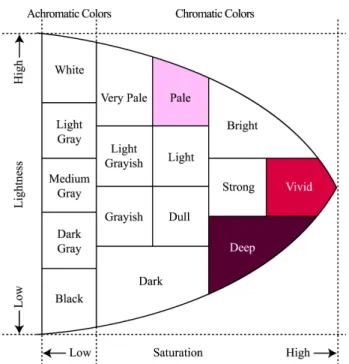
vertical axis. Hue refers to a pure color without tint or shade. Tone indicates the result of the interaction of two factors: lightness or value and saturation or chroma. In order to enhance the subjects’ discrimination performance, the 11 tones were classified into three groups and the representative tone of each group was chosen: vivid, pale, and deep. Colors in these three tones have differences in their lightness (value) and saturation (chroma) parameters. As presented in Figure 2, the color lightness increases from deep to vivid and then to pale tones while color saturation increases from pale to deep and then to vivid tones. Eventually, the experimental color samples consisted of 30 chromatic colors (10 hues x 3 tones) and 3 achromatic colors (white - N9.5, medium gray - N6, and Black).
Figure 2. IRI color tone classification according to lightness and saturation
2.3. Procedure
The IRI Hue and Tone 120 color system has two versions based on the RGB and CMYK color models.
The 33 color samples selected from the system were displayed by the corresponding RGB values on a computer monitor whose brightness and contrast levels
R YR Y GY G BG B PB P RP N Vivid
(R,G,B) 202,0,63 245,151,0 243,217,0 171,206,37 0,164,109 0,132,127 0,125,163 44,110,191 117,52,142 194,68,140 255,255,255 Pale
(R,G,B) 244,205,201 255,221,190 240,231,173 223,237,177 181,228,199 175,228,217 180,224,235 202,216,241 223,209,235 238,206,217 163,164,164 Deep
(R,G,B) 164,85,87 151,99,56 126,113,55 101,123,51 26,117,83 0,104,101 0,99,133 51,87,142 94,59,111 131,55,101 0,0,0 Table 1. RGB values of 33 color samples
were calibrated and optimized. Table 1 shows the 33 color samples that were selected from the IRI Hue and Tone 120 color system and their RGB values.
Meanwhile, commercial perfumes, which can be categorized to the same fragrance family based on their dominant fragrance materials or scents, are produced by mixing diverse/different fragrance materials. Thus it is difficult to represent the general scent features of the fragrance family with one or two particular commercial perfumes. Therefore, in order to identify the overall aspects of the effect colors on the association of the four fragrance families, in this research, the odor stimuli (fresh, floral, oriental, woody fragrance families) were suggested with written words instead of smelling particular commercial perfumes. In order to help participants understand the characteristics of the fragrance family, a brief explanation of their common fragrance materials was described in the first sheet of the survey, as shown in Table 2.
Although some of these fragrance material lists might evoke common visual color images of the material objects, these images helped the students associate more accurate visual-olfactory relationships. For each color sample on the monitor, subjects rated the degree-of-association with the four fragrance families individually on a 7-point Likert scale (7 = “very strong,”
4 = “moderate,” and 1 = “very weak”).
Four family Common fragrance materials 1. Fresh ripe fruits, crisp greens, refreshing water-based
aromas
2. Floral mixed bouquets of flowers 3. Oriental warm spices, vanilla, opulent flowers, patchouli
4. Woody nutty spices, wood blends, moss Table 2. Common fragrance materials of the four fragrance
families
3. Results
3.1. Fragrance associations across the color hues
This research analyzed whether the degree-of association of fragrances varies across the color hues. In order to exclude the tone variable within each hue group, the fragrance association ratings of colors in different tones (vivid, pale, and deep) within the same hue group were averaged. A representative fragrance association rating of each hue group per subject was then computed using Eq. (1):
⋯
(1)
where Hx
, C
ij, and n denote the averaged fragrance
association rating for the xth hue, the color stimulus in the ith hue and the jth tone, and the number of tones in each hue (n = 3 in this experiment), respectively.For each fragrance family, a one-way repeated measures ANOVA was performed (factor: 10 hues groups) because each subject was asked to measure the
Hues
Fragrance Families
Fresh Floral Oriental Woody
M SD M SD M SD M SD
R 3.71 1.04 5.28 0.83 4.13 1.01 3.07 1.06
YR 3.81 1.02 4.14 0.96 4.62 0.80 4.00 0.97
Y 3.96 0.83 4.27 0.76 4.70 0.80 4.04 0.76
GY 4.85 0.96 3.53 1.33 3.89 0.93 4.66 1.13
G 5.20 0.94 3.29 1.23 3.67 0.93 4.41 1.28
BG 5.29 1.00 3.02 1.33 3.66 1.08 4.07 1.03
B 5.65 0.92 2.90 1.16 3.49 1.22 3.08 1.36
PB 5.20 1.01 3.00 1.20 3.45 1.23 2.83 1.20
P 3.72 1.06 5.01 1.29 4.09 1.16 2.58 1.34
RP 3.85 1.39 5.82 1.06 4.20 1.00 2.15 0.96
F statistic 45.53 70.79 14.55 46.18
ε 0.43 0.36 0.48 0.47
p 0.00*** 0.00*** 0.00*** 0.00***
Factor: 10 hue groups, ε : corrected by Greenhouse-Geisser, *** p < 0.001
Table 3. Mean ratings of the degree-of association of the ten hue groups for four fragrance families and results of a one-way repeated measures ANOVA
degree-of-association ratings of all color stimuli sequentially. As presented in Table 3, differences across the ten hue groups were statistically significant at an alpha level of 0.001 for all four fragrance families. A pair-wise multiple comparison, the LSD (least significant difference) post hoc test was also run for each fragrance family. The mean differences (MD) between hues were mostly significant at an alpha level of 0.05 except the following hue pairs: (1) Fresh family: R-YR, R-P, R-RP, YR-Y, YR-P, YR-RP, Y-P, G-BG, G-PB, and BG-PB;
(2) Floral: R-P, YR-Y, BG-B, BG-PB, and B-PB; (3) Oriental: R-GY, R-P, R-RP, YR-Y, GY-G, GY-BG, G-BG, G-B, G-PB, BG-B, B-PB, and P-RP; and (4) Woody: R-B, R-PB, YR-Y, YR-BG, Y-BG, GY-G, and PB-P. In particular, the majority of the aforementioned hue pairs consisted of colors that were similar in terms of warm and cool color images, while some pairs had opposite images (e.g. R-GY in the oriental family, R-B, R-PB, YR-BG, and Y-BG in the woody family).
The line graphs in Figure 3 visualize the existence of differences in the mean association ratings of the four families across the ten hues together. From the statistical results and line graphs in Figure 3, this research found
Figure 3. Four lines showing the mean ratings of the degree- of-association of the ten hues for four fragrance families
the characteristic hue distribution patterns in terms of warm and cool color images for each fragrance type.
From the dominant colors for each fragrance family in Figure 3, it can be seen that the cooler the hues are, the
Fragrance pairs
Quadrants
I (strong-strong) II (strong-weak) III (weak-weak) IV (strong-weak)
1. Fresh-Floral - R, YR, Y, P, RP - GY, G, BG, B, PB
2. Fresh-Oriental - R, YR, Y, P, RP GY, G, BG, B, PB
3. Fresh-Woody GY, G, BG YR, Y R, P, RP B, PB
4. Oriental-Floral R, YR, Y, P, RP - GY, G, BG, B, PB -
5. Woody-Floral Y, YR R, P, RP B, PB GY, G, BG
6. Oriental-Woody Y, YR GY, G, BG B, PB R, P, RP
Table 4. Hue categories according to the four quadrants of the maps of the six fragrance pairs
stronger the associations of the fresh fragrance become, while the associations of the floral and oriental fragrances are the opposite.
In the case of the fresh fragrance, its fragrance association ratings increased as the color stimuli became cooler. Besides, the woody fragrance showed higher association ratings for cool colors (e.g., GY, B, and BG) even though its association ratings for other cool colors (e.g., B, PB, and P) were relatively low. On the other hand, the warmer the hues were, the stronger the associations of the floral and oriental fragrances became.
Compared to the other fragrance types, the oriental type had particularly small fluctuations in hue distribution.
Then, the aforementioned analysis results support the hypothesis that the associations of the four fragrances have characteristic distributions across the color hues [H. 1].
Meanwhile, in order to investigate the relationships among the four fragrances, the mean association ratings of the four fragrance families were pair-compared (see Figure 4 in the next page). Considering that point 4 on the 7-point Likert scale used in the experiment meant a moderate association, the pair (4, 4) on the maps was rebased as the origin of coordinates that divide the map into four quadrants. Interactive patterns between the associations ratings of the four fragrance types were identified via the distinguishable positions of the hues.
For example, in the case of the fresh-floral map, the four quadrants meant the following: I quadrant (+ strong fresh, + strong floral), II (+ weak fresh, - strong floral), III (- weak fresh, - weak floral), and IV (-
strong fresh, - weak floral). The hue distributions of
fresh-floral fragrances showed a strong negative correlation, and woody-floral fragrances also displayed a relatively weak negative correlation. Oriental-floral had a strong positive correlation, while fresh-woody had a weak positive correlation.
Table 4 categorizes the hues positioned in each quadrant of the four maps in Figure 4. Interestingly, fresh-woody and oriental-floral fragrances showed different color images, as in Figure 4. In particular, warm colors evoked strong oriental-strong floral scents, while cool colors evoked weak oriental-weak floral scents. However, this tendency of fresh-woody fragrances was contrary to one of the floral-oriental fragrances.
These hue categorizations can help perfume designers select colors that accurately represent the scent features of mixed fragrance materials. For example, if designers want to visualize perfumes that have strong fresh notes but weak floral notes together, colors in the range of green-yellow through purple-blue will be more effective in conveying the perfume’s proper scent image.
3.2. Fragrance associations across the color tones
Along with the color hues, this study analyzed whether color tones affect the degree-of-association of fragrances. For this purpose, the fragrance association ratings of colors that belong to the same tone group were averaged using Eq. (2):
⋯
(2)
Figure 4. Two-dimensional maps for the six fragrance pairs according to the mean intensity ratings
Tones
Fragrance Families
Fresh Floral Oriental Woody
M SD M SD M SD M SD
Vivid 4.98 0.733 4.29 0.68 3.84 0.73 3.04 0.75
Pale 4.84 0.65 4.60 0.70 4.13 0.78 3.05 0.84
Deep 3.75 0.78 4.00 0.73 4.00 0.73 4.38 0.57
F statistic LSD results
74.09 Vivid, Pale > Deep
158.44 Pale > Vivid > Deep
2.94 Pale > Vivid
125.15 Deep > Vivid, Pale
ε - - 0.856 0.88
p 0.00*** 0.00*** 0.065 0.00***
Factor: three tone groups, ε : corrected by Greenhouse-Geisser, *** p < 0.001 Tone group differences significant at p < 0.05 by the LSD post hoc test
Table 5. Mean ratings of the degree-of association of three tone groups for four fragrance families and results of one-way repeated measures ANOVA
where Tx
, C
ij, and n denote the averaged fragrance
association rating for the xth tone, the color stimulus in the ith hue and the jth tone, and the number of hues in each tone (n = 10 in this experiment), respectively.This experiment used the visual stimuli that were categorized into three tone groups (including vivid, pale, and deep). Thus, each subject was characterized by averaged association ratings for three tone groups. Based on the averaged association ratings, a one-way repeated measures ANOVA was performed (factor: three tone groups). The LSD post hoc test was also performed to detect significant differences (at p < 0.05) between the tones. Relevant statistics in Table 5 show significant differences in the fragrance association ratings across the three tones, except for the oriental fragrance family. The oriental fragrance association ratings across the tones also had no significant difference statistically. The four lines in Figure 5 illustrate the averaged fragrance association ratings of 67 subjects alongside the tone groups.
In the case of the fresh fragrance, the mean association value of the vivid tone was the highest (vivid
= 4.98 > pale = 4.84 > deep = 3.75) and the LSD test indicated that the deep tone was statistically different (smaller) from the other two tones. The subjects associated a stronger fresh scent from more vivid color tones. In particular, the perceptual dimension of the floral fragrance association ratings varied systematically
with the lightness attribute of tone (pale = 4.60 > vivid
= 4.29 > deep = 4.00) with statistically significant differences between the three groups. Contrary to the fresh and floral fragrances, the deep tone (4.38) was associated with the strongest woody scent. Darker colors even enhanced the sense of smelling woody fragrances.
Meanwhile, saturation level of the three tone groups increased from pale to deep and then to vivid tones.
Even though the oriental family had no significant statistic difference in tones and its associating ratings of the three tones were slightly different, the oriental family had a negative linear relationship with the saturation attribute of tone. That is, the subjects associated stronger oriental scents with more unsaturated colors contrary to the fresh scent. Based on the aforementioned results, this study partially supports the hypothesis that the associations of the four fragrances vary systematically with the color tones (lightness and saturation attributes) [H. 2].
Colors
Fragrance Families
Fresh Floral Oriental Woody
M SD M SD M SD M SD
White (W) 5.37 1.69 4.18 1.60 4.34 1.68 2.39 1.46
Medium Gray (MG) 2.76 1.50 2.10 1.26 4.31 1.55 3.90 1.94
Black (B) 1.72 1.31 1.70 1.47 4.04 2.21 4.30 2.20
F statistic LSD results
92.84 W > MG >B
63.94 W > MG > B
0.74 -
13.38 B > MG >B
ε 0.70 0.67 0.74 -
p 0.00*** 0.00*** 0.441 0.00***
Factor: three achromatic colors, ε : corrected by Greenhouse-Geisser, *** p < 0.001 Achromatic color group differences significant at p < 0.05 by the LSD test
Table 6. Mean ratings of the degree-of association of three achromatic color groups for four fragrance families and results of a one-way repeated measures ANOVA
Figure 5. Four lines showing the mean ratings of the degree- of-association of the three tones for four fragrance families
3.3. Fragrance associations across the achromatic colors
Together with the above analyses of the relationships between the hue and tone of chromatic colors and fragrance associations, this study explored whether the
degree-of associations of the four fragrance families differed across the achromatic colors that have a different degree of lightness.
For each fragrance, a one-way repeated measures ANOVA was performed (factor: three achromatic colors).
In conjunction with the ANOVA, the LSD test was conducted to determine whether the mean intensities for the achromatic colors differed at the 0.05 significance level for each fragrance family. Relevant statistics in Table 6 revealed significant differences in fragrance intensities across the three achromatic colors for the three fragrances, except the oriental family. Figure 6 depicts the differences of association ratings among the three achromatic colors (white, medium gray, and black).
In the case of fresh and floral fragrances, the averaged association value of the white was the highest (white >
medium gray > black) and the LSD results indicated that the white group was statistically different (bigger) from the gray and black groups. On the contrary, the woody fragrance had the lowest value in the white group (black
> medium gray > black). These tendencies suggest that the lightness level of achromatic colors influences the degree of fragrance association for the fresh and floral fragrances (positively), as well as the woody fragrance (negatively), supporting [H. 2].
Figure 6. Four lines showing mean ratings of the degree- of-association of the three achromatic colors for four fragrance families
3.4. Gender differences in fragrance associations across colors
This research investigated whether gender influences on the association of fragrances across the colors. A mixed between-within subjects repeated measures ANOVA was conducted for each fragrance family (male : female = 32 : 35 subjects). The analysis revealed that gender difference was statistically significant at an alpha level of 0.05 for the fresh (F1,65 = 5.15, p = 0.027) and floral (F1,65 = 4.18, p = 0.045) families while the oriental (F1,65 = 0.62, p = 0.434) and woody (F1,65 = 0.76, p = 0.3854) families were not, partially supporting [H.3].
In this vein, Figure 7 illustrates the mean fragrance association ratings of the two gender groups across the ten hues and the three tones, especially for the fresh and floral families. Female subjects associated stronger fresh fragrance for all the hues with the exception of red and red-purple and all the tones. For the floral family, which dominates products targeting females, especially in the perfume industry, male subjects rated a higher degree of association to the hues (in range of yellow through purple-blue) and the vivid and deep tones.
4. Discussions and conclusions
The purpose of this experiment was to examine the cross-modal association between the color hue-tone and the fragrance family. The results showed that the fragrance association ratings varied systematically with the hue and tone of color, even though it did not have a consistent pattern of variation for all four fragrances.
Among the fragrance types, the oriental fragrance showed no distinctive patterns for variations in the hue and tone of the color stimuli due to the subjects’ lack of knowledge and experience with oriental fragrance materials. Otherwise, the subjects might have simultaneously associated more various types of fragrance materials with the oriental type. Besides, the associated fragrance materials for the other fragrance types might be more concrete and specific. Indeed, perfumes in the floral and fresh families have fragrance materials whose scents are more recognizable and can more easily evoke common color images (e.g., the floral family-flowers, the fresh family-water and green leaves).
The fresh and floral families, which are more popular and familiar fragrances with subjects in their early 20s, showed statistically significant gender differences in the degree-of-association of the fragrances across the hues and tones. Moreover, interactive patterns (see Figure 5), which were discovered from the associated intensity distributions of the four fragrance types across the ten hues, provide practical color design guidelines to designers who create appropriate color palettes for perfumes mixed with diverse types of fragrances.
Meanwhile, applying the identified links between colors and fragrances to real perfume product design can be somewhat inaccurate because the color stimuli represented in the RGB color system were used in the experiment. However, the major findings of this research suggest effective perfume design guidelines about hue-tone dimensions as follows:
Figure 7. Comparing the mean ratings of two gender groups across the hues and tones for the fresh and floral families (1) For the three fragrances, except for the oriental
type showing somewhat uncharacteristic links between colors and fragrances in this experiment, their cross-modal relationships between color and fragrance appear to be dimensional according to the warm-cool image of hues and tones (especially, the lightness attribute).
(2) As colors, which are applied to commercial perfume bottles and packaging, become warmer and brighter, the associated floral scents will be stronger, while the woody scents will be less associated.
(3) People tend to associate stronger fresh scents from
more vivid and brighter cool colors while the darker colors become, the more weakly fresh scents are evoked.
In conclusion, this research supported the notion that visual color stimuli, which have hue and tone parameters, influence the degree-of-association of fragrances by identifying the existence of congruent links between color and fragrance. Furthermore, people’s pervious knowledge or experiences with perfumes in a certain type of fragrance family can affect the degree-of-association between color and fragrance, together with their gender and age. Therefore, this
cross-modal study can be expended to diverse types of populations in the future.
It is hoped that this research will be beneficial for companies that want to convey the unique characteristics and fragrances of their perfumes to consumers by designing their bottles and packages in more effective and attractive ways.
References
Ayabe-Kanamura, S., Schicker I., Laska, M., Hudson, R., Kobayakawa, T., & Saito, S. (1998). Differences in perception of everyday odors: a Japanese-German cross-cultural study. Chemical Senses, 23, 31-38.
Amoore, J. E. (1970). Molecular basis of odor. Charles Thomas.
Chiazzaru, S. (1998). The complete book of color. Barnes
& Noble Book: New York.
Chain, W. S. (1982). Odor identification by males and females: predictions vs. performance. Chemical
Senses, 7, 129-142.
Demattè, M. L., Sanabria, D., & Spence, C. (2006).
Cross-modal associations between odors and colors.
Chemical Senses, 31, 531-538.
Déribéré, M. (1978). Relationship between perfumes and colors. Color Research & Application, 3, 115-116.
Doty, R. L., Applebaum, S., Zusho, H., & Settle, R. G.
(1985). Sex differences in odor identification ability:
a cross-cultural analysis. Neuropsychologia, 23, 667-672.
Edwards, M. (2008). Fragrances of the world: Parfums
du monde 2008 (24th ed.). Sydney: Fragrances of the
World.Fragrances of the world 2008. (n. d.). Retrieved March 1, 2010 from http://www.fragranceoftheworld.com Gilbert, A. N., Martin, R. & Kemp, S. E. (1996).
Cross-modal correspondence between vision and olfaction: the color of smells. American Journal of
Psychology, 109, 335-351.
Halpern, D. F. (2000). Sex differences in cognitive abilities. Lawrence Erlbaum.
Hope, A. & Walch, M. (1990). The Color Compendium.
Van Nostrand Reinhold.
Ishihara, S. (1976). Ishihara’s tests for color blindness.
Kanehara.
Kemp, S. E. & Gilbert, A. N. (1997). Odor intensity and color lightness are correlated sensory dimensions.
American Journal of Psychology, 110, 35-46.
Kim, Y. J. (2008). Cross-modal associations between colors and fragrances for commercial perfume design.
Journal of the Science of Emotion and Sensibility, 11(3), 427-439.
Kobayashi, S. (1990). Color Image Scale. Kodansha International.
Korea Society of Color Studies (2002). Colorist: practice.
Kukje Publishing House.
Östernauer, R. A., Matthews, P. M., Jenkinson, M., Beckmann, C. F., Hansen, P. C., & Calvert, G. A.
(2005). Color of scents: chromatic stimuli modulate odor responses in the human brain. The American
Physiological Society, 93, 3434-3441.
Sagiv, N. & Ward, J. (2006). Cross-modal interactions:
lessons from synesthesia. Martinez-Conde, Macknik,
Martinesz. Alonso & Tse Progress in Brain Research, 155, 263-275.
Schifferstein, H. N. J. & Tangudjaja, I. (2004).
Visualizing fragrances through colours: the mediating role of emotions. Perception, 33, 11249-1266.
Sephora.com. (n.d.). Retrieved May 5, 2010 from http://www.sephora.com
Song, I. G. (2004). The story of perfume. Hangilsa.
Zarzon, M. & Stanton, D. T. (2009). Understanding the underlying dimensions in perfumers’ odor perception space as a basis for developing meaningful odor mapes. Attention, Perception, and Psychophysics,
71(2), 225-247.
Zellner, D. A., Bartoli, A. M., & Eckard, R. (1991).
Influence of color on odor identification and liking ratings. American Journal of Psychology, 104, 547-561.
Zellner, D. A. & Kautz, M. A. (1990). Color affects perceived odor intensity. Journal of Experimental
Psychology: Human Perception and Performance, 16,
391-397.Zellner, D. A., McGarry, A., Mattern-McClory, R., &
Abreu, D. (2007). Masculinity/femininity of fine
fragrances affects color-odor correspondences: a case for cognitions influencing cross-modal correspondences.
Chemical Senses, 33, 211-222.
원고접수:10.07.14 수정접수:10.08.17 게재확정:10.08.19