—10—
서 론
바리과 (family Serranidae) 중 능성어아과 (sub-family Epi- nephelinae)는 15속 159종으로서 산업적으로 매우 중요한 분류군이다 (Heemstra and Randall, 1993; Froese and Pauly, 2014). 이 중 대왕바리(Epinephelus lanceolatus)는 초대형 어
류로서 인도-서태평양 일대의 열대 및 아열대 해역에 서식 하며 (Heemstra and Randall, 1993; Nelson, 2006), 최근 우리 나라 제주도 연안에서도 1마리가 채집되어 보고된 바 있다 (Myoung et al., 2013).
세계자연보전연맹(IUCN)에서 발간한 적색목록(red list)을 참고하면 대왕바리는 현재 야생에서 절멸 위기에 처할 가능 성이 높은 취약 (VU, Vulnerable) 등급에 속한다 (Shuk Man and Chuen, 2006). 이에 따라 인위적인 자손생산을 통한 자 원확보가 필요하며, 이를 위해 우선적으로 유전 다양성을 유
Microsatellite 마커를 이용한 대왕바리(Epinephelus lanceolatus) 친어 집단의 가계도 분석 효율
김근식∙노충환∙Ahemad Sade
1∙방인철
2,*
한국해양과학기술원 동해연구소, 1말레이시아 사바주 수산청, 2순천향대학교 생명시스템학과
Effectiveness of Microsatellite Markers for Parentage Analysis of Giant Grouper (Epinephelus lanceolatus) Broodstockby Keun-Sik Kim, Choong Hwan Noh, Ahemad Sade1and In-Chul Bang2,* (East Sea Research Institute, Korea Institute of Ocean Science and Technology, Uljin, Korea; 1Department of Fisheries, Sabah, 4th Floor, Wisma Pertanian Sabah, Jalan Tasik, 88624 Kota Kinabalu, Sabah, Malaysia; 2Department of Life Science and Biotechnology, Soonchunhyang University, Asan 336-745, Korea)
ABSTRACT Giant grouper (Epinephelus lanceolatus) is a endangered species considered as a vul- nerable grade-organism in the International Union for Conservation of Nature (IUCN) red list. As a fun- damental baseline study for establishing a giant grouper broodstock management system, the effici- ency for parentage analysis was evaluated by using microsatellite makers previously available in this species. The eight microsatellites generated a total 52 alleles from 32 individuals, the mean expected heterozygosity was 0.663, and mean inbreeding coefficient was 0.011, consequently suggesting that the present broodstock has retained the high level of genetic diversity. However, our analysis also rec- ommended the collection of more broodfish for more stable brood line, since the estimated value of the effective population size was proven to be 35. The average probability of identity was 6.85×10--11. NE-2P and NE-PP of paternity non-exclusion probabilities were 0.00835 and 0.00027, respectively. As the result of principle coordinate analysis, the genotype of broodstock was not overlapped, suggesting that the management system of giant grouper based on eight selected microsatellite markers might be effective, although further validation with extended number of broodfish might also be needed in future. Data of present study could be a useful basis to avoid the unwanted selection of broodfish that possess close genetic relationship with current broodstock, and consequently to establish effective broodstock management system allowing the production of progeny with high genetic diversity.
Key words : Giant grouper, Epinephelus lanceolatus, broodstock management, microsatellite marker, parentage analysis
*Corresponding author: In-Chul Bang Tel: 82-41-530-1286, Fax.: 82-41-530-1256, E-mail: [email protected]
http://www.fishkorea.or.kr
지하고 있는 친어의 확보가 선행되어야 한다. 유전 다양성 의 감소는 유전적 부동과 병목현상으로 집단 근친도의 증가, 성장 저하, 질병 저항성 감소, 기형 증가 등의 악영향으로 이어질 가능성이 높다 (Frankham et al., 2004; Allendort et al., 2013). 친어의 유전자형을 고려하지 않은 무작위 교배 는 극단적인 유전자형의 손실을 야기할 수 있으며(Rudnick and Lacy, 2008), 이는 근교약세(inbreeding depression)로 이 어져 생산한 자손의 생존에 악영향을 미칠 수 있다. 특히 대왕바리는 자원량이 부족할 뿐만 아니라 개체 크기가 20 kg 이상일 때 교배가 가능하기 때문에 사용할 수 있는 친어 의 수가 제한적일 수밖에 없다. 따라서 효율적인 교배 지침 을 마련하기 위해서는 우선 친어의 유전자형을 파악할 수 있는 검증된 분자마커의 확보가 필요하다.
Microsatellite 마커는 2~4 bp 크기의 염기서열이 반복되는 부분으로서, 진핵생물 유전체에 전체적으로 존재한다 (Liu and Cordes, 2004; Liu, 2011). 특히 개체 간 차이를 나타낼 수 있을 만큼의 높은 다형성을 표현할 수 있으며, Hardy- Weinberg 평형 가설을 기초하기 때문에 집단유전학적 연구 에 널리 활용되고 있다(Tautz, 1989; Jarne and Lagoda, 1996).
따라서 microsatellite 마커는 멸종위기종을 대상으로 유전 다양성 유지를 위한 포획 사육(captive breeding) 프로그램을 개발하기 위해 다양하게 이용되고 있으며 (Schwartz et al., 2007), 또한 연어과 어류 (Koljonen et al., 2002; Beacham et al., 2004), 넙치 (Sekino et al., 2003), 참돔 (Perez-Enriquez et al., 1999), 전복(Evans et al., 2004; Li et al., 2004), 굴(Boudry et al., 2002; Li et al., 2006) 등의 유전적 관리에 적극 활용되 고 있다. 대왕바리 역시 종 보전과 집단유전학적 분석을 위 해서 microsatellite 마커가 개발되어 있다(Zeng et al., 2008;
Yang et al., 2011). 대만에서는 대왕바리의 근친교배를 방지 하고자 microsatellite 마커를 활용한 가계 분석 시스템을 개 발한 바 있지만 (Kou et al., 2014), 대왕바리뿐만 아닌 다른 바리과 어류의 microsatellite 마커를 이용하였다. 다른 종의 microsatellite 마커를 이용할 시 유전적 거리가 멀어 null allele 발생 가능성이 높으며, 이로 인해 가계도 분석에 오류 가 생길 수 있다(Wan et al., 2004).
따라서 본 연구는 대왕바리 친어의 효율적인 관리 시스 템 구축을 위한 기반 마련의 일환으로 기 개발되어 있는 동종의 microsatellite 마커를 이용하여 현재 확보되어 있는 대왕바리 친어를 대상으로 가계도 분석 효율을 조사하고자 하였다.
재료 및 방법
1. 친어 확보
본 연구에 이용한 대왕바리(Epinephelus lanceolatus)는 말
레이시아 사바주 타와우 (Tawau) 인근에서 포획하여 3.0×
6.0×3.0 m 가두리에서 사육한 개체로서 전장 95.9±9.06 cm, 체장 83.5±7.98 cm, 체중 20.3±6.28 kg의 32마리를 이용하 였다 (Fig. 1). 이용한 개체는 등 근육에 RFID microchip을 삽입하여 태깅을 수행하였다.
2. Genomic DNA 분리
Genomic DNA의 추출을 위해 가슴지느러미를 약 1 cm2 내외로 절단하여 99.9% ethanol에 담아 실험실로 운반하여 이용하였다. 운반한 지느러미는 멸균 3차 증류수로 세정하 고, TNES-urea buffer와 100 mg/mL 농도의 proteinase K (Sig- ma, USA)가 혼합된 용액에 담아 55�C에서 12시간 동안 반 응하였다. 이 반응액에 phenol : chloroform : isoamylalcohol (25 : 24 : 1)을 처리하여 단백질을 제거하였으며, 2-propanol 로 침전하였다. 침전된 pellet은 70% ethanol로 세척하고 멸 균 3차 증류수로 용해하였다. 추출한 genomic DNA는 Nano- Drop ND-1000 (Thermo Scientific Inc., Germany)을 이용하 여 양을 측정하고, 0.8% 아가로즈 젤에 전기영동 후 질을 확 인하여 실험에 이용하였다.
3. Microsatellite 마커 PCR 및 genotyping
본 연구에 이용한 microsatellite 마커는 이전의 연구들에 서 개발된 마커들을 대상으로 하였으며 (Zeng et al., 2008;
Yang et al., 2011), PCR 증폭이 원활하고, genotyping이 용이 한 8개를 최종 이용하였다(Table 1). PCR 반응은 20 μL 용적 의 AccuPower®PCR Premix Kit (Bioneer Inc., Korea)에 gen- omic DNA 20 ng과 마커별 프라이머 각각 5 μM을 넣은 후, Fig. 1.Giant grouper (Epinephelus lanceolatus) samples collected from Tawau region, Sabah, Malaysia.
Tawau Sabah
in Malaysia
94�C에서 10분간 초기 열변성 반응을 시킨 후, 94�C 30초, 각 마커별 annealing 온도 (ELM : 55�C, An : 60�C) 30초, 72
�C 30초의 순환 반응을 35회 실시하였으며, 최종 신장반응 은 72�C 15분간 수행하였다. 증폭된 산물은 1.5% 아가로즈 젤 상에서 전기영동으로 확인하였으며, 각 마커 밴드는 gen- otyping에 적정한 농도로 희석하였다. 희석한 PCR 산물과 GenescanTM400HD (ROX) size standard, HiDi mixture를 섞 고 95�C에서 5분간 변성시킨 후 ABI 3730xl DNA analyzer (Applied Biosystems, Inc., Foster City, CA, USA)를 이용하 여 명시된 매뉴얼에 따라 genotyping을 수행하였다.
4. 데이터 분석
대립유전자의 정확한 크기는 모두 Peak ScannerTMsoft- ware (ver. 1.0; Applied Biosystems, USA)으로 분석하였다.
대립유전자의 크기가 결정된 데이터는 MICRO-CHECKER 프로그램(ver. 2.2.3; Van Oosterhout et al., 2004)를 이용하여 null allele 유무, large allele dropout, scoring errors 유무에 대 한 검사를 실시하였다. Genepop 프로그램(ver. 4.0; Raymond and Rousset, 1995)을 이용하여 Hardy-Weinberg equilibrium (HWE) 이탈에 대한 분석을 수행하였다. 유효집단 크기 추 정은 LDNe 프로그램(ver. 1.31; Waples and DO, 2008)을 이 용하였다. 대립유전자 수, 기대치 이형접합률 (expected het- erozygosity, HE), 관찰치 이형접합률(observed heterozygosi- ty, HO) 및 부권 부정률 (non-exclusion probability)은 Cervus 프로그램(ver. 3.0; Marshall et al., 1998)을 이용하였다. 부권 부정률은 부모에 대한 정보가 전혀 없는 경우 (NE-1P), 한 쪽 부모에 대한 정보만 있는 경우 (NE-2P), 양친과 자손을 모두 알고 있는 경우(NE-PP)를 산출하였다. 추정된 F-통계
량을 이용하여 무작위, 반형매 그리고 전형매 교배집단으로 가정하여 유전자형의 동일한 개체 출현 확률은 API-CALC 프로그램(ver. 1.0; Ayres and Overall, 2004)을 이용하여 산출 하였다. 또한 확보한 대왕바리 친어 개체 간 유전형 중복 여부를 확인하고자 유전적 거리를 기반으로 주좌표 분석 (principal coordinates analysis; PCoA)을 수행하였으며, 이는 GenAlEx 프로그램(ver. 6.0; Peakall and Smouse, 2006)을 이 용하였다.
결과 및 고찰
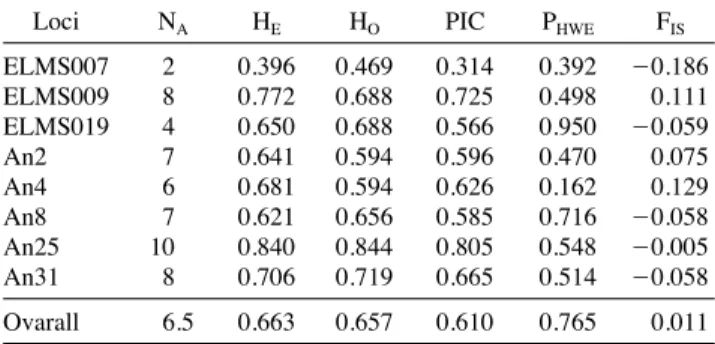
대왕바리 (Epinephelus lanceolatus) 32마리를 대상으로 8 개의 microsatellite 마커를 이용하여 확보된 유전자형을 MICRO-CHECKER 프로그램으로 분석한 결과 null allele, large allele dropout, scoring errors는 나타나지 않았다. 각 마 커에서 산출된 대립유전자 수, 기대치 이형접합율 (expected heterozygosity, HE), 관찰치 이형접합율 (observed heterozyg- osity, HO), 다형정보지수 (polymorphic information content, PIC) 및 Hardy-Weinberg equilibrium 통계치 및 근친교배계 수 (inbreeding coefficient, FIS)는 Table 2에 제시하였다. 총 52개의 대립유전자가 검출되었으며, 평균 대립유전자수는 6.5개로 마커에 따라 2~10개로 나타났다. 평균 기대치 이 형접합율은 0.663으로 0.396~0.840, 평균 관찰치 이형접합 율은 0.657로 0.469~0.844로 확인되었다. 대왕바리의 유전 다양성은 해산 어류 평균인 0.79에 비해 다소 낮았으나(De- Woody and Avise, 2000), 8종의 Epinephelus 속의 어류에서 확인된 0.36~0.62의 기대치 이형접합율에 비해 다소 높은 유전 다양성 지수를 보였으며(Koedprang et al., 2007), 근친 Table 1.Primers used for characterization of microsatellite loci in giant grouper, Epinephelus lanceolatus
Loci Accession number Repeat motif Primer sequences (5′→3′) Allele size range Reference ELMS007 EF607130 (AG)n… (AGC)n… F: TTTGCCTTTCCTAGACTTAT 337~339 Zeng et al., 2008
(CA)n… (CAG)n… R: CATCACATGATTCCTTTCTAT (AG)n
ELMS009 EF607131 (CA)n F: TTCCACAGCAATTAGCAGCA 249~267
R: TTTCCTCCCACAGTCCAAAG
ELMS019 EF607138 (TC)n… (TCC)n F: TCAGCAAGCACTTTTTGGAC 373~381
… (TC)n… (TG)n R: TGCTTCCTTCAGTGCATCAG
… (AC)n
An2 JN185623 (TG)nAG (TG)n F: TGCCCCTCCGACAACTAATA 218~242 Yang et al., 2011 R: AACGGGACTTGTGGTTTTTG
An4 JN185625 (CA)n F: GATGCACACAAGCACAAACA 180~200
R: GCAGGCTTATCCAAAACAGC
An8 JN185629 (CA)n F: ACCATGCATAAATGCCCACT 134~164
R: GCTCTCTGTCTCGCAAGGAT
An25 JN185646 (TG)n… (GT)n F: TCTGTGCTGATGCCGACTAC 147~183 R: CCGTGTTTGCACACTCTCTG
An31 JN185652 (GT)n F: TCATGTGTGCAAACGCTGTA 174~194
R: CAACATGGCCGAAACCTAAT
교배계수는 0.011로 낮고 유의하지 않았다. 따라서 현재 확 보된 대왕바리 친어는 유전 다양성을 비교적 잘 유지하고 있는 것으로 조사되었다. 하지만 대왕바리 친어 집단의 유 효집단 크기 (effective population size)는 35로 추정됨으로 써 자손 집단의 유전 다양성 감소에 영향을 미칠 수 있다 (Frankham et al., 2004; Palstra and Ruzzante, 2008). 유효 집 단 크기가 50 이하일 경우 근친교배에 따른 심각한 악영향 이 있을 수 있어(Franklin, 1980), 자손 집단의 유전 다양성 을 유지하고 근친교배를 방지하기 위해서는 지속적인 수집 을 통한 친어 개체수의 확대가 필요하다. 그리고 현재 제한 된 친어의 유효 집단 크기를 고려할 때 유전 다양성을 유지 하기 위해서는 무작위 교배보다는 유전적 거리가 먼 암수 친어 간 선택적인 1 : 1 교배를 여러 차례 수행하는 것이 바 람직할 것이다.
Microsatellite 마커의 다형성은 기본적으로 유전자 조합의
반복수에 의해 결정되며, 이것은 부모로부터 반반씩 물려받 는 멘델 유전법칙을 기반으로 하기 때문에 친자감별, 가계 도 분석 등의 연구에 큰 장점을 가지고 있다(McConnell et al., 1995; Sunnucks, 2000). 많은 바리과 어류는 암컷에서 수 컷으로 성 전환하는 자성선숙형 (protogynous) 생식 특성을 보유하고 있다(Bean et al., 2003; Oh et al., 2013). 이로 인해 일반적으로 한쪽 부모로부터 전달받는 미토콘드리아 DNA 영역의 염기서열을 분자마커로 이용할 시 오류를 범할 수 있다 (Kuo et al., 2014). 따라서 microsatellite 마커를 이용한 데이터베이스 구축은 친어의 체계적인 관리 측면에서 큰 장점을 가지고 있다고 할 수 있다. 본 연구에 이용한 8개의 microsatellite 마커 중 7개가 0.500 이상의 다형정보지수가 나타남은 물론 모든 마커가 Hardy-Weinberg equilibrium을 위배하지 않는 것으로 확인됨에 따라 친자확인, 가계도 분 석 등을 수행할 시 비교적 높은 식별력과 낮은 오류 확률을 가질 것으로 예상된다.
8개의 microsatellite 마커를 사용할 경우 동일한 유전자형 출현확률과 부권 부정률 (non-exclusion probability)에 대한 정보는 Table 3에 정리하였다. 본 마커 세트를 이용할 시 동 Table 2.Descriptive statistics summary of eight microsatellite loci
for giant grouper, Epinephelus lanceolatus
Loci NA HE HO PIC PHWE FIS
ELMS007 2 0.396 0.469 0.314 0.392 -0.186 ELMS009 8 0.772 0.688 0.725 0.498 0.111 ELMS019 4 0.650 0.688 0.566 0.950 -0.059 An2 7 0.641 0.594 0.596 0.470 0.075 An4 6 0.681 0.594 0.626 0.162 0.129 An8 7 0.621 0.656 0.585 0.716 -0.058 An25 10 0.840 0.844 0.805 0.548 -0.005 An31 8 0.706 0.719 0.665 0.514 -0.058 Ovarall 6.5 0.663 0.657 0.610 0.765 0.011 NA, number of allele; HE, expected heterozygosity; HO, observed hetero- zygosity; PIC, polymorphic information content; PHWE, significance of the probability test for deviation from expected Hardy-Weinberg proportions; FIS, inbreeding coefficient
Table 3.Paternity identity and combined non-exclusion probabili- ties based on eight microsatellite loci
Paternity identity Combined non-exclusion probabilities probabilities
PI PIhalf-sibs PIsibs NE-1P NE-2P NE-PP
6.59×10⁻¹¹ 2.74×10⁻⁸ 1.53×10⁻⁴ 0.07198 0.00835 0.00027 PI, probability of identity; PIhalf-sibs, probability of identity from half sibs; PIsibs, probability of identity from sibs; NE-1P, average non-exclusion probability for one candidate parent; NE-2P, average non-exclusion probability for one candidate parent given the genotype of a known parent of the opposite sex;
NE-PP, average non-exclusion probability for a candidate parent pair
Fig. 2.Principal coordinate analysis (PCoA) of 32 individuals giant grouper, Epinephelus lanceolatus based on Nei’s genetic distances.
PC1 (25.7%)
PC2(20.3%)
일한 유전자형 출현 확률은 무작위 교배집단(PI)에서는 6.59
×10-11, 반형매 교배집단 (PIsibs)은 2.74×10⁻⁸로 추정되었 고, 전형매 교배집단(PI)에서는 1.53×10⁻⁴로 추정되었다. 부 권 부정률은 부모에 대한 정보가 전혀 없는 경우(NE-1P)에 0.07198로 다소 높았으나, 한쪽 부모의 유전자형 확보 (NE- 2P) 또는 양친의 유전자형이 확보된 상황(NE-PP)에서 교배 에 활용할 시 부권 부정률은 각각 0.00835, 0.00027로 나타 났다. 대만의 대왕바리 친어 관리를 위한 microsatellite 마커 세트의 경우 한쪽 부모의 유전자형이 확보된 상황 (NE-1P) 에서의 부권 부정률이 0.00090으로서 (Kuo et al., 2014), 본 연구와 큰 차이를 보이지 않았다. 또한 개체 간 유전자형 중 복을 판단하기 위해 수행한 주좌표 분석 (principal coordi- nates analysis) 결과 확보한 32마리의 유전자형은 중복되지 않았다 (Fig. 2). 이 결과는 본 연구에 이용한 microsatellite 마커 조합으로도 개체 식별력이 높음을 의미하며, 친어의 유전자형 데이터베이스를 작성하여 관리할 시 반형매 및 무작위 교배집단의 경우 동일한 유전자형이 출현할 확률이 낮고, 한쪽 부모의 유전자형 또는 양친의 유전자형이 확보된 상황에서 교배에 활용할 시 친자감별 확률이 높을 것으로 기대된다.
따라서 현재까지 추정된 판별효율로 미루어 볼 때 본 연 구에 이용한 8개의 microsatellite 마커로도 유전자형 데이 터베이스를 기반으로 한 대왕바리 친어 관리 시스템 구축 이 가능할 것으로 판단된다. 또한 이러한 대왕바리 친어 관 리 시스템은 유전 다양성이 높은 자손 생산을 가능하게 할 뿐만 아니라 유전적으로 유사한 개체의 중복 확보를 방지 할 수 있어 친어 확보의 효율성을 높일 수 있을 것이다.
요 약
현재 IUCN의 취약 등급인 대왕바리(giant grouper, Epine- phelus lanceolatus) 친어의 효율적인 관리 시스템 구축을 위 한 기반연구로서 기 개발되어 있는 동종의 microsatellite 마 커를 이용한 가계도 분석 효율을 조사하였다. 대왕바리 친어 32마리를 8개의 microsatellite 마커로 분석한 결과 총 52개 의 대립유전자가 검출되었으며, 기대치 이형접합율은 0.663, 근친교배계수는 0.011로 조사되어 현재 확보된 대왕바리 친 어는 유전 다양성이 비교적 잘 유지되고 있었다. 하지만 유 효집단 크기가 35로 추정됨으로써 지속적인 친어 확보의 필요성을 보였다. 해당 마커를 이용한 동일 유전자형 출현 확률은 무작위 집단에서 6.85×10⁻¹¹그리고 한쪽 부모의 유전자형 확보 및 양친의 유전자형이 확보된 상태에서의 부권 부정률은 각각 0.00835, 0.00027로 나타났으며, 주좌표 분석 결과 친어의 유전자형은 중복되지 않았다. 따라서 본 연구에 이용한 8개의 microsatellite 마커로도 유전자형 데이
터베이스를 기반으로 한 대왕바리 친어 관리 시스템 구축 이 가능할 것이며, 이를 활용한 유전 다양성이 높은 자손 생 산 및 유전적으로 유사한 개체의 중복 확보를 방지할 수 있 어 친어 확보의 효율성을 높일 수 있을 것이다.
사 사
본 논문은 농림축산식품부, 해양수산부, 농촌진흥청, 산림 청 ‘Golden Seed 프로젝트 사업 (213004-04-2-SB510)’ 지원 에 의해 수행되었습니다.
인 용 문 헌
Allendort, F.W., G. Luikart and S.N. Aitken. 2013. Conservation and the Genetics of Populations. Wiley-Blackwell, Oxford, U.K.
Ayres, K.L. and A.D.J. Overall. 2004. API-CALC 1.0: a computer program for calculating the average probability of identity allowing for substructure, inbreeding and the presence of close relatives. Mol. Ecol. Notes, 4: 315-318.
Beacham, T.D., M. Lapointe, J.R. Candy, K.M. Miller and R.E. Wi- thler. 2004. DNA in action: rapid application of DNA varia- tion to sockeye salmon fisheries management. Conserv. Gen., 5: 411-416.
Bean, K., B.D. Mapstone, C.R. Davies, C.D. Murchie and A.J. Willi- ams. 2003. Gonad development and evidence of protogyny in the red-throat emperor on the Great Barrier Reef. J. Fish Biol., 62: 299-310.
Boudry, P., B. Collet, F. Cornette, V. Hervouet and F. Bonhomme.
2002. High variance in reproductive success of the Pacific oyster (Crassostrea gigas, Thunberg) revealed by microsatel- lite-based parentage analysis of multifactorial crosses. Aqu- acult., 204: 283-296.
DeWoody, J.A. and J.C. Avise. 2000. Microsatellite variation in mar- ine, freshwater and anadromous fishes compared with other animals. J. Fish Biol., 56: 461-473.
Evans, B., J. Bartlett, N. Sweijd, P. Cook and N.G. Elliott. 2004. Loss of genetic variation at microsatellite loci in hatchery produc- ed abalone in Australia (Haliotis rubra) and South Africa (Haliotis midae). Aquacult., 233: 109-127.
Frankham, R., J.D. Ballow and D.A. Briscoe. 2004. A primer of con- servation genetics. Cambridge University Press, Cambridge, U.K.
Franklin, I.R. 1980. Evolutionary change in small populations. In:
Soule, M.E. and B.A. Wilcox (eds.), Conservation Biology:
An Evolutionary Ecological Perspective. Sinauer Associates, Sunderland, Massachusetts.
Froese, R. and D. Pauly. (eds.). 2014. FishBase. World Wide Web electronic publication. www.fishbase.org (version 02/2014).
Heemstra, P.C. and J.E. Randall. 1993. FAO species catalogue. Vol.
16. Groupers of the world (family Serranidae, subfamily Epinephelinae). An annotated and illustrated catalogue of the grouper, rockcod, hind, coral grouper and lyretail species known to date. FAO Fish. Synop., 125: 382 p.
Jarne, P. and P.J.G. Lagoda. 1996. Microsatellites, from molecules to populations and back. Trends Ecol. Evol., 11: 424-429.
Koedprang, W., U. Na-Nakorn, M. Nakajima and N. Taniguchi. 2007.
Evaluation of genetic diversity of eight grouper species Epi- nephelus spp. based on microsatellite variations. Fish. Sci., 73: 227-236.
Koljonen, M.L., J. Tähtinen, M. Säisä and J. Koskiniemi. 2002. Ma- intenance of genetic diversity of Atlantic salmon (Salmo salar) by captive breeding programmes and the geographic distribution of microsatellite variation. Aquacult., 212: 69- 92.
Kuo, H.C., H.H. Hsu, C.S. Chua, T.Y. Wang, Y.M. Chen and T.Y.
Chen. 2014. Development of pedigree classification using microsatellite and mitochondrial markers for giant grouper broodstock (Epinephelus lanceolatus) management in Tai- wan. Mar. Drugs, 12: 2397-2407.
Li, Q., C. Park, T. Endo and A. Kijima. 2004. Loss of genetic varia- tion at microsatellite loci in hatchery strains of the Pacific abalone (Haliotis discus hannai). Aquacult., 235: 207-222.
Li, Q., H. Yu and R. Yu. 2006. Genetic variability assessed by micro- satellites in cultured populations of the Pacific oyster (Cras- sostrea gigas) in China. Aquacult., 259: 95-102.
Liu, Z. 2011. Genomic variations and marker technologies for geno- me-based selection. In: Liu, Z. (ed.), Next Generation Sequ- encing and Whole Genome Selection in Aquaculture. Wiley- Blackwell, Oxford, U.K.
Liu, Z.J. and J.F. Cordes. 2004. DNA marker technologies and their applications in aquaculture genetics. Aquacult., 238: 1-37.
Marshall, T.C., J. Slate, L.E.B. Kruuk and J.M. Pemberton. 1998.
Statistical confidence for likelihood-based paternity inferen- ce in natural populations. Mol. Ecol., 7: 639-655.
McConnell, S., L. Hamilton, D. Morris, D. Cook, D. Paquet, P. Bent- zen and J. Wright. 1995. Isolation of salmonid microsatellite loci and their application to the population genetics of Cana- dian east coast stocks of Atlantic salmon. Aquacult., 137:
19-30.
Myoung, J.-G., C.-B. Kang, J.M. Yoo, E.K. Lee, S. Kim, C.-H. Jeong and B.-I. Kim. 2013. First record of the giant grouper Epine- phelus lanceolatus (Perciformes: Serranidae: Epinephelinae) from Jeju island, South Korea. Fish. Aquat. Sci., 16: 49-52.
Nelson, J.S. 2006. Fishes of the World. Fourth edition. John Wiley
& Sons, Inc., 601pp.
Oh, S.R., H.C. Kang, C.H. Lee, S.W. Hur and Y.D. Lee. 2013. Sex reversal and masculinization according to growth in long- tooth grouper Epinephelus bruneus. Dev. Reprod., 17: 79- 85. (in Korean)
Palstra, F.P. and D.E. Ruzzante. 2008. Genetic estimates of contem-
porary effective population size: what can they tell us about the importance of genetic stochasticity for wild population persistence? Mol. Ecol., 17: 3428-3447.
Peakall, R. and P.E. Smouse. 2006. Genealex 6: Genetic analysis in excel. Population genetic software for teaching and research.
Mol. Ecol. Notes, 6: 288-295.
Perez-Enriquez, R., M. Takagi and N. Taniguchi. 1999. Genetic vari- ability and pedigree tracing of a hatchery-reared stock of red sea bream (Pagrus major) used for stock enhancement, based on microsatellite DNA markers. Aquacult., 173: 413-423.
Raymond, M. and F. Rousset. 1995. GENEPOP (version 1.2): popu- lation genetics software for exact tests and ecumenicism. J.
Hered., 86: 248-249.
Rudnick, J.A. and R.C. Lacy. 2008. The impact of assumptions about founder relationships on the effectiveness of captive breed- ing strategies. Conserv. Gen., 9: 1439-1450.
Schwartz, M.K., G. Luikart and R.S. Waples. 2007. Genetic monitor- ing as a promising tool for conservation and management.
Trends Ecol. Evol., 22: 25-33.
Sekino, M., K. Saitoh, T. Yamada, A. Kumagai, M. Hara and Y.
Yamashita. 2003. Microsatellite-based pedigree tracing in a Japanese flounder Paralichthys olivaceus hatchery strain:
implications for hatchery management related to stock en- hancement program. Aquacult., 221: 255-263.
Shuk Man, C. and N.W. Chuen (Grouper & Wrasse Specialist Group).
2006. Epinephelus lanceolatus. The IUCN Red List of Threatened Species. Version 2014.3. <www. iucnredlist.
org>. Downloaded on 27 March 2015.
Sunnucks, P. 2000. Efficient genetic markers for population biology.
Trends Ecol. Evol., 15: 199-203.
Tautz, D. 1989. Hypervariability of simple sequences as a general source for polymorphic DNA markers. Nucl. Acids Res., 17: 6463-6471.
Van Oosterhout, C., W. Hutchinson, D. Willds and P. Shipley. 2004.
MICRO-CHECKER: software for identifying and correct- ing genotyping errors in microsatellite data. Mol. Ecol. Notes, 4: 535-538.
Wan, Q.-H., H. Wu, T. Fujihara and S.-G. Fang. 2004. Which gene- tic marker for which conservation genetics issue? Electro- phor., 25: 2165-2176.
Waples, R.S. and C. Do. 2008. LDNE: a program for estimating effective population size from data on linkage disequilibri- um. Mol. Ecol., 8: 753-759.
Yang, S., L. Wang, Y. Zhang, X.C. Liu, H.R. Lin and Z.N. Meng.
2011. Development and characterization of 32 microsatel- lite loci in the giant grouper Epinephelus lanceolatus (Ser- ranidae). Genet. Mol. Res., 10: 4006-4011.
Zeng, H.S., S.X. Ding, J. Wang and Y.Q. Su. 2008. Characterization of eight polymorphic microsatellite loci for the giant group- er (Epinephelus lanceolatus Bloch). Mol. Ecol. Resour., 8:
805-807.