http://dx.doi.org/10.12925/jkocs.2017.34.1.91
치자(
Gardenia jasminoides
Ellis) 씨 추출물의 질소산화물 소거능 및 지질과산화 저해능에 관한 연구진동혁․오다영․이영근․김한수
✝ 부산대학교 식품공학과(2017년 2월 7일 접수: 2017년 3월 27일 수정: 2017년 3월 27일 채택)
Effect of Extracts produced from Gardenia jasminoides Seed Using Different Types of Solvents on Nitrogen Oxide Scavenging Activities
and Lipid Peroxidation Inhibition
Dong-Hyeok Jin․Da-Young Oh․Young-Geun Lee․Han-Soo Kim✝
Department of Food Science and Technology, Pusan National University, Miryang 50463, Korea (Received February 7, 2017; Revised March 27, 2017; Accepted March 27, 2017)
요 약 : 치자 씨 추출물이 항산화력 및 지질과산화 저해능에 미치는 영향을 알아 보고 치자의 기능성 식품 소재로서의 가치를 검토하기 위하여 실험을 수행한 결과, 치자 씨의 anthocyanin 함량을 측정한 결과 2.201±0.516 mg/100 g DW로 나타났으며, 치자 씨의 용매 별 추출 수율은 chloroform:methanol (CM, 2:1, v/v) 36.39%, 70% ethanol (27.32%),
n
-butanol (26.23%) 로 확인되었다. 추출 용매 별 항산화 활성은 농도(0.2, 0.4, 0.6 mg/mL)가 증가할수록 유의적으로 증가하였으며 positive control로 사 용된 ascorbic acid, BHA, trolox 보다는 낮은 활성이 관찰되었다. 치자 씨의 total phenol 함량(mg CAE/g)은 CM (32.50), 70% ethanol (30.09),n
-butanol (11.07) 추출물 순으로n
-butanol 추출물에 서 가장 적은 함량을 보였으며, Nitric oxide (NO) radical 소거능에서는 CM (76.97~84.24%), 70%ethanol (74.10~79.99%),
n
-butanol (30.66~37.15%) 추출물 순으로 관찰되었다. Nitrite (NO2) 소거능 은 CM (33.53~43.23%), 70% ethanol (32.40~35.98%),n
-butanol (24.72~28.14%) 순으로 관찰되었 다. β-carotene 탈색 저해능은 CM (23.73~44.70%), 70% ethanol (22.03~41.32%), n-butanol (16.00~27.87%) 순으로 확인되었다. Reducing power (optical density)는 70% ethanol (0.073~0.182), CM (0.057~0.154),n
-butanol (0.028~0.079) 순으로 관찰되었다. 지질과산화 저해능은 씨 추출물 중 CM (53.26~76.56%), 70% ethanol (52.97~76.56%),n
-butanol (38.54~53.33%) 순으로 나타났다. 이 에, 치자씨 추출물은 천연 항산화제로서 기능성 식품의 가치가 높을 것으로 판단된다.주제어 : 치자씨, 항산화 활성, 안토시아닌, 총 페놀
✝
Corresponding author
(E-mail: [email protected])
Abstract : The object of this study was to measure the bioactivity and antioxidant activity of seed from
Gardenia jasminoides
Ellis fructus (GJE). GJE seeds were performed the extraction of them by chloroform:methanol (CM, 2:1, v/v), 70% ethanol andn
-butanol. Sequentially, total phenol content, nitrogen oxide scavenging activity, antioxidant activity and lipid peroxidation inhibition activity of the extracts were investigated. Solvent extract bioactivity of increasing concentrations (0.2, 0.4, 0.6 mg/mL) were significantly increased (p
<0.05). GJE seed extracts showed lower activity than positive control (ascorbic acid, BHA, trolox). The highest concentration of CM extracts was obtained in the same manner as the results of analysis of the total phenol contents of the GJE seed, and 70% ethanol extract showed the highest activity of reducing power.The water soluble carotenoids crocin and flavonoid were effective. As a result of this experiment.
the seeds of GJE showed excellent antioxidant, and lipid peroxidation inhibitory properties.
Keywords : seed of Gardenia jasminoides Ellis fructus, antioxidant activity, anthocyanin, total phenol
1. 서 론
최근 식품은 단순한 영양원이 아닌 기능성을 고려하게 되어 건강의 중요성과 인간수명 연장에 따라 건강기능식품에 대한 관심과 소비가 증가하 는 추세이다[1]. 여러 질병의 주된 원인으로 인체 내의 호흡과정 중 발생하는 산화 생성물의 free radical은 reactive oxygen species (ROS)와 reactive nitrogen species (RNS)로 다양하게 존 재하는 것으로 보고되어 있다[2]. 특정 산화질소 합성효소에 의해 생성되는 RNS는 nitric oxide (NO•), nitrite (NO2-), peroxynitrite (ONOO-)를 형성하여 이러한 free radical을 가 진 물질은 불안정하고 홑 전자를 가지므로 반응 성이 매우 높은 것으로 알려져 있다[3]. ROS와 RNS는 그 안정성을 확보하기 위해 필요한 전자 를 포착하여 다른 화합물과 신속히 반응하기 때 문에 지질 과산화 및 연쇄 반응을 개시하여 세포 막 파괴, DNA 손상 등과 함께 여러 산화에 의 해 여러 생성물들을 생성하여 암을 유발하고 노 화와 관련해 생리적 장애를 일으킨다고 알려져 있다[4]. 식물체의 경우 이차 대사산물의 방어체 계, 효소와 같은 보호 기작이 발달되어 있어서 식물체에서 항산화 물질을 탐색, 연구하는 것은 중요한 의미를 지닌다고 한다[5].
치자는 꼭두서니과(
Rubiaceae
)에 속하는 치자 나무(Gardenia jasminoides
Ellis)의 열매로 국내 를 비롯한 중국, 일본, 대만 등의 기온이 따뜻한 지방에 자생하고 있다. 치자의 주요 생리활성물질은 수용성 carotenoids인 crocin으로 알려져 있으 며, Lee et al.(2005)의 연구에서는 crocin과 그 대사산물인 crocetin이 동물 실험에서 췌장의 lipase 활성을 억제하여 지질 흡수를 감소시키는 것으로 보고되고 있어 고지방 식이로 인한 고지 질혈증(hyperlipidemia)을 개선 할 수 있다는 것 을 시사하였다[6]. 또한 그밖에 항산화[7], 항우울 [8], 항암[9] 등 여러 가지 효과가 있는 것으로 밝혀져 있다. Polyphenol과 같은 phytochemical 은 과일이나 야채와 같은 식물체에 많이 함유되 어 있어 생체 내 산화 생성물 제거, 유전자 조절, 면역체계 자극과 같은 효과가 있어 그 효과가 주 목 받고 있으며, 이러한 phenolic 성분을 함유하 는 과일이나 야채와 같은 식품으로부터의 항산화 활성에 대한 연구가 활발히 진행되고 있다 [10-11].
국내에는 치자를 합성색소를 천연색소로 대체 하여 이용하기 위한 식품 및 섬유산업에서의 시 도와 제품에 첨가 시 변화하는 물성적 특성에 관 한 연구 동향이 대다수이며[12], 치자의 crocin 성분에 대한 연구 또한 많이 진행되어 있지만 치 자를 용매 별로 추출한 후 total phenol 함량 측 정과 그에 따른 생리활성을 측정하여 비교한 연 구는 아직 충분하지 않은 실정이다.
이에 따라 본 연구에서는 치자의 씨의 anthocyanin 함량을 측정하고 70% ethanol, chloroform:methanol (CM, 2:1, v/v) 및
n
-butanol의 용매 별로 추출하여 total phenol 함량을 측정한 뒤 질소산화물 소거능(nitric oxidescavenging activity, nitrite scavenging activity), 항산화능(antioxidant activity by β-carotene bleaching assay), 환원력(reducing power), 지질 과산화 저해(lipid peroxidation inhibition)를 측 정하여 치자의 추출 용매에 따른 생리활성을 비 교하여 생활습관병 예방과 건강기능 식품 개발의 목적으로 이들의 소비 효율성을 높이고 이에 대 한 기초자료를 제시함으로써 고부가 가치의 천연 항산화제의 이용 가능성을 검토하고자 하였다.
2. 재료 및 방법
2.1. 실험 재료본 실험에 사용된 시료인 치자(
Gardenia jasminoides
Ellis)는 경상남도 남해군에서 2014 년 11월에 수확하여 반 건조 상태로 되어있는 시 료를 남해 소재 약재상에서 2015년 1월에 구입 하였다. 구입한 치자의 씨를 분리한 뒤 자연 건 조시켜 분쇄기(HMF-3250S, Han-Il Co., Seoul, Korea)에 분쇄하여 분말로 만든 다음 deep freezer (DF-8514, Il-Shin BioBase Co., Daegu, Korea)에 –80℃로 저장하여 실험에 사용하였다.2.2. Anthocyanin 함량 측정
치자 씨의 anthocyanin 함량은 pH-differential method를 사용하여 측정하였다[13]. 건조된 치자 씨 분말 0.2 g에 methanol-1M HCl (85:15, v/v) 15.0 mL를 가하여 30분 동안 혼합한 뒤 여 과(filter paper, Advantec, No.2, Tokyo, Japan) 하여 분석 시료로 사용하였다. 시료 1.0 mL에 0.025 M potassium chloride buffer (pH 1.0) 3.0 mL를 가하고 또 다른 시험관에 시료 1.0 mL와 0.4 M sodium acetate buffer (pH 4.5) 3.0 mL를 가한 후 암실에 20분간 방치하여 UV/Vis spectrophotometer (SP-200, Analytik Jena Co., Jena, Germany)를 사용하여 510 nm 및 700 nm에서 흡광도를 측정 하였다. 치자 씨 의 anthocyanin 함량은 cyanidin-3-glucoside의 몰 흡광계수(ℇ=26,900 M-1cm-1)를 이용하여 mg/100 g DW (dry weight)로 계산하여 나타하 였다.
2.3. 시료의 추출
시료의 추출은 동결 저장된 치자 씨 분말 100 g 씩 취하여 70% ethanol, chloroform:
methanol (CM, 2:1, v/v),
n
-butanol 용매를 각 10배 가하여(1:10, w/v) 24시간씩 2회 추출한 뒤 여과(filter paper, Advantec, No.2, Tokyo, Japan)하였다. 각 추출물은 rotary vacuum evaporator (Hei-VAP Advantage, Heidolph Co., Germany)를 이용하여 40℃에서 감압 농축 하여 용매를 제거한 후, 실험에 사용하였으며, 시 료의 수율은 추출 전 시료 중량에 대한 추출 후 건조 중량 백분율(%)로 나타내었다[14].2.4. Total phenol 함량 측정
Total phenol 함량은 Folin-Denis` 방법을 변 형하여 실험하였다[15]. 시료 추출액 1.0 mL에 증류수 4.0 mL을 넣고, Folin-Denis reagent (Sigma-Aldrich, St. Louis, USA) 0.5 mL를 가 한 후, 잘 섞어 3분간 실온에 방치한 뒤 10%
sodium carbonate solution 0.5 mL을 첨가하여 실온에 1시간 방치한 후 750 nm에서 흡광도를 측정하였다. 표준물질로는 caffeic acid (Sigma-Aldrich, St. Louis, USA)를 사용하여 시 료 1 g당 mg CAE (mg of caffeic acid equivalents)로 나타내었다.
2.5. Nitric oxide (NO) radical scavenging acticity 측정
Nitric oxide (NO) radical 소거능은 Rao의 방 법을 변형하여 측정하였다[16]. 용매별 추출물 각 농도의 시료 2.0 mL에 10 mM sodium nitroferricyanide (III) dihydrate와 0.2 M PBS (phosphate buffered saline, pH 7.4) 3.0 mL를 넣어 잘 섞은 후 25℃ water bath에서 150분간 반응시켰다. 반응액 0.5 mL에 1% sulfanilamine 과 2% H3PO4 1.0 mL를 섞어 10분간 방치한 뒤 0.1% N-(1-Naphthyl) ethylenediamine dihydrochloride 1.0 mL를 가하여 25℃ water bath에서 30분간 방치하여 540 nm에서 흡광도 를 측정하였다. Positive control은 trolox (6-hydroxy-2,5,7,8-tetramethylchroman-2-car boxylic acid, Sigma-Aldrich, St. Louis, USA)를 사용하였으며 치자 씨의 NO 소거능은 백분율로 계산하여 나타내었다.
2.6. Nitrite (NO2) scavenging activity 측정 Nitrite 소거능은 Lim et al.의 방법을 변형하 여 측정하였다[17]. 시료 2.0 mL와 1 mM sodium nitrite 1.0 mL를 혼합하여 0.2 M
citrate buffer (pH 2.5) 7.0 mL를 첨가한 후, 3 7℃로 1시간 동안 반응시켰다. 반응액 1.0 mL에 2% acetic acid 3.0 mL를 넣은 후, Griess reagent (1% sulfanilic acid 및 30% acetic acid:1% 1-naphthylamine 및 30% acetic acid, 1:1, v/v) 0.4 mL와 15분간 반응시켜 520 nm에 서 흡광도를 측정하였다. Positive control로 BHA를 사용하였으며 백분율로 나타내어 표시하 였다.
2.7. β-carotene bleaching을 이용한 antioxidant activity 측정
β-carotene 탈색을 이용한 치자 씨의 항산화 활성은 Kato et al.의 방법을 변형하여 측정하였 다[18]. Chloroform 10.0 mL에 β-carotene 1 mg을 녹인 용액 1.0 mL를 round-bottomed flask에 넣은 후 linoleic acid 20 mg과 Tween 40 200 mg을 가하여 충분히 혼합하였다. 남아있 는 chloroform을 40℃의 rotary vacuum evaporator로 제거한 후 남아있는 잔여물을 증류 수 100 mL를 넣고 유화시킨 emulsion을 실험직 전에 조제하여 사용하였다. β-carotene-linoleic acid emulsion 4.0 mL와 농도별 시료추출물 0.4 mL를 시험관에 넣고 섞은 뒤 470 nm에서 흡광 도를 측정한 후(t=0 min) 50℃의 water bath에 서 2시간동안 반응 시켜 470 nm에서 흡광도를 재측정 하였다(t= 120 min). Positive control로 BHA를 사용하였으며 항산화 활성은 아래 식에 의해 계산하였다.
Antioxidant activity (%)=
×
As = the absorbance in the presence of sample extract.
Ab = the absorbance of the blank.
2.8. Reducing power 측정
치자 씨의 용매별 추출물에 따른 reducing power의 측정은 각 시료 추출 용액 1.0 mL 에 0.2 M sodium phosphate buffer (pH 6.6) 1.5 mL와 1% potassium ferrycyanide 1.0 mL를 넣 고 50℃의 water bath에서 20분간 반응 시켰다.
반응시킨 혼합액에 10% trichloroacetic acid 1.5 mL를 가하여 섞은 후 3,000 rpm에 10분간 원심
분리하여 분리된 상등액 1.0 mL에 증류수 3.0 mL와 0.1% ferric chloride solution 0.2 mL를 넣어 잘 혼합시켜 10분 후 700 nm에서 흡광도 를 측정하였다[19]. 또한 EC50은 positive control 인 BHA를 통하여 계산하였다.
2.9. Lipid peroxidation inhibition activity 측정
치자 씨의 각 용매별 추출물에서의 지질과산화 저해 활성은 Siriwardhana et al.의 방법을 변형 하여 측정하였다[20]. 0.2 mg/mL, 0.4 mg/mL, 0.6 mg/mL로 희석한 각 용매별 시료 1.0 mL를 취하여 2.5% linoleic acid emulsion 및 ethanol 2.0 mL와 phosphate buffer (pH 7.0) 10 mL를 가한 후 혼합액이 20 mL가 되도록 증류수로 정 용하였다. 빛을 차단한 40℃ water bath에 24시 간동안 혼합액을 반응시킨 후 반응액 0.1 mL에 30% ammonium thiocyanate 0.1 mL와 ethanol 3.7 mL, 0.02 M ferrous chloride 및 3.5% HCl 0.1 mL를 가하여 3분간 혼합하여 산화 정도에 따른 흡광도 차이를 500 nm에서 측정하였다.
positive control로 BHA를 사용하였으며 백분율 로 계산하여 지질과산화 저해능을 나타내었다.
2.10. 통계 처리
실험 데이터는 3회 반복 측정하였으며, mean±SD (
n
=3)으로 표현하였다. 또한 실험 결 과 값 간의 유의적인 차이는 one-way ANOVA (analysis of variance)로 분석 한 뒤p
<0.05 수준 에서 Duncan`s multiple range test에 의하여 각 농도 간의 유의성을 검증하였다. 시료 농도 별 결과값에 대한 IC50과 EC50은 선형 회귀분석을 통하여 구하였다. 통계처리에 대한 프로그램은 IBM SPSS statistic ver. 22를 사용하였다.3. 결과 및 고찰
3.1. Anthocyanin 함량치자 씨의 anthocyanin 함량은 Table 1과 같 이 2.201±0.516 mg/100 g DW (dry weight)로 관찰되었다. Anthocyanin은 적색과 자색 등 식물 체의 수용성 천연 색소로 식물이 씨앗 및 열매를 분산 시키는데 중요한 역할을 하며, 자외선 조사 에 의한 손상을 보호하고 벌과 나비 같은 꽃가루 매개자를 끌어들이는 역할을 한다고 알려져 있다
Assays1) Values Anthocyanin content (mg/100 g DW2)) 2.201±0.516
n-Butanol
CM 70% ethanolExtraction yields (%) 26.23 36.39 27.32
Total phenol content (mg CAE3)/g) 11.07±0.08a4) 32.50±0.27c 30.09±0.23b NO (IC50, mg/mL) 1.382±0.028c 0.003±0.000a 0.004±0.000a NO2 (IC50, mg/mL) 3.173±0.013c 0.902±0.001a 2.162±0.028b BC (IC50, mg/mL) 1.382±0.006c 0.717±0.001a 0.791±0.009b RP (EC50, mg/mL) 2.310±0.014c 1.184±0.019b 1.021±0.005a LPI (IC50, mg/mL) 0.507±0.002c 0.145±0.001a 0.151±0.002b
1) Nitric oxide radical scavenging activity (NO), nitrite scavenging activity (NO2), antioxidant activity by β-carotene bleaching assay (BC), reducing power (RP), lipid peroxidation inhibition activity (LPI). 2) DW: dry weight. 3) CAE: caffeic acid equivalents. 4) The values are means±SD (
n
=3). Values with the different letters in the same row are significantly different (p
<0.05) by Duncan`s multiple range tests.Table 1. Contents of anthocyanin, total phenol, IC50 and EC50 values in the bioactivity evaluation assays of seed from
Gardenia jasminoides
Ellis fructus[21]. 또한 식물에서 유래한 anthocyanin은 인체 내의 다양한 생리활성 중 최근 시각과 뇌 기능의 향상, 비만과 당뇨의 관리, 심혈관 질환 예방에 anthocyanin의 역할에 초점을 두어 종양, 노화방 지, 항암, 항염, DNA 손상 방지 등의 효과가 있 는 것으로 점차 알려지고 있으며 이에 관련된 연 구가 진행되고 있다[22]. 이에 치자 씨는 anthocyanin 성분을 함유하고 있는 것으로 확인 되어 그에 따른 여러 생리활성 효과가 기대된다.
3.2. 수 율
치자 씨의 70% ethanol, chloroform:methanol (CM, 2:1, v/v) 및
n
-butanol에서의 추출 수율 은 Table 1에 나타내었다. 각 용매 별 추출 수율 은 CM에서 36.39%, 70% ethanol에서 27.32%,n
-butanol에서 26.23%로 CM에서 추출 수율이 가장 높게 나타났다.3.3. Total phenol 함량
치자 씨의 용매 별 추출물에서의 total phenol 함량은 Table 1에 나타내었으며, CM 추출물에서 32.50±0.27 mg CAE/g으로 가장 높은 total phenol 함량이 관찰되었으며, 70% ethanol 추출 물에서 30.09±0.23 mg CAE/g,
n
-butanol 추출 물 11.07±0.08 mg CAE/g 순으로n
-butanol 추출물에서 가장 낮은 값으로 측정되었으며 각 용매 추출물에서의 total phenol 함량은 유의적인차이가 있었다. Phenolic 화합물은 항암, 항돌연 변이, 항산화능 뿐 아니라, 단백질과 같은 고분자 물질과 결합하기도 하여 종양증식의 개시, 촉진 및 진행을 억제하며, 골수성 백혈병 세포를 사멸 시키는 역하는 하는 등 인체 내에서 다양한 생리 활성을 가진다고 보고되어있다[23]. Cai et al.(2004)은 항암에 관련된 112가지 중국 약용작 물의 항산화 활성 실험 중 중국산 치자 열매의 주요 phenolic 화합물은 주로 phenolic acids (chlorogenic acid), flavones (gardenins)로 구성 되어 있으며 total phenol 함량은 methanol 추출 물에서 10.0 mg/g, 물 추출물에서 10.8 mg/g으 로 보고하였다[24]. 이는 본 실험 결과는 이보다 높은 수치의 phenol 함량이 확인 되었으며, 유전 적 요인과 재배 환경과 조건에 따라 이와 같은 차이가 나는 것으로 사료된다.
3.4. Nitric oxide (NO) radical scavenging activity
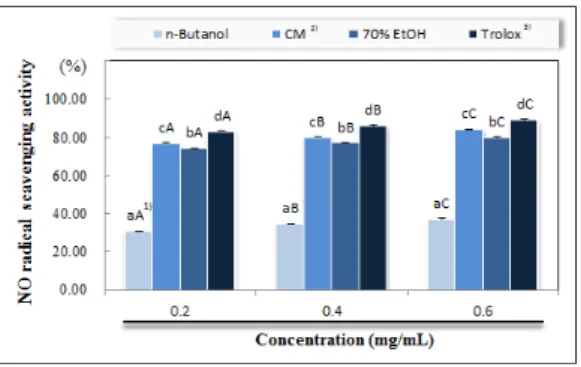
치자 씨의 용매 별 추출물과 positive control 인 trolox의 nitric oxide (NO) radical 소거능을 각 농도 별로 비교한 결과를 Fig. 1에 나타내었 고, IC50값을 구하여 Table 1에 표시하였다. 치자 씨의 각 용매 별 추출물 0.2, 0.4, 0.6 mg/mL의 농도에서 측정한 결과 농도가 증가함에 따라 NO radical 소거능 또한 유의적으로 증가하였다. CM 추출물에서 농도 별로 각각 76.97±0.27%,
80.14±0.32%, 84.24±0.09%, IC50 0.003±
0.000 mg/mL로 가장 강한 소거능이 관찰되었으 며, 70% ethanol 추출물에서 74.10±0.09%, 77.18±0.18%, 79.99±0.09%, IC50 0.004±
0.000 mg/mL,
n
-butanol 추출물에서 30.66±0.23%, 34.39±0.18%, 37.15±0.23%, IC50
1.382±0.028 mg/mL 순으로 NO radical 소거 능이 관찰되었다. 또한 CM과 70% ethanol 추출 물의 소거능은 유의적인 차이가 있었으나 IC50에 서는 유의적인 차이가 관찰되지 않았다. Control 인 trolox는 각 83.37±0.23%, 86.34±0.15%, 89.36±0.09%로 관찰되었으며, trolox는 산화적 스트레스 손상을 감소시키는 생물학적 및 생화학 적 용도로 사용되는 항산화제이며, 항산화 성분 측정 시 항산화 능력에 대한 기준으로도 사용된 다고 알려져 있다[25]. 질소산화물 중 nitric oxide radical (NO)는 신경 전달, 종양 세포의 면역 및 염증 과정과 같은 생물학적의 다양한 과 정에 관련이 있다고 알려져 있다[26]. NO 합성 효소(EC 1.14.13.39)는 L-arginine을 citrulline과 NO radical로 변환시키며, 생성된 NO radical은 신경 세포와 내피 세포, 간세포 등에서 여러 iso-form으로 전환되어 독성을 나타내는 것으로 알려져 있다[27].
Fig. 1. Nitric oxide (NO) radical scavenging activity of various solvent extracts from seed of
Gardenia jasminoides
fructus.1) The values are means±standard deviation (
n
=3). Bars with the different letters are significantly different (p
<0.05) by Duncan’s multiple range tests.2) CM: chloroform:methanol (2:1, v/v).
3) Trolox: 6-hydroxy-2,5,7,8-tetrame- thylchroman-2-carboxylic acid.
3.5. Nitrite (NO2) scavenging activity 치자 씨의 각 용매 별 추출물과 positive control인 ascorbic acid의 nitrite (NO2) 소거 활 성을 각 농도 별로 비교한 결과를 Fig. 2에 나타 내었으며, IC50 값을 구하여 Table 1에 표시하였 다. 치자 씨의 각 용매 별 추출물에서 측정한 결 과 농도가 증가함에 따라 NO2 소거 활성이 유의 적으로 증가하였다. CM 추출물에서 33.53±
0.72%, 36.70±0.08%, 43.23±0.21%, IC50
0.902±0.001 mg/mL로 관찰되었으며, 70%
ethanol 추출물에서 농도 별로 32.40±0.28%, 34.30±0.39%, 35.98±0.27%, IC50 2.162±
0.028 mg/mL,
n
-butanol 추출물 24.72±0.19%, 26.01±0.16%, 28.14±0.28%, IC50 3.173±0.013mg/mL 순으로 관찰되었다. Positive control인 ascorbic acid는 각 농도 별로 49.07±0.21%, 68.51±0.08%, 84.01±0.21%로 관찰되었다. 아질산염은 nitric oxide synthase의 활성 및 산화질소 radical 생성에 대한 바이오마 커로서 임상 화학에서 자주 사용되고 있다[28].
Fig. 2. Nitrite (NO2) scavenging activity of various solvent extracts from seed of
Gardenia jasminoides
fructus.1) The values are means±standard deviation (
n
=3). Bars with the different letters are significantly different (p
<0.05) by Duncan’s multiple range tests. 2) CM: chloroform:methanol (2:1, v/v). 3) AA: ascorbic acid.3.6. β-carotene bleaching을 이용한 antioxidant activity
치자 씨의 각 용매 별 추출물과 control인 BHA에서의 각 농도 별 β-carotene 탈색을 이 용한 항산화 활성의 결과는 Fig. 3에 나타내었으
며, IC50은 Table 1과 같다. 치자 씨의 용매 별 추출물 각 농도에서 측정한 결과 농도가 증가함 에 따라 β-carotene 탈색 저해능이 유의적으로 증가하는 것으로 관찰되었다. CM 추출물에서 농 도 별로 각각 23.73±0.06%, 31.64±0.19%, 44.70±0.09%, IC50 0.717±0.001 mg/mL로 씨 추출 용매 중 유의적인 차이를 보이며 가장 강한 탈색 저해능이 관찰되었으며, 70% ethanol 추출 물에서 22.03±0.07%, 30.11±0.20%, 41.32±
0.00%, IC50 0.791±0.009 mg/mL,
n
-butanol 추출물에서 16.00±0.09%, 18.69±0.06%, 27.87±0.09%, IC50 1.382±0.006 mg/mL 순으 로n
-butanol 추출물에서 유의적으로 가장 낮은 탈색 저해능이 관찰되었다. β-carotene은 일정 온도 이상에서 공기 중에 방치하게 되면 산화가 진행되어 탈색 진행되며, flavonoid나 phenolic 화합물과 같은 항산화 효과가 있는 물질과 함께 존재할 경우 탈색의 진행을 어느 정도 억제하게 되므로 이러한 β-carotene의 탈색 정도를 이용 한 항산화 능력을 분석 방법이 널리 이용되고 있 다[29].Fig. 3. Antioxidant activity by β-carotene bleaching assay of various solvent extracts from seed of
Gardenia jasminoides
fructus.1) The values are means±standard deviation (
n
=3). Bars with the different letters are significantly different (p
<0.05) by Duncan’s multiple range tests. 2) CM: chloroform:methanol (2:1, v/v). 3) BHA: butylated hydroxyanisole.3.7. Reducing power
치자 씨의 각 용매 별 추출물과 positive control인 BHA의 환원력을 각 농도 별로 비교한
결과를 Fig. 4에 나타내었고, EC50 값을 구하여 Table 1에 나타내었다. 치자 씨의 각 용매 별 추 출물 0.2, 0.4, 0.6 mg/mL의 농도에서 환원력을 측정한 결과 농도가 증가함에 따라 유의적으로 흡광도가 증가하였다. 각 추출물의 환원력은 70% ethanol 추출물에서 농도 별로 각각 0.073±0.001, 0.132±0.002, 0.182±0.002, EC50
1.021±0.005 mg/mL로 씨 추출 용매 중 유의적 인 차이를 보이며 가장 강한 환원력이 관찰되었 으며, CM 추출물 0.057±0.001, 0.113±0.001, 0.154±0.001, EC50 1.184±0.019 mg/mL,
n
-butanol 추출물에서 0.028±0.001, 0.056±0.001, 0.079±0.001, EC50 2.310±0.014 mg/mL 순으로 관찰되었다. Senevirathne et al.
(2006)은 nitric oxide 소거능의 결과와 환원력 실험의 결과는 신뢰구간 95%의 유의적인 관계가 있는 것으로 보고하였다[30]. 또한 total phenol, flavonoid 함량이 높아짐에 따라 항산화 활성 증 가한다고 알려져 있다[31], 반면 본 실험에서의 total phenol 함량과 질소산화물 소거능은 환원력 분석에서와 같이 70% ethanol 추출물이 아니라 CM 추출물에서 가장 높게 나타났다. 이러한 결 과는 치자의 주요 생리활성성분 중 수용성 carotenoid 인 crocin과 본 실험에서 측정한 치자 씨 분말의 anthocyanin 및 그 밖의 flavonoid 성 분의 추출된 정도가 환원력 측정에 영향을 준 것 으로 사료된다.
Fig. 4. Reducing power of various solvent extracts from seed of
Gardenia jasminoides
fructus.1) The values are means±standard deviation (
n
=3). Bars with the different letters are significantly different (p
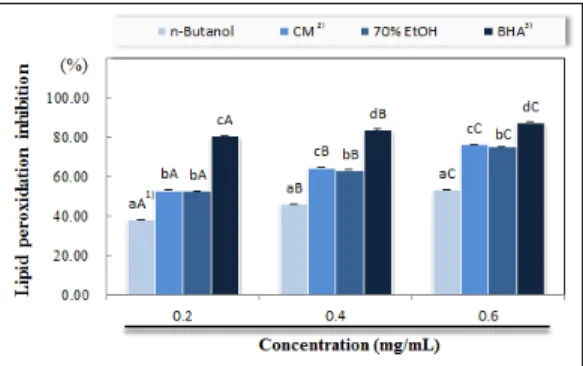
<0.05) by Duncan’s multiple range tests. 2) CM: chloroform:methanol (2:1, v/v). 3) BHA: butylated hydroxyanisole.3.8. Lipid peroxidation inhibition activity 치자 씨의 각 용매 별 추출물과 positive control인 BHA의 지질과산화 저해능을 각 농도 별로 비교한 결과를 Fig. 5에 나타내었고, IC50
값을 구하여 Table 1에 나타내었다. CM 추출물 에서 농도 별로 각각 53.26±0.22%, 64.80±
0.46%, 76.56±0.16%, IC50 0.145±0.001 mg/mL로 강한 저해능이 관찰되었으며, 70%
ethanol 추출물에서 52.94±0.26%, 63.48±
0.22%, 75.20±0.12%, IC50 0.151±0.002 mg/mL로 0.2 mg/mL 농도의 CM과 70%
ethanol 추출물의 지질과산화 저해능은 유의적인 차이가 없었다.
n
-butanol 추출물에서 38.54±0.38%, 46.28±0.10%, 53.33±0.26%, IC50
0.507±0.002 mg/mL 순으로
n
-butanol 추출물 에서 유의적으로 가장 낮은 저해능과 IC50이 관찰되었다. 지질 과산화는 자동산화과정
(autoxidation) 중 활성이 강한 free radical들이 서로 중합하여 중간생성물인 aldehyde류, ketone 류, 산 등의 carbonyl 화합물을 형성하는 것으로 알려져 있으며[32], 유지의 점도 증가와 체내 흡 수를 어렵게 하고 필수지방산 함량의 감소가 일 어나 영양적 가치를 감소시키는 것으로 보고되고 있다[33]. 또한 Esterbauer는 산화된 지질을 실험 동물에게 경구 투여하였을 때 죽상 동맥경화증 위험 증가, 간세포, 림프구 및 여러 유전적 독성
Fig. 5. Lipid peroxidation inhibition activity of various solvent extracts from seed of
Gardenia jasminoides
fructus.1) The values are means±standard deviation (
n
=3). Bars with the different letters are significantly different (p
<0.05) by Duncan’s multiple range tests. 2) CM: chloroform:methanol (2:1, v/v). 3) BHA: butylated hydroxyanisole.을 야기하여 산화된 지질 섭취의 위험성을 시사 하였다[34]. 본 실험 결과 치자 씨의 추출물 모두 에서 높은 지질과산화 저해능이 확인되어 지질 성분에서의 천연 산화방지제로서의 효과가 기대 된다.
4. 결 론
치자 씨의 anthocyanin 함량을 알아보고 70%
ethanol, chloroform:methanol (CM, 2:1, v/v) 및
n
-butanol의 3가지 용매를 사용한 추출물의 용매 별 total phenol 함량 및 질소 산화물 소거 능, 환원력, β-carotene 탈색을 이용한 항산화력 및 지질과산화 저해능 측정을 통하여 치자의 기 능성 식품 재료로서의 가치를 검토하기 위하여 본 실험을 수행하였다.치자 씨의 anthocyanin 함량을 측정한 결과 2.201±0.516 mg/100 g DW로 나타났으며, 치 자 씨의 용매 별 추출 수율은 CM (36.39%), 70% ethanol (27.32%),
n
-butanol (26.23%) 로 관찰되었다. 추출 용매 별 항산화 활성은 농도 (0.2, 0.4, 0.6 mg/mL)가 증가할수록 유의적으로 증가하였으며 positive control로 사용된 ascorbic acid, BHA, trolox 보다는 낮은 활성이 관찰되었 다. 치자 씨의 total phenol 함량(mg CAE/g)은 CM (32.50), 70% ethanol (30.09),n
-butanol (11.07) 추출물 순으로n
-butanol 추출물에서 가 장 적은 함량을 보였으며, Nitric oxide (NO) radical 소거능에서는 CM (76.97~84.24%), 70% ethanol (74.10~79.99%),n
-butanol (30.66~37.15%) 추출물 순으로 관찰되었다.Nitrite (NO2) 소거능은 CM (33.53~43.23%), 70% ethanol (32.40~35.98%),
n
-butanol (24.72~28.14%) 순으로 관찰되었다. β -carotene 탈색 저해능은 CM (23.73~44.70%), 70% ethanol (22.03~41.32%), n-butanol (16.00~27.87%) 순으로 관찰되었다. Reducing power (optical density)는 70% ethanol (0.073~0.182), CM (0.057~0.154),n
-butanol (0.028~0.079) 순으로 관찰되었다. 지질과산화 저해능은 씨 추출물 중 CM (53.26~76.56%), 70% ethanol (52.97~76.56%),n
-butanol (38.54~53.33%) 순으로 관찰되었다. 이상의 결 과를 미루어 볼 때 치자 씨의 용매 별 total phenol 함량 순과 환원력을 제외한 나머지 생리활성 분석에서의 결과와 마찬가지로 CM 추출물 에서 가장 높은 결과가 나타나 phenolic 함량에 따라 여러 생리활성 효과도 증가하는 것을 확인 하였으며, 환원력의 경우 70% ethanol 추출물에 서 가장 높은 활성을 보여 수용성 carotenoid인 crocin 및 flavonoid가 영항을 준 것으로 사료된 다. 본 실험 결과 치자의 씨는 질소산화물 소거 능, 항산화능, 지질과산화 저해능이 우수하여 본 실험에서 측정한 anthocyanin 및 phenolic 성분 뿐만 아니라 여러 유익한 생리활성물질을 가지고 있는 것으로 생각되며, 추출 수율과 여러 생리활 성을 고려하였을 때 CM과 70% ethanol에서 추 출하였을 때 효과가 좋을 것으로 그에 따른 기능 성 식품 및 천연항산화제로서의 가치가 매우 기 대된다.
References
1. K. Menrad, Market and marketing of functional food in Europe,
J. Food Eng.
, 56, 181 (2003).2. B. Halliwell, J. M. Gutteridge and C. E.
Cross, Free radicals, antioxidants, and human disease: where are we now?,
J.
Lab. Clinic. Med.
, 119, 598 (1992).3. Hogg, N., Darley-Usmar, V. M., Wilson, M. T., and Moncada, S, Production of hydroxyl radicals from the simultaneous generation of superoxide and nitric oxide.
Biochemical Journal, 281, 419 (1992).
4. J. S. Hwang, B. H. Lee, X. An, H. R.
Jeong, Y. E. Kim, I. Lee, H. Lee and D.
O. Kim, Total phenolics, total flavonoids, and antioxidant capacity in the leaves, bulbs, and roots of
Allium hookeri
,Korean J. Food Sci. Technol.
, 47, 261 (2015).5. H. O. Edeoga, D. E. Okwu and B. O.
Mbaebie, Phytochemical constituents of some Nigerian medicinal plants,
African J.
Biotechnol.
, 4, 685 (2005).6. I. A. Lee, J. H. Lee, N. I. Baek and D.
H. Kim, Antihyperlipidemic effect of crocin isolated from the fructus of
Gardenia jasminoides
and its metabolite crocetin,Biol. Pharm. Bull.
, 28, 2106 (2005).7. T. Ochiai, S. Ohno, S. Soeda, H. Tanaka, Y. Shoyama and H. Shimeno, Crocin prevents the death of rat pheochromyctoma (PC-12) cells by its antioxidant effects stronger than those of α-tocopherol,
Neurosci. Lett.
, 362, 61 (2004).8. H. Hosseinzadeh, G. Karimi and M.
Niapoor, Antidepressant effects of Crocus sativus stigma extracts and its constituents, crocin and safranal, in mice,
J. Med.
Plants
, 3, 48 (2004).9. J. Escribano, G. L. Alonso, M.
Coca-Prados and J. A. Fernández, Crocin, safranal and picrocrocin from saffron (
Crocus sativus
L.) inhibit the growth of human cancer cells in vitro,Cancer Lett.
, 100, 23 (1996).10. D. L. Luthria, Y. Lu and K. M. John, Bioactive phytochemicals in wheat:
Extraction, analysis, processing, and functional properties,
J. Funct. Foods
, 18, 910 (2015).11. M. P. Kähkönen, A. I. Hopia and M.
Heinonen, Berry phenolics and their antioxidant activity,
J. Agric. Food Chem.
, 49, 4076 (2001).12. H. J. Shin, A trend in research and development of natural gardenia pigments,
KSBB Journal
, 22, 271 (2007).13. T. Fuleki and F. J. Francis, Quantitative methods for anthocyanins,
J. Food Sci.
, 33, 266 (1968).14. D. H. Jin, H. S. Kim, J. H. Seong and H.
S. Chung, Comparison of total phenol, flavonoid contents, and antioxidant activities of
Orostachys japonicus
A.Berger extracts,
J. Environ. Sci. Int.
, 25, 695 (2016).15. T. Sun and C. T. Ho, Antioxidant activities of buckwheat extracts,
Food Chem.
, 90, 743 (2005).16. M. N. A. Rao, Nitric oxide scavenging by curcuminoids,
J. Pharm. Pharmacol.
, 49, 105 (1997).17. J. A. Lim, Y. S. Na and S. H. Baek, Antioxidative activity and nitrite
scavenging ability of ethanol extract from Phyllostachys bambusoides,
Korean J. Food Sci. Technol.
, 36, 306 (2004).18. S. Kato, H. Aoshima, Y. Saitoh and N.
Miwa, Highly hydroxylated or γ -cyclodextrin-bicapped water-soluble derivative of fullerene: The antioxidant ability assessed by electron spin resonance method and β-carotene bleaching assay,
Bioorg. Med. Chem. Lett.
, 19, 5293 (2009).19. M. Singhal, A. Paul and H. P. Singh, Synthesis and reducing power assay of methyl semicarbazone derivatives,
J. Saudi Chem. Soc.
, 18, 121 (2014).20. N. Siriwardhana, K. W. Lee, Y. J. Jeon, S.
H. Kim and J. W. Haw, Antioxidant activity of Hizikia fusiformis on reactive oxygen species scavenging and lipid peroxidation inhibition,
Food Sci. Technol.
Int.
, 9, 339 (2003).21. T. A. Holton and E. C. Cornish, Genetics and biochemistry of anthocyanin biosynthesis,
The Plant Cell
, 7, 1071 (1995).22. Z. Lin, J. Fischer and L. Wicker, Intermolecular binding of blueberry pectin-rich fractions and anthocyanin,
Food Chem.
, 194, 986 (2016).23. A. Sgambato, R. Ardito, B. Faraglia, A.
Boninsegna, F. I. Wolf and A. Cittadini, Resveratrol, a natural phenolic compound, inhibits cell proliferation and prevents oxidative DNA damage,
Mutat.
Res./Genet. Toxicol. Environ. Mutagen.
, 496, 171 (2001).24. Y. Cai, Q. Luo, M. Sun and H. Corke, Antioxidant activity and phenolic compounds of 112 traditional Chinese medicinal plants associated with anticancer,
Life Sci.
, 74, 2157 (2004).25. R. Re, N. Pellegrini, A. Proteggente, A.
Pannala, M. Yang and C. Rice-Evans, Antioxidant activity applying an improved ABTS radical cation decolorization assay,
Free Radical Biol. Med.
, 26, 1231 (1999).26. S. R. M. J. Moncada, R. M. L. Palmer and E. Higgs, Nitric oxide: physiology, pathophysiology, and pharmacology,
Pharmacol. Rev.
, 43, 109 (1991).27. S. H. Snyder and D. S. Bredt, Biological roles of nitric oxide,
Sci. American
, 266, 68 (1992).28. H. Moshage, B. Kok, J. R., Huizenga and P. L. Jansen, Nitrite and nitrate determinations in plasma: a critical evaluation,
Clin. Chem.
,41
, 892 (1995).29. D. Pastore, D. Trono, L. Padalino, S.
Simone, D. Valenti, N. Di Fonzo and S.
Passarella, Inhibition by α-tocopherol and L-ascorbate of linoleate hydroperoxidation and β-carotene bleaching activities in durum wheat semolina,
J. Cereal Sci.
, 31, 41 (2000).30. M. Senevirathne, S. H. Kim, N.
Siriwardhana, J. H. Ha, K. W. Lee and Y.
J. Jeon, Antioxidant potential of ecklonia cavaon reactive oxygen species scavenging, metal chelating, reducing power and lipid peroxidation inhibition,
Food Sci. Technol.
Int.
, 12, 27 (2006).31. O. Firuzi, A. Lacanna, R. Petrucci, G.
Marrosu and L. Saso, Evaluation of the antioxidant activity of flavonoids by “ferric reducing antioxidant power” assay and cyclic voltammetry,
Biochim. Biophys.
Acta-Gen. Subj.
, 1721, 174 (2005).32. E. N. Frankel, Lipid oxidation,
Prog. Lipid Res.
, 19, 1 (1980).33. Y. Yamamoto, M. H. Brodsky, J. C.
Baker and B. N. Ames, Detection and characterization of lipid hydroperoxides at picomole levels by high-performance liquid chromatography,
Anal. Biochem.
, 160, 7 (1987).34. H. Esterbauer, Cytotoxicity and genotoxicity of lipid-oxidation products,