전문가 설문을 통한 주의력결핍 과잉행동장애 변증의 주요 증상 빈도 연구
김락형1․안윤영1․김미연2․정민정2
1우석대학교 한의과대학 한방신경정신과학교실, 2우석대학교 한의과대학 한방소아과학교실
Received: March 31, 2019 ∙ Revised: May 15, 2019 ∙ Accepted: May 15, 2019 Corresponding Author: Minjeong Jeong
Department of Pediatrics, College of Korean Medicine, Woosuk University, 46, Eoeun-ro, Wansan-gu, Jeonju, Gyeongsangnam-do, 50612, Republic of Korea Tel: +82-63-220-8616 / Fax: +82-63-227-6234
E-mail: [email protected]
ⓒ The Association of Pediatrics of Korean Medicine. All rights reserved. This is an open-access article distributed under the tenus of the Creative Commons Attribution Non-Commercial License (http://creativecommons.org/licenses/by-nc/3.0/), which permits unrestricted non-commercial use, distribution, and reproduction in any medium, provided the original work is properly cited.
Abstract
Expert Survey about Frequencies of Symptoms
and Signs in Attention-Deficit/Hyperactivity Disorder Pattern Identification
Kim Lak Hyung
1․An Yun Young
1․Kim Mi Yeon
2․Jeong Min Jeong
21
Department of Neuropsychiatry, College of Korean Medicine, Woosuk University,
2
Department of Pediatrics, College of Korean Medicine, Woosuk University
Objectives
The objectives of this study is to investigate the characteristics of Attention-deficit/hyperactivity disorder (ADHD) pattern identification based on the survey of frequencies of symptoms and signs according to the pediatricians and psychiatrists in Korean Medicine.
Methods
Eleven pediatricians and fourteen psychiatrists participated in this study. 38 symptoms and signs of 4 ADHD pattern identifications (Kidney yin deficiency and liver yang ascendant hyperactivity 腎虛肝亢, Dual deficiencies in the heart and spleen 心脾兩虛, Phlegm-fire harassing the heart 痰火擾心, Spleen weakness and liver energy preponderance 脾虛肝旺) were used to evaluate the frequencies of ADHD. The differences in frequencies of symptoms and signs amongst ADHD pattern identifications, and the correlations between them were analyzed.
Results
There were significant differences in the frequencies of symptoms and signs between each pattern identification.
Dual Deficiencies in the Heart and Spleen 心脾兩虛 is negatively related with hyperactivity and impulsivity, and positively related with inattention. Phlegm-fire Harassing the Heart 痰火擾心 is positively related with hyperactivity and impulsivity, and negatively related with inattention.
Conclusions
The results of the characteristics of ADHD pattern identifications from the survey analysis could be used in the clinical practices of ADHD as well as to improve the ADHD pattern identification questionnaire.
Key words: Attention-Deficit/Hyperactivity Disorder (ADHD), Pattern Identification, Korean Medicine
ISSN 1226-8038(Print), 2287-9463(Online), https://doi.org/10.7778/jpkm.2019.33.2.01
Ⅰ. Introduction
주의력결핍 과잉행동장애 (Attention-Deficit/Hyper- activity Disorder, ADHD)는 기능 또는 발달을 저해하 는 지속적인 양상의 부주의 또는 과잉행동-충동성을 특징으로 하며, 아동기 초기에 발병하고 만성적인 경 과를 가지며 여러 기능 영역에 영향을 주는 중요한 질 환이다
1,2).
국내 한의 임상에서도 ADHD 아동에서 한방치료의 증례
3-7), 뉴로피드백 치료 증례
6,8,9)등이 보고되었으며, 뉴로피드백 치료의 메타분석
10), 동의보감을 중심으로 ADHD 증후에 대한 고찰
11), 중국에서 ADHD 임상연 구에 대한 고찰
12-16)등의 논문이 발표되었다.
변증 (辨證)이란 망 (望), 문 (聞), 문 (問), 절 (切)의 사진 (四診)을 통해 환자의 증상과 징후를 수집하여 종 합적인 분석을 통해 각 증후 사이의 내재 관계와 병 인․병기를 파악하는 과정이자 진단을 도출하는 방법 이다
17). 변증은 한의 임상에서 병리 본질을 명확히 규 명하여 근본적 치료에 접근하는 장점을 갖지만, 변증 의 과정은 직관이 관여되고 평가자의 주관이 개입될 여지가 있다.
ADHD에 대한 연구와 문헌에서도 변증 유형과 각 변증 유형의 주요 증상들을 정리하여 제시하고 있지만, 임상에서의 변증의 과정은 진단자의 주관에 영향을 크 게 받고 있다. 또한 ADHD 변증에서 제시된 주요 증상 들 중에 진단 기준에 해당하는 증상들과 기타 변증에 참고가 되는 증상이 혼재되어 있고, 동일한 증상들이 각 변증에서 중복하여 제시되고 있으며, 하나의 변증 의 특징으로 제시된 여러 증상들이 실제 변증 진단에 서 얼마나 역할을 하는지를 알기 어렵다.
본 연구에서는 ADHD 변증의 주요 증상들이 임상 실제에서 각 변증에서 얼마나 자주 나타나는지에 대해 전문가 설문을 통해 조사하였으며, 이를 통해 각각의 증상이 각 변증에서 나타나는 빈도의 차이를 살펴보고, 각각의 증상이 각 변증과의 어떻게 관련되는지에 대해 살펴보고자 하였다.
II. Materials & Methods
1. 전문가의 연구참여와 진행
ADHD 변증별로 변증에 사용되는 주요 증상들이 임상실제에서 얼마나 자주 관찰되는지에 대해 살펴보 기 위하여 전국 한의과대학 및 한의학전문대학원에 소 속된 한방신경정신과학 교수 15명 및 한방소아과학 교 수 11명에게 연구의 목적과 절차에 대해 설명하고 설 문을 요청하였다. 25명의 전문가가 설문에 응답하였으 며, 변증별 증상의 임상빈도 및 하위요인으로서 부주 의 증상, 과잉행동-충동성 증상의 빈도를 조사하였으 며, 임상에서 치료에 주로 사용하는 처방에 대해 조사 하여 분석하였다.
2. 주요 증상의 변증별 임상 빈도 조사 1) ADHD 변증 및 변증 주요 증상
사전연구에서 문헌조사와 전문가 자문을 통해 선정 된 주의력결핍 과잉행동장애에서 ‘신허간항 (腎虛肝 亢), 심비양허 (心脾兩虛), 담화요심 (痰火擾心), 비허 간왕 (脾虛肝旺)’의 4개 변증 유형 및 ‘多動 神思渙散 多語 注意力不集中 難以靜坐 興趣多變 煩燥不寧 語 言冒失 (多動多語) 而不 躁 做事有頭無尾 急躁易怒 記 憶力差 衝動任性難於自控 學習成績低下 動作笨拙 睡 眠不實 多夢 懊憹不眠 易驚 神疲乏力 形體消瘦 形體 虛胖 盜汗 自汗 面色不華 面頰潮紅 口乾咽燥 口苦或 口渴 胸中煩熱 五心煩熱 胸悶 偏食 納呆 腰酸乏力 遺 尿 小便黃赤 大便秘結 便溏’의 38개 변증 주요 증상을 사용하였다.
2) ADHD 변증별 임상 빈도 조사
주요 증상이 각각의 변증으로 진단되는 ADHD 아 동에서 실제 임상에서 얼마나 자주 관찰되는지에 대하 여 전문가에게 ‘1: 매우 드물게 나타난다 (0~20%), 2:
때로 나타난다 (20~40%), 3: 반반이다 (40~60%), 4: 자 주 나타난다 (60~80%), 5: 매우 자주 나타난다 (80~
100%)’에서 선택하도록 하였다. 변증 진단에서 각 증
상의 중요도가 아닌, ‘임상실제에서 ADHD 변증별로
얼마나 자주 관찰되는지’에 대해 임상적 경험을 중심
으로 답하도록 하였다.
3) 부주의 증상, 과잉행동-충동성 증상의 변증별 빈 도 조사
DSM-5의 ADHD 진단기준에서 제시하는 과잉행동- 충동성 증상과 부주의 증상이 ADHD 변증에서 얼마나 자주 나타날 수 있는지에 대해 전문가에게 ‘1: 매우 드 물게 나타난다 (0~20%), 2: 때로 나타난다 (20~40%), 3:
반반이다 (40~60%), 4: 자주 나타난다 (60~80%), 5: 매 우 자주 나타난다 (80~100%)’에서 선택하도록 하였다.
3. ADHD 아동을 치료하면서 자주 사용하는 처방 조사 연구에 참여한 전문가들에게 처방의 개수에 제한 없이 임상에서 ADHD 아동을 치료하면서 자주 사용하 는 처방을 기록하게 하였다.
4. 자료의 처리
38개 변증 주요 증상 및 DSM-5의 부주의 증상과 과 잉행동-충동성 증상의 각 변증에서의 빈도의 평균과 표준편차를 구하였으며, 각 변증간 차이에 대해 분산 분석을 수행하였으며, 사후분석을 위해 Scheffe의 방법 을 이용하였다.
변증 주요 증상의 임상적 빈도와 각 변증의 상관관 계, 부주의 증상과 과잉행동-충동성 증상의 빈도와 변 증의 상관관계를 파악하기 위해 Spearman correlation coefficient analysis을 수행하였다. 변증 주요 증상이 특 정 변증에 미치는 영향 및 부주의 및 과잉행동-충동성 증상이 특정 변증에 미치는 영향을 알아보기 위해 로 지스틱 회귀분석 (logistic regression analysis)를 수행하 였다.
모든 통계분석은 SPSS (IBM SPSS Statistics Ver. 21, USA)를 사용하였으며, 통계적 유의성은 유의수준 5%
로 판단하였다.
III. Results
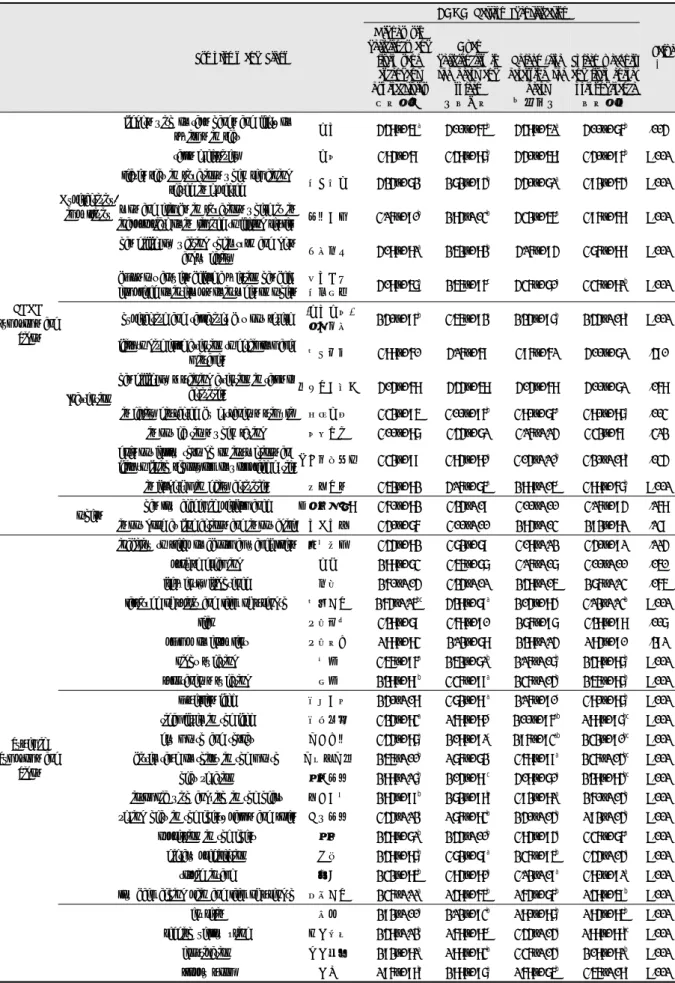
1. ADHD 변증 주요 증상의 변증간 빈도 비교
전문가 설문에서 ADHD 변증 주요 증상의 변증간 임상빈도를 비교하였을 때, 주증에서는 多動은 신허간 항, 담화요심에서 심비양허, 비허간왕에 비해 높은 빈 도를 나타내었고, 多語는 담화요심에서 심비양허, 비 허간왕에 비하여 높은 빈도를 나타내는 등의 차이를
나타내었다. 심비양허는 다른 변증에 비하여 과잉행동 -충동성 증상이 낮고, 興趣多變을 제외한 부주의 증상 이 높게 나타났다. 겸증에서는 神疲乏力은 심비양허에 서 가장 높았고, 비허간왕, 담화요심 순이었으며, 盜汗 은 신허간항에서 나머지 변증에 비하여 높게 나타나는 등의 차이를 나타내었다. 38개 변증 주요 증상 빈도의 변증간 비교를 Table 1에 나타내었다.
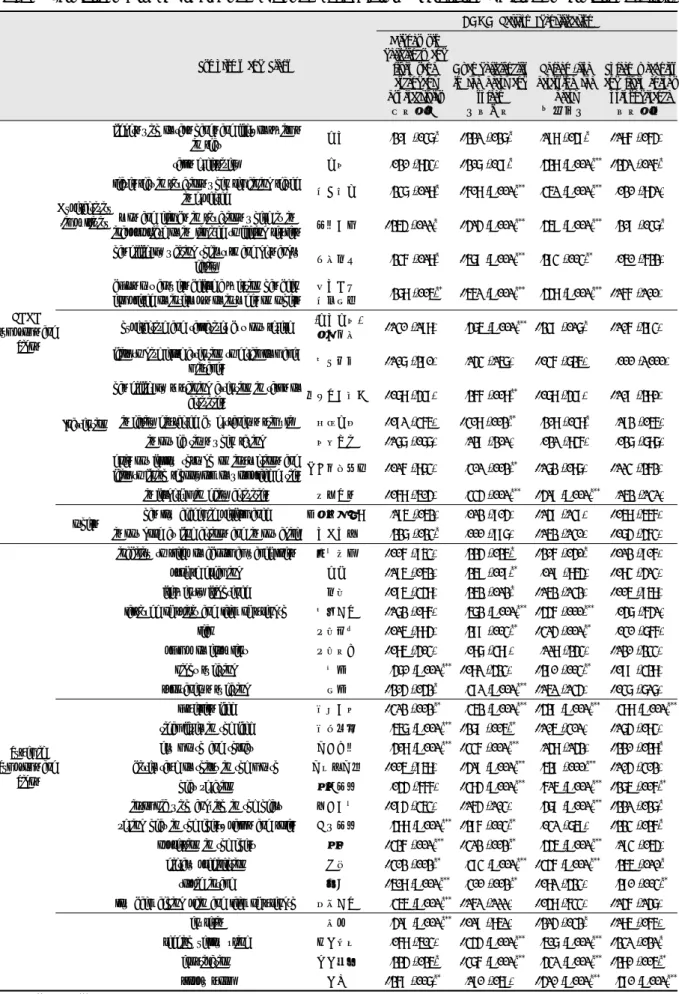
2. 각 증상과 변증 유형의 관계
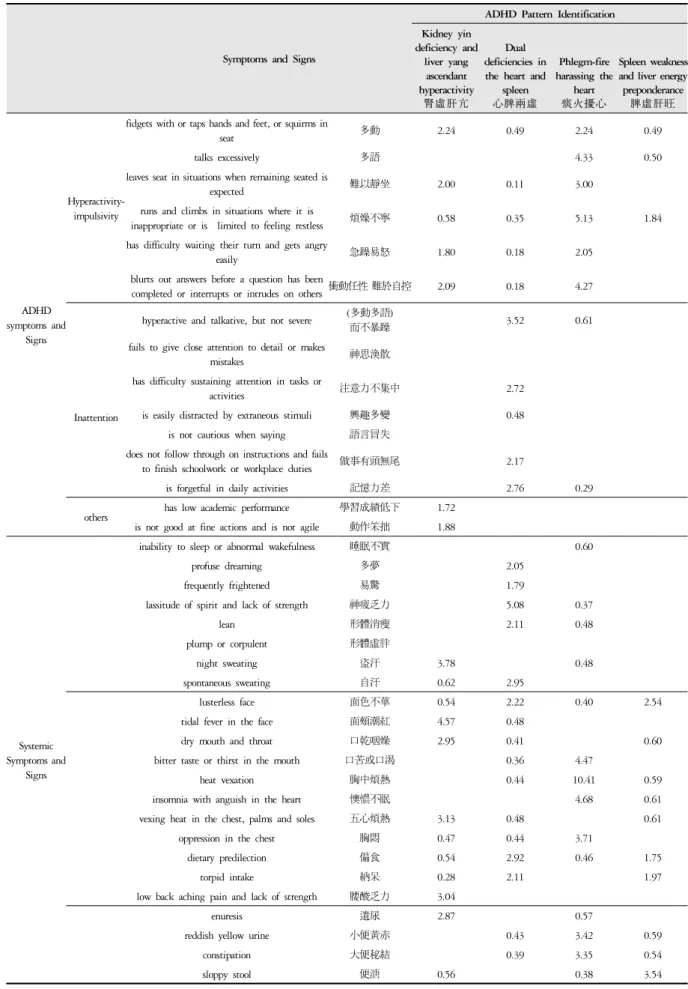
38개 ADHD 변증 주요 증상과 변증의 관계에 대해 상관분석을 실시하였으며 (Table 2), 각 주요증상의 빈 도에서 변증별 차이를 ‘하나의 변증-나머지 전체’로 하 여 로지스틱 회귀분석을 실시하였다 (Table 3).
결과를 요약하면, 學習成績低下, 動作笨拙, 盜汗, 面頰潮紅, 口乾咽燥, 五心煩熱, 腰酸乏力, 遺尿이 높 을수록, 自汗, 納呆이 낮을수록 신허강항과 연관이 높 았으며, (多動多語)而不暴躁, 注意力不集中, 做事有頭 無尾, 記憶力差, 多夢, 易驚, 神疲乏力, 形體消瘦, 自汗 이 높을수록, 難以靜坐, 急躁易怒, 衝動任性 難於自控, 興趣多變, 面頰潮紅, 口苦或口渴이 낮을수록 심비양 허과 연관이 높았다. 多語, 煩燥不寧, 口苦或口渴, 胸 中煩熱, 懊憹不眠, 胸悶, 小便黃赤, 大便秘結이 높을 수록, (多動多語)而不暴躁, 記憶力差, 睡眠不實, 神疲 乏力, 形體消瘦, 盜汗이 낮을수록 담화요심과 연관이 높았으며, 便溏이 높을수록, 多語이 낮을수록 비허간 왕과 연관이 높았다 (Table 2, 3).
3. 주요 증상의 하위요인 (부주의 증상, 과잉행동-충동 성 증상)의 변증별 빈도
DSM-5의 진단기준에서 부주의 증상, 과잉행동-충
동성 증상이 ADHD 변증에서 얼마나 자주 나타날 수
있는지에 대해 전문가들의 응답에서, 부주의 증상은
변증간 차이가 유의하지 않았으며, 과잉행동-충동성
증상은 담화요심이 가장 높은 빈도를, 심비양허가 가
장 낮은 빈도를 나타내었다 (Table 4).
Symptoms and Signs
ADHD Pattern Identification
p value
* Kidney yin
deficiency and liver yang
ascendant hyperactivity
腎虛肝亢
Dual deficiencies in the heart and
spleen 心脾兩虛
Phlegm-fire harassing the
heart 痰火擾心
Spleen weakness and liver energy preponderance
脾虛肝旺
ADHD symptoms and
Signs
Hyperactivity- impulsivity
fidgets with or taps hands and feet, or
squirms in seat 多動 4.48±0.59a 4.00±0.65b 4.48±0.51a 4.00±0.76b .004 talks excessively 多語 3.84±0.69 3.48±0.87b 4.40±0.58a 3.40±0.96b <.001 leaves seat in situations when remaining
seated is expected 難以靜坐 4.24±0.72a 2.72±0.94b 4.40±0.71a 3.92±0.64a <.001 runs and climbs in situations where it is
inappropriate or is limited to feeling restless 煩燥不寧 3.16±0.90b 2.84±1.03b 4.32±0.56a 3.96±0.68a <.001 has difficulty waiting their turn and gets
angry easily 急躁易怒 4.08±0.81a 2.52±0.82b 4.16±0.94 3.76±0.88a <.001 blurts out answers before a question has been
completed or interrupts or intrudes on others
衝動任性
難於自控 4.08±0.57a 2.56±0.96c 4.36±0.70a 3.36±0.81b <.001
Inattention
hyperactive and talkative, but not severe (多動多語)
而不暴躁 2.40±0.96b 3.56±0.92a 2.24±0.97b 2.44±1.08b <.001 fails to give close attention to detail or makes
mistakes 神思渙散 3.88±0.60 4.16±0.69 3.96±0.61 4.00±0.71 .490
has difficulty sustaining attention in tasks or
activities 注意力不集中 4.04±0.68 4.44±0.58 4.04±0.68 4.00±0.71 .068
is easily distracted by extraneous stimuli 興趣多變 3.32±0.95 3.00±0.96b 3.80±0.76a 3.80±0.87a .003 is not cautious when saying 語言冒失 3.00±0.87 3.44±0.71 3.16±1.14 3.32±0.69 .312 does not follow through on instructions and
fails to finish schoolwork or workplace duties做事有頭無尾 3.32±0.99 3.84±0.80a 3.04±1.10b 3.20±1.08b .034 is forgetful in daily activities 記憶力差 3.52±0.82 4.16±0.75a 2.88±1.05c 3.88±0.67b <.001 others has low academic performance 學習成績低下 3.60±0.82 3.24±1.09 3.00±1.00 3.16±0.94 .168
is not good at fine actions and is not agile 動作笨拙 3.40±0.76 3.00±1.00 2.84±1.03 2.92±0.81 .139
Systemic Symptoms and
Signs
inability to sleep or abnormal wakefulness 睡眠不實 3.44±0.82 3.72±0.79 3.08±1.12 3.40±0.91 .114
profuse dreaming 多夢 2.88±0.73 3.56±0.77 3.16±1.07 3.00±1.00 .050
frequently frightened 易驚 2.60±1.04 3.24±1.01 2.48±1.05 2.76±1.13 .065
lassitude of spirit and lack of strength 神疲乏力 2.64±1.15bc 4.28±0.79a 2.04±0.84c 3.12±1.13b <.001
lean 形體消瘦 3.28±0.79 3.68±0.90 2.76±0.97 3.28±0.98 .007
plump or corpulent 形體虛胖 1.88±0.83 2.12±0.78 2.28±1.14 1.84±0.90 .291
night sweating 盜汗 3.56±0.96a 2.52±0.71b 2.16±1.07b 2.48±0.87b <.001 spontaneous sweating 自汗 2.28±0.89b 3.36±0.99a 2.36±1.04b 2.56±0.87b <.001 lusterless face 面色不華 2.40±1.08c 3.72±0.89a 2.16±0.90c 3.80±0.87b <.001 tidal fever in the face 面頰潮紅 3.24±0.83a 1.68±0.80c 2.00±0.96ab 1.88±0.97bc <.001 dry mouth and throat 口乾咽燥 3.44±0.87a 2.08±0.91c 2.96±0.93ab 2.32±0.90bc <.001 bitter taste or thirst in the mouth 口苦或口渴 2.56±1.00b 1.76±0.72c 3.68±0.99a 2.36±1.04bc <.001 heat vexation 胸中煩熱 2.88±1.17b 2.04±0.89c 4.08±0.70a 2.28±0.84bc <.001 insomnia with anguish in the heart 懊憹不眠 2.84±0.99b 2.72±0.98b 3.92±0.81a 2.60±1.04b <.001 vexing heat in the chest, palms and soles 五心煩熱 3.44±1.12a 1.76±0.83b 2.40±1.04b 1.92±1.04b <.001 oppression in the chest 胸悶 2.48±0.71b 2.44±1.00b 3.84±0.94a 3.36±0.76a <.001 dietary predilection 偏食 2.48±0.87b 3.72±0.79a 2.36±0.95b 3.44±1.04a <.001 torpid intake 納呆 2.32±0.85b 3.84±0.80a 3.12±1.09a 3.80±0.91a <.001 low back aching pain and lack of strength 腰酸乏力 2.36±1.11a 1.48±0.65b 1.64±0.76b 1.48±0.59b <.001
enuresis 遺尿 2.92±1.00a 2.12±0.93b 1.80±0.87b 1.84±0.85b <.001
reddish yellow urine 小便黃赤 2.48±1.12b 1.68±0.85c 3.44±1.04a 1.88±0.88bc <.001 constipation 大便秘結 2.92±0.81a 1.88±0.83b 3.36±1.04a 2.08±0.81b <.001 sloppy stool 便溏 1.96±0.98b 2.88±0.97a 1.68±0.75b 3.56±1.08a <.001
* p value was derived from ANOVA and Scheffe’s test was used for post-hoc test. Different superscript letters depict significances of difference between groups.
Table 1. Frequencies of Symptoms and Signs in Each ADHD Pattern Identification
Symptoms and Signs
ADHD Pattern Identification Kidney yin
deficiency and liver yang ascendant hyperactivity
腎虛肝亢
Dual deficiencies in the heart and
spleen 心脾兩虛
Phlegm-fire harassing the
heart 痰火擾心
Spleen weakness and liver energy preponderance
脾虛肝旺
ADHD symptoms and
Signs
Hyperactivity -impulsivity
fidgets with or taps hands and feet, or squirms
in seat 多動 .209 (.037)* -.221 (.027)* .198 (.049)* -.186 (.064) talks excessively 多語 .020 (.843) -.207 (.039)* .428 (<.001)*** -.241 (.016)* leaves seat in situations when remaining seated
is expected 難以靜坐 .237 (.018)* -.608 (<.001)*** .351 (<.001)*** .020 (.841) runs and climbs in situations where it is
inappropriate or is limited to feeling restless 煩燥不寧 -.254 (.011)* -.414 (<.001)*** .459 (<.001)*** .209 (.037)* has difficulty waiting their turn and gets angry
easily 急躁易怒 .236 (.018)* -.579 (<.001)*** .293 (.003)** .050 (.622) blurts out answers before a question has been
completed or interrupts or intrudes on others
衝動任性
難於自控 .278 (.005)** -.561 (<.001)*** .448 (<.001)*** -.166 (.100) hyperactive and talkative, but not severe (多動多語)
而不暴躁 -.130 (.198) .475 (<.001)*** -.239 (.017)* -.106 (.293)
Inattention
fails to give close attention to detail or makes
mistakes 神思渙散 -.107 (.290) .143 (.157) -.036 (.725) .000 (1.000)
has difficulty sustaining attention in tasks or
activities 注意力不集中 -.078 (.439) .266 (.008)** -.078 (.439) -.109 (.280) is easily distracted by extraneous stimuli 興趣多變 -.091 (.365) -.308 (.002)** .208 (.038)* .192 (.056) is not cautious when saying 語言冒失 -.177 (.077) .129 (.201) .021 (.836) .027 (.787) does not follow through on instructions and
fails to finish schoolwork or workplace duties 做事有頭無尾 -.016 (.873) .301 (.002)** -.172 (.087) -.113 (.262) is forgetful in daily activities 記憶力差 -.068 (.504) .334 (.001)*** -.419 (<.001)*** .152 (.131) others has low academic performance 學習成績低下 .195 (.052) .012 (.904) -.149 (.139) -.058 (.566) is not good at fine actions and is not agile 動作笨拙 .227 (.023)* .000 (.997) -.152 (.130) -.074 (.463)
Systemic Symptoms and
Signs
inability to sleep or abnormal wakefulness 睡眠不實 -.006 (.953) .224 (.025)* -.206 (.040)* -.012 (.906) profuse dreaming 多夢 -.195 (.052) .259 (.009)** .019 (.854) -.083 (.413) frequently frightened 易驚 -.095 (.348) .252 (.012)* -.152 (.132) -.005 (.958) lassitude of spirit and lack of strength 神疲乏力 -.172 (.086) .572 (<.001)*** -.446 (.000)*** .047 (.641) lean 形體消瘦 -.015 (.884) .299 (.003)** -.314 (.001)** .030 (.766) plump or corpulent 形體虛胖 -.085 (.403) .087 (.389) .118 (.243) -.120 (.233) night sweating 盜汗 .470 (<.001)*** -.081 (.423) -.290 (.003)** -.099 (.328) spontaneous sweating 自汗 -.204 (.042)* .391 (<.001)*** -.151 (.134) -.037 (.717)
lusterless face 面色不華 -.312 (.002)** .352 (<.001)*** -.429 (<.001)*** .388 (<.001)***
tidal fever in the face 面頰潮紅 .557 (<.001)*** -.279 (.005)** -.105 (.301) -.174 (.083) dry mouth and throat 口乾咽燥 .408 (<.001)*** -.336 (.001)*** .148 (.142) -.220 (.028)* bitter taste or thirst in the mouth 口苦或口渴 -.005 (.958) -.419 (<.001)*** .529 (.000)*** -.104 (.302)
heat vexation 胸中煩熱 .044 (.666) -.384 (<.001)*** .615 (<.001)*** -.275 (.006)**
insomnia with anguish in the heart 懊憹不眠 -.094 (.353) -.164 (.103) .479 (<.001)*** -.221 (.027)* vexing heat in the chest, palms and soles 五心煩熱 .488 (<.001)*** -.296 (.003)** .031 (.759) -.223 (.026)* oppression in the chest 胸悶 -.326 (.001)*** -.312 (.002)** .445 (<.001)*** .193 (.054) dietary predilection 偏食 -.302 (.002)** .393 (<.001)*** -.346 (<.001)*** .255 (.010)*
torpid intake 納呆 -.508 (<.001)*** .300 (.002)** -.081 (.423) .290 (.003)**
low back aching pain and lack of strength 腰酸乏力 .355 (<.001)*** -.161 (.111) -.048 (.633) -.146 (.147) enuresis 遺尿 .419 (<.001)*** -.019 (.851) -.214 (.032)* -.185 (.065) reddish yellow urine 小便黃赤 .068 (.503) -.344 (<.001)*** .507 (<.001)*** -.231 (.021)*
constipation 大便秘結 .224 (.025)* -.376 (<.001)*** .431 (<.001)*** -.280 (.005)**
sloppy stool 便溏 -.269 (.007)** .190 (.059) -.410 (<.001)*** .490 (<.001)***
* p<.05, ** p<.01, *** p<.001.
Table 2. Correlations between Symptoms and Signs and ADHD Pattern Identification (Spearmanʼs correlation analysis)
Symptoms and Signs
ADHD Pattern Identification Kidney yin
deficiency and liver yang
ascendant hyperactivity
腎虛肝亢
Dual deficiencies in the heart and
spleen 心脾兩虛
Phlegm-fire harassing the
heart 痰火擾心
Spleen weakness and liver energy preponderance
脾虛肝旺
ADHD symptoms and
Signs
Hyperactivity- impulsivity
fidgets with or taps hands and feet, or squirms in
seat 多動 2.24 0.49 2.24 0.49
talks excessively 多語 4.33 0.50
leaves seat in situations when remaining seated is
expected 難以靜坐 2.00 0.11 3.00
runs and climbs in situations where it is
inappropriate or is limited to feeling restless 煩燥不寧 0.58 0.35 5.13 1.84
has difficulty waiting their turn and gets angry
easily 急躁易怒 1.80 0.18 2.05
blurts out answers before a question has been
completed or interrupts or intrudes on others 衝動任性 難於自控 2.09 0.18 4.27 hyperactive and talkative, but not severe (多動多語)
而不暴躁 3.52 0.61
Inattention
fails to give close attention to detail or makes
mistakes 神思渙散
has difficulty sustaining attention in tasks or
activities 注意力不集中 2.72
is easily distracted by extraneous stimuli 興趣多變 0.48
is not cautious when saying 語言冒失 does not follow through on instructions and fails
to finish schoolwork or workplace duties 做事有頭無尾 2.17
is forgetful in daily activities 記憶力差 2.76 0.29
others has low academic performance 學習成績低下 1.72
is not good at fine actions and is not agile 動作笨拙 1.88
Systemic Symptoms and
Signs
inability to sleep or abnormal wakefulness 睡眠不實 0.60
profuse dreaming 多夢 2.05
frequently frightened 易驚 1.79
lassitude of spirit and lack of strength 神疲乏力 5.08 0.37
lean 形體消瘦 2.11 0.48
plump or corpulent 形體虛胖
night sweating 盜汗 3.78 0.48
spontaneous sweating 自汗 0.62 2.95
lusterless face 面色不華 0.54 2.22 0.40 2.54
tidal fever in the face 面頰潮紅 4.57 0.48
dry mouth and throat 口乾咽燥 2.95 0.41 0.60
bitter taste or thirst in the mouth 口苦或口渴 0.36 4.47
heat vexation 胸中煩熱 0.44 10.41 0.59
insomnia with anguish in the heart 懊憹不眠 4.68 0.61
vexing heat in the chest, palms and soles 五心煩熱 3.13 0.48 0.61
oppression in the chest 胸悶 0.47 0.44 3.71
dietary predilection 偏食 0.54 2.92 0.46 1.75
torpid intake 納呆 0.28 2.11 1.97
low back aching pain and lack of strength 腰酸乏力 3.04
enuresis 遺尿 2.87 0.57
reddish yellow urine 小便黃赤 0.43 3.42 0.59
constipation 大便秘結 0.39 3.35 0.54
sloppy stool 便溏 0.56 0.38 3.54
* Values are OR (odds ratio), p-values were derived from univariate logistic regression analysis.
Table 3. Correlations between Symptoms and Signs and ADHD Pattern Identification (Logistic Regression Analysis)
4. 주요 증상 하위요인(부주의 증상, 과잉행동-충동성 증상)과 변증유형간 관계
DSM-5의 진단기준에서의 부주의 증상, 과잉행동- 충동성 증상과 변증유형과의 상관분석에서 과잉행동- 충동성 증상은 심비양허와 부적 상관을, 담화요심과 정적 상관을 갖는 것으로 나타났으나, 부주의 증상은 변증과 유의한 상관이 관측되지 않았다 (Table 5).
결과변수를 각 변증과 그 외 변증으로 하여 로지스 틱 회귀분석을 실시한 결과, 과잉행동-충동성 증상이 낮을수록, 부주의 증상이 높을수록 심비양허일 가능성 이 높은 것으로 나타났으며, 과잉행동-충동성 증상이 높을수록, 부주의 증상이 낮을수록 담화요심일 가능성
이 높은 것으로 나타났다 (Table 6).
5. ADHD 아동 임상에서 자주 사용하는 처방 조사 25명의 전문가에게 처방의 개수에 제한 없이 임상 에서 ADHD 아동을 치료하면서 빈용하는 처방에 대하 여 물었다. 전문가들은 5.04 ± 1.42개의 처방을 답하였 는데, 13명 (52%)이 (가미)귀비탕을 사용한다고 답하여 가장 높은 비율이었으며, 시호가용골모려탕 (11명), 육 미지황탕, 억간산 (가반하진피) (9명), 가미소요산 (8 명), 가미온담탕 (7명), 귀비온담탕 (6명), 계지가용골모 려탕 (5명)을 사용한다고 하였다. 또한, 청심연자탕, 청 심온담탕, 보중익기탕, 황련해독탕 (4명), 가미양신탕,
Table 4. Frequencies of Hyperactivity-Impulsivity and Inattention Symptoms and Signs in Each ADHD PatternIdentification
Subfactor
ADHD Pattern Identification
p value*
Kidney yin deficiency and liver yang ascendant
hyperactivity 腎虛肝亢
Dual deficiencies in the heart and spleen
心脾兩虛
Phlegm-fire harassing the heart
痰火擾心
Spleen weakness and liver energy preponderance
脾虛肝旺 Hyperactivity-
Impulsivity 3.93±0.42ab 2.94±0.61c 4.27±0.42a 3.71±0.53b <.001
Inattention 3.51±0.53 3.84±0.50 3.48±0.65 3.70±0.61 .099
* p value was derived from ANOVA and Scheffe’s test was used for post-hoc test. Different superscript letters depict significance of difference between groups. Shapiro-Wilk’s test was employed for test of normality assumption.
Table 5. Correlations between Subfactors and ADHD Pattern Identification (Spearmanʼs correlation analysis)
Subfactor
ADHD Pattern Identification Kidney yin deficiency
and liver yang ascendant hyperactivity
腎虛肝亢
Dual deficiencies in the heart and spleen
心脾兩虛
Phlegm-fire harassing the heart
痰火擾心
Spleen weakness and liver energy preponderance
脾虛肝旺 Hyperactivity-Impulsivity .169 (.093) -.606 (<.001)*** .482 (<.001)*** -.046 (.652)
Inattention -.138 (.171) .195 (.052) -.106 (.293) .049 (.625)
*p<.05, **p<.01, ***p<.001.
Table 6. Correlations between Subfactors and ADHD Pattern Identification (multivariate logistic regression analysis)
Subfactor OR 95% CI p value*
Kidney yin deficiency and liver yang ascendant hyperactivity
腎虛肝亢
Hyperactivity-Impulsivity 1.99 (0.94-4.20) .073
Inattention 0.61 (0.28-1.33) .218
Dual deficiencies in the heart and spleen
心脾兩虛
Hyperactivity-Impulsivity 0.04 (0.01-0.15) <.001
Inattention 4.84 (1.12-20.85) .034
Phlegm-fire harassing the heart 痰火擾心
Hyperactivity-Impulsivity 19.59 (4.59-83.64) <.001
Inattention 0.36 (0.14-0.92) .032
Spleen weakness and liver energy preponderance
脾虛肝旺
Hyperactivity-Impulsivity 0.99 (0.52-1.90) .978
Inattention 1.31 (0.59-2.90) .508
* p-values were derived from multivariate logistic regression analysis.
온담탕, 조등산 (3명), 보심건비탕, 청간소요산, 청폐사 간탕, 보혈안신탕, 삼출건비탕 (2명), 기타 25개 (1명)의 처방을 사용한다고 답하였다.
IV. Discussion
한의학에서 ADHD는 부주의 및 과잉행동-충동성 증상 등의 특징과 관련해서, 건망 (健忘), 실총 (失聰), 간풍 (肝風) 등의 범주에 속한다고 할 수 있다
18). 한의 임상에서 ADHD의 진단은 DSM-5의 진단기준을 중심 으로 이루어지며
18)증상과 징후를 종합하여 변증을 하 게 되고 이에 따른 약물치료와 함께, 침구치료, 생기능 자기조절 치료 등을 시행하게 된다.
한의 문헌에서는 ADHD의 변증 기준에 대해 제시 하고 있는데, 예를 들어 심비양허 (心脾兩虛) 변증의 특징을 ‘神思渙散 注意力不集中 神疲乏力 形體消瘦或 虛胖 多動而不暴躁 言語冒失 做事有頭無尾 睡眠不實 記憶力差 伴自汗盜汗 納差 面色不華 舌質偏淡 舌苔 白 脈細’로 제시하고
18)있는 것처럼, 주요 증상 및 맥진 설진의 특징을 나열식으로 제시한다. 하지만 제시된 증상의 일부는 신허간항 (腎虛肝抗)이나 담화요심 (痰 火搖心)과 같은 다른 변증에서도 제시되고 있어서 해 당 변증의 특징적 증상이라 정의하기 어렵다. 또한 해 당 변증에서 제시된 여러 증상들 중에서 어떤 증상이 얼마나 자주 나타나는지에 대해 알 수 없으며 어떤 증 상이 변증 진단에서 중요한지 알기 어렵다.
이러한 어려움을 극복하기 위해 변증 과정의 객관 화와 정량화를 위한 연구들이 진행되었으며
19), 본 연구 팀에서도 문헌조사에 의한 ADHD 변증 유형 및 주요 증상을 선별하고, 전문가 중요도 평가에 의해 증상에 대해 가중치를 부여하고 변증 점수를 계산하는 방식의 설문지를 개발하였다. 하지만 가중치 방식의 변증 설 문지에서는 여전히 동일한 증상이 여러 변증에서 중복 사용되고, 얻어진 변증 점수가 비슷할 때 변증 결정에 서 어려움이 예상된다.
본 연구에서는 ADHD 변증의 주요 증상이 각 변증 에서 얼마나 자주 나타나는지에 대해 살펴봄으로써, 변증 유형별 임상 표현의 차이를 명확히 하고, 실제 변 증 진단에서 중요한 증상을 알아보고자 전문가를 대상 으로 ADHD 변증 주요 증상의 빈도에 대한 조사를 진 행하였다.
38개 주요 증상들을 ADHD 진단기준과 관련된 증 상을 주증 (主症)과 전신증상과 관련된 겸증 (兼症)으 로 나누어 살펴보았을 때, 주증에서 심비양허 (心脾兩 虛)는 타 변증에 비하여 과잉행동-충동성 증상에서 낮 은 점수를 보였으며, 부주의 증상에서 興趣多變을 제 외한 항목에서 높은 모습을 보였다 (Table 1). 이는 문 헌조사에서 나타난 ADHD 증상의 빈도에 대한 분석과 동일한 결과이다
20).
또한, 겸증에서 神疲乏力, 自汗은 심비양허에서 타 변증에 비하여 높았고, 盜汗, 面頰潮紅, 五心煩熱, 腰 酸乏力, 遺尿는 신허간항에서 타 변증에 비하여 높았 다. 口苦或口渴, 胸中煩熱, 懊憹不眠, 小便黃赤은 담 화요심에서 타 변증에 비하여 높게 나타났으며, 面色 不華, 偏食, 便溏은 심비양허와 비허간왕에서 신허강 항, 담화요심에 비해 높게 나타나는 등의 결과를 나타 내었다 (Table 1).
각 증상과 변증과의 관련성에 대해 살펴보고자 주 요 증상과 변증의 관계에 대해 상관분석을 실시하였으 며, 각 증상에 대해 ‘하나의 변증-나머지 전체’로 하여 로지스틱 회귀분석을 실시하였다. 주증의 결과를 요약 하면, 심비양허는 과잉행동-충동성 증상이 낮을수록, 부주의 증상이 높을수록 가능성이 높다고 할 수 있으 며, 담화요심은 과잉행동-충동성이 높을수록, 부주의 증상이 낮을수록 가능성이 높다고 할 수 있다. 신허간 항은 과잉행동-충동성이 높을수록 가능성이 높다고 할 수 있다 (Table 2, 3).
전문가들에게 DSM-5의 진단기준에서 제시하는 과 잉행동-충동성 증상 및 부주의 증상이 변증별로 얼마 나 자주 나타나는지에 대한 빈도조사에 대해 분석한 결과 (Table 4)에서도 비슷한 결과를 나타내었다.
이러한 결과에서 DSM-5에서의 ADHD 표현형에서 부주의 유형의 경우 심비양허로, 과잉행동-충동성 증 상이 두드러진 경우, 담화요심 또는 신허간왕 변증으 로 변증될 가능성이 크다고 생각해볼 수 있다.
로지스틱 회귀분석에서 얻어진 결과에서 정적 관
련 증상과 부적 관련 증상을 구분하면 아래 표와 같다
(Table 7). ADHD로 변증된 아동에서 증상들을 조사
하였을 때, 정적 관련 증상이 나타나는 것은 해당 변
증의 가능성을 높이지만, 부적 관련 증상이 나타나는
것은 해당 변증 외의 변증 가능성을 높인다고 할 수
있다.
예를 들어 ADHD 아동에서 多動 증상이 두드러질 때는 신허간항, 담화요심 변증 가능성을 높이지만, 심 비양허, 비허간왕 변증 가능성은 낮아진다고 할 수 있 다. 이는 실제 임상에서 변증을 시행할 때 보다 실제 적인 기준으로 활용될 것이며, 기존 변증 설문지에서 증상 중요도에 기초한 가중치를 활용한 변증 점수 계 산의 한계를 보완하는데 활용할 수 있을 것으로 생각 한다.
본 연구에서는 ADHD 한의 문헌과 연구에서 여러 변증에서 동일하게 제시되는 증상을 변증과정에서 어 떻게 활용할지, 그리고 각각의 변증 증상으로 제시되 는 여러 개의 증상들 중에서 보다 중요하게 생각해야 할 증상이 어떤 것인지에 대해 살펴보고자 하였다.
본 연구를 기초로 임상에서의 ADHD 변증 과정을 제시하면 아래와 같이 제시할 수 있다. DSM-5 진단기 준에 의해 진단된 ADHD 아동에서 한의 변증을 정할 때, 1. 먼저 ADHD 진단기준 또는 주증에 해당하는 증 상을 중심으로 부주의 증상이 두드러지고 과잉행동-충 동성 증상이 적게 나타나는 경우, 즉 부주의형의 경우 심비양허로 변증될 수 있을 것이다. 심비양허는 이 때 多夢 易驚 神疲乏力 形體消瘦 自汗 面色不華 偏食 納 呆 등의 증상이 나타나는 것을 참고한다. 2. ADHD 진 단기준 또는 주증에 해당하는 증상을 중심으로 과잉행 동-충동성 증상이 있는 경우, 즉 과잉행동-충동형, 혼 합형에서는 담화요심, 신허간항, 비허간왕으로 변증될 수 있다. 1) 이 중에서 과잉행동-충동성이 특히 두드러
Positively Related Symptoms and Signs Negatively Related Symptoms and Signs
Kidney yin deficiency and
liver yang ascendant hyperactivity
腎虛肝亢
fidgets with or taps hands and feet, or squirms in seat 多動, leaves seat in situations when remaining seated is expected 難以靜坐, has difficulty waiting their turn and gets angry easily
急躁易怒, blurts out answers before a question has been completed or interrupts or intrudes on others 衝動任性 難於自控, has low academic performance 學習成績低下, is not good at fine actions and is not agile 動作笨拙 / night sweating 盜汗, tidal fever in the face 面頰潮紅, dry mouth and throat 口乾咽燥, low back aching pain and lack of strength 腰酸乏力,
enuresis 遺尿
runs and climbs in situations where it is inappropriate or is limited to feeling restless 煩燥不寧 / spontaneous sweating 自汗, lusterless face 面色不華, oppression in the chest 胸悶, dietary predilection
偏食, torpid intake 納呆
Dual deficiencies in the heart and
spleen 心脾兩虛
hyperactive and talkative, but not severe (多動多語)而不暴躁, has difficulty sustaining attention in tasks or activities 注意力不集中, does not follow through on instructions and fails
to finish schoolwork or workplace duties 做事有頭無尾, is forgetful in daily activities 記憶力差 / profuse dreaming 多夢, frequently frightened 易驚, lassitude of spirit and lack of strength 神疲乏力, lean 形體消瘦, spontaneous sweating 自汗, lusterless face 面色不華, dietary predilection 偏食, torpid intake 納呆
fidgets with or taps hands and feet, or squirms in seat 多動, leaves seat in situations when remaining seated is expected 難以靜坐, runs and climbs in situations where it is inappropriate or is limited to feeling restless 煩燥不寧, has difficulty waiting their turn and gets angry easily 急躁易怒, blurts out answers before a question has been completed or interrupts or intrudes on others 衝動任性 難於自控, is easily distracted by extraneous stimuli 興趣多變 / tidal fever in the face 面頰潮紅, dry mouth and throat 口乾咽燥, bitter taste or thirst in the mouth 口苦或口渴, heat vexation 胸中煩熱, vexing heat in the chest, palms and soles 五心煩熱, oppression in the chest 胸悶, reddish yellow urine 小便黃赤,
constipation 大便秘結
Phlegm-fire harassing the
heart 痰火擾心
fidgets with or taps hands and feet, or squirms in seat 多動, talks excessively 多語, leaves seat in situations when remaining seated is expected 難以靜坐, runs and climbs in situations where it is inappropriate or is limited to feeling restless 煩燥不寧, has difficulty waiting their turn and gets angry easily 急躁易怒, blurts out answers before a question has been completed or interrupts or intrudes on others 衝動任性 難於自控 / bitter
taste or thirst in the mouth 口苦或口渴, heat vexation 胸中煩熱, insomnia with anguish in the heart 懊憹不眠, oppression in the chest 胸悶, reddish yellow urine 小便黃赤
hyperactive and talkative, but not severe (多動多語)而不暴躁, is forgetful in daily activities 記憶力差 / inability to sleep or abnormal wakefulness 睡眠不實, lassitude of spirit and lack of
strength 神疲乏力, lean 形體消瘦, night sweating 盜汗, lusterless face 面色不華, dietary predilection 偏食, enuresis 遺尿,
sloppy stool 便溏
Spleen weakness and liver energy preponderance
脾虛肝旺
runs and climbs in situations where it is inappropriate or is limited to feeling restless 煩燥不寧 / lusterless face 面色不華, dietary
predilection 偏食, torpid intake 納呆, sloppy stool 便溏
fidgets with or taps hands and feet, or squirms in seat 多動, talks excessively 多語 / dry mouth and throat 口乾咽燥, heat vexation 胸中煩熱, insomnia with anguish in the heart 懊憹不眠, vexing heat in the chest, palms and soles 五心煩熱, reddish yellow urine
小便黃赤, constipation 大便秘結 Table 7. Symptoms and Signs Positively and Negatively Related with Pattern Identification of ADHD