■투 고 : 2010년 7월 21일, 수 정 : 2010년 8월 14일, 채 택 : 2010년 8월 16일
■교신저자 : 정지호, 전라북도 전주시 덕진구 덕진동 2가 142-1 원광대학교 전주한방병원 소아과 (Tel : 063-270-1019, Fax : 063-270-1594 , E-mail: [email protected])
한방병원 산후조리센터 산모를 대상으로 한 모유수유 실태 및 인식조사
정지호․김미기․박진수*․신권성․박은정
원광대학교 한의과대학 소아과학교실
*원광대학교 한의과대학 침구과학교실
Abstract
A Survey on Understanding and Actual Condition of Breast-feeding of Woman at Oriental Medicine Hospital Postpartum Care Center
Jung Ji Ho, Kim Mi Ki, Park Jin Soo*, Shin Kwon Sung, Park Eun Jung Department of Pediatrics, College of Oriental Medicine, Wonkwang University
*Department of Acupuncture & Moxibustion, College of Oriental Medicine, Wonkwang University Objectives
The purpose of this survey is to investigate the understanding and actual condition of breast-feeding and to encourage breast-feeding.
Methods
From June 2nd to July 3rd, 2010 we conducted the survey with prepared questionnaire based on 53 women at Jeonju Wonkwang University Oriental Medicine hospital postpartum care center.
Results
The majority of women(79.2%) had planned breast-feeding. However, only 32.1% of women currently have fed breast-feeding. 58% of mothers who did partial breast-feeding and breast-feeding currently have planned to breast-feed more than 7 months. The main reason of bottle-fed is concern of insufficient amount of breast milk(72.2%). Also the main reason of breast-feeding is good for baby's health(90%). The average score on the test of the understanding about the methods and advantages of breast-feeding was 13.98±1.92 out of total 18.
49.1% of women thought that taking herbal medicine would affect baby during breast-feeding. Also 71.7% of women thought that herbal treatments (acupuncture, herbal medicine) would be helpful when the amount of breast milk is insufficient.
Conclusions
This survey has showed that in spite of full breast-feeding plan, the percentage of actual breast-feeding rate is low. Timely education is needed to increase breast-feeding rate. It is worth to consider herbal treatment to increase breast milk amount. In addition to that it is necessary to create a hospital environment in which mothers can easily begin breast-feeding as soon as possible after delivery. Moreover, beyond the medical field, political and social supports for breast-feeding are needed.
Key Words : Breast-feeding, Herbal treatment, Survey
Ⅰ. 緖 論
영아기는 일생 중 신체발달이 가장 왕성한 시기이며 또한 성장이 빠르게 진행되므로 이에 필요한 영양공급 이 매우 중요하다. 모유는 자연적으로 사람에게 특별 히 알맞게 만들어진 영양물로서 어느 우유 제품보다 영양면에서 우수하며 생후 첫 6개월 동안 영아의 성장 과 발육에 필요한 모든 영양분을 공급하는 가장 이상 적인 식품으로서 부득이한 사정이 생기지 않는 한 다 른 식품에 의존할 필요가 없다. 모유는 호흡기 질환, 알레르기 질환, 만성 소화기 질환 등에 방어작용이 있 으며, 인지 능력 발달, 정신적, 사회적, 경제적인 면으로 도 분유와는 비교할 수 없을 정도로 많은 장점이 있다
1). 한의학적으로 모유는 人乳, 人乳汁에 해당하며, 동 의보감에서는 “益氣爲百藥之長最宜長服之”, “補五臟 可常服之 ”라 했으며, “乳酪之中牛乳爲上羊次之馬又 次之衆乳之功總不及人乳 ”라 하여 모유의 우수성을 언급하였다
2).
아기에게 완전식품인 모유는 20세기 초까지 영아 영양의 대부분을 차지하였으나, 모유수유율은 사회가 산업화 되면서 1950년대부터 세계적으로 감소하였으 며 1960년대 말 조제분유의 시판으로 더욱 감소하였 다. 1970년대 이후 모유수유의 다양한 장점이 과학적 으로 증명되기 시작하면서 WHO와 UNICEF를 비롯한 여러 단체에서 모유 수유를 적극 권장하기 시작하여 많은 나라에서 모유수유율이 증가되었다. 그러나 우리 나라의 경우 1970년 99.7%, 1979년 30.4%, 1981년 28.5%, 1993년 16.9%, 2000년 10%로 점점 감소하는 경향을 보였고, 2002년 16.3%, 2008년 35% 정도로 2000년 이후로 모유수유에 대한 관심과 모유수유율이 다소 높아지고 있으나 여전히 낮은 실정이다
3,4).
이에 저자는 원광대학교 전주한방병원 산후조리원 에 입원한 산모를 대상으로 설문조사를 실시하여 모유 수유 실태와 모유수유에 대한 산모의 인식을 알아보고 자 하였다.
Ⅱ. 硏究對象 및 方法
1. 연구대상
2010년 6월 2일부터 2010년 7월 3일까지 원광대학 교 전주한방병원 산후조리원에 입원한 산모 53명을 대 상으로 하였다.
2. 설문지 작성
산모 입원과 동시에 설문지를 통하여, 모유수유의 장점에 관한 9문항, 방법에 관한 9문항, 한방치료에 대 한 2문항, 총 20문항의 인식도를 조사하고, 한방치료에 대한 2문항을 제외한 18문항을 1문항 당 1점으로 하여 점수화하였다. 산모의 특성 및 아이의 특성, 분만방법, 모자동실 여부, 출산 전 모유수유 교육 여부, 출산 전 수유계획, 아이의 첫 수유, 현재 아이의 수유방법, 수유 방법 선택의 이유 등에 대해서 설문조사를 하였다. 출 산일로부터 설문 작성까지 평균 4.7±2.1일이 걸렸다.
설문지는 조 등
5), 김 등
6)의 연구에서 사용한 설문지를 수정 보완하여 사용하였다.
3. 통계분석
조사대상자의 일반적인 특성을 알아보기 위하여 빈 도분석(Frequency Analysis)을 실시하였고, 통계처리는 SPSS WIN 12.0 프로그램을 이용하여 독립표본 T-test, 일원배치 분산분석, 교차분석을 시행하여 검정하였고, p<0.05를 통계적으로 유의성이 있다고 판정하였다.
Ⅲ. 硏究結果
1. 산모의 일반적인 특성
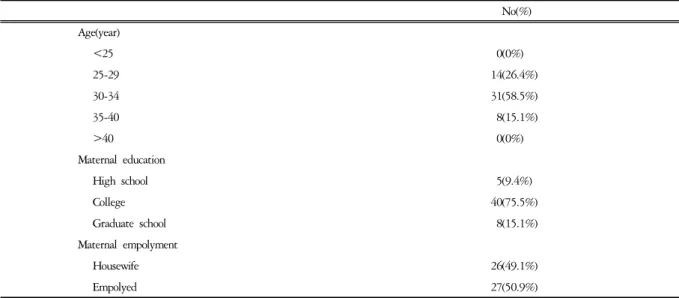
설문에 응답한 산모 나이의 평균은 31.15±2.66세이 고 산모의 사회적인 특성은 Table 1과 같다.
2. 출생과 관련된 요인
설문에 응답한 산모 아이의 출생 시 평균체중은 3.12
±0.47Kg이었으며, 재태기간은 평균 272.30±10.52일 이었다. 이 외 출산과 관련된 요인은 Table 2와 같다.
3. 출산 전 수유 계획과 현재 수유 방법
설문에 응답한 산모 53명 중 분유수유를 계획한 산
모는 없고, 완전 모유수유가 42명(79.2%)으로 가장 많이
계획하였으나, 현재 수유 방법은 혼합수유가 33명(62.3%)
으로 가장 많았다(Table 3). 산모의 나이, 직업유무, 초
산과 경산, 모자동실 여부, 재태기간, 분만방법, 출산
전 모유수유 교육 여부, 아이의 성별에 따른 모유수유
율에 통계학적 차이는 없었다.
No(%) Baby's gender
Male 23(43.3%)
Female 30(56.6%)
Rooming-in
No 50(94.3%)
Yes 3(5.7%)
Breast-feeding in Delivery place
No 43(81.1%)
Yes 10(18.9%)
Delivery type
Normal 35(66%)
C-section 18(34%)
Gestational Weeks
<37 weeks 4(7.5%)
≥37 weeks 49(92.5%)
Birth weight
<2.5kg 4(7.5%)
≥2.5kg 49(92.5%)
Birth order
1st 28(52.8%)
≥2nd 25(47.2%)
Antenatal lactation education
No 36(67.9%)
Yes 17(32.1%)
Table 2. Birth Related Factors
Antenatal Plan No(%) Present Feeding No(%)
Exclusive breast-feeding 42(79.2%)) 17(32.1%)
Partial breast-feeding 11(20.8%) 33(62.3%)
Formula feeding 0(0.0%) 3(5.7%)
Table 3. Antenatal Plan of Feeding and Present Feeding Methods
No(%) Age(year)
<25 0(0%)
25-29 14(26.4%)
30-34 31(58.5%)
35-40 8(15.1%)
>40 0(0%)
Maternal education
High school 5(9.4%)
College 40(75.5%)
Graduate school 8(15.1%)
Maternal empolyment
Housewife 26(49.1%)
Empolyed 27(50.9%)
Table 1. Characteristics of Study Population
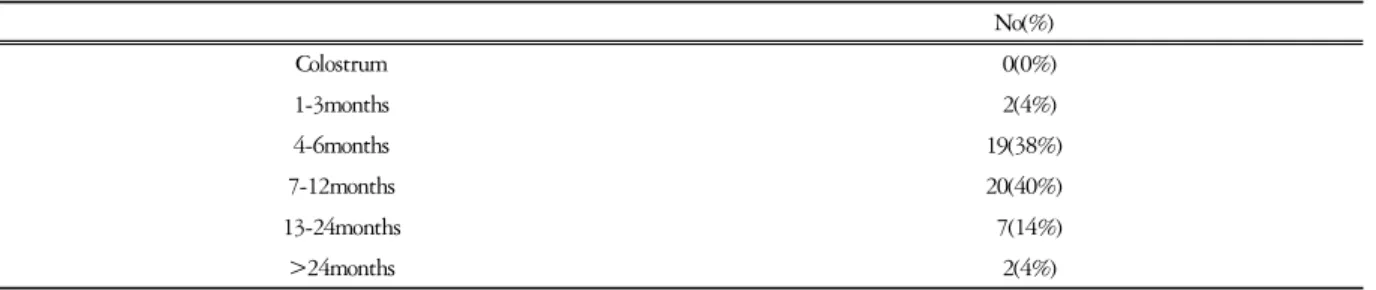
No(%)
Colostrum 0(0%)
1-3months 2(4%)
4-6months 19(38%)
7-12months 20(40%)
13-24months 7(14%)
>24months 2(4%)
Table 5. Time and Advisers on the Decision of Feeding Methods
No(%) Time
Before pregnancy 40(75.5%)
1st trimester 5(9.4%)
2nd trimester 0(0%)
3rd trimester 2(3.8%)
post natal 6(11.3%)
Adviser
Herself 48(90.6%)
Husband 1(1.9%)
Mother 3(5.7%)
Friends and neighbours 1(1.9%)
Table 6. Reason and Information Source of Breast Feeding
No(%) Reason
Baby's health 45(90%)
Relationship between mother and baby 5(10%)
Information Source
Mother or Mother in law 3(6%)
Friends or Relatives 11(22%)
Docter or Nurse 7(14%)
Hospital's Breast-feeding Instructions 10(20%)
Mass media or internet 2(4%)
Lectures 1(2%)
Books and Magazines 16(32%)
Table 7. Reasons to Formula Feeding
No(%)
Return to work 2(5.6%)
Previous failure of breast-feeding 1(2.8%)
Concerns about insufficient amount of breast-feeding 26(72.2%)
Inverted nipple 2(5.6%)
Small breast 3(8.3%)
Concerns about baby's weight gain 1(2.8%)
Abscence of breast-feeding method information 1(2.8%)
Table 4. Duration of Breast-feeding Plan
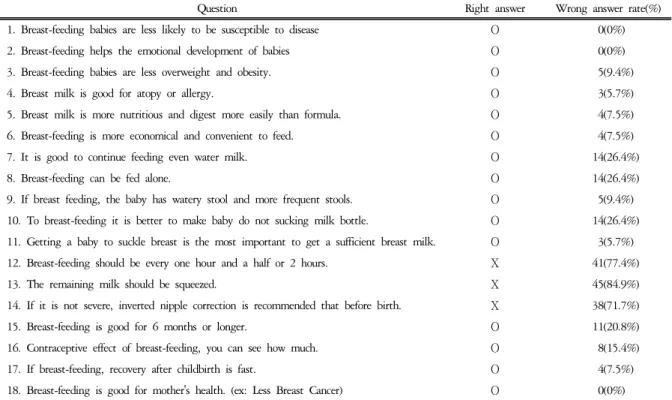
Table 8. Understanding of Breast-feeding
Question Right answer Wrong answer rate(%)
1. Breast-feeding babies are less likely to be susceptible to disease Ο 0(0%)
2. Breast-feeding helps the emotional development of babies Ο 0(0%)
3. Breast-feeding babies are less overweight and obesity. Ο 5(9.4%)
4. Breast milk is good for atopy or allergy. Ο 3(5.7%)
5. Breast milk is more nutritious and digest more easily than formula. Ο 4(7.5%)
6. Breast-feeding is more economical and convenient to feed. Ο 4(7.5%)
7. It is good to continue feeding even water milk. Ο 14(26.4%)
8. Breast-feeding can be fed alone. Ο 14(26.4%)
9. If breast feeding, the baby has watery stool and more frequent stools. Ο 5(9.4%) 10. To breast-feeding it is better to make baby do not sucking milk bottle. Ο 14(26.4%) 11. Getting a baby to suckle breast is the most important to get a sufficient breast milk. Ο 3(5.7%)
12. Breast-feeding should be every one hour and a half or 2 hours. Χ 41(77.4%)
13. The remaining milk should be squeezed. Χ 45(84.9%)
14. If it is not severe, inverted nipple correction is recommended that before birth. Χ 38(71.7%)
15. Breast-feeding is good for 6 months or longer. Ο 11(20.8%)
16. Contraceptive effect of breast-feeding, you can see how much. Ο 8(15.4%)
17. If breast-feeding, recovery after childbirth is fast. Ο 4(7.5%)
18. Breast-feeding is good for mother's health. (ex: Less Breast Cancer) Ο 0(0%)
Table 9. Understanding of Breast-feeding with Herbal Medicine.