DOI: https://doi.org/10.14579/MEMBRANE_JOURNAL.2017.27.6.499
1)
†
Corresponding author(e-mail: [email protected], http://orcid.org/0000-0002-5858-1747)
폴리디메틸실록산-폴리비닐피롤리돈 빗살 공중합체 합성, 모폴로지 및 투과성질
라즈쿠마 파텔⋅박 정 태*⋅박 민 수**⋅김 종 학**,†
서울시립대학교 전기컴퓨터공학과, *건국대학교 화학공학과, **연세대학교 화공생명공학과 (2017년 10월 27일 접수, 2017년 11월 20일 수정, 2017년 11월 22일 채택)
Synthesis, Morphology and Permeation Properties of
poly(dimethyl siloxane)-poly(1-vinyl-2-pyrrolidinone) Comb Copolymer
Rajkumar Patel, Jung Tae Park * , Min Su Park ** , and Jong Hak Kim **
,†School of Electrical and Computer Engineering, The University of Seoul, 163 Seoulsiripdaero Dongdaemun-ro, Seoul 02504, South Korea
*Department of Chemical Engineering, Konkuk University, 120 Neungdong-ro, Gwangjin-gu, Seoul 05029, South Korea
**Department of Chemical and Biomolecular Engineering, Yonsei University, 50 Yonsei-ro, Seodaemun-gu, Seoul 03722, South Korea
(Received October 27, 2017, Revised November 20, 2017, Accepted November 22, 2017)
요 약: 인위적인 온실 가스 배출로 인한 자연 재해가 증가하고 있으며 이로 인해 기체 분리막의 개발이 촉진되게 되었다.
이산화탄소(CO
2)는 지구 온난화의 주요 원인이다. 고유의 유연성을 가지는 유기 고분자 막은 기체 분리막의 좋은 후보군 중 하나이며, 이 중 이산화탄소에 대한 높은 확산도를 가지고 있는 폴리디메틸실록산(PDMS)은 유망한 소재이다. 또한, 폴리비 닐피롤리돈(PVP)은 이산화탄소에 대한 높은 용해도를 가지고 있는 고분자로 기체 분리막에 활용될 수 있다. 따라서 본 연구 에서는 용이한 조건에서 간단한 단일 반응 자유 라디칼 중합에 의하여 다양한 조성의 폴리디메틸실록산-폴리비닐피롤리돈 (PDMS-PVP) 빗살 공중합체를 합성하였다. PDMS와 PVP로 합성된 공중합체는 FTIR을 통해 분석하였다. 고분자의 형태학 및 열적 특성은 TEM, TGA 및 DSC를 통하여 분석하였다. PDMS-PVP 빗살 공중합체를 다공성 폴리설폰 지지체 위에 코팅 하여 복합막을 제조했으며, 제조한 복합막의 기체 투과 특성을 분석하였다. 그 결과 이산화탄소의 투과도 및 이산화탄소/질소 선택도가 각각 140.6 GPU 및 12.0에 도달하였다.
Abstract: The increasing number of natural disasters resulting from anthropogenic greenhouse gas emissions has prompt- ed the development of a gas separation membrane. Carbon dioxide (CO
2) is the main cause of global warming. Organic pol- ymeric membranes with inherent flexibility are good candidates for use in gas separation membranes and poly(dimethyl si- loxane)(PDMS) specifically is a promising material due to its inherently high CO
2diffusivity. In addition, poly(vinyl pyrroli- dine)(PVP) is a polymer with high CO
2solubility that could be incorporated into a gas separation membrane. In this study, poly(dimethyl siloxane)-poly(vinyl pyrrolidine)(PDMS-PVP) comb copolymers with different compositions were synthesized under mild conditions via a simple one step free radical polymerization. The copolymerization of PDMS and PVP was char- acterized by FTIR. The morphology and thermal behavior of the produced polymers were characterized by transmission electron microscopy (TEM), thermogravimetric analysis (TGA), and differential scanning calorimetry (DSC). Composite membranes composed of PDMS-PVP on a microporous polysulfone substrate layer were prepared and their CO
2separation properties were subsequently studied. The CO
2permeance and CO
2/N
2selectivity through the PDMS-PVP composite mem- brane reached 140.6 GPU and 12.0, respectively.
Keywords: comb copolymer, gas separation, composite membrane, permeance, selectivity
1. Introduction
The use of fossil fuels to meet the growing energy demand has led to ever-increasing CO
2emissions.
Although there is growing awareness regarding the negative effects of greenhouse gas emissions and the use of alternative renewable energy resources, the con- trol of CO
2release into the environment is another strategy to mitigate the impacts of global warming.
Gas separation by a polymeric membrane is an im- portant process that has the potential to control the di- rect release of environmental contaminating gases[1-5].
Poly(dimethyl siloxane) (PDMS) is a useful polymer that can be applied as a gas separation membrane due to its well-known affinity towards CO
2gas[6-12]. The presence of siloxane bonds in PDMS imbues good thermal stability, lower glass transition properties, and hydrophobicity to the resulting material. A significant advantage of using PDMS-based membranes is its high permeance for many gases, but due to its low mechan- ical strength and poor selectivity, requires further modification. The polymer backbone has previously been modified and in some cases copolymerized with polyimide, polyamide, polycarbonate, or polyurethane to enhance its gas separation and mechanical properties [13-17]. Poly(vinyl pyrrolidine)(PVP) is another class of polymer which is commonly used in everyday prod- ucts such as paint, coating, and contact lenses. The presence of lone pairs on the amide group enhances its affinity for CO
2. Poly(vinyl chloride) can be grafted with PVP to enhance the gas permeation properties of the resulting free standing membrane[18].
The poor mechanical strength of PDMS can be solved by another method which involves fabricating a composite membrane with a microporous substrate, sin- gle layer, or copolymer[19,20]. There are several types of substrates such as cellulose acetate, polyamide, pol- yacrylonitrile, and polyether sulfone that can support the thin film of PDMS or its copolymers[21,22].
PDMS-b-PI-PDMS triblock copolymers have been linked to functionalized PDMS which is then cast onto
porous polyacrylonitrile substrate[23].
In this work, soft PDMS is copolymerized with hard PVP by a simple one step free radical polymerization to increase the mechanical properties and gas separa- tion performance of the resulting membrane. The PDMS-PVP comb copolymer was characterized by Fourier transform infrared spectroscopy (FTIR), ther- mogravimetric analysis (TGA), and differential scan- ning calorimetry (DSC). The PDMS-PVP copolymer is coated onto a microporous polyether sulfone membrane and its gas permeation proprieties studied.
2. Experimental
2.1. Materials
Monomethacryloxypropyl terminated polydimethyl si- loxane (MMAPDMS, 120-250 cSt, M
w= 10,000) was procured from Gelest, Inc. 1-Vinyl-2-pyrrolidinone (VP) and 2.2’-azobisisobutyronitrile (AIBN) were purchased from Sigma-Aldrich. Ethyl acetate and ethanol was ob- tained from DUCSAN, Korea.
2.2. Synthesis of the PDMS-PVP comb copolymer Different ratios of MMAPDMS and VP were mixed in 100 mL of ethylacetate in the presence of AIBN, a free radical initiator. All the reactants were mixed in a round bottom flask placed on a magnetic stirrer. The mixture was nitrogen purged for approximately 30 min and the temperature of the oil bath was raised to 70°C.
The reaction was performed for 24 h and then cooled to room temperature. The product of the reaction was then precipitated in diethyl ether, filtered and the prod- uct was dried in an oven. Different copolymers of PDMS-PVP with PDMS : PVP ratios of 1 : 0.5, 1 : 1, 1 : 2, and 1 : 3 were synthesized by changing the amount of constituents added.
2.3. Preparation of the PDMS-PVP composite membrane
Solutions of approximately 20 wt% PDMS-PVP
comb copolymers in ethanol were prepared. The poly-
mer solution was coated onto a microporous poly-
sulfone substrate (average pore size of 0.5 µm, Toray Chemical Inc.) by an RK control coater (Model 101, Control RK Print-Coat Instruments Ltd., UK). The fab- ricated composite membrane was then dried in a vac- uum oven at 80°C for 24 h.
2.4. Gas permeation measurements
Gas permeation measurements were conducted using a gas separation apparatus provided by Airrane Co. Ltd (Korea). The measurements were performed using the constant pressure/variable volume method described in de- tail in our previous studies[24-26]. The permeance of each pure gas was calculated using the gas permeance and membrane thickness, and the membrane selectivity was defined as the ratio of the permeabilities of the gases.
2.5. Membrane characterization
Intermolecular interactions were investigated using an Excalibur series FT-IR instrument (Diglab Co., Hannover, Germany) in the frequency range of 4000- 500 cm
-1. For the FT-IR measurements, the PEDOT- PSS solution was cast onto a glass dish and dried in a vacuum oven overnight. The dried PEDOT-PSS film was scraped from the glass dish and used for the measurements. The morphology of the membranes was examined using a field-emission scanning electron mi- croscope (FE-SEM, SUPAR55VP, Carl Zeiss, Germany).
TEM images were obtained using a Zeiss Libra120 op- erating at 120 kV. To prepare the TEM samples, poly- meric solutions were drop-cast onto a standard copper
grid and measured without staining. DSC measure- ments (DSC8000, Perkin Elmer, USA) were performed to analyze the structure and thermal properties of the polymers at a heating rate of 10 °C/min under a nitro- gen atmosphere. The thermal stability of the copolymer was investigated by thermogravimetric analysis (TGA, Q50, TA Instruments), at a heating rate 10 °C/min un- der nitrogen from 50 to 700°C.
3. Results and Discussion
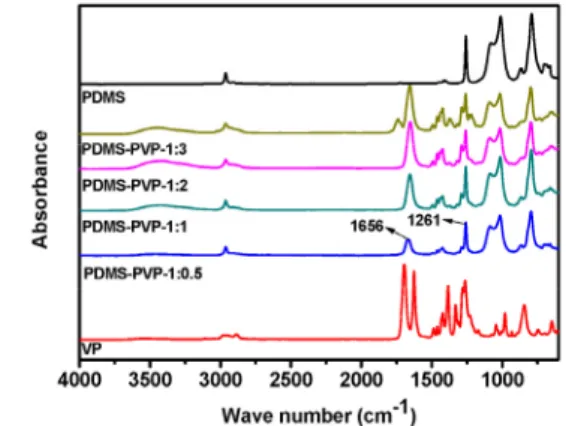
PDMS-PVP was synthesized by a one step free radi- cal polymerization process under mild conditions in ethyl acetate, as presented in Fig. 1. The chemical linking between PDMS and PVP was characterized by FT-IR and presented in Fig. 2. The carbonyl band from the amide group in PVP gives rise to the peak at 1656 cm
-1. The binary band in the vinyl pyridine is merged into one band after the formation of the PDMS-PVP copolymer. The Si-CH
3peak of PDMS is observed at 1261 cm
-1which clearly indicates the for- mation of the PDMS-PVP comb copolymer.
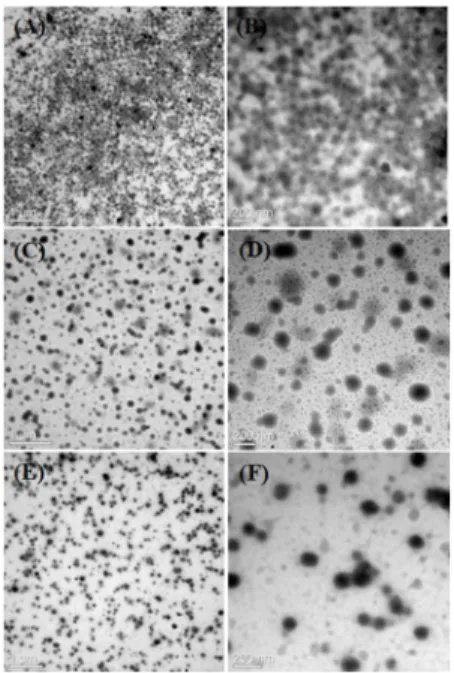
Fig. 3 shows the results of the morphological studies of the PDMS-PVP comb copolymer by TEM. Clear microphase separation morphology can be seen with the dark phase corresponding to the PDMS domain and the bright phase corresponding to the PVP[27,28]. The image contrast is because the electron density of the silicon atoms present in PDMS is higher than its PVP Fig. 1. Synthesis of the PDMS-PVP comb copolymer. Fig. 2. FT-IR spectra of neat PDMS, VP, and PDMS-PVP
comb copolymers with various ratios.
counterpart. The density of the dark phase is highest for PDMS-PVP (1 : 0.5), indicating that the ratio of PDMS was the highest of the three prepared copolymers. The size of the dark phase is smallest for the PDMS-PVP comb copolymers with higher PDMS ratios along with smaller micellar size.
Fig. 4 shows the TGA analysis of the PDMS-PVP comb copolymers. The thermal stability of the copoly- mer increases when the proportion of the hard PVP domain is higher in the copolymer. PDMS-PVP (1 :
0.5) has the lowest and PDMS-PVP (1 : 3) has the highest stability. The degradation of the polymer starts at approximately 400°C and peaks at 430°C. The pres- ence of the two domains in the PDMS-PVP comb co- polymer is clearly visible from the two different degra- dation profiles. The second degradation starts at ap- proximately 500°C and peaks at 580°C which is likely due to the PVP hard domain.
Fig. 5 shows the differential thermal analysis (DTA) of the PDMS-PVP copolymers. It clearly indicates two peak degradation temperatures of PDMS and PVP at 432 and 580°C, respectively, due to the different ther- mal stability of the domains. Fig. 6 shows the results of the differential scanning calorimetry (DSC) charac- terization of the PDMS-PVP copolymers. The presence Fig. 3. TEM images of (a, b) PDMS-PVP (1 : 0.5), (c, d)
PDMS-PVP (1 : 1) and (e, f) PDMS-PVP (1 : 2) comb copolymers.
Fig. 4. TGA curves of (a) PDMS-PVP (1 : 0.5), (b) PDMS-PVP (1 : 1), (c) PDMS-PVP (1 : 2) and (d) PDMS-PVP (1 : 3).
Fig. 5. DTA curves of (a) PDMS-PVP (1 : 0.5), (b) PDMS-PVP (1 : 1), (c) PDMS-PVP (1 : 2) and (d) PDMS-PVP (1 : 3).
Fig. 6. DSC curves of (a) PDMS-PVP (1 : 0.5), (b)
PDMS-PVP (1 : 1), (c) PDMS-PVP (1 : 2) and (d)
PDMS-PVP (1 : 3).
of two glass transition temperatures (T
gs) indicates mi- crophase-separated structure of the PDMS-PVP copoly- mers, which is consistent with the above TEM analysis.
The increase in the hard PVP domain content in the copolymer might increase the chain stiffness. This value is correlated with the gas separation properties of the copolymer, which is discussed in the next section.
The gas separation properties of the PDMS-PVP comb copolymer are shown in Table 1. The PDMS- PVP (1 : 0.5) comb copolymer shows the highest CO
2permeance of 140.6 with a CO
2/N
2selectivity of 12.
The CO
2permeance decreased by a factor of 4 and the selectivity was halved when the PVP concentration was doubled in the PDMS-PVP comb copolymer. It has been reported that when the proportion of the hard urethane segment increases in the PDMS/poly(propy- lene oxide) urethane membrane, the gas permeance and selectivity decreased[29]. The increase in the PVP con- tent with a higher T
gis another factor that explains the decrease in the permeance of the copolymer.
4. Conclusion
A series of PDMS-PVP comb copolymers were syn- thesized by one-pot free radical polymerization. The copolymerization of PDMS and PVP was characterized by FTIR spectroscopy. The thermal stability and glass transition temperature of the PDMS-PVP copolymer in- creased with higher percentages of the PVP domains in the comb copolymer. The soft PDMS domain and the hard PVP domain showed two distinct degradation pro- files, showing a clear difference in their thermal stability. The increase in the proportion of PVP do- mains in the copolymer could be determined from their phase separation properties. The PDMS-PVP (1 : 0.5) comb copolymer with the least amount of hard PVP
chains showed the best CO
2permeance and CO
2/N
2selectivity.
Acknowledgements
This work was supported by the National Research Foundation (NRF) grant funded by the Ministry of Science, ICT and Future Planning (NRF-2017R1A4A 1014569, NRF-2017R1D1A1B06028030).
Reference
1. C. H. Lau, P. Li, F. Li, T. S. Chung, and D. R.
Paul, “Reverse-selective polymeric membranes for gas separations”, Progress Polym. Sci., 38, 740 (2013)
2. S. Basu, A. L. Khan, A. Cano-Odena, C. Liu, and I. F. J. Vankelecom, “Membrane-based technol- ogies for biogas separations”, Chem. Soc. Rev., 39, 750 (2010).
3. C. H. Park, J. H. Lee, M. S. Park, and J. H. Kim,
“Facilitated transport: Basic concepts and applica- tions to gas separation membranes”, Membr. J., 27, 205 (2017).
4. W. W. Chi, J. H. Lee, M. S. Park, and J. H. Kim,
“Recent research trends of mixed matrix mem- branes for CO
2separation”, Membr. J., 25, 373 (2015).
5. H. Lin, Z. Ze, Z. Sun, J. Vu, A. Ng, M.
Mohammaed, J, Kneip, T. C. Kerkel, T. Wu, and R. C. Mambrecht, “CO
2-selective membranes for hydrogen production and CO
2capture - Part I:
Membrane development”, J. Membr. Sci., 457, 149 (2014).
6. T. C. Merkel, V. I. Bondar, K. Nagai, B. D.
Freeman, and I. Pinnau, “Gas sorption, diffusion,
Membrane N2 Permeance (GPU) CO2 Permeance (GPU) Selectivity (CO2/N2)PDMS-PVP (1 : 05) 11.7 140.6 12.0
PDMS-PVP (1 : 1) 5.2 34.9 6.7