• 검색 결과가 없습니다.

Effects of the Non-linear Stress-Strain Behavior of RAP Concrete on Structural Responses for Rigid Pavement Application

N/A
N/A
Protected

Academic year: 2021

Share "Effects of the Non-linear Stress-Strain Behavior of RAP Concrete on Structural Responses for Rigid Pavement Application"

Copied!
8
0
0

로드 중.... (전체 텍스트 보기)

전체 글

(1)

Kim, Kukjoo 김`국`주 Univ. of Florida·Graduate Research Assistant·Corresponding Author (E-mail : [email protected]) Chun, Sanghyun 천`상`현 Member·Univ. of Florida·Postdoctoral Research Associate (E-mail : [email protected])

Park, Bongsuk 박`봉`석 Univ. of Florida·Graduate Research Assistant (E-mail : [email protected]) Tia, Mang 티아 맹 Univ. of Florida·Professor (E-mail : [email protected])

1. INTRODUCTION 1.1. Background

Recently, the use of recycled aggregate in concrete has become more popular because of the substantial savings in cost

and conservation of aggregates. In general, reclaimed asphalt pavement (RAP) material appears to be a viable aggregate source for use not only in asphalt pavement, but also in Portland Cement Concrete (PCC) pavement. Prior research

Int. J. Highw. Eng. Vol. 19 No. 1 : 37-44 FEBRUARY 2017 https://doi.org/10.7855/IJHE.2017.19.1.037

ABSTRACT

PURPOSES : This study is primarily focused on evaluating the effects of the non-linear stress-strain behavior of RAP concrete on structural response characteristics as is applicable to concrete pavement.

METHODS : A 3D FE model was developed by incorporating the actual stress-strain behavior of RAP concrete obtained via flexural strength testing as a material property model to evaluate the effects of the non-linear stress-strain behavior to failure on the maximum stresses in the concrete slab and potential performance prediction results. In addition, a typical linear elastic model was employed to analyze the structural responses for comparison purposes. The analytical results from the FE model incorporating the actual stress-strain behavior of RAP concrete were compared to the corresponding results from the linear elastic FE model.

RESULTS : The results indicate that the linear elastic model tends to yield higher predicted maximum stresses in the concrete as compared to those obtained via the actual stress-strain model. Consequently, these higher predicted stresses lead to a difference in potential performance of the concrete pavement containing RAP.

CONCLUSIONS : Analysis of the concrete pavement containing RAP demonstrated that an appropriate analytical model using the actual stress-strain characteristics should be employed to calculate the structural responses of RAP concrete pavement instead of simply assuming the concrete to be a linear elastic material.

Keywords

Reclaimed asphalt pavement (RAP), Non-linear finite element analysis, RAP concrete, Stress analysis, Concrete pavement

Corresponding Author : Kim, Kukjoo, Graduate Research Assistant Engineering School of Sustainable Infrastructure and Environment, University of Florida, P.O. Box 116580, 365 Weil Hall, Gainesville, FL 32611, USA

Tel : +1.352.392.9537 Fax : +1.352.392.3394 E-mail : [email protected]

International Journal of Highway Engineering http://www.ksre.or.kr/

ISSN 1738-7159 (print) ISSN 2287-3678 (Online)

Received Nov. 01. 2016 Revised Feb. 02. 2017 Accepted Feb. 02. 2017

Effects of the Non-linear Stress-Strain Behavior of RAP Concrete on Structural Responses for Rigid Pavement Application

RAP 콘크리트의 비선형 응력-변형률 특성이 강성포장 구조해석에 미치는 영향
(2)

associated with concrete containing RAP indicated that the increase in the percentage of RAP results in the decrease of the compressive strength, modulus of elasticity, splitting tensile strength and flexural strength (Berry et al. 2013; Delwar et al.

1997; Hossiney et al. 2010; Hossiney et al. 2008; Huang et al.

2005; Tia et al. 2012; Tia et al. 2009). Also, the toughness and energy absorbing capacity of PCC were greatly improved primarily since asphalt thin film in RAP at the interface of cement mortar and the aggregate was able to dissipate more energy when the crack propagate (Huang et al. 2005).

Montana Department of Transportation has evaluated the concrete containing RAP as a pavement application using a field demonstration project section constructed near Lewistown, Montana (Berry et al. 2015). The concrete containing RAP used in the project was batched, placed, and finished using conventional equipment. The performance of these slabs was monitored via site visual inspection and instrumented internal vibrating wire gauges over a two year period. It was reported that the test slabs containing RAP did not experience any visual damages (e.g. cracking and/or spalling), excessive shrinkage, and/or significant curling. In addition, Hossiney et al. (2010) investigated the structural behaviors of RAP concrete using Finite Element (FE) analysis and they showed that as the RAP content of the concrete mix increases, the stress-to-strength ratio decreases. Lower stress- to-strength ratio is desirable for pavement applications because lower stress-to-strength ratio imply that the material is capable of withstanding more fatigue cycles and may perform relatively better to resist the fatigue damage.

Although many previous research indicated the potential benefits of RAP in concrete mix through laboratory study, field demonstration project, and FE analysis, the response characteristics associated with the improved failure strain (strain tolerance) of this ductile concrete materials that affect the structural behavior and performance characteristics of RAP concrete pavements still need to be further investigated.

Moreover, most finite element analysis programs currently being used including WESLIQID, FEACONS, and EverFE consider concrete slabs to be a linear elastic material.

Therefore, there is a need to develop a FE model using actual stress-strain behavior of the RAP concrete to better capture the change in critical response characteristics that affects the performance of this type pavement. In this paper, the effect of improved ductility of the RAP concrete on the critical stress

analysis results was evaluated using a 3-D finite element model which uses the actual stress-strain characteristics of the concrete.

1.2. Objectives

This study primarily focused on evaluating the effect of RAP concrete ductility on critical stress analysis results using FE analysis. The detailed objectives are as follows.

Develop an improved FE model for PCC pavement using actual stress-strain behavior as material property model for RAP concrete to more accurately predict the effect of RAP concrete ductility on the critical response characteristics of the pavement system.

Identify the effect of enhanced ductility of RAP concrete on changes in PCC pavement structural behavior by comparing predicted responses from the model using actual stress-strain behavior with those obtained using typical linear elastic material property model.

Evaluate and quantify the effect of RAP concrete ductility on change in relative performance prediction results using stress-strain model as compared with those estimated using typical linear elastic model.

1.3. Scopes

In this study, a 3-D FE model was developed using ADINA computer program. Two different material property models were considered, including a conventional linear elastic model and a novel approach using the actual stress-strain response characteristics termed as “stress-strain”model.

2. OVERVIEW OF RAP CONCRETE PROPERTIES

RAP is a bituminous concrete material removed and

reprocessed from flexible pavements composed of a

combination of both aged asphalt and aggregate. The

mechanical properties of RAP are predominantly affected by

the condition of the reclaimed pavement material. Also, there

is significant variability in RAP properties depending upon

the type of mix, aggregate quality and size, asphalt mixture

consistency, and asphalt content. In general, coarse RAP is

much finer than the virgin coarse aggregate. However, the

fine RAP is much coarser than the virgin fine aggregate

(3)

(Huang et al. 2006). The addition of RAP to concrete mix leads to improved toughness and cracking resistance primarily due to thin asphalt film in the RAP.

For concrete containing RAP, the compressive strength, flexural strength, and splitting tensile strength of concrete generally decrease as the percentage of RAP increase (Hassan et al. 2000; Hossiney et al. 2010; Huang et al. 2006; Tia et al.

2012; Tia et al. 2009). Also, more reduction in strength was induced by using fine RAP and coarse RAP as compared with the case of using coarse RAP and sand (Hassan et al. 2000).

Al-Oraimi et al. indicated in their study that the percentage of RAP should be controlled to accomplish the required performance and it can be used as an alternative aggregate for application of non-structural layer. The increased amount of RAP potentially results in the reduced elastic modulus of concrete containing RAP (Delwar et al. 1997; Hossiney et al.

2010; Tia et al. 2012; Tia et al. 2009). This confirms the well- known fact that modulus of elasticity and content of the aggregate in the mix significantly influence the elastic modulus of concrete. In general, RAP aggregate is weaker than the virgin aggregate and shows lower elasticity that may cause the decrease in elastic modulus of concrete. Thereby, the elastic modulus of concrete can be further reduced by increasing the percentage of RAP in the mix.

Research conducted by Tia et al. indicated that the coefficient of thermal expansion slightly increases as the percentage of RAP in the concrete mixture increases (Tia et al. 2012). However, no clear trend was observed between the RAP mix and the reference mix for conclusive statement. The nature of this observation is possibly associated with the variability of the RAP aggregate properties that highly affect the coefficient of thermal expansion for concrete mix. The concrete containing RAP may have a higher coefficient of thermal expansion than that of concrete containing the virgin aggregate. In general, there is a proportional relationship between the percentage of RAP in concrete mixture and the modulus of toughness. The toughness value is defined by the area under the stress-strain curve usually obtained from beam tests. Typical beam test results indicate that the strength level (i.e. failure stress) decreases as the percentage of RAP increases. However, the strain level at failure generally increases as the percentage of RAP increases primarily due to the increased ductility of the material. For concrete without RAP, the failure strain is significantly lower and the failure

stress is much higher due to the increased brittleness of concrete material compared with those observed for concrete containing RAP.

3. FINITE ELEMENT MODELING (FEM) 3.1. Characterization of RAP Concrete

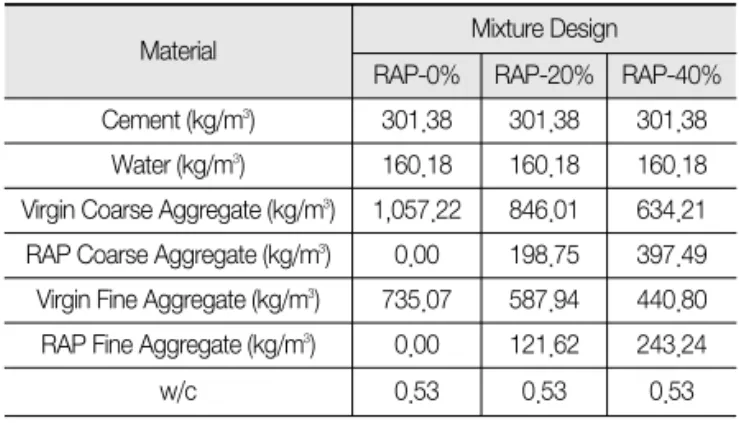
Previous research conducted by Tia et al. (2009) has reported the test results in detail to characterize the RAP concrete. A part of both coarse and fine aggregate fractions were replaced with a pre-wetted RAP to produce the RAP concrete mixtures. The mix designs of concrete evaluated are shown in Table 1. Also, Table 2 presents the coefficient of thermal expansion (ASTM C39, C78, C469, C496, and AASHTO TP60), compressive strength, flexural strength, splitting tensile, and Poisson’ s ratio for the hardened concrete samples at 28 days. All details of mix design, material preparation, and test results used in this study can be found in the report by Tia et. al. (2009).

3.2. Modeling of RAP Concrete Material

Most of FE models for concrete pavement previously introduced consider the concrete slab as a linear-elastic material which is an unrealistic assumption for the RAP concrete. As previously discussed, the RAP concrete behaves

Table 1. Mix Designs for RAP Concrete

Property Mixture Type

RAP-0% RAP-20% RAP-40%

Compressive Strength (MPa) 38.58 26.05 17.38 Flexural Strength (MPa) 4.82 4.11 3.66 Splitting Tensile Strength (MPa) 3.24 2.58 2.42 Coefficient of Thermal Expansion (×10

-6

/℃) 10.89 11.57 11.16

Poisson's ratio 0.24 0.25 0.25

Material Mixture Design

RAP-0% RAP-20% RAP-40%

Cement (kg/m

3

) 301.38 301.38 301.38 Water (kg/m

3

) 160.18 160.18 160.18 Virgin Coarse Aggregate (kg/m

3

) 1,057.22 846.01 634.21 RAP Coarse Aggregate (kg/m

3

) 0.00 198.75 397.49 Virgin Fine Aggregate (kg/m

3

) 735.07 587.94 440.80 RAP Fine Aggregate (kg/m

3

) 0.00 121.62 243.24

w/c 0.53 0.53 0.53

Table 2. RAP Concrete Material Properties

(4)

more ductile and fails at an increased strain level. Therefore, the actual stress-strain response characteristics of concrete should be incorporated to characterize the RAP concrete in FE analysis for more realistic and effective modeling of the RAP concrete behavior. In this study, a three dimensional FE model for analysis of concrete pavement structure which was developed and validated in another research (Kim et al. 2016) was modified to evaluate the structural response characteristics of RAP concrete pavement under critical temperature-load condition in Florida.

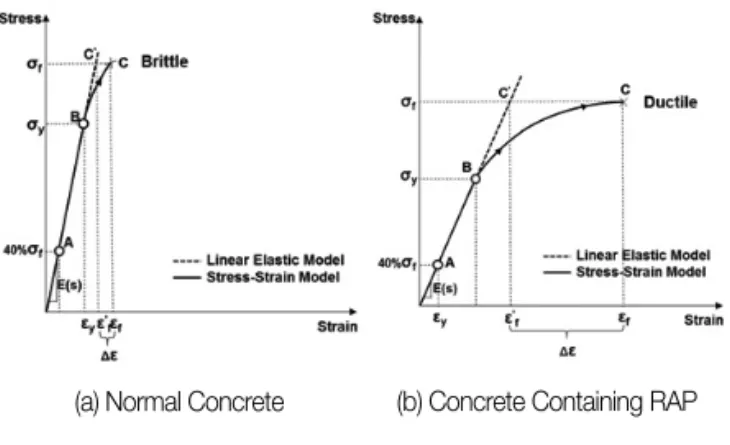
Figs 1 (a) and (b) show a typical stress-strain response for normal concrete and concrete containing RAP obtained from the flexural test. In general, both types of concrete exhibit linear behavior and have similar elastic moduli up to the proportional limit at point B. The concrete is then progressively weakened due to the internal micro-crack development up to failure at point C. However, the increased failure strain was identified for concrete containing RAP before the failure particularly due to the improved toughness and energy absorbing capacity that causes a difficulty to accurately estimate the stress in the concrete if the RAP concrete is considered as the linear elastic material (Huang et al. 2005; Tia et al. 2012; Tia et al. 2009).

There are several options for material characterization model of the RAP concrete. These options for concrete range from modeling it as a simple elastic material to a non-linear plastic material. In this study, the actual stress-strain behavior of the RAP concrete determined from previous study (Tia et al. 2012) was used to represent the behavior of concrete material under the combined effect of temperature and load.

The stress-strain characteristics were determined using the flexural strength test designated by ASTM C78 for the RAP concrete. Tables 3 and 4 show the stress-strain parameters

used in concrete material characterization and the elastic material property inputs of different RAP percentages for FE modeling.

3.3. Modeling of Pavement Structure

The FE model consists of two layers as follows:

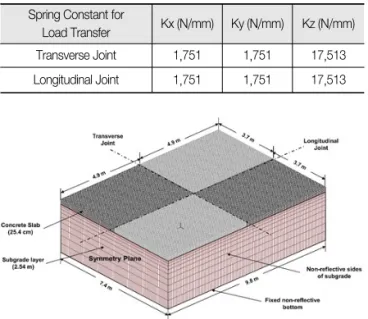
3.65 m wide and 25.4 cm thick concrete slab.

3.65 m wide and 254 cm thick subgrade layer.

These layers were modeled as assemblages of hexahedron elements defined by eight nodes with three degrees of freedom (i.e. translations in the x-, y-, and z-directions). The mechanical and thermal parameters used include modulus of elasticity (E), Poisson’ s ratio, coefficient of thermal expansion (CTE), and mass density. To simulate the boundary condition for subgrade layer, the double symmetry with respect to x- and y-axes with large enough dimensions at a depth of 254 cm (100 in) was considered and the bottom of the subgrade layer was fixed with respect to z-direction.

Also, load transfer across the joint between two adjacent slabs (i.e. longitudinal and transverse joints) was modeled using the spring elements by connecting the nodes of the finite elements along the joint with three degrees of freedom. Table 5 exhibits three values of spring constants used to represent the stiffnesses along x-, y-, and z-directions. Fig 2 shows a 3-D FE model

(a) Normal Concrete (b) Concrete Containing RAP Fig. 1 Stress-strain Curve for Concrete

Table 3. Stress-Strain Parameters Used in Concrete Material

RAP-0% RAP-20% RAP-40%

Strain (ε)

Stress (MPa)

Strain (ε)

Stress (MPa)

Strain (ε)

Stress (MPa) 0.00E+00 0.00 0.00E+00 0.00 0.00E+00 0.00 3.99E-05 1.37 3.50E-05 0.83 4.65E-05 0.84 6.31E-05 2.08 8.80E-05 2.12 7.97E-05 1.42 8.47E-05 2.72 1.30E-04 2.85 1.20E-04 1.97 1.06E-04 3.27 1.89E-04 3.45 1.50E-04 2.41 1.20E-04 3.57 2.24E-04 3.72 1.81E-04 2.61 1.40E-04 3.87 2.71E-04 3.90 2.28E-04 2.90 1.59E-04 4.18 3.37E-04 4.03 2.97E-04 3.16 1.83E-04 4.50 4.57E-04 4.07 4.22E-04 3.51 1.98E-04 4.82 4.98E-04 4.11 7.03E-04 3.66

Table 4. Elastic Material Property Inputs

Layer Modulus (GPa) Poisson’ s ratio Thickness (mm)

RAP-0% 34.23 0.24 228.6

RAP-20% 24.55 0.25 228.6

RAP-40% 18.10 0.25 228.6

Subgrade 0.79 0.40 2540.0

(5)

developed for the analysis of the RAP concrete pavement.

3.4. Loading Configuration and Temperature Effects

The critical stress analysis was performed to determine the maximum stresses in the concrete slabs under combined load-temperature conditions. The maximum tensile stresses in the concrete slab occur when the slab was loaded by a 98- kN (22-kip) axle load (which is the maximum legal single axle load in Florida) at the critical loading positions (i.e. at the slab corner and at the middle edge) with the consideration of critical temperature differential conditions as shown in Fig 3.

According to a previous study conducted by Wu et al. (1993) on concrete pavement in Florida, a typical severe temperature differential in the concrete slab at midday was found to be about +11.1 ℃(+20.0 ℉) and a typical severe condition at nighttime was about -5.6 ℃ (-10 ℉).

4. FE ANALYSIS RESULTS

4.1. Effects of RAP Concrete on Environmental Responses

The environmental loading can cause the deformation of concrete slabs termed as curling movements. This distortion and the concrete slab self-weight induce the curling stresses in concrete that can significantly affect the performance of the concrete pavement. Therefore, it is imperative to appropriately calculate the curling stresses induced by the fluctuation of temperature gradients to accurately predict the performance of concrete pavement. The critical environmental loading conditions in this analysis were (1) a temperature differential of -5.6 ℃ (-10 ℉) which represents a typical severe condition at nighttime, and (2) a temperature differential of +11.1 ℃ (+20 ℉) which reflects a typical severe condition in the daytime.

Tables 6 and 7 summarize the calculated maximum curling stresses in concrete containing different percentages of RAP under the critical temperature conditions. In addition, a typical linear elastic model was also used to calculate the curling stresses using identical environmental condition for comparison purpose. Results indicated that the effect of RAP concrete ductility has minimal effect on curling stresses. The linear elastic model gives approximately 5 % higher maximum tensile stresses in the concrete under the positive temperature differential while almost no difference was noted Fig. 2 3-D Finite Element Model Developed

Fig. 3 Critical Loading Conditions

Table 5. Spring Constants Used for Modeling of Load Transfer Across the Joints

Spring Constant for

Load Transfer Kx (N/mm) Ky (N/mm) Kz (N/mm) Transverse Joint 1,751 1,751 17,513 Longitudinal Joint 1,751 1,751 17,513

Table 6. Comparison of Curling Stresses Computed by the Linear Elastic and Actual Stress-Strain Models at +11.1 ℃ Temperature Gradient

Mix

Linear Elastic Model Stress-Strain Model Max. Stress

(MPa)

Corner Deflection

(mm)

Max. Stress (MPa)

Corner Deflection

(mm)

RAP-0% 2.88 -0.11 2.73 -0.11

RAP-20% 2.17 -0.10 2.14 -0.10

RAP-40% 1.52 -0.08 1.50 -0.08

Table 7. Comparison of Curling Stresses Computed by the Linear Elastic and Actual Stess-Strain Models at -5.6 ℃ Temperature Gradient

Mix

Linear Elastic Model Stress-Strain Model Max. Stress

(MPa)

Corner Deflection

(mm)

Max. Stress (MPa)

Corner Deflection

(mm)

RAP-0% 1.23 0.04 1.23 0.04

RAP-20% 0.96 0.03 0.96 0.03

RAP-40% 0.69 0.03 0.69 0.03

(6)

under the negative temperature gradient condition. This can be explained by the known fact that the concrete materials exhibit a linear behavior up to the proportional limit as shown in Fig 1 and the effect of environmental loading may not be significant to induce the nonlinear deformation of the concrete slabs.

4.2. Effects of RAP Concrete on Critical Stresses Critical stress analysis to evaluate the maximum tensile stresses in the concrete under typical critical temperature-load condition was performed using both linear elastic and stress- strain FE models. The stress-to-strength ratio was calculated using the flexural strength of the concrete determined by the laboratory test. A 98-kN (22-kip) single axle load which is the maximum allowed axle load in Florida was used for analysis. For positive temperature gradient condition, the most critical loading condition occurs when the axle load is placed at the mid-edge of the slab while the slab corner is the most critical loading position at night when the concrete slab experiences the negative temperature gradient.

Based on these critical conditions and the developed FE models, the maximum stresses were calculated for different

temperature gradients as shown in Tables 8 through 10.

Results indicated that the maximum tensile stresses determined using the linear elastic model were overestimated as compared with those calculated using stress-strain model under the combined temperature-load condition. Since the maximum tensile stress in the concrete is an important factor that influences the prediction of potential pavement performance, the effect of RAP concrete ductility should be considered for calculation to more accurately predict the critical stresses in the concrete pavement. Therefore, the appropriate modeling of the nonlinear behavior of RAP concrete is essential. In addition, it should be noted that the difference between two models is observed only at high stress level when the stress-strain plot becomes non-linear.

4.3. Effects of RAP Concrete on Transverse Cracking Performance

The performance of transverse cracking was also evaluated to determine the effect of differences in calculated maximum stresses and stress-to-strength ratio on change in relative performance prediction results. The transverse cracking performance was estimated using the following equation

Table 8. Comparison of Maximum Stresses Computed by the Linear Elastic and Actual Stress-Strain Models Under a 98-kN Single Axle Load with +11.1℃ Temperature Gradient

Mix Flexural Strength (MPa)

Linear Elastic Model Stress-Strain Model

Difference (%) Stress (MPa) Stress Ratio Stress (MPa) Stress Ratio

RAP-0% 4.82 4.12 0.85 3.74 0.78 10.20

RAP-20% 4.11 3.27 0.80 3.00 0.73 9.17

RAP-40% 3.66 2.48 0.68 2.28 0.62 9.02

Table 9. Comparison of Maximum Stresses Computed by the Linear Elastic and Actual Stress-Strain Models Under a 98-kN Single Axle Load with 0℃ Temperature Gradient

Mix Flexural Strength (MPa)

Linear Elastic Model Stress-Strain Model

Difference (%) Stress (MPa) Stress Ratio Stress (MPa) Stress Ratio

RAP-0% 4.82 1.24 0.26 1.24 0.26 0.00

RAP-20% 4.11 1.10 0.27 1.09 0.27 0.57

RAP-40% 3.66 0.97 0.26 0.96 0.26 0.43

Table 10. Comparison of Maximum Stresses Computed by the Linear Elastic and Actual Stress-Strain Models Under a 98-kN Single Axle Load with -5.6℃ Temperature Gradient

Mix Flexural Strength (MPa)

Linear Elastic Model Stress-Strain Model

Difference (%) Stress (MPa) Stress Ratio Stress (MPa) Stress Ratio

RAP-0% 4.82 1.66 0.34 1.66 0.34 0.00

RAP-20% 4.11 1.39 0.34 1.39 0.34 0.45

RAP-40% 3.66 1.14 0.31 1.14 0.31 0.18

(7)

developed by Hoerner et al. (1999).

Where, %Cracked = slabs cracked in percentage (transverse fatigue cracking), n = Actual number of 80-kN (18-kip) ESALs application at slab edge = (0.05×Total ESALs) for pavements without widened slabs, Total ESALs

= cumulative total number of measured 80-kN (18-kip) ESAL applications, and ratio = the ratio of computed edge stress to 28-day modulus of rupture.

Fig 4 shows the percentage of transverse crack in the PCC pavement if the cumulative total number of million ESALs is assumed. According to Fig 4, the transverse cracking prediction results exhibit the differences between the different material property models used. In particular, the performance prediction results showed significant difference between two models evaluated for concrete containing 40 % RAP. This clearly confirmed that the accurate determination of induced stresses using stress-strain model has an important role to more accurately predict the performance of the RAP concrete pavement when the percentage of RAP in the concrete increases.

5. CONCLUSION

In this study, a 3-D FE model was developed using the actual stress-strain behavior of the RAP concrete obtained from the flexural strength test as a material property model to evaluate the effect of the increased strain level to failure on the maximum stresses in the concrete slab and the potential

performance prediction results. The analytical solutions using two FE models incorporated with a linear elastic model and actual stress-strain behavior of the RAP concrete were compared. The main findings and conclusions are summarized as follows.

No significant difference was identified on the environmental responses determined using both linear elastic FE model and the model incorporated with the actual stress-strain behavior of the RAP concrete.

The maximum tensile stresses in the concrete calculated using the linear elastic model appear to be higher for critical temperature-load condition as compared to those calculated with the consideration of the effect of RAP concrete ductility.

The FE model using the actual stress-strain behavior yields the better potential performance than that with the linear elastic model. In other words, the model incorporated with the linear elastic approach results in the underestimated predicted performance.

The predicted transverse cracking performances using the actual stress-strain model shows better performance than those using the linear elastic model.

Based on the analytical results, it can be concluded that the maximum computed tensile stresses in the concrete using the linear elastic model tend to overestimate the induced stresses that result in underestimated potential performance of concrete pavement. Therefore, for the design of the concrete pavement containing RAP, the appropriate analytical material property model in conjunction with the correct value of concrete properties should be employed to more accurately predict the pavement performance. Even though the measured flexural strength of RAP concrete used in this study was lower than the minimum strength recommended by the AASHTO pavement design requirement of a 4.5 MPa, this study clearly confirmed that the effect of non-linear behavior of the RAP concrete must be considered when calculating the maximum stresses in the concrete pavement. The 3-D FE model incorporated with the actual stress-strain behavior of the RAP concrete seems to better capture the structural response characteristics of RAP concrete pavement.

(1)

Fig. 4 Potential Transverse Cracking Performance

(8)

ACKNOWLEDGEMENT

The authors would like to acknowledge the FDOT ’ s State Materials Office Pavement Materials Section staff for their assistance with data collection, materials testing, and technical advice.

REFERENCES

Berry, M., Dalton, K., and Murray, F. (2015). “Feasibility of Reclaimed Asphalt Pavement as Aggregate in Portland Cement Concrete Pavements Phase II: Field Demonstration.”Research Report, Montana Department of Transportation. MT.

Berry, M., Stephens, J., Bermel, B., Hagel, A., and Schroeder, D.

(2013). “Feasibility of Reclaimed Asphalt Pavement as Aggregate in Portland Cement Concrete.”Research Report, Montana Department of Transportation. MT.

Delwar, M., Fahmy, M., and Taha, R. (1997). “Use of reclaimed asphalt pavement as an aggregate in Portland cement concrete.”

ACI Materials Journal, 94(3).

Hassan, K., Brooks, J., and Erdman, M. (2000). “The use of reclaimed asphalt pavement (RAP) aggregates in concrete. ” Waste Management Series, 1, 121-128.

Hoerner, T., Tarr, S., Darter, M., and Okamoto, P. (1999). “Guide to Developing Performance-Related Specifications for PCC Pavements, Volume III: Appendixes C Through F.”FHWA- RD-98-171, Federal Highway Administration, Washington DC.

Hossiney, N., Tia, M., and Bergin, M. J. (2010). “Concrete containing RAP for use in concrete pavement. ”International

Journal of Pavement Research and Technology, 3(5), 251-258.

Hossiney, N., Wang, G., Tia, M., and Bergin, M. “Evaluation of Concrete Containing Recycled Asphalt Pavement for Use in Concrete Pavement.”Proc., Transportation Research Board 87th Annual Meeting.

Huang, B., Shu, X., and Burdette, E. (2006). “Mechanical properties of concrete containing recycled asphalt pavements.”Magazine of Concrete Research, 58(5), 313-320.

Huang, B., Shu, X., and Li, G. (2005). “Laboratory investigation of portland cement concrete containing recycled asphalt pavements.”Cement and Concrete Research, 35(10), 2008- 2013.

Kim, K., Subgranon, T., Tia, M., and Bergin, M. (2016). “Internally Cured Concrete for Use in Concrete Pavement Using Accelerated Pavement Testing and Finite-Element Analysis.”

Journal of Materials in Civil Engineering, 04016011.

Tia, M., Hossiney, N., Su, Y.-M., Chen, Y., and Do, T. A. (2012).

“Use of Reclaimed Asphalt Pavement in Concrete Pavement Slabs. ”Research Report, University of Florida, Gainesville, FL.

Tia, M., Liu, Y., Haranki, B., and Su, Y.-M. (2009). “Modulus of Elasticity, Creep and Shrinkage of Concrete?PHASE II: Part 1- Creep Study.”Research Report, University of Florida, Gainesville, FL.

Wu, C., Tia, M., and Larsen, T. “Analysis of structural response of concrete pavements under critical thermal-loading conditions.”

Proc., Fifth International Conference on Concrete Pavement

Design and Rehabilitation.

수치

Table 1. Mix Designs for RAP Concrete
Table 4. Elastic Material Property Inputs
Fig. 3 Critical Loading Conditions
Table 9. Comparison of Maximum Stresses Computed by the Linear Elastic and Actual Stress-Strain Models Under a 98-kN Single Axle  Load with 0℃ Temperature Gradient
+2

참조

관련 문서