INTRODUCTION
According to a recent news, the number of coffee shops in a single city of Seoul, Korea became over 10 thousands in 2012, which accounted for that this figure presented two times as in 2008 (The hankyor- eh 2015). Not even in a large city, but in a small town, finding a coffee shop is not too difficult re- cently. With a remarkable growth in the number of coffee shop, a considerable deal of imported coffee presents a big rush in a coffee market (Kim JS, Choi SH 2011; Um YH 2010). In a cultural aspect, more- over, a culture of enjoying coffee in Korea is no lon- ger the exclusive property for a privileged minority, but the common asset for all modern individuals (Noh JH, Jang HB 2011). This implies that enjoying coffee is not a new dessert trend any more com- pared to the past as 1970s or 1980s, but it’s a part of life style in the country. Regardless of taking out or enjoying a cup of coffee in a coffee shop, coffee itself appears to be an inevitable product in a con-
sumption market in Korea.
Although there is currently a plethora of research in a theme of coffee, those studies deal with the fol- lowing issues: cultural marketing (Kim KY, Kim MK 2010; Noh JH, Jang HB 2011), servicescape (Um YH 2010), brand personality and loyalty (Kim JS, Choi SH 2011; Kim SH et al 2011). Because a few studies on service quality have been found in a coffee shop at best, the purpose of this study is not only to identify causal relationships between service quality, consu- mer satisfaction, and behavioral intention in coffee shop, but also to focus on whether or not consumer satisfaction plays a moderating role between service quality and behavioral intention. Therefore, under a particular setting of coffee shop, the specific pur- pose of this study is not unlimited to a relationship between attributes of service quality and consumer satisfaction, but unrestricted to looking at whether consumer satisfaction affected by service quality con- tributes to consumer behavioral intention that may result in revenue (Jani D, Han H 2013). By testing Culinary Science and Hospitality Research (October 2015)
Vol. 21, No. 5, pp. 50-58
Comparison with Service Quality Models in Coffee Shop
Hyojin Kim1 and Byung-Gook Kim2
1Dept. of Tourism & Convention, Busan National University
2¶Dept. of Hotel & Tourism, Daegu University
ABSTRACT: The purpose of this study is to identify the causal relationships between service quality, con- sumer satisfaction, and behavioral intention in coffee shop. Additionally, the stud aims at focusing on whether or not consumer satisfaction plays a moderating role between service quality and behavioral intention. Statistical techniques that involve frequency, reliability, exploratory factor analysis, and struc- tural equation modeling were performed. In the third research model, consumer satisfaction was unfolded as a moderating variable that enables to be a key player between service quality and behavioral intention.
Limitations and considerations of this study were discussed for future study.
Keywords: coffee shop, service quality, satisfaction, behavioral intention
¶ Corresponding Author: Byung-Gook Kim, Dept. of Hotel & Tourism, Daegu University, Jillyang, Gyeongsan City, Gyeongbuk, South Korea, Tel. 82-53-850-6143, Fax. 82-53-850-6149, Email: [email protected]
a few service quality models in coffee shop, the re- sults from this study enable to provide a helpful and strategic model to marketers in coffee shop.
LITERATURE REVIEW
Service Quality
As for several features of service that encompass intangibility, inseparability, heterogeneity, and pe- rishability, a great deal of not only academic but al- so practical discussion have been performed in a few disciplines that regard a service concept as im- portant (Lee YJ 2008). Particularly, with respect to measuring service quality perceived by consumers, considerable efforts and contributions from resear- chers appear for years (Grönroos C 1984). According to Lee S (2009) and Zeithmal VA (1988), unlike ob- jective quality, quality perceived by consumers is subjectively considered and judged to the superi- ority or differentiation of a product. That is, service quality perceived by consumers is defined as an emo- tion felt from goods and service made in a particular brand. Moreover, this encompasses reliability and fa- vor from consumers towards a product per se and is distinguished from satisfaction. Among studies on service quality, a remarkable output from these ac- complishments is the advent of the SERVQUAL mo- del, which leads to the DINESERV that deals with re- liability, assurance, responsiveness, tangibles, and empathy (Ha J, Jang S 2010; Stevens P et al 1995).
Based upon a large list of studies associated with service quality, 12 variables were singled out for the study (Stevens P et al 1995; Kim JY et al 2009).
Consumer Satisfaction
For many decades, research in consumer satisfac- tion has been conducted in social science, particu- larly in a service management sector, but the term of satisfaction is defined depending on academic scholars (Kim HJ et al 2015). Typically, researchers define satisfaction as a discrepancy between expect- ation felt by users before the utilization of a parti- cular product and experience felt by them after its consumption (Tse D, Wilton P 1988). Others argue that satisfaction is an emotional reaction from con- sumers after experience of tangible or intangible service (Westbrook RA, Reilly MD 1983). Also, it is
maintained to be a size of overall pleasure and enough felt by consumers, after their experience of service and goods (Hellier P et al 2003). As an inter- esting point from relatively recent literature, some investigators claim that a rise of consumer satisfac- tion plays a preceding variable in positively influenc- ing behavioral intention such as revisit, repurchase, word-of-mouth, and loyalty (Cronin JJ, Talyor SA 1992; Jung YW 2006; Ravald A, Gronrros C 1996; Um YH 2010; Yi YJ, La SA 2004). Through these previous works, it is revealed that consumer satisfaction is germane to behavioral intention.
Behavioral Intention
In regard to behavioral intention or customer lo- yalty in a marketing field, while some researchers define it as a customer’s an attitude towards a firm, others argue that behavioral intention is expressed as a favorable attitude about a purchased product or as how many a product is repurchased (Lee MJ 2009; Um YH 2010). From much previous research, the term of behavioral intention involves a con- sistent repurchase about a preferable goods and service in the future, which is connected to an en- thusiastic patron with loyalty. An instrumental tool to measure behavioral intention is referred to a word-of-mouth and willingness to pay as premium and to repurchase (Oliver RL 1999; Kim HB et al 2007). Therefore, behavioral intention is presented as a form of repurchase over a long period of time or positive word-of-mouth if consumers favorably perceive a specific product (Jeon KC et al 2005). Con- sidering a characteristic of coffee shop, this study adopts revisit and recommendations to others as counter parts of repurchase and word-of-mouth (Szy- manski DM, Henard DJ 2001; Zeithaml VA et al 1996;
Hyun KS 2009).
METHODS
Research Model
Under a setting of coffee shop, this study attem- pted to investigate the relationships between servi- ce quality, overall consumer satisfaction, and beha- vioral intention. In particular, the study examined whether overall consumer satisfaction, as a moderating variable, played a significant role in influencing be-
Figure 1. Service quality model.
havioral intention. Also, the study endeavored to identify if the three service quality models created for this study were suitable for a model fit. The basic research model was presented in Figure 1. In accor- dance with both literature review and the research model, the two hypotheses were as follows:
Hypothesis 1: Service quality in coffee shop will positively affect consumer satisfaction.
Hypothesis 2: Consumer satisfaction will posi- tively affect behavioral intention.
Instrument and Sampling
For the study, a questionnaire pertaining to servi- ce quality, overall consumer satisfaction, and behavi- oral intention was developed from previous research (Ha J, Jang S 2010; Kim JY et al 2009; Stevens P et al 1995). A survey constituted four sections: 1) 12 items on service quality, 2) one item on overall con- sumer satisfaction regarding service provided, 3) two items on behavioral intention which contain revisit and favorable recommendation to others, and 4) demographic profile. Except for a part of demo- graphic profile, all of the items were adopted with a seven point Likert scale (1 - strongly disagree to 7 - strongly agree) based upon extant literature. A data collection was achieved with a convenient sam- pling method from March 3 to May 30, 2015. Survey was distributed and self-administered to those who were college students in Daegu, Kyungpook in Sou- th Korea because a comparison of service quality models in coffee shop has never carried out in this area. Of the collected survey, the sample size of 278 was employed for the analyses, which accounted for a response rate of 95.9%.
Statistical Methods
Using SPSS version 20.0 and Amos 18.0 version programs, statistical methods that involve frequency, reliability, exploratory factor analysis, and structural equation modeling were performed. To identify the maintenance of the basic statistical assumptions en-
compassing the absence of missing value, kurtosis, and skewness in regard to normality, frequency ana- lysis was undertaken. For the internal reliability of variables with service quality and behavioral inten- tion, cronbach’s α coefficients were accepted. With a varimax method that entails orthogonal rotation, exploratory factor analysis was run to evaluate the validity of measurement instrument for construct of service quality. Additionally, structural equation mo- deling was implemented to test the goodness-of-fit of the suggested models and to uncover a variable that plays a moderating role between service quality and behavioral intention in this study.
RESULTS
Frequency and Reliability
Normal distributions for all variables were found from descriptive statistics. No missing value was de- tected. Of a total of 278 respondents, the majority of them were male (63.7%). This uneven gender ra- tio was an insignificant impact on the study results.
As to annual income before taxes, the highest cate- gory was between USD 40,000 and USD 59,999, fol- lowed by between USD 60,000 and USD 79,999, and followed by between USD 20,000 and USD 39,999, assuming that KW (Korean Won) 1,000=USD 1. This implied that annual income before taxes for re- spondents was much higher than average income of about USD 25,000 in South Korea.
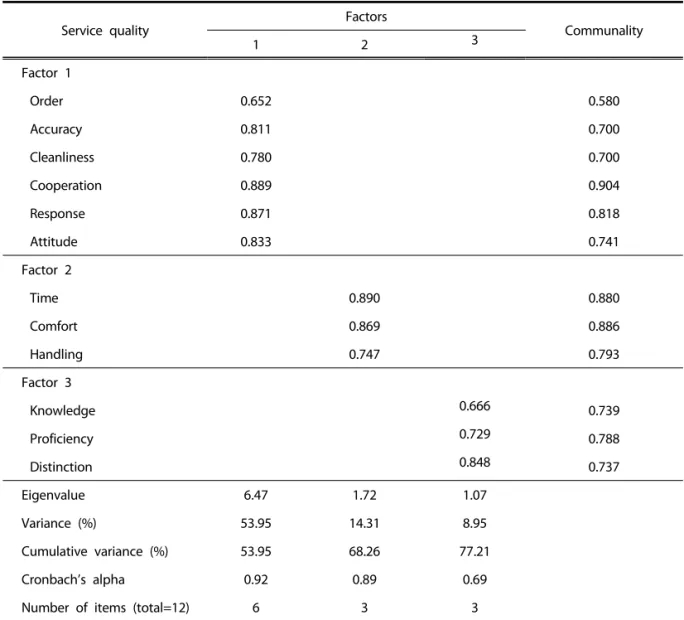
With respect to service quality and behavioral in- tention, cronbach’s α coefficients were calculated for reliability. Specifically, a construct of service quality was extracted into the three factors after exploratory factor analysis. Individual reliability for each factor was measured. Cronbach’s αs for service quality fac- tor 1, 2, and 3 showed 0.92, 0.89 and 0.69, respec- tively, which accounted for high presentations of re- liability (See Table 1). These high values of Cron- bach’s α were paralleled with the results by Kim HJ (2014). In addition, acceptable Cronbach’s α for be- havioral intention was presented with 0.71.
Exploratory Factor Analysis
The required statistical assumptions such as ab- sence of outliers and multicollinearity and factor- ability of the correlation matrices for exploratory fac-
tor analysis were inviolate (Tabachnick B, Fidell L 2007). Principal factors extraction with varimax rota- tion was conducted for a construct of service quality that constituted 12 variables. The 12 variables were extracted into the three factors, which accounted for 77.21% of the total variance. Table 1 presented that the six variables of “Order,” “Accuracy,” “Cleanliness,”
“Cooperation,” “Response,” and “Attitude” were load- ed on service quality factor 1, while service quality factor loaded the three variables that contained
“Time,” “Comfort,” “Handling.” The last three varia- bles that embraced “Knowledge,” “Proficiency,” and
“Distinction” were loaded on service quality factor 3.
These three extracted factors were different from
Service quality Factors
Communality
1 2 3
Factor 1
Order 0.652 0.580
Accuracy 0.811 0.700
Cleanliness 0.780 0.700
Cooperation 0.889 0.904
Response 0.871 0.818
Attitude 0.833 0.741
Factor 2
Time 0.890 0.880
Comfort 0.869 0.886
Handling 0.747 0.793
Factor 3
Knowledge 0.666 0.739
Proficiency 0.729 0.788
Distinction 0.848 0.737
Eigenvalue 6.47 1.72 1.07
Variance (%) 53.95 14.31 8.95
Cumulative variance (%) 53.95 68.26 77.21
Cronbach’s alpha 0.92 0.89 0.69
Number of items (total=12) 6 3 3
Note: 1) Kaiser-Meyer-Olkin (KMO) statistic:.836 (greater than .60).
2) Bartlett’s test of Sphericity: p<.001.
3) Time denotes “The service time promised is met”; Comfort “The coffee shop makes me feel personally safe
“; Handling “Staff quickly correct anything that is wrong”; Order “Staff serve the item(s) exactly in order”; Accuracy
“Staff provide the item(s) exactly as they are ordered”; Cleanliness “Staff regularly clean tables and chairs”;
Cooperation “Staff help each other during busy times”; Response “Staff answer questions satisfactorily”; Attitude
“Staff are pleasant to me”; Knowledge “Staff are able and willing to share information with me about menu items, ingredients, and methods of preparation”; Proficiency “Staff are well-trained and competent”; Distinction “Staff rec- ognize me as a regular customer.”
Table 1. Service quality dimensions
the result of Kim HJ’s (2014) that had the two factors from the same 12 variables of service quality. This might be because of a difference in sample size.
Service Quality Model 1
Using exploratory factor analysis, the three factors were taken out from a construct of service quality.
With each of the three factors, the three different models were developed (See Figure 2, 3, and 4). To test these three service quality models, a few para- meters that involved goodness-of-fit index were esti- mated by an advanced statistical technique of struc- tural equation modeling. As referenced in many studies, an analytical method of structural equation modeling, as the most appropriate statistical tool that enables to verify a causal relationship between independent, moderating, and dependent variables, was applicable to an original or applied research model solely when a thorough theoretical frame- work was established (Oh CH et al 2010; Park HJ, Sohn DH 2010). Because this study contained a moderating variable of consumer satisfaction bet-
ween service quality and behavioral intention in the applied research model, rather than using a multiple regression analysis, structural equation modeling was judged to be adequate.
The adopted criteria for fitness of the models we- re as followed: GFI (Goodness-of-Fit Index) ≥ 0.9, AGFI (Adjusted Goodness-of-Fit Index) ≥ 0.9, NFI (Normed Fit Index) ≥ 0.9, CFI (Comparative Fit Index)
≥ 0.9, RMSR (Root Mean Square Residual) ≤ 0.5, and RMSEA (Root Mean Square Error of Approximation)
≤ 0.08 (Oh CH et al 2010; Park HJ, Sohn DH 2010;
Shin DJ 2010). The three individual models were evaluated, and the first model with the service quali- ty factor 1 resulted in the following parameters: χ2= 1683.868 (df=28, p=.000), GFI=0.370, AGFI=—0.013, NFI=0.111, CFI=0.109, RMR=0.530, and RMSEA=0.462.
While the values of χ2, df, and p were suitable, all parameters were not met to the acceptable criteria for a model fit, in particular the value of RMSEA that should have been less than 0.08, which indicated that the first model was unacceptable, as a research model.
Service Quality Model 2
The second model with the service quality factor 2 was tested as did the first model, and the results showed χ2=682.665 (df=10, p=.000), GFI=0.590, AG- FI=0.138, NFI=0.196, CFI=0.193, RMR=0.386, and RMSEA=0.493. Although the model became a bit better than the first model in terms of GFI, NFI, CFI, and RMR, it remained unacceptable for an appro- priate model fit because of a considerable violation of RMSEA.
Service Quality Model 3 Figure 3. Service quality model 2.
Figure 4. Service quality model 3.
Figure 2. Service quality model 1.
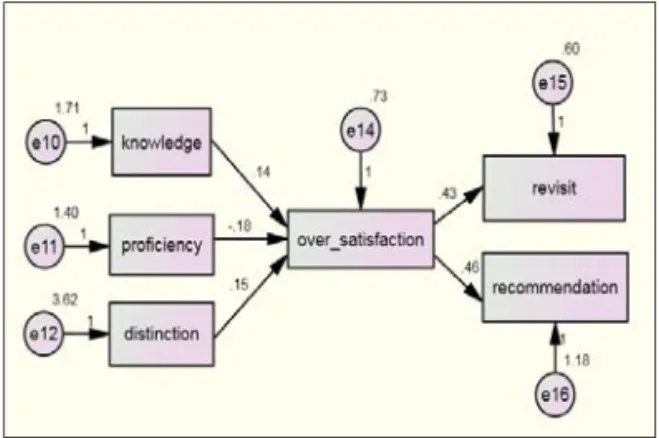
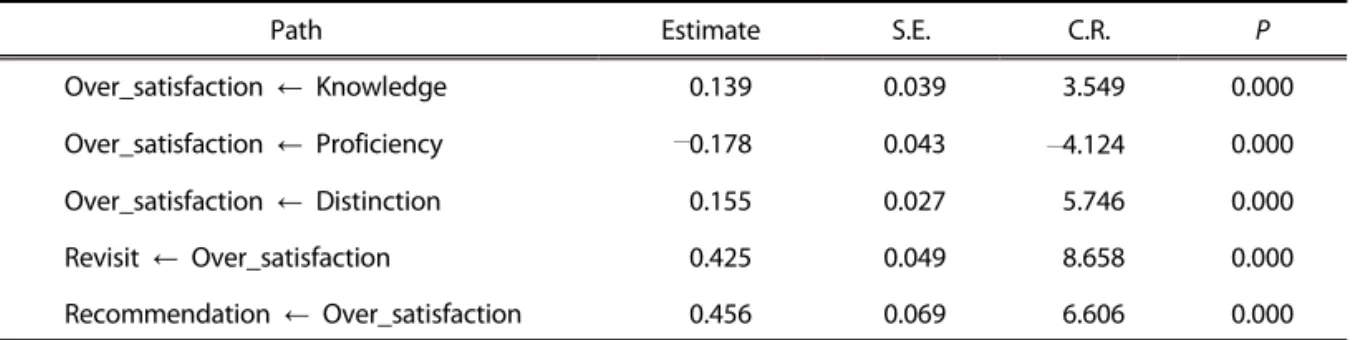
With the service quality factor 3, the last model was analyzed by structural equation modeling. As a result, the model was presented with χ2=341.194 (df= 10, p=.000), GFI=0.939, AGFI=0.910, NFI=0.982, CFI= 0.980, RMR=0.388, RMSEA=0.046. Unlike the re- sults from service quality model 1 and 2, this model satisfied the suggested criteria for a model fit. There- fore, the Figure 4 about the service quality model 3 was allowed to make significant interpretations between service quality, consumer satisfaction, and behavioral intention. As seen in Table 2, the three variables among attributes of service quality became statistically significant to consumer satisfaction. The variable of consumer satisfaction was also significant to the two variables from behavioral intention, whi- ch explained that consumer satisfaction played an important role between a few attributes of service quality and behavioral intention. Based on these re- sults, the hypothesis 1 that addressed service quality in coffee shop will positively affect consumer sati- sfaction was partially supported because the two variables - knowledge and distinction - positively in- fluenced consumer satisfaction, whereas the remain- ing variable of proficiency had a negative effect on consumer satisfaction. As to the relationship be- tween consumer satisfaction and behavioral inten- tion, the hypothesis 2 was fully supported since con- sumer satisfaction positively affected revisit and re- commendation.
CONCLUSIONS
Discussion and Implications
With respect to a heated debate on a wide range of service quality models in the academic world, a
vast array of studies was already achieved over a few decades. This turns out that the issue associated with service quality has been paid much attention to a scholar group, which is especially remarkable in a service management area. With this academic interest, this study was carried out to find the rela- tionships between service quality, consumer satisfac- tion, and behavioral intention under a background of coffee shop. From the three created research models, consumer satisfaction was unfolded as a moderating variable, using an advanced statistical tool of structural equation modeling. This variable was found to be a key player between service quali- ty and behavioral intention in the third model. It was significant, therefore, that the result contributed to suggesting a new service quality model with con- sumer satisfaction.
Although the three research models with different attributes of service quality were suggested, solely the third model with the three attributes that con- stituted knowledge, proficiency, and distinction in a construct of service quality was accepted for a good model fit. These three attributes showed significant relationships with consumer satisfaction. Subsequ- ently, consumer satisfaction significantly affected re- visit and recommendation. This implies that training employees about how to serve and attract consum- ers in coffee shops is an important strategy to in- crease consumer satisfaction, which is finally linked to positive behavioral intention. Unless coffee shop marketers, managers, or owners are much interested in only taking out coffee in coffee shops, they need to become aware of what consumers are attracted and satisfied among attributes of service quality in the coffee industry.
Path Estimate S.E. C.R. P
Over_satisfaction ← Knowledge 0.139 0.039 3.549 0.000
Over_satisfaction ← Proficiency —0.178 0.043 —4.124 0.000
Over_satisfaction ← Distinction 0.155 0.027 5.746 0.000
Revisit ← Over_satisfaction 0.425 0.049 8.658 0.000
Recommendation ← Over_satisfaction 0.456 0.069 6.606 0.000
Note: S.E. denotes standard error; C.R. critical ration; P p-value.
Table 2. Results of service quality model 3
Limitations and Future Research
Limitations and considerations of this study were addressed for the following research. First, as in most empirical studies, this study was limited to making a generalization because a data collection with a particular time span was accomplished in a specific area located in Daegu-Kyungpook, South Korea. Moreover, the sample for the study was tar- geted to college students alone, not regular custo- mers. Therefore, without solving these problems, this study is unable to be free from an issue of generalization. Future research is expected to elabo- rate upon the methods relating to data collection and sampling. Second, although previous research review about service quality has been undertaken, the 12 selected variables pertaining to a construct of service quality were incomplete to fully explain it. More detailed variables to describe service quality are required to add in future research. In the end, as argued by Kim HJ (2014), this study provided a developed model of service quality in coffee shop and revealed that overall consumer satisfaction func- tioned as a significant moderator between attributes of service quality and behavioral intention. Even though there is a contribution to find an important moderator, overall consumer satisfaction, it is need- ed to discover different moderators under varied service quality models in coffee shop.
REFERENCES
Cronin JJ, Taylor SA (1992). Measuring service quali- ty: A reexamination and extension. Journal of Marketing 56(July): 55-68.
Grönroos C (1984). A service quality model and its marketing implication. European Journal of Mar- keting 18(4):36-44.
Ha J, Jang S (2010). Effect of service and food quali- ty: The moderating role of atmospherics in an ethnic restaurant segment. International Journal of Hospitality Management 29(3):520-529.
Hellier P, Geursen G, Carr R, Richard J. (2003). Custo- mer repurchase intention: A general structural equation model. European Journal of Marketing 37(11-12):1762-1800.
Hyun KS (2009). The influence of service's physical environment on customer value and behavior
intention: Focused on five-star hotels in Jeju.
Doctoral Dissertation, Kyunghee University.
Jani D, Han H (2013). Personality, social comparison, consumption emotions, satisfaction, and beha- vioral intentions: How do these and other fac- tors relate in a hotel setting? International Jour- nal of Contemporary Hospitality Management 25 (7):970-993.
Jeon KC, Jung JW, Park BK (2005). The effect of se- lection attributes of Japanese restaurant custom- ers on sales promotion, customer satisfaction, and customer loyalty. Journal of Foodservice Ma- nagement Society of Korea 8(3):107-124.
Jung YW (2006). A study on the factors of consumer satisfaction and consumer loyalty in coffee hou- ses. The Korean Culinary Sciences & Foodservice Research 12 (4):1-17.
Kim HB, Lee JW, Ro YJ (2007). Impacts of choice at- tributes on consumer loyalty in the coffeeshop restaurant. Journal of Foodservice Management Society of Korea 10(4):237-252.
Kim HJ (2014). Are physical environments, service quality, and menu in coffee shop influencing ov- erall satisfaction of college students? Culinary Sciences & Foodservice Research 20(5):124-129.
Kim JS, Choi SH (2011). A study on the effects of brand individuality of specialty coffee shops on brand loyalty. The Korean Journal of Culinary Re- search 17(1):124-141.
Kim KY, Kim MK (2010). A study on the costumers’
perspectives on coffee shops’ culture marketing.
Korea Journal of Tourism and Hospitality Research 24(1):219-234.
Kim HJ, Kim HZ, Lee SM (2015). The relationships be- tween physical environment, consumer satisfac- tion, and consumption behavior: Focused on college students. The Korean Culinary Sciences &
Foodservice Research 21(4):325-338.
Kim JY, Kim HJ, Kim CM (2009). The influence of service elements on customers' emotion and lo- yalty-focused on specialty coffee shop custo- mers. Korean Journal of Culinary Restaurant 15 (1):271-286.
Kim SH, Kim MH, Park JM (2011). The influence of brand personality on satisfaction and loyalty in coffee shop industry: A focus on the mediating effect of brand congruency. Journal of Tourism
Sciences 35(3):57-83.
Lee MJ (2009). The effects of service recovery proce- dure on customer satisfaction and customer loy- alty in the foodservice industry: Focusing on the region of Daejeon. Master Thesis, Paichai Uni- versity.
Lee S (2009). Study on the influence of hotel restau- rant brand asset on customer satisfaction, reli- ability and customer loyalty. Master Thesis, Kei- myung University.
Lee YJ (2008). Service Marketing. Hakhyunsa. Paju:
Korea.
Noh JH, Jang HB (2011). Examining the structure re- lationship between the perception of cultural marketing, brand equity and royalty among cof- fee shop users. Journal of Tourism Sciences 35(3):
201-223.
Oh CH, Baek MS, Cho SI, Kim HS (2010). The effects of cognitive and affective trust between fran- chiser and franchisee on relationship orientation and citizenship behavior among franchisees. Jour- nal of Tourism Sciences 34(9):271-298.
Oliver RL (1999). Whence loyalty. Journal of Marke- ting 63:33-66.
Park HJ, Sohn DH (2010). The effects of slow city brand association characteristic on brand atti- tude and visit intention. Journal of Tourism Scien- ces 34(8):11-31.
Ravald A, Grönroos C (1996). The value concept and relationship marketing. European Journal of Mar- keting 21(3):215-224.
Shin DJ (2010). The effects of experiential factors on enjoyment, satisfaction and behavioral intention in an event: An application of Pine & Gilmore’s experience theory. Journal of Tourism Sciences 34(9):251-270.
Stevens P, Knutson B, Patton M (1995). DINESERV: A tool for measuring service quality in restaurants.
Cornell Hotel Restaurant Administration Quarterly 63(2):56-60.
Szymanski DM, Henard DJ (2001). Customer satisfac- tion: A meta-analysis of the empirical evidence.
Journal of the Academy of Marketing Science 29 (1):16-35.
Tabachnick B, Fidell L (2007). Using Multivariate Statistics. Pearson/Allyn & Bacon, Boston.
The hankyoreh (2015). http://www.hani.co.kr/arti/soci- ety/society_general/675532.html, Retrieved from August 13, 2015.
Tse D, Wilton P (1988). Models of consumer sat- isfaction: An extension. Journal of Marketing Re- search 25:204-212.
Um YH (2010). The impact of servicescape of coffee shop to customer satisfaction and relationship performance. Korea Journal of Tourism and Ho- spitality Research 24(3):329-344.
Westbrook RA, Reilly MD (1983). Value-percept dis- parity: An alternative to the disconfirmation of expectations theory of consumer satisfaction. Ad- vances in Consumer Research 10:256-261.
Yi YJ, La SA (2004). Internal branding: Investigating the influence of employees’ brand identification on employee satisfaction and CS activities. Kore- an Marketing Review 19(3):81-112.
Zeithmal VA (1988). Consumer perception of price, quality and value: A means-end model and syn- thesis of evidence. Journal of Marketing 52(7):2- 22.
Zeithaml VA, Berry LL, Parasuraman A (1996). The be- havioral consequences of service quality. Journal of Marketing 60(April):31-46.
Received: 18 September, 2015 Revised: 13 October, 2015 Accepted: 20 October, 2015
서비스 품질 모형 비교: 커피 전문점을 대상으로
김효진1) 김병국2)
1)부산대학교 관광컨벤션학과, 2)¶대구대학교 호텔관광학과
국문초록
본 연구의 목적은 커피 전문점에서 서비스 품질, 소비자 만족, 그리고 행동의도 사이의 인과관계를 규명하는 것이 다. 본 연구의 추가적인 목적은 소비자 만족이 서비스 품질과 행동의도 사이에서 조절변수의 역할을 하는지를 분석하
는 것이다. 본 연구에 사용된 통계기법으로는 빈도분석, 신뢰도 분석, 탐색적 요인분석, 마지막으로 구조방정식 모형이
사용되었다. 세 가지의 서비스 품질 모형이 분석되었고, 그 중 마지막 세 번째 모형에서 소비자 만족이 서비스 품질과
행동의도 관계 사이의 중요한 역할을 하는 조절변수로 나타났다. 본 연구의 한계점과 향후 연구와 관련된 시사점 및 제안들이 제시되었다.
주제어: 커피 전문점, 서비스 품질, 소비자 만족, 행동의도