접수일자 : 2014. 04. 29 심사완료일자 : 2014. 06. 09 게재확정일자 : 2014. 06. 18
* Corresponding Author Byoung-Chul Ahn(E-mail:[email protected], Tel:+82-53-810-2556)
Department of Computer Engineering, Yeungnam University, Gyeongsan, Gyeongbuk 712-749, Korea
Open Access
http://dx.doi.org/10.6109/jkiice.2014.18.8.1961
print ISSN: 2234-4772 online ISSN: 2288-4165 This is an Open Access article distributed under the terms of the Creative Commons Attribution Non-Commercial License(http://creativecommons.org/li-censes/한국정보통신학회논문지(J. Korea Inst. Inf. Commun. Eng.) Vol. 18, No. 8 : 1961~1972 Aug. 2014
Wireless Body Area Networks의 관련기술과 연구경향에 대한 이해
하일규 · 안병철*
Understanding of Technologies and Research Trends of Wireless Body Area Networks
Il-Kyu Ha · Byoung-Chul Ahn
*Department of Computer Engineering, Yeungnam University, Gyeongsan, Gyeongbuk 712-749, Korea
요 약
최근 들어 정보통신기술과 의료기술의 통합에 관한 관심이 증가되면서 센서네트워크를 인체에 적용하고자 하는 WBAN(Wireless Body Area Networks)에 관한 연구가 활발히 진행되고 있다. 기존의 센서네트워크 기술은 WBAN 에 이용될 수 있는 가능성을 가지고 있으나, 몇 가지 제약사항을 가지고 있다. 특히 신체의 각 센서는 신체의 각 부분 을 관통하여 통신해야 할 가능성이 크므로 자유공간인 센서네트워크와는 상당히 다른 네트워킹 환경을 가진다. 따라 서 WBAN에 관한 연구는 기존의 센서네트워크와는 다른 인체의 특성을 고려한 다양한 영역을 연구의 대상으로 하 고 있다. 본 연구에서는 기존의 센서네트워크와는 다른 WBAN의 환경적인 특성을 조사하고, WBAN의 개념이 도입 된 2001년 전후부터 SLR(Systematic Literature Review)기법을 이용하여 WBAN의 연구 경향을 체계적으로 조사한 다 . 이에는 연구 분류와 연구자의 특성 등이 포함된다. 조사 결과를 요약하고 향후 연구 과제를 전망한다.
ABSTRACT
Recently, with the increasing of the interest in the integration of medical technology and information communication technology, researches on WBAN (Wireless Body Area Networks) that try to apply sensor network to the human body have been processed actively. The existing sensor network technology has the potential to be used in WBAN, but it has some limitations also. In particular, because the sensors are likely to communicate through each part of the body, it has a very different network environment from the sensor network that uses a free space. Therefore, researches on WBAN have a variety area of study that slightly different from the conventional sensor networks and take into account the characteristics of the body. In this study, we investigate the environmental characteristics of WBAN that are separated from the conventional sensor network, and the research trends of WBAN systematically by using the technique of SLR (Systematic Literature Review) from 2001 around when the concept of WBAN has been introduced. The investigation includes the classification of research and the researcher’s features. And the survey results and the outlook for further study are summarized.
키워드 : 무선 신체 네트워크, 체계적 문헌검토, 센서 네트워크, 연구 경향
Key word : Wireless Body Area Networks, Systematic Literature Review, Sensor Networks, Research Trends
Ⅰ. 서 론
WBAN(Wireless Body Area Networks)은 인간의 신 체의 기능과 주변 환경을 감시하는 저전력 , 소형, 저중 량의 신체 내부 또는 외부에 있는 무선 센서 노드들의 집합을 말한다[1]. WBAN은 신체의 표면에 또는 내부 에 장착된 소형의 지능적인 장치들로 구성되며, 무선 통신 연결이 가능하다. WBAN을 구성하는 이러한 장치 들은 계속적인 신체의 건강 모니터링을 가능하게 하고 사용자 또는 의료진에게 실시간 피드백이 가능하도록 한다[2]. 또한 WBAN은 신체의 내부, 표면, 주변에 있 는 센서 또는 작동기(actuator)를 서로 연결할 수 있는 무선 주파수(RF-Radio Frequency) 기반의 무선 네트워 크 기술로도 정의할 수 있다 [3]. WBAN의 개념은 [4]에 의해 처음 도입되었으며 그 후 정보통신기술과 의료기 술의 통합에 관한 관심이 증가하면서 여러 연구자들에 의해 연구가 활발히 진행되고 있다 .
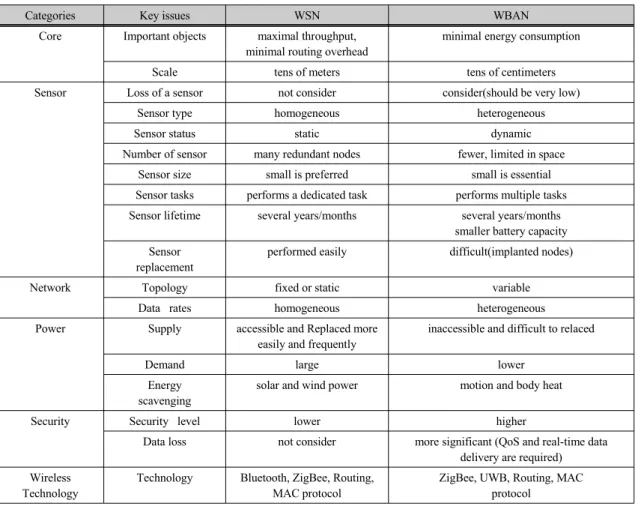
전통적인 무선 센서네트워크를 위한 많은 프로토콜 과 알고리즘들이 개발되어 왔지만 신체의 독특한 네트 워크 환경 때문에 그러한 기술들은 WBAN에 바로 적용 하여 사용할 수 없다[5]. 신체의 무선 네트워크 환경은 다음과 같은 몇 가지 특성을 가진다[1]. 첫째, 신체의 특성 때문에 가능한 대역폭이 제한되어 있고, 자유공 간보다 감쇄(fading), 잡음(noise) 및 간섭(interference) 을 일으키기 쉬워서 대역폭이 가변적이다. 따라서 프 로토콜에 의한 통신제어는 제한적이다. 둘째, 네트워 크를 형성하는 노드 장치들은 이종 기기이며 에너지 의존적이다 . 셋째, 각 노드는 최소한의 전송전력을 소 모하여야 하며, 인체에 해가 없어야 한다. 마지막으로, 신체에 부착된 장치는 움직임이 있다는 것이다. 위와 같은 네트워크 환경의 특성으로 인해 기존의 WSN (Wireless Sensor Networks)과는 다른 기술들이 요구된 다 . 표 1은 전통적인 WSN과 WBAN의 특징을 비교한 것이다 [2].
본 연구에서는 기존의 WSN과는 다른 환경적인 특 성을 가지고 있는 WBAN에서는 어떤 연구가 이루어지 고 있는지 조사하여 연구의 경향성을 살펴본다 . WBAN 의 개념이 도입된 2001년 이후부터 SLR 기법을 이용하 여 체계적인 문헌조사를 실시하여 WBAN의 연구분류, 연구특성 , 연구경향성 등을 밝힌다. 조사된 결과를 바 탕으로 다양한 분석을 실시하고 향후 연구 과제를 전망
한다 .
2장에서는 관련 연구들을 조사하고, 3장에서는 SLR 기 법에 의한 문헌 조사를 실시하며, 4장에서는 조사결과 를 분석하고, 5장에서 연구의 경향성을 요약하고 향후 연구 과제를 제시한다.
Ⅱ. 관련 연구
2.1. WBAN 최신 기술
기존의 WSN과 다른 특성 때문에 WBAN을 위한 여 러 가지 기술들이 연구되어 왔다. 이러한 WBAN 기술 들은 표 2와 같이 분류할 수 있다. WBAN 기술의 분류 는 WBAN을 소개하는 몇몇 조사 분석 연구에서 찾아볼 수 있다.
Physical Layer technology는 물리계층과 관련된 기 술들이다. WBAN을 위한 물리적 장치에 관한 연구들로 신체의 데이터를 감지하고 이를 전달하기 위한 sensor, actuator, transmitter에 관한 연구들이 있고, 데이터 전 달 수단에 관한 연구들로 electromagnetic coupling, signal processing에 관한 연구들이 있으며, 네트워크에 적절한 전원을 공급하기 위한 power supply에 관한 연 구들이 있다. 효율적인 데이터 전달을 위한 antenna 설 계에 관한 연구들 또한 주요 기술에 속한다. WBAN을 구성하는 센서는 신체의 내부 또는 피부에 장착되어 작 동하므로 센서를 작동하는 끊임없는 에너지의 공급이 필수적이다. 따라서 Energy efficiency 기술은 에너지 소모를 줄이거나 에너지를 스스로 만들어 사용하는 기 술에 관한 연구이다. Channel technology는 센서가 감 지한 신호 전달을 위한 channel에 관한 연구이다. 신체 의 특성을 고려한 에너지 효율적인 channel에 관한 연 구가 진행되고 있다. Radio technology는 무선 신호에 관한 기술이다. 기존 WSN에서 사용하는 무선 주파수 영역은 신체의 특성을 고려하지 않아 WBAN에 적합하 지 않다. 이를 위해 Bluetooth, IEEE 802.15.4(ZigBee) 와 IEEE 802.15.6(UWB)관련 기술이 연구되고 있다.
MAC layer technology는 MAC 계층에서의 효율적인
데이터 전달을 위한 기술이다. WBAN에서 가장 많이
다루어지고 있는 연구주제 중 하나로, 에너지 효율적인
MAC 프로토콜에 관한 연구가 주로 진행되고 있다.
Categories Key issues WSN WBAN Core Important objects maximal throughput,
minimal routing overhead
minimal energy consumption
Scale tens of meters tens of centimeters
Sensor Loss of a sensor not consider consider(should be very low)
Sensor type homogeneous heterogeneous
Sensor status static dynamic
Number of sensor many redundant nodes fewer, limited in space
Sensor size small is preferred small is essential
Sensor tasks performs a dedicated task performs multiple tasks Sensor lifetime several years/months several years/months
smaller battery capacity Sensor
replacement
performed easily difficult(implanted nodes)
Network Topology fixed or static variable
Data rates homogeneous heterogeneous
Power Supply accessible and Replaced more easily and frequently
inaccessible and difficult to relaced
Demand large lower
Energy scavenging
solar and wind power motion and body heat
Security Security level lower higher
Data loss not consider more significant (QoS and real-time data delivery are required) Wireless
Technology
Technology Bluetooth, ZigBee, Routing, MAC protocol
ZigBee, UWB, Routing, MAC protocol
표 1. WSN과 WBAN의 비교
Table. 1 영A comparison between WSN and WBAN
Network layer technology는 WBAN을 위한 네트워 크 계층의 기술들이다. 역시 가장 많이 다루어지고 있는 연구주제 중 하나이며 에너지 효율적인 라우팅 방법이 주로 연구되고 있다 . Cross layer technology는 네트워크 계층(layer) 중 어느 한 계층을 위한 것이 아니라 여러 계 층에 걸쳐서 적용되는 기술을 연구하는 분야이다. 여러 계층에 걸쳐 적용되는 효율적인 cross layer 프로토콜 이 주로 연구되고 있다. Localization and mobility technology는 네트워크를 구성하는 센서 노드의 위치와 움직임을 측정하는 것과 관련된 기술이다. Security and privacy technology는 데이터 보안과 개인정보 보호와 관련된 기술이다. WBAN의 특성상 네트워크에서 전달 되는 데이터의 보안과 개인정보의 보호가 WSN보다 상
당히 더 요구되므로 이와 관련한 기술들이 연구되고 있 다. Certification and standardization은 네트워크의 품질 보장과 표준화와 관련된 기술이다.
2.2. SLR 방법
SLR [8] 방법은 문헌을 추출하고 분류하는데 사용되
는 잘 알려진 방법이다. Kitchenham [8]에 따르면 SLR
은 특정한 연구 질문, 관심 있는 연구 분야 또는 현상
에 대해 모든 관련이 있는 문헌을 조사(identifying)하
고 평가(evaluating)하며 해석(interpreting)하기 위한
방법이다. SLR은 당초 3가지 주요 검토 단계로 구성된
다. 즉, 계획(planning), 실행(conducting) 그리고 보고
(reporting)이다.
Technology [6] (2013) [1] (2012) [2] (2011) [5] (2011) [3] (2009) [7] (2009) Physical
Layer technology (Hardware and devices)
-Body sensors -Signal
processing -Data
transmissions -Power source/
conservation -Antenna
design
-Electromagnetic coupling -Antenna
design/testing -Matching
network -Base station
antennas -Implant materials -Signal
propagation
-Types of devices -Data rates -Movement of
the body
-Communication architecture -Platform -Antenna design -Advanced sensor
devices -Sensor/actuator
materials -Improved
Propagation -Power supply -Synchronization
-Sensor Devices -Sensor/Actuato
r Materials -Electronic
Circuits -Improved
Propagation -Power supply
-Sensors -Signal
processing -Storage
Energy
efficiency -Energy -Energy
harvesting Channel
technology -Channel
modeling -Channel modeling
-Multi-channel design
-Channel model -Communication
Radio
technology -Radio technologies -Non-RF
transmissions
-In-body RF
communication -RF
communication -Non-RF
communication -IEEE
802.15.4 -IEEE
802.15.6
-Bluetooth low energy technology -ZigBee and IEEE
802.15.4 -UWB and
IEEE802.15.6 -Other technologies -Integrating
emerging wireless technologies -multi-radio design
-Radio Propagation -Bluetooth Low
Energy Technology -UWB -Bluetooth 3.0 -ZigBee
-Coordination
Mac Layer
technology -MAC
protocols -(energy/power efficient) MAC protocols -MAC security
-WBAN specific protocols
-energy efficient MAC protocols -QoS provisioning
at the MAC layer
Network Layer technology (Networking)
-Routing
protocols -Network topologies -Energy
efficiency -Reliability -Routing
strategies
-Temperature routing -Cluster based
routing
-Networking -Resource
Management Schemes
-Hierarchical aggregation -Topology
Cross-Layer
technology -Cross-layer
approaches -Cross-layer
protocols -Cross-layer protocols Localization
and Mobility
-Location
awareness -Positioning
Security and
Privacy -Data security
-Privacy -Security and
privacy -Security -Authentication -Privacy Issues
-Security -Authentication -Privacy Issues Certification
and
Standardization
-Quality of Service(QoS) -Interference -Dependability -SOA
-Quality of service and reliability -Usability
standardization
Others -Body sensor
projects 표 2. WBAN의 주요 기술
Table. 2 Main Technologies for WBAN
그 후 수행과정은 [9]에 의해 4 단계로 확장되었다.
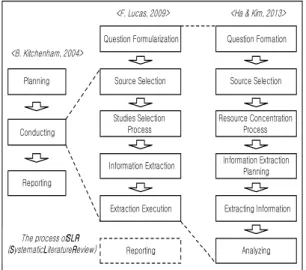
SLR방법을 이용한 몇 가지 문헌 조사에 관한 연구가 있다 . 예를 들어 [9]는 소프트웨어공학 분야의 UML 관 련 연구를 조사하고 분석하고 있으며, [10]은 UML연 구의 경향성을 파악하는 방법으로 이 방법을 사용하고 있다 . 그 이후 이 방법은 [11]에 의해서 6단계의 활동으 로 확장되었고 소셜 네트워크 서비스(Social Network Service) 관련 연구 조사에 이용하였다. 그림 1은 SLR 방법의 절차를 보여주고 있다 .
Planning
Conducting
Reporting
Question Formularization
Source Selection
Studies Selection Process
Information Extraction
Extraction Execution
<B. Kitchenham, 2004>
<F. Lucas, 2009>
The process of SLR (Systematic Literature Review)
Question Formation
Source Selection
Resource Concentration Process
Information Extraction Planning
Extracting Information
Analyzing
<Ha & Kim, 2013>
Reporting
그림 1. SLR방법의 절차
Fig. 1 The process of SLR (Systematic Literature Review) [11]
Ⅲ. SLR방법에 의한 문헌 조사
3.1. Question Formation 단계
SLR 방법에 의한 체계적인 문헌 조사를 위해 우선 다음과 같은 의문점을 가지고 연구를 진행한다 .
1. WBAN은 WSN과 어떤 점에 있어서 다르며, 어떤 주요 기술들이 연구되고 있는가?
- WBAN은 기존의 WSN과 어떤 차이점이 있는가?
- 환경적 특성을 고려한 WBAN의 주요기술들은 무엇 인가?
- 학계에서는 WBAN과 관련하여 어떤 기술들이 연구 되고 있는가?
2. 저자들의 특성은 무엇인가?
- 저자들의 전공분야, 출신국가 등 저자들은 어떤 특성 을 가지고 있는가?
- 국가별 연구의 경향은 어떠한가?
3.2. Source Selection 단계
체계적인 문헌조사를 위하여 다음과 같은 5개의 문 헌 제공 사이트를 선정한다. 즉, IEEE Xplore[12], ACM Digital Library[13], Google Scholar[14], Science Direct[15], Springer[16] 등이다.
선정된 문헌 제공사이트에서 가장 적합한 조회 결과 를 산출하는 키워드는 “Wireless Body Area Networks”
이다 . Wireless, Body, Area, Networks 등의 단어가 “or”
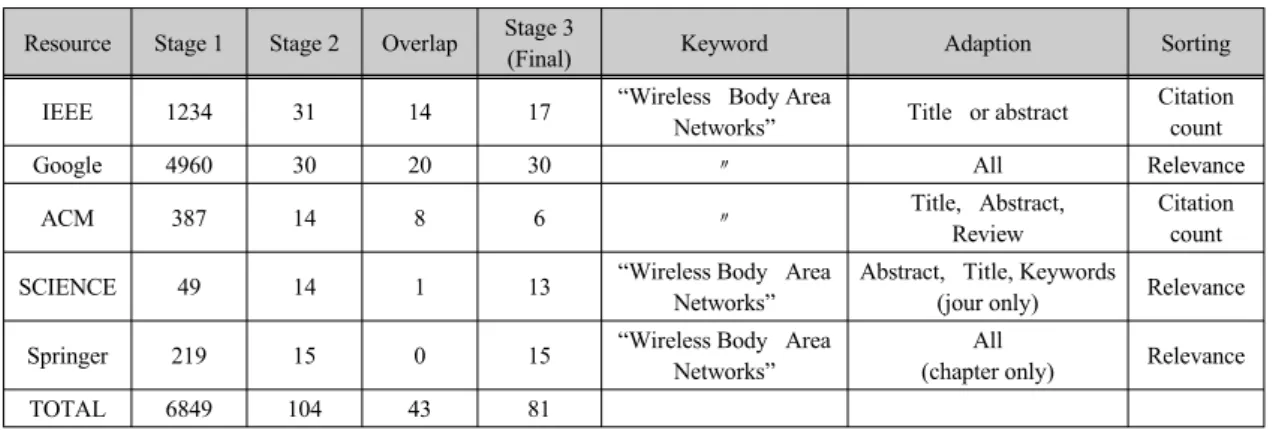
관계로 검색될 경우 많은 검색결과가 산출되므로, 문헌 의 제목, 요약, 키워드 등에 “Wireless Body Area Networks”와 정확하게 일치하는 문구가 있는 문헌만 검색하도록 한다. 각 사이트별 최초 검색결과는 표 3의
“stage 1” 란에 표시되어 있다.
3.3. Resource Concentration Process 단계
문헌 제공 사이트로부터 검색된 논문은 3단계의 절 차를 거쳐 최종 문헌 조사 대상 논문으로 선정된다. 문 헌의 최초 검색은 2014년 3월 20일에 이루어졌다. 3단 계의 선정 절차는 아래와 같다.
(1) 1단계: 각 문헌제공 사이트의 검색 엔진에
“Wireless Body Area Networks”를 적용하여 최초 검색 을 실시한다. 각 사이트별 최초 검색의 결과는 표 3의
“Stage 1” 란에 표시되어 있다. 검색범위는 주로 문헌의 제목 , 요약, 키워드에 적용되었다. 각 사이트별 적용된 검색 적용 범위는 표 3의 “Adaption” 란에 표시되어 있 다.
(2) 2단계: 각 사이트별 최초 검색된 논문의 수, 논문 의 피인용수, 관련도 등을 고려하여 1차 필터링 작업을 실시한다. 필터링 결과는 표 3의 “Stage2”란에 표시되 어 있다.
(3) 3 단계: 다수의 논문이 2개 이상의 사이트에서 중
복되어 검색된다. 따라서 중복 검색된 논문은 중요한
논문으로 판단하여 문헌 조사 대상에 포함시키고, 어느
한 사이트에서 중복된 숫자를 제외하여 최종 문헌 조사
대상 논문을 선정하였다. 각 사이트별 중복된 논문은
Resource Stage 1 Stage 2 Overlap Stage 3
(Final) Keyword Adaption Sorting
IEEE 1234 31 14 17 “Wireless Body Area
Networks” Title or abstract Citation count
Google 4960 30 20 30 〃 All Relevance
ACM 387 14 8 6 〃 Title, Abstract,
Review
Citation count
SCIENCE 49 14 1 13 “Wireless Body Area
Networks”
Abstract, Title, Keywords
(jour only) Relevance
Springer 219 15 0 15 “Wireless Body Area
Networks”
All
(chapter only) Relevance
TOTAL 6849 104 43 81
표 3. 논문 검색과 연구대상 논문 선정 절차
Table. 3 Selected papers at each stage of the selection procedure
표 3의 “overlap” 란에 표시되어 있고, 최종 선정된 논문 은 “Stage 3(Final)”란에 표시되어 있다.
따라서, 최종적으로 선정된 문헌 조사 대상 논문은 81편이다.
3.4. Information extraction planning 단계
정보 추출 계획 단계에서는 3.1절에서 제시된 의문점 을 기준으로 선택된 논문으로부터 어떤 정보를 추출할 것인지를 결정한다 . 각 논문으로부터 다음과 같은 데이 터들이 추출된다. 즉, 연구 제목, 저자, 피인용수, 출판 연도, 논문형태, 주요 내용, 주요 분류, 세부 분류, 키워 드 , 저자의 전공, 국가, 소속기관, 저자수 등이 조사된다.
본 연구의 주요 목적 중 하나는 WBAN 관련 연구의 경향성을 파악하는 것이다. 연구의 경향성을 파악하기 위해 각 연구에서 연구된 주제 또는 기술들을 몇 가지 주요 그룹으로 분류한다. 주요 분류는 다시 몇 개의 세 부 분류로 나뉜다 . 주요 분류는 표 2의 WBAN을 위한 주요 기술들로부터 유도된다 . 주요 분류와 세부 분류는 표 4와 같다. “Hardware and Device”는 물리계층과 관 련된 기술을 위한 연구 분류이다. 세부 연구로 Antenna [17, 18], Sensor [19, 20], Transmitter [21], HW/SW Architecture [22] 등에 관한 연구가 있다. “Energy Efficiency”는 WBAN에서 요구되는 에너지 효율성과 관련된 연구 분류이다 . “Channel”은 신호 전달을 위한 효율적인 channel 모델에 관한 연구 분류이다. channel model [23, 24], measurement [25, 26], fading [27] 등의 세부 연구가 있다 .
표 4. WBAN 연구의 분류
Table. 4 Main categories and Secondary categories Main Categories Secondary Categories Hardware and
Device
Antenna, HW/SW architecture Intra-body device,
Network architecture Sensor, System architecture Transceiver, Transmitter Energy
Efficiency
Energy efficiency decoding Energy efficiency node Channel Channel model,
Channel measurement Channel fading, Multi-channel Radio IEEE 802.15.4(ZigBee),
IEEE 802.15.6(UWB) Mac Layer MAC protocol Networking Routing protocol,
Modular framework Cross Layer Cross-layer design, Cross-layer protocol Localization and
Mobility
Localization, Mobility
Security and Privacy
Security
Certification QoS
Application WBAN prototype, m-health application BAN system,
Implementation of WBAN Cloud computing
Survey Survey
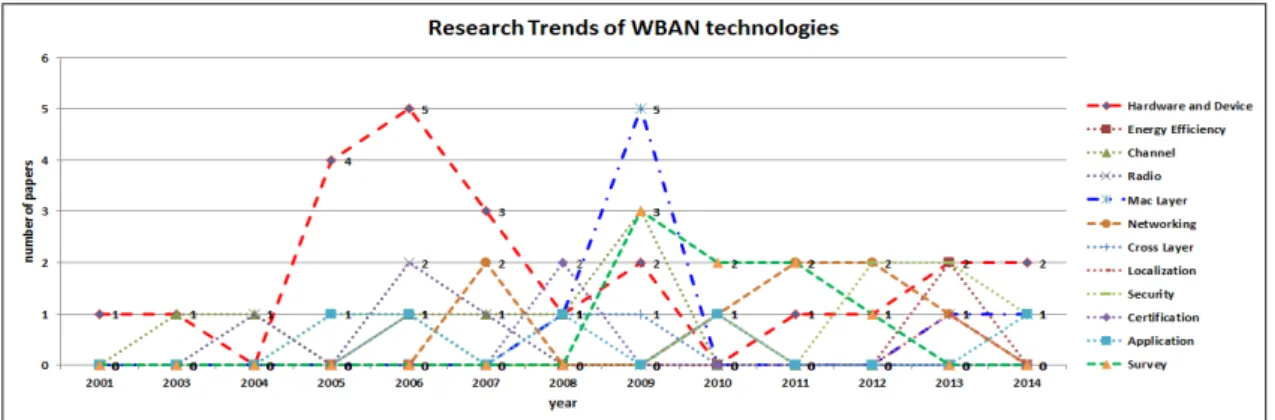
그림 2. WBAN 기술의 연구경향
Fig. 2 Research Trends of WBAN technologies
그림 3. WBAN 핵심기술과 연구경향
Fig. 3 Key technologies of WBAN and Research trends(1)
“Radio”는 WBAN에서 사용하는 무선신호와 관련된 연구 분류이다 . ZigBee[28], UWB[29, 30]와 같은 세부 연구가 있다 . “Mac Layer”는 MAC 계층의 효율적인 데 이터 전달과 관련된 연구 분류이다 . 가장 많이 연구되고 있는 연구 분야 중 하나이다 . [31]과 [32]와 같은 MAC 프로토콜과 관련한 세부 연구가 있다 . “Networking”은 데이터 전달과 관련된 연구 분류로서 routing 프로토콜 [33, 34]에 관한 세부 연구가 있다.
“Cross Layer”은 여러 계층에 걸쳐 효율적인 데이터 전달을 연구하는 연구 분류이다 . WASP[35]와 CICADA [33, 36]와 같은 cross layer 프로토콜에 관한 연구가 있 다 . “Localization”, “Security and Privacy” 그리고
“Certification”은 각각 WBAN에서의 센서노드의 위치
측정 [37], 데이터 보안[38, 39], 품질 보장[40]과 관련된 연구 분류이다. “Application”은 WBAN의 구현[41] 및 응용 [42]에 관한 연구 분류이다. “Survey”는 WBAN 연 구가 활발해지면서 2009년 이후 WBAN 관련기술을 조 사하여 요약한 연구 분류이다. [1]과 [5]가 대표적인 조 사 연구이고, [6]은 최근의 WBAN 기술을 잘 요약하고 있다 .
3.5. Extracting information 단계
조사 대상 문헌을 주의 깊게 읽고 필요한 정보를 추
출하는 단계이다. 정확한 정보의 추출과 계산을 위해
데이터 시트를 이용한다.
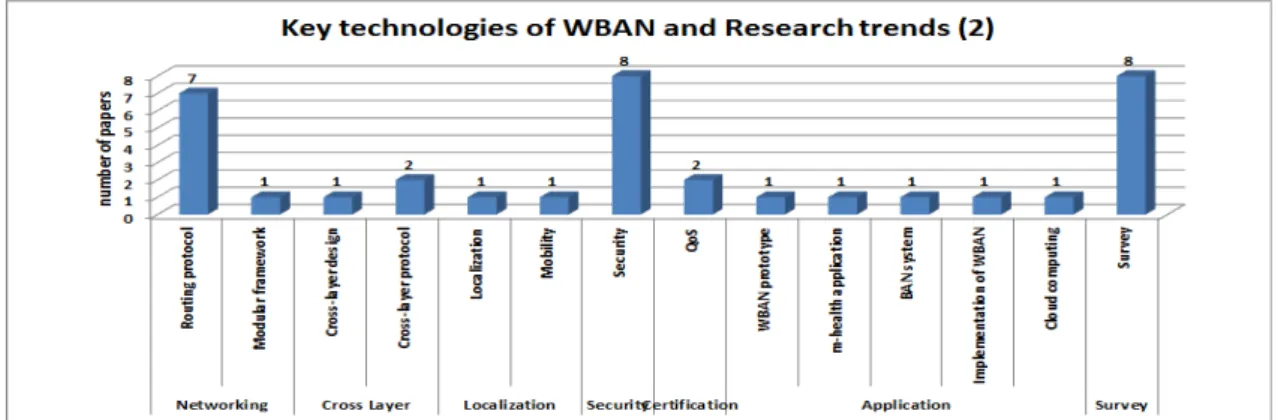
그림 4. WBAN 핵심기술과 연구경향
Fig. 4 Key technologies of WBAN and Research trends(2)
그림 5. WBAN 기술과 논문 형태
Fig. 5 WBAN technologies and Paper types
Ⅳ. SLR의 결과 분석
4.1. 연구 분야
그림 2는 2001년 이후 WBAN 연구의 경향을 보여준 다 . 그림과 같이 “Hardware and Device”와 “Mac Layer”
연구 분야는 2005년 이후 많은 연구의 주제가 되고 있 음을 알 수 있고 , 최근에는 “Security”, “Networking”,
“Channel”, “Survey” 분야의 연구가 비교적 많이 이루 어지고 있음을 알 수 있다 . 그림 3과 4는 주요 연구 분류 의 세부 연구의 경향을 보여준다 . “Hardware and Device” 분야에는 Antenna, Sensor, Network archi- tecture 연구가 많이 이루어지고 있음을 알 수 있고,
“Channel” 분야에는 Channel model 관련 연구, “Mac
Layer” 분야에는 MAC protocol 관련 연구가 다수임을 알 수 있다. 그리고 “Networking” 분야에는 routing protocol 관련 연구가 많이 연구되고 있음을 알 수 있고
“Security”, “Survey” 연구 분야가 많이 연구되고 있음 을 알 수 있다.
4.2. 기타 연구의 경향
조사된 데이터로부터 다른 측면의 연구의 경향을 조
사한다. 그림 5는 연구 분야별 문헌의 종류를 조사한 것
이다 . 그림과 같이 journal 논문이 72.8%로 다수를 차지
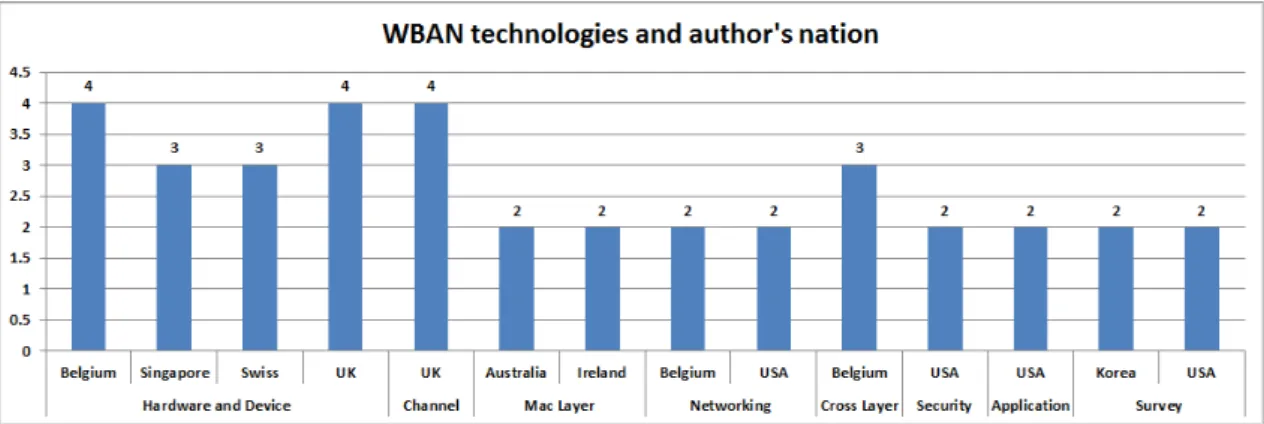
하고 있다. 그림 6은 WBAN 기술과 각 기술을 연구한
저자의 소속 국가를 조사한 것이다. “Hardware and
Device” 분야는 UK와 Belgium에서 “Channel” 분야는
그림 6. 국가별 WBAN 연구 경향
Fig. 6 WBAN technologies and author’s nation
그림 7. 연구의 국가별 분포 Fig. 7 Concentration of Research
UK, “Cross Layer” 분야는 Belgium에서 많은 연구를 하고 있었다. 그림 7은 전체 문헌 검토 대상 연구를 각 국가별로 나눈 것이다. USA, Belgium, UK, Korea 순으 로 WBAN에 관한 많은 연구가 이루어지고 있음을 알 수 있다 . 우리나라는 WBAN에 관한 비교적 많은 연구 가 이루어지고 있으며 , 라우팅 프로토콜과 QoS 관련 연 구가 대표성을 가지는 연구이다. 각 문헌의 소속국가는 제 1저자의 소속 국가를 기준으로 한다.
4.3. WBAN 연구 경향에 대한 결론
SLR 방법에 의한 체계적 문헌 검토의 결과 분석을 통해 WBAN의 연구의 경향에 대해 다음과 같은 몇 가 지 결론을 내릴 수 있다.
(1) 2005년 이후 “Hardware and Device”와 “Mac Layer” 관련 연구가 많이 이루어지고 있음을 알 수 있고, 최근에는 “Networking”, “Security”, “Survey”,
“Channel” 관련 연구가 많이 이루어지고 있음을 알 수 있다 .
(2) “Hardware and Device” 분야는 antenna, sensor가 주요 연구 주제임을 알 수 있고, “Channel” 분야는 channel model, “Radio” 분야는 UWB, “Networking”에 는 routing protocol이 많이 연구되고 있는 주제임을 알 수 있다.
(3) “Hardware and Device” 분야는 UK와 Belgium,
“Channel” 분야는 UK, “Cross Layer” 분야는 Belgium
에서 많이 연구하고 있음을 알 수 있고, USA, Belgium,
UK, Korea 순으로 WBAN에 관해 활발히 연구하고 있 음을 알 수 있다 .
Ⅴ. 결 론
WBAN은 데이터 네트워킹이 신체에 의해 방해를 받 는 등 환경적 특성을 가지므로 기존의 센서 네트워크에 서 적용되던 기술이 WBAN에 적용될 수 없다. 본 연구 에서는 기존의 WSN과는 다른 WBAN의 특성을 구분 하여 보고 , 최근 연구되고 있는 WBAN관련 기술을 분 류하였다 . 또한 WBAN의 최근의 연구 경향을 파악하기 위해 SLR 방법을 통해 체계적 문헌 검토를 실시하였다.
문헌 검토 결과의 분석을 통해 4.3절과 같은 몇 가지 연 구의 경향을 파악할 수 있었다. 최근, 연구 분야의 융합 추세와 함께 WBAN 관련 연구도 활발히 진행될 것으로 예측된다 . 장치를 포함한 하드웨어, 데이터 전송기술, 보안 등이 주된 연구 분야로 예측된다 .
REFERENCES
[ 1 ] S. Ullah, H. Higgins, B. Braem, B. Latre, C. Blondia, K.S.
Kwak, et el., “A Comprehensive Survey of Wireless Body Area Networks”, Journal of Medical System, Vol.36, Iss.3, pp.1065-1094, 2012.
[ 2 ] B. Latre, B. Braem, I. Moerman, C. Blondia and P.
Demeester, “A survey on wireless body area networks”, Journal of Wireless Networks, Vol.17, pp.1-17, 2011.
[ 3 ] H. Cao, V. Keung, C. Chow, and H. Chan, “Enabling Technologies for Wireless Body Area Networks: A Survey and Outlook”, IEEE Communications Magazine, December, pp.84-93, 2009.
[ 4 ] V. Dam. K. Pitchers and Barnard M. “Body area networks:
Towards a wearable future”, Proc. of WWRF kick off meeting, Germany, March 6-7, 2001.
[ 5 ] M. Chen, S. Gonsalez, A. Vasilakos, H. Cao and V. Leung,
“Body Area Networks: A Survey”, Mobile Network Application, Vol.16, pp.171-193, 2011.
[ 6 ] B. Antonescu and S. Basagni, “Wireless Body Area Networks: Challenges, Trends and Emerging Technologies”, Proc. of the 8th International Conference on Body Area Networks, pp.1-7, 2013.
[ 7 ] M. Hanson, H. Powell, A. Barth, K. Ringgenberg, B.
Calhoun, J. Lach, et el., “Body Area Sensor Networks:
Challenges and Opportunities”, Computer, Vol. pp.58-65, 2009.
[ 8 ] B. Kitchenham, "Procedures for Performing Systematic Reviews", NICTA Technical Report, 2004.
[ 9 ] F. Lucas, F. Molina and A. Toval, "A systematic review of UML model consistency management", Information and Software Technology, Vol.51, pp.1631-1645, 2009.
[10] D. Budgen, A.J. Burn, O.P. Brereton, B.A. Kitchenham and R. Pretorius, “Empirical evidence about the UML: a systematic literature review”, Software: Practice and Experience, Vol.41, Iss.4, pp.363-392, 2011.
[11] I.K. Ha, H.Park and C.G. Kim, “Analysis of Twitter Research Trends based on SLR”, Proc. Of The 16th International Conference on Advanced Communications Technologies, pp.774-778, 2014.
[12] IEEE Xplore: http://ieeexplore.ieee.org/ (accessed Mar., 20, 2014)
[13] ACM Digital Library: http:// http://dl.acm.org/ (accessed Mar., 20, 2014)
[14] Google Scholar: http://scholar.google.co.kr/ (accessed Mar., 20, 2014)
[15] Science Direct: http://www.sciencedirect.com/ (accessed Mar., 20, 2014)
[16] Springer: http://link.springer.com/ (accessed Mar., 20, 2014)
[17] M. Klemm and G. Troester, “Textile UWB antennas for wireless body area networks”, IEEE Transations on Antennas and Propagation, Vol.54, No.11, pp.3192-3197, 2006.
[18] A. Tronquo, H. Rogier, C. Hertleer and L. V. Langenhove,
“Robust planar textile antenna for wireless body LANs operating in 2.45 GHz ISM band”, Electronics Letters, Vol.42, Iss.3, pp.142-143, 2006.
[19] B. Gyselinckx, C.V. Hoof, J. Ryckaert, R.F. Yazicioglu, P.
Fiorini and V. Leonov, “Human++: autonomous wireless sensors for body area networks”, Proc. of IEEE 2005 Custom Integrated Circuits Conference, pp.13-19, 2005.
[20] G. Chatterjee and A. Somkuwar, “Design analysis of wireless sensors in BAN for stress monitoring of Fighter Pilots”, Proc. of 16th IEEE International Conference on Networks 2008, pp.1-6, 2008.
[21] J. Ryckaert, C. Desset, A. Fort, M. Badaroglu, V.D. Heyn, B. Gyselinkx, et al., “Ultra-wide-band transmitter for
low-power wireless body area networks: design and evaluation”, IEEE Transactions on Circuits and Systems-I:
Regular papers, Vol.52, No.12, pp.2515-2525, 2005.
[22] C. Otto, A. Milenkovic, C. Sanders and E. Jovanov,
“SYSTEM ARCHITECTURE OF A WIRELESS BODY AREA SENSOR NETWORK FOR UBIQUITOUS HEALTH MONITORING”, Journal of Mobile Multimedia, Vol.1, No.4, pp.307-326, 2006.
[23] J. Ryckaert, P.D. Doncker, R. Meys, A.D. Le Hoye and S.
Donnay, “Channel model for wireless communication around human body”, Electronics Letters, Vol.40, Iss.9, pp.543-544, 2004.
[24] S.L. Cotton and W.G. Scanlon, “An experimental investigation into the influence of user state and environment on fading characteristics in wireless body area networks at 2.45 GHz”, IEEE Transations on Wireless Communications, Vol.8, No.1, pp.6-12, 2009.
[25] T. Zasowski, F. Althaus, M. Stager, A. Wittneben and G.
Troster, “UWB FOR NONINVASIVEWIRELESS BODY AREA NETWORKS: CHANNEL MEASUREMENTS AND RESULTS”, Proc. of 2003 IEEE Conference on Ultra Wideband Systems and Technologies, pp.285-289, 2003.
[26] A. Alomainy, Y. Hao, A. Owadally, C.G. Parini, Y.
Nechayev, P.S. Hall, et el., “Statistical Analysis and Performance Evaluation for On-Body Radio Propagation With Microstrip Patch Antennas”, IEEE Transactions on Antennas and Propagation, Vol.55, No.1, pp.245-248, 2007.
[27] S.L. Cotton and W.G.Scanlon, “A Statistical Analysis of Indoor Multipath Fading for a Narrowband Wireless Body Area Network”, Proc. of The 17th Annual IEEE International Symposium on Personal, Indoor and Mobile Radio Communications, pp.1-5, 2006.
[28] N.F. Timmons and W.G. Scanlon, “Analysis of the performance of IEEE 802.15.4 for medical sensor body area networking”, Proc. of IEEE Communications Society Conference on Sensor and Ad hoc Communications and Networks, pp.16-24, 2004.
[29] A. Alomainy, Y. Hao, X. Hu, C.G. Parini and P.S. Hall,
“UWB on-body radio propagation and system modelling for wireless body-centric networks”, IEE Proceedings- Communications, Vol.153, Iss.1, pp.107-114, 2006.
[30] Y.P. Zhang and Q. Li, “Performance of UWB Impulse Radio With Planar Monopoles Over On-Human-Body
Propagation Channel for Wireless Body Area Networks”, IEEE Transactions on Antennas and Propagation, Vol.55, No.10, pp.2907-2914, 2007.
[31] O. Omeni, A. C. Wong, A.J. Burdett and C. Toumazou,
“Energy efficient medium access protocol for wireless medical body area sensor networks”, IEEE Transactions on Biomedical Circuits and Systems, Vol.2, No.4, pp.251-259, 2008.
[32] S.J. Marinkovic, E.M. Popovici, C. Spagnol, S. Faul and W.P. Marnane, “Energy-efficient low duty cycle MAC protocol for wireless body area networks”, IEEE Transactions on Information Technology in Biomedicine, Vol.13, No.6, pp.915-925, 2009.
[33] B. Latre, B. Braem, I. Moerman, C. Blondia, E. Reusens, P.
Demeester, et el., “A Low-delay Protocol for Multihop Wireless Body Area Networks”, Proc. of Fourth Annual International Conference on Mobile and Ubiquitous Systems: Networking & Services, pp.1-8, 2007.
[34] M. Quwaider and S. Biswas, “DTN routing in body sensor networks with dynamic postural partitioning”, Ad Hoc Networks, Vol.8, Iss.8, pp.824-841, 2010.
[35] B. Braem, B. Latre, I. Moerman, C. Blondia and P.
Demeester, “The Wireless Autonomous Spanning tree Protocol for Multihop Wireless Body Area Networks”, Proc. of International Conference on Mobile and Ubiquitous Systems: Networking & Services, pp.1-8, 2006.
[36] D. Singelee, B. Latre, B. Braem, M. Peeters, M.D. Soete, C. Blondia, et el., “A Secure Cross-Layer Protocol for Multi-hop Wireless Body Area Networks”, Ad-hoc, Mobile and Wireless Networks, Lecture Notes in Computer Science, Vol.5198, pp.94-107, 2008.
[37] S. Gonsalez, M. Chen and V. Leung, “Evaluation of Wireless Body Area Sensor Placement for Mobility Support in Healthcare Monitoring Systems”, Ad Hoc Networks, Vol.49, pp.384-399, 2010.
[38] M. Li, W. Lou and K. Ren, “Data security and privacy in wireless body area networks”, Wireless Communications, IEEE, Vol.17, Iss.1, pp.51-58, 2010.
[39] C. Poon, Y. Zhang and S. Bao, “A novel biometrics method to secure wireless body area sensor networks for telemedicine and m-health”, Communications Magazine, IEEE, Vol.44, Iss.4, 2006.
[40] M.A. Ameen, A. Nessa and K.S. Kwak, “QoS issues with focus on Wireless Body Area Networks”, Proc. of Third 2008 International Conference on Convergence and Hybrid
Information Technology, pp.801-807, 2008.
[41] M.R. Yuce, “Implementation of wireless body area networks for healthcare systems” Sensors and Actuators A:
Physical, Vol.162, Iss.1, pp.116-129, 2010.
[42] E. Monton, J.F. Hernandez, J.M. Blasco, T. Herve, J.
Micallef, V. Traver, et el.,“Body area network for wireless patient monitoring”, IET Communications, Vol.2, Iss.2.
pp.215-222, 2008.
하일규(Il-Kyu Ha)
영남대학교 전산공학과 공학사 영남대학교 컴퓨터공학과 공학박사 증권감독원 전산업무실 근무
영남대학교 컴퓨터공학과 강사, 객원교수
※관심분야 : 무선 센서 네트워크, WBAN, 소셜 네트워크 분석, 빅데이터 처리
안병철(Byoung-Chul Ahn)
영남대학교 전자공학과 공학사
Oregon State University 전기및컴퓨터공학 공학석사 Oregon State University 전기및컴퓨터공학 공학박사 국방과학연구소 연구원, 삼성전자 수석연구원 영남대학교 컴퓨터공학과 교수
※관심분야 : 무선 센서 네트워크, WBAN, 임베디드 시스템, 멀티미디어 시스템