Vol. 22, No. 6 (2012)
316
†Corresponding author
E-Mail : [email protected] (M. W. Jun)
P123-Templated Co
3O
4/Al
2O
3Mesoporous Mixed Oxides for Epoxidation of Styrene
Miewon Jung
†and Youngsil Kim
School of Biological Sciences and Chemistry/Institute of Basic Science, Sungshin Women’s Univ., Seoul 142-732, Korea
(Received May 11, 2012 : Received in revised form June 13, 2012 : Accepted June 13, 2012)
Abstract
Co3O4, Al2O3 and Co3O4/Al2O3 mesoporous powders were prepared by a sol-gel method with starting matierals of aluminum isopropoxide and cobalt (II) nitrate. A P123 template is employed as an active organic additive for improving the specific surface area of the mixed oxide by forming surfactant micelles. A transition metal cobalt oxide supported on alumina with and without P123 was tested to find the most active and selective conditions as a heterogeneous catalyst in the reaction of styrene epoxidation. A bBlock copolymer-P123 template was added to the staring materials to control physical and chemical properties. The properties of Co3O4/Al2O3 powder with and without P123 were characterized using an X-ray diffractometer (XRD), a Field-Emission Scanning Electron Microscope (FE-SEM), a Bruner-Emmertt-Teller (BET) surface analyzer, and 27Al MAS NMR spectroscopy. Powders with and without P123 were compared in catalytic tests. The catalytic activity and selectivity were monitored by GC/MS, 1H, and 13C-NMR spectroscopy. The performance for the reaction of epoxidation of styrene was observed to be in the following order: [Co3O4/Al2O3 with P123-1173 K > Co3O4/Al2O3 with P123-973 K > Co3O4-973 K > Co3O4/Al2O3-973 K > Co3O4/Al2O3 with P123-1473 K > Al2O3-973 K]. The existence of γ-alumina and the nature of the surface morphology are related to catalytic activity.Key words
Co3O4/Al2O3, GC/MS, 1H and13C-NMR spectroscopy, heterogeneous catalyst.1. Introduction
Styrene oxide as chemical and pharmaceutical pro- duction was considered one of important intermediate in the organic synthesis.
1)Several studies on inorganic metal oxides as a heterogeneous catalyst were reported for applying epoxidation of styrene by tertiary butyl hydro peroxide (TBHP) and hydrogen peroxideas a safer and stable oxi-dizing solid catalyst.
2)A lot of study was tried to search catalysts for the epoxidation of styrene which are simple, inexpensive, separable, renewable, highly active, and selective. The use of heterogeneous catalyst as tran- sition metalwould be important to improve on selectivity and activity.
3)Heterogeneous catalysts have been prepared by homoge- neous deposition, co-precipitation, hydrothermal synthesis and sol-gel process.
4)Among these methods, advantage of sol-gel method is to make solid state catalyst with large specific surface area and high porosity from meso- and to macro- ranges in room temperature. This solid network can be controlled from liquid phase of molecular precursor via hydrolysis and condensation to final solid product.
Additionally, the use of template substances as organic
surfactants to synthesize inorganic or hybrids networks brings remarkable effect to obtain stable mesoporous metal- oxides and to control the textual of materials with high surface area. The surface area and pore volume can be changed bycontrolling solution pH, solvent, water/Al ratio, the type of surfactant, the aging time.
5)It is well known that non-ionic surfactant P123 poly (ethylene oxide) as structure-directing agent has a various ability to synthesize nano- and meso- porous metal oxides.
6)The porosity and particle size distribution can be adjusted by using this triblockcopolymer surfactant controlling temperatures and reaction condition.
The performance of metal oxide as catalyst or catalyst support depends on the crystal structure and textural properties. The pore structure, porosityand surface areacan also play important role in the catalytic activity. Vasant R.
choudhary group reported for transition metal oxides with and without alumina supports.
7)However, catalytic activity with relate to temperature, crystal structure and textured properties of transition metal oxide was not monitored.
The γ-alumina among the transition phase of alumina is
used in catalyst and support as inert carrier of heteroge-
neous catalysts and as part of bi-functional metal catalysts
because of moderate cost, stability and having high surface
area as well as uniform mesoporous distribution. The γ-
alumina as intermediate phase has a large specific surface
area only in the proper condition.
8)In this study, the Co
3O
4, Al
2O
3, and Co
3O
4/Al
2O
3with and without P123 as heterogeneous catalyst were synthe- sized by sol-gel method and used to catalytic test for the epoxidation of styrene. P123 template is expected as an active organic additive for improving specific surface area of mixed oxide by forming surfactant micelles. Transition metal cobalt oxide supported on alumina with and without P123 was tested to find the most active and selective condition as a heterogeneous catalyst in the reaction of styrene epoxidation. A difference in size and shape of synthesized powders seem to be related on the use of the P123 and finally catalytic activity.
2. Experimental Procedure
2.1 Preparation of the catalysts and catalytic activity test
Cobalt nitrate and/or aluminum isoproxide (AIP) was dissolved in distilled water under refluxing at 80
oC for 30 min. 1 wt% of P123 (polyethylene oxide-polypropylene oxide-polyethylene oxide) with relate to AIP in 2-propanol was added to make for oxide or metal oxides mixture with P123 template. 0.016 mol of HNO
3(pH = 2.5) solution was added into an individual or the mixture solution of AIP and Co (NO
3)
2to prepare sol. These mixtures were heated at 80
oC for 3 hours and then lowered to room temperature with stirring for 24 hours. This obtained sol was heated again at the same condition until the sol turned into a gel. This gel was dried at 150
oC for 48 hours to get powder. This obtainedpowder was heat-treated from 773K to 1573K for 2 hours 30 minutes.
For catalytic activity tests, styrene epoxidation by aque- ous TBHP over the Co
3O
4, Al
2O
3and Co
3O
4/Al
2O
3with and without P123 was carried at atmospheric pressure with containing 0.1 mol of styrene, 0.15 mol of TBHP and 0.1 g of catalyst (Co
3O
4, Al
2O
3and Co
3O
4/Al
2O
3with and without P123) under refluxing for 10 hours. Small amounts of solution were taken from this mixture to monitor for reaction process through GC-MS and NMR spectroscopy.
2.2 Characterization
The structure change and phase transformation of these- powders with and without P123 were characterized by X- ray diffraction measurements (XRD, Bruker D8 Focus, 40 kV, 40 mA, 0.2
o/min, 10~90
o) using CuK α radiation ( λ = 1.5406 Å). The morphology and microstructure of these powders obtained at various temperatures were an- alyzed by field-emission scanning electron microscopy (FE-SEM, JEOL-JMS 7500F, 10kV). The specific surface area and pore diameter were measured by brunaued- emmett-teller surface analyzer (BET, BELSORP-mini).
The structure was analyzed by solid state
27Al MAS
Nuclear Magnetic Resonance (MAS-NMR, Varian NMR System 500MHz, 11.74T, 9~15 kHz/sec). For the catalytic test, products and unconverted reactants were analyzed by Gas Chromatography with Mass Spectrophotometry (GC/MS, HP 6890 series Injector/5973 Mass Selective Detector, HP-1MS column and He as carrier gas),
1H and
13
C-NMRspectroscopy (NMR, Varian NMR System, 500 MHz, 11.74T).
3. Results and Discussion
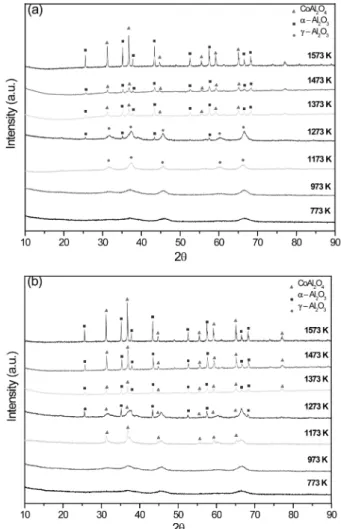
Fig. 1 is shown XRD patterns of the Co
3O
4/Al
2O
3pow- der (a) with (b) without P123. The broad and weak peaks of γ-alumina are appeared at 973K. γ-alumina peaks areappeared until 1173K in the sample with P123 while γ-alumina and complex oxide CoAl
2O
4peaks are shown up powder without P123. This CoAl
2O
4as spinel structure in sample without P123 could be formed due to presence of the empty space of tetrahedral γ-alumina phase at this temperature. The major peaks of γ-alumina with minor peaks of α-alumina, eventually, start to show up powder
Fig. 1. XRD patterns of the Co3O4/Al2O3 powder (a) with and (b) without P123.
with P123 at 1273K. γ-alumina is already transformed to α-alumina and/ or CoAl
2O
4are observed even at this tem- perature in the case of without P123. The phase transition from γ-alumina to α-alumina is delayed in the powder with P123 while the formation of the mixed complex oxide has done at earlier temperature without P123.
The solid state
27Al MAS NMR spectra of Co
3O
4/Al
2O
3powder (a) with and (b) without P123 are obtained in Fig. 2. In case of powder with P123, the peaks around at -55ppm are for the tetra-coordinated environment of alumina and at -5 ppm are for the hexa-coordinated with the ratio of 1:3 at 773K. These peaks are arisen from the presence of γ-alumina at this temperature. With increasing temperature, tetra-coordinated aluminapeaks are reduced and hexa-coordinated alumina peaks are increased due to phase transformation from γ- to α-alumina. Especially, the
strong peaks around at -5ppm were slowly shifted to hexa- coordinated environment of alumina around at 0 ppm in the powder with P123. As comparing to powder without P123, these peaks are broad with having shoulder and slowly shifted to hexa-coordinated alumina since the trans- formation from γ to α-aluminaare delayed on powder with P123 asexplained XRD results.
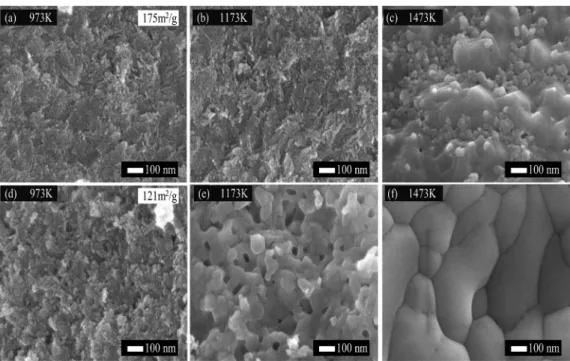
Fig. 3 is SEM pictures of these powders heat-treated at 973K, 1173K and 1473K with and without P123. The porosity of powder with P123 is kept with increasing temperatures and the particle size is smaller than the powder without P123. The surface porosity is rapidly de- creased and the surface shape keeps flat in the powder without P123 even with increasing temperatures. This phenomenon was remarkably recognized at 1473K. All these powders are appeared the same type of IV as de-
Fig. 2. Solid state27Al MAS NMR spectra of Co3O4/Al2O3 powder (a) with and (b) without P123.Fig. 3. FE-SEM micrographs of the Co3O4/Al2O3 powder with and without P123 (a), (b), (c) and (d), (e), (f), respectively.
fined classification of isotherm. The pore size is appeared having mesoporous distribution (2~50 nm). But the shape was changed from type D (bottle net type) without P123 to type A (slit type) with P123 of H
2hysteresis loop. The specific surface area was slightly increased from 121 to 175 m
2/g by adding P123 at 973K. The average pore
diameter and pore volume with P123 was also increased from 8.2 to 11.0 nm and from 0.249 to 0.481 cm
3/g, re- spectively.
The synthesized powders were used for the reaction of epoxidation of styrene. Fig. 4(a) is the GC/MS results with the ratio of styrene oxide/styrene in the mixture with changing reaction time. Fig. 4(b) and (c) are the NMR spectra on reaction product obtained after 3 hours. The Co
3O
4/Al
2O
3powder with P123 heat-treatment at 1173K showed the best performance and remained this activity for 5 hours. This same catalyst at 973K actsas similar trend and the effect is slightly lower than at 1173K. The powder at 1473K has no effect because of the phase transformation of alumina. The order of catalytic activity was Co
3O
4/Al
2O
3with P123-1173K > Co
3O
4/Al
2O
3with P123-973K > Co
3O
4/Al
2O
3-973K > Al
2O
3-973K. The cata- lytic activity seems to be related to the presence of inter- mediate γ-phase and surface morphology, and the best result is the case of Co
3O
4/Al
2O
3with P123 at 1173K.
4. Conclusion
Alumina phase and surface morphology are related to catalytic activity. The catalyst having γ-Al
2O
3phase which depends on the treating temperature acts important role for the selective epoxidation of styrene. Especially, P123 as surfactant makes to delayon the phase transition of alumina and formation of the other phase of complex oxide. Also it makes the enlargement of surface area and pore volume; these values were the largest powder with P123 at 973K. The performance for the reaction of epoxid- ation of styrene is shown as the following order. [Co
3O
4/ Al
2O
3with P123-1173K > Co
3O
4/Al
2O
3with P123-973K >
Co
3O
4-973K > Co
3O
4/ Al
2O
3-973K > Co
3O
4/ Al
2O
3with P123-1473K > Al
2O
3-973K] The existence of γ-alumina and the type of surface morphology is related to catalytic activity.
Acknowledgment
This work was supported by the grants for professors of the Sungshin Women’s university of 2011.
References
1. V. R. Choudhary, N. S. Patil, N. K. Chaudhari and S. K.
Bhargava, J. Mol. Catal. Chem., 227, 217 (2005).
2. N. S. Patil, R. Jha, B. S. Uphade, S. K. Bhargava and V. R. Choudhary, Appl. Catal. Gen., 275, 87 (2004).
3. R. V. Grieken, J. L. Sotelo, C. Martos, J. L. G. Fierro, M.
Lopez-Granados and R. Mariscal, Catal. Today, 61, 49 (2000).
4. Q. Yang, S. Wang, J. Lu, G. Xiong, Z. Feng, Q. Xin and Fig. 4. (a) GC/MS results of the ratio of styrene oxide/styrene with
changing reaction time. The spectra of reaction product obtained after 3 hours for the Co3O4/Al2O3 with P123 at 1173K: (b) 1H and (c) 13C NMR.
C. Li, Appl. Catal. Gen., 194-195, 507 (2000).
5. C. J. Brinker, D. M. Smith, R. Deshpande, P. M. Davis, S. Hietala, G. C. Frye, C. S. Ashley and R. A. Assink, Catal. Today, 14, 155 (1992).
6. V. R. Choudhary, R. Jha and P. Jana, Catal. Comm., 10,
205 (2008).
7. Q. Wu, W. Li, Y. Cheng and Z. Jiang, Mater. Chem.
Phys., 91, 463 (2005).
8. S. B. Lim, H. You, T. W. Hong and M. Jung, Kor. J.
Mater. Res., 20(9), 472 (2010) (in Korean).