청주시 노인급식 관리지원 시범사업의 효과분석 : 위생관리개선을 중심으로
이주은
서원대학교 식품영양학과 부교수
An Analysis of the Effect of the Pilot Project for the Management of the Elderly's Food Service in Cheongju City: Focused on
improving hygiene control
Joo-Eun Lee
Associate Professor, Food and Nutrition Department, Seowon University
요 약 본 연구에서는 청주시 사회복지 급식관리지원센터의 회원인 노인요양시설과 공동생활가정, 주간보호센터를 대 상으로 시설노인을 위한 급식의 위생관리 현황을 조사하고, 조리원이나 시설장 대상 위생교육, 관련 지원물품과 정보제 공 등 관리지원을 실시한 후 시범사업의 효과를 알아보고자 급식위생관리 개선정도를 비교분석하였다. 연구결과 1차 지원을 실시한 후 전체 급식위생관리 평균점수가 63.13점(100점 만점)에서 75.10점으로(
p
<0.001), 2차 지원 후에도 75.10점(100점 만점)에서 80.89점으로 유의하게 증가하였다(p
<0.001). 1차 지원 후 체크리스트에서 평균점수의 유의 한 차이를 보인 항목은 전체 29개 중 16개였고, 2차 방문 지원을 실시한 후에는 29개 중 7개 항목에서 유의한 개선을 보였다(p
<0.05,p
<0.01,p
<0.001). 이상의 노인급식관리지원 시범사업의 효과가 있음을 토대로 보다 많은 노인복지시 설들이 급식관리지원센터의 지원을 지속적으로 받도록 해야 할 것이다.주제어 : 노인복지시설, 급식관리지원, 노인급식, 위생관리, 시범사업
Abstract In this study, the hygiene control status of meals for the elderly was investigated for the elderly care facilities, communal living families, and day care centers, which are members of the Cheongju Social Welfare Food Management Support Center, and the improvement of food hygiene management was compared and analyzed to find out the effectiveness of the pilot project after conducting management support such as hygiene education for the elderly and providing related supplies and information. The study found that after the first support, the average score of overall feeding hygiene control increased significantly from 63.13 points (out of 100) to 75.10 points (
p
<0.001) and from 75.10 points (out of 100) to 80.89 points (p
<0.001). After primary support, 16 out of 29 items showed significant differences in average scores in the checklist, and 7 out of 29 after secondary visit support (p
<0.05,p
<0.01,p
<0.001). Based on the effectiveness of the above-mentioned pilot project to support senior citizens' meal service management, more welfare facilities for senior citizens should be continuously supported by the Foodservice Management Support Center.Key Words : Welfare facilities, Food management support, The elderly, Sanitary control, Pilot project
*Corresponding Author : Joo-Eun Lee([email protected])
Received October 28, 2020 Revised November 7, 2020 Accepted January 20, 2021 Published January 28, 2021
1. 서론
1.1 연구의 필요성
식품의약품안전처에서 공식발표한 우리나라의 2019 년도 식중독 발생 수는 303건, 환자 수는 4,169명이었 고, 2018년도의 식중독 발생 수는 363건, 환자 수는 11,504명이었다. 특히 2018년도에 학교 이외의 집단급 식소에서 발생한 식중독은 82건, 환자 수는 5,011명으로 발생건수로는 음식점(202건) 다음으로 많았고, 환자 수 로는 가장 높은 비율(43.6%)을 차지하였다[1]. 집단급식 소란 우리나라 식품위생법 상으로 1회 급식인원이 50명 이상인 경우를 말하는데, 이에 해당하는 곳으로는 학교, 병원, 사회복지시설, 산업체, 공공기관 등이 있다[2]. 집 단시설에서의 식중독 환자 수가 많은 것은 1회 급식인원 이 외식업소나 가정에 비하여 같은 음식을 동시에 섭취 한 인원이 많기 때문이다. 집단급식소의 급식대상들 중 어린이나 노인, 임산부, 장애인 등 면역력이 약하거나 일 상적 거동과 운동이 어려운 취약계층은 건강한 성인에 비해 음식으로 인한 질병에 높은 민감성을 가지고 있다 [3]. 특히 65세 이상의 노인들은 다른 연령의 인구 집단 에 비하여 식이성 질환에 대한 감염의 가능성이 높아지 게 되는데, 영양섭취가 부족하거나 각종 기저질환이 있는 경우 여러 복합적 원인이 작용하여 식인성 감염의 발병 률 뿐 아니라 사망률 또한 증가하게 된다[4]. 우리나라는 65세 이상 노인인구의 비율이 꾸준히 증가하여 2000년 도에 7.2%로 ‘고령화 사회’로, 2018년에는 14.3%로 ‘고 령사회’가 되었으며, 2025년에는 20.3%가 되어 ‘초고령 사회’가 될 것이라고 한다[5,6]. 이에 우리나라 식품의약 품안전처에서는 고령화 인구 등 취약계층을 위하여 2019년 7월부터 사회복지시설의 급식관리 지원사업을 전국의 7개 지역(서울 송파구, 인천 서구, 광주 광산구, 경기 부천시, 경기 안산시, 강원 강릉시, 충북 청주시)에 선정하여 6개월간 실시하였고, 같은 해 12월 “노인 등 취 약계층 급식관리 지원에 관한 규정”을 제정하여 12월부 터 시행하도록 하였다[7].
고령화된 사회에서 노인들의 삶의 질을 추구고자 하는 많은 노력이 있지만 이 중에서도 영양적으로 균형있고 즐거운 식생활이 중요한 위치를 차지하게 되는데, 식사 전반에 대한 위생 및 영양관리는 질병을 예방하기 위한 기본적인 조건이기 때문이다[8,9]. 그러나 취약집단 중 하나인 사회복지시설 노인들의 식사관련 질병은 꾸준히 발생하고 있는데, 이에 대한 연구의 사례로 2001년부터 2008년까지 호주의 장기요양시설(Long-term care
facilities (LTCFs))에서 발생한 식품 및 수인성 질병 발 생에 대해 데이터를 분석한 연구가 있다[10]. 이를 보면 8년간 호주 장기요양시설에서 발생한 음식이나 물과 관 련된 질병에 걸린 노인은 909명으로 이 중 66명이 병원 에 입원을 하고 23명이 사망했다고 한다. 질병의 원인균 으로는 살모넬라균이 가장 많았으며 다른 원인균보다 사 망 위험이 7.8배가 높았다고 한다. 또 1975년부터 1987 년까지 미국의 26개 주에서 발표한 요양원(nursing homes)에서의 식중독 사례는 모두 115건으로 4,944명 의 환자가 발생하였는데, 이들의 사망률은 미국 전 지역 의 식중독으로 인한 사망률과 비교했을 때 10배나 높은 수준을 보였다고 한다[11]. 우리나라에서 노인요양시설 의 식중독 사례를 조사 연구한 사례는 없지만 노인복지 시설을 대상으로 영양사 고용유무에 따라 급식운영 현황 과 실태를 비교분석한 Han & Yang [12], Seo et al.
[13]이 있었고, 급식만족도와 영양소 섭취상태를 연구한 Seo & Park [14]이 있었다. 국회입법처에서는 노인장기 요양기관의 급식현황을 분석하여 급식품질을 향상시키기 위한 방안을 제시하는 연구를 실시하였다[15]. 또 요양시 설 거주노인들의 에너지와 섭취실태를 연구한 Kwon et al. [16] 이나 노인복지시설과 실버타운의 급식서비스 품 질의 요소를 규명하여 식사 서비스의 만족도를 향상시킬 수 있는 전략을 제시한 Chang [17]과 Baik et al. [18]
이 있다. 이 외에도 복지시설 노인들을 위한 영양식생활 관리 프로그램에 대한 요구도를 분석하거나[19], 노인복 지관의 급식식단을 평가한 연구[20]와 요양병원 여자노 인들의 식사형태와 식사능력에 따른 영양섭취를 조사한 연구[21]가 있었다. 그러나 노인사회복지시설을 대상으 로 급식위생관리 현황을 현장에서 조사한 연구사례는 많 이 부족한 실정이다. 또한 노인급식관리지원 정책 시범사 업을 실시한 후 이의 효과를 분석한 연구도 필요하다. 따 라서 본 연구에서는 노인요양시설 등을 대상으로 급식위 생관리 현장의 현황을 조사하고 급식관리 지원을 실시한 후 노인급식 관리지원 시범사업의 효과를 알아보고자 한 다. 연구결과는 법적으로 영양사를 고용하지 않아도 되어 급식 관리의 사각지대가 되기 쉬운 소규모 노인사회복지 시설의 급식관리를 지원하는 정책 사업에 기초자료가 될 수 있을 것이다.
1.2 연구의 목적
본 연구에서는 사회복지시설 입소노인들을 위한 급식
위생관리 현황을 영양사가 직접 방문하여 조사하고, 부족
한 부분을 조리원이나 시설장을 대상으로 위생교육을 실
시한 후 관리에 개선정도가 있었는지를 비교분석하여, 노 인급식관리지원 시범사업의 효과를 알아보고자 한다.
본 연구의 세부 목적은 다음과 같다.
첫째, 노인요양시설, 노인공동생활가정, 주간보호센터 등 사회복지시설 입소노인들을 위한 급식위생관리 현황 을 현장점검을 통해 정확히 파악한다.
둘째, 조리원과 시설장을 위한 맞춤 위생교육을 실시 하고 위생관리에 필요한 물품과 식단 및 관련정보를 제 공한 후 급식 위생관리의 개선된 정도를 파악한다.
셋째, 급식관리 지원 전과 후의 위생준수 결과점수를 비교하여 개선정도를 과학적으로 분석한다.
넷째, 개선정도의 유의성을 증명하여 노인급식관리 지 원정책 시범사업의 효과를 입증한다.
2. 연구방법
2.1 연구대상 및 기간
본 연구는 청주시 사회복지시설 급식관리지원센터의 회원인 노인요양시설과 노인공동생활가정, 주간보호센터 등 40개소를 대상으로 하였으며, 회원 가입 시 급식관리 지원 서비스에 대한 내용과 관련정보의 수집 및 이용에 대한 설명을 제공하고 동의서를 작성하도록 했다. 연구기 간은 2019년 8월부터 2019년 11월로 급식관리 지원센 터의 영양사가 회원인 노인시설을 직접 방문하여 급식소 현장을 점검하였다.
2.2 조사내용 및 방법
본 연구에서는 노인 급식소 현장 점검 시 식품의약품 안전처의 노인급식관리지원 시범사업의 가이드라인[22]
에 나와 있는 ‘급식소 위생, 안전관리 체크리스트’를 사용 하였다. 현장점검에 사용된 체크리스트는 모두 29개의 항목으로 이루어졌으며, 이를 6개의 영역으로 나누어 분 류하고 있다. 전체 6개 영역에는 시설 등 환경, 개인위생, 원료사용, 공정관리, 보관관리, 기타사항이 있다.
사회복지시설 급식관리지원센터의 영양사들은 회원 노인급식소를 방문하여 먼저 급식소 현장을 점검한 후, 그에 필요한 위생교육을 실시하고 지원물품도 제공한다.
본 연구의 조사에서도 급식센터의 회원가입 후 첫 방문 시 급식위생관리 체크리스트를 가지고 급식소 현장 위생 관리 상태를 점검하고, 점검 직후 조리원과 원장을 대상 으로 체크리스트의 전반적 내용과 관리가 미흡한 부분을 중점적으로 위생교육을 실시하였다. 약 1~1.5개월 간격
으로 두 번째와 세 번째 방문을 하였으며, 이전에 실시한 위생교육 후 변화된 현장관리 상태를 점검하였다. 29개 급식위생관리 항목에 대하여 가이드라인에 나와 있는 배 점대로 점수화하고 1, 2차 급식위생관리 지원 전과 후의 점수를 비교하였다. 1차 점검 및 위생교육은 2019년 8~9월 사이에 이루어졌으며, 2차 점검 및 위생교육은 2019년 9~10월, 3차 점검은 2019년 10~11월 사이에 실시하였다. 현장점검과 교육시간을 합하여 1시간~1시 간 30분이 소요되었고, 방문 시 급식위생관리에 필요한 소정의 물품을 지급하였는데, 1차 방문 시 칼, 가위세트, 2차 방문 시 앞치마와 위생모, 3차 방문 시 재료별 구분 사용을 위해 필요한 칼라 도마세트였다.
2.3 통계분석 방법
통계분석은 SPSS ver. 18.0 for windows(Statistical Package Social Science, SPSS Inc, Chicago, IL, USA)를 이용하였다. 먼저 조사대상 시설의 일반사항에 대한 빈도분석을 하였고, 위생․안전관리 체크리스트 도구 에 대한 신뢰성을 검증하기 위하여 29개 항목에 대한 Cronbach's α값을 산출하였다(1차 0.528, 2차 0.642, 3차 0.607). 1차 위생점검 결과를 토대로 지원 전 급식위 생관리 현황을 백분율(준수율)로 알아보았다. 그 다음 1 차와 2차, 2차와 3차 위생점검 평균점수에 대한 p-paired t-test를 실시하여 급식위생관리에 대한 1차와 2차의 지 원 전과 후의 평균점수 차이를 알아보았다. 또 방문 시 온도계로 냉장, 냉동고의 온도를, ATP(adenosine triphosphate) 기기로 냉장고 손잡이 오염도를 측정하 여 그 결과값을 t-test와 χ
2-test를 실시하고 평균값과 분포의 차이를 분석하였다. ATP 측정기는 오염원이 되 는 미생물의 ATP 양을 형광물질로 간접 측정하여 그 오 염도를 알아보는 기구로, 위생점검 시 급식소 현장의 위 생관리 상태를 즉석에서 알아보는 간이 도구로써 많이 사용되고 있다[23].
3. 연구결과
3.1 조사대상의 일반적 특성
조사 대상 노인사회복지시설 40개소의 일반사항을
Table 1에 나타내었다. 조사대상 노인사회복지시설에는
주거복지시설이 1개소, 요양시설이 12개소, 공동생활가
정이 10개소, 주간보호센터가 17개소였다. 사회복지시설
에 입소한 어르신들의 연령은 전체 901명 중에서 80대
가 545명(60.5%)으로 가장 많았고 그 다음이 90대로 156명(17.3%)이었다. 조사대상 요양원 전체 40개소의 평균 재원 인원은 21.28명이었고, 근무하는 평균직원 수 는 12.63명이었다. 조리원 수는 1명이 21개소(52.5%)로 가장 많았고, 조리원 없이 원장이나 요양보호사가 돌아가 며 조리를 하는 경우가 11개소(27.5%)로 그 다음이었다.
조리원 경력은 1년 이상 3년 미만이 15개소(37.5%)로 가장 많았고, 마시는 식수로는 정수기 물을 사용하는 경 우가 38개소이고 이 중 10개소가 끓인 물과 함께 사용한 다고 하였다. 식사장소로는 식당이 15개소였고, 11개소 에서는 침실로 식사를 가져다준다고 하였다.
Category Frequency
(N)
Percentage (%)
Type of facilities
Elderly Housing Welfare
Facility 1 2.5
Nursing Home 12 30.0
Senior Nursing Community Living
Family
10 25.0
Senior Day Care Center 17 42.5
Age of patients (years)
50 - 59 11 1.2
60 - 69 44 4.9
70 - 79 145 16.1
80 - 89 545 60.5
≥ 90 156 17.3
Total 901 100
Number of patients 21.28±13.261)
Number of staff 12.63±7.43
Number of foodservice employee
0* 11 27.5
1 21 52.5
2 6 15.0
3 1 2.5
4 1 2.5
Working period of foodservice employee(director
or caregiver as a cook) (years)
< 1 14 35.0
1 ≤ - < 3 15 37.5
3 ≤ - < 5 2 5.0
5 ≤ - < 7 4 10.0
7 ≤ - < 10 3 7.5
≥ 10 2 5.0
Drinking water
Using water purifier 28 70.0
Boiling tap water 2 2.5
Both 10 25.0
Place for meal
Dining room 15 37.5
Hospital room 11 27.5
Both 14 35.0
Total 40 100
1)Mean±S.D. *Cooked instead by the director or caregivers.
Table 1. General characteristics of the nursing homes.
3.2 노인 사회복지시설의 급식관리 지원 전 위생관 리 현황
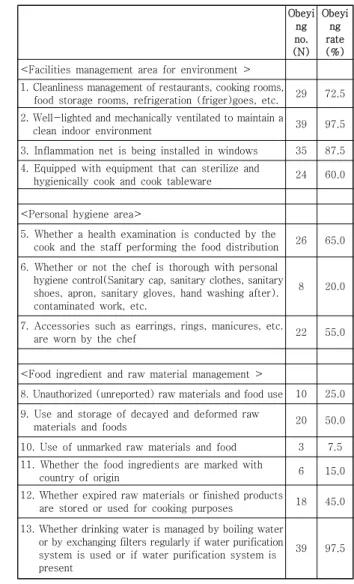
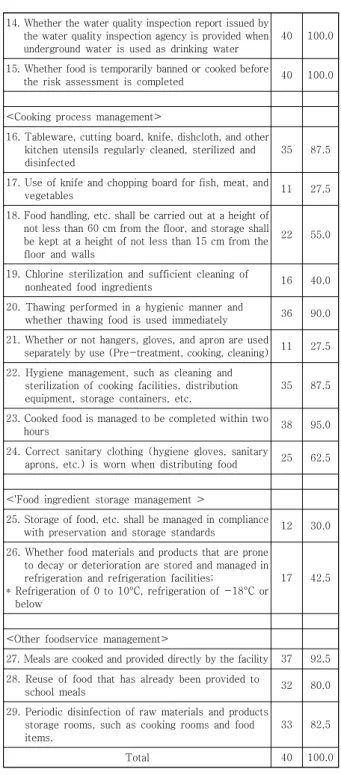
급식관리지원센터가 노인 사회복지시설 급식관리를 지원하기 전의 위생관리 현황이 table 2에 나와있다. 급 식위생관리 현황을 전체 조사대상 요양원 40개소의 체크 리스트 각 항목에 대한 준수율로 나타내었다. 전체 29개 항목 중 가장 낮은 준수율을 보인 항목은 ‘무표시 원료 및 식품의 사용’에 대한 항목으로 40개소 중 3개소 (7.5%)만이 바르게 준수를 하고 있었다. 또 ‘식재료의 원 산지 표기’(6개소, 15.0%)와 ‘위생모, 위생복, 위생화, 앞 치마, 위생장갑 착용, 오염작업 후 손 세척 등의 개인위생 관리 준수’(8개소, 20.0%), ‘어류·육류·채소류를 취급하는 칼·도마 구분 사용’(11개소, 27.5%)’, ‘행주, 사용장갑 및 앞치마를 전처리용, 조리용, 청소용으로 구분 사용’(11개 소, 27.5%)의 항목이 낮은 준수율을 보였다.
Obeyi ng no.
(N) Obeyi
ng rate (%)
<Facilities management area for environment >
1. Cleanliness management of restaurants, cooking rooms,
food storage rooms, refrigeration (friger)goes, etc. 29 72.5 2. Well-lighted and mechanically ventilated to maintain a
clean indoor environment 39 97.5
3. Inflammation net is being installed in windows 35 87.5 4. Equipped with equipment that can sterilize and
hygienically cook and cook tableware 24 60.0
<Personal hygiene area>
5. Whether a health examination is conducted by the
cook and the staff performing the food distribution 26 65.0 6. Whether or not the chef is thorough with personal
hygiene control(Sanitary cap, sanitary clothes, sanitary shoes, apron, sanitary gloves, hand washing after).
contaminated work, etc.
8 20.0
7. Accessories such as earrings, rings, manicures, etc.
are worn by the chef 22 55.0
<Food ingredient and raw material management >
8. Unauthorized (unreported) raw materials and food use 10 25.0 9. Use and storage of decayed and deformed raw
materials and foods 20 50.0
10. Use of unmarked raw materials and food 3 7.5 11. Whether the food ingredients are marked with
country of origin 6 15.0
12. Whether expired raw materials or finished products
are stored or used for cooking purposes 18 45.0 13. Whether drinking water is managed by boiling water
or by exchanging filters regularly if water purification system is used or if water purification system is present
39 97.5
Table 2. The Sanitary management status of the nursing homes before the support.
3.3 노인 사회복지시설의 1차 급식관리 지원 전과 후의 위생관리 점수 비교
노인 사회복지시설에 1차 급식위생관리 지원방문을 실시한 후, 급식관리를 지원하기 전의 위생관리 평균점수 와 지원 후의 평균점수에 유의한 차이가 있는지 알아본 결과가 Table 3에 있다. 1차 방문 지원을 실시한 후 전 체 급식위생관리 평균점수는 63.13점(100점 만점)에서 75.10점으로 유의하게 증가하였고(p<0.001), 각 항목에 서 평균점수의 유의한 증가를 보인 것도 전체 29개 중
‘식기를 소독하고 위생적으로 취사 및 조리할 수 있는 설 비를 갖추고 있는지 여부’, ‘조리원이 개인위생관리에 철 저를 기하는 지 여부(위생모, 위생복, 위생화, 앞치마, 위 생장갑 착용, 오염작업 후 손 세척 등)’, ‘조리원의 귀걸 이, 반지, 매니큐어 등 액세서리 착용 여부’, ‘무표시 원료 및 식품의 사용 여부’, ‘식재료에 원산지 표시를 했는지 여부’, ‘식기, 도마, 칼, 행주, 그 밖에 주방용구를 정기적 으로 세척·살균 및 소독하는지 여부’ 등 16개가 있었다 (p<0.05, p<0.01, p<0.001). 전체 6개 영역별 평균점수 에서는 6개영역 모두에서 유의한 차이가 있었고(p<0.05, p<0.01, p<0.001), 이 중 ‘조리공정’ 영역(t=6.112, p<0.001)에서 평균점수의 증가정도가 가장 컸다.
14. Whether the water quality inspection report issued by the water quality inspection agency is provided when underground water is used as drinking water
40 100.0
15. Whether food is temporarily banned or cooked before
the risk assessment is completed 40 100.0
<Cooking process management>
16. Tableware, cutting board, knife, dishcloth, and other kitchen utensils regularly cleaned, sterilized and disinfected
35 87.5
17. Use of knife and chopping board for fish, meat, and
vegetables 11 27.5
18. Food handling, etc. shall be carried out at a height of not less than 60 cm from the floor, and storage shall be kept at a height of not less than 15 cm from the floor and walls
22 55.0
19. Chlorine sterilization and sufficient cleaning of
nonheated food ingredients 16 40.0
20. Thawing performed in a hygienic manner and
whether thawing food is used immediately 36 90.0 21. Whether or not hangers, gloves, and apron are used
separately by use (Pre-treatment, cooking, cleaning) 11 27.5 22. Hygiene management, such as cleaning and
sterilization of cooking facilities, distribution equipment, storage containers, etc.
35 87.5
23. Cooked food is managed to be completed within two
hours 38 95.0
24. Correct sanitary clothing (hygiene gloves, sanitary
aprons, etc.) is worn when distributing food 25 62.5
<'Food ingredient storage management >
25. Storage of food, etc. shall be managed in compliance
with preservation and storage standards 12 30.0 26. Whether food materials and products that are prone
to decay or deterioration are stored and managed in refrigeration and refrigeration facilities;
* Refrigeration of 0 to 10°C, refrigeration of -18°C or below
17 42.5
<Other foodservice management>
27. Meals are cooked and provided directly by the facility 37 92.5 28. Reuse of food that has already been provided to
school meals 32 80.0
29. Periodic disinfection of raw materials and products storage rooms, such as cooking rooms and food items.
33 82.5
Total 40 100.0
Scor e
Before support
After support
t-valu e
<Facilities management area for environment >
1. Cleanliness management of restaurants, cooking rooms, food storage rooms, refrigeration (friger)goes, etc.
4 2.97±1.
771)
3.08±1.
71 0.374
2. Well-lighted and mechanically ventilated to maintain a clean indoor environment
4 3.90±0.
64
4.00±0.
00 1.000
3. Inflammation net is being installed
in windows 4 3.49±1.
35
3.49±1.
35 0.000
4. Equipped with equipment that can sterilize and hygienically cook and cook tableware
4 2.36±1.
99
3.18±1.
64 2.731
*
Subtotal 16 12.72±2
.88
13.74±
2.21 2.512
*
<Personal hygiene area>
5. Whether a health examination is conducted by the cook and the staff performing the food distribution
4 2.56±1.
94
2.56±1.
94 0.000
6. Whether or not the chef is thorough with personal hygiene control(Sanitary cap, sanitary clothes, sanitary shoes, apron, sanitary gloves, hand washing after contaminated work, etc.).
4 1.74±1.
46
2.31±1.
56 2.567
*
7. Accessories such as earrings, rings, manicures, etc. are worn by the chef
2 1.08±1.
01
1.64±0.
78 2.913
**
Subtotal 10 5.38±2.
76
6.51±2.
74 2.404
*
<Food ingredient and raw material management >
8. Unauthorized (unreported) raw
materials and food use 4 1.03±1.
77
2.15±2.
02 3.451
**
Table 3. The comparison of sanitary management before and after the first support.
3.4 노인 사회복지시설의 2차 급식관리 지원 전과 후의 위생관리 점수 비교
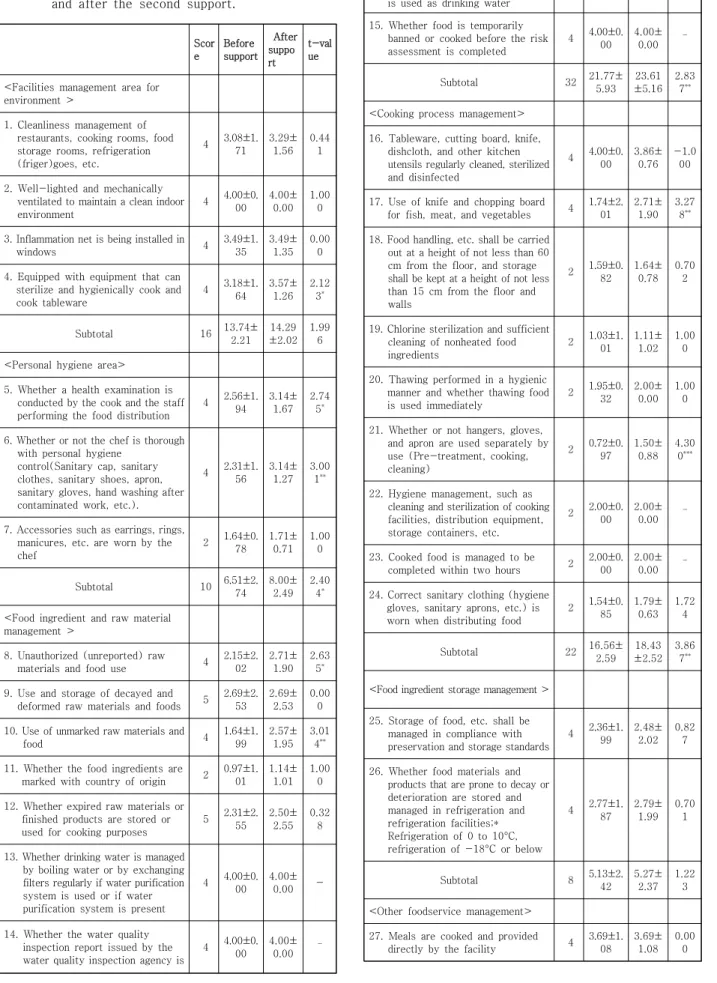
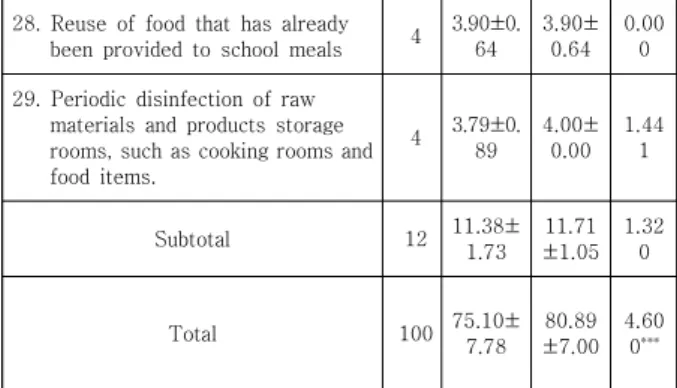
노인 사회복지시설의 2차 급식위생관리 지원을 실시 하고 지원 전과 후의 위생관리 평균점수의 차이를 비교 한 결과를 Table 4에 나타내었다. 2차 방문 지원을 실시 한 후 전체 급식위생관리 점수가 75.10점(100점 만점)에 서 80.89점으로 유의하게 증가하였으며(p<0.001), 체크 리스트에서 유의한 평균점수의 차이를 보인 항목은 전체 29개 중 7개였다(p<0.05, p<0.01, p<0.001). 1차 급식 관리 지원에서는 전과 후의 점수증가가 유의하지 못하였 으나 2차 지원 후에 유의한 차이로 점수가 증가한 항목 으로는 ‘조리원, 배식을 수행하는 직원의 건강진단 실 시’(p<0.05), ‘행주, 사용장갑 및 앞치마의 용도별 구분 사용 여부 (전처리용, 조리용, 청소용)’(p<0.001)의 2개가 있었다.
9. Use and storage of decayed and
deformed raw materials and foods 5 2.56±2.
53
2.69±2.
53 0.255
10. Use of unmarked raw materials
and food 4 0.31±1.
08
1.64±1.
99 3.929
***
11. Whether the food ingredients are
marked with country of origin 2 0.31±0.
37
0.97±1.
01 4.359
***
12.Whether expired raw materials or finished products are stored or used for cooking purposes
5 2.31±2.
55
2.31±2.
55 0.000
13. Whether drinking water is managed by boiling water or by exchanging filters regularly if water purification system is used or if water purification system is present
4 3.90±0.
64
4.00±0.
00 1.000
14. Whether the water quality inspection report issued by the water quality inspection agency is provided when underground water is used as drinking water
4 4.00±0.
00
4.00±0.
00 -
15. Whether food is temporarily banned or cooked before the risk assessment is completed
4 4.00±0.
00
4.00±0.
00
-
Subtotal 32 18.41±5
.21
21.77±
5.93 2.920
**
<Cooking process management>
16. Tableware, cutting board, knife, dishcloth, and other kitchen utensils regularly cleaned, sterilized and disinfected
4 3.49±1.
35
4.00±0.
00 2.364
*
17. Use of knife and chopping board
for fish, meat, and vegetables 4 1.03±1.
77
1.74±2.
01 2.883
**
18. Food handling, etc. shall be carried out at a height of not less than 60 cm from the floor, and storage shall be kept at a height of not less than 15 cm from the floor and walls
2 1.08±1.
01
1.59±0.
82 2.693
*
19. Chlorine sterilization and sufficient cleaning of nonheated food ingredients
2 0.82±1.
00
1.03±1.
01 2.084
*
20. Thawing performed in a hygienic manner and whether thawing food is used immediately
2 1.79±0.
61
1.95±0.
32 1.780
21. Whether or not hangers, gloves, and apron are used separately by use (Pre-treatment, cooking, cleaning)
2 0.51±0.
88
0.72±0.
97 1.275
22. Hygiene management, such as cleaning and sterilization of cooking facilities, distribution equipment, storage containers, etc.
2 1.74±0.
68
2.00±0.
00 2.364
*
23. Cooked food is managed to be
completed within two hours 2 1.90±0.
45
2.00±0.
00 1.433
24. Correct sanitary clothing (hygiene gloves, sanitary aprons, etc.) is worn when distributing food
2 1.23±0.
99
1.54±0.
85 2.226
*
Subtotal 22 13.59±3
.47
16.56±
2.59 6.112
***
<Food ingredient storage management >
25. Storage of food, etc. shall be managed in compliance with preservation and storage standards
4 1.13±1.
82
2.36±1.
99 2.768
**
26. Whether food materials and products that are prone to decay or deterioration are stored and managed in refrigeration and refrigeration facilities;*
Refrigeration of 0 to 10°C, refrigeration of -18°C or below
4 1.64±1.
99
2.77±1.
87 3.148
**
Subtotal 8 2.77±2.
08
5.13±2.
42 5.437
***
<Other foodservice management>
27. Meals are cooked and provided
directly by the facility 4 3.69±1.
08
3.69±1.
08 0.000
28. Reuse of food that has already
been provided to school meals 4 3.28±1.
56
3.90±0.
64 2.629
*
29. Periodic disinfection of raw materials and products storage rooms, such as cooking rooms and food items.
4 3.28±1.
56
3.79±0.
89 2.364
*
Subtotal 12 10.67±2
.49
11.38±
1.73 2.214
*
Total 100 63.13±9
.70
75.10±
7.78 7.782
***
1)Mean±S.D. *p<0.05, **p<0.01, ***p<0.001
Scor e
Before support
After suppo rt
t-val ue
<Facilities management area for environment >
1. Cleanliness management of restaurants, cooking rooms, food storage rooms, refrigeration (friger)goes, etc.
4 3.08±1.
71
3.29±
1.56 0.44
1
2. Well-lighted and mechanically ventilated to maintain a clean indoor environment
4 4.00±0.
00
4.00±
0.00 1.00
0
3. Inflammation net is being installed in
windows 4 3.49±1.
35
3.49±
1.35 0.00
0 4. Equipped with equipment that can
sterilize and hygienically cook and cook tableware
4 3.18±1.
64
3.57±
1.26 2.12
3*
Subtotal 16 13.74±
2.21 14.29
±2.02 1.99
6
<Personal hygiene area>
5. Whether a health examination is conducted by the cook and the staff performing the food distribution
4 2.56±1.
94
3.14±
1.67 2.74
5*
6. Whether or not the chef is thorough with personal hygiene
control(Sanitary cap, sanitary clothes, sanitary shoes, apron, sanitary gloves, hand washing after contaminated work, etc.).
4 2.31±1.
56
3.14±
1.27 3.00
1**
7. Accessories such as earrings, rings, manicures, etc. are worn by the chef
2 1.64±0.
78
1.71±
0.71 1.00
0
Subtotal 10 6.51±2.
74
8.00±
2.49 2.40
4*
<Food ingredient and raw material management >
8. Unauthorized (unreported) raw
materials and food use 4 2.15±2.
02
2.71±
1.90 2.63
5* 9. Use and storage of decayed and
deformed raw materials and foods 5 2.69±2.
53
2.69±
2.53 0.00
0 10. Use of unmarked raw materials and
food 4 1.64±1.
99
2.57±
1.95 3.01
4**
11. Whether the food ingredients are
marked with country of origin 2 0.97±1.
01
1.14±
1.01 1.00
0 12. Whether expired raw materials or
finished products are stored or used for cooking purposes
5 2.31±2.
55
2.50±
2.55 0.32
8
13. Whether drinking water is managed by boiling water or by exchanging filters regularly if water purification system is used or if water purification system is present
4 4.00±0.
00
4.00±
0.00 -
14. Whether the water quality inspection report issued by the water quality inspection agency is
4 4.00±0.
00
4.00±
0.00
-
Table 4. The comparison of sanitary management before and after the second support.
provided when underground water is used as drinking water 15. Whether food is temporarily
banned or cooked before the risk assessment is completed
4 4.00±0.
00 4.00±
0.00
-
Subtotal 32 21.77±
5.93 23.61
±5.16 2.83
7**
<Cooking process management>
16. Tableware, cutting board, knife, dishcloth, and other kitchen utensils regularly cleaned, sterilized and disinfected
4 4.00±0.
00 3.86±
0.76 -1.0
00
17. Use of knife and chopping board
for fish, meat, and vegetables 4 1.74±2.
01 2.71±
1.90 3.27
8**
18. Food handling, etc. shall be carried out at a height of not less than 60 cm from the floor, and storage shall be kept at a height of not less than 15 cm from the floor and walls
2 1.59±0.
82 1.64±
0.78 0.70
2
19. Chlorine sterilization and sufficient cleaning of nonheated food ingredients
2 1.03±1.
01 1.11±
1.02 1.00
0
20. Thawing performed in a hygienic manner and whether thawing food is used immediately
2 1.95±0.
32 2.00±
0.00 1.00
0
21. Whether or not hangers, gloves, and apron are used separately by use (Pre-treatment, cooking, cleaning)
2 0.72±0.
97 1.50±
0.88 4.30
0***
22. Hygiene management, such as cleaning and sterilization of cooking facilities, distribution equipment, storage containers, etc.
2 2.00±0.
00 2.00±
0.00 -
23. Cooked food is managed to be
completed within two hours 2 2.00±0.
00 2.00±
0.00
-
24. Correct sanitary clothing (hygiene gloves, sanitary aprons, etc.) is worn when distributing food
2 1.54±0.
85 1.79±
0.63 1.72
4
Subtotal 22 16.56±
2.59 18.43
±2.52 3.86
7**
<Food ingredient storage management >
25. Storage of food, etc. shall be managed in compliance with preservation and storage standards
4 2.36±1.
99 2.48±
2.02 0.82
7
26. Whether food materials and products that are prone to decay or deterioration are stored and managed in refrigeration and refrigeration facilities;*
Refrigeration of 0 to 10°C, refrigeration of -18°C or below
4 2.77±1.
87 2.79±
1.99 0.70
1
Subtotal 8 5.13±2.
42 5.27±
2.37 1.22
3
<Other foodservice management>
27. Meals are cooked and provided
directly by the facility 4 3.69±1.
08 3.69±
1.08 0.00
0
3.5 노인 사회복지시설의 급식관리 지원 전과 후의 냉장, 냉동고 온도와 냉장고 손잡이 오염도 비교
노인 사회복지시설에 처음 순회점검을 나갔을 때 측정 했던 냉장, 냉동고의 온도 및 냉장고 손잡이 오염도 결과 와 마지막 3차 지원을 나갔을 때 측정한 온도와 오염도 결과를 비교하여 Table 5에 나타내었다. 지원 전 냉장고 평균온도는 3.56℃, 지원 후 3.23℃이었고, 냉동고 온도 는 지원 전 –17.90℃, 지원 후 –18.04℃이었다. 급식관 리지원 전과 후의 요양원 냉장, 냉동고 온도 분포에서 유 의한 차이를 보였다(p<0.001).
Before education
After second visit
t / χ2 -value Refrigerator
mean temperature (℃)
3.56±3.501) 3.23±2.52 0.581
Freezer mean temperature
(℃)
-17.90±4.79 -18.04±4.16 0.163
Refrigerator handle pollution degree
(RLU2))
25,594.42±36, 819.75 (1,933.00~155,
576.00)4)
16,696.38±27,1 03.23 (391.00~134,24
9.00)4)
1.013
Freezer tempera ture (℃)
≤ -18 21(52.5)2) 25(62.5)
26.526**
*
> -18 19(47.5) 15(37.5)
Refriger ator tempera ture (℃)
≤ 5 22(70.0) 31(77.5)
27.097**
> 5 12(30.0) 9(22.5) *
Total3) 40(100.0) 40(100.0)
1)Mean±S.D. 2)Relatively Light Unit. 3)N(%), 4)(Min,~Max.) ***p<0.001
Table 5. 급식관리 지원 전과 후의 냉장, 냉동고 온도와 냉장고 손잡이 ATP 수치변화
4. 고찰
본 연구에서는 청주시 사회복지시설 급식관리지원센 터의 회원인 노인요양시설과 공동생활가정, 주간보호센
터 등 40개소를 대상으로 입소노인들을 위한 급식의 위 생관리 현황을 조사하고, 센터의 지원효과를 알아보고자 조리원, 시설장 대상 위생교육과 정보자료 및 지원물품 제공 등 관리지원을 실시하기 전과 후의 급식위생관리 개선정도를 비교분석하였다.
급식관리지원을 하기 전 처음 노인급식소를 방문하였 을 때 점검한 위생관리 항목의 점수 결과에서 준수율이 가장 낮은 항목은 ‘무표시 원료 및 식품의 사용 여부’와
‘식재료에 원산지 표시를 했는지 여부’로 모두 ‘식재료 관 리(원료사용)’ 영역에 해당하였다. Seo 등(2019)[13]에 의하면 영양사를 고용한 노인복지시설 급식소에서는 무 표시 원료 및 식품 사용을 하지 않는 경우가 77.8%로 높 은 준수율을 보여주었으나 영양사 미고용 시설에서는 51.7%로 낮은 준수율을 보여주었다. 본 연구의 조사대상 시설도 영양사가 없는 소규모 시설이었는데, 무표시 원료 및 식품을 사용하지 않는 경우가 7.5%로 준수 시설이 매 우 적게 조사되어 식재료의 올바른 관리에 대한 교육과 홍보가 필요함을 알 수 있었다. 식품표시에는 유통기한, 원재료명 및 함량, 영양성분 등이 있으며 식품구매 시 이 를 확인하는 과정을 통해 식품의 안전성을 확보하게 된 다[24]. 따라서 노인들의 안전한 급식위생관리를 위하여 무표시 식품이 아닌 식품위생법의 표시기준에 따른 올바 른 식품표시가 되어있는 제품을 구매해야 할 것이다.
본 연구의 조사결과 ‘조리원의 위생복, 앞치마, 위생장 갑 착용과 오염작업 후 손 세척을 제대로 하는지 등의 개 인위생관리의 준수율이 20.0%로 매우 저조함을 보여주 었다. Yi 등[25]의 노인복지관 조리원과 자원봉사자를 대 상으로 급식위생관리 수행수준을 조사한 연구에서는 개 인위생영역이 4.46점(5점 만점)으로 다른 영역에 비해 가장 높은 점수를 보여주었으나, Seo 등[26]의 50인 미 만 노인복지관 조리종사자를 대상으로 한 급식위생 실천 도 설문조사에서는 ‘조리 시 위생복과 위생모를 착용’하 는 개인위생 부문 항목이 다른 항목에 비하여 낮은 수준 의 실천도를 보여주었다. 또 Seo 등(2019)[13]의 영양사 가 없는 노인 여가복지시설에서도 조리 시 위생복과 앞 치마 등을 착용하는 항목의 수행도가 41.7%로 낮게 조사 되어 본 연구결과와 비슷한 양상을 보여주었다. 감염에 취약한 노인들을 위한 급식 준비에서 올바른 개인위생 수칙의 준수는 식중독 예방을 위한 가장 기본적인 요소 이자 중요한 실천 항목이다[4]. 위생교육을 받은 조리종 사자들의 개인위생 실천은 위생교육을 받지 않은 집단에 비하여 유의하게 높았다고 하므로[25,27], 어르신들의 급 식을 제공하는 노인복지시설 조리종사자들을 위한 정기
28. Reuse of food that has already
been provided to school meals 4 3.90±0.
64
3.90±
0.64 0.00
0 29. Periodic disinfection of raw
materials and products storage rooms, such as cooking rooms and food items.
4 3.79±0.
89
4.00±
0.00 1.44
1
Subtotal 12 11.38±
1.73 11.71
±1.05 1.32
0
Total 100 75.10±
7.78 80.89
±7.00 4.60
0***
1)Mean±S.D. *p<0.05, **p<0.01, ***p<0.001
적인 위생교육의 필요성이 절실히 요구되는 바이다.
Soon 등(2012)[28]에 의하면 바람직한 위생교육이란 지 식 뿐 아니라 개인위생 태도(attitudes)에 영향을 주어 위생적 실천(hygiene practices)으로 이어질 수 있어야 한다고 했다. 본 연구에서도 개인위생영역의 점수가 지원 전 5.38점(10점 만점)에서 급식관리지원센터의 1차, 2차 지원을 받은 뒤 6.51점, 8.00점으로 각각 유의한 점수증 가를 보여주었다. 따라서 개인위생의 준수율을 높이기 위 해서는 조리원들을 위한 위생교육의 기회가 보다 지속적 으로 이루어져야 할 것이며, 계속적인 급식관리지원센터 의 지원이 제공되어야 할 것이다.
본 연구의 결과에서 냉장고 손잡이 오염도는 지원 전 보다 후에 최소값과 최대값, 평균 ATP 측정값이 줄어들 었으나 유의하지는 않았다. 식약처의 사회복지시설 급식 관리지원을 위한 가이드라인에서는 냉장고 온도는 0~1 0℃, 냉동고는 –18℃ 이하로 관리하도록 제시하고 있고 [22]. 우리나라 학교급식법 시행규칙의 제3조 급식시설 세부기준에는 냉장고는 5℃ 이하, 냉동실은 –18℃ 이하 로 규정해놓고 있다[29]. 이를 기준으로 했을 때 본 연구 에서 급식관리지원 전과 후 요양원의 냉장, 냉동고 온도 분포에 유의한 차이를 보여주어, 관리지원을 받은 후 식 품보관을 위한 온도관리 개선에 효과가 있는 것으로 보 인다. 식중독 예방을 위해서는 원재료인 식품과 조리한 음식의 온도 및 시간관리가 최우선인데, 식재료의 올바른 보관을 위하여 냉장, 냉동고 온도관리는 조리실의 기본적인 시설 조건이지만 효과적인 위생실천 항목에 해당된다[4].
본 연구의 조사대상 노인복지시설의 급식위생관리 현 황에서 식재료 관리와 개인위생 다음으로 취약한 부분이 조리공정 영역의 ‘칼, 도마의 재료별 구분사용’과 행주, 장갑, 앞치마의 용도별 구분사용‘이었다. Seo 등 [13]에 서도 영양사가 고용된 복지시설에서의 행주, 장갑, 앞치 마의 구분사용은 81.5%의 수행률을 보여 양호하였으나, 영양사가 없는 복지시설은 30.4%였으며 영양사 미고용 여가복지시설에서의 칼, 도마 구분사용도 16.7%로 매우 낮게 나타났다. 특히 본 연구에서 행주, 장갑, 앞치마 구 분사용은 1차 교육 후 개선이 유의적이지 않았지만 2차 교육 후 유의적인 변화가 있었는데, 조사대상 시설의 순 회방문 때마다 지원물품으로 칼과 도마, 앞치마 등을 제 공하고 2회의 위생교육을 실시한 결과 수행도가 유의적 으로 개선된 것으로 보인다. Seo 등[26]에서도 칼과 국 자의 미생물 오염도가 다른 조리도구에 비하여 높게 나 타났는데, 다른 단체급식시설의 상태보다 노인시설이 미 흡함을 지적하였다. 칼이나 도마, 행주 등 조리도구가 위
생적으로 관리되지 못하면 교차오염이 발생하여 깨끗한 식재료나 조리가 완료된 음식으로 식중독균이 옮겨가 결 국 식이성 질환을 유발하는 단초가 될 수 있다[30,31].
따라서 개인위생부터 식재료 보관과 관리, 조리과정 중 생길 수 있는 모든 위험요인들을 조리에 참여하는 사람 들이 반드시 숙지해야 할 필요가 있다. 이에 급식관리지 원센터의 영양사들이 노인급식시설을 직접 방문하여 조 리원과 시설장, 요양보호사 등을 교육하고 관리해주는 지 원 서비스는 현재 영양사 없이 운영되는 소규모 급식시 설들을 위해 반드시 필요한 제도라 할 수 있겠다. 앞으로 관련 법률과 이에 따른 제도적 뒷받침이 완전히 이루어 져서 우리나라 노인복지시설의 급식관리가 보다 위생적 이고 체계적으로 운영되어야 할 것이다.
5. 결론 및 시사점
본 연구에서는 청주시 사회복지 급식관리지원센터의 회원인 노인요양시설과 공동생활가정, 주간보호센터를 대상으로 시설노인을 위한 급식의 위생관리 현황을 조사 하고, 조리원이나 시설장 대상 교육 등 관리지원을 실시 한 후 노인급식 관리지원 시범사업의 효과를 알아보고자 급식위생관리 개선정도를 비교분석하였다. 본 연구의 제 한점은 노인급식관리지원 시범사업의 일부분인 청주지역 노인복지시설 40개소에 국한하여 제시되었다는 것이다.
앞으로 우리나라 전체 노인복지시설에 대한 타당성 있는 모집단을 추출, 구성하여 노인급식관리 현황에 대한 연구 조사가 필요하며, 노인요양시설과 공동생활가정 및 주야 간보호센터, 경로당 등 시설 별 급식관리현황 비교분석에 대한 연구가 추가 진행되면 바람직할 것으로 사료된다.
이번 연구결과 영양사 고용의무가 없는 소규모 사회복지 시설들은 급식관리지원센터의 서비스를 받기 전에 비하 여 1차와 2차 지원 후에 위생관리 점수가 꾸준히 향상되 었다. 따라서 노인급식 관리지원 정책사업을 전국적으로 확대하여 보다 많은 노인복지시설들이 급식관리지원센터 의 지원을 받고 입소 어르신들이 위생적으로 안전한 급 식을 제공받아 건강한 식생활을 영위할 수 있도록 해야 할 것이다.
6. 감사의 글
본 연구의 자료는 청주시 사회복지 급식관리지원센터
점검결과의 일부임을 밝히는 바이며, 현장검점과 관리에
애써주신 팀장, 팀원들과 센터의 회원 시설장님들께 감사 의 인사를 드립니다.
REFERENCES
[1] Food and Drug Administration. 2020. Food Safety Country. Hazard, Prevention. Food Poisoning Information. food poisoning statistics.
https://www.foodsafetykorea.go.kr/portal/healthyfood life/foodPoisoningStat.do?menu_no=3724&menu_grp=
MENU_NEW02
[2] Food and Drug Administration. 2020. Articles 2 and 88 of the Food Sanitation Act.
http://www.law.go.kr/lsInfoP.do?lsiSeq=215801&efYd=
20200324#J2:0
[3] B. M. Lund (2015). Microbiological Food Safety for Vulnerable People. International Journal of Environmental Research and Public Health, 12(8), 10117-10132.
[4] P. A. Kendall, V. V. Hillers, & L. C. Medeiros. (2006).
Food Safety Guidance for Older Adults. Clin Infect Dis, 42(9), 1298-1304.
DOI: 10.1086/503262.
[5] Statistics Korea. 2019. Major population index.
http://kosis.kr/statHtml/statHtml.do?orgId=101&tblId=
DT_1BPA002&checkFlag=N. Accessed July 25, 2020.
[6] J. W. Lee . (2017). A Study on the Problems and Improvement of the medical service for Elderly People towards Super-aged Society. Legal Research 25(4), 181-203.
[7] Food and Drug Administration. 2020. statute, data.
Revision Notice. Announcement of the Regulations on Support for Food Service Management for the Elderly, etc.
https://www.mfds.go.kr/brd/m_207/list.do
[8] M Vandenberghe-Descamps, H Labouré, C Septier , G Feron, C Sulmont-Rossé. 2018. A new concept to understand elderly people’s expectations in terms of food sensory characteristics. Food Quality Preference.
70(1), 57-67.
http://lps3.doi.org.libproxy.snu.ac.kr/10.1016/j.foodqu al.2017.08.009
[9] R. Liu, K. G. Grunert. 2020. Satisfaction with food-related life and beliefs about food health, safety, freshness and taste among the elderly in China: A segmentation analysis. Food Quality Preference.
79(1), 1-10.
http://lps3.doi.org.libproxy.snu.ac.kr/10.1016/j.foodqu al.2019.103775
[10] M. D. Kirk, J. Gregory, K. Lalor, G. V. Hall, & N.
Becker. (2012). Foodborne and waterborne infections in elderly community and long-term care facility residents, Victoria, Australia. Emerging Infectious
Diseases, 18(3), 377-384.
[11] W. C. Levine, J. F. Smart, D. L. Archer, N. H. Bean, &
R. V. Tauxe. (1991). Foodborne disease outbreaks in nursing homes, 1975 through 1987. JAMA, 266(15), 2105–2109.
[12] G. S. Han, E. J. Yang. (2018). Status of Foodservice Operations in Long-term Care Facilities for the Elderly: Focus on the Gwangju Metropolitan City. J East Asian Society of Dietary Life 28(5), 337-344.
[13] J. E. Seo, K. I. Kwon &, G. H. Kim. (2019). Study on the Actual Conditions of Institution Foodservice Management in the Elderly Welfare Facilities by the Employment of Dietitians. J Food Cook Sci 35(2), 216-225.
[14] E. H. Seo & E. J. Park. (2016). Nutrition Intake Status of the Elderly in Residential Welfare Facilities by Dietitian Employment. J Korean Society for Wellness, 11(4), 473-483.
DOI : 10.21097/ksw.2016.11.11.4.473
[15] Y. J. Chang. (2013). Status and Improving the Quality of Foodservice in Long-term Care Facilities for the Elderly. National Assembly Research Service. Field Survey Report.
https://www.nars.go.kr/report/view.do?cmsCode=CM0 156&brdSeq=2179
[16] J. S. Kwon, S. H. Lee, K. M. Lee, & Y. N. Lee. (2016).
Study on Energy and Nutrient Intake and Food Preference of the Elderly in Care Facilities. Korean J Comm Nutr, 21(2), 200-217.
DOI: 10.5720/kjcn.2016.21.2.200
[17] H. J. Chang. (2008). Strategies for the Improvement of Customer Satisfaction on Foodservice through Identifying the Foodservice Quality Factors in Senior Care Facilities. Korean J Comm Nutr, 13(1), 69-79.
[18] S. Y. Baik, S. Y. Shin, S. H. Baek, I. S. Yang. (2008).
The Effect of Foodservice Quality Perception on Residence Satisfaction of Silver Town Residents.
Korean J Food & Nutr. 21(4), 553-561.
http://www.koreascience.or.kr/article/JAKO20080965 1051179.pub
[19] M. J. Lee, J. H. Kim, O. J. Park, Y. M. Lee. (2016). A study on the Needs for Nutrition Management Program for Elderly Who use Welfare Facilities.
Korean J Comm Nutr, 21(1), 65-74.
[20] E. K. Jung, S. J. Park, & J. S. Kim. (2017). Evaluation of the Menus of Senior Welfare Centers for Home-bound Elderly. J Korean Diet Assoc 23(4), 363-373.
[21] H. J. Ahn, J. H. Kang, & H. M. Lee. (2014). Nutrition Status of Elderly Female Patients in Long-term Care Hospital according to Meal Types and Eating Ability.
Korean J Comm Nutr, 19(2), 187-197.
[22] The Korea Food and Drug Administration. 2019.
Guideline for Center for social welfare facility
Foodservice Management. Ministry of Food and Drug
Safety. Cheongju, Korea. pp.82-84.
https://ccfsm.foodnara.go.kr/home/?menuno=164 [23] H. K. Moon. (2017). Comparison of the Sanitary
Inspection Results and Adenosine Triphosphate(ATP) Bioluminescence Assay for Equipment in Children’s Foodservices. Korean J Food Cook Sci 33(4), 461-470.
DOI; 10.9724/kfcs.2017.33.4.461
[24] J. O. Park. (2017). The Use Characteristics and the Use Competencies of Food Label among Main Food Buyers of Households. J Consumer Policy Studies 48(3), 1-31.
http://www.dbpia.co.kr/journal/articleDetail?nodeId=
NODE07301766
[25] N. Y. Yi. K. E. Lee, & J. Y. Park. (2009). Evaluation of Foodservice Workers` Food Safety Knowledge and Practices at Senior Welfare Centers. Korean J Food cookery Sci 25,(6), 677-689.
[26] S. H. Seo, S. J. Moon, J. H. Choi. (2011). Evaluation of Hygienic Status using ATP Bioluminescence Assay and Food Service Workers' Sanitation Performance in Elderly Welfare Facilities. J Korean Diet Assoc 17(2), 142-160.
[27] J. E. Lee. (2017). A Study on the Food Hygiene Knowledge, Attitude, and Practice of Directors and Teachers in the Home Day Care Centers. J Eng Appl Sci. 2SI(12), 6173-6179.
DOI: 10.36478/jeasci.2017.6173.6179
[28] J. M. Soon, R. Baines, & P. Seaman. (2012).
Meta-analysis of food safety training on hand hygiene knowledge and attitudes among food handlers. J Food Prot, 75(4), 793-804
[29] The Department of Education. (2020). Enforcement regulations of the School Foodservice Act.
http://www.law.go.kr/lsInfoP.do?lsiSeq=182664&efYd=
20160420#AJAX
[30] J. Sibanyoni, F. T. Tabit. 2019. An assessment of the hygiene status and incidence of foodborne pathogens on food contact surfaces in the food preparation facilities of schools. Food Control, 98(1), 94-99.
[31] O. A. Mihalache, L. Dumitraşcu, A. I. Nicolau, D.
Borda. 2020. Food safety knowledge, food shopping attitude and safety kitchen practices among Romanian consumers: A structural modelling approach. Food Control, 120(1), 1-8.
https://doi.org/10.1016/j.foodcont.2020.107545
이 주 은(Joo-Eun Lee) [정회원]
․ 1995년 2월 : 연세대학교 식품영양과 (이학사)
․ 2000년 8월 : 연세대학교 생활환경대 학원(이학석사)
․ 2008년 8월 : 연세대학교 식품영양학 과(이학박사)
․ 2012년 3월 ∼ 현재 : 서원학교 식품 영양학과 부교수
․ 관심분야 : 단체급식, 급식경영, 급식위생
․ E-Mail : [email protected]