1. Introduction
Recently, as interest and importance of safety management in manufacturing site has increased, CCTV (closed-circuit television) has been developing as a technology for preventing and managing accidents by analyzing images in addition to simple video recording function. In order to analyze the situation in real time, an intelligent CCTV which includes functions of object detection, tracking, classification, and behavior recognition has been developed. Due to the rapid distribution of CCTV and the development of IT technology, the market for video security system is continuously growing.
Therefore, it is necessary to improve the efficiency of surveillance by supplementing the limitations of people, and to prevent crime and disaster[1,2]. The Korea government
started many projects such as the project of establishing integrated linkage system of disaster video information by fire-fighting agency, the road slope maintenance system through the constant measurement system by Korea Institute of Construction Technology, CCTV-based water level detection system, intelligent integrated control service by the security administration agency, and LG CNS's state-of-the-art intelligent comprehensive situation control system based on CCTV. In the case of overseas, the UK has established the I-LIDS (Imagery Library for Intelligent Detection System) for the evaluation of the performance of the intelligent CCTV system as well as operation of the CCTV control center. In addition, Japan has established a CCTV camera localization system to investigate the earthquake. In the United States, CCTV is used to prevent terrorism with the DAS (Domain
CCTV Monitoring System Development for Safety Management and Privacy in Manufacturing Site
Ji Hee Hana, Sang Hun Oka, Kyu Songa, Dong Young Jangb*
a Graduate School, Department of Manufacturing Systems and Design Engineering,
Seoul National University of Science & Technology, 232, Gongneung-ro, Nowon-gu, Seoul 01811, Korea
b Manufacturing Systems and Design Engineering Programme,
Seoul National University of Science & Technology, 232, Gongneung-ro, Nowon-gu, Seoul 01811, Korea
ARTICLE INFO ABSTRACT
Article history: CCTV image processing techniques have been developed for safety management in manufacturing sites. However, CCTV growth has become a social problem for video surveillance with regard to privacy. This study aims to manage the safety system efficiently and protect privacy simultaneously. In this study, the CCTV monitoring system is composed of five steps (accident monitoring, detection, notification, management, restoration). De-identified image is observed when we are in a normal situation. De-identified image changes to identified image when it detects an accident. As soon as it detects an accident, the accident information is sent to the safety administrator. Then the administrator could conduct safety measures. Afterward, accumulated accident data could be used for statistical data that could be utilized as analyzing expecting accident.
Received 27 March 2017
Revised 5 June 2017
Accepted 5 June 2017
Keywords:
CCTV
Video surveillance Safety management Privacy issue Image processing
* Corresponding author. Tel.: +82-2-970-6450 Fax: +82-2-6499-1883
E-mail address: [email protected] (Dong Young Jang).
Awareness System)[3].
However, as the adoption of CCTV increases, concerns about social problems such as the arrival of electronic surveillance society, privacy infringement, conflict between basic rights and public interest are increasing, and counter- measures should be prepared institutionally, administratively and technically[4]. Previous studies of CCTV are showing the increasing operation status of CCTV, and it is necessary to protect personal image information in addition to the technical development of CCTV camera resolution, transmission method, and storage device and application program[5]. As a result of the passage of the law requiring the installation of CCTVs in the event of child abuse in child care centers, it is suggested that the human rights of teachers should be considered to feel the burden of being monitored constantly as a positive aspect of child abuse prevention[6]. In addition, the necessity of CCTV research in private areas such as daycare centers is more needed for privacy. In this way, video technology has been developed variously in terms of the precise recognition of the situation, but the development of CCTV system focusing on the privacy infringement problem is still weak.
Therefore, in this study, images were captured in order to detect the accident in real time and to protect the privacy through image processing process. In addition, we aimed to implement a CCTV surveillance system that notifies the manager of the occurrence of an accident and solves both safety and privacy issues.
2. System Construction
2.1 CCTV Monitoring System Process
The CCTV surveillance system for safety management and privacy has five functions: real-time accident monitoring, accident recognition, accident notification, accident handling and restoration. When the system starts, the settings of the black light comparison mode, the gain mode, the brightness mode, the exposure mode, the gamma mode, the sharpness value, and the white balance mode are performed according to the hardware specification of the camera. After that, it captures and processes images in the idle state, detects the accident in real time, and classifies and stores the images. The flow of the system is shown in Fig. 1. In case of no accident, the image is displayed as De-identified Image which can be protected by privacy through Image Processing. If an incident
is detected, it is converted to an Identified Image which is not processed image. So that the safety manager can be notified efficiently and the real-time accident situation can be judged efficiently. When an administrator takes an accident action after an accident, the system is restored to a normal state.
Images judged as not an accident are sequentially stored and then deleted in a first in first out process. If an accident is detected, the previous image of a certain time is classified and stored as an accident image based on that point of time, and an alarm is given to the manager to notify the occurrence time, the type of accident, and the location information. The administrator who received the notification can check the real image which has been filtered out and determine the occurrence of an accident, and can perform an accident measure, thereby improving. The result of the accident detection includes information of Edge Point (First / Second, Pixel / Real-World, Pixel Angle, Real-World Angle, Matching Score, Straightness, Average SNR(Signal to Noise Ratio).
Through this, it is possible to directly and indirectly obtain the environmental information collected at the accident site, and accident occurrence data can be classified by accident and used for analysis of accident type and prevention of accident through data accumulated later.
2.2 Filtering Image Processing
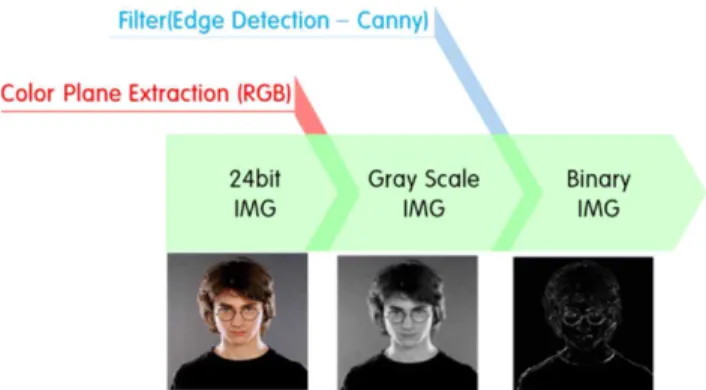
In order to protect privacy, image processing is performed by edge detection of the original image so as not to discriminate the identity. This process is shown in Fig. 2.
Color Plane Extraction (RED Color Extraction) is followed by Fig. 1 Flow chart of CCTV monitoring system for safety manage-
ment and privacy
filtering to complete Edge Detection. The filter uses Canny and adjusts Sigma, High Threshold, Low Threshold, and Window Size depending on the situation. When an accident is detected, it switches to real image to recognize the accident situation. In order to confirm the process of image transition, we experimented an accident that falls. To determine the occurrence of a accident, a container with a flammable substance or high pressure gas was set as a tracking object.
In case of the fallen accident, the height and width change of the object are measured according to the X and Y coordinates. If the rate of change is more than a predetermined threshold value, it is judged as an accident and converted into a real image. Fig. 3(a) shows that de-identified images is a normal screen without an accident. The safety manager will see the filtered image normally and cannot identify the identity displayed on the screen. Fig. 3(b) shows that the identified image is the converted screen after detecting the accident. After the occurrence of the accident, the manager can see the real image and accurately determine the accident situation. The parameters such as Scanning Direction, Edge Polarity, Minimum Edge Strength, Kernel Size, Projection Width, Gap, and Index of Search Line Index are trimmed according to the monitoring target using the Finding Straight Edge algorithm to analyze the image in the region of interest (ROI).
2.3 Object Tracking
In this system, to add the function of determining and tracking the movement of objects in the CCTV, the coordinates of the area in which the movement occurs are set as the target value and the motion of the object is continuously tracked[7]. And the system determines whether there is movement with respect to the reference frame, and then tracks
the object according to the change of the X and Y coordinates.
Object tracking showed different recognition rates depending on color, size, speed, and image distortion rate. The object recognition rate was 86.6 % on the average by analyzing the object recognition on the frame by motion picture taken according to the situations of intrusion, falling, and collision.
In order to increase the recognition rate, it is necessary to analyze the accident situation according to the place and adjust the parameters according to the motion of the object so as to increase the sensitivity of the accident. Also, it is necessary to analyze and apply accident situation by continuous data accumulation.
2.4 Accident Detection
In order to confirm whether or not an accident was detected, three scenarios were constructed by referring to the safety accidents that occurred in the industrial field[8]. Accident detection to ensure the reliability of object recognition and accident detection rate after the experiment, the results were obtained by image analysis using the images from the CMOS camera.
Table 1 shows the method used to detect accidents due to (a) De-identified image in non-accident situation
(b) Identified image in accident situation
Fig. 3 Image differences when not in accident and accident situation
Fig. 2 Image processing of De-identified image for privacy
intrusion, falling, and collision scenarios. Fig. 4(a), ROI logic is used to set object tracking and ROI. Intrusion detection using ROI sets the reference range to store the hazard zone data. The hazard zone is set as the green part of the equipment and the yellow object marked red is set as the reference object.
If the protected object is approaching the reference level or higher in the zone set as the hazardous area, it is judged as an accident. In case of falling in Fig. 4(b), we detected the accident through object tracking, velocity measurement of object motion, and color pattern tracking.
A red ball falling from above is set as the reference object, and an accident is judged when the ball goes downward beyond the reference speed. In case of collision as Fig. 4(c), we used accident detection logic through velocity measurement of object motion and color pattern tracking. A yellow box was set as a reference object and traced. A collision accident was judged when there was a change in the reference velocity of 0 or a decrease in acceleration.
Table 1 Comparison of accident detection methods
Accident Type Accident Detection Method
Intrusion Object Tracking,
ROI Designation
Falling
Object Tracking, Velocity Calculation, Color Pattern Matching and Tracking Collision Velocity Calculation,
Color Pattern Matching and Tracking
(a) Images of intrusion accident detection test
(b) Images of falling accident detection test
(c) Images of collision accident detection test
Fig. 4 Images show when three types of accident conditions are detected in CCTV monitoring system.
3. Experiments and Results
Based on the intrusion, falling, and collision scenarios, the object tracking rate and the accident detection rate were analyzed frame by frame to obtain reliability verification results as shown in Fig. 4. As shown in Table 2, 81.2 % of object recognition rate, 88.3 % of incident recognition rate in intrusion accident, 83.6 % of object recognition rate, 91.7 % of accident recognition rate in falling accident, 95 % of object recognition rate and 80 % accident recognition rate in collision accident, were a reliable result. In order to improve the object recognition rate, in the case of intrusion accidents as Fig. 4(a), the allowable reference value and the reference template image of the area of interest defined as the dangerous area were modified and the illumination of the indoor environment set as the dangerous area was adjusted. In Fig.
4(b) of the falling accident, the direction of object motion and the object displacement were corrected. An object with acceleration at the time of the crash is stored in frame units, so the afterimage appears to remain. Therefore, when the template image of the ball set as the reference is modified according to increase or decrease in velocity, the reference recognition rate is increased. In Fig. 4(c) of collision, the recognition rate was improved by correcting the object motion direction and the object displacement. However, due to differences in intensity of objects caused by no light or nighttime illumination, and the saturation of the object, it is limited to recognize objects. Therefore, it is necessary to improve the image recognition rate of objects due to digital images by applying algorithms of Fuzzy and Retinex techniques[9,10]. Also, if statistical analysis method based on data type considering accident type is applied, it can contribute to prevention of accident by using accident result data.
4. Conclusions and Discussion
In this study, we developed a CCTV surveillance system
that can provide safety management and privacy protection in the manufacturing site. In case of accidents in the industrial site, by increasing the accident recognition rate, the safety management can be done efficiently. Through the image processing process, the problem of human rights violation is solved. From the result of analyzing intrusion, falling, and collision scenarios by dividing the accident type into three types, the average object tracking rate was 86.6 % and the accident detection rate was 86.6 %. If we analyze the situation and experiment with various scenarios in various environments in the future, more reliable results will be obtained.
CCTV, which is increasingly used for the purpose of crime prevention and safety management, has increased the ratio of high-resolution cameras, and the development of image analysis technology has improved the ability to detect accidents or discriminate people. However, more human right and privacy violation problems occur. Hence, the human rights and privacy can be protected by performing the image processing through the border detection method so that the administrator can see the image which is not identifiable to the person. In addition to frame detection, various image processing techniques have been tried to improve image processing speed and to acquire efficient data. In order to reduce the object recognition error rate, classification and data analysis according to the accident situation are performed.
This can be done if sufficient database of images is acquired according to the environment in which the type, color, size, and speed of the object to be monitored are acquired.
Acknowledgement
This paper was supported with the fund of the "Project to Educate Graduate Students in Specializing Fusion Technology for Creative Industry" by the Ministry of Trade, Industry and Energy in 2017 (Project Number N0000717).
References
[1] Moon, H. M., Pan, S. B., 2010, The Human Identification Method in Video Surveillance System, The Korean Institute of Information Technology, 8:5 199-206.
[2] Moon, H. M., Pan, S. B., 2011, The Analysis of De-identification for Privacy Protection in Intelligent Video Surveillance System, The Table 2 Comparison of accident detection rate
Accident Type Object Tracking Rate Accident Detection Rate
Intrusion 81.2 % 88.3 %
Falling 83.6 % 91.7 %
Collision 95.0 % 80.0 %
Korean Institute of Information Technology, 9:7 189-200.
[3] Disaster Prevention Safety Institute, 2014, A Study on Application Method of Smart CCTV Based on 3D-Map for Disaster Management, National Disaster Management Research Institute, Korea.
[4] Shin, Y. J., 2008, A Study on Personal Information Protection According to The Introduction of CCTV in Public Institutions, Journal of Korean Association for Regional Information Society, 11:2 1-21.
[5] Cha, G. S., Shin, Y. T., 2009, Personal Video Privacy Issue to Increasing CCTV Installation, Communications of the Korean Institute of Information Scientists and Engineers, 27:12 25-33.
[6] Cha, S. H., Lee, J. S., 2016, A Study on Teacher’s Experience After The
Installation of CCTV in Kindergarten and Day Care Center, Journal of Critical Social Policy, 51 292-325.
[7] Kang, S. I., Hong, S. H., 2008, Motion Tracking Algorithm for A CCTV System, The Institute of Electronics Engineers of Korea, 32:4 177-178.
[8] Industrial Accidents Status Analysis, 2014, Ministry of Employment and Labor, Korea.
[9] Kim, T. H., Lee, J. H., Hwang, Y. C., Cha, E. Y., 2010, The Study of Vehicle Color Recognition Using the Fuzzy C- means Algorithm Based Quantization, Journal of Korea Multimedia Society, 13:1 235-238.
[10]Cha, H. S., Hong, S. H., 2013, Advanced Retinex Algorithm for Image Enhancement, Journal of Korea Multimedia Society, 16:1 29-41.