Cryopreservation of Embryo by Concentration of Ethylene Glycol and Day 6, 7, 8, 9 Embryo in Korean Native Cattle (Hanwoo)
Joung-Jun Park
1, Han-Jun Yoo
1, Hye-Won Choi
1, Ki-Soo Cheong
3, Ji-Tae Kim
3, Choon-Keun Park
2and Boh-Suk Yang
4,*1
Animal Reproduction & Biotechnology Center, Hoengseong 225-807, Korea
2
College of Animal Life Sciences, Kangwon National University, Chuncheon 200-701, Korea
3
South Branch of Gangwondo Veterinary Service Lab, Wonju 220-170, Korea
4
Hanwoo Experiment Station, National Institute of Animal Science, R.D.A., Pyeongchang 232-950, Korea
ABSTRACT
This study was carried out to effects of ethylene glycol concentration, sucrose and culture day of in vitro production embryo on slow-down freezing in Hanwoo. 6, 7, 8 and 9 day embryos produced in vitro were frozen using 1.8M EG+0.1M sucrose, 1.8M EG+0.5% BSA and 1.5M EG+0.1M sucrose media. Survivability was confirmed after frozen- thawed 24 and 48h and ICM, TE cell number were counted by Hoechst 33342 and PI staining after frozen-thawed 24h. As a result, 1.8M EG+0.1M sucrose group was most significantly (p<0.05) higher compared with the other treatment groups on survivability, TE and total cell number after frozen-thawed 24h (94.2 ± 2.6%, 94.67 ± 3.4 and 129.67
± 5.5). ICM number did not found significant (p<0.05) differences between the three treatment groups. in 6, 7, 8 and 9 day of embryos using three types of freezing media, frozen-thawed, 1.8M EG+0.1M sucrose groups with embryos cultured 8 day was significantly (p<0.05) highest survivability to 98.3 ± 1.7% after frozen-thawed 24h. 1.5M EG+0.1 sucrose group with embryos cultured 9 day was significantly higher survivability than group of embryos cultured 8 day after frozen-thawed 24 and 48h. In conclusion, 1.8M EG+0.1M sucrose media is considered to be effective to cryopreservation of embryos cultured 8 and 9 day.
(Key words : cryopreservation, ethylene glycol, embryo stage, Hanwoo)
†
This work was carried out with the support of “Cooperative Research Program for Agriculture Science & Technology Development(Project No. PJ907008)” Rural Development Administration, Republic of Korea.
*
Correspondence : E-mail : [email protected]
INTRODUCTION
The research on survivability of in vitro embryos of cows after freezing-thawing has been done by numerous researchers.
It has been reported that factors that affect survival rates are in vitro production procedures (Rorie et al., 1990), equilibra- tion method or removal method of cryoprotectant (Voelkel and Hu, 1992), the various types of cryoprotectants (Suzuki et al., 1993), developmental stages of embryos (Han et al., 1994), aging periods of embryos (Takagi et al., 1994), and the rate of freezing speed of embryos (Liu et al., 1996). Since slow-down freezing has been developed to freeze in vivo embryos, slow- down freezing and vitrification have been used for the proce- dure of freezing and thawing (Massip et al., 1993). FCS and BSA freezing solution were classically used in cryopreserva- tion solutions for bovine embryos (Hasler, 2010). Also, ethy- lene glycol (EG) is used as a cryoprotectant for freezing in
vitro embryos, since it contains the properties, lower molecular
weight and endotoxin, and it allows the direct transfer of fer-
tilized embryos into the recipients (Suzuki et al., 1993). Further-
more, the cryoprotectant, EG and glycerol, depending on the
developmental stages of fertilized embryos - in the stages of
compact morula and blastocysts, show the higher survival rates
on the freezing-thawed embryos(Niemann, 1991). According to
Yokohama’s report(1994), freezing with the use of EG and
DMSO, permeabilities of cryoprotectants determine the survi-
vability of embryos since it differently affects the cells based
on permeabilities to cells, concentrations and exposure time of
cryoprotectants within/or -out the cells, temperatures and the
superficial layer of embryos. On the other side, substances
such as sucrose and proteins, and PVP(polyvinyl pyrrolidone)
are used as cryoprotectants, such substances are high-mole-
cular compounds and carry the characteristics of non-perme-
ability, they can be used separately or consecutively for the cryo-
preservation of bovine embryos. Leibo and Loskutoff reported (1993) the survival rates of embryos after using of ethylene glycol and saccharides abreast. Embryo is known to be easily affected by osmotic pressure when it gets exposed to the cryo- protectant during freezing so that sucrose plays an important role to lessen the damage from the osmotic pressure. Therefore, this research was carried out to study the survival rates of em- bryos after freezing-thaw, being slowly frozen with the various levels of concentration of ethylene glycol - often used cryo- protectant, addition of sucrose. It also was carried out to find out the effects of different length of cultured days of cryopre- servation of in vitro fertilized embryos.
MATERIALS AND METHODS
1. Production of In Vitro Fertilized Embryos
Cumulus oocytes complexes (COCs) from the ovaries of slaughtered cows were used in this experiment. Ovaries were kept in the saline under 37 ℃ and were transported to the la- boratory, 18-gauge needle 10 ml syringe was used to collect the COCs from the follicles below 10 mm. COCs were cultured under IVM media - TCM-199 was added with FSH (0.5 ug/ml), LH (5 ug/ml), 5% FBS- for 22 h within the incubator with 5%
CO
2and the temperature of 38.5 ℃. For in vitro fertilization, TL media was used with the sperm concentration of 1×10
6/ml and in vitro fertilization was induced for 18 ~20 h within the incubator with 5% CO
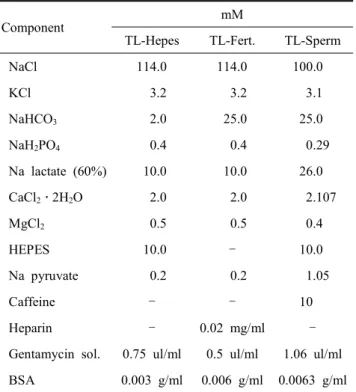
2, 38.5 ℃ (Table 1). Synthetic oviduct fluid-bovine embryo1(SOF-BEI) was used as the developmen- tal culture media based on CaCl
2․2H
2O 1.17 mM, MgCl
2․ 6H
2O 0.49 mM, KH
2PO
41.19 mM, KCl 7.16 mM, NaCl 107.7 mM, Tri-Na-cirtate 0.50 mM, Myo-Inositol 2.77 mM, NaHCO
325.07 mM, Na-lactate 5.3 mM, Gentamicin 25 ug/ml and for the culture of fertilized embryos, glutamine 1 mM, Na-pyru- vate 0.4 mM, non-essential amino acids 10 ul/ml, essential amino acids 20 ul/ml were added (Fields et al., 2011). IVC was done with the micro drop of 30 ul, and the change of culture media was carried out with the 48 hours interval.
Developmental culture was carried out under the environment with 5% CO
2, 5% O
2and 38.5 ℃.
2. Slow-down Freezing and Thawing
After fertilizing-procedure was completed, 6, 7, 8, and 9 cul- tured days- old fertilized embryos have been under slow-down freezing using a cryoprotectant of 1.8 M EG with the addition of 0.1 M sucrose and using 1.5 M EG with the addition of 0.5%
Table 1. Composition of TL media for in vitro fertilization
Component
mM
TL-Hepes TL-Fert. TL-Sperm
NaCl 114.0 114.0 100.0
KCl 3.2 3.2 3.1
NaHCO
32.0 25.0 25.0
NaH
2PO
40.4 0.4 0.29
Na lactate (60%) 10.0 10.0 26.0
CaCl
2․2H
2O 2.0 2.0 2.107
MgCl
20.5 0.5 0.4
HEPES 10.0 10.0
Na pyruvate 0.2 0.2 1.05
Caffeine 10
Heparin 0.02 mg/ml
Gentamycin sol. 0.75 ul/ml 0.5 ul/ml 1.06 ul/ml
BSA 0.003 g/ml 0.006 g/ml 0.0063 g/ml
BSA, 1.8 M EG and 0.1 M sucrose as a freezing solution(Fig.
1). Freezing of fertilized embryos were kept in the each free- zing solution for 10 ~15 min of equilibrium time, and then slow-down freezing was carried out with the 0.25 ml straw loaded with CL-8800i (Cryologics, USA) from 6 ℃ to 32℃
(0.3 ℃/min). At the each end of the straw, a swab use for seeding on the temperature of 6 ℃. The straw was put under liquid nitrogen after the completion of slow-down freezing for cryopreservation of fertilized embryos. For frozen-thawing of embryos, 0.25 ml straw was exposed in the air for about 10 s,
Fig. 1. Picture of fresh embryos on day 6, 7, 8 and 9 for freezing.
a: fresh embryos on Day 6, b: fresh embryos on Day 7,
c: fresh embryos on Day 8, d: fresh embryos on Day 9.
still being cryopreserved, and also was put under the melting phase for 20 s within the warmed water baths to 36 ℃. To find out the survival rates following the re-expansion of blastocyst, frozen-thawed embryos were cultured under the developmental culture media under the 5% CO
2, 5% O
2, and 38.5 ℃(Fig. 2).
3. Analysis of the Inner Cell Mas and Trophectoderm of In Vitro Fertilized Embryos
Six, seven, eight and nine cultured days fresh blastocyst em- bryos and frozen-thawed embryos, 24 h after the thawing were used for the research. In order to count the number of cells of the embryos, Hoechst 33342 (B2661, Sigma, USA) and Pro- pidium Iodide Sol. (PI, P4864, Sigma, USA) were used to do fluorescent staining and the method stated through the paper (Thouas et al., 2001) was used. Briefly, 1 mg/ml of PVP was diluted into 0.1 M PBS and the solution was used as the basic culture medium and embryo washing solution. Solution for fluo- rescent staining was a 10 mg/ml of stock solution made from Hoechst 33342 and diluted into 1000 times and was used as H working solution. PI was diluted into 50 times and made into P working solution. Also, Triton X-100 (T8532, Sigma, USA) was diluted into 0.1% (v/v). For the inner cell mass (ICM) staining of fertilized embryos, the fertilized embryos were cul- tured in H Solution for 30 min and the remaining H Solution was removed after washing the embryos with the PBS/PVP.
After washing it more than three times, TE cell staining was made sure to be done by letting it remain in 0.1% Triton X- 100 Solution for one minute. Again, the fertilized embryos were washed more than three times. After staining the TE cells by culturing the embryos within the heated P solution of the temperature of 37 ℃, the fluorescent staining of fertilized em- bryos was completed with the last washing procedure. Stained embryos were transferred to the slide glasses for the obser- vation of number of cells and the culture media was removed
Fig. 2. Frozen-thawed embryos of Day 6, 7, 8 and 9 following slow-down freezing after 48 h of thawing. a: 1.8 M EG+0.1 M sucrose, b: 1.8 MEG+0.5% BSA, c: 1.5 M EG+0.1 M sucrose.
as much as possible on slide glasses. To observe the fluore- scent stained cells, glycerol was added into the fertilized em- bryos and covered with the cover glass and fluorescent micro- scope was used to observe with the ×200 and ×400 magnifica- tions (Fig. 3).
4. Statistical Analysis
ANOVA analysis and Duncan’s multiple range test using SAS 9.1 (SAS Institute INC., Cary, NC, USA) showed the sig- nificant difference (p<0.05) with the results on the survival rates according to the time difference between 24 h and 48 h after frozen-thawed and the number of cells on each culture group.
RESULTS AND CONCLUSION
Voelkel and Hu (1992a) used 1.5 M EG for freezing solu- tion of in vitro fertilized embryos and reported the survival rates. The survival rate with the 1.5 M EG showed 69% and with the 2.0 M EG, reported 48%. The 2.0 M EG showed a low survival rate because it was greater effect of osmotic pressure on the embryos. Also, according to Dochi (1995), the rate was 78.6% when it was frozen and thawed in 1.8 M EG and it reported the production of 19 survivals after transferring frozen embryos using 1.8 M EG with proving that 1.8 M EG was an effective cryoprotectant. Table 2 shows the surviv- ability of frozen-thawed embryos following freezing solutions
Fig. 3. Differential staining of the embryos as a valuable approach
for assessment of the blastocyst quality. a: fresh embryo
on day 7 (×200), b: fresh embryo on day 8 (×200), c: fresh
embryo on day 9 (×100), d: thawed embryo on day 7 with
1.8 M EG+0.1 M sucrose (×200), e: thawed embryo on
day 8 with 1.8 M EG+0.1 M sucrose (×200), f: thawed
embryo on day 9 with 1.8 M EG+0.1 M sucrose (×100).
Table 2. ICM and TE cell number of frozen-thawed embryos following freezing media after 24 h of thawing
Tre. No. thawed
embryos
Survivability
(%) No. of ICM No. of TE No. of total ICM:TE (%)
Control 57.75 ± 7.8
a127.25 ± 6.8
a185.00 ± 3.9
a46.60 ± 8.28
a1.8M EG+0.1M sucrose 65 94.2 ± 2.6
a35.00 ± 2.7
b94.67 ± 3.4
b129.67 ± 5.5
b36.94 ± 2.17
a1.8M EG+0.5% BSA 63 74.0 ± 9.9
b34.00 ± 2.9
b70.67 ± 3.5
c104.67 ± 0.9
c48.77 ± 6.62
a1.5M EG+0.1M sucrose 69 84.1 ± 4.9
ab30.75 ± 3.0
b89.75 ± 3.8
b120.50 ± 2.0
b34.78 ± 4.45
a(Mean ± SEM, p<0.05)
after 24 h of thawing. It shows that 1.8 M EG + 0.1 M sucrose group showed the highest survival rate after 24 h, 94.2 ± 2.6%
compared to the other 1.8 M EG + 0.5% BSA group and 1.5 M EG + 0.1 M Sucrose group. The difference was significantly notable (p<0.05). The numbers of cells within 1.8 M EG+ 0.5%
BSA group and 1.5 M EG + 0.1 M sucrose group were com- pared and in the 1.5 M EG + 0.1 M sucrose group, number of TE and number of total cells were observed highly (p<0.05).
Generally, sucrose used as a nonpermeating cryoprotectant is known to be used as being added to the main cryoprotectant and to remove the cryoprotectant from the fertilized embryos after thawing. According to the study done by Voelkel and Hu (1992b), when sucrose is diluted to the cryoprotectant, it plays a buffer-role from the osmotic pressure and the characteristic of low permeatibility helps to freeze the fertilized embryos effectively. Such researches and studies lead to a conclusion that freezing culture media made from the combined EG and sucrose are more effective.
As a result of comparison of cell numbers of frozen-thawed embryos, in the case of ICM and ICM:TE ratio, 1.8 M EG+0.1 M sucrose, 1.8 M EG+0.5% BSA and 1.5 M EG+0.1 M sucrose groups did not show any significant difference. On the account of TE and the total cell number, 1.8 M EG+0.1 M sucrose and 1.5 M EG+0.1 M sucrose group, compared to the 1.8 M EG + 0.5% BSA group, showed the significantly higher (p<0.05) number of cells (94.67 ± 3.4 and 89.75 ± 3.8 vs. 70.67 ± 3.5; 129.67 ± 5.5 and 120.50 ± 2.0 vs. 104.67 ± 0.9). As a result, the number of cells of the post frozen-thawed embryo is more highly affected by the addition of sucrose than the different level of concentration of EG. The total cell numbers, espe- cially TE were significantly decreased in BSA group added 0.5%. The ratio of ICM:TE cells is one of the criteria for assess- ment of blastocyst quality(Yu et al., 2007). Aberrant popula- tion of ICM and TE cells in embryos at preimplantation stages
may cause placental abnormalities and early fetal loss(Im et al., 2006). Therefore, it is important that maintaining the TE cell number after thawing for successfully implantation. Accor- ding to the study of Rizo et al. (2002) the factor that affects the survival of frozen-thawed embryos the most should be the quality of the embryo, and the qualified embryo is able to affect the implantation rate when it is transferred to the reci- pient.
Table 3 shows the survivability of freezing-thawed embryos following three types freezing solution and culture days after 24 h and 48 h of thawing. On the day 8 after the culture, em- bryos showed the significantly higher survival rate on the 1.8 M EG + 0.1 M sucrose group compared to the effect of freezing solutions of 1.8 M EG + 0.5% BSA and 1.5 M EG +
0.1 M sucrose (98.3 ± 1.7 vs. 64.4 ± 7.7, 55.6 ± 5.6%). On the day 8 of embryos after 48 h freezing-thawing, and day 6, 7 and 9 embryos also did not show any significant difference in its survivability with different freezing solutions (p<0.05). 1.8 M EG + 0.1 M sucrose group showed the highest (p<0.05) sur- vival rate on the day 8 of embryos after 24 h of frozen-thawed.
For the 1.5 M EG + 0.1 M sucrose group, day 9 embryos after both 24 h and 48 h of frozen-thawed showed the highest survival rates (p<0.05). On the contrary, within the 1.8 M EG +
0.5% BSA group, the period of culture day did not affect sur- vival rate on any embryos significantly (p<0.05). Since so many lipid molecules exist within the cells during the beginning phase of development of in vitro fertilized embryos, the sur- vival rates of in vitro embryos dramatically decrease (Plante and King, 1994). To improve the survivability of fertilized em- bryos and to use embryos commercially, it was reported to be more effective to use blastocyst embryos instead of early-staged blastocyst (Hochi et al, 1996).
In conclusion, through this research, when 1.8 M EG+0.1 M
sucrose is used as freezing solution, higher survival rates and
Table 3. Survivability of frozen-thawed embryos following freezing media and culture days after 24 h and 48 h of thawing
Tre.
Embryo culture day
Day 6 (%) Day 7 (%) Day 8 (%) Day 9 (%)
24 h 48 h 24 h 48 h 24 h 48 h 24 h 48 h
1.8M EG +
0.1M sucrose 60.6 ± 8.9
aBC73.7 ± 4.4
aABC55.2 ± 12.2
aC58.7 ± 15.1
aBC98.3 ± 1.7
aA65.0 ± 15.0
aBC87.4 ± 8.2
aAB88.4 ± 5.4
aAB1.8M EG +
0.5% BSA 75.3 ± 3.1
aA75.3 ± 3.1
aA59.6 ± 13.1
aA64.4 ± 15.9
aA64.4 ± 7.7
bA64.4 ± 7.7
aA84.5 ± 9.7
aA83.6 ± 7.9
aA1.5M EG +
0.1M suc. 66.8 ± 9.4
aAB66.8 ± 9.4
aAB64.3 ± 7.1
aAB73.8 ± 11.9
aAB55.6 ± 5.6
bB55.6 ± 5.6
aB85.6 ± 9.9
aA83.1 ± 5.0
aAa~c
Different superscripts within the column. (Mean ± SEM, p<0.05)
A~C