• 검색 결과가 없습니다.

Possible Application of Artificial Insemination Buffer for Increasing Production Efficiency of Female Cow Offspring

N/A
N/A
Protected

Academic year: 2021

Share "Possible Application of Artificial Insemination Buffer for Increasing Production Efficiency of Female Cow Offspring"

Copied!
6
0
0

로드 중.... (전체 텍스트 보기)

전체 글

(1)

Possible Application of Artificial Insemination Buffer for Increasing Production Efficiency of Female Cow Offspring

Jae-Il Bang

1

, A-Na Ha

1

, Kyeong-Lim Lee

1

, Jong-In Jin

1,4

, Kyung-Il Jung

3

, Jin-Gean Lee

5

, Yeong-Sil Ryu

5

, Chan-Sik Min

6

, Gautam Kumar Deb

7

and Il-Keun Kong

1,2,*

1

Department of Animal Science, Division of Applied Life Science (BK21), Gyeongsang National University, Jinju 660-701, Republic of Korea

2

Institute of Agriculture and Life Science, Graduate School of Gyeongsang National University, Jinju 660-701, Republic of Korea

3

Hyundai Livestock Artificial Inseminate Center, Namhae 668-805, Republic of Korea

4

Busan Milk Cooperation, Hamsan 637-941, Republic of Korea

5

Namhae Livestock Cooperation, Namhae 668-801, Republic of Korea

6

Gyeongsangnamdo Agriculture Research & Extension Services, Jinju 660-985, Republic of Korea

7

Biotechnology Division, Bangladesh Livestock Research Institute, Savar, Dhaka 1341, Bangladesh

ABSTRACT

The present research was carried out to evaluate the possibility of increasing female offspring production ratios using artificial insemination buffer (AIB) before artificial insemination (AI). In this experiment, we optimized AIB composition, made an AIB gun and analyze factors affecting AI non-return rate after AIB treatment. The AIB was made with the base of Tris-buffer supplemented with L-arginine and several other chemicals that might reduce the motility of male sperm compared to the female counterpart, therefore, increasing the possibility of fertilization by female sperm. AIB must be deposited into 2

nd

to 4

th

cervix by AIB gun. After 15 min of AIB deposition, frozen semen was deposited into the same place. A total of 348 cattle were inseminated with AIB insemination, and there were no significant differences between AIB and traditional AI non-return rates (56.8% vs. 55.7%). The AI non-return rate in AIB group, however, differed significantly among 7 Hanwoo farms. The parturition numbers (1

st

to 7

th

) of cows did not affect AIB AI rate. The proportion of AIB AI success rates was significantly higher in Hanwoo cows than in dairy cows (61.0% vs. 48.7%), but the average AI success rate did not differ significantly between AIB and conventional AI (56.8% vs. 55.7%). The female offspring production rate in 2

nd

to 4

th

cervix deposition place was significantly higher than that in the uterus body (77.7% vs. 59.6%, p<0.05). The injection volume of AIB in 5 and 10 ml was significantly higher than that in 2 ml (77.7%, 78.7% vs. 51.8%, p<0.05), but there were no differences in AIB injection volume between 5 and 10 ml. The best exposure time of AIB in the cervix was 10 to 15 min rather than 5 min (79.2%, 77.2% vs. 52.6%, p<0.05). AIB therefore needs to have an exposure time of at least over 10 min for a higher production rate of female offspring. In conclusion, AIB could be used in AI industry to increase the female offspring ratio and AIB AI can increase the AI success rate.

(Key words : artificial insemination buffer, artificial insemination, cow, female)

This study was supported by IPET (10901603-3-CG000) and Jae-Il Bang, A-Na Ha, and Kyeong-Lim Lee were supported by BK21 Scho- larship.

*

Correspondence : E-mail : [email protected]

INTRODUCTION

The domestic livestock industry meets a big crisis from Free Trade Agreement (FTA) with USA and several more coun- tries. Moreover, outbreak of Foot and Mouth Disease (FMD) sharply dropped total dairy cattle numbers last year. Therefore, the milk supply is not enough and milk producing farm ow-

ners announced to increase their milk price. To overcome this situation, number of high yielding dairy cows population should be increased for increasing milk production of the country.

Although farmers and government want to do it, it is not so easy to overcome this situation as soon.

To produce and increase the female offspring ratio, a lot of

research was conducted in several technologies as karyotyping

(2)

of sex chromosome (King, 1984; Iwaskai and Nakahara, 1990;

Sohn et al., 1996), H-Y antigen (Williams, 1986; Utsumi et al., 1989; Park et al., 1996; Yu et al., 1999), differences in embryo development speed (Williams, 1986; Avery et al., 1989;

Itagaki et al., 1995), X-linked enzymes for metabolism di- fference of male and female embryo (Lee et al., 1987), PCR of Y-specific DNA (Agrawala et al., 1992; Kudo et al., 1993;

Bredbacka et al., 1995; Itagaki et al., 1996), and PCR of biopsy (Kim et al., 2000, 2003). Recently, flowcytometer me- thod can separate XX and XY sperm for using in AI system (Johnson, 1991; Gran et al., 1993; Abeydeera et al., 1998;

Tubman et al., 2004; Wheelera et al., 2006; Cerchiaroa et al., 2007). However, the use of sexed semen which is separated by flocytrometic separation method is limited by several fac- tors including low sperm separation efficiency (about 10% of total sperm), high cost and low pregnancy rate. Therefore, a method for production of calf with desired sex that will help fertilization of ovum by female sperm as well as minimize operation costs and easiness in application at field level is important for increasing female dairy cattle population.

This study was carried out to determine the possibility of application of artificial insemination buffer (AIB) in AI indu- stry that is optimize the AIB composition, development of AIB gun and pregnancy rate and increase of female offspring ratio with AIB using.

MATERIALS AND METHODS

1. Experimental Design

This experiment was carried out in 7 Hanwoo farms, Nam- hae livestock cooperation from September 1, 2009 to October 30

,

, 2011. For this experiment total 348 Hanwoo cows from 7 farms were used for AI and AI with AIB, and 5 artificial inse- minaters were participated at the beginning of this experiment, but only one person conducted to final point.

2. Optimization and Making of AIB

AIB was consisted of Tris-buffer supplemented with L-Ar- ginine and several more factors those are affecting viability of sperm. The AIB regulates sperm motility by changing the condition in the uterus cervix which might affect motility of male sperm. After preparation, the AIB was allocated into 2 ml, 5 ml or 10 ml volume in 10 ml tube and stored at 70 ℃ deep freezer until use as shown in Fig. 1.

AIB package and storage AIB making

Fig. 1. Procedure of AIB making and storage in lab.

3. Making of AIB Gun for Deposing of AIB into Cervix

AIB gun was designed and developed in our laboratory for deposition of the AIB into the 2

nd

to 4

th

cervix of uterus (Fig.

2). It was made with stainless steel tube and can control through vagina and uterus cervix without any problems. AIB gun have to use AI sheath together by fixation of AI sheath inner the AIB gun. It also have a hole on the AIB gun to control the AI sheath without any contamination of top of AI sheath and confirm the filling of AIB solution.

4. Optimization of Artificial Insemination with AIB into Uterus Cervix Before use the AIB was thawed at 30 ℃ water bath or by keeping in the pocket for approximately 10 min. After thawing,

Fig. 2. Diagram and photograph of AIB gun and its assembly.

(3)

AIB solution was loaded into AI sheath that was set up with a 5 ml syringe in the AIB gun and the inserted it into uterus cervix through vagina. Before loading the AIB solution, about 1 ml air was be loaded into the AI sheath so that all AIB solution was expelled into the cervix without any residues in the AI sheath. The AIB deposition site was compared between 2

nd

to 4

th

cervix of uterus and intra uterus, AIB volume of 2, 5, 10 ml, and exposure times for 5, 10 and 15 min. AI was carried out with conventional AI method that is post-thaw semen was deposited into the same place of uterus cervix or inner uterus as shown in Fig. 3. All of the recipient cattle have been experienced with 1

st

to 7

th

parturition and so worked in various parturition conditions.

5. Recipient Selection for AIB Insemination

All of recipients were selected in 7 farms of Hanwoo, Namhae Livestock Cooperation. Most of recipients were replacement heifer, and cows at first and second parities with fews in higher parities (> 3 to 7). Body conditions of cows in this study were not different between AIB-AI and conventional AI groups, be- cause they did not selected in both groups.

6. Analysis of Female Offspring

All offspring born during the experimental period were re- corded for sex to determine the sex ratio of female and male offspring. We did not recorded birth weight of calves due to unavailability of weighing balance at farmers’ homes.

7. Statistical Analysis

An analysis of variance (ANOVA) was performed using SAS (Statistical Analysis Program, 2002) and significant value

Fig. 3. Procedure of AIB deposition into the cervix and conven- tional AI in cow.

was analysis by Duncan new multiple range test. A p value of less than 0.05 was considered statistically significant.

RESULTS AND DISCUSSIONS

1. Effect of AIB Use on the Non-Return Rate of AI

The effect of AIB AI on non-return rate was compared with conventional AI to evaluate whether AIB AI negatively affect non return rates, because, low non return rate will limit its application in the AI industry. As shown in Table 1, total 348 dairy cows were inseminated with AIB or without AIB. Re- sults showed that AIB did not affect non-return rate of AI (52.1% in AIB AI vs. 50.6% in conventional AI). However, the success rate of AI with AIB and without AIB in farm C was significantly higher than those in other farms (p<0.05).

This mean that AIB does not affect non-return rate of AI and AIB could be applied in the AI industry.

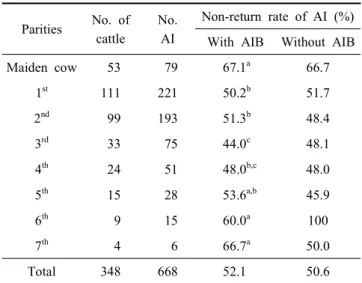
This study also evaluated the effect of parity number of cows on AI non return rate followed by administration of AIB and without AIB. To analysis non-return rate of AI according to parity number, total 348 dairy cows from maiden to 7

th

parities were inseminated with AIB and without AIB. Non-return rate did not differ between with and without AIB groups (52.1%

vs. 50.6%). However, AIB AI non return rates were lower in 3

rd

and 4

th

parities within AIB group. This variation in non- return rates within AIB AI group might be affected by body

Table 1. Comparison of AI rate using AIB with traditional AI accor- ding to farms

Farms No. of cattle

No. of AI (Average AI

no./cattle)

Non-return rate of AI (%) With AIB Without AIB

A 45 81 (1.8) 55.6

b

55.4

b

B 36 67 (1.9) 53.7

b

50.7

b

C 38 51 (1.3) 74.5

a

83.3

a

D 66 126 (1.9) 52.4

b

45.0

b,c

E 56 108 (1.9) 51.9

b

53.9

b

F 66 124 (1.9) 53.2

b

44.4

b,c

G 41 111 (2.7) 36.9

c

51.2

b

Total 348 668 (1.9) 52.1 50.6

* Values with different superscript in the same column were

denoted significantly different (p<0.05).

(4)

Table 2. Effect of parities numbers on the non-return rate of AI with AIB

Parities No. of cattle

No.

AI

Non-return rate of AI (%) With AIB Without AIB

Maiden cow 53 79 67.1

a

66.7

1

st

111 221 50.2

b

51.7

2

nd

99 193 51.3

b

48.4

3

rd

33 75 44.0

c

48.1

4

th

24 51 48.0

b,c

48.0

5

th

15 28 53.6

a,b

45.9

6

th

9 15 60.0

a

100

7

th

4 6 66.7

a

50.0

Total 348 668 52.1 50.6

* Values with different superscript were denoted significantly different (p<0.05).

condition of recipient cow instead of parity number. Although AIB could not affect the non-return rate of AI, AIB could be applied in the AI industry for obtaining higher female off-spring.

2. Determination of Deposition Place of AIB

In conventional AI system, the semen is generally deposited into the uterine body or cervix, but AIB must be deposited in the 2

nd

to 4

th

cervix of uterus instead of uterine body. To determine which place is better to deposit the AIB, AIB was deposited into the 2

nd

to 4

th

cervix of uterus and uterus body as shown in Fig. 3 and Fig. 4. To setting of AIB gun, AI sheath have to insert in the AIB gun and then connected with a 5 ml syringe and AIB was loaded into the AI sheath by pulling the syringe. AIB was deposited as semen deposited by conventional AI method except AIB solution was deposited into the 2

nd

to 4

th

cervix of uterus or uterine body. After 15 min of AIB deposition, AI was conducted with conventional

Fig. 4. Setting of AIB gun and procedure of AIB into the 2

nd

to 4

th

cervix of uterus.

AI techniques, except of deposition place either the 2

nd

to 4

th

cervix of uterus or uterine body.

Female offspring was produced significantly higher in 2

nd

to 4

th

cervix than that in uterine body (77.7%, 115/148 vs. 59.6%, 31/52, p<0.05). Although the number of uterine body group was not enough, the trend of female offspring production was much higher in 2

nd

to 4

th

cervix AIB deposition group than that in uterine body group. It mean that AIB must be de- posited into the 2

nd

to 4

th

cervix of uterus, not in the uterine body and also deposited the semen in same place, just cervix instead of uterine body. AIB can be changed the condition of cervix to reduce the viability of male spermatozoa and then increase the female viability, which could affect the fertiliza- tion of oocyte with female spermatozoa. AIB gun need to AIB deposition in the cervix of uterus exactly, because AI sheath is too weak and flexible to control it without any guide as AIB gun. When AI sheath use for AIB deposition, AI with AIB was failed to do it, because of broken the AI sheath or could not control AI sheath by myself. Taking all together the pre- sent study concluded that AIB should be deposited in the 2

nd

to 4

th

cervix of uterus and semen should also be deposited in the same place for desired female sex ratios.

3. Optimization of Deposition Volume of AIB

To optimize AIB deposition volume 2, 5, and 10 ml AIB solution were deposited into the 2

nd

to 4

th

cervix of uterus.

Female offspring ratio was significantly higher in 5 and 10 ml AIB volume than that in 2 ml AIB deposition (Table 4). Two ml volume AIB was not enough to spread out into the uterine cervix, but 5 and 10 ml AIB volume were enough to expose the AIB on the cervix. It means that 5 to 10 ml of AIB volume is better than that of 2 ml AIB volume. Moreover, considering cost of AIB, 5 ml is much cheaper than 10 ml.

Table 3. Effect of deposit place on the sex ratio of offspring after AI with AIB

Deposition place

No. of offspring (%)

Female Male Total

2

nd

to 4

th

cervix 115 (77.7)

a

33 (22.3) 148 Uterus body 31 (59.6)

b

21 (40.4) 52

Total 146 (73.0) 54 (27.0) 200

*Values with different superscripts were significantly different

(p<0.05).

(5)

Table 4. Effect of deposition volume of AIB on the sex ratio of offspring

AIB volume (ml)

No. of offspring (%)

Female Male Total

2 14 (51.8)

b

13 (48.2)

a

27

5 42 (77.7)

a

12 (22.3)

b

54

10 23 (76.7)

a

7 (23.3)

b

30

Total 79 (71.2) 32 (28.8) 111

*Values with different superscripts were significantly diffe- rent (p<0.05).

This study concluded that deposition of 5 ml AIB will increase female calf ratios.

4. Optimization of Exposure Time of AIB

To determine the best exposure time of AIB in the cervix, AI was conducted after 5, 10 and 15 min of AIB exposure time. AIB was deposited into uterus cervix with 5, 10 and 15 min before conventional AI. As shown in Table 5, female off- spring rate in 10 and 15 min exposure time were significantly better than that in 5 min (79.2%, 77.2% vs. 63.2%, p<0.05).

Therefore, a 10 minute exposure time was enough to change the cervix condition. This means that AI must be conducted after 10 min of AIB deposition because a 10 minute exposure time will change the condition of cervix. If exposure time was less than 10 minutes, the female offspring ratio decreased significantly compared to that of 10 or 15 min exposure time.

AI with AIB can increase the female offspring ratio following the exact procedure asdescribed previously with an AIB vo- lume of over 5 ml; and exposure time of at least 10 min. As shown in Fig. 5, the AI with AIB system produced lots of

Table 5. Effect of exposure time on the sex ratio of offspring Exposure time

(min)

No. of offspring (%)

Female Male Total

5 10 (52.6)

b

9 (47.4) 19

10 38 (79.2)

a

10 (20.8) 48

15 17 (77.2)

a

5 (22.8) 22

Total 65 (73.0) 24 (27.0) 89

*Values with different superscripts were significantly diffe- rent (p<0.05).

Fig. 5. Production of female offspring using AIB.

female offspring. This system can be applied in the breeding system to produce the highest quality female Hanwoo cows.

AIB is a new female offspring production technology that can be applied in the elite female cow system. However, many fe- male dairy cows must also be produced to overcome the insu- fficient milk production and bring down the price dairy pro- ducts. AIB can also be applied to the dairy cow industry since it can produce approximately 80% female offspring in com- bination with conventional AI system.

REFERENCES

Abeydeera LR, Johnson LA, Welch GR, Wang WH, Boquest AC, Cantley TC, Rieke A and Day BN. 1998. Birth of piglets preselected for gender following in vitro fertilization of in vitro matured pig oocytes by X and Y chromosome bearing spermatozoa sorted by high speed flow cytometry.

Theriogenology 50:981-988.

Agrawala PL, Wagner VA and Geldermann H. 1992. Sex determination and milk protein genotyping of preimplanta- tion stage bovine embryos using multiplex PCR. Therio- genology 38:969-978.

Avery B, Bak A and Schmidt M. 1989. Differential cleavage rates and sex determination in bovine embryos. Therioge- nology 32:139-147.

Bredbacka P, Kankaanpää A and Peippo J. 1995. PCR-sexing of bovine embryos: A simplified protocol. Theriogenology 44:167-176.

Cerchiaroa I, Cassandroa M, Dal Zottoa R, Carniera P and

Gallo L. 2007. A field study on fertility and purity of sex-

sorted cattle sperm. J. Dairy Sci. 90:2538-2542.

(6)

Cran DG, Johnson LA, Miller NG, Cochrane D and Polge C.

1993. Production of bovine calves following separation of X- and Y-chromosome-bearing sperm and in vitro fertili- zation, Vet. Rec. 132:40-41.

Itagaki Y, Kimura N, Yamanaka M and Sutou S. 1995. Deve- lopmental rate differences and sex of bovine preimplanta- tion embryos generated in vitro. J. Mamm. Ova. Res. 12:

73-78.

Itagaki Y, Kimura N, Yamanaka M, Muneta Y and Sutou S.

1996. PCR sexing and survival following embryo biopsy- bisection of in vitro produced bovine embryos. J. Mamm.

Ova. Res. 13:48-51.

Iwaskai S and Nakahara T. 1990. Cell number and incidence of chromosomal anomalies in bovine blastocysts fertilized in vitro followed by culture in vitro or in vivo in rabbit oviducts. Theriogenology 33:669-675.

Johnson LA. 1991. Sex preselection in swine: altered sex ratios in offspring following surgical insemination of flow sorted X- and Y-bearing sperm. Reprod. Domest. Anim.

26:309-314.

Kim YJ, Chong GN, Lee HL, Cho SW, Kim YS and Yu IJ.

2000. Sex determination of biopsied Hanwoo embryos by polymerase chain reaction and embryo transfer with sexed blastocysts. Korean J. Emb. Tras. 15:219-230.

Kim YJ, Lee CM, Chong GN, Lee HL, Cho SW, Kim YS, Shin DS, Hong YM and Yu IJ. 2003. Embryo transfer with sex-determined Hanwoo embryos produced by in-vitro ferti- lization. Korean J. Emb. Trans. 18:97-108.

King WA. 1984. Sexing embryos by cytological methods. The- riogenology 21:7-17.

Kudo T, Sato S and Sutou S. 1993. Sexing of bovine embryos with male-specific repetitive DNA by polymerase chain reac- tion: Cloning and characterization of bovine male specific repetitive DNA. Reprod. Dev. 39:55-63.

Lee SY, Yang BK and Kim CI. 1987. Study on the sex-ratio of fast- and slow-developing mouse embryo. Korean J. Anim.

Reprod. 11:218-222.

Park YI, Im KS, Han JY, Nam KW, Hwang KC and Park HC.

1996. Studies on isolation of Y-specific DNA marker and development of monoclonal H-Y antibody for embryo sexing in rabbit. Ⅱ. Sex determination of rabbit embryo by PCR amplified Y-specific DNA. Korean J. Anim. Reprod. 20:

89-99.

SAS Institute. 2002. User's Guide: Statistics. SAS Inst., Inc., Cary, NC. USA.

Sohn SH, Park CS and Song SH. 1996. Sexing by the chro- mosome analysis of in vitro fertilized embryos in cattle.

Korean J. Anim. Reprod. 20:179-190.

Tubman LM, Brink Z, Suh TK and Seidel GE Jr. 2004. Cha- racteristics of calves produced with sperm sexed by flow cytometry/cell sorting. J. Anim. Sci. 82:1029-1036.

Utsumi K, Hayashi M, Takakura R, Utaka K and Iritani A.

1993. Embryo sex selection by a rat male-specific antibody and the cytogenetic and developmental confirmation in cattle embryos. Mol. Reprod. Dev. 34:25-32.

Wheeler MB, Rutledge JJ, Fischer-Brown A, VanEtten T, Ma- lusky S and Beebe DJ. 2006. Application of sexed semen technology to in vitro embryo production in cattle. The- riogenology 65:219-227.

Williams TJ. 1986. A technique for sexing mouse embryos by a visual colorimetric assay of the X-linked enzyme, glu- cose-6-phosphate dehydrogenase. Theriogenology 25:733-739.

Yu IJ, Kim YJ and Lee KK. 1999. Sex determination of bo- vine embryos with hamster H-Y antibody and by polyme- rase chain reaction. Korean J. Vet. Res. 39:189-203.

( 접수: 2011. 11. 28 / 심사: 2011. 11. 29 / 채택: 2011. 12. 7)

수치

Fig.  2.  Diagram  and  photograph  of  AIB  gun  and  its  assembly.
Fig.  3.  Procedure  of  AIB  deposition  into  the  cervix  and  conven- conven-tional  AI  in  cow.
Table  2.  Effect  of  parities  numbers  on  the  non-return  rate  of  AI  with  AIB Parities No
Table  4.  Effect  of  deposition  volume  of  AIB  on  the  sex  ratio  of  offspring

참조

관련 문서