* Corresponding author : Sang Moo Lee, Department of Animal Science, Kyungpook National University, Sangju 742-711. Korea. Tel:
+82-54-530-1224. E-mail: [email protected]
Effects of Mixed Application of Chemical Fertilizer and Liquid Swine Manure on Agronomic Characteristics, Yield and Feed Value of Sorghum ×
Sudangrass Hybrid for Silage in Paddy Field Cultivation
Joo Hwan Hwang and Sang Moo Lee*
Department of Animal Science, Kyungpook National University, Sangju 742-711, Korea
ABSTRACT
This study was conducted to investigate the influence of the mixed application of chemical fertilizer (CF) and liquid swine manure (LSM) on the agronomic characteristics, dry matter yield, amino acids, minerals, and free sugars in cultivating Sorghum x Sudangrass hybrid (SSH) on paddy soil. The field experiment was designed in a randomized block design with three replications and consisted of CF 100% (C), CF 70% + LSM 30% (T1), CF 50% + LSM 50% (T2), CF 30% + LSM 70% (T3), and LSM 100%
treatment (T4). The application of LSM was based solely on the nitrogen. Plant length, leaf length, leaf width and number of leaf were significantly higher in T4 (p<0.05), but stem diameter did not show significant differences among treatments. Stem hardness increased significantly (p<0.05) as the LSM application rate decreased, but sugar degree decreased significantly (p<0.05) as the LSM application rate decreased. Fresh yield, dry matter yield and TDN yield were the highest in T4, whereas the lowest in T2 (p<0.05). Crude protein, crude fat and crude ash were the highest in C, T4 and T2, respectively (p<0.05). However, NDF and ADF did not show significant difference among treatments. Crude fiber decreased significantly (p<0.05) as the LSM application rate increased. The total mineral content was decreased significantly (p<0.05) as the LSM application rate increased. Total amino acid content was higher in the order of T1> C> T3> T4> T2 (p<0.05). Free sugar content increased significantly (p<0.05) as the LSM application rate increased. The analysis of all the above results suggests that the application of liquid swine manure is very effective, considering the yield performance and the content of sugar degree and free sugar. In addition, liquid swine manure may be possible to grow Sorghum × Sudangrass hybrid without chemical fertilizer.
(Key words : Sorghum × Sudangrass hybrid, Manure, Yield, Mineral, Amino acid and free sugar)
Ⅰ. INTRODUCTION
Many researches are being carried out in various ways in many countries around the world including Korea to use animal manure as resources and fertilizers. More researches are called upon as the use of animal manure is emphasized as an alternative that can lead to sustainable and organic livestock production through reduced chemical fertilizer and cyclic farming (Lim et al., 2006). In recent years especially, consumers are more interested in eco-friendly and organic livestock products, and government also is focusing the direction of future livestock development on the high quality eco-friendly livestock products (Lee and Jeon, 2004).
Therefore, the production of organic forage crops will play the greatest role in the production of future eco-friendly and organic livestock products, thus the use of cattle feces
and urine is expected to increase. For these reasons, lot of studies are being carried out domestically on the cultivation of forage crops using animal manure (Lee et al., 1995;
Ryoo and Jacob, 1997; Shin et al., 1998a; Seo et al, 2000;
Lim et al. 2003; Yook and Choi, 2005; Na et al, 2006), and on the effects of the animal manure on soil environment (Shin et al., 1998b; Lee and Jeon, 2004; Lim et al., 2007;
Kim et al., 2008; Yang et al., 2008;). Their studies,
however, mostly on the growth of forage crops and on the
soil by the application of animal manure, and most
researches were conducted on upland soil. However, this
research was carried out to investigate the influence of the
mixed application of chemical fertilizer and liquid swine
manure on the productivity, amino acids, minerals, and free
sugars in Sorghum × Sudangrass hybrid for silage on paddy
soil, and to provide the results as basic data for mixing
Treatments Mixing ratio of fertilizer types
CF (%) LSM (%)
C 100 0
T1 70 30
T2 50 50
T3 30 70
T4 0 100
Table 1. Experimental design
Table 2. Chemical properties of the soil before experiment
pH OM T-N Av. P
2O
5Ex. cation (cmol
+kg
-) CEC
(1:5) (%) (%) (mg/kg) K Na Ca Mg (cmol
+kg
-)
6.41 2.39 0.15 81.58 0.56 0.13 3.67 0.95 11.5
pH T-N (%) Av.P
2O
5(%) K
2O (%)
7.8 0.45 0.25 0.39
Table 3. Chemical characteristics of used liquid swine manure
liquid swine manure and chemical fertilizer to cultivate of forage crops on paddy soils in the future.
Ⅱ. MATERIALS AND METHODS
This field experiment was performed at a paddy field in the northwestern inland of Gyeongbuk, Korea. Especially, the experiment paddy field was on low-lying land. In order to solve this problem, drainage made 50 cm depth along the circumference of the field experiment to prevent flooding in rainy season. The field experiment was designed in a randomized complete block design of 3 repetitions with chemical fertilizer 100% treatment (C), chemical fertilizer 70% + liquid swine manure 30% treatment (T1), chemical fertilizer 50% + liquid swine manure 50% treatment (T2), chemical fertilizer 30% + liquid swine manure 70% treatment (T3), and liquid swine manure 100% treatment (T4) (see Table 1).
The conditions of the field experiment were a paddy field with higher organic matter and nitrogen content and lower phosphate content than the general upland soil as shown in Table 2.
The cultivated variety used in this experiment was P877F.
Sowing was May 30 and harvest time was August 20 in 2009. Nitrogen, phosphorus and potassium components of using liquid swine manure were 0.45, 0.25 and 0.39%, respectively (Table 3).
The application rates of chemical fertilizer were calculated in total nitrogen (200 kg/ha), phosphorus (150 kg/ha) and potassium contents (200 kg/ha) (see Table T4). The method of chemical fertilizer application was applied nitrogen and potassium with 60% as basis of fertilizer, and 40% as added fertilizer; and entire phosphorus as the basis fertilizer.
Application rates of liquid swine manure were calculated in total nitrogen contents.
The LSM was also applied as much as 60% as the basis of fertilizer, and 40% as add fertilizer. Adding fertilizer was applied 35 days after seeding. The planting distance was 50 cm × 5 cm and each plot was 15 m
2(3 × 5 m). For the investigation items and methods, the growth characteristics were observed 10 sampling 10 which is the most averaged plants for each repetition after cutting the central 2 rows of 6 rows. Sugar degree was measured by a PR-101 saccharimeter for extracted the juice at 20 cm from cutting point. Stem hardness was measured by KM spring gradiometer from the part 10 cm away from the cutting.
Fresh yield was calculated after cutting of the two central rows. All dry matter rates were calculated by oven drying the samples at 65℃ for more than 4 days. Dried samples were ground and stored under vacuum to use as analysis.
TDN yields were calculated using the formula by Holland et al. (1990).
TDN dry matter yield = [88.9-(0.779 × ADF)] × Dry matter yield per ha.
Nutritive values were analyzed using the AOAC method
(1995), ADF and NDF were analyzed by Goering and Van
Soest method (1970). The mineral composition was analyzed
from the pre-treated samples using ICP (Inductively Coupled
Plasma, Iris Intrepid, Thermo Elemental Co., UK). The
Table 5. Effects of LSM application ratio on agronomic characteristics and yield of SSH in the paddy field
Items Treatments
C T1 T2 T3 T4
Plant length (cm) 264.2
b263.5
b249.3
b261.5
b301.0
aLeaf length (cm) 83.3
b84.2
b78.8
c85.7
ab89.0
aLeaf width (cm) 4.4
b4.6
b3.8
b4.5
b6.7
aNumber of leaf (No.) 8.8
ab8.3
ab7.8
b9.2
a9.3
aStem diameter (Cm) 0.8
ns0.8 0.7 0.8 0.9
Stem hardness (kg/cm
2) 2.8
a2.8
a2.1
b2.0
b1.9
bSugar degree (B
o) 6.2
b7.7
b6.7
b7.7
b9.9
aFresh yield (kg/ha) 54,080
c50,976
d47,347
d58,119
b65,711
aDry matter yield (kg/ha) 12,920
c12,115
c10,786
d15,518
b18,373
aTDN yield (kg/ha) 6,602
c6,191
c5,663
d8,069
b10,032
ans : not significant.
a, b, c, dMeans in a row with different superscripts are significantly different (P<0.05).
Table 4. The application amount of CF and LSM
Treatments
Application levels of N, P, K
CF (kg/ha) LSM (kg/ha)
N P K N P K
C (CF
1)100%) 200 150 200 0 0 0
T1 (CF 70% + LSM
2)30%) 140 105 140 60 33 52
T2 (CF 50% + LSM 50%) 100 75 100 100 56 87
T3 (CF 30% + LSM 70%) 60 45 60 140 78 121
T4 (LSM 100%) 0 0 0 200 111 173
CF1): Chemical fertilizer, LSM2): Liquid Swine Manure.
analysis of composition amino acid was done in the following sequence: 1 g of the pulverized sample was precisely taken and put in to a test tube; 10 mL of 6N-HCl was added, pressure reduced and sealed; hydrolysis at 110
℃ in a dry oven for 24 hours; pre-treated and filtered by 0.45 μm membrane filter; and the filtered sample was analyzed by amino acid automatic analyzer (Biochrom 30, Biochrom Ltd, Cambridge, England). Free sugar was analyzed in the following order: exactly 5 g of sample was taken by Wilson method (1981); 100 mL of 80% ethanol solution was added; sugar composition was extracted repetitively for 2 hours at 80℃ from the heating mantle in the reflux cooling extraction unit; filtered by Whatman No.
5 and pre-treated; and was analyzed with HPLC analyzer (Waters 2414, Waters Co, USA) respectively. All data were analyzed using the general linear model (GLM) procedure of SAS (2002). Differences among treatment means were
determined using the Duncan’s multiple range test. A probability level of p<0.05 was considered to be statistically significant.
Ⅲ. RESULT ANA DISCUSSION 1. Growth characteristics and dry matter yield
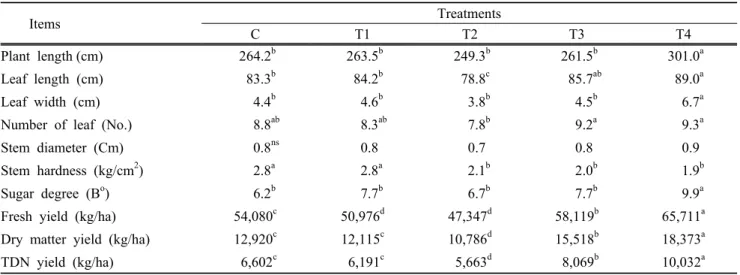
The growth characteristics and dry matter yield are
shown in Table 5. Plant length, leaf length, leaf width and
number of leaf of SSH were the highest in T4 (p<0.05),
but stem diameter was no significant differences among the
treatments. Stem hardness shown higher in the order of C,
T1 > T2 > T3 > T4 (p<0.05). Sugar degree (in stem
portion) was significant improvement in the T4 with LSM
compared to C with chemical fertilizer only (p<005), but
there were no significant differences among the treatments
Table 6. Effects of LSM application ratio on chemical compositions of SSH in the paddy field (DM.%)
Items Treatments
C T1 T2 T3 T4
Crude protein 5.7
a5.6
a4.9
b5.2
b5.0
bCrude fat 1.6
c1.6
c1.9
b1.9
b2.3
aCrude ash 5.9
bc6.1
b6.5
a5.7
c4.4
dNDF 70.7
ns69.7 70.4 69.4 68.5
ADF 47.3
ns47.9 46.1 46.7 44.4
Crude fiber 41.1
a40.3
a39.8
ab38.5
bc38.0
cns : not significant.
a, b, c, dMeans in a row with different superscripts are significantly different (p<0.05).
(C, T1, T2 and T3). Lee (2012b) reported that sugar degree was increased according to increasing of the LSM application. On the other hand, Seo et al. (2002) reported that sugar was decreased according to increasing of the LSM application.
Fresh yield, dry matter yield and TDN yield were shown higher in the order of T4> T3> C> T1> T2 treatments (p
<0.05), especially higher in T4 and T3 treatments which was applied more LSM compared to C, T1 and T2. These results have the same trend as the studies by Lee (2012), Lim, et al. (2003), Choi and Yook (2000), and Lim, et al.
(2006).
On the effect of application of LSM compared to CF, Jin et al. (1996) claimed that the animal manure application increased maize production by the chemical improvement of soil. Pain et al. (1986), Long and Gracey (1990) and Lee (2012b) reported that the application of low concentration LSM during drought periods at high temperature increased the production of forage crops because it reduced moisture stress owing to the supply of a large amount of water in addition to the fertilizer effect. Since we applied the LSM at time of drought, we can infer that LSM application at the time of SSH seeding and growing might enhance SSH growth and yield by reducing moisture stress.
2. Chemical compositions
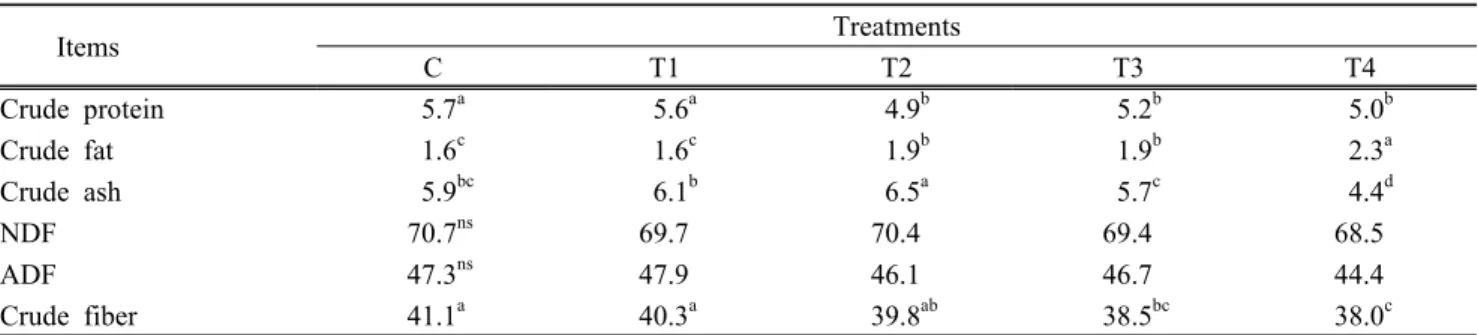
The chemical compositions are shown in Table 6. Crude protein content showed the highest content of 5.7% in C treatment, while the lowest 4.9% in T2 treatments (p<0.05).
This study showed similar to the result of Lim et al.
(2003) and Na et al. (2006) in maize cultivation, and Park
et al. (2006) in rye cultivation, all of whom reported reduced content of the crude protein with the application of LSM (N application is same as the chemical fertilizer) compared to the treatments with the CF only. The crude fat tended to significantly increase with the increase of the LSM compared to the CF (p<0.05). Crude ash showed significantly higher content in T2 compared to the other treatments. NDF and ADF contents did not show significant differences among treatments. Crude fiber shown higher in the order of C > T1 > T2 > T3 > T4 (p<0.05). Shin et al. (1999b) reported the increase in the contents of NDF and ADF according to the increase of LSM application, but Lim et al. (2003) claimed the slight decrease.
3. Mineral contents
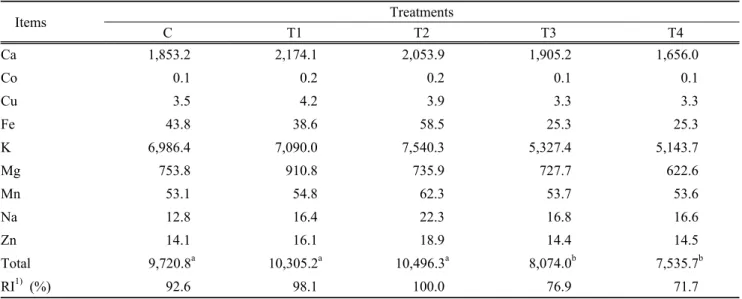
The mineral contents are shown in Table 7. The mineral contents of all treatments were higher in the order of K >
Ca > Mg. It is consistent with the report of Kim et al.
(2012b). The mineral contents showed K > Ca > Mg > Mn
> Fe in order, and the total content of the three minerals (K + Ca + Mg) accounted for 97% or more of the total mineral contents (Jeon et al. 2012; Lee and Lee, 2010; Lee, 2012ab; Lee and Kim, 2013). Ca content of C, T1, T2 and T3 showed similar, but tended a little decreasing in T4. Co and Cu contents appeared a very small trace mineral amount. Fe, Mn, Na and Zn were higher in T2 treatments.
K content was higher in the order of T2 > T1 > C > T3
> T4, Mg was T1 > C > T2 > T3 > T4 respectively.
Total mineral content showed the highest in T2 (10,496.3
mg/100g), while T4 treatment showed the lowest of 7,535.7
mg/100g. The total mineral content was higher in CF and
Table 7. Effects of LSM application ratio on mineral contents of SSH in the paddy field cultivation (DM. mg/100g)
Items Treatments
C T1 T2 T3 T4
Ca 1,853.2 2,174.1 2,053.9 1,905.2 1,656.0
Co 0.1 0.2 0.2 0.1 0.1
Cu 3.5 4.2 3.9 3.3 3.3
Fe 43.8 38.6 58.5 25.3 25.3
K 6,986.4 7,090.0 7,540.3 5,327.4 5,143.7
Mg 753.8 910.8 735.9 727.7 622.6
Mn 53.1 54.8 62.3 53.7 53.6
Na 12.8 16.4 22.3 16.8 16.6
Zn 14.1 16.1 18.9 14.4 14.5
Total 9,720.8
a10,305.2
a10,496.3
a8,074.0
b7,535.7
bRI
1)(%) 92.6 98.1 100.0 76.9 71.7
RI : relative index.
a, bMeans in a row with different superscripts are significantly different (p<0.05).
mixed CF + LSM treatments (C, T1, T2) than the LSM treatment (T4), and tended to decrease significantly according to the increased application of the LSM (p<0.05).
This result showed the same trend as Shin et al. (1998b, 1999a), who reported that the silage corn and rye of the CF treatment showed the highest contents of K, Ca, and Mg compare to the LSM treatment (as the basis of nitrogen 160∼200 kg/ha).
4. Composition amino acid contents
The composition amino acid contents are shown in Table 8. Leucine showed the highest and histidine content was the lowest essential amino acids at all treatments. The content of the total essential amino acids was the highest in T1 treatment, but lowest in T2 treatment (p<0.05). Among non-essential amino acids, aspartic acid showed the highest content, and tyrosine content was the lowest in all treatments. Total non-essential amino acid was the highest in T1 treatment (p<0.05). The total amino acid content was in the range of 3,668.9~4,336.6 mg/100g according to mixed ratio of the chemical fertilizer and liquid swine manure.
This experiment was the highest content of total amino acids in T1 treatment, which showed the highest content both in essential and non-essential amino acids (p<0.05).
The reason of the highest content of the total amino acid
in the T1 is thought to be attributable to the significantly higher content of crude protein in T1, as shown in Table 6. Kim et al. (2012b) reported that silage corn varies in the content of the amino acid of 3,653.0~5,433.1 mg/100g, and Do et al. (2012) reported that silage corn, P32W86 has 3,831.0 to 4,480.8 mg/100g according to the harvest time.
Jeon et al. (2012) reported that SSH varies in content of the amino acid of 2,324.7∼3,908.2 mg/100g.
Therefore, the amino acid content is considered to vary depending on the varieties, cultivation management and climatic conditions. Chiang et al. (1972) analyzed some species of concentrated feedstuff, and Kim et al. (2012a) studied on the amino acid content of some kinds of barley, both researchers reported that high amino acid contents were related to high crude protein contents.
5. Free sugar contents
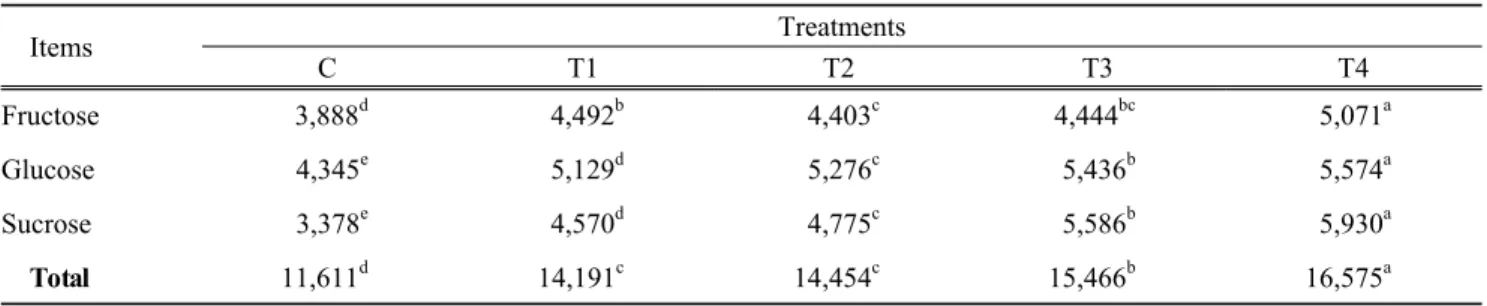
The free sugar contents are shown in Table 9. Free sugar analysis revealed three sugars of fructose, glucose and sucrose in the SSH. The content of fructose, glucose and sucrose was higher in the treatments (T1, T2, T3 and T4) with the mixed application of chemical fertilizer and liquid swine manure compared to the C treatment of 100%
chemical fertilizer (p<0.05). Especially, fructose, glucose and
sucrose contents were very high in the T4 treatment
Table 9. Effects of swine slurry application ration on free sugar contents of silage corn hybrid in the paddy field (DM. mg/100g)
Items Treatments
C T1 T2 T3 T4
Fructose 3,888
d4,492
b4,403
c4,444
bc5,071
aGlucose 4,345
e5,129
d5,276
c5,436
b5,574
aSucrose 3,378
e4,570
d4,775
c5,586
b5,930
aTotal
11,611
d14,191
c14,454
c15,466
b16,575
aa, b, c, d, e
Means in a row with different superscripts are significantly different (p<0.05).
Table 8. Effects of LSM application ratio on composition amino acid contents of SSH in the paddy field (DM.
mg/100g)
Items Treatments
C T1 T2 T3 T4
Threonine 166.4 191.3 157.4 168.6 165.6
Valine 274.6 295.4 261.6 280.8 248.3
Isoleucine 118.5 131.4 106.5 121.5 121.2
Leucine 324.2 319.4 271.4 292.5 329.3
Phenylalanine 228.0 257.5 228.5 250.5 229.5
Histidine 77.5 88.3 75.3 82.3 80.5
Lysine 258.7 282.6 231.7 255.8 241.6
Arginine 130.7 156.6 122.5 133.5 119.7
Sum of EAA 1,578.6b 1,722.5a 1,454.9b 1,585.5b 1,535.7b
Serine 211.3 234.8 192.4 217.6 194.5
Glutamic acid 485.6 516.5 465.3 527.4 515.4
Proline 287.6 378.8 331.3 265.5 369.6
Glycine 198.6 225.4 185.6 206.4 193.8
Alanine 279.4 308.7 273.3 304.2 300.6
Tyrosine 79.5 68.7 54.4 85.6 62.7
Aspartic acid 819.7 881.2 711.7 657.4 573.4
Sum of NEAA 2,361.7b 2,614.1a 2,214b 2,264.1b 2,210b
Total
(EAA+NEAA) 3,940.3b 4,336.6a 3,668.9b 3,849.6b 3,745.7b
EAA: Essential amino acids, NEAA: Non-essential amino acids.
a, bMeans in a row with different superscripts are significantly different (p<0.01).
(p<0.05).
Free sugar content in the silage corn is very important because it affects the fermentation quality of silage ingredients (Lee and Lee, 2010, Lee, 2012a). In particular, the free sugar content acts as a good factor enhancing the taste in fermentation products (palatability) (Son et al.,
2002). In addition, Jin et al. (1996) reported an increase of
lactic acid in a fully fermented cattle manure (20 ton/ha)
treatment compared with a standard chemical fertilizer
treatment at corn cultivation times, and mentioned the
feasibility of the silage quality improvement depending on
the amount and method of cattle manure application.
Ⅳ. ACKNOWLEDGEMENT
The research was supported by Kyungpook National University research Fund, 2010.
Ⅴ. REFERENCES
AOAC. 1995. Official Methods of analysis. 16th ed. Association of analytical chemist, Washington, DC., USA.
Choi, K.C. and Yook, W.B. 2000. The effects of the application rate of fermented swine manure and additional mineral fertilizer on productivity and nutritive value of corn for silage. Journal of the Korean Society of Grassland Science. 20(1):41-48.
Chiang, Y.H., Lee, C.Y., Kim, S.C., Lee, C.W., Kim, K.S. and Yoon, C.Y. 1972. Studies on amino acids in feed stuffs. Korean Journal of Animal Science. 14(3):224-229.
Do, G. H., Kim, E. J. and Lee, S.M. 2012. Effects of harvest stage on agronomic characteristics, yield and food value of silage corn in the newly reclaimed hilly land. Journal of the Korean Society of Grassland Science. 32(3):253-264.
Goring, H.K. and Van Soest, P.J. 1970. Forage fiber analysis. Agic.
handbook. No. 379. ARS. USDA. Washington DC.
Holland, C., Kezar, W., Kautz, W.P., Lazowski, E.J., Mahanna, W.C. and Reinhart, R. 1990. The pioneer forage manual; A nutritional guide. Pioneer Hi-Bred., Des Moines, IA.
Jeon, B.T., Moon, S.H. and Lee, S.M. 2012. A comparative studies on the growth characteristics and feed components of Sorghum × Sudangrass hybrids at paddy field cultivation. Journal of the Korean Society of Grassland Science. 32(1)
Jin, H.J., Yang, J.S., Kim, J.G. and Jeong, E.S. 1996. Effects of cattle manure application on the soil properties, yield performance and quality of silage corn cultivated on paddy land.
Journal of the Korean Society of Grassland Science. 16(1):81-86.
Kim, H.Y., Chu, G.M., Kim, S.C., Ha, J.H., Kim, J.H., Lee, S.D.
and Song, Y.M. 2012a. The nutritive value of grains from barley cultivars (Wooho, Youngyang, Yuyeon). Korean Journal of Agriculture and Life Science. 46(3):69-78.
Kim, W.S., Hwang, J.H., Lee, J.H., Kim, E.J., Jeon, B.T. and Lee, S.M. 2012b. A comparative study on the growth characteristics and nutritional components of corn hybrids for silage at paddy field cultivation. Journal of the Korean Society of Grassland Science. 32(1):15-28.
Kim, M.C., Song, J.Y., Hwang, K.J., Song, S.T. 2008. The effects of application of liquid swine manure on productivity of rye and subsequent soil quality. Journal of the Korean Society of Grassland Science. 28(2):81-88.
Lee, J.S., Jo, I.K., Ahn, J.H. and Kim, S.K. 1995. Application of animal excreta for forage production on uncultivated rice paddy.
Journal of the Korean Society of Grassland Science. 15(3):
175-185.
Lee, S.M. 2012a. Effects of ridging times on agronomic characteristics, yield and feed value of corn hybrid for silage in paddy field cultivation. Journal of the Korean Society of Grassland and Forage Science. 32(3):265-274.
Lee, S.M. 2012b. Effects of mixed application of chemical fertilizer and liquid swine manure on agronomic characteristics, yield and feed value of Corn hybrid for silage in paddy field cultivation.
Journal of the Korean Society of Grassland and Forage Science.
32(4):1-10.
Lee, S.M. and Jeon, B.T. 2004. Effect of chemical fertilizer and liquid manure application on the growth characteristics and feed value of corn for silage and NO3 of soil. Journal of the Korean Society of Grassland Science. 24(3):237-244.
Lee, S.M. and Lee, J.H. 2010. Effects of seeding dates and growth periods on the growth characteristics, dry matter yield and feed value of corn for silage in paddy field. Journal of Animal Science and technology. 52(5):441-448.
Lee, S.M. and Kim, E.J. 2013. Study on nutritive value of whole crop barley varieties growth in a paddy field. Journal of the Korean Society of Grassland and Forage Science. 33(1):30-38.
Lim, Y.C., Yoon, S.H., Kim, J.G., Kim, W.H., Kim, M.G., Shin, J.S., Chung, E.S., Lee, J.K., Shin, D.E., Cho, J.H., Yook, W.B.
and Park, G.J. 2003. Effect of application level of swine slurry on production and nutritive value rye. Journal of the Korean Society of Grassland Science. 23(4):293-298.
Lim, Y.C., Yoon, S.H., Kim, W.H., Kim, J.G., Shin, J.S., Jung, M.W., Seo, S. and Yook, W.B. 2006. Effects of livestock manure application on growth characteristics, yield and feed value of sorghum-sudangrass hybrid and NO3-N leaching in paddy field. Journal of the Korean Society of Grassland Science.
26(4):233-238.
Lim, Y.C., Yoon, S.H., Jung, M.W., Kim, W.H., Kim, J.G., Lee, J.K., Seo, S., Park, N.G. and Yook, W.B. 2007. Effect of livestock manure application on the productivity of whole crop rice, feed value and soil fertility. Journal of the Korean Society of Grassland Science. 27(4):287-296.
Long, F.N.J. and Gracey, H.I. 1990. Effect of fertilizer nitrogen source and cattle slurry on herbage production and nitrogen utilization. Grass and Forage Science. 45:431-442.
Na, H.C., Jung, M.W., Choi, Y.S., Choi, K.C. and Yook, W.B. 2006.
Studies on the types and rates of application of cattle slurry and swine manure fermented with sawdust on productivity of silage
corn and leaching of nutrients. Journal of the Korean Society of Grassland Science. 26(4):177-186.
Park, J.G., Kim, J.D. and Kwon, C.H. 2006. Effect of liquid manure source, application rate and time on agronomic characteristics and forage yield of winter rye. Journal of the Korean Society of Grassland Science. 26(4):227-232.
Pain, B.F., Smith, K.A. and Dyer, C.J. 1986. Factors affecting the response of cut grass to the nitrogen content of dairy cow slurry.
Journal of Agricultural Wastes. 17:189-202.
Ryoo. J.W. and Jacob, H. 1997. The effect of cattle slurry on the forage yield and grassland ecosystem. J. Kor. Grassl. Sci.
17(1):35-42.
SAS. 2002. SAS/ STAT user’s guide ver. 9.2 SAS Institute Inc., Cary, NC.
Seo, S., Kim, J.G., Chung, E.S., Kim, W.H. and Kang, W.S. 2002.
Effect of methods and rates of seeding on the forage production and nutritive value of sorghum × sudangrass hybrid grown under application of animal manure. Journal of the Korean Society of Grassland Science. 20(1):49-54.
Shin, D.E., Kim, D.A., Choi, H.L. and Song, K.C. 1999a. Studies on the liquid manure application for silage corn. Korean Joural of Soil and Fertilizer. 32(1):22-26.
Shin, D.E., Kim, D.A., Shin, J.S., Seo, S., Kim, W.H., Kim, J.G., Yook, W.B. and Chung, J.R. 1998a. Studies on the slurry application of winter rye. I. Agronomic characteristics, yield and nutritive value of winter rye. Journal of the Korean Society of Grassland Science. 18(3):235-242.
Shin, D.E., Kim, D.A., Shin, J.S., Song, K.C., Lee, J.K., Yun, S.H., Kim, W.H. and Kim, J.G. 1998b. Studies on the slurry application of winter rye. II. Effect of mineral content, nitrogen balance and environmental soil. Journal of the Korean Society of Grassland Science. 18(3):233-250.
Shin, J.S., Lee, H.H., Shin, D.E., Kim, J.G., Cho, Y.M., Yook, W.B.
and Ryoo, J.W. 1999b. Effects of daily liquid manure amount on silage corn productivity and soil chemical characteristics. Journal of the Korean Society of Grassland Science. 19(1):17-22.
Son, D.H., Kwon, O.J., Choi, U.K., Kwon, O.J., Lee, S.I., Im, M.H., Kwon, K.I., Kim, S.H. and Chung, Y.G. 2002. Taste characteristics of Kanjang made with barley bran. Korean.
Journal of Applied Biological Chemistry. 45(1):18-24.
Wilson, A.M., Work, T.M., Bushway, A.A. and Bushway, R.J. 1981.
HPLC determination of fructose, glucose and sucrose in potatoes.
Journal of Food Science. 46:300-306.
Yang, C.H., Lee, S.B., Kim, T.K., Ryu, J.H., Yoo, C.H., Lee, J.J.
and Kim, J.D. and Jung, K.Y. 2008. The effect of tillage methods after application of liquid pig manure on silage barley growth and soil environment in paddy field. Korean Joural of Soil and Fertilizer. 41(5):285-292.
Yook, W.B. and Choi, K.C. 2005. Effect of the degrees of slope and the types of animal manures on corn productivity and nutrient runoff in corn cultivation soil. Journal of the Korean Society of Grassland Science. 25(2):89-96.
(Received July 23, 2014 / Revised September 11, 2014 / Accepted September 17, 2014)