I. INTRODUCTION
Due to recent population aging, the population of senior citizen of prospect dental patients at the age of
65 or over has increased from 448 million in 2004 to 551 million in 2010, has risen by 22.99% for 6 years all over the world, on the domestic side, the population of senior citizens has been increased by about 60.83%
Journal of Radiological Science and Technology, 39(4), 651-660 eISSN 2384-1168 ISSN 2288-3509 http://dx.doi.org/10.17946/JRST.2016.39.4.23
<원저>
A Study on Development of Guideline on Writing Technical Document for Electrical Medical Devices: Dental X-ray Equipment
- 치과용엑스선장치의 기술문서 작성을 위한 가이드라인 개발 연구 -
Division of Medical Device Research, National Institute of Food and Drug Safety Evaluation, Ministry of Food and Drug Safety
Seung-Youl Lee・Jae-Ryang Kim・Jun-Ho Lee・Chang-Won Park
―Abstract ―
Due to recent population aging, the number of check-up for senior citizens has increased steadily. According to this trend, the market size of dental X-ray equipment and the number of approval and review for these de- vices have simultaneously increased. The technical document of medical device is required for approval and re- view for medical device, and medical device companies needs to have work comprehension and expertise, as the document needs to include the overall contents such as performances, test criteria, etc.. Yet, since most of domestic manufacturers or importers of medical devices are small businesses, it is difficult for them to recruit professional manpower for approval of medical devices, and submission of inaccurate technical documents has increased. These problems lead to delay of the approval process and to difficulties in quick entering into the market. Especially, the Ministry of Food and Drug safety (MFDS) standards of a dental extra-oral X-ray equip- ment, a dental intra-oral X-ray equipment, an arm-type computed tomography, and a portable X-ray system have been recently enacted or not. this guideline of dental X-ray equipment adjusting revised standards was developed to help relative companies and reviewers. For this study, first, the methods to write technical docu- ment have been reviewed with revised international and domestic regulations and system. Second, the domestic and foreign market status of each item has been surveyed and analyzed. Third, the contents of technical docu- ments already approved by MFDS have been analyzed to select the correct example, test items, criteria, and methods. Finally, the guideline has been developed based on international and domestic regulation, through close review of a consultative body composed of academic, industrial, research institute and government experts.
Key words : Dental X-ray equipment, Technical document, Specific standard of medical device, Medical device
This research was supported by a grant (16171MFDS307) from Ministry of Food and Drug Safety in 2016.
Corresponding author: Seung-Youl, Lee, 187 Osongsaengmyeong 2-ro, Heungdeok-gu, Cheongju-si, Chungcheongbuk-do, Korea(28159),
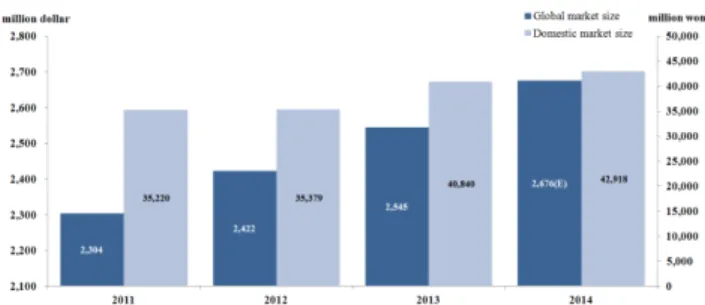
for the past 10 years from 3.37 million in 2000 to about 5.42 million in 2010 (Statistics korea, population and housing census)1). For this reason, The size of global medical device market has reached about 336.8 billion dollars in 2014, and the size of domestic medical device market has reached 5.02 trillion won during the same time2,3). The size of global market of dental X-ray equipment has CAGR (Compound Annual Rate Growth) 5.11% from 2011 as shown in Fig. 13-5), and the market size has reached about 2.68 billion dollars in 20144). The size of domestic market has reached 35.2 billion won in 2011 and about 42.9 billion won in 2014, and it is reported that the market will grow by about 21.88% every year3).
In accordance with the statistics of the number of approval by the Ministry of Food and Drug Safety (MFDS), the number of technical document approval has increased by about 85.98% for the past 3 years from 2,568 in 2012 to 4,776 in 2014; the number of technical document examination for manufacturing permit has reached 1,422, the number of technical document approval for import permit has reached 3,282, and the independent approval of technical document has reached 726). The technical document is an essential information to be attached for approval and review of medical devices, and as the overall items of relative medical devices shall be written under the regulations of medical devices, writer needs expertise7). However, since 91.16% of domestic importers and 83.92% of manufacturers are small businesses with the number of employ ees less than 20, it is
difficult for them to secure professional manpower to prepare the technical documents, and the increase of technical document inaccurately prepared has put more burden on reviewers8). Therefore, on this guideline (draft), the correct example of items for 13 technical documents in 4 sections of a dental extra-oral X-ray equipment, a dental intra-oral X-ray equipment, an arm-type computed tomography, and a portable X-ray system (hereinafter referred to as dental X-ray equipment) are provided, and the test criteria, items, and method are proposed to help petitioners to cite this guideline on writing the technical document of medical devices.
Ⅱ. MATERIALS AND METHODS
This study has been performed based on the promotion diagram as shown in Fig. 2.
At first, the domestic and foreign specifications of medical devices related to dental X-ray equipment have been studied, and the data already approved by MFDS have been compared and analyzed to prepare the guideline (draft). Thereafter, through the review of a consultative body composed of academic, industrial, research institute and government experts, the internationalized guideline (draft) on writing the technical document of X-ray device for dental clinic for domestic circumstances has been developed.
Fig. 2 Research strategy to develop guideline on writing the technical document for the dental X-ray equipment Fig. 1 Global and domestic market size of the dental X-ray
equipment during the period 2011-2014 (Global Data, MFDS)
1. Research of international and domestic standards
To develop the scientific and international-harmonized test criteria, the international and domestic standards have been surveyed; the international standards (IEC 60601-1, IEC 60601-1-2, IEC 60601-1-3, IEC 60601-2-63, etc.) enacted by IEC (International Electrotechnical Commission) and domestic regulations (Medical Device Act, Regulation on Approval · Declaration · Review of Medical Devices, the General Standard and Specifications on Electrical and Mechanical Safety of Medical Devices, and the General Standard and Specifications on Safety of Electromagnetic Wave of Medical Devices) enacted by MFDS.
2. An analysis of approved technical documents For the guideline suitable for domestic circumstances, the approved licenses and technical documents during the period (2010-2015) have been collected and analyzed through the approval administration system of MFDS. The contents of the technical documents by each company used in common have been drawn on this guideline.
3. Preparation of guideline and operation of expert consultation body
Based on the analytic data of technical document already approved and the study of international and domestic standards, the initial guideline (draft) has been prepared, and the guideline has been developed through close review of a consultative body composed of academic, industrial, research institute and government experts.
Ⅲ. RESULT AND DISCUSSION
1. A study of domestic and foreign standards and selection of performance test
The specific standard related to dental X-ray
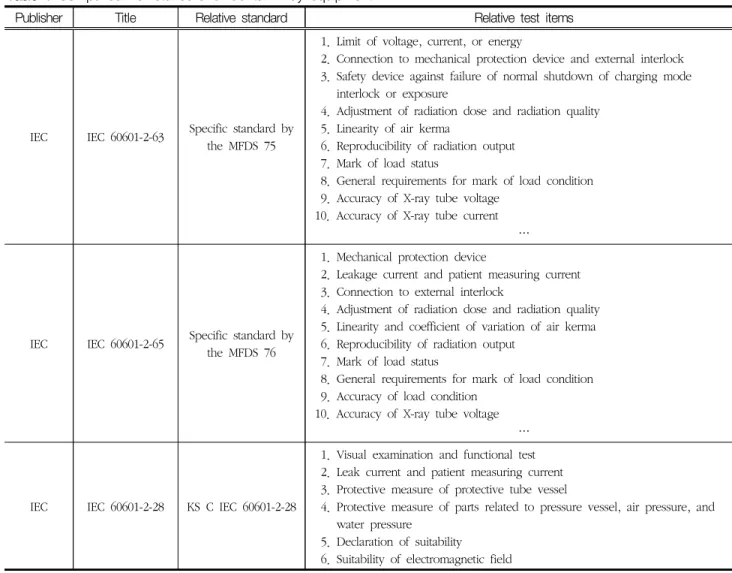
equipment are shown in Table 1. The specific standard of dental intra-oral X-ray equipment and dental extra-oral X-ray equipment have been enacted by MFDS in August 2016, and while the domestic KS standard of arm-type computerized tomographic scanning device based on the IEC standards (IEC 60601-2-54, IEC 60601-2-63 and IEC 60601-2-65) has been prepared, but it's not reflected to MFDS standard. Thus it is need to develop the guideline instructing the correct example, test items, criteria, and methods based on recent acted domestic standard regulations, to help companies under difficulties of preparing technical documents.
2. Comparison of performance test item under approved technical documents To study the application of performance test in each item of dental X-ray equipment, the item of performance test by each manufacturer and importer with approval have been compared and analyzed.
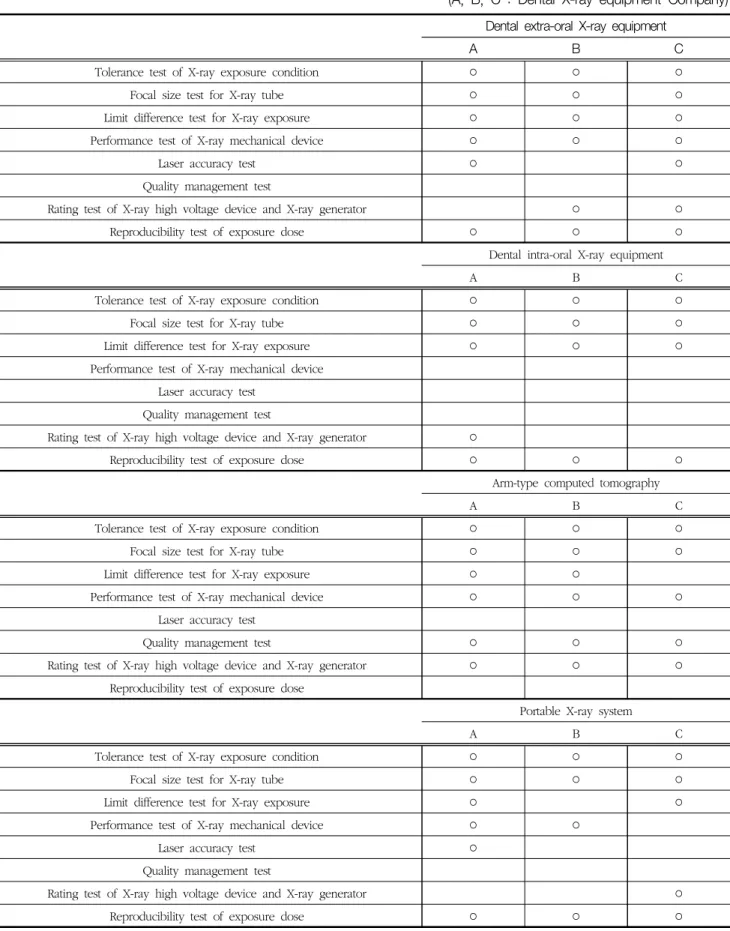
Table 2 shows the arrangement of performance test item by selecting 3 companies in each item, and while most of items comply, some items have been different among manufacturers because each company claims to stand for different performance from the same item and because each manufacturer certifies its own performance.
Most companies include the tolerance test of X-ray irradiation condition, the focal size test of X-ray tube, and the X-ray irradiation field limit difference test in four items of dental X-ray equipment, and many companies are performing the performance test of X-ray mechanical device, the rating test of X-ray high voltage device and X-ray generator, and recurrence test of irradiation dose. The performance test items to be selected by most firms through the analysis of such test item are IEC 60601-2-639), IEC 60601-2-6510), specific standard of medical devices by the MFDS 8. X-ray equipment for radiography , 75.
dental extra-oral X-ray equipment, and 76. dental intra-oral X-ray equipment, and the companies are selectively using them.
3. Development of guideline
This guideline of writing technical document is composed of title (product title, model title), category number (class), feature and structure (operation principle, external appearance, dimension, property), raw material, manufacturing method, purpose of use (performance), usage method, caution in use, packing unit, storage and term of use, and test criteria, and each item has been developed under the Article 8~18 of the 「Regulation on Approval · Declaration · Review of Medical Devices」. Moreover, each item has been developed by referring the correct examples through the analysis of approved technical documents, and the opinions of consultants and reviewers of expert consultive body have been reflected for civil petitioners to comprehend the examination criteria and to
prepare the documents under these. Especially, this guideline has been prepared by concentrating on the major items of examination instruction and on parts where petitioners make frequent mistakes while writing technical documents. The definitions have been clarified to prevent confusion between principle of feature and structure and operation principle under property, and the method of writing general purpose of use and special purpose of use has been suggested along with examples for civil petitioners to clearly distinguish between general purpose of use and special purpose of use. Moreover, the list order of parts has been unified for better comprehension and quicker review by examiners, and the explanation on requirements of IEC 60601-1 to be applied in stages has been added as shown in Table 3 to prevent confusion.
Table 1 Comparison of standard of dental X-ray equipment
Publisher Title Relative standard Relative test items
IEC IEC 60601-2-63 Specific standard by the MFDS 75
1. Limit of voltage, current, or energy
2. Connection to mechanical protection device and external interlock 3. Safety device against failure of normal shutdown of charging mode
interlock or exposure
4. Adjustment of radiation dose and radiation quality 5. Linearity of air kerma
6. Reproducibility of radiation output 7. Mark of load status
8. General requirements for mark of load condition 9. Accuracy of X-ray tube voltage
10. Accuracy of X-ray tube current
…
IEC IEC 60601-2-65 Specific standard by the MFDS 76
1. Mechanical protection device
2. Leakage current and patient measuring current 3. Connection to external interlock
4. Adjustment of radiation dose and radiation quality 5. Linearity and coefficient of variation of air kerma 6. Reproducibility of radiation output
7. Mark of load status
8. General requirements for mark of load condition 9. Accuracy of load condition
10. Accuracy of X-ray tube voltage
…
IEC IEC 60601-2-28 KS C IEC 60601-2-28
1. Visual examination and functional test 2. Leak current and patient measuring current 3. Protective measure of protective tube vessel
4. Protective measure of parts related to pressure vessel, air pressure, and water pressure
5. Declaration of suitability 6. Suitability of electromagnetic field
Table 2 Comparison of the performance test lists of dental X-ray equipment by manufactured or imported products already approved by MFDS
(A, B, C : Dental X-ray equipment Company) Dental extra-oral X-ray equipment
A B C
Tolerance test of X-ray exposure condition ○ ○ ○
Focal size test for X-ray tube ○ ○ ○
Limit difference test for X-ray exposure ○ ○ ○
Performance test of X-ray mechanical device ○ ○ ○
Laser accuracy test ○ ○
Quality management test
Rating test of X-ray high voltage device and X-ray generator ○ ○
Reproducibility test of exposure dose ○ ○ ○
Dental intra-oral X-ray equipment
A B C
Tolerance test of X-ray exposure condition ○ ○ ○
Focal size test for X-ray tube ○ ○ ○
Limit difference test for X-ray exposure ○ ○ ○
Performance test of X-ray mechanical device Laser accuracy test
Quality management test
Rating test of X-ray high voltage device and X-ray generator ○
Reproducibility test of exposure dose ○ ○ ○
Arm-type computed tomography
A B C
Tolerance test of X-ray exposure condition ○ ○ ○
Focal size test for X-ray tube ○ ○ ○
Limit difference test for X-ray exposure ○ ○
Performance test of X-ray mechanical device ○ ○ ○
Laser accuracy test
Quality management test ○ ○ ○
Rating test of X-ray high voltage device and X-ray generator ○ ○ ○
Reproducibility test of exposure dose
Portable X-ray system
A B C
Tolerance test of X-ray exposure condition ○ ○ ○
Focal size test for X-ray tube ○ ○ ○
Limit difference test for X-ray exposure ○ ○
Performance test of X-ray mechanical device ○ ○
Laser accuracy test ○
Quality management test
Rating test of X-ray high voltage device and X-ray generator ○
Reproducibility test of exposure dose ○ ○ ○
1) Selection of safety test item
From July 2015, the IEC 60601-1 3rd edition has been applied to the medical devices of class 2, and the test items besides the domestic standard are to be written15). As the safety test of medical devices, first, the notice of the MFDS 「General Standard and Specifications of Electrical and Mechanical Safety of Medical Devices」 or equivalent international standard IEC 60601-1 is required, and second, the notice of the MFDS 「General Standard and Specifications about Electromagnetic Wave Safety of Medical Devices」 or IEC 60601-1-2 is required. Third, the notice of the MFDS 「specific standard of Use Suitability」 [Attached Table 3] or IEC 60601-1-6 is required. Fourth, the specific standard of MFDS newly established under IEC 60601-2-63 75. dental extra-oral X-ray equipment and specific standard of MFDS under IEC 60601-2-65 76. dental intra-oral X-ray equipment are required.
2) Proposal of performance test method
The performance test items on this study have been extracted as shown in Table 4 from the specific standard of medical devices by the IEC and the MFDS, analytical data of approved technical documents, and consultation with expert consultation agency. The test items to be applied in common to dental extra-oral X-ray equipment, dental intra-oral X-ray equipment, arm-type computed tomography, and portable X-ray system are recurrence test of exposure dose and tube voltage and tube current (tolerance of X-ray irradiation condition) test. The dental extra-oral X-ray equipment, dental intra-oral X-ray equipment, and portable X-ray system shall additionally pass the Illumination test, timer test, mAs test, and focal size test, and the arm-type computerized tomographic scanning device shall additionally pass dose test, slice thickness test, CT number linearity test, noise evaluation, and spatial resolution-MTF evaluation.
The specific methods of performance test in common are as shown below.
(1) Reproducibility test of exposure dose
a. As shown in Fig. 3, place devices for the test and
set the irradiation dose to measure each exposure condition with dosimeter or fluorescent light meter 10 times within one hour continuously to check whether the coefficient of variation from calculation is proper for the test criteria.
b. During the test, the exposure condition controller Table 3 Comparison of the technical documents required for MFDS approval between IEC 60601-1 3rd edition and IEC 60601-1 2nd edition
Before revision 1. Initial technical document draft 2. User manual
3. Service manual 4. Electric circuit diagram 5. Certificate of parts
After revision 1. Initial technical document draft 2. User manual
3. Service manual 4. Electric circuit diagram
5. List of major parts and relative certificates
6. Risk management file (risk management checklist included) 7. Software validation data
8. Essential performance data
9. Data for suitability in use (risk management checklist included) 10. Other items required for 「Standard Specifications of Medical
Devices」 or test of individual standard specifications (if applicable)
11. Additional parts required for other tests (if applicable)
Fig. 3 Diagram for exposure dose reproducibility test (IEC 61223-3-4 : 5.7)
shall not be moved in principle, but if the power voltage is changed during the test, the power voltage shall be adjusted right before the irradiation of X-ray.
c. The irradiation field shall be perpendicular to the detector, and the detector shall be placed at the center of line of use.
d. The coefficient of variation is calculated as follows.
SD = standard deviation of irradiation dose of group
= average irradiation dose Xi = ith irradiation dose
n = number of measurement (10 or more)
(2) Tube voltage test
a. In case of using a connective measurer (digital Table 4 Comparison of the test item and criteria between existing system and guideline
Item Test standard to be applied*
Reproducibility test of
exposure dose a. Coefficient of variation calculated to be applied for the measured exposure dose to
the average value to be 0.05 or below A, B, C, D
Tube voltage test a. Percentage average error to be within ±10% from readout
b. Within ±7% from readout of arm-type computed tomography A, B, C, D Tube current test a. Average error of tube current to be within ±15% from set value
b. Arm-type computed tomography to be within ±10% from readout A, B, C, D
Illumination test
a.Illumination of optical irradiation field penetrated from the irradiation field adjustment tool shall be, on average, 100 Lux or over after dividing the sum of each measurement on 4 surfaces by 4 under 0 Lux background.
b. Illumination ratio of 3 or more in case of portable X-ray system A, B, D
Timer test
a. Average percentage error of inverter-type high voltage device:
1) T<0.01 sec : ±1 ms 2) 0.01 sec≤T : ±10%
b. Average percentage error of single-phase transformer high voltage device:
1) T<10 pulse : ±0 pulse
c. Average percentage error of three-phase 6-peak and 12-peak transformer high voltage device:
1) T<0.01 sec : -1.5~6 ms 2) 0.01 sec≤T<0.04 sec : ±20%
3) 0.04 sec≤T : ±10%
d. Half-wave rectifier of exposure time below 0.5 sec or single-phase full-wave rectifier of exposure time below 0.2 sec: within ±2 pulse
A, B, D
mAs test
a. Average percentage error of transformer or inverter high voltage device:
1) ±10%+0.2 mAs
b. Average error of condenser high voltage device:
1) 10<mAs : ±2 mAs 2) 10>mAs : ±20%
A, B, D
Focal size test a. Actual focal spot of nominal focal spot value under the standard by a manufacturer
to be suitable for KS C IEC 60336 A, B, D
Dose test a. Tolerance between measured value and set value by the document of manufacturer
to be within ±20% C
Slice thickness test a. Tolerance between measured value and set value by a manufacturer to be within
±1 mm C
CT number linearity test a. CT number of each material provided by a manufacturer to be within 5 HU C Noise evaluation a. At most ±10% or above under standard of manufacturer or tolerance within 7 HU C Spatial resolution
– MTF evaluation a. 0.5 lp (line pair) of 50% point of MTF evaluation curve or 10% point of MTF
evaluation curve or within ±10% from the value by a manufacturer C
kV meter, oscilloscope, dynalyzer, etc.), connect a high voltage divider to the second port of high voltage transformer to measure the tube voltage toward the both ends.
b. In case of using non-connective measurer (multifunction meter, non-invasive kVp divider, etc.), detect X-ray from the X-ray tube and convert the amount to measure.
c. The average percentage error (PAE) of tube voltage is calculated with the following equation for the set value (input value).
×
PAE = average percentage error Xp = set value (input value)
= average irradiation dose
(3) Tube current test
a. In case of using connective measurer, AC current flows at the neutral terminal of the second port of high voltage transformer of the full-wave rectifier, and if a digital mA meter is used, directly connect a measurer here to measure the tube current.
b. In case of using non-connective measurer, or dynalyzer, follow the connection and measurement method given by a manufacturer, and measure about 5 times.
c. The average percentage error of tube current is calculated with the following equation for the set value (input value).
×
PAE = average percentage error Xp = set value (input value)
= average irradiation dose
d. For the test point of long-term rating tube current test, insert an ammeter for high voltage that has been calibrated in advance at both electrodes of high voltage circuit to measure whether it is proper for the test criteria.
e. For the test point of short-term rating tube current test, since there is a test point set from high voltage device of transformer X-ray, connect a tube current measurer of time constant below 0.1 second calibrated in advance at the neutral terminal or at both electrodes of high voltage circuit to measure whether the percentage error is proper for the test criteria. In this case, the load carrying time shall be 0.1 second or more.
f. In case of condenser-type X-ray high voltage device, compare it with the value measured by a peak ammeter calibrated in advance.
Ⅳ. CONCLUSION
The guideline on writing technical document of X-ray equipment developed in this study has been made to reduce petition by companies and quicken the task of approval and review. To enhance the completeness of the guideline, the opinions of reviewer and the consultative body composed of academic, industrial, research institute, and government opinions have been reflected, and through the meeting with consultative body, the 『dental extra-oral X-ray equipment』 and other 3 types has been made. The guidelines recommends the performance test items to be performed essentially, informed the changes by revision of third edition of IEC 60601-1, and guides how to write technical documents and criteria for approval with correct example and relational statute.
It is expected it helps them to enter into the market more easily and reviewer to have better work efficiency as well. Consequentially, this guideline may contribute to the development of medical device market.
REFERENCES
1. Global Data, Centers for Disease Control and Prevention – KHIDI, KHIDI Medical Device Market Research Report Vol. 11: Dental radiology equipment,
Korea Health Industry Development Institute, 2013, Quoted in page 9
2. Espicom, The World medical markets factbook 2015, BMI Espicom, 2015
3. MFDS, Medical device produce and trade record sta- tistics 2011-2014(2015), Ministry of Food and Drug Safety, Accessed Sep 12, 2016 Accessed: http://www.
mfds.go.kr/index.do?mid=683&pageNo=2&seq=
19696&cmd=v
4. Global Data, Dental Devices[Dental Radiology Equipment] Market Size, Global, 2006-2020, USD Constant Millions
5. KHIDI, KHIDI Brief Vol. 37: Dental radiology equip- ment market analysis, Korea Health Industry Development Institute, 2015, Quoted in page 7 6. MFDS, Medical device technical documents and eval-
uation number(2014), Ministry of Food and Drug Safety, Accessed Sep 12, 2016 Accessed: http://
116.67.54.59:9070/statHtml/statHtml.do?orgId=14 5&tblId=DT_145_05_05_14
7. Ki-jung-Park, Gyu-Ha Ryu, Sung-hee Lee et al.:
The Development for guideline of raw matrials on
technical document of Medical Device, Journal of Biomedical Engineering Research, 31(6), 434-437, 2010
8. MFDS, The number of operate persons produce and trade record current state, Ministry of Food and Drug Safety, Accessed Sep 12, 2016 Accessed: http://www.
mfds.go.kr/index.do?mid=683&pageNo=1&seq=
19696&cmd=v(2014)
9. IEC, IEC 60601-2-63:2012; Medical electrical equip- ment - Part 2-63: Particular requirements for the basic safety and essential performance of dental extra-oral X-ray equipment, International Electrotechnical Commission, 2012
10. IEC, IEC 60601-2-65:2012; Medical electrical equipment - Part 2-65: Particular requirements for the basic safety and essential performance of dental intra-oral X-ray equipment, International Electrotechnical Commission, 2012
11. MFDS Research management system, A study on the Development of the Guideline for the Test Method of the Standard (IEC 60601-1, 3rd), Ministry of Food and Drug Safety, 2012
∙국문초록
치과용엑스선장치의 기술문서 작성을 위한 가이드라인 개발 연구
이승열・김재량・이준호・박창원
식품의약품안전처 식품의약품안전평가원 의료기기연구과
최근 인구고령화로 인하여 치과진료 주요대상인 노인층의 검사가 꾸준히 증가하고 있다. 따라서 치과 진단 용 엑스선장치 시장도 꾸준히 성장하고 있으며, 동시에 치과용엑스선장치의 허가·심사건수도 증가하고 있다.
의료기기 기술문서는 의료기기의 허가·심사 시 필수로 요구되는 자료이며, 해당 의료기기의 전반적인 항목 을 기술해야 하는 만큼 작성자의 업무 이해도 및 전문성이 필요하다. 그러나 국내 의료기기 제조·수입 업체 대부분이 영세하여 의료기기 인·허가 관련 전문 인력의 확보가 쉽지 않아, 이로 인한 기술문서의 부정확한 작성이 증가하고 있다. 이에 따른 심사자의 민원 처리 지연과, 제품의 신속한 시장 진입의 어려움이 발생되고 있다. 특히 치과용구강외엑스선장치, 치과용구강내엑스선장치, 암형전산화단층엑스선촬영장치, 포터블엑스선 촬영장치(이하 치과용엑스선장치)는 식품의약품안전처 기준 규격이 최근에 제정되거나 부재한 품목으로, 의료 기기 제조·수입업체에서 시험항목 설정 시 많은 어려움을 겪고 있기에, 개선된 규격이 반영된 치과용엑스선 장치 가이드라인(안)을 개발하여 관련 업체 및 심사자에게 도움을 주고자 한다. 본 연구를 위하여 첫째, 기술 문서에 대한 개선된 제도 운영 조사 및 의료기기의 제도 적용에 따른 문서 작성 방법을 검토하였으며, 둘째, 품목별 시장현황을 조사하고, 국내·외 규격을 분석하였으며, 셋째, 기 허가된 제품의 기술문서를 분석하여 품목별 올바른 작성방법과 국제조화된 시험항목, 기준 및 방법을 도출하였다. 마지막으로, 산·연·관 전문가 협의체 회의를 통하여, 공정하고 전문성이 강화된 기술문서 작성 가이드라인(안)을 도출하였다.
중심 단어 : 치과용엑스선장치, 기술문서, 의료기기 기준규격, 의료기기