
http://dx.doi.org/10.7840/kics.2015.40.12.2317
부분 중계노드 선택 기반의 협력 네트워크에서 증폭 후 전송 방식에 대한 성능분석
황 호 선, 안 경 승*
Performance Analysis of Amplify-and-Forward Relaying in Cooperative Networks with Partial Relay Selection
Ho-seon Hwang, Kyung-seung Ahn*
요 약
본 논문에서는, 증폭 후 재전송하는 부분 릴레이 선택 방식의 듀얼홉 릴레이 시스템에 대한 성능을 분석한다.
증폭 후 재전송하는 릴레이 이득은 채널과 잡음을 동시에 고려한 이득이다. 수신 SNR 모델을 이용하여 닫힌형태 의 end-to-end SNR 확률밀도함수와 누적분포함수를 유도한다. 또한, 부분 릴레이 선택 방식을 갖는 듀얼홉 릴레 이 시스템의 정확한 닫힌 형태의 채널 용량을 분석한다.
마지막으로 본 논문의 이론적인 분석은 Monte-Carlo 시험을 통하여 검증한다.
Key Words : Amplify-and-forward (AF) relaying, cooperative networks, ergodic capacity, relay selection
ABSTRACT
In this paper, we analyze the performance of dual-hop amplify-and-forward (AF) relaying in cooperative networks with partial relay selection. An AF relay gain considered in this paper includes channel-noise-assisted relay gain. Leveraging a received signal-to-noise ratio (SNR) model, we derive exact closed-form expressions for the probability density function (pdf) and cumulative distribution function (cdf) of the end-to-end SNR. Moreover, an exact closed-form expression of the ergodic capacity for dual-hop AF relaying with channel-noise-assisted relay gain and partial relay selection is investigated. The analytical results shown in this paper are confirmed by Monte-Carlo simulations.
First Author : LIGNex1, Maritime R&D Lab. [email protected], 정회원
* Samsung Digital Media and Communication R&D Center, [email protected]
논문번호:KICS2015-11-355, Received November 5, 2015; Revised November 19, 2015; Accepted December 1, 2015
Ⅰ. Introduction
Cooperative communications for wireless networks including cellular systems, sensor networks, and wireless ad-hoc networks are the objective of intensive research. One of cooperative communication schemes uses relays to enhance the wireless link quality, which is well-known
cooperative diversity. Two well-known relaying protocols are decode-and-forward (DF) and amplify-and-forward (AF) relaying. In particular, AF relaying is one of the most promising technique owing to simple protocols and design simplicities. In the AF relaying, the relay receives a noisy signal transmitted at the source, amplifies it and re-transmits it to the destination[1].
Recently, there is a lot of interest in AF relaying, where the relay nodes are selected according to some criteria, which minimizes signaling overhead of the relaying process. Bletsas et al. proposed an opportunistic relaying for a two-hop AF relaying system, where the best relay is selected before the transmission by taking into account all relay links[2]. An opportunistic relaying is time sensitive and requires perfect timing synchronization among the all nodes, as well as introduces additional network delays which is a crucial issue for practical systems.
On the other hand, partial relay selection was proposed in [3], wherein the source monitors the connectivity among the node locally rather than globally. Therefore, this approach can prolong the network lifetime for resource-constrained wireless systems such as sensor networks[4]. Although the performance of AF relaying in cooperative networks have been extensively studied in terms of error rate, there have been few results on the ergodic capacity.
To the best of the authors’ knowledge, there is no work in the literature studying the ergodic capacity of partial relaying systems. In [5], an upper bound for the ergodic capacity with closed-form expression was derived, however, the work in [5] did not give an exact closed-form expression of the ergodic capacity. In [6], exact closed-form expressions are derived for the probability density function (pdf) and the cumulative distribution function (cdf) of the end-to-end signal-to-noise ratio (SNR) of opportunistic dual-hop AF relaying systems with relay selection. The selection rule follows a maximum end-to-end SNR policy, based on the available channel state information. The relay selection rule in [6] is based on end-to-end SNR between source and destination.
AF relays may be categorized as fixed gain, channel assisted, and channel noise assisted, based on how source-to-relay channel information and noise statistics are used in determining the relay gains. In this paper, we derive exact closed-form expressions for the pdf and the cdf of the end-to-end SNR for dual-hop AF relaying with channel noise assisted relay gain and partial relay selection between source and relay node. Moreover, an exact
closed-form expression of the ergodic capacity is investigated.
The rest of this paper is organized as follows. In Section II, we present the signal and system model used in the paper. Section III discusses the derivation of the end-to-end SNR statistics including pdf, cdf and outage probability. We also derive an exact closed-form expression for the ergodic capacity. Section IV provides simulation results verifying the derived analytical results. Finally, we provide conclusions in Section V.
Ⅱ. System Models
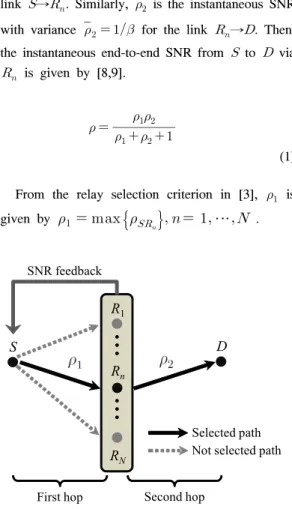
Consider a dual-hop cooperative network consisted of one source node , one destination node , and AF relay nodes for ⋯ shown in Fig. 1. Assume that each node is equipped with a single antenna and relays operate in a half-duplex mode. The transmission is performed in two orthogonal channels in time or frequency [7].
The source has no direct link with the destination and the communication is performed by choosing one out of the relays according to a partial relay selection strategy. For each link, the channel is assumed to be block flat-fading and modeled as zero-mean, independent, circularly-symmetric complex Gaussian random variable with each variance and for . We assume that all additive white Gaussian noise terms have zero mean and equal variance. Let and
be the instantaneous SNRs have variance and of the links → and →, respectively.
According to the partial relay selection criterion given in [3], the source monitors the quality of its connectivity with the relays via the transmission of local feedback, and selects a single th relay among the relay nodes having the maximum → hop instantaneous SNR .
Hereafter, for simplicity, let be the instantaneous SNR with variance for the
link →. Similarly, is the instantaneous SNR with variance for the link →. Then, the instantaneous end-to-end SNR from to via
is given by [8,9].
(1) From the relay selection criterion in [3], is given by ⋯ .
S
R1
Rn
RN
⋅⋅⋅⋅⋅⋅ D
Selected path Not selected path
First hop Second hop
SNR feedback
Fig. 1. Dual-hop cooperative network with relay selection.
Ⅲ. Performance Analysis
The source monitors the quality of its connectivity with the relays via the transmission of local feedback, and selects a single th relay among the relay nodes having the maximum → hop instantaneous SNR with variance . From the order statistics [10], the pdf of can be expressed as
(2)
The second part of (2) can be obtained by using the binomial expansion. Also, the pdf of with
variance is given by
(3)
3.1 Statistical Analysis
We now present the main results on the statistics of the instantaneous end-to-end SNR in (1).
Theorem 1: The cdf of in (1) is given by
⋅
⋅
(4)
where ⋅ is the modified Bessel function of the second kind of order
Proof : The cdf can be derived as follows:
≤
≥
∞≤
∞
(5)
We also know that
and make the change of variables in (5), then, (5) can be rewritten as
⋅∞
(6)
Finally, using [11, eq. (3.471.9)], we can get the cdf of as shown in (4).
Theorem 2: The pdf of in (1) is given by
⋅
⋅
(7)
Proof: By differentiating (4) with respect to and using the identity [11, eq. (8.486.12)] that gives the derivative .
Closed-form expressions of the cdf and pdf of the end-to-end SNR are also calculated in [5]. However, our results are more concise than the results in [5], allowing for simpler analysis.
3.2 Outage Probability
The outage probability is a meaningful performance measure in wireless communication systems over fading channels. For good codes and long block lengths, outage probability gives an approximation of the frame error rate [12]. We consider the outage probability that corresponds to the probability that the SNR falls below the specific SNR threshold . Thus, the outage probability for the AF relay channel can be easily obtained as
≤ (8)
where ⋅ is given in (4).
To get a further insight on the outage probability, we develop a simple outage probability expression for high SNR region. In the asymptotic SNR region
→, the Bessel function can be approximated by ≃ for small . By applying this approximation to (4) and simplifying further using the first order terms of an exponential approximation ≃ , the outage probability can be simplified as follows
≈ (9)
Therefore, for relays, the relaying link
→→ asymptotically approaches the performance of the single link →. Furthermore, it can be seen from (9) that the asymptotic performance of the cooperative network with partial relay selection does not depend on the quality of source-relay links and thus it is equivalent for any choice of . Furthermore, we can observe that the performance asymptotically approaches faster to the
performance of the single link as increases to infinity. The observation of this asymptotic results will be shown in Section IV.
For example, if the two links are identical, i.e.,
, the outage probability in (9) can be reduced to and for and
, respectively. For this special case, we know that the outage performance of cooperative network with partial relay selection has better performance than conventional relay system by 3.01 dB at high SNR region. For unbalanced link, and , the gain of partial relay selection over conventional relay system is 7.8 dB and 10 dB, respectively.
3.3 Ergodic Capacity Analysis
In communications over fading channels, the maximum error-free data rate that a channel can support is called the channel capacity. The work in [5] derived an upper bound for the ergodic capacity by using the Jensen’ inequality, however, an exact closed-form of the ergodic capacity is not shown in [5]. In this section, we derive an exact ergodic capacity of AF relaying system with partial relay selection.
Theorem 3: An exact closed-form expression for the ergodic capacity is given by
⋅
(10)
where is the upper incomplete Gamma function [11, eq. (3.381.3)].
Proof : Given the pdf of , the ergodic capacity is
(11)
where the factor is due to the fact that the transmission is performed in 2 time slots or two orthogonal channels. Therefore, based on (1), we
0 1 2 3 4 5 6 7 8 9 10 0
0.05 0.1 0.15 0.2 0.25 0.3 0.35 0.4 0.45 0.5
End-to-end SNR
Probability Density Function
N = 2 N = 4 N = 8 N = 16 Monte-Carlo
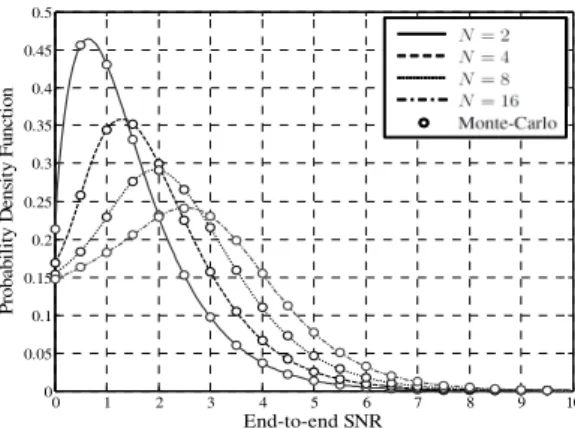
Fig. 2. Probability density function for unbalanced links,
= 3 dB and = 9 dB.
have
(12)
To evaluate (12), we need the pdfs of , and
. The pdf of and are given by (2) and (3), respectively. Then, using the moment generating function (MGF) definition expression, i.e.,
∞ , the MGFs for and
are given by and
, respectively. Given that and are independent, the MGF of can be written as
. Therefore, the MGF of is given by
⋅
(13)
To find the pdf of , we use
ℒ , where ℒ ⋅ is the inverse Laplace transform operator, hence we can get the following
⋅
(14)
Let us define the integral ,
∞ , which has the closed-form solution where
is the upper incomplete Gamma function [13, eq. (79)]. Finally, an exact closed-form expression for the ergodic capacity in (12) can be written by
⋅
(15)
After some mathematical manipulation, we can get the ergodic capacity in (10). To the best of author’ knowledge, (10) is novel. Note that the upper incomplete Gamma function can be evaluated in commercial mathematics software package, such as Mathematica and Maple.
Ⅳ. Numerical Results
In this section, we present numerical results to verify Theorems 1–3 through Monte-Carlo simulations. For Monte-Carlo simulations, we simulate the performance index which we average over data block realizations at each SNR. The data block length is set to .
Fig. 2 shows the pdf of the end-to-end SNR
for the AF relaying with partial relay selection for when and are assumed to be 3 dB and 9 dB, respectively. As the number of relays increases, the pdf values shift to the right and the peak value becomes smaller implying that the end-to-end SNR becomes more distributed. Fig. 2 confirms that our analytical results correspond exactly to the simulation results.
Fig. 3 shows the outage probability as a function
0 5 10 15 20 25 30 35 40 10-4
10-3 10-2 10-1 100 101
First-Hop Average SNR [dB]
Outage Probability
Asymptotics (α+β)γTH Asymptotics βγTH Exact Pout(γTh) Monte-Carlo
10 dB N = 16, 8, 4, 2, 1
0 5 10 15 20 25 30 35 40
10-4 10-3 10-2 10-1 100 101
First-Hop Average SNR [dB]
Outage Probability
Asymptotics (α+β)γTH Asymptotics βγTH Exact Pout(γTh) Monte-Carlo
10 dB N = 16, 8, 4, 2, 1
Fig. 4. Outage probability versus for unbalanced links
.
0 5 10 15 20 25 30 35 40
10-4 10-3 10-2 10-1 100
First-Hop Average SNR [dB]
Outage Probability
N = 1, α = β N = 5, α = β N = 1, α = 5β N = 5, α = 5β Monte-Carlo
3 dB
7.8 dB
0 5 10 15 20 25 30 35 40
10-4 10-3 10-2 10-1 100
First-Hop Average SNR [dB]
Outage Probability
N = 1, α = β N = 5, α = β N = 1, α = 5β N = 5, α = 5β Monte-Carlo
3 dB
7.8 dB
Fig. 3. Outage probability versus for balanced and unbalanced links.
-100 -5 0 5 10 15 20
0.5 1 1.5 2 2.5 3 3.5
Second-Hop Average SNR [dB]
Ergodic Capacity [bps/Hz]
α = β α = 0.1β α = 10β Monte-Carlo
Fig. 5. Ergodic Capacity versus for balanced and unbalanced links.
of the first-hop average SNR (for a threshold
= 6 dB) for balanced ( ) and unbalanced links ( ) and for different number of relays
. Moreover, as discussed in the previous section, the outage probability performance of AF relaying with partial relay selection has better performance than the conventional relaying( ) by 3.01 dB and 7.78 dB for balanced ( ) and unbalanced ( ) links, respectively at high SNR. From Fig. 3, it can be seen that the partial relay selection system improves the outage performance of the conventional relaying link ( ) and the resulting gain is equal to 3 dB at the high SNR region for balanced link.
Fig. 4 gives the outage performance as a function
of the number of relay for unbalanced link with
at threshold = 9 dB. Exact and asymptotic results are given by (8) and (9), respectively. From Fig. 3, we can observe that the exact result given by (8) corresponds exactly to the simulations results, and the asymptotic result in (9) corresponds closely to the exact result in (8) at high SNR region. Also, it can be observed that the outage performance converges into the same value of
irrespective of as SNR goes to high. As described in Section III, the performance asymptotically approaches faster to the performance of the single link as increases, and it can be verified in Fig.
5.
In Fig. 5, the ergodic capacity in terms of the second-hop average SNR assuming and balanced or unbalanced links. It is clear that (10) in Theorem 3 provides the exact results.
All numerical results confirm our analyzes.
Ⅴ. Conclusions
This paper has presented performance analysis of AF relaying in cooperative networks with partial relay selection. New closed-form expressions for the statistical behavior including pdf, cdf and outage probability have been derived. Through some approximation of the outage probability at high SNR region, we give some insight for impact of the relay location on the system performance. The asymptotic
performance of partial relay selection does not depend on the quality of source-relay links. The analysis in this paper is useful for practical AF relaying systems where the relay selection based on the first hop channel state information. Moreover, we have derived the ergodic channel capacity with closed-form solution. An exact agreement between analytical and Monte-Carlo simulation results is observed.
References
[1] A. Nosratinia, T. E. Hunter, and A. Hedayat,
“Cooperative communication in wireless networks,” IEEE Commun. Mag., vol. 42, no.
10, pp. 74-80, Oct. 2004.
[2] A. Bletsas, A. Khisti, D. P. Reed, and A.
Lippman, “A simple cooperative diversity method based on network path selection,”
IEEE J. Sel. Areas Commun., vol. 24, no. 3, pp. 659-672, Mar. 2006.
[3] I. Krikidis, J. Thompson, S. McLaughlin, and N. Goertz, “Amplify-and-forward with partial relay selection,” IEEE Commun. Lett., vol. 12, no. 4, pp. 235-237, Apr. 2008.
[4] J. N. A. Karaki and A. E. Kamal, “Routing techniques in wireless sensor networks: a survey,” IEEE Wireless Commun., vol. 11, no.
12, pp. 6-8, Dec. 2004.
[5] D. B. da Costa and S. Aïssa, “Amplify-and- forward relaying in channel-noise-assisted cooperative networks with relay selection,”
IEEE Commun. Lett., vol. 14, no. 7, pp. 608- 610, Jul. 2010.
[6] S. S. Soliman and N. C. Beaulieu, “Exact analysis of dual-hop AF maximum end-to-end SNR relay selection,” IEEE Trans. Commun., vol. 60, no. 8, pp. 2135-2145, Aug. 2012.
[7] J. N. Laneman and D. N. C. Tse,
“Cooperative diversity in wireless networks:
efficient protocols and outage behavior,” IEEE Trans. Inf. Theory, vol. 50, no. 12, pp. 3062- 3080, Dec. 2004.
[8] M. O. Hasna and M.-S. Alouini, “End-to-end performance of transmission systems with
relays over Rayleigh-fading channels,” IEEE Trans. Wirel. Commun., vol. 2, no. 6, pp. 1126- 1131, Nov. 2003.
[9] M. O. Hasna and M.-S. Alouini, “A performance study of dual-hop transmission with fixed gain relay,” IEEE Trans. Wirel.
Commun., vol. 3, no. 6, pp. 1963-1968, Nov.
2004.
[10] H. A. Davis, Order Statistics, New York:
Wiley, 1981.
[11] I. S. Gradshteyn and I. M. Ryzhik, Table of Integrals, Series, and Products, 5th Ed., London: Academic Press, 1994.
[12] R. Knopp and P. A. Humblet, “On coding for block fading channels,” IEEE Trans. Inform.
Theory, vol. 46, no. 1, pp.189-206, Jan. 2000.
[13] M. Alouini and A. Goldsmith, “Capacity of rayleigh fading channels under different adaptive transmission and diversity combining techniques,” IEEE Trans. Veh. Technol., vol.
48, no. 4, pp. 1165-1181, Jul. 1999.
황 호 선 (Ho-seon Hwang)
2009년 2월~현재 : LIG넥스원 Maritime연구소
<관심분야>수중통신, 수중소나
안 경 승 (Kyung-seung Ahn) 2007년 10월~현재 : 삼성전자
<관심분야>무선통신, 이동통신
![Fig. 3. Outage probability versus for balanced and unbalanced links. -100 -5 0 5 10 15 200.511.522.533.5Second-Hop Average SNR [dB]Ergodic Capacity [bps/Hz]α = βα = 0.1βα = 10βMonte-Carlo](https://thumb-ap.123doks.com/thumbv2/123dokinfo/5276138.371299/6.808.85.381.82.312/outage-probability-balanced-unbalanced-second-average-ergodic-capacity.webp)
