http://dx.doi.org/10.7840/kics.2013.38B.1.34
※ 이 논문은 2011년 울산대학교 연구비에 의하여 연구되었음
주저자:울산대학교 전기컴퓨터공학과 석박사 통합 과정, [email protected], 준회원
° 교신저자:울산대학교 전기공학부 컴퓨터정보통신전공, [email protected], 정회원 논문번호:KICS2012-09-443, 접수일자:2012년 9월 17일, 최종논문접수일자:2012년 12월 12일
전술 모바일 애드혹 네트워크에서 무인기를 이용하는 이동 예측 기반의 데이터 링크 연결 유지 알고리즘
르 반 둑 , 윤 석 훈°
Mobility Prediction Based Autonomous Data Link Connectivity Maintenance Using Unmanned Vehicles in a Tactical Mobile
Ad-Hoc Network
Duc Van Le , Seokhoon Yoon° 요 약
자가구성 능력을 가진 전술모바일애드혹 네트워크는 기간망을 사용할 수 없는 전술환경에서 단위전술부대와 중 앙지휘소와의 통신연결을 제공하기 위해 사용된다. 하지만, 작전 전술부대가 임무수행을 위해 중앙지휘소로부터 장거리 위치로 이동하거나 지형적 장애물이 있는 경우에는 통신단말간 데이터링크가 단절되어 전술부대로부터 지 휘소까지의 데이터 경로가 유효하지 않을 수 있다. 이러한 문제를 해결하기 위하여 본 논문에서는 ADLCoM (Autonomous Data Link Connectivity Maintenance) 구조를 제안한다. ALDCoM하에서 각 전술그룹단위는 하나이 상의 GW 노드 (게이트웨이)를 갖으며 GW 노드들은 전술부대 및 지휘소 간의 데이터 링크상태를 지속적으로 확 인한다. 만약 데이터링크가 단절될 가능성이 높다면 하나이상의 육상 또는 공중 무인기를 데이터링크를 위한 릴 레이로서 동작하도록 요청하여 전술 부대 및 지휘소간, 또는 전술 부대간의 데이터링크의 연결을 지속적으로 유효 하게 유지 시킨다. 전술환경을 모의한 시뮬레이션을 통하여 ADLCoM구조가 전술모바일애드혹망의 성능을 현저히 높일 수 있음을 보인다.
Key Words : Tactical mobile ad hoc network, unmanned vehicles, mobility prediction, data link connectivity
ABSTRACT
Due to its self-configuring nature, the tactical mobile ad hoc network is used for communications between tactical units and the command and control center (CCC) in battlefields, where communication infrastructure is not available. However, when a tactical unit moves far away from the CCC or there are geographical constraints, the data link between two communicating nodes can be broken, which results in an invalid data route from the tactical units to CCC. In order to address this problem, in this paper we propose a hierarchical connectivity maintenance scheme, namely ADLCoM (Autonomous Data Link Connectivity Maintenance). In ADLCoM, each tactical unit has one or more GW (gateway), which checks the status of data links between tactical units. If there is a possibility of link breakage, GWs request ground or aerial unmanned vehicles to become a relay for the data link. The simulation results, based on tactical scenarios, show that the proposed scheme can significantly improve the network performance with respect to data delivery ratio.
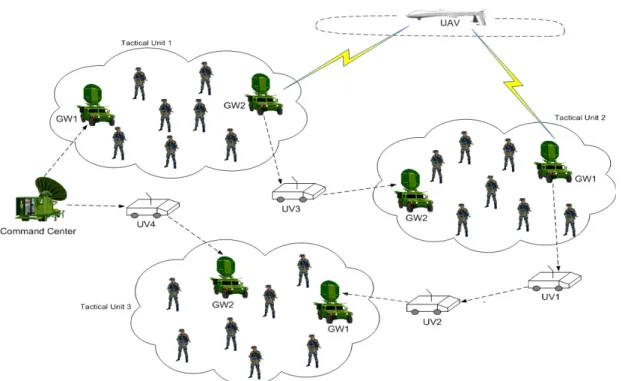
Fig. 1. An example of data link connectivity maintenance for a tactical mobile ad hoc network
Ⅰ. Introduction
Since a mobile ad hoc network (MANET) is an autonomous, capable of self-forming, and self-maintaining network, it can be deployed in a wild area without the need for the central management. One of the most challenging applications of MANETs is the tactical mobile ad hoc network (TMANET) that is used to support tactical operations in hostile wirelesses communication environments. In TMANET, there is an increasing demand for information exchange among groups of mobile nodes (e.g., soldiers, tactical vehicles, and tanks in companies/squadrons) and centric supporting elements or CCCs, such as brigade headquarters
[1,2]
. An example of a data exchange requirement in TMANET is distribution of situational awareness data including voice, video streaming and images in the format of control and command structure that ensures commanders can overlook critical information in the battlefield in real, or near-real time[3].
Unfortunately, in a practical deployment scenario of TMANET in the battlefield, if a
tactical unit moves far away from CCC or there are geographical constraints (e.g, obstacles), the data link between two communicating nodes can be broken. As a result, the data route from the tactical unit to CCC may not exist, and hence network is not able to provide the data transfer service required by tactical missions.
Although there are a lot of MANET routing protocols including AODV [4], DSR [5], DYMO [6] and OLSR [7] but they cannot solve the problem of data link breakage. This is because those existing MANET routing protocols are designed to find an optimal route only using given network topology. More specifically, those existing routing protocol may not establish a route from the source and to the destination due to physical constraints such as obstacles and a long distance between those communicating peers.
In order to overcome the limitations of existing data routing architecture, in this paper we propose a hierarchical connectivity maintenance scheme, called ADLCoM (Autonomous Data Link Connectivity Maintenance), which utilizes the autonomous unmanned vehicles to keep the route between tactical units and CCC effective by actively controlling the network topology. In
ADLCoM, each tactical unit consists of multiple normal nodes usually carried by group of soldiers in the form of handheld, manpack, or small form fit. In addition, each tactical unit has one or more GW node that is equipped in a tactical vehicle, which has more capabilities and power than normal nodes. A GW establishes a data link with other GWs in different tactical units. Those GWs periodically estimate the possibility of link breakage based on packet delivery ratio and mobility predication that takes account the duration in which the link remains connected. In case the estimated possibility of link breakage is high, GWs request ground or aerial unmanned vehicles to become a relay for the data link, in order to keep the data route valid for critical data transfer.
Fig. 1 illustrates the an example of data link connectivity maintenance for a tactical mobile ad hoc network. As shown in Fig. 1, the data link between the command center and GW2 of tactical unit 3 is maintained by Unmanned Vehicle 4 (UV4). Also, in Fig. 1, UV1 and UV2 are added as relay nodes in data link between GW1 of tactical unit 2 and tactical unit 3.
It is worthwhile to note that there also have been studies that use robotic nodes for routing in ad hoc networks[8-10]. Those works differ from ours in that they focus on the minimization of energy consumption of the network for communication. Moreover, they assume that the network consists of only robotic agents, which are impractical for modern tactical scenarios.
The remainder of the paper is organized as follows. Section II presents the related work and contrast with proposed algorithm. In section III, the algorithm of ADLCoM is illustrated. In section IV, simulation scenarios and analysis of simulation results are detailed. Finally, section V concludes the paper.
Ⅱ. Related Work
In this section, we present overview of tactical mobile ad hoc networks and controllable mobility
aided routing protocols.
2.1. Tactical Mobile Ad Hoc Network
TMANETs have been studied extensively for many years around the world[1-3,11]. TMANETs have several distinct characteristics that are not found in normal civilian ad hoc networks.
While a civilian network usually contains fairly high bit transmission rate and homogeneous links, a TMANET can consist of heterogeneous links which are based on different transmission technologies, i.e., different operation frequency, bandwidth, modulation[1]. Military tactical deployments have well-defined chain of command which is one of the most important characteristics of tactical networks[12]. Moreover, military tactical deployments are mission based, and therefore units are expected to cooperate with one another and operate within reasonable bounds of doctrine.
This mission based characteristic can also lead to a certain amount of predictability in a unit’s movement.
The studies in [2] presented information operation scenarios that consider communication networking concepts, such as node mobility, networks size, and quality of service, which are integral factors in designing a military tactical wireless ad hoc network. For example, node mobility is a basic assumption in military tactical network design. A tactical unit is given a mission that may start at one coordinate and end at another. While moving, every nodes consist of soldiers with PDAs, tanks, unmanned aerial vehicles (UAVs), and even helicopters and fighter jets in combat need to exchange voice, data, and perhaps video each other in mobile networks.
2.2. Controllable Mobility Aided Routing Protocols
Controllable mobility has been studied to achieve the objectives related to the performance for MANET routing protocol [8], [9], [10], [13]
for many years. For example, the studies in [10]
presented a controlled mobility aided geographic routing, namely CoMNet (Connectivity
preservation Mobile routing protocol for actuator and sensor NETwork), which considers the controllable mobility ability of nodes to minimize power consumption and maintain network connectivity. In [13], the optimal positions to which relay nodes should move after the route is established is discussed. To optimize energy consumption for communication, relay nodes on route should be placed at the positions which are evenly spaced along the straight line from source and destination.
In [8], a routing algorithm, namely OHCR (Optimal Hop Count Routing) which studies the optimal number of hops and distance between relay nodes on the route was proposed. In OHCR, a node selects a neighboring node which has minimum distance to the pre-computed optimal position as its next-hop on the path. After a node is selected as relay node, it moves to its optimal position and starts to forward data packet to destination node. Moreover, the mobility method that considers network connectivity was discussed.
In [9], a controllable mobility routing that is incorporated in AODV protocol was proposed.
After the route which takes account the total traveling distance of relay nodes is established using AODV route discovery mechanism, relay nodes on the route move to their optimal position to minimize power consumption.
Those works focused on optimizing the energy consumption for communication that is suitable for networks such as sensor networks where energy is constrained. In contrast, this work focuses on link connectivity maintenance for tactical operations in tactical mobile ad hoc networks.
It is worthwhile to note that the use of robotic relay in an ad hoc network has been studied in
[14]. However, the algorithms in [14] cannot be applied to the tactical scenario since it assumes that all nodes in the network are homogeneous and have same capabilities. Furthermore, the objective of the study in [14] is to improve the link quality rather than preventing link breakage.
In contrast, this work focuses on link connectivity
maintenance using mobility prediction of tactical units in a hierarchical network structure, which makes it directly applicable to tactical scenarios.
In addition, this work also proposes a routing scheme for inside a group and inter-groups in a hierarchical network architecture.
Ⅲ. Autonomous Data Link Connectivity Maintenance (ADLCoM) Scheme We consider the network that consists of multiple groups of nodes and ground/aerial UVs.
Each group has multiple normal nodes and one or more GW that connects the normal nodes to the network outside of the group, i.e. communication between normal nodes in different groups is conducted through the links between GWs. It is assumed that each GW knows its geographic position using GPS (Global Positioning System) or other localization technologies[15,16]. Moreover, GWs can obtain their moving speed and direction.
Note that these assumptions are reasonable for practical tactical mobile ad hoc networks. For example, GW node can be equipped in a tactical vehicle that has more capabilities and power than normal nodes carried by soldiers (e.g, in the form of handheld, manpack, or small form fit).
In this section, we present ADLCoM scheme in detail, which is intended to maintain data link connectivity between GWs of different groups.
We first describe the estimation of possibility of link breakage between GWs. Then, we discuss the routing scheme inside of a group and among groups. Finally, we elaborate connectivity maintenance algorithms for the data links between GWs.
3.1. Estimation of Possibility of Link Breakage
In ADLCoM, each GW periodically broadcasts Hello message that contains its position, mobility speed and moving direction. Based on the received Hello messages, each GW maintains a list for information related to position, speed and moving direction of neighboring GWs that belong
Algorithm 1: Autonomous Data Connectivity Control Algorithm – Run at R-GW node
⊳ : set of neighboring UVs
⊳ : number of re-transmission of CC-REQ
⊳ : defined maximum number of re-transmission of CC-REQ
⊳ : waiting time for ACK 1: ←
2: ←
3: While TRUE
4:
5: If then 6:
7: Calculate midpoint position;
8: While ≠ ∅ or ACK isn’t received 9: Select a UV;
10:
11: Repeat
12: Send a CC-REQ;
13:
14: Pause for time ; 15: Until n = k or ACK is received 16: End
17: End
18: Pause for time
19: End to other groups.
Each GW estimates the possibility of link breakage for each link with its neighboring GWs using PDR (Packet Delivery Ratio) values of the link and mobility prediction based expected duration of link connection. For example, if the expected duration of link is long and the PDR value is high, the possibility of link breakage is low. Meanwhile, if the expected duration of link is short or the PDR value is low (e.g., due to obstacles), the possibility of link breakage becomes high.
To obtain the expected duration of the link connection based on mobility prediction, link expiration time (LET) mechanism [17] is used, assuming that the received signal strength is dominated by the distance from the transmitter to the receiver. Let’s denote and are coordinates of node i and node j respectively.
Also let and be mobility speeds, and
≤ be moving directions of node i and node j. If two nodes i and j are within the transmission range of r each other, the LET value, which is duration time they will remain connected, is predicted as:
(1)
where
cos cos
sin sin
Note that when and , LET is set to ∞ without applying the Eq. 1.
In order to approximate a PDR value, the probe packet based approach [18] is used, which is known for its simplicity and accurate approximation. In ADLCoM, Hello packets are used as probe packets. More specifically, if the number of Hello packets of s is sent at the sender during a time window of and the number of Hello packets of m is received at the
receiver, the PDR value of link between the sender and the receiver becomes .
Each GW updates PDR values of its links with its neighboring GWs at every .
Based on the obtained LET and PDR value of R, we estimate the possibility of link breakage by calculating the measure of link breakage (MLB) that is
(2)
where f(LET) is function of LET, which is expressed as
max
max
i f max
i f ≥ max
(3)
where max is maximum time, is system
parameter and ≤ . More specifically, the link is considered more stable with a higher MLB value i.e. the possibility of link breakage becomes lower. In contrast, with a low MLB value, the possibility of link breakage becomes high.
3.2. Routing Scheme for Inside Group and Inter Groups
It is assumed that each group consists of multiple normal nodes and one GW. In a group, normal nodes and GW have a unique sequence number which is periodically increased by 1 every a specific time period. Each node (i.e., normal nodes and GW) maintains a routing table which consists of route entries for routes to different destinations (other nodes) in group. Each route entry in a routing table contains destination's IP address, sequence number, lifetime of route as well as the number of hops and the IP address of next hop on the route to the destination.
In group, each node periodically broadcasts its routing table to neighboring nodes. When the node receives routing information from other nodes, it first checks whether it is valid to update or not by noting the destinations’ sequence number and the number of hops to destinations of newly received routes. The node updates a new route to a destination if the newly received route has the destination’s sequence number greater than the currently stored destination’s sequence number itself. Moreover, the node also updates new route which has the same destination’s sequence number but the number of hops smaller than its current one stored in its routing table. Otherwise, the node discards the routing information received from others nodes in group.
In other words, GWs and UVs also maintain routes between different groups based on receiving routing information which is broadcasted by other UVs and GWs. If a direct link between two GWs can not be established, the route between two different groups may contain UVs as relay nodes.
Note that when a node updates a new route or receives data packet on the route to the destination, the lifetime field of route entry
corresponding to this route in its routing table is updated to current time plus a specific time period, called by ACTIVE_PERIOD. The node periodically checks its routing table every ACTIVE_PERIOD second. The route entry will be is deleted from node’s routing table if its lifetime field is less then current time.
Assume that a source node S needs to send data packets to a destination node D in a different group. Node S sends data packets to GW in its group using routing information of route to GW in its routing table. When a GW receives a data packet from node S in its group, it checks which GW the packet needs to be forwarded, and sends the packet to the GW, directly or via UV based relay nodes. When the GW, which belongs to the same group as node D, it forwards the packet to node D.
3.3. Algorithms for Data Link Connectivity Maintenance
When a data-receiving GW node (which referenced to as R-GW node hereafter) receives a first data packet from its predecessor GW (or P-GW node), the R-GW node obtains the MLB value of applying Eq. 2 with the estimated PDR value of at the current time window and the current LET value of of the link. The R-GW node compares the current value of with the threshold MLB value of .
If the is less than , which implies that the link has the high possibility of breakage, the R-GW node looks up its list of neighboring UVs and chooses a UV and requests it to relocate in the mid-position between the P-GW node and the R-GW node. Note that, each GW maintains the list for positions of neighboring UVs which is periodically broadcasted by UVs in Hello messages. If the R-GW node could not find a UV nearby, it may request CCC to send a UV.
Note that the mid-position of two communicating nodes is the optimal position for placing a relay, which results in maximization of the link quality and minimization of the link transmission power [13].
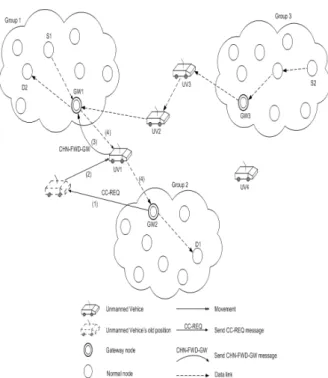
Fig. 2. An example of autonomous data link connectivity maintenance process
After a UV is selected, the P-GW node sends connectivity control request (CC-REQ) message that contains the network address of its P-GW node on the data path and the position to which the UV should move. The selection of UV is repeated until the list of neighboring UVs of the R-GW node is empty or a CC-REQ is successfully sent. If the R-GW node could not select any UV, it stops the data link connectivity management process or sends a request to CCC for a UV. The R-GW node periodically performs the data link connectivity maintenance process every time window of . Algorithm 1 presents the algorithms for R-GW node more formally.
Upon reception of CC-REQ, the UV sends ACK which indicates that the CC-REQ is successfully received, and starts moving to the position that is included in the CC-REQ. When the UV arrives at the relay position, it sends a CHN-FWD-GW message to the P-GW node.
Upon reception of the CHN-FWD-GW, the P-GW node updates its routing table and begins forwarding the data packets to the UV. The UV also sets the R-GW node as the next gateway
hop.
In case the UV cannot reach the required position due to obstacles or other geographical constraints, it does not send the CHN-FWD-GW message to the P-GW node, i.e. the new data links through the UV are not established. As a result, data packets are still forwarded through the current link between R-GW and P-GW nodes.
Recall that the R-GW node periodically estimates the possibility of link breakage of its links every time window of . Therefore, another UV will be required to move for the link between R-GW and P-GW nodes in next time window. Moreover, the UV which cannot arrive at the required position stops at its current position and become available to receive the CC-REQ messages from other GWs in the network.
Fig. 2 illustrates the ADLCoM operation that maintains the connectivity of data links between GWs. As shown in the example of Fig. 2, the route from source node S1 in group 1 to destination node D1 in group 2 is established, which involves the link of GW1 and GW2.
Assuming that the current MLB value of link between GW1 and GW2 is less than the MLB threshold value, GW2 sends a CC-REQ message to UV1 (1). Upon reception of CC-REQ, UV1 moves to the mid-position between GW1 and GW2 (2). When UV1 arrives at the position, it sends the CHN-FWD-GW message to the GW1 (3) and adds itself to the route from node S1 to node D1. GW1 updates its routing table and starts forwarding the data packets to UV1 (4). As a result, the data packets are forwarded from GW1 to GW2 through UV1 as a relay node (4).
The UVs consistently maintain data link connectivity by moving to keep the mid-position between P-GW and R-GW nodes. More specifically, each UV periodically tracks the positions of its P-GW and R-GW nodes by using the position information included in the Hello messages, which it has received from them. If the newly calculated mid-position is different from the current position, the UV moves to the new
position with an interval, second.
Note that a UV can work as both R-GW and P-GW nodes after it becomes a relay node. This means that the UV may request another UV for a relay node for the link for which it is relaying.
In other words, multiple UVs can be added as relay nodes for a data link of two GWs if needed. As an example in Fig. 2, two unmanned vehicles, UV2 and UV3 are added as relay nodes for the data link of GW3 and GW1 of the route from source node S2 of group 3 to destination node D2 of group 1.
Ⅳ. Performance Evaluation
In this section, we evaluate the performance of ADLCoM scheme by comparing it with other existing ad hoc routing protocols, such as AODV, DSR, DYMO, and OLSR.
4.1. Simulation Scenario
In order to evaluate the performance of ADLCoM, a tactical mobile ad hoc network under a military operation is considered. Multiple mobile nodes (e.g., devices carried by soldiers and tactical vehicles) are deployed in groups. Each group consists of a GW for communications between groups in the network. Tactical data (e.g., voice, text messages, and snapshots) is distributed to mobile groups through their GWs.
Since nodes in each group moves cooperatively to perform pre-planned tactical military operations, they have group mobility. In this paper, we use reference point group mobility model (RPGM) [19] to emulate movements of nodes in a group.
In RPGM, a group has a logical group center that moves according to group movement vector, which determines the group-wise movement. Each member node in a group is assigned with a reference point which determines the relative mobility of the node. Reference points move based on the group movement vector. In addition, each member node has a random movement vector that allows the node to move randomly in the group. Thus, the mobility of the node is
decided by a mobility vector that can be considered as the sum of the two mobility vectors, the group mobility vector and the internal mobility vector.
Movements of member nodes in a group are also limited by the group boundary. The random waypoint model (RWP) [5] is used to simulate both group-wise movements and member movements inside the group.
A network simulator Qualnet 5.1, integrated with controllable mobility simulator architecture, is used for simulation. In the scenario under consideration, groups of soldiers and tactical vehicles (i.e., companies/squadrons) transmit situational awareness (SA) data, including voice, video streaming and images to report environment status to a given command center through GW of group with data rate from 10 Kbps to 80 Kbps.
In order to emulate the SA data transmission, constant bit rate traffics with 512 bytes data packets on top of UDP is used.
In the network, 20 mobile nodes are deployed in 2 groups in the terrain dimension of 15km × 15km. Each group consists of 10 mobile nodes which are randomly placed in a circular group area with the radius of 5km. In addition, 5 UVs are used to evaluate ADLCoM algorithm.
There are various tactical radios that have different capabilities. For example, JTRS GMR (Joint Tactical Radio System Ground Mobile Radio) can cover around 10km range and support the transmission rate up to 5Mbps[20]. Also, JTRS HMS (Joint Tactical Radio System Handheld, Manpack, Small Form Fit) can provide up to 2 Mbps with the maximum transmission range of 5 km. In this paper, taking into consideration the harsh communication environments, the data rate of physical layer is set to 2Mbps and the average transmission radio range is set to approximately 2 kilo meters. A CSMA based random access protocol is used for medium access control.
4.2. Simulation Results
The effects of node speed and network traffic on the performance of ADLCoM algorithm are
Fig. 3. Effects of mobility on data delivery ratio
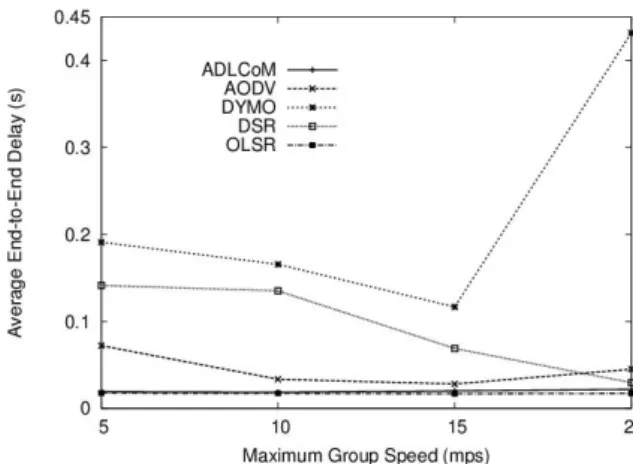
Fig. 4. Effects of mobility on average end-to-end delay evaluated using the following performance metrics.
Data delivery ratio: the average ratio of the data packets successfully delivered to destinations over the data packets sent by sources in data flows.
Average end-to-end delay: the average time which takes into account delay caused by buffering, queuing, re-transmissions, and propagation of transfer that a CBR packet takes to travel from the source to the destination.
4.2.1. Node Mobility
First, we analyze the effects of node mobility on the network performance. RWP is used to simulate movement of group with pause time of 30 seconds. The group speed is randomly chosen in an interval from 0 m/s (meter/seconds) to max which varies from 5 to 10, 15, and 20 m/s. Two data flows from two sources in 2 groups to command center are established with the load of each data source of 10 Kbps.
Fig. 3 shows the relation between maximum group speed and data delivery ratio of routing protocols. As shown in Fig. 3, ADLCoM exhibits a data delivery ratio than AODV, DYMO, DSR and OLSR. For example, when the maximum speed of the group is 10 m/s, ADLCoM’s data delivery ratio is higher than 0.8, while other protocols show less than 0.4. Also, ADLCoM's data delivery ratio is consistently kept higher than other protocols when the maximum group speed is varied. It is because in ADLCoM, GW (i.e., R-GW) node estimates possibility of link breakage of links with other GWs on the route and adds UVs as relay nodes before the links are broken.
Therefore, data link connectivity between GWs is maintained over time and kept high quality. As shown in Fig. 3, OLSR shows the lowest packet delivery ratio compared with others.
Fig. 4 compares the average end-to-end delay of ADLCoM with other protocols. As shown in Fig. 4, ADLCoM exhibits consistently low end-to-end delay values compared to reactive protocols (e.g., AODV, DYMO, and DSR), and
has similar delay values to OLSR over the variation of the maximum group speed. Reactive protocols have high end-to-end delay because they need to find an alternative route when a link breakage is detected. Until a new valid route established, packets pending for transmission stay in the queue, which results in a high packet delay. In contrast, ADLCoM can predict and prevent possible link breakage, which makes it keep an effective route for a long time, reducing the need for new route discoveries. Also note that OLSR shows low end-to-end delay. It is because OLSR is a proactive protocol which consistently maintains fresh routes regardless of packet transmissions. However, OLSR has to periodically flood link state control packets to update routes, which can lead to high end-to-end delay when the network traffic is high, as seen in Fig. 7.
Fig. 5 shows the number of packet
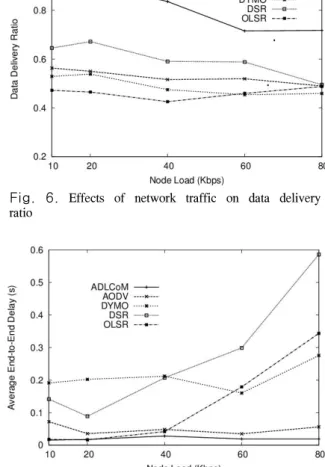
Fig. 6. Effects of network traffic on data delivery ratio
Fig. 7 Effects of network traffic on average end-to-end delay
Fig. 5 The number of packet transmission errors at MAC with the maximum group speed of 5 m/s
transmission errors at the MAC (medium access control) protocol when the packets are relayed on the route during simulation with the maximum group speed of 5 m/s. The packet transmission errors can imply the link breakage, since most packet transmission errors come from link breakage due to node mobility. As shown in Fig.
5, the number of packet transmission errors of ADLCoM is the lowest among compared protocols, which also implies that ADLCoM can prevent link breakage and keep the route effective. The reason of low packet transmission errors of OLSR is that it is a proactive protocol, which updates the route using control messages independent of data packets. If OLSR cannot find a valid route to the destination, the source node immediately drops the packets, which results in less packet transmission errors in the middle of the route.
4.2.2. Network Load
We also analyze the effects of the network load on the network performance. ADLCoM is compared with other protocols under various network loads. Data rate from to each source in a group is set at the values from 10 Kbps to 20, 40, 60, and 80 Kbps. The maximum mobility speed of groups is set to 5 m/s.
As we can see in Fig. 6, ADLCoM also shows the highest data delivery ratio compared with others when node load is varied. For example,
when the load of each source is 40 Kbps, ADLCoM has the data delivery ratio over 0.8, while other protocols show less than 0.6. As also shown in Fig. 6, the improvement of ADLCoM on data delivery ratio is stable as node load increases. OLSR also shows the lowest data delivery ratio over variation of the node load.
Fig. 7 shows the relation between the node load and the average end-to-end delay of ADLCoM and other protocols when node load varies. As shown in the Fig. 7, ADLCoM exhibits a consistently lowest average end-to-end delay over the variation of node load compared with other protocols. This result indicates that ADLCoM can be applied effectively in the networks where requirement of delay is low. As also shown in Fig. 7, DSR shows the highest average end-to-end delay which is fluctuating over variation of node load.
Ⅴ. Concluding Remarks
When a tactical unit moves far from the command center or there are obstacles, the data link in a tactical mobile ad hoc network can be broken, resulting in an invalid data route from the tactical units to command center. In order to tackle this problem, in this paper we have proposed a hierarchical connectivity maintenance scheme, namely ADLCoM (Autonomous Data Link Connectivity Maintenance). In ADLCoM, each tactical unit has multiple normal nodes carried by soldiers and one or more GW (gateway) equipped in a tactical vehicle. GWs checks the status of data links between tactical units, and when there is a possibility of link breakage, GWs request ground/aerial unmanned vehicles to become a relay for the data link. The simulation results have shown that the ADLCoM scheme can improve the network performance significantly in terms of data delivery ratio.
References
[1] M. A. Brose and M. Hauge, “Group communication in mobile military networks,”
Norwegian Defence Research Establishment, Feb. 2012.
[2] M. Salmanian, “Military wireless network information operation scenarios,” Technical Memorandum, Defence Research and Development Canada, Dec. 2003.
[3] S. Munk, “Situational awareness (data) bases in military command and control,” Inform.
Technol., vol. 3, no. 3, pp. 373–385, Apr.
2004.
[4] C. E. Perkins and E. M. Royer, “Ad-hoc on-demand distance vector routing,” in Proc.
IEEE Workshop on Mobile Comput. Syst. and App., pp. 90-100, Feb. 1999.
[5] D. Johnson, Y. Hu, and D. A. Maltz, “The dynamic source routing protocol (DSR) for Mobile ad hoc wireless networks for IPv4,”
RFC 4728, Feb. 2007.
[6] C. Perkins and I. Chakeres, “Dynamic MANET
on-demand (AODVv2) routing,” Mobile Ad-hoc Networks Working Group Internet Draft, Mar.
2012.
[7] T. Clausen and P. Jacquet, “Optimized link state routing protocol (OLSR),” RFC 3626, Oct.
2003.
[8] H. Liu, A. Nayak, and I. Stojmenovi,
“Localized mobility control routing in robotic sensor wireless networks,” in Proc. Int. Conf.
Mobile Ad-hoc and Sensor Netw., pp. 19-31, China, Dec. 2007.
[9] V. Loscr, E. Natalizio, and C. Costanzo,
“Simulations of the impact of controlled mobility for routing protocols,” EURASIP J.
Wirel. Commun. Netw., vol. 2010, no. 7, pp.
1-12, Apr. 2010.
[10] E. Hamouda, N. Mitton, and D. Simplot-Ryl,
“Energy efficient mobile routing in actuator and sensor networks with connectivity preservation,” in Proc. Int. Conf. Ad Hoc Netw.
and Wirel., pp. 15-28, Jul. 2011.
[11] K. Ko, K. Kang, and Y. Cho, “A scalable content-based routing scheme considering group Mobility in tactical mobile ad-hoc networks,” J. KICS, vol. 35, no. 5, pp. 721-733, May. 2010.
[12] P. Holliday, "SWARMM - a mobility modelling tool for tactical military networks," in Proc.
Military Commun. Conf. (MILCOM), pp.
689-875, Nov. 2008.
[13] D. K. Goldenberg, J. Lin, A. S. Morse, B. E.
Rosen, and Y. R. Yang, “Towards mobility as a network control primitive,” in Proc. the 5th ACM Int. Symp. on Mobile Ad Hoc Netw. and Comp., pp. 163-174, Japan, May. 2004.
[14] D. V. Le, H. Oh, and S. Yoon, “Reinforcing wireless links using controllable mobility of robotic relays,” in Proc. IEEE Asia-Pacific Conference Communications (APCC 2012), pp.
23-28, Korea, Oct. 2012.
[15] L. Zhang, L. Liu, C. Gotsman, and S. J. Gortler,
“An as-rigid-as-possible approach to sensor network localization,” ACM Trans. Sensor Netw., vol. 6, no. 35, pp. 35:1-35:21, Jul. 2010.
[16] W. Li, J. Bao and, W. Shen, “Collaborative
wireless sensor network: a survey,” in Proc.
2011 IEEE Int. Conf., pp. 2614-2619, Oct.
2011.
[17] W. Su, S.-J. Lee, and M. Gerla, “Mobility prediction and routing in ad hoc wireless networks,” Int. J. Netw. Manag., vol. 11, no.
1, pp. 3-30, Feb. 2001.
[18] G. Cheng, Z. Jinglong, P. Pawelczak, and R.
Hekmat, “Improving packet delivery ratio estimation for indoor ad hoc and wireless sensor networks,” in Proc. Consumer Commu. and Netw. Conf., pp. 1-5, Jan. 2009.
[19] X. Hong, M. Gerla, G. Pei, and C.-C. Chiang,
“A group mobility model for ad hoc wireless networks,” in Proc. ACM Int. Workshop on Modeling, Analysis and Simul. of Wirel. and Mobile Syst., pp. 53-60, United States, Aug.
1999.
[20] Sep., 14, 2012, from
http://www.globalsecurity.org/military/systems/
ground/jtrs_cluster1.htm
Duc Van Le
June 2011 Bachelor of Electrical and Electronic Engineering, Military Technical Academy, Ha Noi, Viet Nam
September 2011~Present
MS/Ph.D Student,
Department of Electrical and Computer Engineering, University of Ulsan
<Research Area> Ad-hoc networks, tactical networks, controllable mobility
윤 석 훈 (Seokhoon Yoon)
2000년 2월 인하대학교 자동화 공학과 공학사
2005년 6월 뉴욕주립대 (SUNY at Buffalo) 컴퓨터공학석사 2009년 9월 뉴욕주립대 (SUNY
at Buffalo) 컴퓨터공학박사 2009~2011 LIG 넥스원 책임 연구원
2011~현재 울산대학교 전기공학부 조교수
<관심분야> 애드혹네트워크, 협력형 로봇네트워크, 수중 통신망, 전술통신망