식물병연구
Res. Plant Dis. 18(3) : 201−209 (2012)
Research in Plant Disease
© The Korean Society of Plant Pathology http://dx.doi.org/10.5423/RPD.2012.18.3.201
Bacillus subtilis 균주의 기능성 분석 및 이를 활용한 고추 흰가루병 방제
김용기*·홍성준·심창기·김민정·최은정·이민호·박종호·한은정·안난희·지형진 국립농업과학원 유기농업과
Functional Analysis of Bacillus subtilis Isolates and Biological Control of Red Pepper Powdery Mildew Using Bacillus subtilis R2-1
Yong-Ki Kim*, Sung-Jun Hong, Chang-Ki Shim, Min-Jeong Kim, Eun-Jung Choi, Min-Ho Lee, Jong-Ho Park, Eun-Jung Han, Nan-Hee An and Hyeong-Jin Jee
Organic Agriculture Division, Department of Agricultural Environment, National Academy of Agricultural Sciences, Rural Development Administration, Suwon 441-707, Korea
(Received on September 12, 2012; Revised on September 20, 2012; Accepted on September 24, 2012)
The multi-function of 18 Bacillus subtilis isolates collected from agricultural extension centers of local government and National Academy of Agricultural Science was investigated by measuring their antifungal activities against five plant pathogens, such as Rhizoctonia solani, Colletotrichum acutatum, Fusarium oxysporum, Magnaporthe oryzae and Phytophthora capsici, phosphorus solubilization ability, production of indole acetic acid (IAA) and siderophore, and nitrogen fixation. The B. subtilis isolates showed antifungal activity against several plant pathogens and nitrogen fixation activity, and produced siderophore and IAA.
They could control pepper powdery mildew (Leveillula taurica), but there was no difference in control efficacy among the B. subtilis isolates. In fields, the control efficacy of B. subtilis R2-1 (108 cells/ml) was compared with two microbial fungicides, Q-pect and Topsid. In 2009, the control efficacy of B. subtilis R2-1 (37.7%) was lower than that of Topsid (47.6%), but higher than that of Q-pect (25.7%). In 2010, the control efficacy of B.
subtilis R2-1 (83.3%) was higher than that of Topsid (67.9%). In order to elucidate mode of action of B.
subtilis R2-1 for controlling pepper powdery mildew, spore germination rates of pepper powdery mildew pathogen collected on treated leaves was investigated when suspensions of B. subtilis R2-1 and two microbial fungicides (Q-pect and Topsid) were foliar-sprayed. They highly suppressed spore germination of the pathogen with inhibition values of 84.2% for B. subtilis R2-1, 97.9% for Q-pect and 94.7% for Topsid.
Further study on the mass-culturing method and formulation is needed for development of a microbial fungicide.
Keywords : Antifungal activity, Bacillus subtilis R2-1, Indole acetic acid, Nitrogen fixation, Pepper powdery mildew, Siderophore
서 론
고추는 전국적으로 51,000 ha에서 재배되고 있으며 생 산량도 350,000 M/T에 달하며, 채소 중 재배면적이 가장 많다. 고추 재배 중 역병이나 탄저병의 피해가 심해 고추 안정생산의 제한 요인이 되고 있으며, 농약을 사용하지
않고 이들 병들을 방제하기는 매우 어렵다.
최근 들어 친환경 유기농 고추를 재배하는 농민이 증 가하면서 농약을 사용하지 않고 병을 방제하려는 노력이 다각도로 시도되었다. 고추역병의 경우, 최근 들어 다행 히 저항성 품종이 육성 보급되고 상습발생지를 중심으로 저항성 품종이 재배되면서 역병에 의한 피해는 점차 감 소되는 추세이다. 그러나 탄저병의 경우, 고추에 병 저항 성 유전자가 없다고 알려져 있어 저항성 품종 재배에 의 한 방제는 거의 불가능한 실정이다. 따라서 최근 유기농 현장에서 농약을 사용하지 않고 고추 탄저병을 경감하기
*Corresponding author
Phone)+82-31-290-0554, Fax) +82-31-290-0507 Email) [email protected]
Research Article Open Access
위한 기술로 반비가림시설을 설치하여 비바람을 차단함 으로써 탄저병균의 생성, 전파 및 침입을 획기적으로 줄 일 수 있는 기술을 개발하여 친환경 농가를 중심으로 활 용되고 있다. 반비가림시설 내에서 재배하면 고추 탄저병 을 획기적으로 줄일 수 있으나, 노지에서는 경미하게 발 생되는 흰가루병(Leveillula taurica (Lév) Arnaud) 피해가 높게 나타난다(Anonymous, 2011). 이는 노지와 달리 시 설 내에는 환기가 불량하고 주야간 온도 차가 커 고추 흰 가루병 발생에 유리하게 작용했기 때문으로 사료된다.
고추 흰가루병은 주로 잎에 발생하며 처음에는 잎맥을 따라 서릿발 모양의 포자가 발생하고 발병이 진전하여 심 하게 발병되면 잎이 고사되면서 떨어진다(NAIST, 1977).
고추 흰가루병균은 다른 흰가루병균과는 달리 내부 기생 균이므로 방제가 비교적 어렵다. 고추 흰가루병균은 주야 간 기온 차가 큰 가을에 많이 발생하고 노지에 비해 시 설 내에서 발병이 심하다. 고추 흰가루병은 질소질 성분 이 과다하지 않도록 비배관리를 잘하고, 유황제나 구리제 와 같은 친환경 농자재를 사용하거나, 큐펙트 수화제와 같은 미생물살균제를 처리하면 환경 친화적인 방제가 가 능하다.
최근에는 지방자치단체(지자체)를 중심으로 병해충 방 제 또는 작물 생육촉진을 목적으로 다양한 미생물을 활 용하고 있다. 농업 현장에서 활용되고 있는 미생물은 주 로 Bacillus 속 세균, 유산균, 광합성균, 효모이며, 미생물 종류별로 기능성에 있어서 차이가 있는 것으로 알려져 있 다. Bacillus 속 세균은 대부분 항균활성물질을 생산하며 (Feio 등, 2004; Jeong 등, 2010; Sgroy 등, 2009; Swain 등, 2009; Swain 등, 2008b; Zonzheng 등, 2009; Todorova 등, 2010), 균주에 따라서는 siderophore 생성(Grossman 등,
1993; Melo-Pereira 등, 2011; Woo 등, 2008), 인산가용화 능력(Jeon 등, 2003; Jeong 등, 2010; Raj 등, 1981; Swain 등, 2009), 질소고정능력(Ding 등, 2005; Jadhav 등, 2010;
Zlotnikov 등, 2001), 오옥신 생성능력(Jeong 등, 2010;
Melo-Pereira 등, 2011; Prashanth 등, 2010; Swain 등, 2008a) 및 효소활성을 나타내며(Ahlawat 등, 2008; Swain 등, 2009; Swain 등, 2008b), 작물의 생육을 증진시키는 것으로 알려져 있다(Jeong 등, 2010; Melo-Pereira 등, 2011;
Swain 등, 2009; Zonzheng 등, 2009). 이상의 Bacillus 속 세균이 가지는 다양한 기능성은 병 방제에 직접 또는 간 접적으로 영향을 미치므로 이를 활용하여 유기합성 농약 을 대체코자 하는 연구가 전 세계적으로 활발히 수행되 고 있다(Asaka 등, 1996; Crisp 등, 2006; Hegaji 등, 2010;
Janousek 등, 2009; Raudales 등, 2008; Romero 등, 2007).
본 연구는 지자체에서 생산보급하고 있는 미생물 중 Bacillus subtilis를 채집한 후 국립농업과학원(농과원)이 보 유하고 있는 B. subtilis R2-1 균주를 대조로 기능성을 분 석하고, 이들을 활용한 고추 흰가루병의 방제 가능성을 검토하고자 수행하였다.
재료 및 방법
항균활성 검정. 채집한 Bacillus 속 세균의 식물병원균 에 대한 항균활성을 농과원이 보유한 Bacillus subtilis R2- 1균주를 대조로 하여 다음과 같이 조사하였다. 채소류 시 들음병균(Fusarium oxysporum), 벼 도열병균(Magnaporthe oryzae), 입고병균(Rhizoctonia solani), 채소류 잿빛곰팡이 병균(Botrytis cinerea) 및 고추 탄저병균(Colletotrichum acutatum)은 Potato dextrose agar(PDA) 배지 상에서, 고
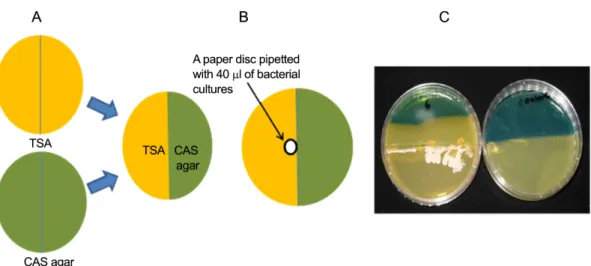
Fig. 1. Evaluation of siderophore production formation of Bacillus subtilis isolates using CAS agar and TSA. (A) Preparation of testing medium. (B) bacterial inoculation. (C) color change (blue to yellow) caused by siderophore production.
추 역병균(Phytophthora capsici)은 V8주스배지 상에서 대 치배양(dual culture)을 통해서 검정하였다.
Siderophore 생성능 조사. 농업미생물의 siderophore 생성여부를 확인하기 위하여 TSA(tryptic soy agar)와 CAS 배지(Milagres 등, 1999; Schwyn and Neilands, 1997)를 각 각 조제하여 샤레에 분주한 후 Fig. 1과 같이 반으로 절 단하여 중앙부분의 배지가 잘 맞닿도록 배지를 잘 붙인 후 TSA 배지 상에 농업미생물을 접종하고 28oC에서 14일 이상 배양하면서 변색여부를 조사하였다.
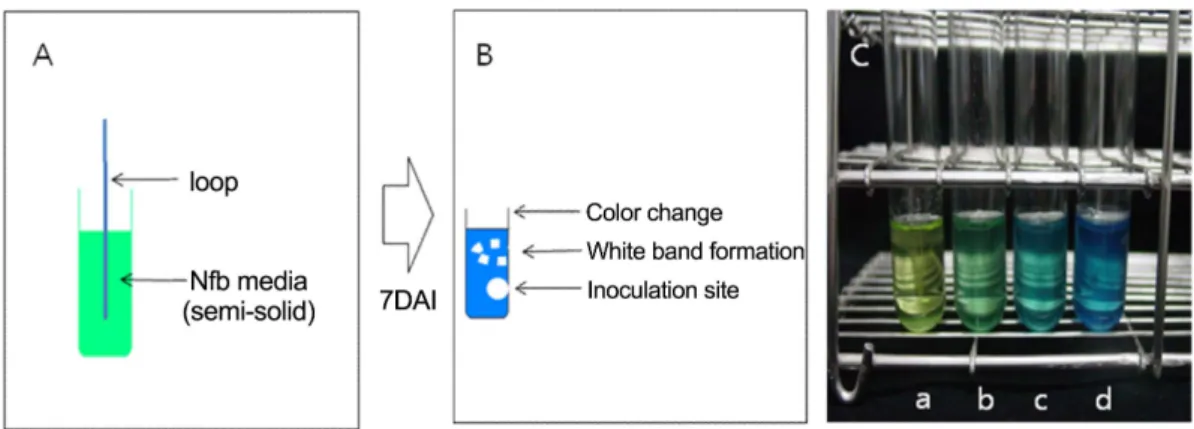
질소고정능력 조사. 농업미생물의 질소 고정능력을 확 인하기 위하여 Kanimozhi와 Panneerselvam(2010)의 질소 고정능력 측정법을 응용한 방법을 사용하였다. 시험관에 KOH와 NaOH로 pH를 6.6−7.0으로 조정한 NFB배지{Malic acid 5.0 g, K2HPO4 0.6 g, KH2PO4 0.4 g, MnSO4 0.01 g, MgSO4 0.05 g, NaCl 0.02 g, Na2MoO4 0.002 g, Bromothymol blue (0.5% in alcohol) 2 ml, 증류수 1000 ml, Agar 1.75 g}
를 시험관에 5 ml씩 분주하고 고압 멸균하여 식힌 후 Fig.
2와 같이 전 배양한 한 다음 미생물을 loop로 접종하여 배양하면서 변색여부를 관찰하였다. 접종 주변에 하얀 밴 드가 형성되거나 색깔이 파란색으로 변할 경우 양성으로 판단하였다. 변색정도에 따라 −, +, ++, +++로 구분하여 조사하였다.
인산가용화 능력조사. 농업미생물의 인산가용화 능력 을 확인하기 위하여 Tricalcium phosphate를 포함하는 Pikovaskaya's medium(Zaidi 등, 2006) {Glucose 10.0 g, (NH4)2SO4 0.5 g, KCl 0.2 g, MgSO4 0.1 g, MnSO4 0.002 g, FeSO4 0.002 g. Yeast extract 0.5 g, Tricalcium phosphate (Calcium phosphate tribasic, Ca3(PO4)2) 5.0 g, 증류수 1000 ml, Agar 20 g}을 샤레에 10 ml씩 분주하여 굳힌 후 샤레 정 중앙에 paper disc를 치상하고 그 위에 미생물 현 탁액을 40 µl씩 접종하였다. 30oC에서 14일간 배양한 후
균총 주변에 투명환(Clear zone, halo zone) 형성여부를 조 사하였다.
IAA(오옥신류) 생성여부조사. 농업미생물의 오옥신류 생성여부를 확인하기 위하여 DF minimal salts media {KH2PO4 4.0 g, Na2HPO4 6.0 g, MgSO4·7H2O 0.2 g, Glucose 2.0 g, Calcium gluconate 2.0 g, Citric acid 2.0 g, Trace metal solution (Sol.A) 0.1 ml, Sol.B 0.1 ml, (NH4)2SO4 2.0 g, L-tryptophan (100 ug/ml)}를 15 ml conical tube에 담아 8000 rpm에서 15분간 원심 분리하였다. 실험에 쓰 일 시험관(test tube)은 70% 알코올에 헹궈서 미리 준비하 고, 각각의 tube에 10 mM phosphoric acid를 100 µl씩 넣 은 다음 상기한 배지액의 상등액 2 ml을 넣고, Salkovasky reagent (35% HClO4 50 ml + 0.5 M FeCl3 1 ml) 4 ml을 넣 고 실내에서 25분간 보관하면서 핑크색이 발현되면 530 nm 에서 UV-spectrophotometer로 OD 값을 측정하였다. 순수 IAA를 이용한 standard curve를 산출한 다음 미생물 배양 결과 얻어진 OD 값을 산출식에 대입하여 오옥신 생성량 을 측정하였다.
고추 흰가루병에 대한 농업미생물 방제효과 검정(온실 검정). 채집한 농업미생물의 고추 횐가루병 방제효과를 구명하기 위하여 각각의 농업미생물을 25oC TSB 배지상 에서 3일간 액체 배양한 다음 5배로 희석(105−106 cfu/ml) 하여 저농도로 조제한 길항균 현탁액을 고추 흰가루병 발 생 초 및 7일 후에 분무처리하고 최종처리 후 7일에 병 발생 정도를 병반면적률로 조사하였다. 시험은 각 처리 당 고추 3주씩 3반복으로 공시하여 수행하였다.
농업용 미생물 처리에 의한 고추 흰가루병 방제효과 검 정(포장시험). 다기능 농업미생물 B. subtilis R2-1의 포 장 처리효과를 검증하기 위하여 고추 유기재배농가에서 미생물 농약을 대조로 처리효과를 조사하였다. B. subtilis R2-1은 25oC TSB 배지상에서 3일간 액체 배양하여 원액
Fig. 2. Measurement of nitrogen fixation ability of Bacillus subtilis isolates in NFb semi-solid medium. (A) Inoculation of B. subtilis isolate in Nfb medium. (B) color change by nitrogen fixation. (C) Index of color change by nitrogen fixation; a, b, c and d means no, a little, moderate and strong nitrogen fixation, respectively. DAI: days after inoculation.
(108cfu/ml)을 7일 간격으로 3회 처리하였고, 미생물농약 (큐펙트 수화제, 탑시드 수화제)은 기준농도로 희석하여 B. subtilis R2-1 처리와 같은 방법으로 살포하였다. 병 발 생 정도는 1차 처리 후 7일과 최종 처리 후 5일에 각각 조사하였다. 다기능 농업미생물 B. subtilis R2-1의 포장 처리효과를 검증하기 위하여 2009년에 이어 2010년도에 도 미생물 농약인 탑시드를 대조로 고추 흰가루병에 대 한 처리효과를 조사하였다.
농업용 미생물 처리에 의한 고추 흰가루병 포자발아억 제 효과조사. 다기능 농업미생물 B. subtilis R2-1의 작 용기작 구명을 위하여 고추 흰가루병 발생초기에 B. subtilis R2-1 포자현탁액을 살포한 후 7일에 처리된 잎을 채취하 여 포자를 회수하여 0.1% PDB broth를 포함하는 홀글라 스 내에 첨가하고, 24시간 25oC 배양기내에 인큐베이션 한 후 건전한 포자수를 조사하였다.
결과 및 고찰
지자체 배양공급 농업미생물의 항균활성. 지자체 생산 공급 농업미생물의 항균활성을 입고병균(R. solani), 고추 탄저병균(C. acutatum), 채소류 시들음병균(F. oxysporum), 벼
도열병균(M. oryzae), 고추 역병균(P. capsici)을 대상으로 검정한 결과 공시한 모든 균에 대하여 항균활성을 보였 다(Table 1). 이는 일반적으로 Bacillus속 세균은 여러 식 물병원균에 항균활성을 보인다는 보고와 일치한다(Feio 등, 2004; Jeong 등, 2010; Sgroy 등, 2001; Swain 등, 2009; Swain 등, 2008b; Zonzheng 등, 2009). B. subtilis의 항균활성은 배양하는 배지에 따라 차이를 보이는데, B, subtilis 355균주의 경우 yeast extract glucose broth에 배 양할 때 항균활성 및 항균 스펙트럼이 높아진다는 보고 가 있다(Feio 등, 2004).
지자체 배양공급 농업미생물의 기능성. 지자체 생산 공급 농업미생물의 기능성 조사결과, 2009년도 채집 균 주의 경우 모두 킬레이트물질인 siderophore를 생성하고 강한 오옥신 활성을 보였으나 활성에는 차이를 보였다.
질소고정능력도 대부분의 Bacillus 속 균주가 보유하고 있 는 것으로 나타났다. 인산가용화능력은 Bacillus 속 균주 중 단 한 균주 만이 활성을 보였다(Table 2).
결론적으로 지자체에서 활용하고 있는 대부분의 B. subtilis 는 폭넓은 항균활성을 보이며, 질소고정과, 오옥신 생성 능력을 지닌 것으로 판명되었다. Woo 등(2008)은 고추역 병 방제효과를 보이는 B. subtilis AH18균주는 siderophore Table 1. Antifungal activity of the selected Bacillus subtilis isolates tested in this study
Isolatea Antifungal activity (cm)b
Pc Mo Rs Fo Ca
1 0c 0.1 0 0 0
2 0.3 0.9 0.1 0.6 0.5
3 0.5 1.5 0.1 0.7 0.8
4 0.4 0.9 0.1 0.8 0.4
5 0.2 0 0.1 0.3 0.6
6 0.4 1.9 0.2 0.2 1.3
7 0.2 0.9 0.4 0.4 0.9
8 0.3 0.8 0.5 0.2 1.1
9 0.3 0.8 0.1 0.5 0.6
10 0 1.7 0.4 0.6 1.1
11 0 0 0 0 0
12 1.0 1.0 1.0 2.5 2.3
13 3.5 1.0 1.0 6.0 8.3
14 2.3 12.5 0 0 0.8
15 2.5 12.5 0 0 2.0
16 4.5 12.3 2.0 1.0 6.5
17 0 1.0 1.0 1.5 7.3
18(R2-1) 0 1.5 0.3 0.1 0.9
a Isolate 1-17: collected from agricultural extension centers; isolate 18: Bacillus subtilis R2-1 from National Academy of Agicultural Science.
bAntifungal activity was measured by dual culturing fungal pathogens and the collected Bacillus subtilis isolates. Pc: Phytophthora capsici, Mo:
Magnaporthe oryzae, Rs: Rhizoctonia solani, Fo: Fusarium oxysporum, Ca: Colletotrichum acutatum.
cEach number represents an average of three replicates.
를 생성하고 이 siderophore는 고추역병균에 강한 활성을 보임을 보고하였다. Ding 등(2005)도 북경지역에서 식물 근권에서 분리한 Bacillus 속 세균과 Paenibacillus 속 세 균이 질소고정능력을 가지고 있음을 보고하면서 질소고 정에는 nifH 유전자가 관여함을 보고한 바 있다. Jadhav 등(2010)도 식품에서 분리한 Bacillus 속 세균이 염에 대 한 내성을 보이며 질소를 고정함을 보고하였다. Jeong 등 (2010)은 산림토양에서 분리한 B. subtilis가 배양배지 상 에서 9종의 필수 아미노산을 생성하고, 질소고정을 하고, 오옥신을 생성하면서 여러 가지 미생물을 억제하는 항균 활성을 보임을 보고하면서 생물농약 또는 생물비료로의 활용 가능성을 제시하였다. Melo Pereira 등(2011)은 딸기 과실내부에서 분리한 B. subtilis가 여러 가지 미생물에 항 균활성을 보이며, siderophore를 생성하고, indole-3-acetic acid(IAA)을 생성하고 온실조건에서 딸기에 처리하였을 때 잎 수, 줄기 길이, 뿌리 및 지상부 무게(건물중)를 각 각 42.8%, 15.26%, 43.5%, 77% 증가시킨다고 보고하였 다. Sgroy 등(2009)도 Prosopis 속 식물에 내생하는 B.
subtilis는 오옥신(IAA)을 비롯한 다양한 식물호르몬을 생 성하며 식물생장을 촉진한다고 보고하였다. Zaidi 등(2006)
도 겨자에 B. subtilis를 처리하였을 때 오옥신을 생성하 고 인산을 가용화한다고 보고하였다. 또한 Swain 등(2009, 2008b)은 소 똥에서 분리한 B. subtilis가 여러 가지 식물 병원균에 항균활성을 보이고, 작물 생장을 촉진하며 황산 화, 인산가용화 및 효소활성을 보인다고 보고하였다.
상기한 바와 같이 B. subtilis는 다양한 기능을 가지고 있기 때문에 균주별 특성을 잘 파악하여 농업현장에서 활 용하면 병 방제, 작물생육 촉진, 염류장해 제거 등 다양 한 효과를 얻을 수 있을 것으로 사료된다.
본 시험에서 조사한 대부분의 Bacillus속 세균은 인산 가용화 능력이 없는 것으로 나타났는데 이는 선행연구에 서 Bacillus속 균주가 인산가용화 능력이 있다는 보고와 는 차이가 있다(Jeong 등, 2010; Khan 등, 2009; Pandy 등, 2008; Raj 등, 1981; Swain 등, 2009). Jeong 등(2010) 은 산림토양에서 분리한 B. subtilis가 인산을 가용화한다 고 보고하였고, Khan 등(2009)도 진균에 비해 세균이 인 산가용화 능력이 일반적으로 높다고 보고하면서 B. subtilis 를 포함한 여러 Bacillus 속 세균이 인산가용화 능력이 있 고 대부분 식물 근권에 높은 밀도로 존재하며, 인산가용 화는 Bacillus 속 미생물이 생성하는 유기산 활성에 기인 하는 것으로 보고하였다.
농업용 미생물 처리에 의한 고추 흰가루병 방제효과(온 실). 고추 흰가루병은 일단 발병하면 병원균이 식물체 내부에 깊숙이 침투하므로 방제가 매우 어려운 병이다 (National Institute of Agricultural Science and Technology, 1977). 고추 흰가루병에 효과적인 B. subtilis 균주를 선발 하고자 저농도(105−106cfu/ml)로 살포하여 병 방제효과를 조사한 결과 B. subtilis 18균주를 제외한 모든 균주의 병 방제효과가 인정되었으나 균주 간에는 차이를 보이지 않 았다(Table 3). 비록 시험균주를 처리하였을 때 병 억제효 과는 인정되었으나 그 효과가 저조하였는데 이는 처리농 도가 105−106cfu/ml로 비교적 낮았기 때문으로 사료된 다. 일반적으로 항생물질을 생성하는 바실러스 속 세균의 병 방제효과는 처리농도가 중요한 요인으로 알려져 있 다. Berger 등(1996)에 따르면 병 억제효과가 병원균의 생 육을 억제하는 항생물질에 기인되는 B. subtilis인 경우 처 리농도가 108cfu/ml 이상 되어야만 적절한 효과를 얻을 수 있다. 따라서 바실러스 속 균주들의 처리효과를 높이 기 위해서는 병원균을 효과적으로 억제할 수 있도록 적 정농도 이상으로 처리농도를 높이는 것이 필요하다. 최근 지자체를 중심으로 병 방제 또는 작물생육 촉진을 목적 으로 미생물을 혼합하여 살포하기도 한다. Janousek 등 (2009)은 방선균과 2종의 바실러스 속 세균을 혼합하여 처리할 경우 바실러스 속 세균만을 단독 처리했을 때보 Table 2. Production of siderophore and IAA, nitrogen fixation
and phosphorus solubilization of the collected Bacillus subtilis isolates
Isolate
Functional activity Siderophore
formation (cm)
IAA formation
(µg/ml)
Nitrogen fixation (color change)
Phosphorus solubilization
(cm)
1 0.5 6.3 − 3.3
2 1.4 37.3 ++ −
3 1.6 35.4 ++ −
4 1.2 41.1 ++ −
5 1.6 22.7 − −
6 1.8 61.6 +++ −
7 1.6 19.0 − −
8 2.7 21.0 + −
9 2.0 34.7 ++ −
10 1.2 21.4 ++ −
11 2.3 26.6 − −
12 11.3 9.5 ++ −
13 15.3 6.6 ++ −
14 3.0 3.7 ++ −
15 5.0 11.0 ++ −
16 14.7 11.4 ++ −
17 9.0 29.6 ++ −
18(R2-1) 1.6 14.0 − −
다 효과가 경감됨을 보고하면서 이는 처리한 방선균과 Bacillus 속 세균 간에 상호 생육을 억제하기 때문으로 고 찰하였다. 따라서 지자체에서 미생물을 혼합하여 사용하 기 위해서는 기능성을 충분히 검토한 후 균주 간 상가적 인 효과를 보는 균주들에 국한하여 사용할 필요가 있다 고 사료된다.
농업용 미생물 처리에 의한 고추 흰가루병 방제효과(화 천 유기농 재배농가 시험). 항균활성을 보이는 농업미생 물 B. subtilis R2-1균주의 현장 적용가능성을 구명하기 위 하여 2009년도에 강원도 화천의 유기재배농가에서 오이 흰가루병 방제용 미생물 농약으로 등록되어 사용되고 있 는 ‘큐펙트’와 ‘탑시드’를 대조로 하여 방제효과를 검정 하였다. 1차 조사시 B. subtilis R2-1균주는 두 가지 미생 물농약 비하여 다소 낮은 방제효과를 보였으나, 2차 조사 시에는 ‘탑시드’보다는 약간 낮은 방제효과를 보였고 ‘큐 펙트’에 비해서는 다소 높은 방제효과를 보였다(Table 4).
1년차 실험에서는 B. subtilis R2-1균주의 고추 흰가루병 방제효과는 1차 조사에서 38.7%, 2차 조사에서 37.7%로 친환경 고추재배농가에서 병 방제를 위해 사용하기에는 효과가 다소 저조하다고 판단되었다.
B. subtilis R2-1균주의 병 방제 효과를 재확인하기 위 하여 2010년도에도 2009년도와 동일한 포장에서 방제효 과 시험을 수행한 결과, 2009년도에 비하여 처리효과가 높게 나타났다. 고추 흰가루병 방제효과는 1차 조사에서 72.0%, 2차 조사에서 83.3%로 미생물 농약 탑시드보다도 높게 나타났다(Table 5). 2010년도에 병 방제효과가 높은 것은 2009년도에 B. subtilis R2-1균주를 비롯한 미생물제 처리가 발병 초가 아닌 병 진전기에 살포하였던 것과는 Table 3. Suppressive effect of the collected Bacillus subtilis
isolates against powdery mildew (Leveillula taurica) of red pepper in the green house
Isolate
Diseased leaf area (%) Replication
I
Replication II
Replication III Average
6 15.0a 21.3 42.5 26.3
8 20.0 32.5 31.3 27.9
12 28.8 23.8 28.8 27.1
13 30.0 30.0 26.3 28.8
14 8.8 42.5 27.5 26.3
15 17.5 40.0 43.8 33.8
16 13.8 36.3 26.3 25.5
17 15.0 20.0 53.8 29.6
18(R2-1) 26.3 30.0 26.3 27.5 Untreated check 46.3 28.8 37.5 37.8
aEach number represents an average of diseased leaf area occurred on three plants.
Table 4. Suppressive effect of Bacillus subtilis R2-1 and microbial fungicides against powdery mildew (Leveillula taurica) of red pepper which was organically-cultivated in Whachon, Gangwon province in 2009
Treatment
Diseased leaf area (%)
1st trial (Sep. 18) 2nd trial (Sep. 30)
Replication I Replication II Average Replication I Replication II Average
Bacillus subtilis R2-1 19.5b 19.0 19.3 21.5 25.0 23.3
Q-pecta 10.0 21.8 15.9 22.5 33.0 27.8
Topsida 9.1 20.8 15.0 14.9 24.3 19.6
Untreated check 29.5 33.5 31.5 35.3 39.5 37.4
a Microbial fungicide for controlling powdery mildew of cucumber.
b Each number represents an average of diseased leaf area occurred on ten plants.
Table 5. Suppressive effect of Bacillus subtilis R2-1 and the microbial fungicide against powdery mildew (Leveillula taurica) of red pepper organically-cultivated in Whachon, Gangwon province in 2010
Treatment
Diseased leaf area (%)
1st trial 2nd trial
Replication I
Replication II
Replication
III Average Replication I
Replication II
Replication
III Average Bacillus subtilis R2-1 3.1 4.8 3.2 3.7 ab 0.8 0.8 2.6 1.4 a
Topsida 5.9 3.8 10.5 6.7 ab 1.0 0.9 6.2 2.7 a
Untreated check 10.8 10.3 18.6 13.2 a 5.8 8.4 11.0 8.4 b
a Microbial fungicide for controlling powdery mildew of cucumber.
b The values with the same letter are not significantly different according to Duncan's multiple range test at 5% level.
달리 2010년도에는 전체 시험포장에서 고추 흰가루병이 부분적으로 발생되었을 때(발병초기)에 살포하였기 때문 으로 추정된다. Berger 등(1996) 등에 따르면 병원균의 밀 도가 높은 경우에는 길항균의 처리효과가 현저히 감소된 다고 한다. 따라서 병원균을 효과적으로 억제하기 위해서 는 병원균의 밀도가 낮을 때 즉, 병이 진전되기 전인 발 병초기에 길항균을 처리하는 것이 좋다. 본 시험에서도 B. subtilis R2-1균주를 발병초기에 처리한 2010년도 시험 에서 병 진전기에 처리한 2009년에 비해 높은 방제효과 를 얻을 수 있었다. 또한 미생물의 처리효과를 높이기 위 해서는 적기에 적절한 농도로 처리하는 것이 매우 중요 한데, B. subtilis R2-1균주의 경우에도 균 농도 및 처리시 기를 고려하여 처리할 경우 보다 높은 방제효과를 얻을 수 있을 것으로 사료되며 이에 대한 심도있는 검토가 필 요하다. 또한 길항균 처리에 의한 병 방제효과를 높이기 위해서 길항균이 처리부위에 잘 정착하여 증식할 수 있
도록 양질의 영양분을 제공해 주는 것도 검토할 필요가 있다. Hoitink 등(1999)은 적절한 퇴비(compost) 첨가할 경 우 생물방제제가 잘 정착되어 생물적 방제효과를 증진시 킬 수 있음을 보고한 바 있다. Romero 등(2007)에 따르 면 호박 흰가루병 방제를 위해 처리한 B. subtilis는 저습 도(75−80%)보다는 고습도(90−95%)에서 훨씬 더 병 진전 을 억제함을 보고하였다. 고추 재배지에서 흰가루병 피해 가 심각함에도 불구하고 이를 방제할 수 있는 생물방제 제가 아직 개발된 바 없다(Raudales 등, 2008). 앞으로 B.
subtilis R2-1을 고농도로 배양할 수 있는 대량배양기술을 개발하고 항균활성 기능이 잘 발현되도록 제형화하면 생 물농약으로의 개발이 가능할 것으로 사료된다.
농업용 미생물 처리에 의한 고추 흰가루병 포자발아억 제. 농업미생물 처리에 의한 병원균 억제효과를 조사하 고자 B. subtilis R2-1균주와 미생물 농약(탑시드, 큐펙트) 처리후 포자발아율을 계수한 결과, 큐펙트는 97.9%, 탑시 Table 6. Suppressive effect of Bacillus subtilis R2-1 and two microbial fungicides on spore germination of Leveillula taurica
Treatment Spore germination (%)
Replication I Replication II Replication III Replication IV Replication V Average
Bacillus subtilis R2-1 0 0 10.0 25.0 10.0 9.0
Q-pecta 0 0 0 0 5.9 1.2
Topsida 0 0 0 10.0 4.8 3.0
Untreated check 75.0 50.0 47.6 52.3 60.0 57.0
aMicrobial fungicide for controlling powdery mildew of cucumber.
Fig. 3. Spores of Leveillula taurica observed on the treated red pepper leaves tested with Bacillus subtilis R2-1 (A), Q-pect (B) and Topsid (C). (D) healthy spores germinated in control plot.
드는 94.7%의 억제율을 보였으나, B. subtilis R2-1균주는 84.2% 억제율을 나타냈다(Table 6, Fig. 3). B. subtilis R2- 1균주의 포자발아 억제효과는 미생물농약인 큐펙트나 탑 시드에 비해 다소 낮았으나 고추 흰가루병균의 포자발아 를 현저히 억제하는 것으로 나타났다. 따라서 고추 흰가 루병에 대한 B. subtilis R2-1균주 처리효과는 항균활성에 기인하는 것으로 판단되었다.
요 약
지자체 농업기술센터와 농과원에서 수집한 18개의 Bacillus subtilis 균주들이 보유하고 있는 기능성을 구명하기 위하 여 항균활성을 비롯한 사이데로포아 생산, 질소고정능력, 인산가용화 능력 및 오옥신 생성능력을 조사하였다. B.
subtilis 균주들은 대부분 입고병균(R. solani), 고추 탄저 병균(C. acutatum), 채소류 시들음병균(F. oxysporum), 벼 도열병균(M. oryzae), 고추 역병균(P. capsici)에 대하여 항 균활성을 보였다. 대부분의 균주가 Siderophore와 오옥신 생성능력을 보였으며 질소고정능력도 함께 보유하고 있 는 것으로 나타났다. 인산가용화능은 조사한 Bacillus 속 균주 중 단 한 균주에서 활성을 보였다. 대부분의 B. subtilis 균주가 고추 흰가루병 억제효과를 보였으나, 균주 간에는 방제효과에 있어서 큰 차이를 보이지 않았다. B. subtilis R2-1균주의 농업현장에서의 활용 가능성을 구명하기 위 하여 2009년도에 강원도 화천의 유기재배농가에서 오이 흰가루병 방제용 미생물 농약으로 등록되어 사용되고 있 는 ‘큐펙트’와 ‘탑시드’를 대조로 하여 방제효과를 검정 하였다. 2009년도에 B. subtilis R2-1 처리시 방제효과는 37.7%로 ‘탑시드’(47.6%)보다는 낮았으나, ‘큐펙트’(25.7%) 에 비해서는 높았다. 2010년도에는 B. subtilis R2-1의 고 추 흰가루병 방제효과가 83.3%로 미생물 농약인 탑시드 보다도 높게 나타났다. B. subtilis R2-1균주의 발병억제 기작을 구명하기 위하여 B. subtilis R2-1균주와 미생물 농 약(탑시드, 큐펙트)을 경엽 처리한 후 포자발아율을 계수 한 결과, 미생물 농약인 큐펙트는 97.9%, 탑시드는 94.7%
억제하는데 비해서 B. subtilis R2-1균주는 84.2% 억제하 는 것으로 나타났다. 앞으로 B. subtilis R2-1을 고농도로 배양할 수 있는 대량배양기술을 개발하고 항균활성 기능 이 잘 발현되도록 제형화한다면 생물농약으로의 개발이 가능할 것으로 사료된다.
Acknowledgement
This study was carried out with the support of “Research
Program for Agricultural Science & Technology Development (Project No. PJ0084362012)”, National Academy of Agricultural Science, Rural Development Administration, Republic of Korea.
References
Ahlawat, S., Mandham, R. P., Dhiman, S. S., Kumar, R. and Sharma, J. 2008. Potential application of alkaline pectinase from Bacillus subtilis SS in pulp and paper industry. Appl.
Biochem. Biotechnol. 149: 287−293.
Anonymous. 2011. Management of powdery mildew, Leveillula taurica, in green house peppers (http://www.afg,gov.bc.ca) Asaka, O. and Shoda, M. 1996. Bio-control of Rhizoctonia solani
damping-off of tomato with Bacillus subtilis RB14. Appl.
Environ. Microbiol. 62: 4081−4085.
Berger, F., Li, H., Qhite, D., Frazer, R. and Leifert, C. 1996. Effect of pathogen inoculum, antagonist density and plant species on biological control of Phytophthora and Pythium damping-off by Bacillus subtilis cot1 in high-humidity fogging glasshouses.
Phytopathology 86: 428−433.
Crisp, P., Wicks, T., Bruer, D. and Scott, E. 2006. An evaluation of biological controls for grapevine powdery mildew. Aust. J.
Grape Wine Res. 12: 203−211.
Ding, Y., Wang, J., Liu, Y. and Chen, S. 2005. Isolation and identification of nitrogen- fixing bacilli from plant rhizosphere in Beijing region. J. Appl. Microbiol. 99: 1271−1281.
Feio, S. S., Barbosa, A., Cabrita, M., Nunes, L., Esteves, A., Roseiro, J. C. and Curto, M. J. M. 2004. Antifungal activity of Bacillus subtilis 355 against wood-surface contaminant fungi.
J. Ind. Microbiol. Biotechnol. 31: 199−203.
Grossman, T. H., Tuckman, M., Elletad, S. and Osburne, M. S.
1993. Isolation and characterization of Bacillus subtilis genes involved in siderophore biosynthesis: Relationship between Bacillus subtilis and E. coli entD genes. J. Bacteriol. 175:
6203−6211.
Hegazi, M. A. and El-Kot, G. A. 2010. Biological control of powdery mildew on Zinnia using some bio-control agents and plant extract. J. Agric. Sci. 2: 221−228.
Hoitink, H. A. J. and Boehm, M. J. 1999. Bio-control within the context of soil microbial communities: A substrate-dependent phenomenon. Annu. Rev. Phytopathol. 37: 427−446.
Jadhav, G. G., Salunkhe, D. S., Nerkar, D. P. and Bhadekar, R. K.
2010. Isolation and characterization of salt-tolerant nitrogen- fixing microorganisms from food. Eur. Asia J. BioSci 4: 33−
40.
Janousek, C. N., Lorber, J. D. and Gubler, W. D. 2009. Combination and rotation of bacterial antagonists to control powdery mildew on Pumpkin. J. Plant Dis. Prot. 116: 260−262. (Short communication)
Jeon, J. S., Lee, S. S., Kim, H. Y., Ahn, T. S. and Song, H. G.
2003. Plant growth promotion in soil by some inoculated microorganisms. J. Microbiol. 41: 271−276.
Jeong, J. H., Jeon, Y. D., Lee, O. M., Kim, J. D., Lee, N. R., Park, G. T. and Son, H. J. 2010. Characterization of multi-functional feather-degrading Bacillus subtilis isolated from forest soil.
Biodegradation 21: 1029−1040.
Kanimozhi, K. and Panneerselvam, A. 2010. Studies on isolation and nitrogen fixation ability of Azospirillium spp. isolated from Thanjavur district. Der Chemica Sinica 1: 138−145.
Khan, A. A., Jilani, G. M., Akhtar, S., Naqvi, S. M. S. and Rasheed, M. 2009. Phosphorus-solubilizing bacteria: occurrence, mechanisms and their role in crop production. J. Agric. Biol.
Sci. 1: 48−58.
Melo-Pereira, G. V., Magalhaes, K. T., Lorenzetii, E. R., Souza, T.
P. and Schwan, R. F. 2012. A multi-phasic approach for the identification of endo-phytic bacterial in strawberry fruit and their potential for plant growth promotion. Microbial Ecol. 63:
405-417.
Milagres, A. M. F., Machuca, A. and Napoleão, D. Detection of siderophore production from several fungi and bacteria by a modification of chrome azurol S (CAS) agar plate assay. J.
Microbiol. Met. 37: 1−6.
National Institute of Agricultural Science and Technology. 1977.
Compendium of vegetable diseases with color plates. Sammi Press, Seoul, Korea. 447 pp. (In Korean)
Pandey, A., Bringel, F. and Meyer, J. M. 1994. Iron requirement and search for siderophores in lactic acid bacteria. Appl.
Microbiol. Biotechnol. 40: 735−739.
Prashanth, S. and Mathivanan, N. 2010. Growth promotion of groundnut by IAA producing bacteria Bacillus licheniformus.
MML2501. Arch. Phytopathol. Plant Prot. 43: 191−208.
Raj, J., Bagyaraj, D. J. and Manjunath, A. 1981. Influence of soil inoculation with vesicular-arbuscular mycorrhiza and a phosphate-dissolving bacterium on plant growth and P-uptake.
Soil Biol. Biochem. 13: 105−108.
Raudales, R. E. and Gardener, B. B. M. 2008. Microbial bio- pesticides for the control of plant diseases in organic farming.
Agriculture and Natural resources (Fact sheet). Ohio State University. 5 pp.
Romero, D., Vicente, A., Zeriouh, H., Cazorla, F. M., Fernandez- Orouno, D., Tores, J. A. and Perez-Garcia, A. 2007. Evaluation
of biological control agents for managing cucurbit powdey mildew on greenhouse-grown melon. Plant Pathol. 56: 976− 986.
Schwyn, B. and Neilands, J. B. 1997. Universal chemical assay for the detection and determination of siderophores. Anal.
Biochem. 160: 46−56.
Sgroy, V., Cassan, F., Masciarelli, O., Papa, M. F. D. and Lagares, A. 2009. Isolation and characterization of endophytic plant growth-promoting (PGPB) or stress homeostasis- regulating (PSHB) bacteria associated to the halophyte Prosopis strombulifera. Appl. Microbiol. Cell Physiol. 85: 371−381.
Swain, M. R. and Ray, R. C. 2008a. Optimization of cultural conditions and their statistical interpretation for production of indole-3-acetic acid by Bacillus subtilis CM5 using cassava fibrous residue. J. Sci. Ind. Res. 67: 622−628.
Swain, M. R. and Ray, R. C. 2009. Bio-control and other beneficial activities of Bacillus subtilis isolated from cow dung microflora. Microbiol. Res. 164: 121−130.
Swain, M. R., Ray, R. C. and Nautiyal, C. S. 2008b. Bio-control efficacy of Bacillus subtilis strains isolated from cow dung against postharvest yam pathogens. Curr. Microbiol. 57: 407− 411.
Todorova, S. and Kozhuharova, L. 2010. Characteristics and antimicrobial activity of Bacillus subtilis strains isolated from soil. World J. Microbiol. Biotechnol. 26: 1207−1216.
Woo, S. M. and Kim, S. D. 2008. Structural identification of siderophore from Bacillus subtilis AH18, a biocontrol agent of Phytophthora blight disease in red pepper. Korean J.
Microbiol. Biotechnol. 36: 326−335.
Zaidi, S., Usmani, S., Singh, B. R. and Musarrat, J. 2006.
Significance of Bacillus subtilis strain SJ-101 as a bio- inoculant for concurrent plant growth promotion and nickel accumulation in Brassica juncea. Chemosphere 64: 991−997.
Zlotnikov, A. K., Shapovalova, Y. N. and Makarov, A. A. 2001.
Association of Bacillus firmus E3 and Klebsiella terrigena E6 with increased ability for nitrogen fixation. Soil Biol. Biochem.
33: 1525−1530.
Zongzheng, Y., Xin, L., Zhong, L., Jinzhhao, P., Jin, Q. and Wenyan, Y. 2009. Effect of Bacillus subtilis SY1 on antifungal activity and plant growth. Int'l J. Agric. Biol. Eng. 2: 33−61.