Background/Aims: School nurses’ knowledge of inflam- matory bowel disease (IBD) has not been evaluated. We aimed to investigate school nurses’ knowledge of IBD and determine whether education could improve this knowledge.
Methods: School nurses were invited to complete self-report- ed questionnaires on IBD. Then, IBD specialists from tertiary referral hospitals provided a 60-minute lecture with educa- tional brochures on two occasions, with a 3-month interval.
Within 6 months after the educational interventions, school nurses were asked to complete the same IBD questionnaire via e-mail. Results: Among 101 school nurses who were invited to participate, 54 nurses (53.5%) who completed two consecutive questionnaires were included in this study (median age, 45 years; range, 25 to 59 years; 100% female);
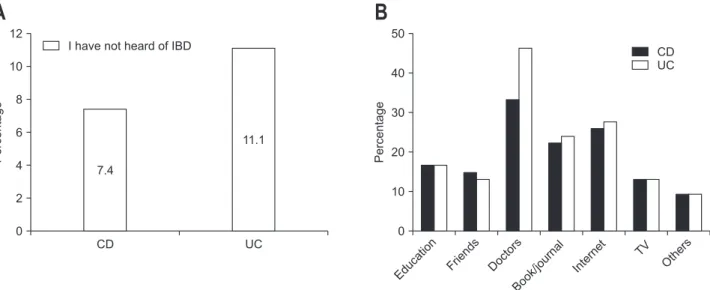
11.1% and 7.4% of the study participants had no knowledge regarding ulcerative colitis and Crohn’s disease, respectively.
They had heard of IBD most frequently from doctors (33.3%), followed by internet sources (25.9%). After 6 months, the number of nurses who could explain IBD to students with over 30% confidence increased from 24 (44.5%) to 42 (77.8%) (p<0.001). Most nurses (81.5%) reported that the educational intervention was helpful for managing students with abdominal pain or diarrhea. The number of students who received IBD-related welfare services from the Daegu Metropolitan Office of Education doubled when compared with the corresponding number during the prior educational year. Conclusions: There is room for improvement in school nurses’ knowledge of IBD. A systematic educational program on IBD should be implemented for these nurses. (Gut Liver
2019;13:48-53)
Key Words: Inflammatory bowel disease; Crohn disease;
Colitis, ulcerative; Schools, nursing INTRODUCTION
Inflammatory bowel disease (IBD), which includes Crohn’s disease (CD) and ulcerative colitis (UC), is characterized by chronic inflammation of the gastrointestinal tract that often re- quires life-long management. IBD has a relapsing disease course that negatively impacts patients’ quality of life.
1,2Although no keys to the pathogenesis of this disease have been clearly identified, environmental and genetic factors are known to be involved in the development of IBD.
3In approximately one-quarter of IBD cases, the disease de- velops during childhood or adolescence.
4IBD occurrence at this young age has several clinical implications that merit consider- ation. First, for IBD, onset at a young age is a factor associated with poor prognosis. For CD, young age at diagnosis is associ- ated with a high risk of upper gastrointestinal involvement, extensive disease and a disabling course.
5-7For UC, patients diagnosed at a young age are more likely to have extensive dis- ease, undergo colectomy, and exhibit proximal disease exten- sion and/or colorectal neoplasia.
8-10Second, when children do not receive optimal treatment, IBD may cause irreversible linear growth impairment, one of the critical complications of this dis- ease.
11Third, for CD, younger age at diagnosis is an independent risk factor for long diagnostic delay, which has a detrimental
This is an Open Access article distributed under the terms of the Creative Commons Attribution Non-Commercial License (http://creativecommons.org/licenses/by-nc/4.0) which permits unrestricted non-commercial use, distribution, and reproduction in any medium, provided the original work is properly cited.
Impact of Education on School Nurses’ Knowledge of Inflammatory Bowel Disease
Eun Soo Kim
1, Ki Tae Kwon
1, Sung Kook Kim
1, Miyoung Kim
2, Hyun Seok Lee
1, Byung Ik Jang
3, Kyeong Ok Kim
3, Eun Young Kim
4, Yoo Jin Lee
5, Suk Jin Hong
6, Chang Heon Yang
7, Ben Kang
8, Byung-Ho Choe
8, and on behalf of the Crohn’s and Colitis Association in Daegu-Gyeongbuk (CCAiD)
1
Department of Internal Medicine, School of Medicine, Kyungpook National University,
2Keimyung University College of Nursing,
3Department of Internal Medicine, Yeungnam University College of Medicine,
4Department of Internal Medicine, Catholic University of Daegu School of Medicine,
5Department of Internal Medicine, Keimyung University School of Medicine,
6Department of Pediatrics, Catholic University of Daegu School of Medicine, Daegu,
7Department of Internal Medicine, Dongguk University School of Medicine, Gyeongju, and
8Department of Pediatrics, School of Medicine, Kyungpook National University, Daegu, Korea
Correspondence to: Byung-Ho Choe
Department of Pediatrics, School of Medicine, Kyungpook National University, 680 Gukchaebosang-ro, Jung-gu, Daegu 41944, Korea Tel: +82-53-200-5704, Fax: +82-53-425-6683, E-mail: [email protected]
Received on March 20, 2018. Revised on May 29, 2018. Accepted on June 17, 2018. Published online November 12, 2018 pISSN 1976-2283 eISSN 2005-1212 https://doi.org/10.5009/gnl18139
Eun Soo Kim and Ki Tae Kwon contributed equally to this work as first authors.
impact on clinical outcomes, leading to issues such as a high risk of intestinal surgery and poor quality of life.
12,13Therefore, timely, appropriate management enabled by the early detection of IBD is of utmost importance for young patients with IBD.
Children spend a large proportion of their time at school.
According to an Organization for Economic Co-operation and Development (OECD) indicator, for elementary- and middle- school-aged students from OECD countries, the average com- pulsory instruction times at school are 794 and 905 hours per year, respectively.
14These statistics only reflect part of the total time that students are at school because compulsory hours only account for time in formal classroom settings. Therefore, chil- dren and adolescents with IBD may experience symptoms while they are at school.
In this context, school nurses who take care of students’
health at school may play a crucial role in identifying and man- aging students with IBD. However, school nurses’ knowledge of IBD has never previously been evaluated. Thus, we aimed to assess school nurses’ degree of awareness regarding IBD and to determine whether education improved this awareness.
MATERIALS AND METHODS 1. Methods
This investigation was a prospective follow-up study based on a survey that assessed school nurses’ knowledge of IBD. School nurses who were registered at the Daegu Metropolitan Office of Education were invited to come to a meeting and asked to complete a questionnaire on IBD. The main questions used in the study were as follows: (1) Have you heard of CD or UC? (2) What is your source of information regarding these conditions?
(3) How would you rate your confidence regarding knowledge of IBD in terms of explaining IBD to students? (4) How would you rate your confidence regarding knowledge of IBD in terms of identifying symptoms suspicious for IBD? (5) Do you know of the welfare service system of the Daegu Metropolitan Office of Education for students with IBD?
Since January 2009, the Daegu Metropolitan Office of Educa- tion has provided students with IBD with financial support to cover their medical expenses. Candidates for this support have been selected by a school nurse and a homeroom teacher from each school after a review of medical documentation.
After the aforementioned survey was administered, 60-min- ute educational lectures with brochures regarding the epidemi- ology, pathogenesis, clinical symptoms, signs, diagnosis, and treatment of IBD were delivered in February 2015 by gastro- enterologists from tertiary referral hospitals on two occasions, with a 3-month interval between these occasions. The follow-up survey sent via e-mail was collected within 6 months after the final educational lecture.
2. Statistical analysis
Categorical variables were expressed using numbers and per- centages, whereas continuous variables were described using median values and ranges. Variables were compared before and after education using paired t-tests. For a question with a di- chotomized answer (yes or no), responses before and after edu- cation were compared using the McNemar test. All tests were two-sided, and p<0.05 was regarded as indicative of statistical significance. All statistical analyses were performed using SPSS software version 18.0 (SPSS Inc., Chicago, IL, USA).
RESULTS
1. Baseline characteristics of school nurses
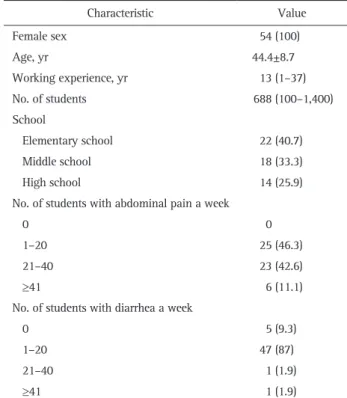
Among 101 school nurses invited to participate in the study, 54 respondents (53.5%) who completed both surveys were even- tually included (100% female; median age, 45 years; range, 25–
59 years). Their median working experience was 13 years (range, 1–37 years). The median number of students that school nurses were caring for was 688 (range, 100–1,400 students). Twenty- two (40.7%), 18 (33.3%) and 14 (25.9%) of the nurses were working at elementary, middle and high schools, respectively. In the nurses’ experiences, more students complained of abdomi- nal pain than diarrhea. More than half of the participants (29/54, 53.7%) responded that they encountered more than 20 students with abdominal pain per week, whereas only one nurse reported that she encountered more than 20 students with diarrhea per
Table 1. Baseline Characteristics of School Nurses (n=54)
Characteristic Value
Female sex 54 (100)
Age, yr 44.4±8.7
Working experience, yr 13 (1–37)
No. of students 688 (100–1,400)
School
Elementary school 22 (40.7)
Middle school 18 (33.3)
High school 14 (25.9)
No. of students with abdominal pain a week
0 0
1–20 25 (46.3)
21–40 23 (42.6)
≥41 6 (11.1)
No. of students with diarrhea a week
0 5 (9.3)
1–20 47 (87)
21–40 1 (1.9)
≥41 1 (1.9)
Data are presented as number (%), mean±SD, or median (range).
week. Baseline characteristics of the participants are described in Table 1.
2. Responses to questionnaires on IBD
Six (11.1%) and four (7.4%) of the school nurses had never heard of UC and CD, respectively (Fig. 1A). For the study par- ticipants, information regarding these conditions was most frequently obtained from doctors (46.3% for UC, 33.3% for CD), followed by internet searches (27.8% for UC, 25.9% for CD) (Fig.
1B).
With respect to confidence regarding knowledge of IBD, the percentage of school nurses who could explain IBD to their stu- dents with over 30% confidence was 44.5% (24/54). However, this figure significantly increased to 77.8% (42/54) within 6
months after the educational intervention (p<0.001) (Fig. 2A). In addition, the percentage of school nurses who replied that they could differentiate students with symptoms suspicious for IBD from those with functional symptoms with over 30% confidence significantly increased from 11.1% (6/54) to 27.9% (15/54) after the educational intervention (p<0.001) (Fig. 2B).
3. Awareness of the Daegu Metropolitan Office of Educa- tion’s welfare system for students with IBD
The percentage of school nurses who were aware of the wel- fare system for students with IBD provided by the Daegu Met- ropolitan Office of Education also significantly increased from 50% (27/54) to 68.5% (37/54) after the educational interven- tion (McNemar test p=0.038) (Fig. 3A). In addition, the actual
Percentage
A B
CD 12
10
8
6
4
2
UC 0
I have not heard of IBD
Percentage
Educatio n
Friends Doctor s
Book/journal Internet
TV Other
s
50
40
30
20
10
0
CD UC
7.4
11.1
Fig. 1. School nurses’ knowledge and sources of information regarding inflammatory bowel disease (IBD). (A) The percentages of school nurses who have not heard of Crohn’s disease (CD) or ulcerative colitis (UC). (B) The main sources of information on CD and UC.
Percentage
A B
60
50
40
30
20
10
0
Percentage
70
40 30 20 10
0
Before After
Confidence (%)
0130 31
50 51
80 81
100
Confidence (%)
01 30 31
50 51
80 81
100
p<0.001* p<0.001*
60 50 Before
After
Fig. 2. School nurses’ confidence regarding knowledge of inflammatory bowel disease (IBD) before and after education. (A) How would you rate
your confidence regarding knowledge of IBD in terms of explaining IBD to students? (B) How would you rate your confidence regarding knowl-
edge of IBD in terms of identifying symptoms suspicious of IBD? *Paired t-test.
number of students with IBD who received this welfare service more than doubled for the year after the educational interven- tion (arrow, Fig. 3B) compared with the corresponding number for the previous year, increasing from 24 to 56. Notably, the first student with IBD from middle school who benefited from this service was enrolled immediately after the educational in- tervention (Fig. 3B). Most of the participants (81%) replied that the educational efforts were helpful for managing students with abdominal pain or diarrhea (Fig. 4).
DISCUSSION
This follow-up survey-based study showed that one out of ten school nurses did not have any knowledge regarding IBD and that school nurses’ overall knowledge did not sufficiently translate to the ability to identify IBD students at schools, sug-
gesting suboptimal awareness of IBD in the school nurse popu- lation. After medical personnel such as doctors, the internet was school nurses’ main source of information regarding IBD. How- ever, educational efforts, in the form of a 60-minute lecture and brochures that were delivered on two occasions with a 3-month interval between occasions, significantly improved school nurs- es’ knowledge of IBD.
The incidence of pediatric IBD has been rapidly increasing in Asian countries, such as South Korea, China and Japan, causing significant social and economic burdens.
15-17A recent popula- tion-based study of IBD showed that CD incidence was highest (9.1 per 10
5) in the age group 15 to 19 years that are middle or high school age.
18Further, incidence of pediatric IBD in Daegu area increased from 9 per 10
5in 2011 to 30 per 10
5in 2016.
19Although the prevalence of IBD remains lower in Asia than in Western countries, it is time to brace for a dramatic surge in Asian patients with IBD.
Given that children and adolescents spend a large portion of time at school, school nurses, who stand on the front lines of medicine at schools, may play an essential role in managing students’ various medical conditions. Several studies have eval- uated the efficacy of an educational intervention on emergency, disaster or biological event preparedness for school nurses and shown that education significantly improved school nurse pre- paredness with respect to knowledge and skills.
20,21However, no prior studies have determined school nurses’ awareness of IBD and assessed the impact of education on this awareness.
Chronic abdominal pain is a major symptom of IBD.
22Al- though most recurrent abdominal pain results from functional disorders such as irritable bowel syndrome, with organic causes (including IBD) only observed in 5% to 10% of cases, differ- entiating among these causes based on symptoms is known to be extremely challenging.
23Recurrent abdominal pain is one
Percentage
A B
Before education 80
60
40
20
After education 0
No.ofstudents
2009
60
40
30
20
10
0
5068.5
50
I know the welfare system
Middle school High school Total
Year
2010 2011
2012 2013 2014 2015
2016 ( Aug)
p=0.038*
Fig. 3. School nurses’ awareness of the welfare service system (A) and the number of students who benefited from this service each year (B). The arrow indicates the educational intervention. *The McNemar test.
Very much (31%)