• 검색 결과가 없습니다.

A Case of Secondary FSGS due to Chronic Chloride Diarrhea

N/A
N/A
Protected

Academic year: 2021

Share "A Case of Secondary FSGS due to Chronic Chloride Diarrhea"

Copied!
5
0
0

로드 중.... (전체 텍스트 보기)

전체 글

(1)

DOI: https://doi.org/10.3339/jkspn.2016.20.2.83

ISSN 2384-0250 (online)

A Case of Secondary FSGS due to Chronic Chloride Diarrhea

Congenital chloride diarrhea (CLD) is a rare autosomal recessive disease that is dif- ficult to diagnose. CLD requires early treatment to correct electrolyte imbalance and alkalosis and to prevent severe dehydration. Renal injury is clearly associated with defective electrolyte balance induced by CLD, particularly during the first months or years of life. A 7-year-old boy was diagnosed with CLD following detec- tion of a homozygous mutation (c.2063-1G>T) in SLC26A3 at 6 months of age.

During treatment with electrolyte supplements, mild proteinuria was detected at 8 months of age, and is still present. Renal biopsy showed the presence of focal renal dysplasia, with metaplastic cartilage and mononuclear cell infiltration, cal cification, and fibrosis in the interstitium. Up to two-thirds of the glomeruli exhi bited global obsolescence, mostly aggregated in the dysplastic area. In non- dysplastic areas, the glomeruli were markedly increased in size and severely hyper- cellular, with increased mesangial matrix, and displayed segmental sclerosis. The marked glomerular hypertrophy with focal segmental glomerulosclerosis sug- gested a compensatory reaction to the severe nephron loss or glomerular obsole- scence associated with renal dysplasia, with superimposed by CLD aggravating the tubulointerstitial damage.

Key words: Congenital chloride diarrhea, Renal complication, Focal segmental glomerulosclerosis, Renal dysplasia

Byung Kwan Kim, M.D.

1

Hyun Soon Lee, M.D., Ph.D.

2

Hyung Eun Yim, M.D., Ph.D.

3

Hae Il Cheong, M.D., Ph.D.

4,5

Kee Hwan Yoo, M.D., Ph.D.

1

Department of Pediatrics

1

, Korea University Guro Hospital, Seoul, Korea, Hankook Kidney and Diabetes Institute

2

, Seoul, Korea, Department of Pediatrics

3

, Korea University Ansan Hospital, Gyeonggi-do, Korea, Depart- ment of Pediatrics

4

, Seoul National University Children’s Hospital, Seoul, Korea, Research Coordination Center for Rare Diseases

5

, Seoul National University Hospital, Seoul, Korea

Corresponding author:

Kee Hwan Yoo, M.D., Ph.D.

Department of Pediatrics, Korea University Guro Hospital, 148, Gurodong-ro, Guro- gu, Seoul, 08308, South Korea, Tel: +82-2-2626-1222

Fax: +82-2-2626-1249 E-mail: [email protected] Received: 17 August 2016 Revised: 12 September 2016 Accepted: 10 October 2016

This is an open-access article distributed under the terms of the Creative Commons Attribu tion Non-Commercial License (http://

crea tivecom mons.org/licenses/by-nc/4.0/) which permits unrestricted non-commercial use, distribution, and reproduction in any medium, provided the original work is properly cited.

Copyright © 2016 The Korean Society of Pediatric Nephrology

Introduction

Congenital chloride diarrhea (CLD) is a rare disease with an autosomal recessive inheritance

1)

. The incidence is in the range of 1 in 30,000 to 40,000 live births in Finland, which accounts for approximately one-fifth of the 250 reported cases

2)

. The solute carrier family 26 member 3 ( SLC26A3) gene cau- sative of CLD encodes a Cl

-

/HCO

3-

exchanger expressed mainly in the inte- stinal epithelium

3)

.

CLD is an intestinal disorder of defective electrolyte transport characte-

rized by chronic secretory diarrhea with high fecal chloride levels. Because of

the intrauterine onset of diarrhea, CLD patients present maternal polyhydram-

nios and premature birth

4)

. Postnatally, profuse watery chloride-rich diarrhea

leads to excessive loss of fluids, dehydration, and weight loss

5)

. Electrolyte im-

balances such as hypochloremia and hyponatremia are usually accompanied

by metabolic alkalosis, activation of the renin-angiotensin system, and

(2)

hypopotassemia

6)

. If untreated, this metabolic imbalance with severe dehydration can be lethal in infancy

4)

.

During childhood, growth retardation, development delay, and progressive renal involvement are common complications of CLD

7,8)

. The renal injury manifests as mul- tiple changes in the hyalinized glomeruli, juxtaglomerular hyperplasia, vascular changes, and nephrocalcinosis

9)

. Ac- cording to past reports, the main feature of the renal injury is known as nephrocalcinosis, which is caused by urine supersaturation and crystal precipitation, with no hyper- calciuria or nephrolithiasis

7)

.

This report describes a case of CLD with mild proteinuria in which renal biopsy showed renal dysplasia and focal seg- mental sclerosis (FSGS) with only patchy calcification.

Case report

A 6-month-old male patient was brought to the Korea University Guro Hospital for severe watery diarrhea and lethargy in June, 2008. The patient’s diarrhea symptoms began immediately after birth, and had been continuous up to the writing of this report. There were no accompa- nying symptoms such as vomiting or fever. The patient was born with a birth weight of 2,780 g at 37 weeks’ gestation and was normal for his gestational age, except for the poly- hydramnios in the prenatal phase.

The patient weighed 5.7 kg at the time of admission to the hospital, which indicated weight below the third per- centile corrected by age. His height and head circumference were 67.8 cm (50

th

percentile) and 41 cm (25

th

percentile), respectively, which were within normal ranges. In blood tests after hospitalization, the patient’s serum sodium level was 125 mmol/L, potassium 3.1 mmol/L, and chloride 62 mmol/L Serum magnesium was also low, at 0.9 mg/dL.

Severe metabolic alkalosis was observed on blood gas an- alysis, with a pH of 7.71 and HCO

3-

43.0 mmol/L. Notably, the patient’s serum renin and serum aldosterone were very high, at 47.3 ng/mL/hr (normal range 1.4-7.8) and 1,479.9 pg/mL (normal range 65-860), respectively. Serum blood urea nitrogen was slightly increased at 25.6 mg/dL, but the patient’s kidney function was normal, with serum creati- nine (Cr) being 0.34 mg/dL and, estimated glomerular filt- ration rate 82 mL/min/1.73m

2

. Serum protein was 8.3 g/

dL, and urine specific gravity was slightly increased at 1.025 on urine analysis. Proteinuria, hematuria, and hypercal- ciuria were absent (urinary protein/Cr 0.38 mg/mg, urinary Ca/Cr 0.04 mg/mg). However, with regards to urine elec- trolytes, Na

+

, K

+

, and Cl

-

levels were decreased (<10 mmol/

L, 22.5 mmol/L, <10 mmol/L, respectively). There was no abnormal findings from the fecal studies, yet the fecal elec- trolyte testing could not be proceeded due to lack of related devices and protocols in our hospital laboratory. After treat- ment, symptoms of dehydration and the blood tests im- proved, although diarrhea symptoms continued even at discharge from hospital. Thus, a genetic test was conducted in August, 2008, which detected a homozygous splicing ac- ceptor site mutation in SLC26A3 (c.2063-1G>T in intron

18)

, leading to the diagnosis of CLD. This mutation is known as a common mutation in Korean patients with CLD

10)

.

Treatment with NaCl and KCl oral formulations was continued during the outpatient follow-up period. Protei- nuria was detected when the patient was 10-months-old with spot urine protein to creatinine ratio of 1.38. Though mild hypochloremia (88 mmol/L) was detected on blood testing, both serum Na

+

and K

+

and the blood gas analysis were normal; the serum Cr was 0.28 mg/dL. The patient have maintained a level of serum Cr ranging from 0.4 to 0.7 mg/dL since the age of 6 months, and mild proteinuria continued until the age of seven (urinary protein/Cr 0.2- 1.7 mg/mg). Due to the patient’s mild proteinuria, a percu- taneous ultrasound-guided renal biopsy was performed at 7 years of his age. His vital sign was stable without hyper- tension and blood tests were within normal range: a serum protein and albumin level of 7.1 g/dL and 4.4 g/dL, respec- tively. The renal ultrasonography showed no abnormal findings and 24hr urine protein was checked as 173.1 mg/

day.

After the biopsy, the electrolyte supplement is currently maintained. His height and body weight are all below than 3

rd

percentile (118.3 cm and 19.8 kg). His blood pressure is stable between 50

th

and 90th percentile, and blood tests showed no abnormal findings. But proteinuria is steadily detected with a urinary protein/Cr, 0.57 mg/mg.

1. Renal pathology findings

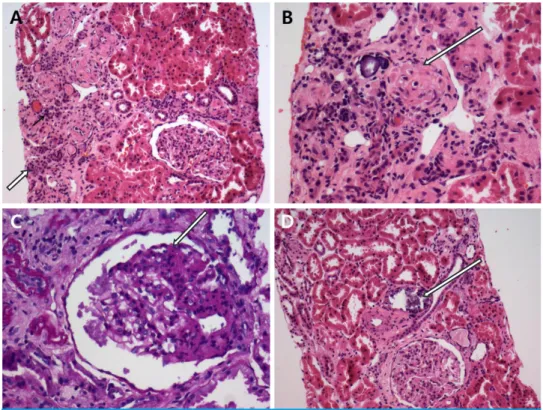
In a biopsy core of renal cortex, an abnormal dysplastic

focus is present separated by normal cortical areas showing

(3)

immature tubules and aggregates of small globally sclerotic glomeruli (Fig. 1A). Furthermore, metaplastic cartilage is shown together with calcification (Fig. 1B). In another cor- tical areas without dysplasia, seven glomeruli are observed.

The glomeruli are markedly enlarged, measuring 250 μm in maximum diameter, and severely hypercellular invol- ving mesangial cells. Mesangial matrix is also increased.

Two glomeruli exhibit segmental sclerosis (Fig. 1C). By electron microscopy, the glomerular basement membrane measures up to 400 nm in average thickness having rela- tively smooth inner and outer contours. No electron-dense deposits are found. Epithelial cell foot processes remain relatively patent (Figure not shown). In non-dysplastic areas, tubules reveal focal moderate atrophy and loss with interstitial fibrosis. Rarely, tubular calcification is seen (Fig. 1D).

Discussion

Renal complications are known to occur relatively fre-

quently in CLD patients. A previous study reported that chronic kidney disease occurs in 28% of CLD patients

7)

. Based on previous study results, early diagnosis is essential in these conditions to delay the progression of CLD-related kidney complications. In addition, timely balancing of elec- trolytes through proper supplementation of NaCl and KCl, together with acid-base balance, and periodical evaluation of kidney functions delay disease progression

8,11)

. However, kidney complications often progress in CLD patients despite proper treatments. Such progression has been re- ported in previous studies, even in cases with transplanted kidneys

7)

.

These CLD-induced kidney diseases are known to occur mainly in the form of nephrocalcinosis

7)

. Reabsorption of calcium ions filtered by the kidney glomerulus occurs in the proximal tubule and thick ascending loop of Henle (ThALH). Calcium reabsorption in this region occurs through passive para-cellular routes promoted by Na

+

and Cl

-

reabsorption. The distal nephron accounts for only 10% of calcium reabsorption

12,13)

. CLD patients fall into a continuous state of hyponatremia and hypochloremia as a

Fig. 1. A portion of dysplastic area is present separated by normal cortical areas. In dys plastic area, immature tubules (arrows) and aggregates of small globally sclerotic glo meruli are shown (H&E, x10, A).

In another dysplastic area, metaplastic cartilage (arrow) is shown together with calcification (H&E, x10,

B). An enlarged glomerulus showing seg mental sclerosis (arrow) (PAS, x20, C). In non-dysplastic areas,

focal tubular calcification (arrow) is seen (H&E, x10, D).

(4)

result of impaired reabsorption of Na

+

and Cl

-

by the inte- stines. This greatly increases Na

+

and Cl

-

reabsorption in the proximal tubule. As a result, the amount of Na

+

and Cl

-

that reaches the ThALH and distal nephron decreases, which then in turn negatively affects the passive para-cel- lular calcium reabsorption

7)

. At the same time, dehydration caused by continued diarrhea, as well as hypovolemia, reduces urinary flow, resulting in urine supersaturation, occurrence of crystal precipitation, and progression of ne- phrocalcinosis. Accordingly, renal biopsy in CLD patients is primarily characterized by calcinosis.

In our patient, however, the main renal injuries included both glomerular sclerosis and renal dysplasia, accompanied by a severely hypertrophic glomerulus, though very little calcinosis was observed. Unlike previous reports, this sug- gests that a different mechanism in addition to nephrocal- cinosis may cause kidney complications in CLD patients.

First, the patient’s glomerulus showed sclerotic changes. It is unusual to consider this as a difference distinguishing congenital FSGS from CLD, because the patient’s clinical pattern and proteinuria were too mild, and because the kidneys continued to function normally. Although no particular treatment was administered to retain kidney function, the patient’s serum Cr level was stable, showing less than 1 mg/dL during this period. Furthermore, reduc- tions in urine volume or edema symptoms were not de- tected. Therefore, the patient’s glomerulosclerosis was con- sidered to be a CLD-induced secondary change. In CLD patients, the need for electrolyte reabsorption in kidneys increases because of continued electrolyte loss. This ine- vitably induces the activation of the renin-angiotensin- aldosterone system (RAAS)

4,5,8)

. An activated RAAS in- creases angiotensin II expression, and the glomerulus can show gradual sclerotic changes as a result

14)

.

Second, it should be noted that this patient showed cha- racteristics of a dysplastic kidney. As mentioned in the pa- thology report above, the patient’s tissue sample showed metaplastic cartilage, as well as a dysplastic area accom- panied by immature tubules. In addition, numerous glo- meruli showing global obsolescence were observed. Ours is presumably a case in which kidney malformation oc- curred due to genetic causes, resulting in interference with normal kidney development and occurrence of global ob- solescence. We may hypothesize that focal renal dysplasia

in this case may lead to loss of orderly nephrogenesis with decreased functioning nephrons. Thus, the loss of normal nephrons induced hyper-perfusion and hyper-filtration in the remaining glomeruli, resulting in mesangial expansion and compensatory hypertrophy of the glomeruli

15)

. Con- comitant CLD might also aggravated the tubulointerstitial damage contributing to progression of FSGS.

In conclusion, it is possible that complications in CLD patients can also be caused by an increase in RAAS activity levels, thus renal tissues may exhibit characteristics other than those we generally expect to find in CLD.

Conflicts of Interest

No potential conflict of interest relevant to this article was reported.

Acknowledgement

This study was sup ported by a grant (HI12C0014) from the Korean Health Technology R&D Project, Ministry of Health & Welfare, Republic of Korea.

References

1. Norio R, Perheentupa J, Launiala K, Hailman N. Congenital chlo­

ride diarrhea, an autosomal recessive disease. Clin Gen 1971;2:

182­92.

2. Höglund P, Auranen M, Socha J, Popinska K, Nazer H, Rajaram U, et al. Genetic background of congenital chloride diarrhea in high­incidence populations: Finland, Poland, and Saudi Arabia and Kuwait. Am J Hum Genet 1998;63:760­8.

3. Höglund P, Haila S, Socha J, Tomaszewski L, Saarialho­Kere U, Karjalainen­Lindsberg M­L, et al. Mutations of the down­regu­

lated in adenoma (DRA) gene cause congenital chloride diarr­

hoea. Nat Genet 1996;14:316­9.

4. Holmberg C. Congenital chloride diarrhoea. Clin Gastroenterol 1986;15:583­602.

5. Holmberg C, Perheentupa J, Launiala K, Hallman N. Congenital chloride diarrhoea. Clinical analysis of 21 Finnish patients. Arch Dis Child 1997;52:255­67.

6. Holmberg C. Electrolyte economy and its hormonal regulation

in congenital chloride diarrhea. Pediatr Res 1978;12:82­6.

(5)

7. Wedenoja S, Örmälä T, Berg UB, Halling SFE, Jalanko H, Karikoski R, et al. The impact of sodium chloride and volume depletion in the chronic kidney disease of congenital chloride diarrhea.

Kidney Int 2008;74:1085­93.

8. Wedenoja S, Höglund P, Holmberg C. Review article: the clinical management of congenital chloride diarrhoea. Aliment Phar­

macol Ther 2010;31:477­85.

9. Holmberg C, Perheentupa J, Pasternack A. The renal lesion in congenital chloride diarrhea. J Pediatr 1977;91:738­43.

10. Hong J, Seo JK, Ko JS, Cheong HI, Choi J­H, Lee JH, et al. Congenital chloride diarrhea in Korean children: novel mutations and ge­

netic characteristics. Eur J Pediatr 2013;172:545­50.

11. Hihnala S, Höglund P, Lammi L, Kokkonen J, Örmälä T, Holmberg C. Long­term clinical outcome in patients with congenital chlo­

ride diarrhea. J Pediatr Gastroenterol Nutr 2006;42:369­75.

12. Friedman PA. Codependence of renal calcium and sodium trans­

port. Annu Rev Physiol 1998;60:179­97.

13. Sayer JA, Georgina C, Simmons NL. Nephrocalcinosis: molecular insights into calcium precipitation within the kidney. Clin Sci 2004;106:549­61.

14. Meyrier A. Nephrosclerosis: update on a centenarian. Nephrol Dial Transplant 2015;30:1833­41.

15. Hostetter TH, Olson J, Rennke H, Venkatachalam M, Brenner B.

Hyperfiltration in remnant nephrons: a potentially adverse

response to renal ablation. J Am Soc Nephrol 2001;12:1315­25.

수치

Fig. 1. A portion of dysplastic area is present separated by normal cortical areas. In dys plastic area,  immature tubules (arrows) and aggregates of small globally sclerotic glo meruli are shown (H&amp;E, x10, A)

참조

관련 문서