*Corresponding author: Myung-Hyun Kim Phone: +82-63-238-2503; Fax: +82-63-238-3823;
E-mail: [email protected]
Korean J Environ Agric. 2016;35(2):143-147. Korean Online ISSN: 2233-4173
Published online 2016 June 22. http://dx.doi.org/10.5338/KJEA.2016.35.2.16 Print ISSN: 1225-3537
한반도 중서부 지역 논습지를 이용하는 조류 현황
남형규1, 김미란2, 최그린3, 장둘리3, 최승혜1, 조광진4, 최락중5, 최순군6, 방혜선6, 나영은6, 김명현6*
1한국교원대학교 황새생태연구원, 2국립공원관리공단 국립공원연구원, 3경희대학교 생물학과·한국조류연구소,
4국립생태원 생태평가연구실, 5국립종자원 동부지원, 6국립농업과학원 농업환경부
Status of Birds using Rice Fields in Mid-western Part of Korean Peninsula
Hyung-Kyu Nam
1, Miran Kim
2, Green Choi
3, Dooly Jang
3, Seung-Hye Choi
1, Kwang-Jin Cho
4, Lak-Jung Choe
5, Soon-Kun Choi
6, Hea-Son Bang
6, Young-Eun Na
6and Myung-Hyun Kim
6*(
1Ecological Institute for Oriental Stork, Korea National University of Education, Cheongwon 28173, Korea,
2National Park Research Institute, Korea National Park, Namwon 55803, Korea,
3The Korea Institute of Ornithology and Department of Biology, Kyung Hee University, Seoul 02447, Korea,
4Division of Ecological Assessment, National Institute of Ecology, Seocheon 33657, Korea,
5Dongbu Office, Korea Seed & Variety Service, Pyeongchang, 21966, Korea,
6Department of Agricultural Environment, National institute of Agricultural Sciences, Wanju 55365, Korea)
Received: 21 March 2016 / Revised: 12 April 2016 / Accepted: 15 June 2016 Copyright ⓒ 2016 The Korean Society of Environmental Agriculture
This is an Open-Access article distributed under the terms of the Creative Commons Attribution Non-Commercial License (http://creativecommons.org/licenses/by-nc/3.0) which permits unrestricted non-commercial use, distribution, and reproduction in any medium, provided the original work is properly cited.
ORCID
Myung-Hyun Kim
http://orcid.org/0000-0002-5590-6622
143
Abstract
BACKGROUND: Rice fields are one of the most important habitats for various bird species. The list of bird species occurred in rice fields in Korean peninsula have been documented. However, information of listed bird species is included not only rice fields but also other wetland habitats such as lakes, tidal flats and rivers. Therefore, the study was conducted to clarify the status of bird observed in rice fields of Korea.
METHODS AND RESULTS: Birds using rice fields defined as birds which forage or rest on rice paddies, levees, ditches and farming roads. Birds using rice fields recorded as total 124 species belonging to 40 families. Anatidae and Scolopacidae were the best represented family, followed by Ardeidae, Accipitridae, Motacillidae and Emberizidae;
50% of species belonged to these six families. 18 of 124 endangered wild species, which designated threatened at
the national scale, found in this study regions.
CONCLUSION: Despite interest in birds using rice fields of Korean peninsula, knowledge of birds and rice fields there is extremely limited. We need more studies to understand and conserve for birds in rice fields of Korea.
Key words: Agriculture, Avifauna, Korean peninsula, Rice fields
서 론
논은 인류에게 대표적인 식량자원인 쌀을 재배하는 생산 지이며, 습지생태계로서 조류를 포함한 다양한 생물들이 이용 하는 서식지이다(Elphick, 2010; Han et al ., 2011; Nam et al ., 2015). 향후, 논습지를 유지 및 관리하는 것은 조류 보전 측면에서 더욱 중요해질 것이다(Elphick, 2015).
전 세계적으로 논습지를 이용하는 조류에 대한 연구는 과 거부터 많이 수행되었지만 나라별로 국지적인 연구가 수행되 어, 연구 내용 및 그 양의 편차가 크게 나타난다(Elphick, 2015). 최근에서야 대륙별 조류상이나 보전관리에 관한 연구 등의 결과들로 통합 및 일반화되고 있는 실정이다(Elphick, 2010). 한반도는 논습지가 넓게 분포하여 다양한 조류가 이용
Open Access
Short Communication
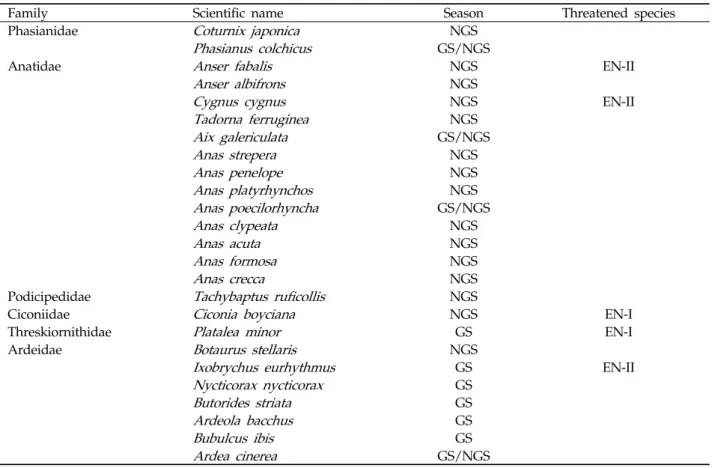
Table 1. Birds using rice fields in Mid-western part of Korean Peninsula with descriptions of their occurring season and conservation status. Occurring season defined rice growing season (GS: May-August) and rice non-growing season (NGS: September-April). Threatened species in related to conservation status are considered Endangered Wild Species Class I (EN-I) and Endangered Wild Species Class II (EN-II) by Korea Ministry of Environment.
EN-I species that are facing extinction due to tremendous decreases from natural or artificial threats. EN-II species that are facing extinction in the near future unless threatening factors are eliminated or mitigated
Family Scientific name Season Threatened species
Phasianidae
Coturnix japonica
NGS
Phasianus colchicus
GS/NGSAnatidae
Anser fabalis
NGS EN-II
Anser albifrons
NGS
Cygnus cygnus
NGS EN-II
Tadorna ferruginea
NGS
Aix galericulata
GS/NGS
Anas strepera
NGS
Anas penelope
NGS
Anas platyrhynchos
NGS
Anas poecilorhyncha
GS/NGS
Anas clypeata
NGS
Anas acuta
NGS
Anas formosa
NGS
Anas crecca
NGSPodicipedidae
Tachybaptus ruficollis
NGSCiconiidae
Ciconia boyciana
NGS EN-IThreskiornithidae
Platalea minor
GS EN-IArdeidae
Botaurus stellaris
NGS
Ixobrychus eurhythmus
GS EN-II
Nycticorax nycticorax
GS
Butorides striata
GS
Ardeola bacchus
GS
Bubulcus ibis
GS
Ardea cinerea
GS/NGS하는 특성을 보이지만, 논습지에 도래하는 조류상에 대한 연 구는 실질적인 관찰을 기초로 하기보다는 문헌자료를 기초로 한 조류상에 대한 정리가 전부이다(Kim et al ., 2013). 또한 이러한 문헌 자료를 기반으로 이루어진 연구는 논습지뿐만 아니라 그 주변 갯벌이나 호수 등과 같은 습지에 서식하는 조 류들도 상당수 포함되어 있어 조류의 서식지로서 논의 역할 을 설명하기에는 한계점을 가진다. 또한 관찰을 기반으로 한 조류 연구는 백로과 조류나 오리기러기류와 같은 일부 수조 류(waterbirds) 그룹에 관한 연구가 대부분이며, 전체 조류 상에 대한 정보는 부족한 실정이다(Yoo et al ., 2007, Choi et al ., 2008). 따라서 본 연구에서는 최근 연구 동향에 맞춰 실제 한반도의 중서부지역에서 직접 관찰에 의해서 확인된 논습지를 이용하는 조류상에 대한 자료 축적의 일환으로 조 류상에 대해 정리하고자 한다.
재료 및 방법
조사는 한반도 중서부지역인 충남 아산시 둔포면, 영인면, 인주면(36º 54′N, 126º 59′E)과 당진시 석문면(37º 02′N, 126º 30′E) 지역의 논습지에서 수행되었다. 선정된 조사지역 들은 동아시아-대양주 철새이동경로 상에 위치하며 계절에
따라 다양한 조류들이 이용하는 곳이다. 아산 지역은 2009년 4월부터 2010년 3월, 2011년 4월부터 2014년 3월까지, 당진 지역은 2013년 7월부터 2016년 2월까지 월 1회씩 조사하여 논습지를 이용하는 조류상을 확인하였다. 논습지를 이용하는 조류 종은 본답, 논둑, 농로, 수로에서 취식 또는 휴식하고 있 는 개체로 제한하였지만, 맹금류나 제비와 같은 종들은 논습 지 범위 내에서 비행 중인 경우도 포함하였다. 조류 조사는 농로를 따라 이동하면서 쌍안경(Leica 10 × 42)과 필드스코 프(Leica ×25-50)를 이용하여 동정하였다. 종 목록의 정리는 Gill과 Donsker(2014)에 따른 분류학적 체계와 종 배열 순 서에 따라 정리하였다. 실제 관찰된 시기는 벼 재배기와 비재 배기로 나누었으며, 환경부지정 법적보호종(멸종위기 야생생 물 Ⅰ급, Ⅱ급) 여부도 확인하였다.
결과 및 고찰
조사 지역인 한반도 중서부 지역 논습지에서 관찰된 조류
는 총 40과 124종이었다(Table 1). 논습지를 이용하는 조류
종은 오리과(13종, 10.5%)와 도요과(13종, 10.5%)가 가장 많
았고 다음으로 백로과(12종, 9.7%), 수리과(10종 8.1%), 할미
새과(8종 6.5%) 등의 순이었다. 관찰된 조류 중 보호종에 포
Family Scientific name Season Threatened species
Ardea alba alba
NGS
Ardea alba modesta
GS
Egretta intermedia
GSArdeidae
Egretta garzetta
GS/NGS
Egretta europhotes
GS EN-IFalconidae
Falco tinnunculus
GS/NGS
Falco columbarius
NGS
Falco subbuteo
GS EN-II
Falco peregrinus
GS/NGS EN-IAccipitridae
Aegypius monachus
NGS EN-II
Circus cyaneus
NGS EN-II
Circus melanoleucos
NGS EN-II
Accipiter gularis
NGS EN-II
Accipiter nisus
NGS EN-II
Accipiter gentilis
NGS EN-II
Butastur indicus
NGS
Buteo buteo
NGS
Buteo lagopus
NGS
Aquila clanga
NGS EN-IIRallidae
Gallicrex cinerea
GS EN-II
Gallinula chloropus
GS
Fulica atra
NGSGruidae
Grus monacha
NGS EN-IIHaematopodidae
Haematopus ostralegus
GS EN-IIRecurvirostridae
Himantopus himantopus
GSCharadriidae
Vanellus vanellus
NGS
Pluvialis fulva
GS
Charadrius dubius
GS/NGSScolopacidae
Gallinago gallinago
GS/NGS
Limosa limosa
GS
Numenius minutus
GS
Numenius phaeopus
GS
Tringa erythropus
GS
Tringa stagnatilis
GS
Tringa nebularia
GS
Tringa ochropus
GS/NGS
Tringa glareola
GS
Actitis hypoleucos
GS/NGS
Calidris ruficollis
GS
Chlidris subminuta
GS
Calidris acuminata
GSLaridae
Larus crassirostris
GS/NGS
Larus ridibundus
GS
Sterna albifrons
GSColumbidae
Streptopelia orientalis
GS/NGSCuculidae
Cuculus micropterus
GSStrigidae
Asio flammeus
NGSAlcedinidae
Alcedo atthis
GS/NGSUpupidae
Upupa epops
GS/NGSPicidae
Picus canus
GSLaniidae
Lanius bucephalus
GS/NGS
Lanius cristatus
GS
Lanius sphenocercus
NGSFamily Scientific name Season Threatened species
Oriolidae
Oriolus chinensis
GSCorvidae
Garrulus glandarius
GS/NGS
Cyanopica cyana
GS/NGS
Pica pica
GS/NGSCorvidae
Corvus dauuricus
NGS
Corvus frugilegus
NGS
Corvus macrorhynchos
GS/NGSParidae
Parus major
GS/NGS
Parus ater
GS/NGS
Parus varius
GS/NGSHirundinidae
Hirundo rustica
GSAlaudidae
Alauda arvensis
NGS
Melanocorypha mongolica
NGSCisticolidae
Cisticola juncidis
GSPycnonotidae
Microscelis amaurotis
GS/NGSAcrocephalidae
Acrocephalus orientalis
GSPhylloscopidae
Phylloscopus borealis
GSSylviidae
Paradoxornis webbianus
GS/NGSSturnidae
Sturnus cineraceus
GSTurdidae
Turdus naumanni
NGS
Turdus eunomus
NGSMuscicapidae
Phoenicurus auroreus
GS/NGS
Saxicola torquatus
GS/NGS
Saxicola ferreus
NGSPloceidae
Passer montanus
GS/NGSMotacillidae
Motacilla flava
NGS
Motacilla cinerea
GS
Motacilla alba leucopsis
GS/NGS
Motacilla alba lugens
GS/NGS
Anthus richardi
GS
Anthus hodgsoni
GS
Anthus cervinus
GS
Anthus rubescens
GS/NGSFringillidae
Fringilla montifringilla
NGS
Carduelis sinica
NGS
Carduelis spinus
NGS
Carpodacus erythrinus
NGSEmberizidae
Emberiza cioides
GS/NGS
Emberiza fucata
NGS
Emberiza rustica
NGS
Emberiza elegans
GS/NGS
Emberiza spodocephala
NGS
Emberiza pallasi
NGS
Emberiza schoeniclus
NGSCalcariidae
Calcarius lapponicus
NGSColumbidae
Columba livia
GS/NGS함되는 멸종위기 야생생물 Ⅰ급은 황새, 저어새, 노랑부리백 로, 매 등 4종이 관찰되었고, Ⅱ급은 큰기러기, 큰고니, 큰덤 불해오라기, 새호리기, 독수리, 잿빛개구리매 등 14종이 관찰 되었다. 이는 환경부 지정 멸종위기야생동물 61종 중 29.5%
가 한반도 중서부 지역의 논습지를 이용하고 있다는 것을 나 타낸다. 본 조사는 전체 한반도 논습지 면적 중 극히 일부에 서 이루어졌기 때문에 실제로 한반도 전역에서 논습지를 이
용하는 조류는 이보다 훨씬 많을 것으로 판단된다(Yoo et al ., 2007).
도래시기와 종을 고려했을 때, 논습지를 이용하는 조류는
벼 재배기에 40종, 비재배기에 50종, 두 기간 모두 출현한 종
은 34종이었다. 계절별 이용하는 조류 군집에 차이가 뚜렷하
게 보이며, 재배기에는 중간기착지와 번식지로 이용하는 도요
물떼새류나 백로류와 같은 종들이, 비재배기에는 월동지로 이
용하는 오리기러기류와 같은 종들이 나타났다.
세계적으로 논습지를 서식지로 이용하는 조류에 관한 연 구는 대륙 별 국지적으로 진행된 연구 결과를 통합하여 일반 화하는 과정 중이다. 이러한 동향에 따라, 국내에서도 다양한 지역에서의 논습지를 주 서식지로 이용하는 조류에 대한 자 료의 축적과 조류의 논습지 이용에 영향을 미치는 물리적, 화 학적, 생물학적 요인에 대한 연구들이 필요하다.
Acknowledgment
This study was carried out with the support of
“Research Program for Agricultural Science &
Technology Development (Project No. PJ008608), National Institute of Agricultural Sciences, Rural Development Administration, Republic of Korea.
References