ORIGINAL ARTICLE
난분해성 우모분해
Pseudomonas geniculata
에 의한 케라틴 분해효소 생산 및 식물성장 촉진 활성고태훈․이상미․이나리․정성윤1)․홍창오․손홍주*
부산대학교 생명자원과학대학 및 생명산업융합연구원, 1)대구가톨릭대학교 의생명과학과
Keratinase Production by Recalcitrant Feather Degrading
Pseudomonas Geniculata and Its Plant Growth Promoting Activity
Tae-Hun Go, Sang-Mee Lee, Na-Ri Lee, Seong-Yun Jeong1), Chang-Oh Hong, Hong-Joo Son*
College of Natural Resources & Life Science, Life and Industry Convergence Institute, Pusan National University, Miryang 627-706, Korea
1)Department of Medical Life Science, Catholic University of Daegu, Daegu 712-784, Korea
Abstract
We investigated the optimal conditions for keratinase production by feather-degrading Pseudomonas geniculata H10 using one variable at a time (OVT) method. The optimal medium composition and cultural condition for keratinase production were determined to be glucose 0.15% (w/v), beef extract 0.08% (w/v), KH2PO4 0.12% (w/v), K2HPO4 0.02% (w/v), NaCl 0.07%
(w/v), MgSO4․7H2O 0.03%, MgCl2․6H2O 0.04% along with initial pH 10 at 200 rpm and 25℃, respectively. The production yield of keratinase was 31.6 U/ml in an optimal condition, showing 4.6-fold higher than that in basal medium. The strain H10 also showed plant growth promoting activities. This strain had ammonification activity and produced indoleacetic acid (IAA), siderophore and a variety of hydrolytic enzymes such as protease, lipase and chitinase. Therefore, this study showed that P. geniculata H10 could be not only used to upgrade the nutritional value of feather wastes but also useful in situ biodegradation of feather wastes. Moreover, it is also a potential candidate for the development of biofertilizing agent applicable to crop plant soil.
Key words :Biofertilizer, Feather waste, Keratinase, Pseudomonas geniculata
1. 서 론1)
우모(羽毛)는 가금류 중량의 5~7%를 차지하며, 케라틴(keratin)이 주요 구성 단백질이다(Onifade 등, 1998). 케라틴은 수소결합 및 소수성 상호작용이 많아 물리화학적으로 안정한 특성을 가지고 있으므로 일반
적인 protease의 효소적 분해에 저항성을 지닌 난분해 성 단백질이다. 따라서 전 세계적으로 연간 100만 톤 이상 발생하고 있는 우모 폐기물을 적절하게 처리한 다는 것은 쉽지 않은 과정이다(Wang과 Shih, 1999).
현재 우모 폐기물을 재활용하기 위해 가압 및 가열 후, NaOH를 처리하여 화학적으로 분해시킨 우모 분
Received 3 April, 2013; Revised 28 May, 2013;
Accepted 30 May, 2013
*Corresponding author : Hong-Joo Son, College of Natural Resources and Life Science, Pusan National University, Miryang 627-706, Korea Phone: +82-55-350-5544
E-mail: [email protected]
ⓒ The Korean Environmental Sciences Society. All rights reserved.
This is an Open-Access article distributed under the terms of the Creative Commons Attribution Non-Commercial License (http://
creativecommons.org/licenses/by-nc/3.0) which permits unrestricted non-commercial use, distribution, and reproduction in any medium, provided the original work is properly cited.
말을 가축의 사료로 사용하고 있다. 그러나 이 처리법 은 폐수와 악취 발생으로 인한 환경오염을 초래하며, 처리 비용이 높아 비경제적이고, 일부 아미노산이 파 괴되기도 한다. 또한 사료로 이용할 경우, 가축의 소화 관 내에서 소화율이 낮다는 단점도 가지고 있다. 따라 서 환경친화적인 처리와 비용 절감을 위해 미생물을 이용한 우모 분해 기술이 대안으로 떠오르고 있다 (Papadoulos 등, 1986).
자연 환경으로 방출된 우모는 미생물에 의해 서서 히 분해되는데, 이 때 중요한 역할을 수행하는 것이 환 경에 서식하는 미생물이 생성하는 단백질 분해효소인 keratinase 또는 keratinolytic protease이다(Bertsch와 Coello, 2005). 이러한 사실이 밝혀진 이후, 전 세계적 으로 대량 발생되고 있는 우모 폐기물을 생물학적으 로 처리하기 위한 연구가 활발하게 진행되고 있으며, 미생물이 생산하는 keratinase를 각질 제거를 위한 화 장품 성분 및 생분해성 필름, 가죽과 직물 공정에 제모 제로 응용하려는 연구도 시작되고 있다(Onifade 등, 1998). 한편, 일부 동물성 폐기물은 질소 비료로서 사 용 가능성 높은 것으로 보고되어 있는데, 양모를 화학 적으로 분해한 산물은 농작물의 성장을 촉진하며 (Nustorova 등, 2005), 우모는 완효성 질소 비료로써 사 용 가능성이 높은 것으로 보고되었다(Hadas와 Kautsky, 1994). 이러한 관점에서 우모를 분해하는 미생물이 식 물 성장을 촉진하는 활성까지 가진다면 우모 분해산 물은 보다 효율적인 친환경 생물비료로써 평가될 수 있을 것이다.
지금까지 Bacillus sp. (Lin 등, 1992; Zaghloul, 1998), Chryseobacterium sp. (Riffel 등, 20070), Vibrio sp. (Sangali와 Brandelli, 2000), Actinomycetes (Bockle 등, 1995; Mitsuiki 등 2004), Aspergillus sp.
(Parag와 Hassan, 2004), Microsporum sp. (Lee 등, 1987) 등의 많은 미생물들이 keratinase를 생산하는 것으로 보고되어 있어 환경 중에 우모 분해세균이 매 우 다양하게 존재함을 알 수 있다.
본 연구팀은 이전에 keratinase를 생산하여 우모를 효율적으로 분해할 수 있는 Pseudomonas geniculata 를 최초로 분리하여 기질 특이성 등을 보고한 바 있다 (Go 등, 2012). 따라서 본 연구에서는 이 균주에 의한 keratinase 생산 최적조건을 조사하고, 동시에 실험균
주의 식물성장 촉진 활성을 검토함으로써 난분해성 우모의 생물학적 처리 및 분해산물의 생물비료로써의 응용을 위한 기초자료를 획득하고자 하였다.
2. 재료 및 방법
2.1. 사용균주 및 배양조건
Keratinase 생산을 위해 사용한 균주는 본 실험실에 서 분리 및 동정한 균주들 중 가장 높은 효소 활성을 나타내었던 P. geniculata이었다(Go 등, 2012). 이 세 균은 가정의 욕실 배수구에 축적되어 있던 모발로부 터 분리한 균주이다. 전배양은 50 ml의 nutrient broth 가 함유된 250 ml Erlenmeyer flasks에 균주를 접종하 여 30℃, 200 rpm에서 24시간동안 배양하였다. 본배 양은 전배양액 2% (v/v)를 50 ml의 기본배지가 함유 된 250 ml Erlenmeyer flask에 접종한 후, 전배양과 동 일한 조건에서 배양하였다. 사용한 기본배지의 조성 은 KH2PO4 0.04%, K2HPO4 0.03%, NaCl 0.05%, feather 0.1%이었으며, 초기 pH 7.0은 별도로 조정되 었다.
2.2. One variable at a time (OVT) 방법에 의한 keratinase 생산조건 검토
Keratinase 생산조건을 최적화하기 위해 사용한 방 법은 OVT 방법이며, 탄소원, 질소원, 무기염, pH, 온 도 및 진탕속도의 순서로 배지 및 배양조건을 변화시 키면서 keratinase 활성을 측정하였다.
각종 탄소원(glucose, fructose, sucrose, maltose, lactose, galactose, glycerol, mannitol, soluble starch) 0.1%를 배지에 첨가하여 배양한 후, 최저 탄소원을 선 정하였다. 최적 탄소원이 첨가된 배지에 각종 질소원 (beef extract, hammersten casein, casamino acid, casein, corn steep liquor, gelatin, malt extract, polypeptone, skim milk, tryptone, yeast extract, soytone, urea, (NH4)2SO4, NH4Cl, NH4NO3, NH4H2PO4, (NH4)2HPO4, KNO3, NaNO2, NaNO3) 0.01%를 첨가하여 배양한 후, 최적 질소원을 선정하였다. 이후, K2HPO4, KH2PO4, NaCl, MgSO4·H2O, MgCl2·H2O 첨가 실험도 순차적 으로 수행하였다.
배지의 pH (4~11), 배양온도(20~45℃) 및 진탕속 도(100~250 rpm)가 keratinase 생산에 미치는 영향
을 조사하였으며, 기본배지와 최적배지에서 배양시간 에 따른 keratinase 활성의 변화를 측정하였다.
2.3. 식물성장 촉진 활성 검토
대표적인 식물성장 호르몬인 indoleacetic acid (IAA)의 생성능은 Tang과 Bonner의 방법(1947)에 의 하여 조사하였다. 실험균주의 배양 상등액을 Salkowsky reagent와 혼합하여 30분간 반응시킨 후, 반응액의 색상이 분홍색으로 전환된 것을 IAA 생성능이 있는 것으로 결정 하였다. 실험균주의 암모니아 생성능(ammonification)은 Dey 등(2004)의 방법에 의하여, siderophore 생성능 은 Chrome azurol S assay (Schwyn과 Neilands, 1987) 에 의하여, 식물병원성 진균 세포성분 분해효소(amylase, cellulase, chitinase, lipase, pectinase, protease)의 활 성은 standard method (Gerhardt 등, 1981)에 의하여 정성 분석하였다.
2.4. 분석방법
배양이 완료된 배지를 13000 rpm, 4℃에서 30분간 원심분리한 후, 그 상등액을 조효소액으로 사용하였으며, keratinase 활성 측정을 위한 기질은 dimethylsulfoxide- soluble keratin을 사용하였다(Wawrikiewicz 등, 1987).
조효소액 400 μl를 0.01 g soluble keratin이 함유된 0.1 M phosphate buffer (pH 7.5) 600 μl에 첨가하여 30℃, 13000 rpm에서 3시간동안 반응시켰다. 5%
trichloroacetic acid를 첨가하여 30분간 상온에 방치 함으로써 효소 활성을 정지시킨 후 13000 rpm, 20℃
에서 30분간 원심분리하였다. 280 nm에서 상등액의 흡광도를 측정하여 효소 활성을 측정하였으며, 이 때 keratinase 활성 1 unit는 시간당 0.01의 흡광도 증가 를 나타내는 효소의 양으로 정의하였다.
실험균주의 생육도는 배양액 내에 잔존하는 미분 해 우모를 Whatman no.1 여과지를 이용하여 제거한 후, 여액의 흡광도를 660 nm에서 측정함으로써 확인 하였다. 배양액의 단백질 농도는 Bradford법(Bradford, 1976)을 이용하여 측정하였으며, 표준물질로는 bovine serum albumin을 사용하였다. 우모의 분해율은 우모 의 건조무게 감소량을 측정한 후, % 백분율로 나타내 었다.
3. 결과 및 고찰
3.1. OVT를 이용한 keratinase 생산 최적조건
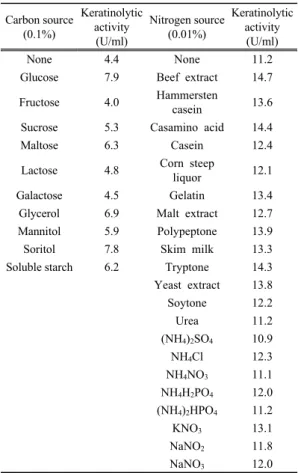
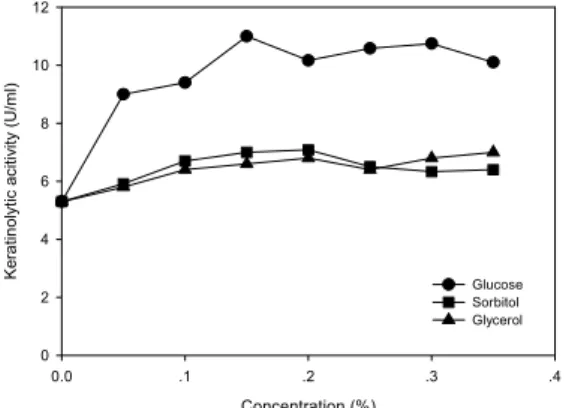
탄소원에 따른 kertatinase 활성을 조사한 결과는 Table 1에서 보는 바와 같다. 각 탄소원을 0.1%씩 첨 가했을 때 glucose, sorbitol 그리고 glycerol이 다른 탄 소원에 비해 높은 keratinase 생산(6.9~7.9 U/ml)을 유도하였다. 탄소원을 첨가하지 않았을 경우에도 4.4 U/ml의 keratinase가 생산되어 우모가 탄소원으로 작 용했음을 알 수 있었으며, 이러한 결과는 Jeong 등 (2010a)의 보고와 일치하였다. 상기 세 탄소원을 각 농도별로 첨가하여 keratinase 활성을 조사한 결과, glucose 0.15%에서 가장 높은 활성(11.0 U/ml)을 나 타내었다(Fig. 1).
Carbon source (0.1%)
Keratinolytic activity (U/ml)
Nitrogen source (0.01%)
Keratinolytic activity
(U/ml)
None 4.4 None 11.2
Glucose 7.9 Beef extract 14.7 Fructose 4.0 Hammersten
casein 13.6
Sucrose 5.3 Casamino acid 14.4
Maltose 6.3 Casein 12.4
Lactose 4.8 Corn steep
liquor 12.1
Galactose 4.5 Gelatin 13.4
Glycerol 6.9 Malt extract 12.7 Mannitol 5.9 Polypeptone 13.9
Soritol 7.8 Skim milk 13.3
Soluble starch 6.2 Tryptone 14.3 Yeast extract 13.8
Soytone 12.2
Urea 11.2
(NH4)2SO4 10.9 NH4Cl 12.3 NH4NO3 11.1 NH4H2PO4 12.0 (NH4)2HPO4 11.2
KNO3 13.1
NaNO2 11.8
NaNO3 12.0
Table 1. Effect of carbon and nitrogen sources on keratinolytic activity of strain H10
Concentration (%)
0.0 .1 .2 .3 .4
Keratinolytic acitivity (U/ml)
0 2 4 6 8 10 12
Glucose Sorbitol Glycerol
Fig. 1. Effect of carbon source concentration on keratinolytic activity of strain H10.
최적 탄소원이 첨가된 배지에 각종 질소원을 첨가 하여 keratinase 활성을 조사한 결과, 첨가된 모든 유 기질소원은 keratinase 활성을 증가시켰는데, 특히 beef extract, casamino acid 및 tryptone을 첨가했을 때 ketratinase 활성이 높았다(14.3~14.7 U/ml). 무기 질소원 중 (NH4)2SO4, NH4NO3,(NH4)2HPO4,NaNO2
는 keratinase 활성을 저해하거나 별다른 효과는 없었 으나 그 외 무기질소원은 keratinase 활성을 증가시켰 다. 일반적으로 무기질소원은 keratinase 활성을 저해 한다고 보고(Rao 등, 1998)되어 있어, 본 실험결과와 다소 상이하였다. Beef extract를 0.08% 첨가했을 때 keratinase 활성이 16.3 U/ml로 가장 높았다(Fig. 2).
Concentration (%)
0.00 .02 .04 .06 .08 .10 .12
Keratinolytic activity (U/ml)
0 2 4 6 8 10 12 14 16 18
Beef extract Casamino acid Tryptone
Fig. 2. Effect of nitrogen source concentration on keratinolyitc activity of strain H10.
기본배지에 첨가되어있는 K2HPO4, KH2PO4 및 NaCl의 농도에 따른 keratinase 활성을 조사한 결과는
Table 2에서 보는 바와 같다. KH2PO4의 농도 증가에 따라 효소 활성은 비례적으로 증가하여 0.12%에서 가 장 높은 값(20.7 U/ml)을 나타내었으며, 그 이상의 농 도에서는 keratinase 활성이 감소하였다. K2HPO4의 경우, 0.02%에서 가장 높은 효소 활성(21.4 U/ml)을 나타내었으며, 그 이상의 농도에서 keratinase 활성은 비교적 일정하게 유지되었다. 또한 NaCl은 0.07%까 지 농도에 비례하여 효소 활성(22.4 U/ml)이 증가되 었으며, 그 이상의 농도에서 keratinase 활성은 감소하 였다. Keratinas 생산에 영향을 미치는 것으로 알려진 Table 2. Effect of inorganic salts on keratinolytic activity of
strain H10
Inorganic salt Concentration (%)
Keratinolytic activity (U/ml)
KH2PO4
0 9.8
0.02 11.4
0.04 14.9
0.06 15.5
0.08 16.2
0.10 18.3
0.12 20.7
0.14 18.1
0.16 17.4
K2HPO4
0 12.8
0.01 21.4
0.02 21.4
0.03 19.9
0.04 20.8
0.05 21.1
NaCl
0 14.9
0.01 15.7
0.03 16.1
0.05 18.3
0.07 22.4
0.09 19.6
0.10 17.1
MgSO4․7H2O
0 19.4
0.01 20.9
0.02 21.5
0.03 23.8
0.04 23.5
0.05 23.9
MgCl2․6H2O
0 20.5
0.01 21.1
0.02 24.6
0.03 25.3
0.04 26.2
0.05 18.4
(Rao 등, 1998) MgSO4․7H2O 및 MgCl2․6H2O의 추 가 첨가 실험을 실시한 결과, 두 무기염 모두 keratinase 활성을 증가시키는 효과가 있었다. 즉, MgSO4․ 7H2O 및 MgCl2․6H2O를 각각 0.03%, 0.04% 첨가시 효소 활성이 23.8 U/ml 및 26.2 U/ml을 나타내었다.
Initial pH
3 4 5 6 7 8 9 10 11 12
Keratinolytic activity (U/ml)
0 5 10 15 20 25 30
Temperature ( )℃
15 20 25 30 35 40 45 50
Keratinolytic activity (U/ml)
0 5 10 15 20 25 30 35
Fig. 3. Effect of initial pH (upper) and temperature (lower) on keratinolytic activity of strain H10.
배지의 초기 pH 및 배양온도가 keratinase 활성에 미치는 영향을 조사한 결과는 Fig. 3에서 보는 바와 같 다. pH 4~6.5의 범위에서 keratinase 활성은 10.1~
12.1 U/ml을 유지하다가 알칼리 영역으로 감에 따라 크게 증가하여 pH 11에서 24.5 U/ml의 최고값을 나타 내었다. 이러한 결과는 keratinase 생산은 중성~알칼 리성 영역에서 일어난다는 이전의 보고와 잘 일치하 였다(Suntornsuk과 Suntornsuk, 2003). 결과에 제시 하지는 않았지만 실험균주의 생육도는 pH 7에서 A660
가 0.557을 나타내었으나 알칼리 영역인 pH 9~11에
서 0.819~0.842를 나타내어 본 균주는 alkaliphile임 을 알 수 있었다. 또한, 20℃에서 17.3 U/ml, 30~35℃
에서 19.9~21.7 U/ml, 40~45℃에서 3.8~6.8 U/ml 에 해당하는 keratinase 활성을 나타내었으며, 25℃에 서 29.9 U/ml의 최고값을 나타내었다. 한편, 진탕속도 는 keratinase 활성에 큰 영향을 미치지 않았으며, 200 rpm에서 가장 높은 활성을 나타내었다(미제시).
3.2. 최적조건에서 keratinase 생산
앞의 실험을 통하여 확립된 keratinase 생산 최적조 건은 glucose 0.15%, beef extract 0.08%, KH2PO4
Time (days)
0 6 12 18 24 30 36 42
Keratinolytic activity (U/ml)
0 5 10 15 20 25 30 35
Optimal medium Basal medium
Time (days)
0 6 12 18 24 30 36 42
Cell growth (A660)
0.0 .2 .4 .6 .8 1.0
Optimal medium Basal medium
Time (h)
0 6 12 18 24 30 36 42
Feather degradation (%)
0 20 40 60 80 100 120
Optimal medium Basal medium
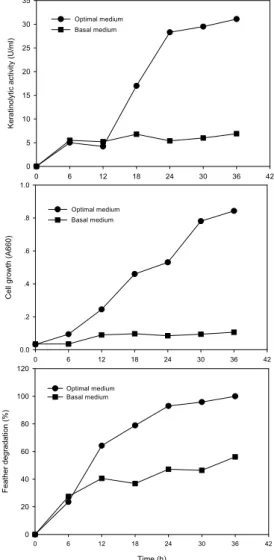
Fig. 4. Keratinolytic activity and cell growth by strain H10 in optimized and basal media.
Protease Lipase (tributyrin) Lipase (Tween 80) Chitinase
Ammonification Indoleacetic acid Sidrophore
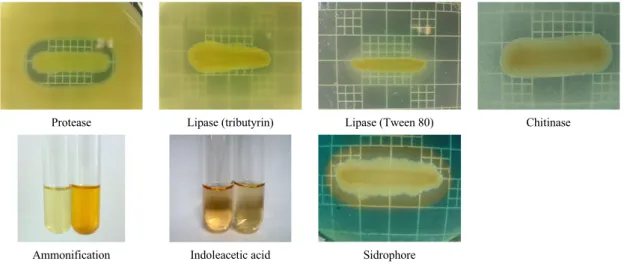
Fig. 5. Various plant growth-promoting activities of strain H10.
0.12%, K2HPO4 0.02% NaCl 0.07%, MgSO4․7H2O 0.03%, MgCl2․6H2O 0.04% (pH 10, 25℃ 및 200 rpm)이었다. 최적배지에서 배양시간 경과에 따른 각 종 배양변수의 변화를 관찰한 결과는 Fig. 4에서 보는 바와 같다. 기본배지에서 실험균주는 배양 12시간까 지 생육하다가 정지기에 도달하였으며, keratinase 활 성은 최고 6.8 U/ml을 나타내었다. 반면, 최적배지에 서 배양된 실험균주는 약 6 시간의 유도기를 거친 후, 대수증식기에 도달했으며, 배양 36시간까지 지속적으 로 생육하였다. Keratinase의 생산은 균체 생육과 비례 하여 증가하다가 36시간 경에 31.6 U/ml의 최고 활성을 보여주어 기본배지의 4.6배에 해당하는 keratinase 생산 개선효과가 있는 것으로 나타났다. 한편, 기본배지에 서 우모 분해율은 56.1%를 나타내었으나 최적배지에 서는 첨가된 모든 우모가 분해(100%)되었음을 알 수 있었다. 배지 성분으로 첨가한 우모의 형태, 효소반응 에 사용된 기질의 종류 및 반응시간 등의 상이성으로 인하여 기 보고된 keratinase 활성과 본 실험 결과를 직 접적으로 비교할 수는 없지만 Xanthomonas sp. P5 (Jeong 등, 2010b)와 Bacillus subtilis S8 (Jeong 등, 2010a)에 의한 keratinase 생산은 5일과 4일이 소요된 반면, 본 실험균주에 의한 효소 생산은 24 시간 만에 이루어져 보다 짧은 단위시간에 keratinase를 생산할 수 있음을 알 수 있었다.
3.3. 식물성장 촉진 활성
실험균주의 식물성장 촉진 활성을 조사한 결과는 Fig. 5에서 보는 바와 같다. 본 균주는 protease, lipase 및 chitinase 등 식물병원성 진균의 세포성분과 세포 벽을 분해할 수 있는 효소를 생성할 수 있었다. 또한 본 균주는 Chrome azurol S 평판배지에서 콜로니 주 위에 orange zone을 형성함에 따라 siderophore 생성 능이 있음을 알 수 있었다. Siderophore는 철 이온과 결합할 수 있는 대사산물로써, 식물 병원성 진균의 생 육을 억제할 뿐만 아니라 식물이 이용할 수 없는 불용 성 철을 가용화시킴으로서 식물 성장에 도움을 주는 것으로 보고되어 있다(Pandey 등, 2005). 한편, 실험 균주의 IAA 생성능 및 암모니아 생성능을 조사하기 위한 실험에서 배양 상등액은 각각 분홍색과 노란색 으로 변화됨에 따라 실험균주는 IAA 및 암모니아 생 성능이 있음을 알 수 있었다. IAA는 대표적인 식물성 장 호르몬으로써, 뿌리 신장, 과실 형성 등을 촉진하는 것으로 보고되어 있다(Khalid 등, 2004). 또한 미생물 은 암모니아 생성을 통하여 농작물의 성장에 유해한 진균의 생육을 억제하는 것으로 알려져 있다(Dye 등, 2004).
4. 결 론
본 연구에서는 우모를 분해할 수 있는 것으로 보고
된 P. geniculata의 keratinase 생산 최적조건을 OVT 방법을 통하여 조사하였다. 확립된 keratinase 생산 최 적 배지 조성은 glucose 0.15%, beef extract 0.08%, KH2PO4 0.12%, K2HPO4 0.02% NaCl 0.07%, MgSO4․ 7H2O 0.03%, MgCl2․6H2O 0.04%이었으며, 최적 배 양조건은 초기 pH 10, 25℃ 및 200 rpm이었다. 최적 조건에서 keratinase 생산량은 기본배지보다 4.6배 개 선되었으며, 우모도 완전히 분해하였다. 본 실험균주는 protease, lipase 및 chitinase와 같은 식물병원성 진균의 세포성분 분해효소, 식물성장 호르몬인 IAA, 식물병원 성 진균의 생육을 저해하는 siderophore, ammonification 등의 생리활성을 가지고 있었다. 따라서 본 균주는 우모 폐기물의 생물학적 처리를 통한 우모의 영양적 가치 향상이나 우모 폐기물의 현장에서의 분해뿐만 아니 라 생물비료 개발에도 응용 가능성이 있음을 알 수 있 었다.
감사의 글
이 논문은 2010년도 정부(교육과학기술부)의 재원 으로 한국연구재단의 지원을 받아 수행된 기초연구사 업입니다(No. 2010-0023046).
참 고 문 헌
Bertsch, A., Coello, N., 2005, A biotechnological process for treatment and recycling poultry feathers as a feed ingredient, Bioresource Technol., 96, 1703-1708.
Bockle, B., Galunski, B., Muller, R., 1995, Characterization of a keratinolytic serine protease from Streptomyces pactum DSM40530, Appl. Environ. Microbiol., 61, 3705-3710.
Bradford, M. M., 1976, A rapid and sensitive method for the quantitation of microgram quantities of protein utilizing the principle of protein-dye binding, Anal. Biochem., 72, 248-254.
Chon, D. H., Kang, S. M., Kwon, T. J., 2003, Purification and some properties of protease produced by Pseudomonas sp. KP-364, Kor. J. Microbiol.
Biotechnol., 31, 224-229.
Dye, R., Pal, K. K., Bhatt, D. M., Chauhan, S. M., 2004, Growth promotion and yield enhancement of peanut (Arachis hypogaea L.) by application of plant
growth-promoting rhizobacteria, Microbiol. Res., 159, 371-394.
Gerhardt, P., Murray, R. G. E., Costilow, R. N., Nester, E. W., Wood, W. A., Krieg, N. R., Phillips, G. B., 1981, Manual of methods for general bacteriology.
American Society for Microbiology, Washington, D.C.
Go, T. H., Jeong, J. H., Lee, N. R., Jeong, S. Y., Park, G.
T., Son, H. J., 2012, Isolation and characterization of duck feather-degrading microorganism for treatment of recalcitrant ketinous waste, J. Environ. Sci., 21, 253-231.
Hadas, A., Kautsky, L., 1994, Feather meal, a semi-slow release nitrogen fertilizer for organic farm, Fertilizer Res., 38, 165-170.
Jeong, J. H., Jeon, Y. D., Lee, O. M., Kim, J. D., Lee, N R., Park, G. T., Son, H. J., 2010a, Characterization of a multifunctional feather-degrading Bacillus subtilis isolated from forest soil, Biodegradation, 21, 1029-1040.
Jeong, J. H., Park, K. H., Oh, D. J., Hwang, D. Y., Kim, H. S., Lee, C. Y., Son, H. J. 2010b. Keratinolytic enzyme-mediated biodegradation of recalcitrant feather by a newly isolated Xanthomonas sp. P5, Polym. Degrad. Stab., 95, 1969-1977.
Khalid, A., Arshad, M., Zahir, Z. A., 2004, Screening of plant growth-promoting rhizobacteria for improving growth and yield of wheat, J. Appl. Microbiol., 96, 473-480.
Lee, K. H., Park, K. K., Park, S. H., Lee, J. B., 1987, Isolation, purification and characterization of keratinolytic proteinase from Microsporum canis, Yonsei Med. J., 28, 131-138.
Lin, X., Lee, C. G., Casale, E. S., Shih, J. C. H., 1992, Purification and characterization of a keratinase from a feather-degrading Bacillus licheniformis strain, Appl. Environ. Microbiol., 58, 3271–3275.
Mitsuiki, S., Ichikawa, M., Oka, T., Sakai, M., Moriyama, Y., Sameshima, Y., Goto, M., Furukawa, K., 2004, Molecular characterization of a keratinolytic enzyme from an alkaliphilic Nocardiopsis sp.
TOA-1, Enz. Microb. Technol., 34, 482-489.
Nustorova, M., Braikova, D., Gousterova, A., Vasileva- Tonkova, E., Nedkov, P., 2005, Chemical, microbiological and plant analysis of soil fertilized with alkaline
hydrolysate of sheep's wool waste, World J. Microbiol.
Biotechnol., 22, 383-390.
Onifade, A. A., Al-Sane, N. A., Al-Musallam, A. A., Al-Zarban, S., 1998, Potentials for biotechnological applications of keratin-degrading microorganisms and their enzymes for nutritional improvement of feathers and other keratins as livestock feed resources, Bioresource Technol., 66, 1-11.
Pandey, P., Kang, S. C., Gupta, C. P., Maheshwari, D.
K., 2005, Rhizosphere competent Pseudomonas areuginosa GRC1 produces characteristic siderophore and enhances growth of Indian mustard (Brassica campestris), Curr. Microbiol., 51, 303-309.
Papadoulos, M. C., Ketelaars, E. H., 1986, Effects of processing time and moisture content on amino acid composition and nitrogen characteristics of feather meal, Anim. Feed Sci. Technol., 14, 279-290.
Parag, A. M., Hassan, M. A., 2004, Purification, charac- terization and immobilization of a keratinase from Aspergillus oryzae, Enz. Microb. Technol., 34, 85-93.
Rao, M. B., Tanksale, A. M., Ghatge, M. S., Deshpande, V. V., 1998, Molecular and biotechnological aspects of microbial proteases, Microbiol. Mol. Biol. Rev., 62, 597-635.
Riffel, A., Brandelli, A., Bellato, C. M., Souza, G. H. M.
F., Eberlin, M. N., Tavares, F. C. A., 2007, Purification
and characterization of a keratinolytic metalloprotease from Chryseobacterium sp. kr6, J. Biotechnol., 128, 693-703.
Sangali, S., Brandelli, A., 2000, Feather keratin hydrolysis by a Vibrio sp. strain kr2, J. Appl. Microbiol., 89, 735-743.
Schwyn, B., Neilands, J. B., 1987, Universal chemical assay for the detection and determination of siderophores, Anal. Biochem., 160, 47-56.
Suntornsuk, W., Suntornsuk, L., 2003, Feather degradation by Bacillus sp. FK46 in submerged cultivation, Bioresource Technol., 86, 239-243.
Tang, Y. W., Bonner, J., 1947, The enzymatic inactivation of indoleacetic acid I. Some characteristics of the enzyme contained in pea seedlings, Arch. Biochem., 13, 17-25.
Wang, J. J., Shih, J. C. H., 1999, Fermentation production of keratinase from Bacillus licheniformis PWD-1 and a recombinant B. subtilis FDB-29, J. Ind.
Microbiol. Biotechnol., 22, 608-616.
Wawrzkiewicz, K., Lobarzewski, J., Wolski, T., 1987, Intracellular keratinase of Trichophyton gallinae. J.
Med. Vet. Mycol., 25, 261-268.
Zaghloul, T. I., 1998, Cloned Bacillus subtilis alkaline protease (apr A) gene showing high level of keratinolytic activity, Appl. Biochem. Biotechnol., 70-72, 199-205.