Print ISSN: 2288-4637 / Online ISSN 2288-4645 doi:10.13106/jafeb.2020.vol7.no11.789
The Effect of Covid-19 Pandemic on the Adoption of Internet Banking in Indonesia: Islamic Bank and Conventional Bank
Heri SUDARSONO
1, Rindang Nuri Isnaini NUGROHOWATI
2, Yunice Karina TUMEWANG
3Received: August 01, 2020 Revised: October 05, 2020 Accepted: October 15, 2020
Abstract
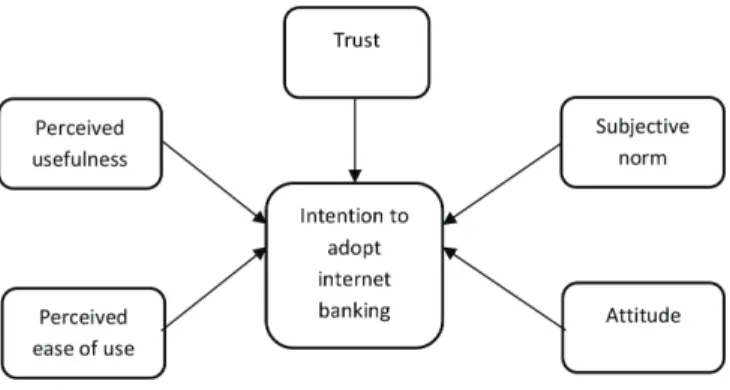
This study aims to examine the effect of perceived usefulness (PU), perceived ease of use (PEU), trust (TR), subjective norm (SN), and attitude (AT) on customer’s Intention to Adopt Internet Banking (IAIB) at Islamic banks and conventional banks before and during the Covid-19 pandemic in Indonesia. The research model is based on the Theory of Planned Behavior (TPB) and the Technology Acceptance Model (TAM).
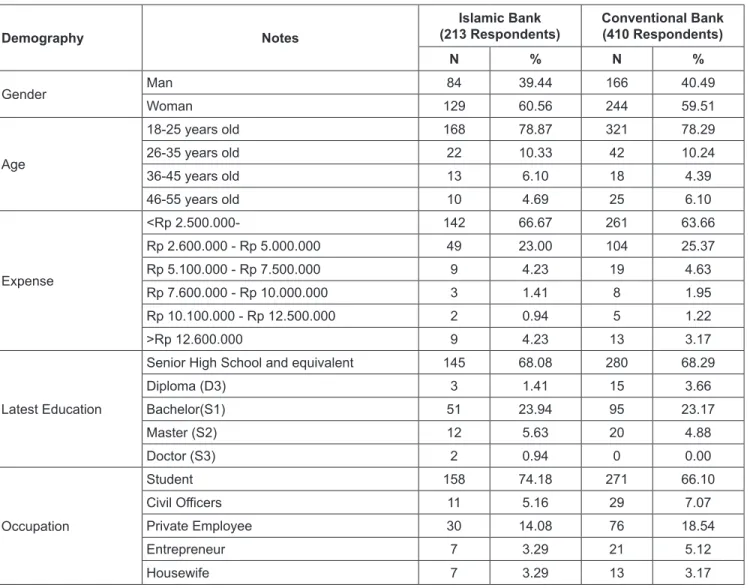
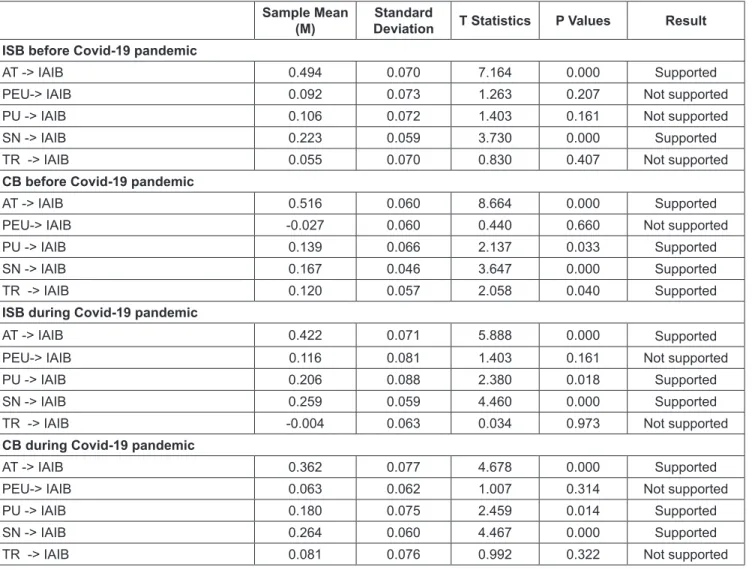
This study involves 213 respondents for Islamic banks and 410 respondents for conventional banks from 25 provinces in Indonesia. Data was analyzed using partial least square (PLS) regression with the Structural Equation Model (SEM) method. The result of data analysis confirms several hypotheses taken from the literature. The results before the Covid-19 pandemic showed that AT and SN influence IAIB in Islamic banks. Whereas in conventional banks, AT, PU, SN, and TR influence IAIB. While during the Covid-19 pandemic, it shows that the AT, PU, IB, SN, and customer TR influence IAIB in Islamic banks and conventional banks. From the analysis, it was found that the PEU variable did not have a significant effect on the intention of customers of Islamic banks and conventional banks to use Internet banking.
Keywords: Internet Banking, Islamic Bank, Conventional Bank, Technology Acceptance Model, Theory Planned Behavior JEL Classification Code: M15, M31, M38
Abd-Ghani, 2016; Shahzad et al., 2017). The tremendous growth of the Internet is changing how a business stays connected with its customers, including the banking business (Aldás-Manzano et al., 2009). The survival of the financial industry, especially banking, will greatly depend on the ability of Internet adaptation and the progress of technology. One form of technology adaptation in the banking industry is IB and mobile banking which offer various benefits (Sitorus et al., 2017).
Adaptation of banking technology must at least offer services that support customer activities, offer relevant markets, provide benefits for customers, as well as accessible and easy to use (Tabash et al., 2019; Yudha et al., 2015). Customers are encouraged to use Internet services because there is no need to have a physical meeting with the bank officers in person and no need to deal with other customers. The same thing was expressed by Kaleem &
Ahmad (2010) in their research which found that IB was used to reduce inconvenience, transaction costs, and time consumed. Because of the ease of obtaining information and many other benefits, the use of an online financial system is increasing (Lech, 2012). By replacing employee functions and physical facilities with information technology, banks do not need to have branch offices to reduce operating and fixed costs.
1. Introduction
Nowadays banking services are required to be more flexible, quicker, and easier along with the tremendous technology in the globalization era. Internet Banking (IB) has become the most profitable among other e-commerce applications. All banks have introduced IB to improve customer service and growth of information reduce costs (Rahi & Abd-Ghani, 2019). Besides, IB will not only benefit banks but will also fulfill customer needs (Rahi &
1
First Author and Corresponding Author. Lecturer, Department of Economics, Faculty of Business and Economics, Universitas Islam Indonesia, Indonesia [Postal Address: Gedung Ace Partadiredja, Ring Road Utara, Condongcatur, Sleman, Yogyakarta, 55283, Indonesia] Email: [email protected]
2
Lecturer, Department of Economics, Faculty of Business and Economics, Universitas Islam Indonesia, Indonesia.
Email: [email protected]
3
Lecturer, Department of Accounting, Faculty of Business and Economics, Universitas Islam Indonesia, Indonesia.
Email: [email protected]
© Copyright: The Author(s)
This is an Open Access article distributed under the terms of the Creative Commons Attribution Non-Commercial License (https://creativecommons.org/licenses/by-nc/4.0/) which permits unrestricted non-commercial use, distribution, and reproduction in any medium, provided the original work is properly cited.