방사선사의 감정노동이 이직의도 및 직무 만족도에 미치는 영향
박 주 현*†
*서라벌대학교 간호학과
Effect of Radiographer Emotional Labor on Turnover Intention and Job Satisfaction
Ju Hyun Park*†
*College of nursing Healthcare, Sorabol college
ABSTRACT
Objectives: Radiologists are the service worker with emotional labor who works within a relatively small space of the hospital, dealing with multiple patients. The purposes of this study were to search the turnover intention and job satisfaction through the work of emotional labor of radiologists.
Methods: A questionnaire survey was conducted on 109 radiologists working at university hospitals, general hospitals, clinics and other facilities across the domestic. The regions were aggregated according to Quality Function Deployment (QFD) method, which was applied in proportion to the population distribution. A questionnaire was composed of 26 questions which were used in Korean Emotional Laboratory Scale (K-ELS).
Results: The overall emotional labor score was 48.3±15.8. The most pressing requirement of radiologists to improve emotional labor was the topic about the exchange of colleagues (75.8±15.6 score, β=0.78, p<0.001).
Conclusions: In order to resolve the emotional labor of radiologists, it could be necessary to have a meeting through training and workshops where the exchange of colleagues can take place.
Keywords: Radiographer, emotional labor, turnover intention, job satisfaction
I. 서 론
방사선사의 주요 업무 내용은 병원 내 1인의 전문 직으로 좁은 방사선실 공간 내에서 다수의 환자를 매일 응대해야 하는 직종에 속한다. 방사선사의 근 로형태는 업무의 위험성과 강도가 높은 반면, 근로 에 대한 임금은 낮은 것으로 알려져 있다. 방사선사 가 지속적으로 방사선실의 소음과 전리방사선에 노 출되는 것은 불안요소로 작용할 수 있다.1) 안전보건 공단의 산재인정 사례집을 살펴보면 전리 방사선 노 출이 방사선사의 직업성 질병을 초래하기 위해서는 약 20년간 근무해야 가능성이 있다고 보고되고 있
으며, 누적 방사선의 노출량 측정 시 인과확률 미달 에 따라 대부분 업무상 관련성이 낮게 평가되고 있다.1,2) 한편, 모든 직업의 업무 만족도 및 이직의도의 원 인은 직무스트레스와 감정노동이 큰 원인이라고 보 고 있다.1) 20C 이후로 의료산업이 발전하면서 병원 의 수요는 증가되었고, 의료 보건계 종사자들의 업 무량 및 개인당 전담 환자의 수가 증가됨에 따라 환 자 중심 서비스 요구도가 높아지고 있다.3) 방사선사 는 환자에게 의료서비스 제공할 때 일반적으로 1인 이 다수의 환자를 상대해야하고 의료서비스를 제공 할 때 일반적으로 1인이 다수의 환자를 상대하고 환 자의 아픔에 대한 스트레스를 모두 상대해야 하기
†
Corresponding author: Main building 508-2, 516 Taejong-ro, Gyeongju-si, Gyeongsangbuk-do, Rep. of Korea., College of nursing healthcare, Sorabol College, Tel: +82-54-770-3658, Fax: +82-54-741-5429, E-mail: [email protected] Received: 07 December 2018, Revised: 10 December 2018, Accepted: 20 December 2018
원 저 Original articles
때문에 의료 보건계의 대부분이 감정노동에 노출될 수 있다.
감정노동자의 대상은 고객을 상대로 하는 서비스 직종에 대하여 고객만족제도(Customer Satisfaction, CS)의 운영을 따르는 직종으로 방사선사의 경우 보 건의료 종사자가 서비스 직종에 속할 수 있다. 방사 선사는 직업적 환경 및 건강 특히, 감정노동으로 인 해 이직을 생각하고 있으며 직무만족도 또한 낮다는 연구결과가 보고되고 있다.4-8)방사선사의 직무 스트 레스에 관한 연구는 활발하게 이뤄지고 있으나 감정 노동에 대한 연구는 상대적으로 적은 편이다.
‘직업상 고객을 대할 때 자신의 감정이 즐겁거나, 화나거나, 슬픈 상황이 있더라도 회사에서 요구되는 감정과 표현을 고객에게 보여줘야 하는 고객 응대 업무 노동’을 감정노동이라 정의한다9). 감정노동은 적은 감정표현의 빈도, 표현규범에 대한 주의성의 증 가, 근로자에게 요구되는 상황에 따른 감정 변화의 다양성 및 근로자들의 감정적 부조화 등이 주된 특 성이다. 근로자의 표면과 진심의 대립을 통해 내적 자아의 갈등이 심화될수록 감정노동 강도는 심화 된다.9) 감정노동은 직무스트레스와 마찬가지로 신체적, 정 신적 건강을 위협한다. 항상 응대를 위해 긴장된 상 태로 근무하는 감정노동에 노출된 근로자는 생리학 적으로 교감신경 이상 상태가 지속되므로 혈압, 맥 박, 스트레스 호르몬 항상성의 건강지표 이상이 초 래될 수 있다. 이러한 스트레스 상태는 뇌심혈관계 질환이나 소화기질환을 유발하고 외상 후 스트레스 장애, 자살충동 및 우울 장애 등의 정신적 건강문제 도 유발할 수 있다.10)
이에 본 연구는 방사선사의 감정노동 지표를 조사 하고 이에 대한 이직의도 및 직무 만족도에 미치는 영향에 대하여 연구하고자 한다.
II. 연구 방법 1. 연구대상
본 연구의 자료 수집은 ‘17년 4월 6일~5월 9일까 지 전국의 대학, 종합, 준 종합병원 및 의원과 기타 시설에서 근무하고 있는 방사선사 109명의 감정노 동, 이직의도, 직무만족도 등을 조사하였다. 설문 방 법은 자기기입식 설문조사로 응답 방법에 대한 내용
을 충분히 기재한 설문지로 객관 문형이 대부분인 설문지에 해당된다.
설문지는 인터넷 설문지의 Google docs 서비스를 이용하여 109부를 배포하였고 100% 응답하여 109 부에 대한 유효 설문 숫자를 확보하였다.
대상 설문 지역은 전국의 방사선사 인구 분포에 따른 인구비례 적용을 한 QFD (Quality Function Deployment)의 품질 기능 전개 방법으로 집계를 하 였다.
2. 설문 항목
설문지는 근로자 기본 특성 조사, 감정노동 조사 로 구성하였다.
2.1. 근로자 특성 조사
근로자 특성에 대한 설문은 근무 년 수, 성별, 연 령, 음주 빈도 4가지 항목을 실시하였다. 병원특성 파악을 위한 설문으로 지역, 병원 규모의 2가지 항 목으로 실시하였다. 근로시간은 1일 평균 근로시간 을 조사하였고 근무형태는 부서에 따라 5가지 분류 를 하여 조사하였으며, 업무에 대한 만족도, 이직 가 능성에 관한 이직의도를 조사하여 12문항으로 구성 하였다.
2.2 감정노동 조사
‘한국형 감정노동 평가도구’는 한국의 조직생활문 화와 서비스 산업의 특성을 반영하여 근로자들의 감 정노동의 수준, 감정노동으로 인한 부정적인 정서표 출 등을 평가한다. 감정노동 항목은 총 26문항이나 2개의 함정문항을 두고 있어 실질적으로 24개 문항 으로 구성되어 있다.
한국형 감정노동(K-ELS: Korean Emotional Labor Scale) 항목은 ‘감정부조화 및 손상’에서 총 6문항,
‘조직의 지지 및 보호체계’에서 총 7문항, ‘감정조절 의 요구 및 규제’에서 총 5문항, ‘조직의 감시 및 모 니터링’에서 총 3문항, ‘고객응대의 과부하 및 갈등
’에서 총 3문항 등으로 전체 5가지 세부 항목과 총 24개의 문항으로 구성된다.11)
각 문항에 관한 척도 기준으로는 1-2-3-4 리커트 척도를 기본으로 하되, ‘조직의 지지 및 보호체계’만 4-3-2-1 리커트 척도로 지정하였다.
III. 결과 및 고찰 1. 연구대상의 특성
Table 1은 설문조사에 따른 방사선사의 기본정보 를 설문한 결과이다.
평균연령은 34.40±16.59세로 조사되었다. 성별의 경우 남자 55.05%, 여자 44.95% 조사되었다. 근속 년 수는 평균 16.72±6.82 년으로 조사되었다. 근무 시간은 8.6±0.83 기간/일으로 조사되었다. 직업만족 도는 불만 43.1%, 보통 44.0%, 만족 12.8%으로 조 사되었다. 이직의도는 그렇다 33.0% 고민중 60.6%, 없다 6.4% 조사되었다. 1년 내 이직확률은 100점 만 점에 66.44±32.25 점으로 이직확률이 높은 것으로 조사되었다. 직무추천은 100점 만점에 22.99±24.24 점으로 조사되어 낮은 수치를 나타냈다.
방사선사에 대한 감정노동의 정도 파악과 그에 따 른 관계를 알아보고자 위계적 회귀분석에 대한 다음 과 같은 가설을 설정하였다.
가설 1 방사선사의 업무만족도와의 관계에서 감정 노동에 대한 통계적 차이는 없을 것이다.
가설 2 방사선사는 이직의도와 감정노동에 대한 통계적 차이는 없을 것이다.
2. 감정노동 결과
Table 2는 방사선사의 감정노동에 관한 기술통계 결과이다. Table 3은 안전보건공단의 K-ELS 지표를 통한 감정노동 참고치이다. 방사선사의 전체 감정노 동 점수는 44.0±15.6점으로 조사되었으며 본 연구의 결과 ‘조직의 지지 및 보호체계’ 더미 이외는 모두 정상으로 조사되었다.
‘조직의 지지 및 보호체계’의 더미 위험으로 나타 났는데 가장 높은 영향을 항목은 ‘동료의 피드백’으 로써 1인 전문직업인 방사선사 특성에 따른 감정노 동을 호소하는 것으로 나타났다.
각 항목당 감정노동의 관계를 분석하기 위하여 요 인분석을 실시하였다.
Table 4는 감정노동 내 요인분석을 통한 Varimax 회전에 의한 결과를 나타낸 것이다. 구조상 가설의 내용을 충족하였으므로 감정노동 구조의 5가지 유형 이 나타났다. 공통성 분석을 실시한 결과 1차에서 모두 0.5 이상이 되었으므로 다음의 통계분석으로 단계로 진행하였다.
‘감정요구 및 규제-고객응대표현절제’ 항목은 다른 유형에서 더미를 이루고 있었다. 고객을 응대 할 때 표현을 절제하지 못하고 감정적으로 표현하게 되거
Table 1. Survey target information of radiographer Province
(%)
Gyeong-gi Chung-cheong Jeol-la Gyeong-sang The Others
41.3 8.2 5.5 39.5 5.5
Medical type (%)
University General Quasi-general small-general The others
28.4 19.3 22.9 23.9 5.5
Treatment type (%)
Imaging Nuclear Tumor Examination The others
78.9 1.8 8.3 7.3 3.7
Gender (%)
Male Woman
55.05 44.95
Job satisfaction (%)
Discontentment Normal Satisfaction
43.1 44.0 12.8
Turnover Intention (%)
Yes Worried thought No
33.0 60.6 6.4
Age 34.40±16.59
Duty hours 8.6±0.83 Hours/Days
Drink of Alcohol 2.40±1.40 Days/Weeks
Continuous years of service 16.72±6.82 Years
The percent of moving out within a year 66.44±32.25%/100%
Recommendation of duty 22.99±24.24%/100%
Table 2. Emotional labor of radiographer
Emotional labor items Means Standard deviation
Demand and control of emotional control
Negative expression system 33.0 12.6
Customer courtesy expression 39.6 16.6
Concealment of emotion 36.2 13.0
Emotional control 32.2 13.0
Customer response expression inhibition 37.4 15.4
Average 35.6 14.2
Overload and conflict of customer handling
Aggressive customer 30.8 13.0
Out-of-authority customer reception 42.4 15.6
Random reception 40.6 16.0
Average 38.0 14.8
Trap question Preference for Customer Position 38.6 13.8
Emotional dissonance and damage
Self-control 47.0 17.2
Emotional restraints 43.2 16.4
Commodification of one's business 40.4 16.6
Post-work feeling residues 44.0 17.6
Customer receiving target 43.8 17.2
Customer fatigue 36.6 15.4
Average 42.0 16.4
Organizational surveillance and Monitoring
Surveillance at work 53.4 17.8
Personnel review stress 45.6 17.0
Unfair treatment at work 47.6 16.8
Average 48.8 17.2
Trap question Company record confirmation 58.4 17.2
Organization support and protection system
Internal control function 70.6 14.6
Workplace feedback function 64.8 15.6
Internal audit function 55.2 16.0
Senior feedback 69.4 17.0
Peer feedback 75.8 15.6
Manual status 66.8 17.0
Customer response rate status 63.4 16.6
Average 65.6 16.2
Total Average 44.0 15.6
Table 3. A comparative study on the factors affecting the emotional labor evaluation tool (K-ELS)
12)Sub-factor of emotional labor Normal group Dangerous group Radiographer Demand and control of emotional control 0~76.66 76.67~100 35.6 Normal Overload and conflict of customer handling 0~72.21 72.22~100 38.0 Normal
Emotional dissonance and damage 0~63.88 63.89~100 42.0 Normal
Organizational surveillance and Monitoring 0~49.99 50.00~100 48.8 Normal
Organization support and protection system 0~45.23 45.24~100 65.6 Dangerous
나 상처를 받게 되는 형태가 나타났으나 구성요소 요인관계 수치가 낮은 것으로 크게 신뢰할 수 없는 문항으로 조사 되었다.
이 외 모든 항목 및 더미에서 올바른 문항연결이 되는 것으로 나타났다.
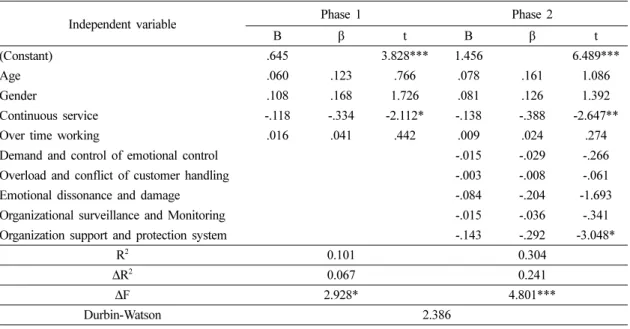
Table 5는 이직의도에 따른 감정노동의 위계적 회 귀분석 결과를 나타낸 것이다.
연령, 성별, 초과근무에 따른 이직의도의 통계적 패턴은 보이지 않았으나 근무년수는 부(−)의 영향을 보였는데 근무년수가 길수록 감정노동은 낮은 것으 로 조사되었으며, 감정노동 부문에서는 조직의 지지 및 보호체계에서 부(−)의 영향을 나타냈는데 이직의 도가 낮아지면 조직의 지지 및 보호체계라는 감정노 동 호소부분을 감정을 누르면서 방사선사 업무로 돌
아갈 수 밖에 없기 때문이라는 해석을 할 수 있다.
Table 6은 직무만족도에 따른 감정노동의 위계적 회귀분석 결과를 나타낸 것이다.
성별, 초과근무, 근무시간에 따른 직무만족도의 통 계적 패턴은 보이지 않았으나 연령에서 부(−)의 영 향을 보이게 되는데 연령이 높을수록 감정노동은 낮 은 것으로 조사되었다. 이것은 상대적으로 근무년 수 에서 유의하지 않지만 거시적으로 확인할 수 있는데 근무년 수가 오래될수록 감정노동을 호소하지 않는 것을 볼 수 있다. 감정노동 부문에서는 조직의 지지 및 보호체계에서 정(+)의 영향을 보였는데 직무만족 도가 높아지려면 조직의 지지 및 보호체계가 탄탄해 야 한다는 것을 확인할 수 있었다.
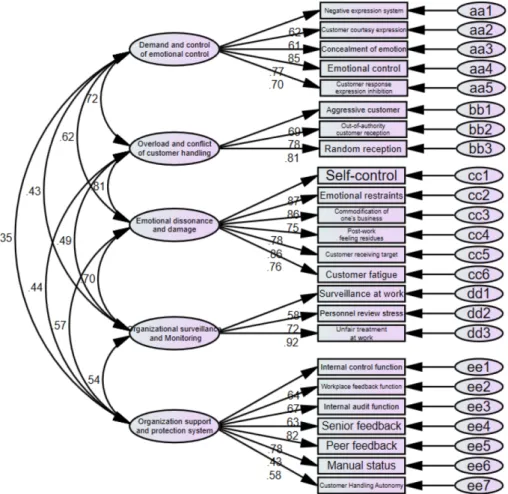
Fig. 1은 방사선사의 감정노동에 대한 각 문항의
Table 4. Varimax rotation of component matrix according to factors analysis (emotional labor)
Emotional Labor Items Components
1 2 3 4 5
Emotional dissonance and damage
Customer fatigue .796 .096 .252 .182 .059
Post-work feeling residues .764 .226 .065 .184 .122 Customer receiving target .734 .161 .141 .265 .323
Emotional restraints .669 .285 .135 .306 .333
Commodification of one’s business .655 .129 .357 .317 .046 Customer response expression inhibition .513 .142 .507 .296 -.018
Organization support and protection system
Workplace feedback function .040 .760 .016 .329 .029
Senior feedback .335 .737 .018 -.054 .156
Internal audit function -.038 .720 -.037 .032 .279
Peer feedback .424 .678 -.076 .001 .111
Internal audit function .226 .650 .267 -.027 .046
Customer Handling Autonomy .058 .644 .216 .041 .208
Manual status .065 .583 .070 .265 -.319
Demand and control of emotional control
Negative expression system -.030 -.042 .805 .129 .186
Concealment of emotion .245 .138 .796 .121 .093
Emotional control .186 .244 .758 .193 -.036
Customer courtesy expression .368 -.087 .543 .183 .273
Overload and conflict of customer handling
Out-of-authority customer reception .267 .039 .334 .768 .123 Preference for Customer Position .436 .129 .295 .767 .133
Random reception .491 .133 .133 .706 .086
Aggressive customer .376 .180 .370 .410 .249
Organizational surveillance and Monitoring
Personnel review stress .270 .072 .260 .027 .784
Surveillance at work .024 .245 .083 .326 .713
Unfair treatment at work .447 .308 .075 .008 .660
가중치를 나타내는 관계도이다.
감정요구 및 규제에 대하여 감정숨김(β=0.85, p<0.001)에서 가장 높은 영향력을 주는 것으로 조사 되었다. 고객응대의 과부하 및 갈등에서는 막무가내 고객응대(β=0.81, p<0.001)에서 가장 높은 영향력을
나타냈다. 감정부조화 및 손상에서는 감정억제의 속 상함(β=0.87, p<0.001), 자신 업무의 상품화(β=0.86, p<0.001), 고객응대 상처 받음(β=0.86, p<0.001)의 항목에서 높은 영향력을 주는 것으로 조사되었다. 조 직의 감시 및 모니터링에서는 직장 내 부당 처우
Table 5. A hierarchical regression analysis of emotional labor due to job turnover
Independent variable Phase 1 Phase 2
B β t B β t
(Constant) .645 3.828*** 1.456 6.489***
Age .060 .123 .766 .078 .161 1.086
Gender .108 .168 1.726 .081 .126 1.392
Continuous service -.118 -.334 -2.112* -.138 -.388 -2.647**
Over time working .016 .041 .442 .009 .024 .274
Demand and control of emotional control -.015 -.029 -.266
Overload and conflict of customer handling -.003 -.008 -.061
Emotional dissonance and damage -.084 -.204 -1.693
Organizational surveillance and Monitoring -.015 -.036 -.341
Organization support and protection system -.143 -.292 -3.048*
R
20.101 0.304
∆R
20.067 0.241
∆F 2.928* 4.801***
Durbin-Watson 2.386
*p<0.05, **p<0.01, ***p<0.001
Table 6. A hierarchical regression analysis of emotional labor based on job satisfaction
Independent variable Phase 1 Phase 2
B β t B β t
(Constant) .349 2.674** -.171 -.962
Age -.109 -.299 -1.805 -.116 -.317 -2.027*
Gender -.075 -.155 -1.544 -.057 -.117 -1.232
Continuous service .053 .197 1.211 .061 .228 1.478
Over time working .008 .028 .295 .017 .057 .623
Demand and control of emotional control .005 .012 .108
Overload and conflict of customer handling .038 .137 1.028
Emotional dissonance and damage .052 .168 1.323
Organizational surveillance and Monitoring -.027 -.086 -.769
Organization support and protection system .098 .267 2.636*
R
20.046 0.009
∆R
20.226 0.156
∆F 1.249 3.214**
Durbin-Watson 1.836
*p<0.05, **p<0.01, ***p<0.001
(β=0.92, p<0.001)에서 높은 영향력을 주는 것으로 조사되었다. “조직의 지지 및 보호체계”의 항목에서 는 상사의 피드백 (β=0.82, p<0.001)에서 높은 영향 력을 주었다. 종합 결과를 판단하였을 때 감정노동 에서는 방사선사가 “동료의 피드백(75.8±15.6점, β=0.78, p<0.001)” 항목이외에는 감정노동을 호소하 는 항목을 특별히 찾을 수 없었다.
3. 타 업종의 감정노동 비교
선행연구를 보면 방사선사 및 병원근로자의 직무 스트레스에 관한 연구는 많이 이뤄지고 있으나 감정 노동에 관한 내용은 안전보건공단에서 2013년 개발 이래 활발한 연구가 이뤄지지 않았다.12-13) 방사선사 (보건·의료관련직)는 일반적인 직무스트레스평가에서 보았을 때 높은 직종에 속하였다.14)이를 통해 방사
선사의 감정노동 지표 또한 높을 것이라는 가정으로 가설을 설정하여 설문조사를 실시하였고 타 직종과 비교를 하기 위하여 안전보건공단 내 발표되었던 감 정노동에 관한 결과 중 감정노동 지표가 높은 직종 에 속한 그룹군을 나열하였다(Table 7), 타 직종과 비교하여 가장 높은 항목은 “조직의 지지 및 보호체 계”로 이는 의료근로자 중 1인 종사가 많고 타 직 종보다 조직성이 결여됨에 따른 동료의 피드백 (75.8±15.6점, β=0.78, p<0.001)에서의 소외감이 가 장 큰 원인의 결과로 나타났다. 다만, 본 연구의 제 한점으로 감정노동의 원인을 구체적이고 다각적으로 분석하기 위하여 환경유해인자(방사선량, 실내 환경 오염물질) 및 직무스트레스에 대한 내용을 본 연구 에서는 수행되지 않았기 때문에 추후 이와 관련된 연구가 필요할 것으로 생각한다.
Fig. 1. Weight relation of each question regarding emotional labor of radiographer
IV. 결 론
방사선사의 감정노동의 원인은 감정을 숨기고 고 객 응대 및 업무의 상품화를 통한 직장 내 부당처 우가 직접적인 원인이 되고 있었다. 감정노동에서는 방사선사가 ‘동료의 피드백’ 항목에서 감정노동을 호 소하고 있다. 방사선사는 1인 전문직으로 타 동료와 의 소통을 통한 감정노동을 해결할 수 있는 시스템 이 결여되어 있는 직종이므로, 동료간의 소통결여의 결과는 감정노동이 이직의도와 직무만족도 결여의 영향을 준다고 볼 수 있다. 방사선사의 감정노동을 해결하기 위해서는 동료의 환류가 이루어 질 수 있 는 교육 및 워크숍 등을 통한 모임이 필요할 것으 로 판단된다.
References
1. Kwon WS, Kim YJ, Lee GM. A Meta-Analysis of the Effects of Emotional Labor on the Related Out- comes of Hospitality Employees: Focusing on Domestic Research. Journal of Tourism Sciences.
2016; 40(9): 51-68.
2. Park E. Emotional Labor and Labor Law. Quarterly Journal of Labor Policy. 2016; 16(3): 55-85.
3. Jung YS, Hur MH. An Analysis on the Publicness of Medical Services in Public Hospitals. Korean Public Administration Review. 2000; 33(4): 355- 370.
4. Lee MH. Relationship of Job-Satisfaction Due to Radiographer”S Job-Characteristics and Job-Stress.
Journal of the Korea Contents Association. 2012;
12(8): 224-32
5. Lee HN, Lim CH, Lee JS. 2012, pp. 185-186 (The Korea Contents Society).
6. Jung HR, Son BS, Lim CH. An Analysis of Reli- ability by Factors for Development of Job Stress Measurement Tools of Radiological Technologists.
Korean Journal of Environmental Health. 2006;
32(2): 103-110.
7. Kim YJ, Hwang CM, Kim HK. A Study on the Work of the Radiologist Expanded as Radiologist Assistant (Ra). Journal of Korean Society of Car- dio-Vascular Interventional Technology. 2012;
15(1): 116-127.
8. KOSHA. Guidelines for Preventing Job Stress by Emotional Labor (Korea Occupational Safety and Health Agency) (KOSHA GUIDE H-34-2011). 2011.
9. KOSHA. Occupational Disease Case in Korea (Korea Occupational Safety and Health Agency).
2016.
10. KOSHA. Appraisal of Korean Emotional Labor (Korea Occupational Safety and Health Agency).
2014.
11. Jeong JJ. The Effect of Hospital Environment on Employee’s Job Stress. Korean Journal of Environ- mental Health. 2002; 28(3): 72-76.
12. KOSHA. A Study on the Emotional Labor Status, Risk Factors, and Health Effects of Emotional Labor Workers. 2015.
13. KOSHA. A Study on the Application of Korean- style Emotional Labor and Violence Investigation Tools. 2013.
14. MOEL. Developing an Occupational Stress Scale for Korean Employees. 2006.
저자정보