국립공원 탐방프로그램 참가자 만족도 및 재참여의향에 관한 연구 1a
- 2019년 국립공원 봄 주간 프로그램을 중심으로 - 심규원2⋅장진3*
A Study on the Satisfaction and Intention to Re-participation of Participants in National Park Exploration Programs
1a- Focusing on ‘2019 National Park Spring Week Program - Kyu-Won Sim
2, Jin Jang
3*요 약
최근 문화체육관광부에서는 범국민적 여행분위기 조성과 여름철 집중된 국내 관광수요 분산 등을 위해 2014년부터 ‘여행주 간 ’을 정하여 운영하고 있다. 이 사업의 일환으로 국립공원공단에서도 2018년부터 ‘여행주간’ 동안 전국 국립공원에서 자연을 주제로 한 볼거리 ·즐길거리를 제공하는 국민 참여형 저지대 탐방 프로그램을 운영하고 있다. 따라서 본 연구의 목적은 국가 정책으로 시행되고 있는 ‘여행주간’ 동안 국립공원에서 진행되었던 ‘국립공원 봄 여행주간 프로그램’ 참가자를 대상으로 프로그램 만족도와 재참여의향에 대한 인식 특성을 파악하기 위해 진행되었다 . 연구방법은 전국의 총 18개 국립공원에서 진행된 ‘2019년 국립공원 봄 주간 프로그램’에 참여한 탐방객 1,281명을 대상으로 자기보고식 설문조사를 실시하였다. 연구결 과 , 참가자의 ‘국립공원 봄 주간 프로그램’ 사전 인지 여부에 따른 만족도 및 재참여의향 차이를 분석한 결과, 국립공원 방문 전 프로그램을 인지한 참가자의 만족도와 재참여의향은 사전에 인지하지 못했던 참가자 보다 만족도와 재참여의향 모두 평균값이 통계적으로 유의하게 높게 나타났다. 국립공원 유형별로 살펴보면, ‘해상·해안형 국립공원’과 ‘사적형 국립공원’
이 ‘도시형 국립공원’ 보다 만족도와 재참여의향 평균값이 통계적으로 유의하게 높게 나타났다. 프로그램 유형별로 살펴보면, 참가자의 만족도는 ‘전시회’, ‘홍보부스’, ‘캠페인’ 보다 ‘문화공연’과 ‘탐방체험’ 형태가 통계적으로 유의하게 평균값이 높았 고 , 재참여의향은 ‘전시회’, ‘홍보부스’ 형태 보다 ‘문화공연’과 ‘탐방체험’에서 평균값이 통계적으로 유의하게 높았다. 본 연구는 향후 국립공원 여름 성수기 외에도 봄과 가을 탐방객 수 증가에 대응한 탐방서비스 개선을 위한 탐방정책 수립을 위한 기초자료로서 활용될 수 있다.
주요어 : 여행주간, 국립공원 체험, 참여의향, 탐방객 인식, 탐방서비스
1 접수 2019년 8월 5일, 수정 (1차: 2019년 8월 12일), 게재확정 2019년 8월 12일 Received 5 August 2019; Revised (1st: 12 August 2019); Accepted 12 August 2019
2 국립공원공단 국립공원연구원 연구위원, National Park Research Institute, Korea National Park Service, Wonju 26441, Korea ([email protected])
3 국립공원공단 국립공원연구원 책임연구원, National Park Research Institute, Korea National Park Service, Wonju 26441, Korea ([email protected])
a 이 논문은 국립공원공단에서 진행한 ‘2019년 국립공원 봄 주간 운영결과’자료를 활용한 연구결과의 일부임.
* 교신저자 Corresponding author: [email protected]
ABSTRACT
The Korean Ministry of Culture, Sports and Tourism has held “Travel Week” since 2014 to encourage the people to take a vacation and disperse the seasonal tourism demand that is concentrated in summer in Korea.
As part of the program, the Korea National Park Service has also operated the participatory lowland exploration program that offers nature-themed attractions and enjoyment in national parks across the country during the
“Travel Week” since 2018. The purpose of this study was to investigate the satisfaction with the program and intention to participate again of participants in the “National Park Spring Week Program” which is held in national parks during the “Travel Week.” We conducted a self-report survey of 1,281 participants in the “2019 National Park Spring Week Program” held in 18 national parks across the country. The analysis of responses on the difference in the participants’ satisfaction and intention to participate again according to the awareness in advance of the “2019 National Park Spring Week Program” showed that the average satisfaction and intentional to participate again of those who were aware of the program before visiting national parks were statistically significantly higher than those who were not. As for the type of national parks, those who participated in “maritime and coastal national parks” and “historical national parks” showed the statistically significantly higher satisfaction and intention to participate again than those who participated in “urban national parks.” As for the type of the programs, those who participated in “cultural performance” and “exploration experience” showed the statistically significantly higher satisfaction than those who participated in
“exhibition,” “PR booth,” and “campaign.” Those who participated in “cultural performance” and “exploration experience” showed the statistically significantly higher intention to participate again than those who participated in “exhibition” and “PR booth.” This study is expected to provide basic data for establishing a policy to improve exploration services in response to the increasing number of visitors to national parks in spring and fall as well as the peak season of summer.
KEY WORDS: TRAVEL WEEK, NATIONAL PARK EXPERIENCE, PARTICIPATION INTENTION, VISITOR RECOGNITION, EXPLORING SERVICE
서 론
최근 문화체육관광부에서는 범국민적 여행분위기 조성과 국 민의 시간적, 경제적 제약요인 개선을 통한 신규 관광수요 창출 과 여름철 집중된 국내 관광수요 분산을 위해 2014년부터 ‘여 행주간’을 정하여 운영하고 있다. 여행주간을 통해 하계휴가 분산, 가족여행 확대 등을 통해 국민의 삶의 질 향상과 내수경 제 활성화를 도모하는데 그 목적이 있다(Ministry of Culture, Sports and Tourism, 2018). 이 사업의 일환으로 국립공원공 단에서도 2018년부터 ‘여행주간’ 동안 전국 국립공원에서 자연 을 주제로 한 볼거리·즐길거리를 제공하는 국민 참여형 저지대 탐방 프로그램을 운영하고 있다. 2019년 여행주간(4. 27.~5.
12.)에는 전국의 국립공원에서는 등산 외 국립공원 자연을 주
제로 한 저지대 탐방 콘텐츠인 ‘문화공연’, ‘전시회’, ‘탐방체 험’, ‘홍보부스’, ‘캠페인’ 5개 분야별로 총 153회 프로그램을 운영하였다(Inside data of Korea National Park Service, Table 1).
국립공원은 자연생태계와 수려한 자연경관, 문화유적 등을
보호하고 지속적으로 이용할 수 있도록 하여 자연환경의 보전,
국민의 여가와 휴양 및 정서생활의 향상을 기하기 위하여 지정
한 일정구역이다(Min․Lee, 2015). 우리나라 국립공원은 매년
2,700만 명 정도의 탐방객이 방문하여 자연을 감상하며 찾은
새로운 휴양경험의 만족을 통해 환경을 새롭게 인식하고 단순한
이용차원을 넘어 보전필요성에 대한 환경인식을 하는데 많은
역할을 하고 있다(Kim, 2007). 따라서 국립공원 탐방 후 평가와
관련된 조사는 탐방객에 대한 이해를 돕고 탐방객과의 마찰을
줄이는 동시에 국립공원의 보전관리와 지속가능한 이용을 도모 하기 위한 중요한 자료이다. 또한, 탐방프로그램 만족도 등을 파악함으로써 탐방객의 요구에 맞는 차별화된 서비스를 제공하 는 등 탐방정책 수립·운영에도 객관적인 근거자료가 될 수 있다.
만족도와 재방문에 관한 연구는 서비스분야 측면이 많기 때문 에 오늘날 여러 분야에서 적용되어 왔다. 특히 관광객의 만족도 는 관광활동을 통해서 느끼는 전반적인 감정이며(Del Bosque
․ Martin, 2008) 향후 재행동 의도에 큰 영향을 미치기 때문에 (Kim․Kim, 2017) 관광분야에서 관광객의 만족에 대해서는 광 범위하게 연구되어져 왔다.
국립공원을 대상으로 한 관련 선행연구를 살펴보면, 탐방객의 만족요인 파악(Baek․Kim, 2008), 프로그램 참여동기와 계절별 프로그램 선호도(Seo et al., 2016), 탐방객의 활동 및 행동이 만족에 미치는 영향 파악(Bae․Nam, 2017), 탐방객의 생태관광 만족도와 재참여 의사(Sim et al., 2012) 등 탐방객의 탐방활동 에 대한 인식 연구가 꾸준히 진행되었으며, 이를 통해 공원자원 관리와 탐방서비스 질 향상을 위한 개선점을 제안하였다.
이러한 측면에서 Min․Lee(2015)는 국립공원 이용자인 탐방 객이 지니고 있는 가치와 요구를 제대로 파악하여, 부정적 요인 을 제거하고 양질의 서비스를 제공하기 위해 탐방객이 국립공 원 방문 후 느끼는 만족도와 그 만족도에 영향을 미치는 변수에 대한 연구의 필요성을 제기하였고, Gwak(2013)은 국립공원의 효율적 관리를 위한 근원적 연구는 다름 아닌 수요자특성을 파악하는 것이며, 그들에게 적합하고 적절한 서비스가 지속가 능성 내에서 선택적으로 제공되어야 함을 주장하였다.
따라서 본 연구의 목적은 국가 정책으로 시행되고 있는 ‘여 행주간’ 동안 국립공원에서 진행되었던 ‘국립공원 봄 여행주간 프로그램’ 참가자를 대상으로 프로그램 만족도와 재참여의향 에 대한 특성을 파악하기 위해 진행되었다. 본 연구결과는 향후 봄철 탐방객 수 증가에 대응한 탐방서비스 개선을 위한 자료로 활용함으로써 국립공원의 탐방관리 정책을 수립하는데 객관적 인 자료로 활용될 것으로 판단된다.
연구방법
1. 연구대상
본 연구는 전국의 총 18개 국립공원에서 진행된 ‘2019년 국립공원 봄 주간 프로그램’에 참여한 탐방객 1,281명을 대상 으로 하였다. 국립공원 유형 분류는 Korea Environment Institute(2019)에서 제시한 우리나라에서 일반적으로 사용되 는 ‘산악형’, ‘도시형’, ‘해상·해안형’, ‘사적형’ 유형으로 구분 하여 분석에 적용하였다(Table 2).
2. ‘2019년 국립공원 봄 주간 프로그램’ 현황
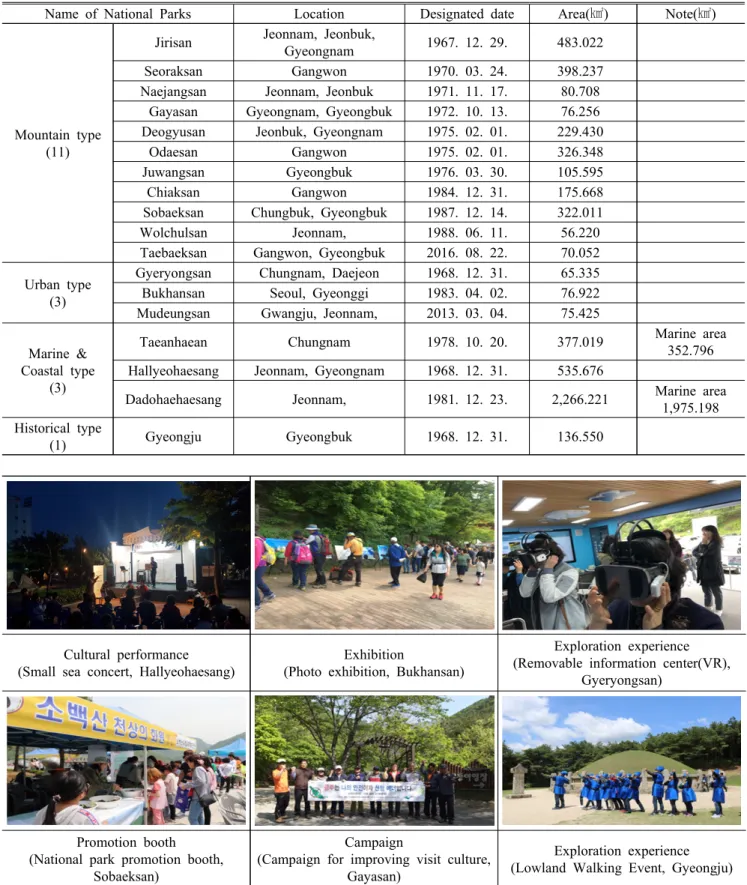
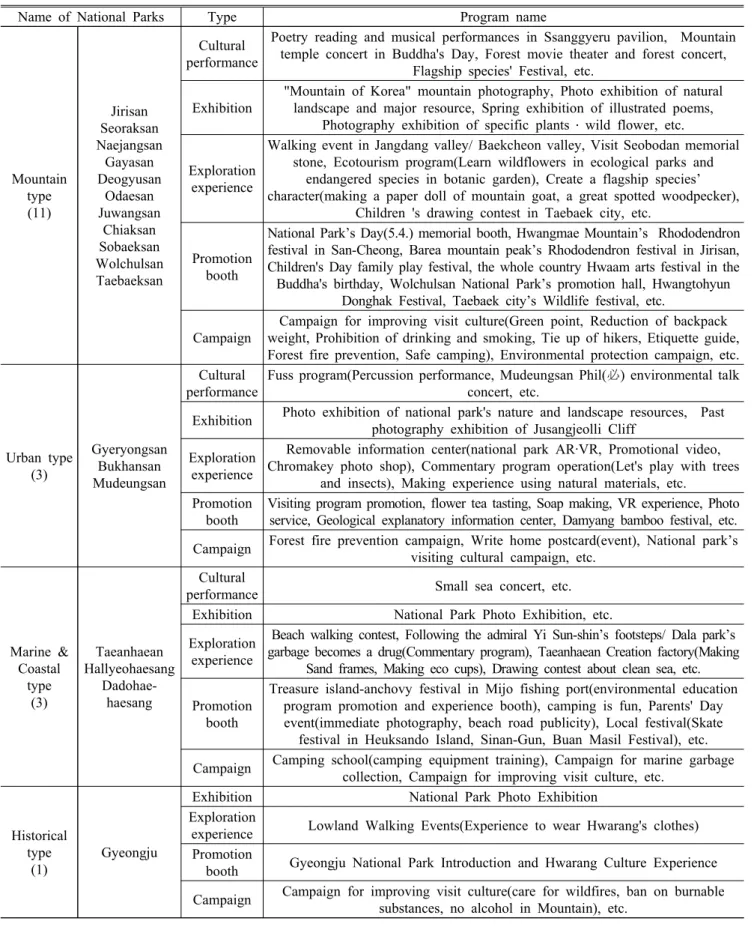
국립공원 유형별 운영된 ‘2019년 국립공원 봄 주간 프로그 램 ’ 운영 현황은 다음과 같다(Table 3, Figure 1).
3. 설문조사 및 분석
‘2019년 국립공원 봄 주간 프로그램’ 참가자들을 대상으로 프로그램 참가 후 자기보고식 설문조사를 실시하였다. 설문기 간은 여행주간인 4월 27일부터 5월 12일까지 총 16일 간 진행 하였다 . 설문지 문항은 동반유형, 사전인지, 정보획득, 만족도, 재참여의향 , 기타(프로그램 개선점 등) 총 6개 문항으로 구성하 였다. 만족도 항목은 ‘1점 매우 별로였다’부터 ‘5점 매우 좋았 다 ’로 점수가 높을수록 만족도가 높은 것을 나타내며, 재참여의 향 항목은 ‘1점 매우 그렇지 않다’부터 ‘5점 매우 그렇다’로 점수가 높을수록 재참여의향이 더 있는 것으로 각각 5점 리커 트 척도를 사용하였다. 설문조사는 18개 각 국립공원사무소별 해당 프로그램을 운영하는 담당자가 조사를 진행하였으며, 개 별프로그램 각 회 마다 10부씩 설문지를 회수하였다. 이 중 유효한 설문지 총 1,281부를 분석에 사용하였다. 수집된 자료 는 SPSS 25.0 프로그램을 활용하여 기술통계 분석, 독립표본
t-test, 회귀분석(Regression analysis), ANOVA 검증 및Scheffé, Duncan 사후검증을 실시하였다.
Variables Total Cultural
performance Exhibition Exploration experience
Promotion
booth Campaign
Number of times 153 16 32 16 60 29
Number of
participants 147,145 3,960 54,961 7,449 65,395 15,380
Table 1. Operation status of national parks spring week program in 2019
Name of National Parks Location Designated date Area(㎢) Note(㎢)
Mountain type (11)
Jirisan Jeonnam, Jeonbuk,
Gyeongnam 1967. 12. 29. 483.022
Seoraksan Gangwon 1970. 03. 24. 398.237
Naejangsan Jeonnam, Jeonbuk 1971. 11. 17. 80.708 Gayasan Gyeongnam, Gyeongbuk 1972. 10. 13. 76.256 Deogyusan Jeonbuk, Gyeongnam 1975. 02. 01. 229.430
Odaesan Gangwon 1975. 02. 01. 326.348
Juwangsan Gyeongbuk 1976. 03. 30. 105.595
Chiaksan Gangwon 1984. 12. 31. 175.668
Sobaeksan Chungbuk, Gyeongbuk 1987. 12. 14. 322.011
Wolchulsan Jeonnam, 1988. 06. 11. 56.220
Taebaeksan Gangwon, Gyeongbuk 2016. 08. 22. 70.052 Urban type
(3)
Gyeryongsan Chungnam, Daejeon 1968. 12. 31. 65.335 Bukhansan Seoul, Gyeonggi 1983. 04. 02. 76.922 Mudeungsan Gwangju, Jeonnam, 2013. 03. 04. 75.425
Marine &
Coastal type (3)
Taeanhaean Chungnam 1978. 10. 20. 377.019 Marine area
352.796 Hallyeohaesang Jeonnam, Gyeongnam 1968. 12. 31. 535.676
Dadohaehaesang Jeonnam, 1981. 12. 23. 2,266.221 Marine area
1,975.198 Historical type
(1) Gyeongju Gyeongbuk 1968. 12. 31. 136.550
Table 2. Research sites
Cultural performance (Small sea concert, Hallyeohaesang)
Exhibition
(Photo exhibition, Bukhansan)
Exploration experience (Removable information center(VR),
Gyeryongsan)
Promotion booth
(National park promotion booth, Sobaeksan)
Campaign
(Campaign for improving visit culture, Gayasan)
Exploration experience (Lowland Walking Event, Gyeongju)
Figure 1. Pictures of national parks spring week program in 2019.
Name of National Parks Type Program name
Mountain type (11)
Jirisan Seoraksan Naejangsan
Gayasan Deogyusan
Odaesan Juwangsan
Chiaksan Sobaeksan Wolchulsan Taebaeksan
Cultural performance
Poetry reading and musical performances in Ssanggyeru pavilion, Mountain temple concert in Buddha's Day, Forest movie theater and forest concert,
Flagship species' Festival, etc.
Exhibition
"Mountain of Korea" mountain photography, Photo exhibition of natural landscape and major resource, Spring exhibition of illustrated poems,
Photography exhibition of specific plants ․ wild flower, etc.
Exploration experience
Walking event in Jangdang valley/ Baekcheon valley, Visit Seobodan memorial stone, Ecotourism program(Learn wildflowers in ecological parks and
endangered species in botanic garden), Create a flagship species’
character(making a paper doll of mountain goat, a great spotted woodpecker), Children 's drawing contest in Taebaek city, etc.
Promotion booth
National Park’s Day(5.4.) memorial booth, Hwangmae Mountain’s Rhododendron festival in San-Cheong, Barea mountain peak’s Rhododendron festival in Jirisan, Children's Day family play festival, the whole country Hwaam arts festival in the Buddha's birthday, Wolchulsan National Park’s promotion hall, Hwangtohyun
Donghak Festival, Taebaek city’s Wildlife festival, etc.
Campaign
Campaign for improving visit culture(Green point, Reduction of backpack weight, Prohibition of drinking and smoking, Tie up of hikers, Etiquette guide, Forest fire prevention, Safe camping), Environmental protection campaign, etc.
Urban type (3)
Gyeryongsan Bukhansan Mudeungsan
Cultural
performance Fuss program(Percussion performance, Mudeungsan Phil(必) environmental talk concert, etc.
Exhibition Photo exhibition of national park's nature and landscape resources, Past photography exhibition of Jusangjeolli Cliff
Exploration experience
Removable information center(national park AR·VR, Promotional video, Chromakey photo shop), Commentary program operation(Let's play with trees
and insects), Making experience using natural materials, etc.
Promotion booth
Visiting program promotion, flower tea tasting, Soap making, VR experience, Photo service, Geological explanatory information center, Damyang bamboo festival, etc.
Campaign Forest fire prevention campaign, Write home postcard(event), National park’s visiting cultural campaign, etc.
Marine &
Coastal type
(3)
Taeanhaean Hallyeohaesang
Dadohae- haesang
Cultural
performance Small sea concert, etc.
Exhibition National Park Photo Exhibition, etc.
Exploration experience
Beach walking contest, Following the admiral Yi Sun-shin’s footsteps/ Dala park’s garbage becomes a drug(Commentary program), Taeanhaean Creation factory(Making
Sand frames, Making eco cups), Drawing contest about clean sea, etc.
Promotion booth
Treasure island-anchovy festival in Mijo fishing port(environmental education program promotion and experience booth), camping is fun, Parents' Day event(immediate photography, beach road publicity), Local festival(Skate
festival in Heuksando Island, Sinan-Gun, Buan Masil Festival), etc.
Campaign Camping school(camping equipment training), Campaign for marine garbage collection, Campaign for improving visit culture, etc.
Historical type
(1)
Gyeongju
Exhibition National Park Photo Exhibition Exploration
experience Lowland Walking Events(Experience to wear Hwarang's clothes) Promotion
booth Gyeongju National Park Introduction and Hwarang Culture Experience Campaign Campaign for improving visit culture(care for wildfires, ban on burnable
substances, no alcohol in Mountain), etc.
Table 3. Examples of national parks spring week program in 2019
연구결과
1. 응답자의 일반특성
‘2019년 국립공원 봄 주간 프로그램’에 참가한 응답자 수는 다음과 같다(Table 4). 지리산국립공원 등 11개의 산악형 국립 공원에서는 723명(56.4%), 계룡산국립공원 등 3개의 도시형 국립공원 361명(28.2%), 태안해안국립공원 등 3개의 해상․해 안형 국립공원 157명(12.3%), 경주국립공원과 같은 사적형 국 립공원 1개소에서 40명(3.1%)의 탐방객이 본 설문조사에 참여 한 것으로 조사되었다(Table 4).
응답자의 국립공원 방문시 동반형태는 가족 658명(51.4%), 친구․동료 450명(35.1%), 혼자 138명(10.8%), 기타 35명(2.7%) 순으로 나타났다 . 봄 여행주간(19. 4. 27.~5. 12.)에 국립공원에 방문한 탐방객은 가족과 함께 방문한 경우가 가장 많았고, 그 다음으로 친구․동료가 대부분을 차지하였다(Table 5). 이 결과는 Ministry of Culture, Sports and Tourism(2019)의 국민여행조 사 실태 분석결과에서 국내 관광여행 동반자 유형으로는 ‘가 족 ’(49.4%)이 가장 높았고, 다음은 ‘친구/연인’(41.2%), ‘친목단 체/모임’(7.3%) 등의 순으로 나타난 결과처럼 국립공원 역시 가 족과 친구 ·동료가 함께 방문하는 비율이 높아 유사하게 나타났다.
Variables Number of participants
n %
Mountain type (11)
Jirisan 40
723
3.1
56.4
Seoraksan 30 2.3
Naejangsan 130 10.1
Gayasan 20 1.6
Deogyusan 60 4.7
Odaesan 100 7.8
Juwangsan 50 3.9
Chiaksan 90 7.0
Sobaeksan 93 7.3
Wolchulsan 60 4.7
Taebaeksan 50 3.9
Urban type (3)
Gyeryongsan 50
361
3.9
28.2
Bukhansan 206 16.1
Mudeungsan 105 8.2
Marine & Coastal type (3)
Taeanhaean 60
157
4.7
12.3
Hallyeohaesang 40 3.1
Dadohaehaesang 57 4.5
Historical type
(1) Gyeongju 40 40 3.1 3.1
Total 1,281 100.0
Table 4. Number of respondents by national park type
Type of companion Number of participants
n %
Alone 138 10.8
Family 658 51.4
Friend / Colleague 450 35.1
Etc. 35 2.7
Total 1,281 100.0
Table 5. Companion when respondent visits a national park
국립공원 유형별로 살펴보면, 혼자 방문한 탐방객의 경우 도시형(12.5%), 산악형(11.3%), 해상․해안형(6.4%), 사적형 (2.5%)의 순으로 나타났다. 즉, 도시형 국립공원은 인구규모가 큰 배후도시와 지리적으로 인접해 있고, 교통접근성도 용이하 기 때문에 여행주간에 혼자 방문하는 탐방객 비율이 상대적으 로 높게 나타난 것으로 판단된다(Table 6).
응답자의 ‘국립공원 봄 주간 프로그램’ 사전인지 여부를 살 펴보면, 사전에 ‘국립공원 봄 주간 프로그램’을 알고 있었다고 응답한 탐방객은 462명(36.1%), 몰랐다고 응답한 탐방객은 819명(63.9%)으로 나타났다(Table 7).
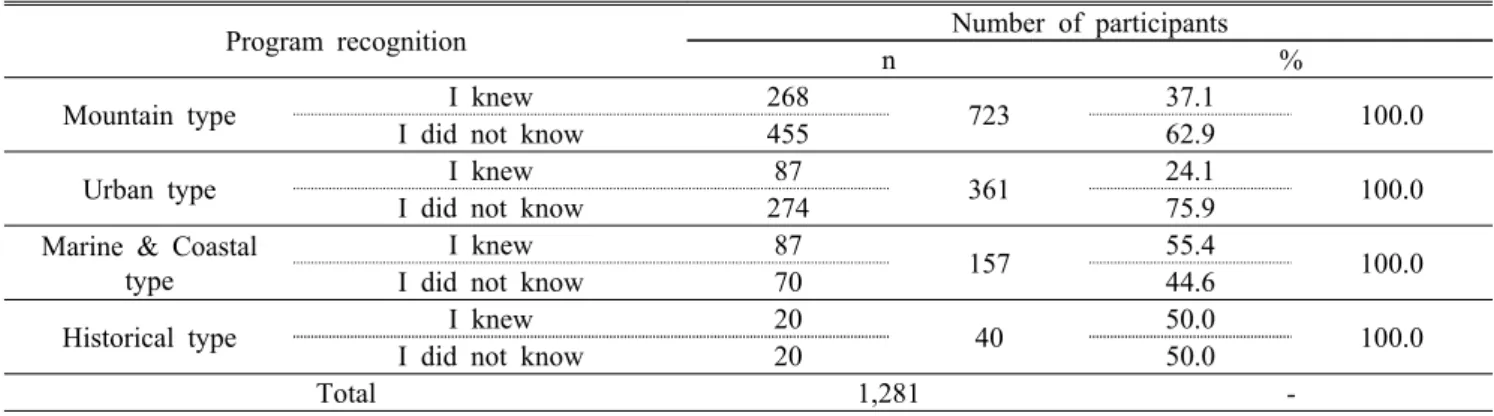
국립공원 유형별로 살펴보면 , ‘국립공원 봄 주간 프로그램’을 사전에 인지한 탐방객 비율은 해상․해안형 국립공원 (55.4%), 사적 형 국립공원(50.0%), 산악형 국립공원(37.1%), 도시형 국립공원 (24.1%) 순으로 나타나 여행주간 동안 해상․해안형 국립공원을 방문한 탐방객의 경우 절반 이상이 사전에 국립공원 봄 주간 프로 그램 관련 정보를 접하고 방문한 것으로 분석되었다(Table 8).
‘국립공원 봄 주간 프로그램’에 대해 사전에 인지한 응답자 를 대상으로 정보획득 경로를 조사한 결과 , 현수막 등 현장홍보 물 (53.0%), 인터넷(15.8%), 지인의 소개 등 기타(15.4%), 방 송․신문․잡지 (8.0%), SNS(7.8%)의 순으로 나타났다(Table 9).
2. 공원별 프로그램 현황
국립공원별 탐방객이 참여한 ‘국립공원 봄 주간 프로그램’
현황은 홍보부스 운영이 총 544건(42.5%)으로 가장 비율이 높았고, 전시회 313건(24.4%), 캠페인 189건(14.8%), 문화공 연 123건(9.6%), 탐방체험 112건(8.7%)의 순으로 분석되었다 (Table 10).
3. 참가자의 프로그램 만족도 및 재참여의향
참가자의 ‘국립공원 봄 주간 프로그램’ 사전 인지 여부에
Type of companion Number of participants
n %
Mountain type
Alone 82
723
11.3
100.0
Family 403 55.7
Friend / Colleague 223 30.8
Etc. 15 2.1
Urban type
Alone 45
361
12.5
100.0
Family 157 43.5
Friend / Colleague 149 41.3
Etc. 10 2.8
Marine & Coastal type
Alone 10
157
6.4
100.0
Family 78 49.7
Friend / Colleague 59 37.6
Etc. 10 6.4
Historical type
Alone 1
40
2.5
100.0
Family 20 50.0
Friend / Colleague 19 47.5
Total 1,281 -
Table 6. Companion when a respondent visits according to the national park type
Program recognition Number of participants
n %
I knew 462 36.1
I did not know 819 63.9
Total 1,281 100.0
Table 7. Whether the participants' program was recognized before the visit
Program recognition Number of participants
n %
Mountain type I knew 268
723 37.1
100.0
I did not know 455 62.9
Urban type I knew 87
361 24.1
100.0
I did not know 274 75.9
Marine & Coastal type
I knew 87
157 55.4
100.0
I did not know 70 44.6
Historical type I knew 20
40 50.0
100.0
I did not know 20 50.0
Total 1,281 -
Table 8. Whether the participants' program was recognized before the visit by park type
Information acquisition path Number of participants
n %
On-site promotional materials such as banners 245 53.0
Internet 73 15.8
SNS 36 7.8
Broadcast·Newspaper·Magazine 37 8.0
Etc. 71 15.4
Total 462 100.0
Table 9. Participants’ information acquisition path
Name of National Parks
Cultural
performance Exhibition Exploration experience
Promotion
booth Campaign Total
n (%) n (%) n (%) n (%) n (%) n %
Mountain type
Jirisan - 10 - 30 - 40 3.1
Seoraksan - 10 - 15 5 30 2.3
Naejangsan 20 50 20 30 10 130 10.1
Gayasan - - - - 20 20 1.6
Deogyusan 10 30 - 20 - 60 4.7
Odaesan - 10 - 80 10 100 7.8
Juwangsan 40 10 - - - 50 3.9
Chiaksan - 20 20 - 50 90 7.0
Sobaeksan 13 20 - 40 20 93 7.3
Wolchulsan 10 20 - 10 20 60 4.7
Taebaeksan - 10 10 30 0 50 3.9
Subtotal 93 (7.3) 190 (14.8) 50 (3.9) 255 (19.9) 135 (10.5) 723 56.4
Urban type
Gyeryongsan 10 20 20 - - 50 3.9
Bukhansan - 33 12 157 4 206 16.1
Mudeungsan 10 30 - 55 10 105 8.2
Subtotal 20 (1.6) 83 (6.5) 32 (2.5) 212 (16.5) 14 (1.1) 361 28.2 Marine &
Coastal type
Taeanhaean - 10 20 20 10 60 4.7
Hallyeohaesang - - - 20 20 40 3.1
Dadohaehaesang 10 20 - 27 - 57 4.5
Subtotal 10 (0.8) 30 (2.3) 20 (1.6) 67 (5.2) 30 (2.3) 157 12.3 Historical
type
Gyeongju - 10 10 10 10 40 3.1
Subtotal - 10 10 10 10 40 3.1
Total 123 (9.6) 313 (24.4) 112 (8.7) 544 (42.5) 189 (14.8) 1,281 100.0
Table 10. Current state of programs in national park
따른 만족도 차이를 분석한 결과, ‘알았다’고 응답한 참가자의 만족도(M=4.44, p<.05)가 ‘몰랐다’고 응답한 참가자의 만족도 (M=4.33, p<.05) 보다 평균값이 통계적으로 유의하게 높게 나타났다(Table 11). 즉, 국립공원 봄 주간 프로그램 운영에 대해 사전에 파악하고 온 탐방객 스스로가 참여를 원하는 프로 그램을 선택하고, 해당 프로그램의 운영 일정에 맞추어 국립공 원 방문일정을 계획하였기 때문에 사전에 프로그램에 대해 전 혀 정보가 없이 국립공원을 방문하여 본 프로그램에 우연하게 참가한 탐방객보다 만족도가 더 높았을 것이라 판단된다.
그리고 참가자의 ‘국립공원 봄 주간 프로그램’ 사전 인지 여부에 따른 재참여의향 차이를 분석한 결과, ‘알았다’고 응답 한 참가자의 재참여의향(M=4.41, p<.05)이 ‘몰랐다’고 응답한 참가자의 재참여의향(M=4.28, p<.05) 보다 평균값이 통계적으 로 유의하게 높게 나타났다(Table 11). 또한, 참가자가 지각하 는 프로그램 만족도는 재참여의향에 정(+)의 영향을 미칠 것이 라는 가설에 대한 검정결과, 회귀모형은 F값이 p=.000에서 1977.341의 수치를 보이고 있으며, 회귀식에 대한 R
2=.607로 60.7%의 설명력을 보이고 있다. t값은 44.467(p=.000)로 통계 적 유의수준하에서 영향을 미치는 것으로 나타났다. 즉, 참가자 의 프로그램에 대한 만족도가 높으면 재참여의향도 높아진다는 것을 의미한다. 이 결과는 만족도가 높을수록 재 행동의도에 긍정적 영향을 준다는 Kim·Kim(2013), Kim·Kim(2014)의 연 구결과를 뒷받침한다(Table 12).
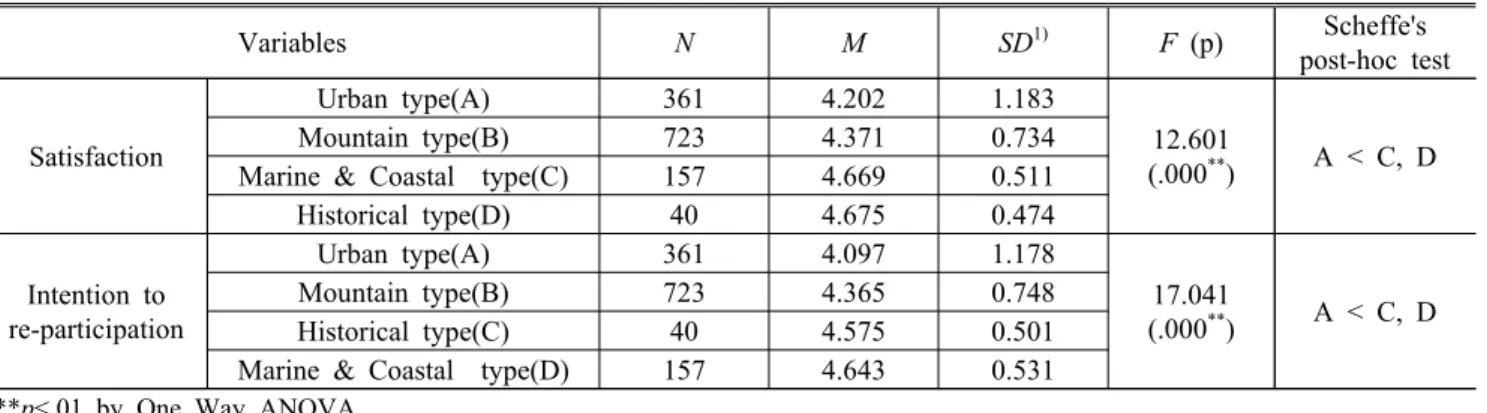
국립공원 유형에 따른 탐방객의 프로그램 만족도 및 재참여 의향의 차이를 분석한 결과, 만족도(F=12.601, p<.01)’와 ‘재
참여의향 (F=17.041, p<.01)’이 국립공원 유형에 따라 통계적 으로 유의한 차이를 보였다. 국립공원 유형 간 차이를 알아보기 위해 Scheffe 사후검증을 실시한 결과, ‘해상·해안형 국립공원 (M=4.669, SD=0.511)’과 ‘사적형 국립공원(M=4.675, SD
=0.474)’이 ‘도시형 국립공원(M=4.202, SD=1.183)’ 보다 통 계적으로 유의하게 높은 점수를 보였다 (F=12.601, p<.01). 이 결과는 탐방객들이 기존 산악형 형태의 국립공원 등반활동 보 다 봄 여행주간 프로그램으로 해변길을 걸으며 해양식물을 관 찰하고 섬 관광 , 유적답사 등의 활동을 할 때 만족도에 더 영향 을 미친다는 Bae·Nam(2017)의 연구결과를 뒷받침한다.
국립공원 유형에 따른 탐방객의 프로그램 재참여의향의 차 이를 분석하기 위하여 Scheffe 사후검증을 실시한 결과, ‘사적 형 국립공원(M=4.575, SD=0.501)’과 ‘해상·해안형 국립공원 (M=4.643, SD=0.531)’이 ‘도시형 국립공원(M=4.097, SD=
1.178)’ 보다 통계적으로 유의하게 높은 점수를 보였다(F=
17.041, p<.01, Table 13). 즉, 탐방객들이 기존에 거주지 인근 에 위치하고 교통 접근성이 좋은 도시형 국립공원 보다 봄 여행 주간동안 역사문화 자원 , 해양생태계와 해양경관 같은 희귀한 자연경관을 경험하고 새로운 학습경험을 갖고자 하는 욕구가 반영된 것으로 판단된다.
국립공원 봄 주간 프로그램 유형에 따른 탐방객의 프로그램 만족도 및 재참여의향의 차이를 분석한 결과, 만족도(F=6.762,
p<.01)’와 ‘재참여의향(F=4.906, p<.01)’이 국립공원 봄 주간프로그램 유형에 따라 통계적으로 유의한 차이를 보였다. 세부 적으로 프로그램 유형 간 차이를 알아보기 위해 Duncan 사후
Variable
N
Mean(M)SD
1)t p
Satisfaction I knew 462 4.44 0.871
2.303 .021*
I did not know 819 4.33 0.868
Intention to re-participation
I knew 462 4.41 0.869
2.542 .011*
I did not know 819 4.28 0.886
*p<0.05
1) SD: Standard Deviation
Table 11. Satisfaction and intention to re-participation according to whether or not the program is known in advance
Independent variable
Dependent variable
Non standardized
coefficient β
t p
StatisticsB SE
1)Satisfaction
(Constant) .882 .079 11.154 .000**
R=.779
R
2=.607 Modified R2=.607F=1977.341, p=.000
Intention tore-participation .789 .018 .779 44.467 .000**
**p<0.01
1) SE: Standard Error
Table 12. Regression analysis of intention to re-participation according to satisfaction
검증을 실시한 결과, 프로그램 만족도는 ‘전시회(M=4.236,
SD=1.035)’, ‘홍보부스(M=4.329, SD=0.921)’, ‘캠페인(M=4.407, SD=0.690)’ 유형보다 ‘문화공연(M=4.602, SD=0.539)’
와 ‘탐방체험(M=4.616, SD=0.524)’이 통계적으로 유의하게 높은 점수를 보였다(F=6.762, p<.01). 또한, 국립공원 봄 주간 프로그램 유형에 따른 탐방객의 프로그램 재참여의향의 차이를 분석하기 위하여 Duncan 사후검증을 실시한 결과, ‘전시회 (M=4.240, SD=1.055)’, ‘홍보부스(M=4.270, SD=0.901)’
유형 보다 ‘문화공연(M=4.496, SD=0.729)’과 ‘탐방체험 (M=4.563, SD=0.533)’ 유형이 통계적으로 유의하게 높은 점 수를 보였다(F=4.906, p<.01). 즉, 전시회나 홍보부스와 같이 단편적인 관람을 하는 활동 보다는 문화공연과 같이 현장에서 즉석으로 진행되는 공연을 보며 함께 참여하고, 국립공원의 자 연경관을 감상하여 직접 참여할 수 있는 탐방체험 프로그램이 참가자들의 만족도가 높고, 재참여의향도 높았다(Table 14).
고 찰
본 연구는 국립공원에서 ‘2019년 국립공원 봄 여행주간 프 로그램’ 참가자 1,281명을 대상으로 프로그램 만족도와 재참 여의향에 대한 인식과 그 특성을 파악하기 위해 진행되었다.
연구결과, ‘2019년 국립공원 봄 주간(19. 4. 27.~5. 12.) 프 로그램 ’은 가족과 함께 방문한 경우가 가장 많았고, 그 다음으 로 친구․동료가 대부분을 차지하였다. 혼자 방문한 탐방객의 경 우는 도시형 국립공원이 상대적으로 가장 많았다. 해상․해안형 국립공원을 방문한 탐방객의 경우 절반 이상이 사전에 국립공원 봄 주간 프로그램 관련 정보를 접하고 방문한 것으로 분석되었 다. 참가자 중 사전 정보획득은 현수막 등 현장홍보물(53.0%), 인터넷(15.8%), 지인의 소개 등 기타(15.4%), 방송․신문․잡지 (8.0%), SNS(7.8%)의 순으로 나타났다.
참가자의 ‘국립공원 봄 주간 프로그램’ 사전 인지 여부에 따른 만족도 및 재참여의향 차이를 분석한 결과, ‘알았다’고
Variables
N M SD
1)F (p)
Scheffe'spost-hoc test
Satisfaction
Urban type(A) 361 4.202 1.183
12.601
(.000**) A < C, D
Mountain type(B) 723 4.371 0.734
Marine & Coastal type(C) 157 4.669 0.511
Historical type(D) 40 4.675 0.474
Intention to re-participation
Urban type(A) 361 4.097 1.178
17.041
(.000**) A < C, D
Mountain type(B) 723 4.365 0.748
Historical type(C) 40 4.575 0.501
Marine & Coastal type(D) 157 4.643 0.531
**p<.01 by One Way ANOVA.
1) SD: Standard Deviation
Table 13. Difference of satisfaction and intention to re-participation according to type of national park
Variables
N M SD
1)F (p)
Duncan'spost-hoc test
Satisfaction
Exhibition(A) 313 4.236 1.035
6.762 (.000**)
A, B, C < D, E
Promotion booth(B) 544 4.329 0.921
Campaign(C) 189 4.407 0.690
Cultural performance(D) 123 4.602 0.539
Exploration experience(E) 112 4.616 0.524
Intention to re-participation
Exhibition(A) 313 4.240 1.055
4.906
(.001**) A, B < D, E
Promotion booth(B) 544 4.270 0.901
Campaign(C) 189 4.407 0.713
Cultural performance(D) 123 4.496 0.729
Exploration experience(E) 112 4.563 0.533
**p<.01 by One Way ANOVA.
1) SD: Standard Deviation
Table 14. Satisfaction and intention to re-participation by program type
응답한 참가자의 만족도와 재참여의향이 ‘몰랐다’고 응답한 참 가자의 만족도와 재참여의향 보다 모두 평균값이 통계적으로 유의하게 높게 나타났다. 즉, 참가자의 프로그램에 대한 만족도 가 높으면 재참여의향도 높아진다는 것으로 해석할 수 있으며, 본 연구결과는 만족도가 높을수록 재 행동의도에 긍정적 영향 을 미치는 Lee et al.,(2015)의 연구결과를 지지한다.
국립공원 유형별 탐방객의 프로그램 만족도 및 재참여의향 의 차이를 알아보기 위해 Scheffe 사후검증을 실시한 결과,
‘해상·해안형 국립공원(M=4.669, SD=0.511)’과 ‘사적형 국립 공원(M=4.675, SD=0.474)’이 ‘도시형 국립공원(M=4.202,
SD=1.183)’ 보다 통계적으로 유의하게 높은 점수를 보였다(F=12.601, p<.01). 또한, 재참여의향에서도 ‘사적형 국립공원 (M=4.575, SD=0.501)’과 ‘해상·해안형 국립공원(M=4.643,
SD=0.531)’이 ‘도시형 국립공원(M=4.097, SD=1.178)’ 보다통계적으로 유의하게 높은 점수를 보였다(F=17.041, p<.01).
이 결과는 탐방객들이 기존에 거주지 인근에 위치하고 교통 접근성이 좋은 도시형 국립공원 보다 봄 여행주간동안 역사문 화 자원, 해양생태계와 해양경관 같은 희귀한 자연경관, 역사문 화유적 체험 등을 경험하며 새로운 학습경험을 갖고자 하는 욕구가 반영되어 만족도 및 재참여 의향이 높게 나타난 것으로 판단된다. 프로그램 유형에 따른 탐방객의 프로그램 만족도 및 재참여의향의 차이를 알아보기 위해 Duncan 사후검증을 실시한 결과, 프로그램 만족도는 ‘전시회(M=4.236, SD=1.035)’, ‘홍보 부스(M=4.329, SD=0.921)’, ‘캠페인(M=4.407, SD=0.690)’
유형 보다 ‘문화공연(M=4.602, SD=0.539)’과 ‘탐방체험(M=
4.616, SD=0.524)’ 유형이 통계적으로 유의하게 높은 점수를 보였다(F=6.762, p<.01). 그리고 재참여의향의 경우 ‘전시회 (M=4.240, SD=1.055)’, ‘홍보부스(M=4.270, SD=0.901)’
유형 보다 ‘문화공연(M=4.496, SD=0.729)’과 ‘탐방체험 (M=4.563, SD=0.533)’ 유형이 통계적으로 유의하게 높은 점 수를 보였다(F=4.906, p<.01). 즉, 전시회나 홍보부스와 같이 단편적인 관람을 하는 활동보다는 문화공연과 같이 현장에서 즉석으로 진행되는 공연을 보며 함께 참여하고, 국립공원의 자 연경관을 감상하여 직접 참여할 수 있는 탐방체험 프로그램이 참가자들의 만족도가 높고, 재참여의향도 높았다.
향후 국립공원 봄 여행주간 프로그램이 진행될 경우 탐방객 들이 직접 체험할 수 있는 프로그램을 다양하게 구성함으로써 국립공원에서 새로운 휴양경험의 만족을 통해 환경을 새롭게 인식하고 단순한 이용차원을 넘어 보전필요성에 대한 환경인식 을 증진하는 데에도 긍정적인 영향을 줄 것이라 기대된다.
본 연구는 국립공원에서 진행되는 여행주간 프로그램 사례 를 분석하였다. 이 프로그램은 문화체육관광부에서 시행하는 범국민적 사업의 일환으로서 여름철 성수기에 집중된 국립공원 탐방객을 분산시킴으로써 국립공원 자원관리 및 지속가능한 이용 측면에서 긍정적인 효과가 있다. 또한, 본 프로그램은 등
산 외 수평저지대걷기 등 탐방문화개선을 위한 체험활동이 중 심을 이루었으며 , 국립공원 인근 지역 주민들이 지역축제와 특 산품을 홍보하고, 국민이 직접 찍은 사진을 전시하며, 다양한 환경보호 캠페인에 참여하는 등 국립공원 자연을 주제로 한
‘국민 참여형 저지대 탐방 콘텐츠 확대’ 목적으로 운영되어 의 미가 있다 . 그리고 국립공원공단에서는 전 국립공원 ‘가을주간’
과 소백산과 태백산에서 ‘겨울주간’ 최초(시범)운영 계획을 갖 고 있기 때문에(Inside data of Korea National Park Service, 2019), 본 연구에서 프로그램 참가자 만족도 등 인식을 파악하 고 모니터링 하는 것은 향후 프로그램의 지속적인 운영을 위한 개선점 마련 측면에서 의의가 있다.
본 연구는 향후 국립공원 자원보전 및 지속가능한 이용을 위한 국립공원의 탐방관리 정책을 수립과 여름 성수기 외에도 봄과 가을 탐방객 수 증가에 대응한 탐방서비스 개선을 위한 기초자료로 활용될 것이다.
마지막으로 국립공원을 이용하는 탐방객의 만족도를 높이기 위해 다양한 탐방체험 프로그램 개발과 관련 정보의 홍보 등을 고려하는 것이 필요하다. 이를 위해서 탐방객의 특성(연령, 계 층)에 따른 저지대탐방 중심의 체험 프로그램 개발이 필요하다.
하지만 본 연구에서는 탐방객에 대한 사회 ·경제적 특성파악을 하지 못한 연구의 한계점이 있다 . 따라서 향후 연구에서 ‘국립공 원 봄 주간 프로그램’ 참가자의 사회·경제적 특성과 프로그램 선택 결정요인, 프로그램 참여 효과 등에 대한 추가 연구를 통해 탐방객 특성별 심리 및 행동에 영향을 주는 요인을 파악하는 다각적인 연구가 지속적으로 수행되어야 할 것으로 생각된다.
REFERENCES
Bae, J.H. and S.M. Nam(2017) A Study on the effect of Satisfaction with the tourist activity and behavior among the marine national park visitors in South Korea : Centered Hallyeo National park and byeonsan National park. Journal of Tourism and Leisure Research 29(9): 185-197. (in Korean with English abstract)
Baek, J.B. and D.P. Kim(2008) Satisfaction Factors and Determinants of Visitors in Bukhansan National Park, Korea.
Korean Journal of Environment and Ecology 22(2): 113-118.
(in Korean with English abstract)
Del Bosque, I.R. and H. San Martín(2008) Tourist satisfaction a cognitive-affective model. Annals of Tourism Research 35(2):
551-573.
Gwak, G.H.(2013) Core demand market by visitor’s characteristics of mountain types of a national park: Focused on demographic and social economical factors. The Journal of the Korea Contents Association 13(7): 361-368. (in Korean with English
abstract)
Kim, D.P.(2007) Satisfaction Factors and Determinants of user in Hallasan National Park, Korea. Korean Journal of Environment and Ecology 21(2): 120-125. (in Korean with English abstract) Kim, J.O. and D.Y. Kim(2014) Influence of the Trackers` Pursuit of
Wellness on Emotion, Satisfaction and Loyalty -The Example of Trackers` in Mt. Bukhan National Park-.Journal of the Association of Korean Photo-Geographers 24(4): 153-169. (in Korean with English abstract)
Kim, J.O. and D.Y. Kim(2017) Influence of the National park Visitors" Participative Motivation on Subjective Happiness : Focusing on Mt. Bukhan National Park Visitors. Journal of Tourism and Leisure Research 29(1): 25-42. (in Korean with English abstract)
Kim, J.O. and N.J. Kim(2013) An Analysis of Structural Relationships between Motivation, Values, Satisfaction, and Loyalty for Auto Camping Participants'. International Journal of Tourism Management and Sciences 28(5): 45-70. (in Korean with English abstract)
Korea Environment Institute(2019) The 3rd National Park’s validity investigation standard and Improvement of natural park system. pp. 18-19. (in Korean)
Lee, J.E., J.O. Kim and N.J. Kim(2015) Analysis on the Structural Relationships between Outdoor Recreation Trackers' Participation
Motivation, Wellness, Satisfaction, and Loyalty: Focusing on Mt. Bukhan National Park Trackers. Journal of Tourism Sciences 39(6): 225-244. (in Korean with English abstract) Min, E.S. and Y.C. Lee(2015) The Importance-Performance
Analysis(IPA) for Decided Selection by Visitors at Gyeryongsan National Park. The Journal of Korean institute of Forest Recreation 19(4): 67-75. (in Korean with English abstract)
Ministry of Culture, Sports and Tourism(2018) 2018 Spring Travel Week Plan(2018.4.17.) 28pp. (in Korean)
Ministry of Culture, Sports and Tourism(2019) 2018 Korea National Tourism Survey. 11pp. (in Korean)
Seo, B.W., D.Y. Kim, B.G. Jeoun and J.H. Lee(2016) A Study on the Current Status of Korean National Park Visiting Programs by Season and Visitors’ Perception in the Winter -Case of Deogyusan National Park- .The Journal of Korean institute of Forest Recreation 20(3): 49-60. (in Korean with English abstract)
Sim, K.W., H.K. Kwon, D.J. Song, G.H. Do and I.S. Kim(2012) A Study on the Present Condition and Visitors' Perception of Eco-tourism in Korea National Parks. The Journal of Korean institute of Forest Recreation 16(2): 85-91. (in Korean with English abstract)