
This is an Open Access article distributed under the terms of the Creative Commons Attribution License (http://creativecommons.org/licenses/by/4.0) which permits unrestricted use, distribution, and reproduction in any medium, provided the original work is properly cited.
Copyright © 2021 Korean Society of Women Health Nursing
Purpose: This study aimed to analyze the content and effectiveness of psychosocial support inter-
ventions for women with gestational diabetes mellitus (GDM).
Methods: The following databases were searched with no limitation of the time period:
Ovid-MEDLINE, Cochrane Library, Ovid-Embase, CINAHL, PsycINFO, NDSL, KoreaMed, RISS, and KISS. Two investigators independently reviewed and selected articles according to the predefined inclusion/exclusion criteria. ROB 2.0 and the RoBANS 2.0 checklist were used to evalu- ate study quality.
Results: Based on the 14 selected studies, psychosocial support interventions were provided for the
purpose of (1) informational support (including GDM and diabetes mellitus information; how to manage diet, exercise, stress, blood glucose, and weight; postpartum management; and prevention of type 2 diabetes mellitus); (2) self-management motivation (setting goals for diet and exercise management, glucose monitoring, and enhancing positive health behaviors); (3) relaxation (prac- ticing breathing and/or meditation); and (4) emotional support (sharing opinions and support).
Psychosocial supportive interventions to women with GDM lead to behavioral change, mostly in the form of self-care behavior; they also reduce depression, anxiety and stress, and have an impact on improving self-efficacy. These interventions contribute to lowering physiological parameters such as fasting plasma glucose, glycated hemoglobin, and 2-hour postprandial glucose levels.
Conclusion: Psychosocial supportive interventions can indeed positively affect self-care behaviors,
lifestyle changes, and physiological parameters in women with GDM. Nurses can play a pivotal role in integrative management and can streamline the care for women with GDM during pregnancy and following birth, especially through psychosocial support interventions.
Keywords: Gestational diabetes; Psychosocial support systems; Social support; Systematic review
Psychosocial support interventions for women with gestational diabetes mellitus: a systematic review
Seulgi Jung
1, Yoojin Kim
1, 2, Jeongok Park
3, Miyoung Choi
2, Sue Kim
31
Graduate School, Yonsei University, Seoul, Korea
2
National Evidence-based Healthcare Collaborating Agency, Seoul, Korea
3
Mo-Im Kim Nursing Research Institute, Yonsei Evidence Based Nursing Centre of Korea: a JBI Affiliated Group, College of Nursing, Yonsei University, Seoul, Korea
pISSN 2287-1640 · eISSN 2093-7695 Korean J Women Health Nurs 2021;27(2):75-92 https://doi.org/10.4069/kjwhn.2021.05.13
Received: February 19, 2021 Revised: May 12, 2021 Accepted: May 13, 2021 Corresponding author:
Sue Kim
Mo-Im Kim Nursing Research Institute, Yonsei Evidence Based Nursing Centre of Korea: a JBI Affiliated Group, College of Nursing, Yonsei University, 50-1 Yonsei-ro, Seodaemun-gu, Seoul 03722, Korea Tel: +82-2-2228-3276
E-mail: [email protected]
This article is based on the master’s thesis of the first author (Seulgi Jung) from Yonsei University.
Introduction
Gestational diabetes mellitus (GDM) is the most common med- ical complication during pregnancy and is defined as diabetes mellitus (DM) or impaired glucose tolerance first detected during pregnancy with the secretion of placental hormones nec-
essary for the fetus to grow [1]. Changes in hormone metabo- lism, such as estrogen, progesterone, prolactin, and placental hor- mones [2], as well as increased weight due to increased food in- take and reduced levels of physical activity, can result from in- creased insulin resistance [3].
The prevalence of GDM is reported to be 3% to 14% of preg-
nant women worldwide and has been steadily increasing [4].
GDM can have a significant impact on obstetric complications and perinatal fetal mortality, and various health problems such as neonatal hypoglycemia, respiratory distress syndrome, obesity, DM, and a decline in brain development after childbirth [5]. A history of GDM increases women’s probability of being diag- nosed with GDM in the next pregnancy by 30% to 50% [6], and progression to type 2 diabetes mellitus (T2DM) occurs in 35%
to 60% of women [7]. Therefore, strategies to promote self-man- agement are required to prevent complications during pregnancy and childbirth [1].
According to the literature, the effectiveness of intervention programs for women with GDM has been confirmed to a certain extent, especially with regard to physical and dietary interven- tions. Consuming a low-glycemic index diet and increasing activ- ity levels lowered blood glucose levels, helped reduce insulin re- quirements during pregnancy, and had a positive effect on appro- priate maternal weight gain and reduction in macrosomia rates [8]. In addition, regular moderate-intensity exercise helped con- trol postprandial blood glucose levels in women with GDM [9].
Pregnant women with GDM, however, are confronted with a complex situation where they must acquire knowledge about GDM and practice a healthy lifestyle at the same time as they are diagnosed [10]. Pregnant women diagnosed with GDM are un- der stress due to the psychosocial changes that pregnancy brings, and concerns that GDM can negatively affect the health of the mother and the fetus can prompt them to feel more stress and depression than women with normal pregnancies, making it dif- ficult to control their blood glucose levels [11]. These concerns can cause women to feel pressured to do well with treatment,
which may lead to further stress and anxiety [12]. Postpartum women with GDM need regular self-management such as weight management, diet management, exercise, breastfeeding, and blood glucose testing [13]. However, due to the lack of evi- dence-based information on the necessity of postpartum care and health beliefs about how these efforts affect health promo- tion in the future, self-management for GDM has not been found to be effective in most studies [14]. Of particular note, it is diffi- cult for women with GDM to practice self-management due to lack of time and childcare [15].
As such, women with GDM experience various psychological changes and find it difficult to practice self-management due to a lack of social support. Therefore, it is necessary to provide psy- chosocial support interventions to facilitate regular self-manage- ment among women with GDM. Nursing interventions that re- flect the needs of pregnant women with GDM and include psy- chosocial support, taking into account the complex situation of pregnancy and GDM management, have a positive effect on the health of pregnant women and fetuses, as well as prevention of type 2 DM (T2DM). However, intervention studies for women with GDM have mainly focused on diet and exercise, and as such, systematic reviews have been mostly conducted on these topics. Few systematic investigations have focused on the psy- chological aspects of women with GDM, such as stress, anxiety, or social support. Therefore, this study aimed to analyze the con- tent and impact of psychosocial interventions for women with GDM, and to evaluate their effectiveness. This research is ulti- mately expected to provide basic data for the development of in- terventions for GDM education programs.
Summary statement
• What is already known about this topic?
Gestational diabetes mellitus (GDM) can negatively affect the mother and fetus during pregnancy, and postpartum develop- ment of type 2 diabetes mellitus is also possible. However, the modalities and impact of various psychosocial support interven- tions have not been clearly identified.
• What this paper adds
This systematic review found that informational support and motivational encouragement were frequently used, whereas relaxation and emotional support were underused. Psychosocial support interventions induced changes in self-care behaviors, depression, anxiety, self-efficacy, stress, and fasting plasma glucose, glycated hemoglobin, and 2-hour postprandial glucose levels.
• Implications for practice, education, and/or policy
For positive maternal-fetal outcomes, more relaxation and emotional support measures are needed for women with GDM. Nurses
should ensure that integrated psychosocial supportive interventions are offered in both internal medicine and obstetrics; in partic-
ular, such interventions should be provided not only during pregnancy but also after childbirth.
Methods
Ethics statement:
This study is a systematic review of previ- ously published studies and therefore received an exemption from the Institutional Review Board of Yonsei University Health Systems (Y-2020-0130).
Study design
The study was conducted and described in accordance with the guidelines for systematic literature review reporting of (Preferred Reporting Items for Systematic Reviews and Meta-Analyses, PRISMA 2020) [16]. The study protocol was registered in the International Prospective Register of Systematic Reviews (PROSPERO) at the National Institute for Health Research (registration number: CRD42020221764).
Following a search of the literature, processes of literature se- lection, literature quality evaluation, and data extraction were conducted. In order to ensure consistency when selecting litera- ture and evaluating the quality of the literature, two researchers (the main researcher and an assistant researcher with systematic review expertise) independently conducted assessments, and in instances of disagreement, a decision was made through discus- sion together.
Search of the literature
Nine online databases were used to search for literature pub- lished in domestic and international journals. The following in- ternational databases were searched based on the COSI (core, standard, ideal) model [17]: Ovid-MEDLINE, Cochrane Li- brary, Ovid-Embase, Cumulative Index for Nursing Allied Health Literature (CINAHL), and PsycINFO. The domestic databases searched were the National Discovery for Science Leaders (NDSL), KoreaMed, Research Information Sharing Service (RISS), and Korean Studies Information Service System (KISS).
Keywords such as “diabetes, gestational,” “psychosocial support systems,” “psychosocial support,” “psychological support,” “social support,” “stress,” “anxiety,” and “depression” were used. A manu- al search was also conducted to review the references of the se- lected literature. The databases were searched with no limitation of the time period, and the final search for literature selection was conducted on September 22, 2020 (Supplementary Material).
Criteria for selection and exclusion of literature Criteria for inclusion of literature
In this study, using the participant, intervention, comparison,
outcome, study design (PICO-SD) framework, the following cri- teria were applied: studies of women with GDM, studies of inter- ventions and programs including psychosocial support, studies in which the effectiveness of an intervention was reported, studies published in English or Korean, and peer-reviewed studies.
• Participants: The participants were pregnant women diag- nosed with GDM or women with a GDM history within 5 years of childbirth, who had not been diagnosed with T2DM.
GDM is diagnosed in the second or third trimester of preg- nancy, by a 75-g oral glucose tolerance test (OGTT) with a one-step approach [18], a 100-g OGTT with a two-step ap- proach [19], or according to the guidelines of the Australian Diabetes in Pregnancy Society (ADIPS) [20] (Appendix 1).
• International Association of Diabetes and Pregnancy Study Group criteria (one-step approach): A 75-g OGTT is per- formed in a fasting state, and if at least one marker of plasma glucose is abnormal, GDM is diagnosed (fasting plasma glu- cose [FPG] ≥ 92 mg/dL, 1-hour plasma glucose ≥ 180 mg/
dL, and 2-hour plasma glucose ≥ 153 mg/dL).
• Carpenter criteria (two-step approach): Regardless of fasting, a screening test of 50-g OGTT is performed, and if the result is higher than 140 mg/dL, it is determined as positive. If two or more plasma glucose levels are abnormal, GDM is diag- nosed (FPG ≥ 95 mg/dL, 1-hour plasma glucose ≥ 180 mg/
dL, 2-hour plasma glucose ≥ 155 mg/dL, and 3-hour plasma glucose ≥ 140 mg/dL).
• ADIPS guidelines: FPG ≥ 5.5 mmol/L or 2-hour plasma glucose ≥ 8.0 mmol/L on a 75-g OGTT.
• Intervention: intervention and education programs, includ- ing psychosocial support (informational support, motiva- tional encouragement for self-management, relaxation, emo- tional support) at least two times or more than 30 minutes.
• Comparisons: usual care or nonintervention that did not provide psychosocial support interventions.
• Outcomes: A classification of the dependent variables of ran- domized controlled trials (RCTs) and non-RCTs that includ- ed psychosocial support interventions for women with GDM through a literature review.
• Behavioral variables: self-management (self-care behavior), practicing healthy eating habits (energy from total fat, fiber intake), and practicing healthy physical activities.
• Psychosocial variables: self-efficacy, prenatal attachment, ma-
ternal identity, psychological distress, stress, depression, anxi-
ety, emotional adjustment to diabetes, positive mental health,
motivation to change, cues to action, barriers for physical ac-
tivity and diet, health-related quality of life, social support,
perceived susceptibility, perceived severity, perceived benefit,
perceived barriers, and risk perception of T2DM.
• Physiological variables: FPG, 1-hour postprandial glucose (PP1hr), 2-hour postprandial glucose (PP2hrs), glycated he- moglobin (HbA1c), 75-g OGTT, glycated albumin, insulin resistance, systolic blood pressure, diastolic blood pressure, triglyceride, low-density lipoprotein, high-density lipopro- tein, total cholesterol, body weight after childbirth, body mass index (BMI) after childbirth, waist circumference, and weight loss after childbirth.
• Study design: RCT and non-RCTs were included.
Criteria for exclusion of literature
The following studies were excluded from the selection of litera- ture: non-original articles (editorials, reviews, letters and opinion pieces, etc.), gray literature (theses, congress presentation, con- ference material, abstracts, etc.), studies not focused on women with GDM, studies that did not present an intervention or pro-
gram that included psychosocial support, qualitative studies, those not reporting the effectiveness of the intervention, and those not published in English or Korean.
Process of literature selection
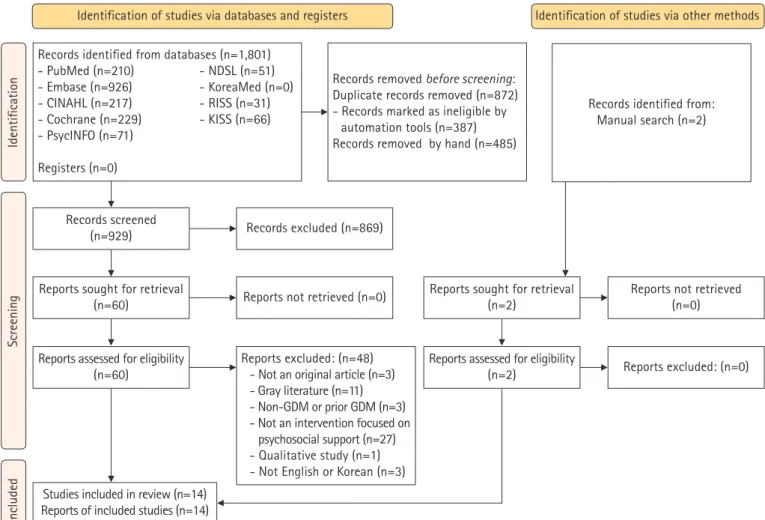
In total, 1,801 studies were identified through the aforemen- tioned databases and two more were added through a manual search of the references, finally confirming 1,803 studies. Dupli- cate literature was eliminated (n= 872) through the EndNote X9 program (Clarivate Analytics, Philadelphia, PA, USA) and by hand. Finally, studies were excluded according to the exclusion criteria (n= 869).
In the first selection process, the title and abstract were checked to determine whether to select or exclude the docu- ment, and for the 60 studies remaining, the secondselection pro- cess involved reviewing the full text to determine whether to in- clude or exclude it. After excluding 48 studies, 14 studies were
Figure 1. PRISMA 2020 flow chart for the literature search.
GDM, Gestational diabetes mellitus.
Identification
Identification of studies via databases and registers Identification of studies via other methods
IncludedScreening
Records identified from databases (n=1,801) - PubMed (n=210) - NDSL (n=51) - Embase (n=926) - KoreaMed (n=0) - CINAHL (n=217) - RISS (n=31) - Cochrane (n=229) - KISS (n=66) - PsycINFO (n=71)
Registers (n=0)
Records screened (n=929)
Reports sought for retrieval (n=60)
Reports assessed for eligibility (n=60)
Studies included in review (n=14) Reports of included studies (n=14)
Reports sought for retrieval (n=2)
Reports assessed for eligibility (n=2)
Records excluded (n=869)
Reports not retrieved (n=0)
Reports excluded: (n=48) - Not an original article (n=3) - Gray literature (n=11) - Non-GDM or prior GDM (n=3) - Not an intervention focused on
psychosocial support (n=27) - Qualitative study (n=1) - Not English or Korean (n=3)
Reports not retrieved (n=0)
Reports excluded: (n=0) Records removed before screening:
Duplicate records removed (n=872) - Records marked as ineligible by
automation tools (n=387) Records removed by hand (n=485)
Records identified from:
Manual search (n=2)
selected (Figure 1).
Literature quality evaluation
The quality of the final selected articles was evaluated using the Cochrane Risk of Bias (RoB) 2.0 for RCTs [21], and the Health Insurance Review & Assessment Service (HIRA) Study Design Algorithm for Medical Literature of Intervention (DAMI) and the Risk of Bias assessment tool for Non-Randomized Studies (RoBANS) 2.0 for non-RCTs [22].
The RoB 2.0 was used to assess the quality of RCTs in six ar- eas: bias arising from the randomization process, bias due to de- viations from intended interventions, bias due to missing out- come data, bias in measurement of the outcome, bias in selection of the reported results, and overall bias. RoBANS 2.0 was applied to non-RCTs to evaluate quality in eight areas: comparability of participants, selection of participants, confounding variables, in- tervention measurement, blinding of the outcome assessment, outcome evaluation, incomplete outcome data, and selective outcome reporting. In each area of the RoB 2.0 and RoBANS 2.0 tools, the risk of bias was judged as low, high, or unclear. In order to ensure the consistency of the literature quality evaluation, two researchers (the first and second authors) independently con- ducted it, and in cases of disagreement, consensus was reached through a reevaluation after discussing together.
Data extraction and synthesis
Data were extracted using a predefined format that included the author’s name, publication year, country of the study, study de- sign, sample, content of the intervention, intervention methods, interventions sessions, measurement time, and outcomes of the intervention (behavioral, psychosocial, and physiological vari- ables). We did not perform a meta-analysis because of heteroge- neity in the population and intervention characteristics. We syn- thesized the results quantitatively.
Results
General characteristics of the selected studies
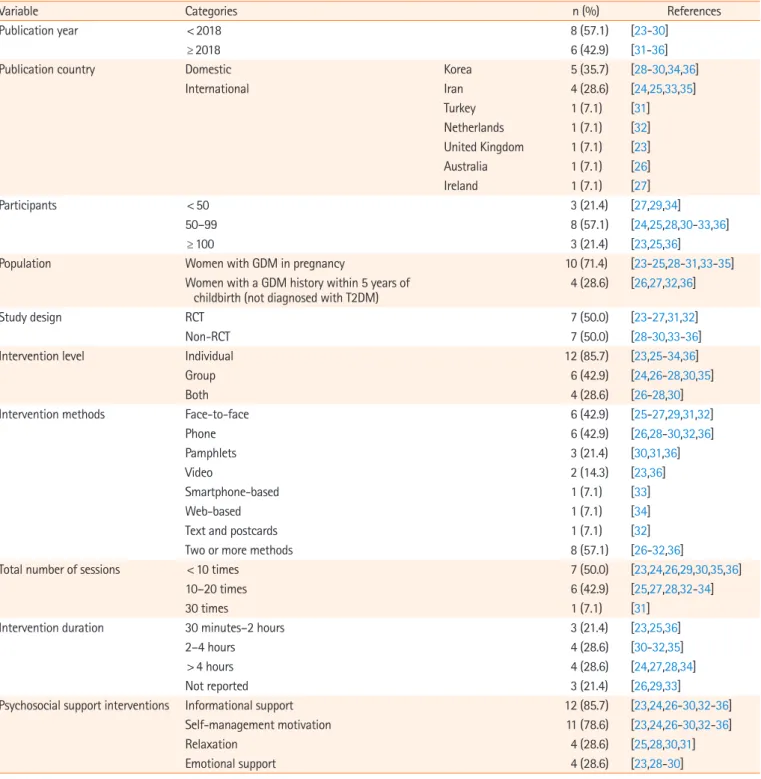
Among the 14 articles selected for the evaluation of the psychoso- cial intervention program, studies conducted prior to 2013 could not be identified. Eight studies (57.1%) [23-30] were published before 2018, and six studies (42.9%) [31-36] were published after 2018. In the past 3 years, psychosocial support interventions for women with GDM have been actively studied, and it can be con- firmed that various intervention methods such as smartphone- or web-based interventions are being used. There were nine interna- tional studies and five domestic studies done in Korea (n =5,
35.7%) [28-30,34,36], which was the country with the most stud- ies included in this analysis, followed by Iran (n =4, 28.6%) [24,25,33,35], while one study (7.1%) each was included from Turkey [31], Netherlands [32], United Kingdom [23], Australia [26], and Ireland [27]. The total number of study participants was 1,331, with eight studies (57.1%) [24,25,28,30-33,36] having more than 50 but fewer than 100 participants, three studies (21.4%) [23,26,35] having more than 100 participants, and three studies (21.4%) [27,29,34] having fewer than 50 participants. Ten studies (71.4%) [23-25,28-31,33-35] were conducted among women with GDM during pregnancy and four (28.6%) [26,27,32,36] focused on women with a GDM history within 5 years of childbirth, who had not been diagnosed with T2DM.
The studies comprised seven RCTs (50.0%) [23-27,31,32] and seven non-RCTs (50.0%) [28-30,33-36] (Table 1).
Literature quality evaluation results
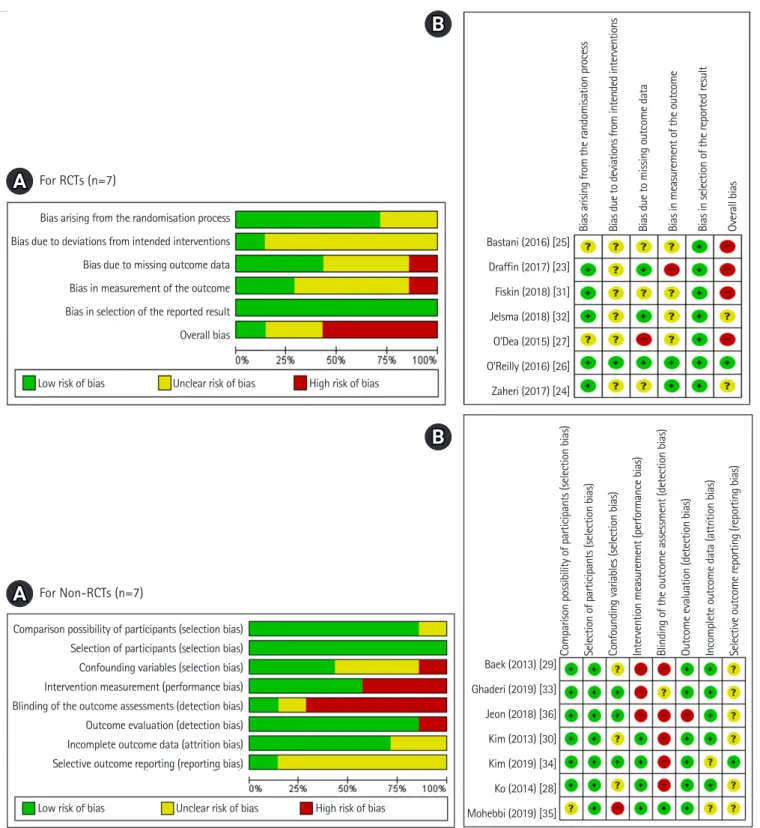
The quality evaluation of the literature showed that five of the seven RCTs (71.4%) [23,24,26,31,32] were well randomized; al- though the remaining two studies (28.6%) [25,27] were de- scribed as involving random assignment, the method was not re- ported. Six studies (85.6%) [23-25,27,31,32] did not clearly state whether either the participants or researchers were aware of the intervention received by study participants, and only one study (14.3%) [26] was found to be well-blinded for both. As such, bias due to deviations from intended interventions was of some concern. Three studies (42.9%) [23,26,32] used an intent-to- treat (ITT) analysis to correct for bias due to missing outcome data. Although all studies used appropriate methods of measur- ing the outcome, only two studies (28.6%) [24,26] reported that the outcome assessors were not aware of the intervention re- ceived by study participants. This suggests the possibility that outcome assessment may have been influenced by knowledge of the intervention received. All studies (100%) [23-27,31,32] re- ported outcome data according to a predefined analysis plan. No studies were excluded as a result of the quality assessment. How- ever, the selected literature was assessed overall as being some- what risky in terms of bias, so the results should be interpreted carefully (Figure 2).
Six of the seven non-RCTs (85.6%) [28-30,33,34,36] con-
firmed the homogeneity of the experimental group and the con-
trol group. All studies (100%) [28-30,33-36] were prospective
studies, and three studies (42.9%) [33,34,36] reported a suffi-
cient follow-up period to correct for variables may have been dis-
turbed by the learning effects, and the overall selection bias was
evaluated to be low. In four studies (57.1%) [28,30,34,35], the
measurements were obtained from reliable sources such as medi-
cal records and measured at least two times, so the performance bias was low. One study (14.3%) [35] stated that the evaluator was well-blinded for the outcome assessments. In the outcome evaluation, the results were evaluated well by using tools with proven reliability and validity in six studies (85.6%) [28-30,33- 35]. There were two studies (28.6%) [34,35] for which it was difficult to confirm whether incomplete results were presented,
and overall the probability of attrition bias was low. One study (14.3%) [34] reported outcome variables such as HbA1c, FPG, and PP1hr, which are expected to be mainly reported in GDM studies, and for six studies (85.6%) [28-30,33,35,36], it was diffi- cult to determine whether selective results were reported. Thus, a possibility of reporting bias was found overall (Figure 2).
Table 1. Comparison of studies’ characteristics (N=14)
Variable Categories n (%) References
Publication year < 2018 8 (57.1) [23-30]
≥ 2018 6 (42.9) [31-36]
Publication country Domestic Korea 5 (35.7) [28-30,34,36]
International Iran 4 (28.6) [24,25,33,35]
Turkey 1 (7.1) [31]
Netherlands 1 (7.1) [32]
United Kingdom 1 (7.1) [23]
Australia 1 (7.1) [26]
Ireland 1 (7.1) [27]
Participants < 50 3 (21.4) [27,29,34]
50–99 8 (57.1) [24,25,28,30-33,36]
≥ 100 3 (21.4) [23,25,36]
Population Women with GDM in pregnancy 10 (71.4) [23-25,28-31,33-35]
Women with a GDM history within 5 years of
childbirth (not diagnosed with T2DM) 4 (28.6) [26,27,32,36]
Study design RCT 7 (50.0) [23-27,31,32]
Non-RCT 7 (50.0) [28-30,33-36]
Intervention level Individual 12 (85.7) [23,25-34,36]
Group 6 (42.9) [24,26-28,30,35]
Both 4 (28.6) [26-28,30]
Intervention methods Face-to-face 6 (42.9) [25-27,29,31,32]
Phone 6 (42.9) [26,28-30,32,36]
Pamphlets 3 (21.4) [30,31,36]
Video 2 (14.3) [23,36]
Smartphone-based 1 (7.1) [33]
Web-based 1 (7.1) [34]
Text and postcards 1 (7.1) [32]
Two or more methods 8 (57.1) [26-32,36]
Total number of sessions < 10 times 7 (50.0) [23,24,26,29,30,35,36]
10–20 times 6 (42.9) [25,27,28,32-34]
30 times 1 (7.1) [31]
Intervention duration 30 minutes–2 hours 3 (21.4) [23,25,36]
2–4 hours 4 (28.6) [30-32,35]
> 4 hours 4 (28.6) [24,27,28,34]
Not reported 3 (21.4) [26,29,33]
Psychosocial support interventions Informational support 12 (85.7) [23,24,26-30,32-36]
Self-management motivation 11 (78.6) [23,24,26-30,32-36]
Relaxation 4 (28.6) [25,28,30,31]
Emotional support 4 (28.6) [23,28-30]
GDM: Gestational diabetes mellitus; RCT: randomized controlled trial; T2DM, type 2 diabetes mellitus.
Figure 2. Risk of bias graphs. (A) Risk of bias summary. (B) Risk of bias for selected studies.
RCT, randomized controlled trial.
Content of psychosocial support interventions for women with GDM
Among the 10 studies conducted on pregnant women diagnosed with GDM, seven programs [23,28-30,33-35] focused on pro- moting lifestyle changes (management of diet, exercise, stress,
and blood glucose), and other psychological support interven- tions involved diaphragmatic breathing exercises [31], a stress re- duction intervention applying cognitive-behavioral stress man- agement training [24], and an anxiety reduction intervention through acupressure [25] (Table 2).
Bias arising from the randomisation process Bias due to deviations from intended interventions Bias due to missing outcome data Bias in measurement of the outcome Bias in selection of the reported result Overall bias
Comparison possibility of participants (selection bias) Selection of participants (selection bias) Confounding variables (selection bias) Intervention measurement (performance bias) Blinding of the outcome assessments (detection bias) Outcome evaluation (detection bias) Incomplete outcome data (attrition bias) Selective outcome reporting (reporting bias)
Bastani (2016) [25]
Draffin (2017) [23]
Fiskin (2018) [31]
Jelsma (2018) [32]
O'Dea (2015) [27]
O'Reilly (2016) [26]
Zaheri (2017) [24]
Baek (2013) [29]
Ghaderi (2019) [33]
Jeon (2018) [36]
Kim (2013) [30]
Kim (2019) [34]
Ko (2014) [28]
Mohebbi (2019) [35]
Low risk of bias
Low risk of bias
Unclear risk of bias
Unclear risk of bias
High risk of bias
High risk of bias
Bias arising from the randomisation process Bias due to deviations from intended interventions Bias due to missing outcome data Bias in measurement of the outcome Bias in selection of the reported result Overall bias
Comparison possibility of participants (selection bias) Selection of participants (selection bias) Confounding variables (selection bias) Intervention measurement (performance bias) Blinding of the outcome assessment (detection bias) Outcome evaluation (detection bias) Incomplete outcome data (attrition bias) Selective outcome reporting (reporting bias)
A
A
B
B
For RCTs (n=7)
For Non-RCTs (n=7)
Four studies were conducted on women with a history of GDM, most of which were diabetes prevention programs [26,27,32,36]. The lifestyle interventions were for women with a history of GDM and BMI more than 25 kg/m
2[32], women di- agnosed with GDM within the last 1 year [26], women with a history of GDM who had been diagnosed with prediabetes [27], and women who give birth after being diagnosed with GDM [36] (Table 2).
Of the selected articles, 12 used individual interventions (85.7%) [23,25-34,36], six used group interventions (42.9%) [24,26-28,30,35], and four used both types of interventions (28.6%) [26-28,30]. The intervention methods were face-to-face in six studies (42.9%) [25-27,29,31,32], phone-based in six stud- ies (42.9%) [26,28-30,32,36], pamphlet-based in three studies (21.4%) [30,31,36], and video-based in two studies (14.3%) [23,36], while one study each (7.1%) used smartphone-based [33], web-based [34], and short message service and post- card-based interventions [32]. Eight studies (57.1%) [26-32,36]
used two or more methods (Table 1).
The total number of sessions was up to 10 in seven studies (50.0%) [23,24,26,29,30,35,36], 10 to 20 in six studies (42.9%) [25,27,28,32-34], and 30 times in one study (7.1%) [31]. The total duration of the interventions was 2 to 4 hours in four stud- ies (28.6%) [30-32,35], more than 4 hours in four studies (28.6%) [24,27,28,34], and 30 minutes to 2 hours in three stud- ies (21.4%) [23,25,36], while three studies (21.4%) [26,29,33]
did not specify the total intervention duration (Table 1).
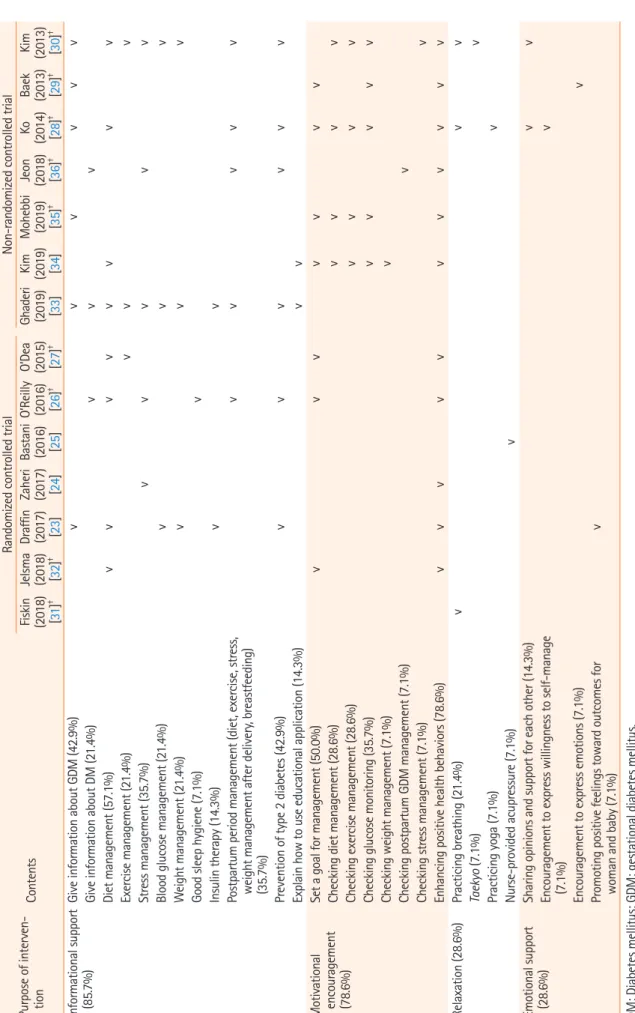
Psychosocial support interventions were found to provide (1) informational support, (2) self-management motivation, (3) re- laxation, and (4) emotional support. Among them, information- al support was the most common, as it was addressed in 12 stud- ies (85.7%) [23,24,26-30,32-36], followed by 11 studies (78.6%) [23,24,26-30,32-36] that promoted motivation for self-manage- ment, and four studies each (28.6%) that used relaxation [25,28,30,31] or emotional support [23,28-30] (Table 3).
In a detailed analysis of the 12 interventions providing infor- mational support, diet management was the most common (n= 8, 57.1%) [23,26-28,30,32-34]. Six studies each dealt with GDM information (42.9%) [23,28-30,33,35] and T2DM pre- vention (42.9%) [23,26,28,30,33,36]. Among the 11 interven- tions provided for the purpose of self-management motivation, strengthening health behavior practices was the most common (n= 11, 78.6%) [23,24,26-30,32,34-36]. Among the four inter- ventions provided to promote relaxation, deep breathing was the most common (n= 3, 21.4%) [28,30,31]. Other measures used were acupressure [25], yoga [28], and encouraging taekyo (Kore- an traditional prenatal bonding and interacting with the fetus)
[30]. Finally, from the four interventions provided for the pur- pose of emotional support, sharing opinions and supporting each other in small groups was the most common (n= 2, 14.3%) [28,30], while other measures included encouraging expression of positive feelings toward maternal and fetal outcomes [23], willingness to self-manage [28], and emotional status [29] (Ta- ble 3).
Effectiveness of psychosocial support interventions for women with GDM
The effectiveness of the psychosocial support interventions for women with GDM was evaluated by categorizing the outcomes of the interventions conducted in the literature into (1) behav- ioral variables, (2) psychosocial variables, and (3) physiological variables.
Half of the selected studies (n= 7) reported behavioral vari- ables. Of the five studies [28,30,34-36] that analyzed behavioral change, four studies [28,30,34,35] noted increased self-care be- havior with statistical significance. Changes in psychosocial vari- ables after psychosocial support intervention were reported in all studies, and depression, anxiety, self-efficacy, and stress were the major variables. Out of the studies dealing with depression (n= 7 [24,26-29,31,34]), anxiety (n = 7 [23-25,27,29,31,34]), and stress (n = 4 [23,24,27,31]), statistically significant improve- ments were found in four studies [24,28,29,31], five studies [24,25,29,31,34], and three studies [24,27,31], respectively. Of the six studies [23,27,29,32,35,36] dealing with self-efficacy, four studies [29,32,35,36] demonstrated statistically significant in- creases after the intervention. Finally, for physiological parame- ters, out of the 14 selected studies, nine studies [23,24,26- 28,30,34-36] measured FPG, HbA1c, and PP2hrs as main vari- ables. Out of the studies measuring FPG (n= 5 [24,26-28,34]), HbA1c (n = 4 [28,30,34,35]), and PP2hrs (n = 3 [26,27,30]), statistically significant improvements were reported in three studies [24,26,28], three studies [28,34,35], and two studies [27,30], respectively (Table 4).
Discussion
This study was conducted to analyze the content and effective- ness of psychosocial interventions for women with GDM. Most of the 14 selected studies were conducted in Korea (35.7%) or Iran (28.6%). Since sociocultural factors are very important fac- tors in the management of GDM [37], psychosocial support in- terventions should be utilized with active consideration of the sociocultural background of various countries.
The reviewed studies mostly had 50 to 99 participants
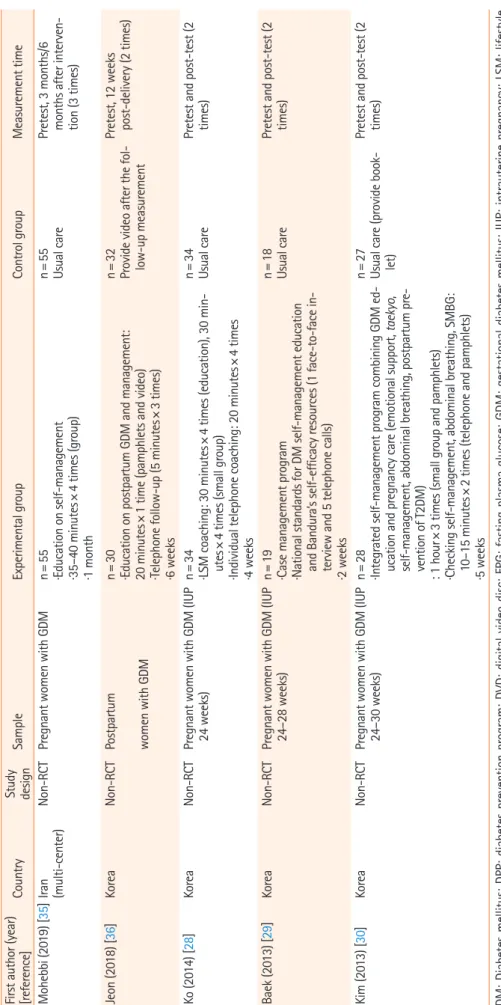
Table 2. Characteristics of the selected studies (N=14) First author (year) [reference]
Country
Study design
SampleExperimental groupControl groupMeasurement time Fiskin (2018) [31]TurkeyRCTPregnant women with GDM (IUP 24–28 wk)n=30
·Diaphragmatic breathing exercises ·5 minutes every morning (face-to-face, pamphlets) ·30 days
n=30 Usual carePretest, at 15 days, post- test (3 times) Jelsma (2018) [32]NetherlandsRCTWomen with GDM history (6–48 months after delivery) and BMI ≥25 kg/m2n=29
·Behavioral LSM education ·Counseling: 1 hour (2 face-to-face), 5 telephone, follow-up (5 via text messaging, 4 postcard) ·5 months
n=30 Usual carePretest and post-test (2 times) Draffin (2017) [23]United Kingdom (multi-center)RCTPregnant women with GDMn=75 ·Educational DVD (46 minutes) on GDM and GDM manage-
ment (individual): encouraging positive health behaviors and promoting positive feelings
n=67 Usual carePretest, 2 weeks after in-
tervention, 6–8 weeks post-delivery (3 times)
Zaheri (2017) [24]Iran (two health centers)RCTPregnant women with GDM, stress score >15n=40 ·Relaxation and cognitive-behavioral techniques: 2 hours×6 times (group) ·3 weeks
n=40 Usual carePretest, 2 weeks after the last session (2 times) Bastani (2016) [25]IranRCTPregnant women with GDMn=28 ·Nurse-provided acupressure at the true point on the fore- arm: 3 minutes×3 times×2 (individual) ·2 days
n=29 Acupressure at false pointPretest and post-test (2 times) O’Reilly (2016) [26]Australia (multi-center)RCTWomen with a history of GDM within their first postnatal year
n=206 ·Individual education on DPP (1 time), group reviewing and longer-term goal setting (5 times), telephone reviewing and longer-term goal setting (2 times)
· 3 months
n=228 Usual carePretest, 3 months/12 months after pretest (3 times)
O’Dea (2015) [27]Ireland
Mixed methods
Women with a history of GDM in the past 1–3 years and abnor
- mal glucose tolerance
n=16 ·Individualized assessment, 1-hour group exercise, group education seminar, one-to-one motivational interview and individual goal setting with specialist nurse, physio- therapist, or dietician ·2.5 hours×12 times (face-to-face and group) ·12 weeks
n=20 Usual care (educational pamphlets and routine follow-up)
Pretest, post-test, 1-year follow-up (3 times) RCT Ghaderi (2019) [33]IranNon-RCTPregnant women with GDM (IUP 22–32 weeks)n=44 ·Smartphone-based individual education on GDM and man- agement, postpartum management, T2DM prevention ·Monitored the number of log-ins and duration of using the application
n=43 Usual carePretest, 6 weeks after the intervention (2 times) Kim (2019) [34]KoreaNon-RCTPregnant women with GDM (IUP 24–28 weeks)n=22 ·Web-based individual program+nutrition session ·Online health diary once a week, logging daily FPG and number of steps taken ·20–30 minutes×12 times every week
n=22 Usual carePretest and post-test (2 times) (Continued to the next page)
First author (year) [reference]
Country
Study design
SampleExperimental groupControl groupMeasurement time Mohebbi (2019) [35]Iran (multi-center)
Non-RCTPregnant women with GDMn=55
·Education on self-management ·35–40 minutes
×4 times (group) ·1 month
n=55 Usual carePretest, 3 months/6 months after interven- tion (3 times) Jeon (2018) [36]KoreaNon-RCTPostpartumn=30
·Education on postpartum GDM and management: 20 minutes
×1 time (pamphlets and video) ·Telephone follow-up (5 minutes×3 times) ·6 weeks
n=32 Provide video after the fol- low-up measurement
Pretest, 12 weeks post-delivery (2 times) women with GDM Ko (2014) [28]KoreaNon-RCTPregnant women with GDM (IUP 24 weeks)n=34 ·LSM coaching: 30 minutes×4 times (education), 30 min- utes×4 times (small group) ·Individual telephone coaching: 20 minutes×4 times ·4 weeks
n=34 Usual carePretest and post-test (2 times) Baek (2013) [29]KoreaNon-RCTPregnant women with GDM (IUP 24–28 weeks)n=19
·Case management program ·National standards for DM self-management education and Bandura’s self-efficacy resources (1 face-to-face in- terview and 5 telephone calls) ·2 weeks
n=18 Usual carePretest and post-test (2 times) Kim (2013) [30]KoreaNon-RCTPregnant women with GDM (IUP 24–30 weeks)n=28 ·Integrated self-management program combining GDM ed- ucation and pregnancy care (emotional support, taekyo, self-management, abdominal breathing, postpartum pre- vention of T2DM) : 1 hour×3 times (small group and pamphlets) ·Checking self-management, abdominal breathing, SMBG: 10–15 minutes×2 times (telephone and pamphlets) ·5 weeks
n=27 Usual care (provide book- let)
Pretest and post-test (2 times) DM: Diabetes mellitus; DPP: diabetes prevention program; DVD: digital video disc; FPG: fasting plasma glucose; GDM: gestational diabetes mellitus; IUP: intrauterine pregnancy; LSM: lifestyle modification; RCT: randomized controlled trial; SMBG: self-monitoring blood glucose; T2DM: type 2 diabetes mellitus.
Table 2. Continued
Table 3. Content of selected studies (N=14) Purpose of interven- tionContents
Randomized controlled trialNon-randomized controlled trial
Fiskin (2018) † [31]
Jelsma (2018) † [32]
Draffin (20
17) [23]
Zaheri (2017) [24]
Bastani (20
16) [25]
O’Reilly (20
16) [26]†
O’Dea (2015) † [27]
Ghaderi (2019) [33]
Kim (2019) [34]
Mohebbi (20
19) [35]†
Jeon (2018) † [36]
Ko (2014) [28]†
Baek (2013) † [29]
Kim (2013) † [30] Informational support Give information about GDM (42.9%)vvvvvv (85.7%)Give information about DM (21.4%)vvv Diet management (57.1%)vvvvvvvv Exercise management (21.4%)vvv Stress management (35.7%)vvvvv Blood glucose management (21.4%)vvv Weight management (21.4%)vvv Good sleep hygiene (7.1%)v Insulin therapy (14.3%)vv Postpartum period management (diet, exercise, stress, weight management after delivery, breastfeeding) (35.7%)
vvvvv Prevention of type 2 diabetes (42.9%)vvvvvv Explain how to use educational application (14.3%)vv Motivational encouragement (78.6%)
Set a goal for management (50.0%)vvvvvvv Checking diet management (28.6%)vvvv Checking exercise management (28.6%)vvvv Checking glucose monitoring (35.7%)vvvvv Checking weight management (7.1%)v Checking postpartum GDM management (7.1%)v Checking stress management (7.1%)v Enhancing positive health behaviors (78.6%)vvvvvvvvvvv Relaxation (28.6%)Practicing breathing (21.4%)vvv Taekyo (7.1%)v Practicing yoga (7.1%)v Nurse-provided acupressure (7.1%)v Emotional support (28.6%)Sharing opinions and support for each other (14.3%)vv Encouragement to express willingness to self-manage (7.1%)v Encouragement to express emotions (7.1%)v Promoting positive feelings toward outcomes for woman and baby (7.1%)v DM: Diabetes mellitus; GDM: gestational diabetes mellitus. † Two or more intervention methods used, e.g.: Jelsma (2018) used face-to-face, telephone, short message service (SMS), postcards.
Table 4. Outcomes of selected studies (N=14) First author (year) [reference]Variable BehavioralPsychosocialPhysiological Fiskin (2018) [31]Prenatal attachment↑† , depression↓† , anxiety↓† , stress↓† Jelsma (2018) [32]Barriers for PA and diet ↓† Social support for PA and diet ↑† Self- efficacy for PA and diet ↑† Draffin (2017) [23]1°: anxiety, 2°: prenatal stress, emotional adjustment to diabetes, self-efficacy, GDM knowledge, risk perception1°: glycemic control (PP1hrs breakfast glucose↓† ) Zaheri (2017) [24]1°: psychological stress (depression, anxiety, stress) ↓† 2°: glycemic control (FPG↓† ) Bastani (2016) [25]Maternal anxiety↓† O’Reilly (2016) [26]2°: energy from total fat, fiber intake, moderate-intensity PA2°: depressive symptoms1°: [3 months] diabetes risk factor (Wt↓† , WC↓† , FPG↓† ) : [12 months] diabetes risk factor (Wt, WC↓† , FPG↓† ) 2°: reduction in body weight, PP2hrs, SBP, DBP, T.chol↓† , TG , LDL↓† , HDL↓† O’Dea (2015) [27]2°: PA and diet2°: mood (positive mental health, psychological distress, depression, anxiety, stress↓† ), cognition (perceived social support, motivation to change, exercise self-efficacy, diet self-efficacy↑† ), wellbeing (QOL↑† )
1°: glycemic control (FPG) 2°: glycemic control (PP2hrs↓† , IR), lipid profile (TG, HDL, LDL, T.chol), Wt & WC (Wt, BMI, WC) Ghaderi (2019) [33]1°: T2DM risk perception ↑† 2°: T2DM risk perception ↑† Kim (2019) [34]Self-care behavior↑† Anxiety↓† , depressionGlycemic control (HbA1c↓† , glycated albumin, FPG, PP1hr) Mohebbi (2019) [35][3 months] Perceived severity↑† Self-management↑† [3 months][6 months] Perceived susceptibility↑† , severity↑† , barriers↓† , bene- fits↑† , self-efficacy↑† , cues to action↑†[6 months] Glycemic control (HbA1c↓† ) Self-management↑† [6 months] Jeon(2018) [36]Self-managementSelf-efficacy↑† Glycemic control (75-g OGTT ) Ko (2014) [28]Self-care behavior↑† Depression↓† Glycemic control (FPG↓† , HbA1c↓† ) Baek (2013) [29]Self-efficacy↑† , depression↓† , anxiety↓† Kim (2013) [30]Self-management ↑† Maternal identity↑† Glycemic control (PP2hrs ↓† , HbA1c) 1°: Primary outcome; 2°: secondary outcome; BMI: body mass index; DBP: diastolic blood pressure; FPG: fasting plasma glucose; GDM: gestational diabetes mellitus; HbA1c: glycated hemoglobin; HDL: high-density lipoprotein; IR: insulin resistance; LDL: low-density lipoprotein; OGTT: oral glucose tolerance test; PA: physical activity; PP1hr: 1-hour postprandial glucose; PP2hrs: 2-hour postprandial glucose; QOL: quality of life; SBP: systolic blood pressure; T.chol: total cholesterol; T2DM: type 2 diabetes mellitus; TG: triglycerides; WC: waist circumference; Wt: weight. † Statistically significant.
[24,25,28,30-33,36] and half were of RCT design [23-27,31,32], while there were only four multi-center intervention studies [23,24,26,35]. There is a need for more well designed RCTs in the future, expanding to a greater number of participants, and a need to actively conduct multi-center and multi-national studies.
In terms of study quality, seven RCTs [23-27,31,32] were eval- uated as having a low overall level of bias in the randomization process and selection of the reported results, while there was a likely overall risk of bias in the areas of deviations from intended interventions, missing outcome data, and measurement of the outcomes. Only three studies [23,26,32] used an ITT analysis, underscoring the need for more ITT analysis studies to correct for bias due to missing outcome data. In the seven non-RCTs [28-30,33-36], selection bias, performance bias, and attrition bias were evaluated to be low overall, but there was a possibility of detection bias because the evaluators’ blinding was not men- tioned [33] or impossible, as researchers provided interventions for participants directly, making it difficult to blind the outcome evaluators. For example, researchers reviewed the participants’
health diaries [34], provided a postnatal care program for GDM postpartum women [36], and helped participants change their health behavior [28]. In two studies involving questionnaires, the researcher conducted a consultation on self-management af- ter questionnaire administration [29] or collected the question- naire immediately [30]. Furthermore, six studies [28- 30,33,35,36] were found to have possible reporting bias. In the future, it is necessary to ensure that the evaluators are well-blind- ed to minimize the risk of detection bias.
Most of the selected studies (n = 10, 71.4%) were aimed at pregnant women diagnosed with GDM, of which the most com- mon focus was on promoting lifestyle changes, whereas only four dealt with women with GDM after childbirth. Because pregnant women diagnosed with GDM are seven times more likely to de- velop T2DM than pregnant women who maintain normal blood glucose [38], GDM interventions are not only needed for preg- nancy, but should be continued after childbirth. It is possible that the lack of GDM intervention studies continuing beyond preg- nancy is related to the fact women diagnosed with GDM are of- ten referred to a separate clinician for diabetes management [30], which may result in women with GDM feeling confusion and disconnection in care, as well as decreased collaborative fol- low-up. Therefore, nurses can play a pivotal role, especially link- ing clinical departments (internal medicine and obstetrics), and helping women with GDM to continue practicing self-care be- yond childbirth.
Individual interventions were performed in most of the stud- ies, and group interventions were used in six studies (42.9%). In
addition, various methods such as face-to-face interventions, telephone interventions, pamphlets, and videos were used. One- to-one coaching provides effective knowledge acquisition by en- abling participants to receive advice tailored to individual needs and levels [39]. It is effective to organize small-group meetings with 5 to 10 people. If there are more than 10 people, it is difficult to meet individual learning needs [40]. Other studies provided video that stimulated learners’ curiosity and enhanced their un- derstanding and satisfaction [41] or informational support using smartphones, which have advantages such as accessibility and economics [33]. It is necessary to find additional interventions that can provide relaxation and emotional support.
Although half of the studies had fewer than 10 sessions, of the four studies [28,30,34,35] that presented statistically significant results on changes in self-care behavior, it is notable that the fre- quency of intervention was 4 to 12 times, the total intervention duration was 20 to 60 minutes per session, and the total duration was 2.3 to 6 hours. In GDM management, it is important to pro- vide regular and consistent interventions to facilitate changes in self-care behavior; these four studies appear to suggest that at least four sessions, with more than 20 minutes per session, for a total of 2.3 hours or more is recommendable to promote changes in self-care behavior.
While this review found that informational support and moti- vational encouragement for self-management were frequently used, relaxation and emotional support were underused. Failure to recognize the seriousness of GDM due to poor education and poor knowledge of health can make it difficult to practice self-management for GDM [42]. On the contrary, regular moti- vation allows women to adapt well to self-management of GDM [43]. Therefore, informational support for women lacking GDM knowledge, along with strategies for strengthening women’s mo- tivation, is needed and should be continued. In addition, psycho- social support interventions should actively incorporate emo- tional support and relaxation, especially considering the fear of- ten associated with GDM diagnosis, concerns about the health of the fetus, and anxiety of developing T2DM [44].
The main behavioral variable affected by psychosocial support interventions was change in self-care behaviors. Diagnosis of GDM can be a motivator for healthy behavioral changes and subsequent lifestyle changes [45], so nurses should actively sup- port women with GDM at the time of diagnosis. In addition, be- cause spousal or family support can promote self- management in women with GDM [46], intervention studies based on family support and actively including family members should be con- ducted.
Depression, anxiety, self-efficacy, and stress were major psy-
chosocial variables found to improve with intervention. Pregnant women with GDM were found to have depressive symptoms that were 3.78 times as severe as those of women with normal pregnancies, and are known to have higher depression and anxi- ety due to the possibility of complications of GDM [47]. Fur- thermore, anxiety symptoms significantly increase the risk of DM [48]. In addition, high psychological stress experienced by pregnant women can negatively affect their emotional changes, maternal role, and fetal attachment [49]. Therefore, GDM should be recognized as a high-risk condition and coordinated psychosocial supportive interventions should be offered to re- duce depression, anxiety, and stress.
Self-efficacy is an important determinant for self-management and self-control in GDM. As a perception of confidence or a judgment of one’s ability to perform the actions necessary to achieve the desired outcome [50], it plays an important role in adherence to treatment and control of blood glucose [51].
Therefore, psychosocial supportive interventions should also be offered to increase self-efficacy.
The goal of glycemic control during pregnancy is to maintain an FPG of < 95 mg/dL, a PP1hr of < 140 mg/dL, and a PP2hrs of < 120 mg/dL in both pre-GDM and GDM states [52]. The goal of HbA1c control is less than 6.0% to 6.5% in the first tri- mester of pregnancy and less than 6.0% in the second trimester, but individualized targets must be set with consideration of the risk of hypoglycemia [53]. Fasting hyperglycemia at more than 105 mg/dL in pregnant women with GDM is a risk factor for se- rious perinatal complications such as intrauterine fetal death, macrosomia, neonatal hypoglycemia, trauma, jaundice, maternal hypertension, preeclampsia, cesarean delivery, and induced de- livery [54]. Since postprandial blood glucose during pregnancy has a very strong correlation with the neonatal outcomes of mac- rosomia [5], it is appropriate to use physiological variables such as FPG, HbA1c, and PP2hrs as the main outcomes. Since 35% to 60% of women diagnosed with GDM develop T2DM [7], it is necessary to determine whether prediabetes or T2DM develops through a 75-g OGTT 6 to 12 weeks after childbirth. If the test results are normal, the woman should have an annual diabetes screening test [4]. Therefore, when designing an intervention program for postpartum women, the 75-g OGTT 6 to 12 weeks after childbirth should be considered as a physiological variable.
Since it is difficult to change self-care behaviors through one- time diabetes education, which is conducted in internal medi- cine, it is necessary to ensure that integrated psychosocial sup- portive interventions between internal medicine and obstetrics can be provided on a regular basis, even after childbirth. At a hos- pital, internal medicine and obstetrics should work together for
women with GDM who complain of anxiety about the negative effects of GDM on the fetus (such as macrosomia, hypoglyce- mia, and respiratory distress syndrome), fear of childbirth, and awareness of the risk of T2DM. Furthermore, the role of profes- sional nurses who systematically manage pregnant women with GDM and promote collaboration between both departments should be emphasized.
The main limitation of this study is that only studies published in Korean or English were selected. Furthermore, since most studies were determined to have a high potential for performance bias, detection bias, and reporting bias, it is necessary to be care- ful about generalizing the effectiveness of interventions.
Nevertheless, this study is meaningful in that it is the first sys- tematic review study conducted in Korea focusing on psychoso- cial support interventions for women with GDM; therefore, it can provide basic data for the development of programs for GDM management and T2DM prevention that actively incor- porate psychosocial support components.
Based on the results of this study, psychosocial support inter- ventions for GDM should continue to provide informational support and strengthen the motivation to engage in self-care be- haviors, and greater use of relaxation and emotional support is needed for women with GDM to maintain positive health behav- iors. Psychosocial supportive interventions positively affect self- care behaviors, depression, anxiety, self-efficacy, and stress, as well as improving FPG, HbA1c, and PP2hrs in women with GDM. Therefore, in addition to diet and exercise therapy, which are the main therapeutics for GDM, integrated and comprehen- sive interventions that include psychosocial dimensions are needed. GDM control and T2DM prevention are needed by continuing to provide GDM interventions including psychoso- cial support after childbirth. Nurses can bridge the divided care of women with GDM and advanced practice nurses specializing in diabetes care are well poised to provide integrated manage- ment starting at pregnancy and extending beyond birth.
ORCID
Seulgi Jung, https://orcid.org/0000-0002-4720-6984 Yoojin Kim, https://orcid.org/0000-0002-7686-6797 Jeongok Park, https://orcid.org/0000-0003-4978-817X Miyoung Choi, https://orcid.org/0000-0002-2424-9965 Sue Kim, https://orcid.org/0000-0003-3785-2445
Authors’ contributions
Conceptualization: Jung S, Kim S; Data collection, Formal analy-
sis: Jung S, Kim Y; Writing-original draft: Jung S; Writing-review
& editing: Jung S, Kim S, Park J, Choi M.
Conflict of interest
Sue Kim has been the editor-in-chief of the Korean Journal of
Women Health Nursing since January 2020. She was not involvedin the review process of this manuscript. Otherwise, there was no conflict of interest.
Funding
This study was supported by the 2020 Seoul Nurses Association Fund.
Data availability
The dataset files are available from Harvard Dataverse at https://
doi.org/10.7910/DVN/EFHSOY.
Acknowledgments
None.
Supplementary materials
Further details on supplementary materials are presented online (available at https://doi.org/10.4069/kjwhn.2021.05.13).
References
1. American Diabetes Association. Standards of medical care in diabetes--2010. Diabetes Care. 2010;33(Suppl 1):S11S61.
https://doi.org/10.2337/dc10-S011
2. Jang EH, Kwon HS. β-Cell dysfunction and insulin resistance in gestational glucose intolerance. Korean J Intern Med.
2013;28(3):294-296. https://doi.org/10.3904/kjim.2013.28.
3.294
3. Ozuguz U, Isik S, Berker D, Arduc A, Tutuncu Y, Akbaba G, Gokay F, et al. Gestational diabetes and subclinical inflam- mation: evaluation of first year postpartum outcomes. Diabe- tes Res Clin Pract. 2011;94(3):426-433. https://doi.org/10.1016/
j.diabres.2011.08.024
4. American Diabetes Association. 13. Management of diabetes in pregnancy: Standards of Medical Care in Diabetes-2018.
Diabetes Care. 2018;41(Suppl 1):S137-S143. https://doi.
org/10.2337/dc18-S013
5. Cunningham FG, Leveno KJ, Bloom SL, Rouse D, Spong CY.
Williams obstetrics. 25th ed. New York: McGraw-Hill Profes- sional; 2018. p. 1718-1752.
6. Shah BR, Lipscombe LL, Feig DS, Lowe JM. Missed opportu- nities for type 2 diabetes testing following gestational diabe- tes: a population-based cohort study. BJOG. 2011;118(12):1484- 1490. https://doi.org/10.1111/j.1471-0528.2011.03083.x 7. Centers for Disease Control and Prevention. National diabe-
tes fact sheet, 2011: fast facts on diabetes [Internet]. Atlanta:
Author; 2011 [cited 2011 Jan 27]. Available from: http://www.
cdc.gov/diabetes/pubs/pdf/ndfs_2011.pdf
8. Carolan-OIah MC. Educational and intervention pro- grammes for gestational diabetes mellitus (GDM) manage- ment: An integrative review. Collegian. 2016;23(1):103-114.
https://doi.org/10.1016/j.colegn.2015.01.001
9. Sklempe Kokic I, Ivanisevic M, Biolo G, Simunic B, Kokic T, Pisot R. Combination of a structured aerobic and resistance exercise improves glycaemic control in pregnant women di- agnosed with gestational diabetes mellitus. A randomised controlled trial. Women Birth. 2018;31(4):e232-e238. https://
doi.org/10.1016/j.wombi.2017.10.004
10. Park JE. Effective education strategies for women with gesta- tional diabetes mellitus. J Korean Diabetes. 2012;13(3):148- 151. https://doi.org/10.4093/jkd.2012.13.3.148
11. Katon JG, Russo J, Gavin AR, Melville JL, Katon WJ. Diabetes and depression in pregnancy: is there an association? J Wom- ens Health (Larchmt). 2011;20(7):983-989. https://doi.org/
10.1089/jwh.2010.2662
12. Lydon K, Dunne FP, Owens L, Avalos G, Sarma KM, O’Con- nor C, et al. Psychological stress associated with diabetes during pregnancy: a pilot study. Ir Med J. 2012;105(5 Suppl):
26-28.
13. American Diabetes Association. 13. Management of diabetes in pregnancy. Diabetes Care. 2017;40(Suppl 1):S114-S119.
https://doi.org/10.2337/dc17-S016
14. Lee SS, Park JS, Lee SY, Oh MA, Choi HJ, Song MY. The 2015 national survey on fertility and family health and welfare. Se- jong: Korea Institute for Health and Social Affairs; 2016. p.
201-204.
15. Kaiser B, Jeannot E, Razurel C. Determinants of health be- haviors after gestational diabetes mellitus: a prospective co- hort study in Geneva. J Midwifery Womens Health. 2016;
61(5):571-577. https://doi.org/10.1111/jmwh.12486
16. Page MJ, McKenzie JE, Bossuyt PM, Boutron I, Hoffmann TC, Mulrow CD, et al. The PRISMA 2020 statement: an up- dated guideline for reporting systematic reviews. Syst Rev.
2021;10(1):89. https://doi.org/10.1186/s13643-021-01626-4
17. Bidwell S, Jensen MF. Etext on Health Technology Assess- ment (HTA) Information Resources. Chapter 3: Using a search protocol to identify sources of information: The COSI model [Internet]. Bethesda, MD: U.S. National Library of Medicine; 2003 [updated 2003 Jun 14; cited 2018 Aug 8].
Available from: https://www.nlm.nih.gov/archive/20060905/
nichsr/ehta/ chapter3.html#COSI
18. International Association of Diabetes and Pregnancy Study Groups Consensus Panel; Metzger BE, Gabbe SG, Persson B, Buchanan TA, Catalano PA, et al. International association of diabetes and pregnancy study groups recommendations on the diagnosis and classification of hyperglycemia in pregnan- cy. Diabetes Care. 2010;33(3):676-682. https://doi.org/10.2337/
dc09-1848
19. Carpenter MW, Coustan DR. Criteria for screening tests for gestational diabetes. Am J Obstet Gynecol. 1982;144(7):768- 773. https://doi.org/10.1016/0002-9378(82)90349-0
20. Hoffman L, Nolan C, Wilson JD, Oats JJ, Simmons D. Gesta- tional diabetes mellitus--management guidelines. The Aus- tralasian Diabetes in Pregnancy Society. Med J Aust. 1998;
169(2):93-97
21. Sterne JA, Savović J, Page MJ, Elbers RG, Blencowe NS, Boutron I, et al. RoB 2: a revised tool for assessing risk of bias in randomised trials. BMJ. 2019;366:14898-51. https://doi.
org/10.1136/bmj.l4898
22. Health Insurance Review& Assessment Service (HIRA).
DAMI & risk of bias assessment tool for non-randomized studies (RoBANS) 2.0 for non-randomized controlled trial.
Seoul: HIRA; 2013. p. 31-51.
23. Draffin CR, Alderdice FA, McCance DR, Maresh M, Harper R, Patterson CC, et al. Impact of an educational DVD on anxiety and glycaemic control in women diagnosed with ges- tational diabetes mellitus (GDM): a randomised controlled trial. Diabetes Res Clin Pract. 2017;126:164-171. https://doi.
org/10.1016/j.diabres.2017.02.016
24. Zaheri H, Najar S, Abbaspoor Z. Effectiveness of cogni- tive-behavioral stress management on psychological stress and glycemic control in gestational diabetes: a randomized controlled trial. J Matern Fetal Neonatal Med. 2017;30(11):
1378-1382. https://doi.org/10.1080/14767058.2016.1214699 25. Bastani F. Effect of acupressure on maternal anxiety in wom-
en with gestational diabetes mellitus: a randomized clinical trial. Clin Nurs Res. 2016;25(3):325-341. https://doi.org/10.
1177/1054773815579344
26. O’Reilly SL, Dunbar JA, Versace V, Janus E, Best JD, Carter R, et al. Mothers after gestational diabetes in Australia (MAG- DA): a randomised controlled trial of a postnatal diabetes
prevention program. PLoS Med. 2016;13(7):e1002092. https://
doi.org/10.1371/journal.pmed.1002092
27. O’Dea A, Tierney M, McGuire BE, Newell J, Glynn LG, Gib- son I, et al. Can the onset of type 2 diabetes be delayed by a group-based lifestyle intervention in women with prediabetes following gestational diabetes mellitus (GDM)? findings from a randomized control mixed methods trial. J Diabetes Res. 2015;2015:798460. https://doi.org/10.1155/2015/798460 28. Ko JM, Lee JK. Effects of a coaching program on comprehen- sive lifestyle modification for women with gestational diabe- tes mellitus. J Korean Acad Nurs. 2014;44(6):672-681. https://
doi.org/10.4040/jkan.2014.44.6.672
29. Baek ES, Park HJ. Effects of a study management program on self-efficacy, depression and anxiety in pregnant women with gestational diabetes mellitus. Korean J Women Health Nurs.
2013;19(2):88-98. https://doi.org/10.4069/kjwhn.2013.19.2.88 30. Kim H, Kim S. Effects of an integrated self-management pro-
gram on self-management, glycemic control, and maternal identity in women with gestational diabetes mellitus. J Kore- an Acad Nurs. 2013;43(1):69-80. https://doi.org/10.4040/
jkan.2013.43.1.69
31. Fiskin G, Sahin NH. Effect of diaphragmatic breathing exer- cise on psychological parameters in gestational diabetes: a randomised controlled trial. Eur J Integr Med. 2018;23:50-56.
https://doi.org/10.1016/j.eujim.2018.09.006
32. Jelsma JG, van Poppel MN, Smith BJ, Cinnadaio N, Bauman A, Tapsell L, et al. Changing psychosocial determinants of physical activity and diet in women with a history of gesta- tional diabetes mellitus. Diabetes Metab Res Rev. 2018;34(1):
e2942. https://doi.org/10.1002/dmrr.2942
33. Ghaderi M, Farahani MA, Hajiha N, Ghaffari F, Haghani H.
The role of smartphone-based education on the risk percep- tion of type 2 diabetes in women with gestational diabetes.
Health Technol. 2019;9:829-837. https://doi.org/10.1007/
s12553-019-00342-3
34. Kim YS, Kim HS, Kim YL. Effects of a web-based self-man- agement program on the behavior and blood glucose levels of women with gestational diabetes mellitus. Telemed J E Health. 2019;25(5):407-414. https://doi.org/10.1089/tmj.
2017.0332
35. Mohebbi B, Tol A, Sadeghi R, Mohtarami SF, Shamshiri A.
Self-management intervention program based on the Health Belief Model (HBM) among women with gestational diabe- tes mellitus: a quazi-experimental study. Arch Iran Med.
2019;22(4):168-173.
36. Jeon YK, Kim HJ, Yang MY, Jung DY, Yoon KY, Noh GO. Ef-
fects of a postnatal care program on self-efficacy, self-man-
agement, and glycemic control in women with gestational di- abetes mellitus. Korean J Women Health Nurs.
2018;24(4):367-378. https://doi.org/10.4069/
kjwhn.2018.24.4.367
37. Wazqar DY, Evans MK. Socio-cultural aspects of self-man- agement in gestational diabetes. J Diabetes Nurs. 2012;16(2):
62-67.
38. Bellamy L, Casas JP, Hingorani AD, Williams D. Type 2 dia- betes mellitus after gestational diabetes: a systematic review and meta-analysis. Lancet. 2009;373(9677):1773-1779.
https://doi.org/10.1016/S0140-6736(09)60731-5
39. Armstrong C, Wolever RQ, Manning L, Elam R 3rd, Moore M, Frates EP, et al. Group health coaching: strengths, chal- lenges, and next steps. Glob Adv Health Med. 2013;2(3):95- 102. https://doi.org/10.7453/gahmj.2013.019
40. Park JY. A study for developing an effective group coaching process. J Korean Coaching Res. 2010;3(1):41-64.
41. Kim YM, Kim MY, Kwon WK, Kim HS, Park SH, Chun MS, et al. Effects of a discharge education program using comput- erized animation video for post-operative colon cancer pa- tients. Korean J Rehabil Nurs. 2013;16(1):37-46. https://doi.
org/10.7587/kjrehn.2013.37
42. Carolan M, Steele C, Margetts H. Attitudes towards gestation- al diabetes among a multiethnic cohort in Australia. J Clin Nurs. 2010;19(17-18):2446-2453. https://doi.org/10.1111/j.
1365-2702.2010.03305.x
43. Carolan M. Women’s experiences of gestational diabetes self-management: a qualitative study. Midwifery. 2013;29 (6):637-645. https://doi.org/10.1016/j.midw.2012.05.013 44. Hjelm K, Berntorp K, Frid A, Aberg A, Apelqvist J. Beliefs
about health and illness in women managed for gestational diabetes in two organisations. Midwifery. 2008;24(2):168- 182. https://doi.org/10.1016/j.midw.2006.12.008
45. Kaptein S, Evans M, McTavish S, Banerjee AT, Feig DS, Lowe J, et al. The subjective impact of a diagnosis of gestational di-
abetes among ethnically diverse pregnant women: a qualita- tive study. Can J Diabetes. 2015;39(2):117-122. https://doi.
org/10.1016/j.jcjd.2014.09.005
46. Carolan M, Gill GK, Steele C. Women’s experiences of factors that facilitate or inhibit gestational diabetes self-management.
BMC Pregnancy Childbirth. 2012;12:99. https://doi.org/10.
1186/1471-2393-12-99
47. Byrn M, Penckofer S. The relationship between gestational diabetes and antenatal depression. J Obstet Gynecol Neonatal Nurs. 2015;44(2):246-255. https://doi.org/10.1111/1552-69 09.12554
48. Hasan SS, Thiruchelvam K, Ahmed SI, Clavarino AM, Ma- mun AA, Kairuz T. Pregnancy complications, mental health-re- lated problems and type 2 diabetes mellitus in Malaysian women. Diabetes Metab Syndr. 2013;7(4):191-197. https://
doi.org/10.1016/j.dsx.2013.10.023
49. Kang SK, Chung MR. The relationship between pregnant woman’s stress, temperament and maternal-fetal attachment.
Korean J Human Ecol. 2012;21(2):213-223. https://doi.org/
10.5934/KJHE.2012.21.2.213
50. Bandura A. Self-efficacy: toward a unifying theory of behav- ioral change. Psychol Rev. 1977;84(2):191-215. https://doi.org /10.1037/0033-295x.84.2.191
51. Bastani F, Zarrabi R. Correlations of self-efficacy among women with gestational diabetes. Hayat. 2010;16(3-4):56-65.
52. American Diabetes Association. 2. Classification and diagno- sis of diabetes: Standards of Medical Care in Diabetes-2018.
Diabetes Care. 2018;41(Suppl 1):S13-S27. https://doi.
org/10.2337/dc18-S002
53. Maresh MJ, Holmes VA, Patterson CC, Young IS, Pearson DW, Walker JD, McCance DR, et al. Glycemic targets in the second and third trimester of pregnancy for women with type 1 diabetes. Diabetes Care. 2015;38(1):34-42. https://doi.
org/10.2337/dc14-1755
54. Korean Diabetes Association. Clinical practice recommenda-
tion 2005. Clinical Diabetes. 2005;6(3-4):206-209.
Appendices
Appendix 1. Details of selected studies (N=14)
First author (year) [reference] Diagnostic criteria Theoretical framework
Baek (2013) [29] Carpenter criteria 100-g glucose tolerance test Bandura’s (1977) self-efficacy Bastani (2016) [25]† Not described (personal communications 3 times, but no
answer) Not described
Draffin (2017) [23] IADPSG criteria 75-g glucose tolerance test Not described Fiskin (2018) [31]† Carpenter criteria 100-g glucose tolerance test Not described Ghaderi (2019) [33]† Carpenter/IADPSG criteria* (diagnosis reported in patient file) Not described
Jelsma (2018) [32] ADIPS criteria 75-g glucose tolerance test Rosal’s (2001) patient‐centered counseling model Jeon (2018) [36]† Carpenter criteria 100-g glucose tolerance test Health belief model
Kim (2013) [30] Carpenter criteria 100-g glucose tolerance test Cox’s (1982) interaction model of client health behavior Kim (2019) [34]† Carpenter criteria 100-g glucose tolerance test Not described
Ko (2014) [28] IADPSG criteria 75-g glucose tolerance test Whitemore’s (2009) goal-reality-options-will (GROW) coaching model
Mohebbi (2019) [35] No concerns about clinical diagnostic criteria (diagnosed
GDM by physicians) Health belief model
O’Dea (2015) [27] IADPSG criteria 75-g glucose tolerance test Not described O’Reilly (2016) [26] ADIPS criteria 75-g glucose tolerance test Not described
Zaheri (2017) [24]† IADPSG criteria 75-g glucose tolerance test Antoni’s (2007) cognitive-behavioral stress management ADIPS: Australian Diabetes in Pregnancy Society; GDM: gestational diabetes mellitus; IADPSG: International Association of Diabetes and Pregnancy Study Group.
†The author was contacted to determine the diagnostic criteria.
![Table 2. Characteristics of the selected studies (N=14) First author (year) [reference]](https://thumb-ap.123doks.com/thumbv2/123dokinfo/5363320.402699/9.892.87.815.104.1105/table-characteristics-selected-studies-n-author-year-reference.webp)
![Table 4. Outcomes of selected studies (N=14) First author (year) [reference]Variable BehavioralPsychosocialPhysiological Fiskin (2018) [31]Prenatal attachment ↑†, depression↓†, anxiety↓†, stress↓† Jelsma (2018) [32]Barriers for PA and diet ↓† Social supp](https://thumb-ap.123doks.com/thumbv2/123dokinfo/5363320.402699/12.892.85.708.91.1103/outcomes-reference-variable-behavioralpsychosocialphysiological-prenatal-attachment-depression-barriers.webp)
