• 검색 결과가 없습니다.

Effect of Elastic-Band Exercise and Cognitive Rehabilitation in Cognition and Walking Speed of Elderly People -Pilot Study-

N/A
N/A
Protected

Academic year: 2021

Share "Effect of Elastic-Band Exercise and Cognitive Rehabilitation in Cognition and Walking Speed of Elderly People -Pilot Study-"

Copied!
13
0
0

로드 중.... (전체 텍스트 보기)

전체 글

(1)

JESK http://jesk.or.kr eISSN:2093-8462

Effect of Elastic-Band Exercise and Cognitive Rehabilitation in Cognition and Walking

Speed of Elderly People -Pilot Study-

Seonghun Yu

1

, Youngsin Lee

2

, Seongsu Kim

3

1

Department of Physical Therapy, Gwangju Trauma Center, Gwangju, 61964

2

Musculoskeletal Disorder Prevention Center, Gwangju Samsung Electronics, Gwangju, 62217

3

Department of Physical Therapy, Gwangju Health University, Gwangju, 62287

Corresponding Author Youngsin Lee

Musculoskeletal Disorder Prevention Center, Gwangju Samsung Electronics, Gwangju, 62217

Mobile : +82-10-8624-4750 Email : [email protected]

Received : April 02, 2015 Revised : July 08, 2015 Accepted : October 06, 2015

Objective: This study aims to recognize the risk of current traffic systems and to investigate a method to decrease risk by doing exercise using an elastic-band and cognitive rehabilitation.

Background: The existing traffic system usually focuses on the ordinary citizens, which may not be appropriate to the elderly. It may affect the cognition and walking speed of the elderly. This study tries to examine whether cognition and muscle training is appropriate to improve their vulnerability. Therefore this study will provide human ergonomics - based basic data in relation to the elderly to identify the risk of current signal system and to mitigate the risk.

Method: A total of 30 elderly participants were divided into two groups: experimental and control groups. Experimental group (n=15) was trained to strengthen their muscles and to promote cognition, whereas control group (n=15) was not. The training was conducted twice a week for three weeks. To strengthen muscles, a yellow colored elastic-band was used, and a computer program for cognitive rehabilitation was used to develop cognition. In the experimental group, there were significant differences between pre and post exercises However, the control group didn't show any significant difference. The increase in cognition and walking speed was found in the experimental group, whereas there were no differences in the control group. Statistically there was no significant difference between the two groups.

Results: The results of this study show that the exercise program using the elastic- band gave a positive effect on gait training thanks to the development of muscle power and balance.

Conclusion: This study did not show any statistical difference or significant differences between the two groups, since time was restricted, we believe.

Application: The results of the walking speed will help to prevent traffic collision.

Keywords: Cognition, Gait, Elastic-band, Traffic system, Walking speed Copyright@2015 by Ergonomics Society

of Korea. All right reserved.

ccThis is an open-access article distributed under the terms of the Creative Commons Attribution Non-Commercial License (http://

creativecommons.org/licenses/by-nc/3.0/), which permits unrestricted non-commercial use, distribution, and reproduction in any medium,
1. Introduction

Although many efforts are recently made to reduce traffic accidents, the traffic

accidents of the elderly have yet to decrease. In such a situation, the increase of elderly

people's traffic accidents is concerned in view of a feature in Korea that elderly people

(2)

population rapidly increases (Ji, 2010).

According to the White Paper of Road transportation safety book (2010), the death toll per 100,000 population of Korea by traffic accidents tallied in 2009 was 12, far higher than 6.8, 6.5, 7.1 and 4.5 of France, Canada, Italy and Japan, respectively. Actually, the ratio of traffic accidents of elderly people is gradually on the rise: the death toll of elderly people aged 61 or older in 1973 was 121, or just 4% of the Korea's total death toll by traffic accidents in 1973, but the death toll of elderly people was 2,076, or took up 37.7% in 2010. What gains attention is that the traffic accidents of elderly people increase together with the aging society, and the ratio of the elderly people's traffic accidents is higher than the elderly people's population constitution ratio.

One of the important reasons of elderly people's traffic accident ratio increase is diverse change according to aging, which is ascribed to the fact that human behaviors like walking declined through the reduction of human body's balance adjustment ability and motor adjustment capability. Therefore, muscle power weakening, due to aging, bed rest and inactivity, restricts elderly people's motility, and their musculoskeletal functions decrease in a fast speed (Trappe et al., 1995). Muscle system's change owing to aging is linked with the loss of muscles, because of muscular fiber's volume decrease, and the walking speed becomes slow, when the elderly walk (Hong and Park, 2004), and production ability of muscle power from skeletal muscles is reduced according to age change (Rogers and Evans, 1993). Together with elderly people's musculoskeletal function decline, the decrease of dynamic visual acuity reduces a cognitive ability and an ability to respond to surrounding situation, and therefore, a possibility to be exposed to traffic accident risk is high (Brouwer and Ponds, 1994). Due to overall reduction of physical functions by aging, elderly people face with many risks in movement using public transportation and walking, despite no particular physical disorder. As elderly people get older, their one step length and the number of step per minute in walking ability decrease, but stride increases (Bak, 2010). Elderly people were reported that their walking speed and walking length were relatively lower than people from 18 to 62 years of age (Himann et al., 1988). Average walking speed of people aged younger than 65 was 1.46m/s, and the walking speed of 15% of those was 1.20m/s. Meanwhile, the average walking speed of people aged 65 or older was 1.20m/s, and the walking speed of 15% of those was 0.94m/s (Richard et al., 1996). Also, their cognitive ability or sensibility on risk is very low, when they walk on the road with pot pole or severely steep road.

Due to elderly people's degraded cognitive function, they do not make an accurate judgment on continuous behaviors in driving or crossing the street at a crosswalk, because of instantaneous memory loss, arising from low instantaneous memory recovery in many cases (Bak, 2010). Average cognitive response time of the pedestrians aged younger than 65 was 1.93 seconds, and that of 85% of those was 3.06 seconds; however, the average cognitive response time of those who aged 65 or older was 2.48 seconds, and that of 85% of those was 3.76 seconds (Richard et al., 1996). Owing to such characteristics of elderly people, they can cross a road under their judgement in the Netherlands, and enough walking time is provided to the elderly or the disabled through sensitive signal control. The UK offers amber flickering signal time or reflects sensitive signal control to provide enough time to the elderly or the disabled. In the meantime, Korea's pedestrian signal is operated with green, red and green flickering signals (Ahn et al., 2006), and many elderly people lack in terms of the understanding of green flickering signal. Therefore, they try to cross a road by force, and they are exposed to traffic accidents. They have been surveyed that they feel anxiety while they cross during the green flickering signal (Shim et al., 2008).

The purpose of this study is to seek the measures to identify and reduce elderly people's risks of signal systems, tuned to the

general public. Although the unclear environment of virtual signal systems and uncertain results according to individual differences

may arise, this study provides ergonomic basic data that can identify and reduce the risks of the current signal systems according

to elderly people's cognitive ability and walking speed.

(3)

2. Method 2.1 Subjects

This study randomly selected 30 males and females aged 65 or older, whose cognitive ability is OK for the test, and divided them into an experimental group and a control group. Actually, the subjects were limited to those who could conduct independent walking exercise on the experiment, and those who had no musculoskeletal disorders. The experimental group was a training group combining muscle power and cognition consolidation, and six times of training program was conducted in total, namely twice a week for three weeks. The training was not offered to the control group. The average age of the participants in this study was 75.46±7.36, their average height was 157.91±7.35cm, and their average weight was 57.21±9.15㎏.

2.2 Procedure

2.2.1 Muscle power evaluation

As for muscle power, three times of measurement for muscle powers of quadriceps femoris and hamstring for the left and right muscles were conducted with maximum strength, respectively, by providing isometric resistance using a digital muscle power gauge, Power Track II (JTech, USA). The digital muscle power gauge can precisely measure each human body part, and the measuring unit was LBS (Roy et al., 2009).

2.2.2 Dynamic balance test

The dynamic balance test was carried out with Timed Up & Go (TUG). Actually, the speed of sitting on a chair is measured by returning after walking 3m by standing from a chair at the start signal of the evaluator. The first measurement was a rehearsal, and the average value was calculated with three repeated measurements. Seven to ten seconds are normal range for normal elderly people, and active walking is difficult, if it is over 30 seconds. In such a case, they need dependent walking, and independent outdoor walking is impossible (Podsiadlo and Richardson, 1991).

2.2.3 Walking speed measurement

To measure elderly people's walking speed, this study made them walk by making a virtual pedestrian crossing using a 30m tape measure. The walking distance was selected as 6m and 12m. The Enforcement Regulation of the Road Traffic Act sets forth that the width of a lane should be 3m or over, and may be 2.75m or over in an unavoidable case. Therefore, the experiment in this study set the criterion of width as 3m, and selected the length of one way single lane, and 12m as the length of one-way two lanes.

2.2.4 Comparison of two-lane crossing time

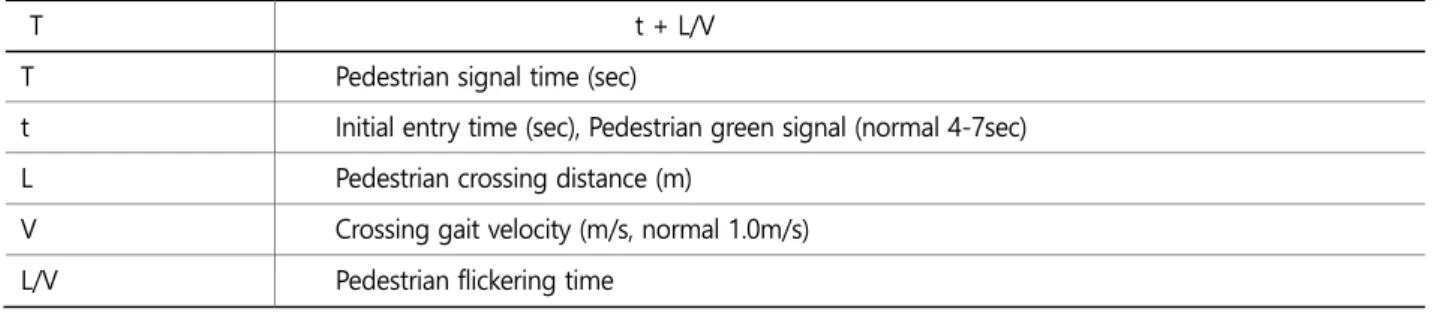
This study calculated gait signal time using the formula printed in the Traffic Signal Installation and Management Menu, and

measured individual walking speed per 6m and 12m before the experiment, and analyzed the measurements (Table 1). According

to the National police agency (2005), the gait signal time of 3 seconds in the 6m distance and 19 seconds in the 12m distance

was calculated. Through this, this study made virtual pedestrian crossings, and compared crossing time by measuring with flags

and a time watch (Figure 1).

(4)

2.2.5 Cognitive function evaluation

For cognitive function evaluation, a computerized cognitive program was used, and the evaluation result values were automatically stored in the computer. After measurement was finished, correct answer percentage was calculated, and then entered. Percentage (%) was calculated by (number of correct answers/total number of questions) x 100. This study compared the first time response speed and the response speed change to the last sixth times of training of the experimental group, and the unit was "ms", which is mean response speed.

2.3 Intervention

2.3.1 Elastic-band exercise

This study conducted a 60 minutes program consisting of warm-up exercise, main exercise and cool-down exercise. After five minutes of whole body stretching as the warm-up exercise to prevent damage by exercise, the elderly were instructed to conduct main exercise 10 reps for 3 sets using a yellow elastic-band suitable for the elderly twice a week.

Concerning the main exercise, the participants conducted diagonal pulls for whole body muscle power: a person stands with feet shoulder length apart, steps on the elastic-band, makes a diagonal posture through mutual crossing, and makes arm and leg opposite (Figure 2).

Table 1. The calculation of the standard gait signal time

T t + L/V

T Pedestrian signal time (sec)

t Initial entry time (sec), Pedestrian green signal (normal 4-7sec)

L Pedestrian crossing distance (m)

V Crossing gait velocity (m/s, normal 1.0m/s)

L/V Pedestrian flickering time

Figure 1. Comparison of walk across time

(5)

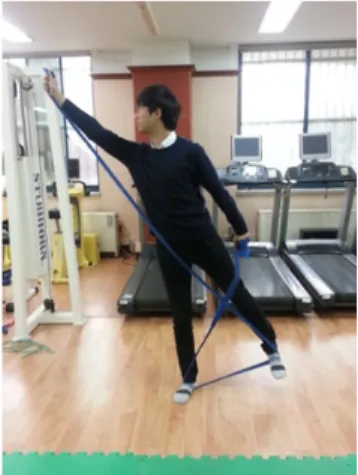
Abduction to consolidate the outside of legs is to make your feet apart alternately from side to side by tying the elastic-band on both ankles (Figure 3). Abduction to consolidate the inside of legs is to make your feet gather alternately from side to side by tying the elastic-band on both ankles. Standing leg curl to strength hamstring is to tie the elastic-band on one ankle, step on the band with the other foot, and then stretch the tied leg. Side step to enhance balance is to tie the electric band on the middle of the thigh, and walk from side to side alternately.

Based on those motions, the feeling at the tenth rep out of the ten reps using the elastic-band was set as one's strength, and 10~20 reps were applied. When 20 reps were possible, the strength was adjusted by increasing the number of set. In this manner, the length of the elastic-band, the numbers of reps and sets increased gradually according to the subject's adaptation degree and muscle power (Shin et al., 2006). When the yellow elastic-band used in this study was fully extended (100%), namely from 1m to 2m, the resistance of the band against load was 1.3kg. Actually, the cool-down was carried out with whole body stretching for the elderly to maintain physical stability (Table 2).

Figure 2. Diagonal pulls Figure 3. Abduction exercise

Table 2. Elastic-band exercise program (N=15)

Section Program composition Intensity Frequency/sets Time

Warm-up Stretch 5min

Main exercise (Elastic-band)

Diagonal pulls (whole body muscle power)

Yellow 10/3set 20min

Abduction Adduction

Standing leg curl (hamstring) Side step (balance)

Cool-down Stretch 5min

(6)

2.3.2 Cognitive function reinforce training

This study used a computerized cognitive program, and measured simple visual cognitive response speed using the figures and signs of the reactive power test among 55 programs. The distance between a participant and the computer was 30cm to minimize eye fatigue, and the mouse was used at the location of hand that usually responds. This study set the program focused on cognitive function reinforcement including reading questions (12 questions) and who-what (18 questions) in attention, and picture-name (24 questions) and calorie (20 questions) in memory using the mouse, keyboard or touch screen, and applied the program for 30 minutes.

During that period, language feedback or any specific contact between participants and researcher was not made. The computer cognitive rehabilitation of the participants was carried out for 30 minutes every day, and the results were automatically stored and recorded on the computer. The same training time was applied to all the experimental group members, and the researcher explained enough for the participants to understand tasks (Park et al., 2005), when the participants carry out the tasks.

2.4 Statistical analysis

For the statistical analysis of the data values obtained from the experiment, the SPSS ver. 18.0 for windows

®

was used. The means and standard deviations were calculated for the participants' age, weight and height, and ANCOVA was used for significance test between groups on the lower limbs and dynamic balance change according to each condition. To compare the differences between the experiment and control groups, this study conducted an independent sample T-test. To compare the measured values within the groups before and after the exercise, this study analyzed with a paired T-test, and statistical significance level was p =.05.

3. Results

3.1 Change of muscle power before and after elastic-band exercise

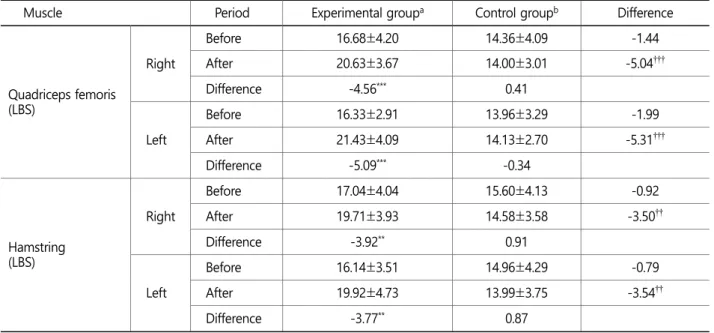
The right quadriceps femoris of the experimental group showed a significant difference (-4.56) between 16.68±4.20LBS before the exercise and 20.63±3.67LBS after the exercise. The right quadriceps femoris of the control group did not show a significant difference (0.41) between 14.36±4.09LBS before the exercise and 14.00±3.01LBS after the exercise ( p <0.001). However, a significant difference (05.04) was shown between the two groups ( p <0.001).

The left quadriceps femoris of the experimental group showed a significant difference (-5.09) between 16.33±2.91LBS before the exercise and 21.43±4.09LBS after the exercise. The left quadriceps femoris of the control group did not show a significant difference (-0.4) between 13.91±3.29LBS before the exercise and 14.13±2.70LBS after the exercise ( p <0.05). However, a significant difference (-5.31) was shown between the two groups ( p <0.001).

The right hamstring of the experimental group showed a significant difference (-3.92) between 17.04±4.04LBS before the exercise and 19.71±3.93LBS after the exercise. The right hamstring of the control group did not show a significant difference (0.91) between 15.60±4.13LBS before the exercise and 14.58±3.58LBS after the exercise. However, a significant difference (-3.50) was shown between the two groups ( p <0.01).

The left hamstring of the experimental group showed a significant difference (-377) between 16.14±3.51LBS before the exercise

and 19.92±4.73LBS after the exercise. The left hamstring of the control group did not show a significant difference (0.87) between

14.96±4.29LBS before the exercise and 13.99±3.75LBS after the exercise ( p <0.05). However, a significant difference (-3.54) was

(7)

shown between the two groups ( p <0.01) (Table 3).

3.2 Change of dynamic balance before and after elastic-band exercise

As a result of comparison of TUG, dynamic balance, according to differences before and after the experiment, the experimental group showed a significant difference (5.13) between 9.36±2.10 seconds before the exercise and 8.33±1.93 seconds after the exercise. However, the control group did not show a significant difference (-2.66) between 12.23±3.43 seconds before the exercise and 12.93±3.51 seconds after the exercise ( p <0.01). Actually, a significant difference (4.34) was shown between the two groups ( p <0.001) (Table 4).

Table 3. Change of muscle power after elastic-band exercise program (N=30)

Muscle Period Experimental group

a

Control group

b

Difference

Quadriceps femoris (LBS)

Right

Before 16.68±4.20 14.36±4.09 -1.44

After 20.63±3.67 14.00±3.01 -5.04

†††

Difference -4.56

***

0.41

Left

Before 16.33±2.91 13.96±3.29 -1.99

After 21.43±4.09 14.13±2.70 -5.31

†††

Difference -5.09

***

-0.34

Hamstring (LBS)

Right

Before 17.04±4.04 15.60±4.13 -0.92

After 19.71±3.93 14.58±3.58 -3.50

††

Difference -3.92

**

0.91

Left

Before 16.14±3.51 14.96±4.29 -0.79

After 19.92±4.73 13.99±3.75 -3.54

††

Difference -3.77

**

0.87

M ± SD,

a

: Elastic-band+cognition program,

b

: non exercise program

*: significantly different within group by paired t -test,

**

: p <.01,

***

: p <.001

†: significantly different each group by Independent t -test,

††

: p <.01,

†††

: p <.001

Table 4. Change of dynamic balance after elastic-band exercise program (N=30)

Dynamic balance Period Experimental group

a

Control group

b

Difference

Time up and go test (sec)

Before 9.36±2.10 12.23±3.43 2.68

After 8.33±1.93 12.93±3.51 4.34

†††

Difference 5.13

***

-2.66

M ± SD,

a

: Elastic-band+cognition program,

b

: Non-exercise program

*: significantly different within group by paired t -test,

***

: p <.001

†: significantly different each group by Independent t -test,

†††

: p <.001

(8)

3.3 Walking speed change before and after elastic-band exercise

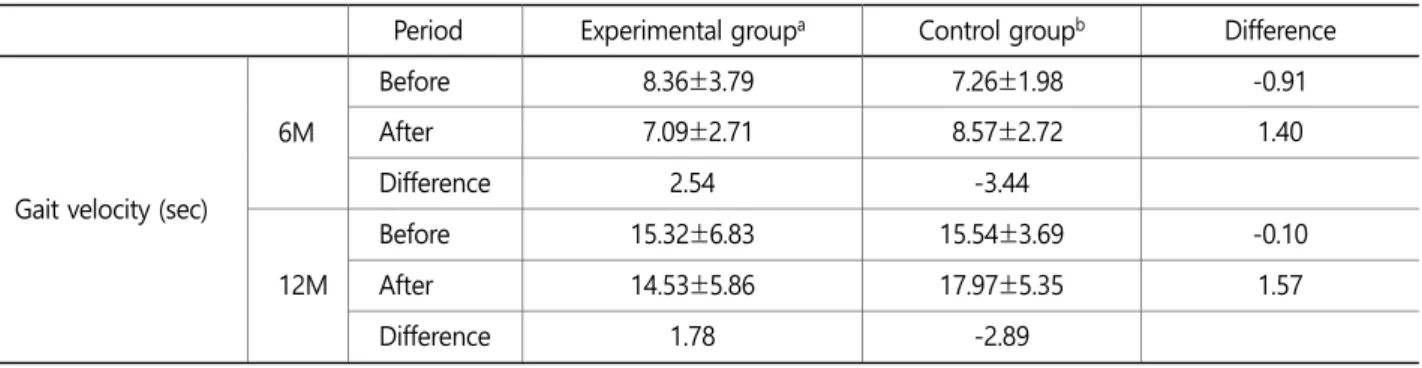
As a result of comparing the 6m and 12m walking speeds (sec) after lower limbs' muscle strength reinforcing exercise using the elastic-band, the experimental group showed improvement from 8.36±3.79 seconds before the exercise to 7.09±2.71 seconds after the exercise in 6m walking speed in terms of numerical value, but did not show a significant difference (2.54). The control group did not show a significant difference (-3.44) between 7.26±1.98 seconds before the exercise and 8.57±2.72 seconds after the exercise ( p <0.05). As a result of the post test, a significant difference (1.40) was not shown between the two groups ( p <0.05).

In 12m walking, the experimental group's walking speed improved from 15.32±6.83 seconds before the exercise to 14.53±5.86 seconds after the exercise in terms of numerical value, but did not show a significant difference (1.78). The control group did not show a significant difference (-2.89) between 15.54±3.69 seconds before the exercise and 17.97±5.35 seconds after the exercise ( p <0.05). As a result of the post test, a significant difference (1.57) was not shown between the two groups ( p <0.05) (Table 5).

3.4 Comparison of one-lane crossing time and two-lane crossing time

The experimental group and control group crossed the pedestrian crossing on 6m one-lane road within 13 seconds, which is the gait signal time specified in the Traffic Signal Installation and Management Menu from 10.63±2.82 seconds before the exercise to 9.05±1.67 seconds after the exercise, and from 9.94±2.30 seconds before the exercise to 11.21±2.65 seconds after the exercise, respectively.

Although the experimental group crossed the pedestrian crossing on the 12m two-lane road within 19 seconds, which is the gait signal time from 17.60±4.49 seconds before the exercise to 16.49±3.66 after the exercise, the control group did not cross the pedestrian crossing within the 19 seconds in view of 18.19±3.71 seconds before the exercise and 20.62±4.78 seconds after the exercise (Table 6). In this study, both the experimental and control groups crossed the pedestrian crossing on the 6m one-lane road within the gait signal time. However, the experimental group crossed the pedestrian crossing within the gait signal time on the 12m two-lane road, but the control group did not.

Table 5. Change of dynamic gait velocity after elastic-band exercise program (N=30)

Period Experimental group

a

Control group

b

Difference

Gait velocity (sec)

6M

Before 8.36±3.79 7.26±1.98 -0.91

After 7.09±2.71 8.57±2.72 1.40

Difference 2.54 -3.44

12M

Before 15.32±6.83 15.54±3.69 -0.10

After 14.53±5.86 17.97±5.35 1.57

Difference 1.78 -2.89

M ± SD,

a

: Elastic-band+cognition program,

b

: non exercise program

(9)

3.5. Cognition change before and after cognitive function reinfocing training

According to the cognition comparison result according to cognitive function reinforcing training, the experimental group showed a significant difference (3.84) between 2.49±0.81 seconds before the exercise and 1.74±0.24 after the exercise. However, the control group did not show a significant difference (-4.05) between 2.42±0.97 seconds before the exercise and 2.50±0.74 seconds after the exercise ( p <0.01). As a result of the post test, no significant difference (-3.77) was shown between the two groups ( p <0.01) (Table 7).

4. Discussion

This study aims to identify the effects of the traffic systems focused on the general public on the elderly people's cognition and walking speed, and find out whether cognition or muscle power training can be a measure to improve the negative effects.

The resistance exercise using the band used in this study makes a person maintain more accurate posture by stimulating proprioceptive sense of joints and muscles, and by conveying the information on joint's location and movement to cerebrum.

The elastic-band exercise is very suitable for the exercise of elderly people, because shock imposed upon when motions are conducted is small, despite exercise in various joint motion scopes (McCarthy et al., 2008). The merits of the cognition therapy program using a computer are that patients can conduct and learn, and the therapist's intervention time decreases. Also, the feedback is immediately offered to the patients in relation with the performing results, and therefore, information on precise and continuous performing results can be retained (Jeong et al., 2010). This study let elderly people conduct muscle power and balance reinforcing exercise using an elastic band exercise, which is easy and has small injury risk, and this study examined the effects of the cognition reinforcing training using the computerized cognition program, after six times of the training for three weeks.

Table 6. The comparison of 1 and 2 lane crossing time (N=30)

Period Experimental group

a

Control group

b

6m gait velocity+cognition reaction speed (sec) Before 10.63±2.82 9.94±2.30

After 9.05±1.67 11.21±2.65

12m gait velocity+cognition reaction speed (sec) Before 17.6±4.49 18.19±3.71

After 16.49±3.66 20.62±4.78

M ± SD,

a

: Elastic-band+cognition program,

b

: non exercise program

Table 7. Change of cognitive function after cognition program (N=30)

Cognitive function Period Experimental group

a

Control group

b

Difference

cognition program (sec)

Before 2.49±0.81 2.42±0.97 .212

After 1.74±0.24 2.50±0.74 -3.77

††

Difference 3.84

**

-4.05

M ± SD,

a

: Elastic-band+cognition program,

b

: non exercise program

*: significantly different within group by paired t -test,

**

: p <.01

†: significantly different each group by Independent t -test,

††

: p <.01

(10)

Although the experimental group showed a significant difference on the muscle power evaluation on the elastic-band exercise, the control group did not show a significant difference. Therefore, the elastic-band exercise is considered to positively affect muscle power increase. Since the experimental group showed a significant difference in dynamic balance, and the control group did not show a significant difference in dynamic balance, the elastic-band exercise is conjected to positively affect balance improvement.

From this, stability is considered to be enhanced with balanced muscle power by elastic-band's consolidating the left and right quadriceps femoris muscles and hamstring muscles, which are the lower limb's muscle power. In terms of gait speed, the experimental group did not show significant differences in 6m and 12m pedestrian crossings, however, showed improved in numerical value. However, the control group did not show significant differences in 6m and 12m gait speed, and the gait speed slowed down in terms of numerical value. According to these results, balance and the reduction of gait speed according to muscle power increase are judged not to reach the level of daily life application, due to short-term intervention period of three weeks for the experimental group.

As a result of comparing the one-lane crossing time and two-lane crossing time, both the experimental and control groups crossed the pedestrian crossing within 13 seconds, the gait signal time specified in the Traffic Signal Installation and Management Menu on the 6m one-lane. Although only the experimental group crossed the pedestrian crossing on the 12m two-lane road within 19 seconds, the control group did not. This shows that the provided gait signal time is not enough, as the crossing length becomes longer.

In the cognition change according to the cognitive rehabilitation program, the experimental group showed a significant difference, but the control group did not. This is because the computerized cognition program is considered to positively affect elderly people's cognition improvement. This study tried to improve visual concentration and resulting response speed through the computerized cognitive rehabilitation, but there was no significant differences before and after the training similar to the prior papers mentioned above in terms of rehabilitation result The reason is conjectured that three weeks of short period and insufficient intervention time led to no more training with more items. The cognitive rehabilitation training is judged to be meaningful, if various items are trained during the sufficient intervention time.

Although this study tried to apply the gait signal in the actual traffic systems to an experiment, this study took into account risks to the elderly people on the change of the traffic environment, and therefore checked response speed using the same flags lifting as a measuring tool to complement such risks. The intervention effect is conjected to have a limitation to objectively conclude it in this study, due to such three weeks of short period of experiment. Due to such a limitation, an experiment is considered to be required on the pedestrian crossing with gait signal through proper number of subjects and intervention period in consideration of the difference between the virtual environment and real environment of the traffic systems. Despite such a limitation of this study, the elastic-band exercise and cognition reinforcing training in terms of elderly people' walking speed and cognition are proposed as new methods to reduce elderly people's traffic accident risks in the current traffic systems using the study results presented above.

5. Conclusion

This study compared lower limbs' muscle power, dynamic balance, walking speed and the crossing time at pedestrian crossing on one-lane and two-lane road according to crossing length, after application of the elastic-band exercise program and cognition reinforcing training targeting 30 elderly people aged 65 or older twice a week for three weeks, and this study actually identified the effects on their cognition. The results are as follows:

In the change of muscle power after the elastic-band exercise, significant differences were shown from the left and right quadriceps

femoris muscles and hamstring muscles of the experimental group; however, the control group did not show significant differences.

(11)

Therefore, significant differences were shown between the two groups.

In the comparison of dynamic balance before and after the training, the experimental group showed significant differences, but the control group did not. Actually, significant differences were shown between the two groups.

In the walking speed, both the experimental and control groups did not show significant differences. No significant differences were shown between the two groups.

In the comparison of one-lane crossing time and two-lane crossing time according to the crossing length, the two groups crossed within the crossing time on one lane (6m); however, the control group showed insufficient time, as the crossing length increased to a two-lane road.

Although the experimental group showed a significant difference in terms of cognition, the control group did not. Therefore, a significant difference was shown between the two groups.

In view of the results above, if the elastic-band exercise and computerized cognitive rehabilitation program are used together, they are predicted to be effective to muscle power, walking speed and cognitive function. As the ratio of elderly people population is quite high in the current society, the role of elderly people is also socially important. For such a role, attention should be focused on elderly people's safety and the extension of comfortable daily life. By applying a positive exercise program, elderly people's muscle power needs to be improved, and their cognitive function needs to be reinforced in everyday life through steady exercise. In doing so, better social effects can be expected, and the elderly people can approach the traffic systems more positively than before the application of the program.

References

Ahn, K.H., Kim, Y.J. and Ko, K.Y. et al., A study on the estimation of pedestrian signal timing. Journal of Korean Society of Transportation , 4(5), 57-66, 2006.

Bak, B.S., A study on reducing the aged traffic acciedents, J korea Banalce Development studies , 1(1), 147-173, 2010.

Brouwer, W.H. and Ponds, R.W., Driving competence in older person, Disabil Rehabil , 16(3), 149-161, 1994.

Jeong, W.M., Hwang, Y.J. and Youn, J.H., Effects of a computer-based cognitive rehabilitation Elasticpy on mild dementia patients in a community, Journal of Korean Gerontological Society , 30(1), 127-140, 2010.

Himann, J.E., Cunningham, D.A., Rechnitzer, P.A. et al., Age-related changes in speed of walking, Med Sci Sports Exerc , 20(2), 161-166, 1988.

Hong, J.H. and Park K.T., Gait characteristic of old elderly and assistive technology, Journal of Korean Society of Mechanical Engineers , 44(1), 61-65, 2004.

Ji, O.S., Analysis of elderly pedestrian traffic accident data and suggestions, Journal of the Korean Gerontological Society , 30(3), 843-853, 2010.

McCarthy, L.H., Bigal, M.E., Katz, M. et al., Chronic pain and obesity in elderly people: results from the Einstein aging study, J Am

(12)

Geriatr Soc , 57(1), 115-119, 2008.

National police agency, Manual of signal installation and management , 2005.

Park, Y.J., Youn, T. and Kim, M.S., The effect of computerized attention rehabilitation training on the improvement of cognitive functions in schizophrenic patients, The Korean Journal of Clinical Psychology , 24(4), 721-737, 2005.

Podsiadlo, D. and Richardson, S., The timed "Up & Go": a test of basic functional mobility for frail elderly persons. J Am Geriatr Soc , 39(2), 142-148, 1991.

Richard, L., Knoblauch, Martin, T. et al., Field studies of pedestrain walking speed and start-up time, Transportation research record, Journal of the Transportation Research Board , 1538, 27-38, 1996.

Road transportation safety book, 2010 Traffic accident statistics , 2011.

Rogers, M.A. and Evans, W.J., Changes in skeletal muscle with aging: effects of exercise traning. Exerc Sports Sci Rev, 21, 65-102, 1993.

Roy, J.S., Macdermid, J.C., Orton, B. et al., The concurrent validity of a handheld versa stationary dynamaometer in testing isometric shoulder strength, J Hand Ther , 22(4), 320-326, 2009.

Shin, S.M., Ahn, N.Y. and Kim, K.J., Effect of resistance training with elastic band on the improvement of balance and gait in the elderly women, The Korean Journal of Growth and Development , 14(3), 45-56, 2006.

Shim, K.B., Go, M.S. and Kim, J.H., A study on the beginning time of flashing green signals for pedestrians, Journal of Korean Society of Transportation , 26(5), 91-100, 2008.

Trappe, S.W., Costill, D.L., Fink, W.J. et al., Skeletal muscle characteristics among distance runners: a 20-yr follow-up study, J Appl Physiol , 78(3), 823-829, 1995.

Author listings

Seonghun Yu: [email protected]

Highest degree: PhD, Department of Physical Therapy, Dong-shin University

Position title: Physical Therapist, Department of Physical Therapy, Gwangju trauma center Areas of interest: Trauma, Psychology, Orthopedic manual therapy

Youngsin Lee: [email protected]

Highest degree: doctor completion, Department of Physical Therapy, Dong-shin University

Position title: Physical Therapist, Musculoskeletal Disorder Prevention Center, Gwangju Samsung Electronics Co., Ltd Areas of interest: Musculoskeletal Disorder Prevention, Therapeutic exercise, Neuroscience

Seongsu Kim: [email protected], [email protected]

(13)

Highest degree: PhD, Department of Physical Education, Korea University

Position title: Professor, Department of Physical Therapy, Gwangju Health University

Areas of interest: Physiology of Exercise, Therapeutic Exercise

수치

Table 1. The calculation of the standard gait signal time
Figure 2. Diagonal pulls  Figure 3. Abduction exercise
Table 3. Change of muscle power after elastic-band exercise program (N=30)
Table 5. Change of dynamic gait velocity after elastic-band exercise program (N=30)
+2

참조

관련 문서