Herpes Simplex Virus 2 Infection Rate and Necessity of Screening during Pregnancy: A Clinical and
Seroepidemiologic Study
Il Dong Kim, Ho Sun Chang, and Kyung Jin Hwang
Department of Obstetrics and Gynecology, Grace Women’s Hospital, Goyang, Korea.
Received: March 18, 2011 Revised: June 5, 2011 Accepted: June 22, 2011
Corresponding author: Dr. Il Dong Kim , Department of Obstetrics and Gynecology, Grace Women’s Hospital,
1334 Baekseok-dong, Ilsandong-gu, Goyang 410-360, Korea.
Tel: 82-31-901-4000, Fax: 82-2-2297-8409 E-mail: [email protected]
∙ The authors have no financial conflicts of interest.
© Copyright:
Yonsei University College of Medicine 2012 This is an Open Access article distributed under the terms of the Creative Commons Attribution Non- Commercial License (http://creativecommons.org/
licenses/by-nc/3.0) which permits unrestricted non- commercial use, distribution, and reproduction in any medium, provided the original work is properly cited.
Purpose: This study determined the seroprevalence of herpes virus 2 in gravidas and the differences between herpes virus 2-infected and healthy gravidas. The need to screen gravidas for herpes virus 2 was also evaluated. Materials and Methods: A retrospective analysis involving 500 gravidas who underwent herpes virus 2 serologic testing and delivery in our hospital between January 2009 and August 2010 was performed. All patients in the study group were classified as her- pes simplex virus 2 (HSV2) positive, and all cases were analyzed with respect to the clinical course of the pregnancy, pregnancy outcome, obstetric complications, and neonatal outcomes. SPSS software (version 14.0) was used for statistical anal- ysis. A chi-square test and Student’s t-test were used for statistical analysis. Re- sults: In the current study, the herpes virus 2 seroprevalence rate in gravidas was 17%. There was no significant difference in the rates of preterm delivery, prema- ture rupture of membranes, preterm labor, and intrauterine growth restriction be- tween the herpes virus 2-infected gravidas and the healthy control group. The rates of spontaneous abortion and sexually transmitted disease were higher in the herpes virus 2 infection group than the healthy control group. Conclusion: After educat- ing gravidas on genital herpes and, if gravidas thereafter consent to herpes virus 2 screening, the risk of neonatal herpes virus 2 infections can be reduced. In addi- tion, examination of gravidas for sexually transmitted diseases would increase as would appropriate treatment.
Key Words: Herpes virus 2, seroprevalence, pregnancy, sexually transmitted dis- ease
INTRODUCTION
Herples simplex virus (HSV) is an enveloped, double stranded DNA virus perti- nent to the human herpesvirus family. Although closely related, HSV1 and HSV2 still contain sufficient differences to enable type identification and serodiagnosis, however both viruses are neurotropic,1 attaching themselves to a host epidermal or mucosal cell and then transporting the enveloped virions via axons to the nuclei of the neuronal cells.2
Herpes virus 2 serologic tests were performed between 27 and 29 weeks gestation. Gravidas were educated about genital herpes, and, after informed consent for a herpes vi- rus 2 serologic test was granted, a blood sample was ob- tained. At 38 weeks gestation and at the time of delivery, herpes lesions were confirmed based on genital inspection and answers to questions regarding herpes symptoms. If there were symptoms of vaginosis or abnormal vaginal se- cretions antepartum, sexually transmitted disease (STD) testing was performed. Human papillomavirus (HPV) test- ing was performed early during the pregnancy upon request from the gravida.
SPSS software (version 14.0) was used for statistical anal- ysis. The average and standard deviations are shown. A chi- square test and Student’s t-test were used for statistical anal- ysis. The significance level for the p-value was set at 0.05.
RESULTS
Comparison of maternal demographic data
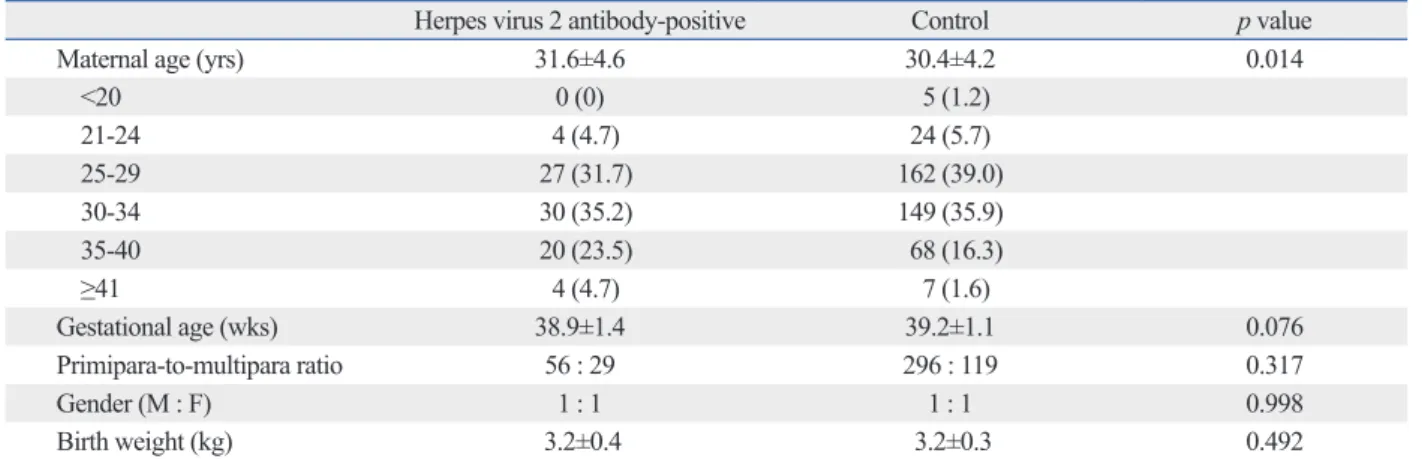
The mean age of the gravidas was 31.6±4.6 years in the HSV2 positive group and 30.4±4.2 years in the healthy con- trol group. There was a significant difference in the ages of the gravidas between the two groups (p<0.05). The mean gestational age of the gravidas was 38.9±1.4 weeks in the HSV2 positive group and 39.2±1.1 weeks in the healthy control group. Among 85 gravidas in the HSV2 positive group, 56 were primiparas and 29 were multiparas; in the control group, 296 gravidas were primiparas and 119 were multiparas. The gender ratio of neonates were 1 : 1 in both the HSV2 positive group (42 males and 43 females) and the healthy control group (205 males and 210 females). The av- erage birth weight of neonates was 3.2±0.4 kg in the HSV2 positive group and 3.2±0.3 kg in the healthy control group.
There were no significant differences in gestational age, ra- tio of primiparas to multiparas, gender ratio of neonates, and birth weights of neonates between the two groups (Table 1).
Comparison of seropositivity
No gravidas were rubella IgM-positive in either group. Sev- enty-eight gravidas (91.8%) in the HSV2 positive group and 369 of 415 gravidas (88.9%) in the health control group were rubella IgG-positive. Seventy-eight gravidas (91.8%) in the HSV2 positive group and 386 gravidas (93.0%) in the healthy control group were positive for anti-varicella anti- body. Six of the 85 gravidas (7.1%) in the HSV2 positive The two viruses, HSV1 and HSV2, spread themselves
through different means. The former being via salivary and respiratory contact whiles the latter through genital contact.
Cases of HSV1 infections are seen worldwide and do not discriminate by age. A human with a primary infection may manifest orolabial herpes, gingivostomatitis, pharyngitis and genital herpes.3
One of the most commonly seen sexually transmitted disease would be an HSV infection of the genital tract. Ac- cording to serologic test results, there is a 2% incidence of HSV1 or HSV2 infections among women during pregnan- cy,4 most of them being asymptomatic, as with non-preg- nant women.1 It has also been observed that while postnatal infections are rare (though possible), neonatal infections are usually acquired in utero; during the intrapartum period via exposure to the virus in the genital tract.5 Long-term neuro- logic sequelae has been noted in about 20% of neonatal herpes survivors.6 However neonatal mortality rates have decreased substantially in the last two decades. More spe- cifically, disseminated disease and central nervous system disease mortality rates fell 30% and 4% each.6
Herpes virus screening of gravidas reduces neonatal her- pes infection rates and the need for antiviral drug treatment at the time of delivery. Thus, we studied the presence of HSV2 infections in gravidas by serological methods, and determined the differences between infected and healthy groups of gravidas. Furthermore, we evaluated the need for herpes virus 2 serologic screening in gravidas.
MATERIALS AND METHODS
A retrospective analysis including 500 gravidas who under- went HSV2 serologic testing and gave birth at our hospital, was carried out between January 2009 and August 2010. The study group was classified as anti-herpes virus 2 antibody- positive, and the following variables were analyzed: clinical course of pregnancy, pregnancy outcome, obstetric compli- cations, and neonatal outcomes. The clinical course and out- comes of pregnancy were assessed for gestational age at de- livery and incidence of fetal loss. Obstetric complications were assessed according to rates of intrauterine growth re- striction, premature rupture of membranes, preterm deliver- ies, and preterm labor. Routine prenatal tests included tests of rubella, varicella, and hepatitis B (HB) antibody titers, and human immunodeficiency virus (HIV) and venereal disease research laboratory (VDRL) tests.
group and 123 of 415 gravidas (29.6%) in the healthy con- trol group had a history of abortions. There was a signifi- cant difference in the abortion rates between the 2 groups (p<0.05). Two of 85 gravidas (2.3%) in the HSV2 positive group and 15 of 415 gravidas (3.6%) in the healthy control group had preterm labor. Eighteen gravidas (21.2%) in the HSV2 positive group and 73 gravidas (17.6%) in the healthy control group had premature rupture of membranes. Seven gravidas (8.2%) in the HSV2 positive group and 26 gravi- das (6.2%) in the healthy control group had preterm deliv- eries. Fourteen of 85 gravidas (16.4%) in the HSV2 posi- tive group and 75 of 415 gravidas (18.0%) in the healthy control group were diagnosed with intrauterine growth re- tardation. Three of 85 newborns (3.5%) in the HSV2 posi- tive group and 6 of 415 neonates (1.4%) in the healthy con- trol group were admitted to the neonatal ICU (Table 4).
There were no significant differences in the rates of preterm labor, premature rupture of membranes, preterm delivery, intrauterine growth retardation, and neonatal ICU admis- sion between the two groups.
DISCUSSION
This is the first study to attempt to determine the prevalence group and 21 of 415 gravidas (5.1%) in the healthy control
group were HBsAg-positive. Sixty-four gravidas (75.3%) in the HSV2 positive group and 308 gravidas (74.2%) in the healthy control group were HBsAb-positive. There were no significant differences in rubella and varicella antibody ti- ters, as well as the HBsAg-positive, and HBsAb-positive rates between the two groups of gravidas (Table 2).
Comparison of sexually transmitted pathogens
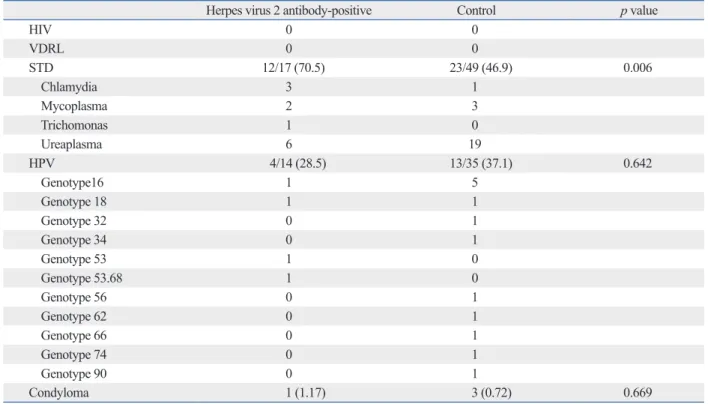
No gravidas were HIV-positive or VDRL-positive in either group. One gravida (1.2%) in the HSV2 positive group and three gravidas (0.7%) in the healthy control group had geni- tal condyloma infections. Four of 14 gravidas (28.6%) in the HSV2 positive group and 13 of 35 gravidas (37.1%) in the healthy control group had HPV infections. There were no significant differences in condyloma and HPV infections between the two groups of gravidas. Twelve of 17 gravidas (70.6%) in the HSV2 positive group and 23 of 49 gravidas (46.93%) in the control group had positive sexually trans- mitted disease screens (Table 3). There was a significant difference in sexually transmitted disease screening be- tween the two groups (p<0.05).
Comparison of obstetric complications
Thirty-three of 85 gravidas (38.8%) in the HSV2 positive Table 1. Comparison of Maternal Demographic Data
Herpes virus 2 antibody-positive Control p value
Maternal age (yrs) 31.6±4.6 30.4±4.2 0.014
<20 0 (0) 5 (1.2)
21-24 4 (4.7) 24 (5.7)
25-29 27 (31.7) 162 (39.0)
30-34 30 (35.2) 149 (35.9)
35-40 20 (23.5) 68 (16.3)
≥41 4 (4.7) 7 (1.6)
Gestational age (wks) 38.9±1.4 39.2±1.1 0.076
Primipara-to-multipara ratio 56 : 29 296 : 119 0.317
Gender (M : F) 1 : 1 1 : 1 0.998
Birth weight (kg) 3.2±0.4 3.2±0.3 0.492
Values are presented as the mean±SD or number (%).
Table 2. Comparison of Seropositivity
Herpes virus 2 antibody-positive Control p value
Rubella IgM 0 0
Rubella IgG 78 (91.8) 369 (88.9) 0.437
Varicella antibody-positive 78 (91.8) 386 (93.0) 0.648
HBsAg-positive 6 (7.1) 21 (5.1) 0.434
HBsAb-positive 64 (75.3) 308 (74.2) 0.892
HB, hepatitis B.
Values are presented as a number (%).
symptoms.7 75-85% of recurrences of genital infections are asymptomatic in infected women, however individuals in- fected with herpes virus are generally unaware of the inci- dent; as a mere 5-15% of people report an infection.8,9 There- fore gravidas, early in pregnancy, should be questioned for signs that may indicate genital herpes, not excluding pro- dromal symptoms. Suspected herpes virus infections should then be confirmed through viral or serological testing, as clinical presentation alone has a sensitivity of 40%, speci- ficity of 99% and a false positive rate of 20%.10 Only type- of HSV2 infections in gravidas in Korea. In the current
study, the HSV2 positive rate was 17% in Korean gravidas.
The HSV2 positive rate in gravidas from several countries has been surveyed. The HSV2 positive rate was higher in African countries, such as Uganda (67.2%)33 and Zimba- bwe (49.1%).34 In contrast, the HSV2 positive rates in Aus- tralia (13.6%)37 and the US (22%)36 are similar to the rate now shown for Korea (17%) (Table 5).
Compared to women with primary Herpes Virus 2 infec- tions, women with non-primary infections reflect milder Table 3. Comparison of Sexually Transmitted Pathogens
Herpes virus 2 antibody-positive Control p value
HIV 0 0
VDRL 0 0
STD 12/17 (70.5) 23/49 (46.9) 0.006
Chlamydia 3 1
Mycoplasma 2 3
Trichomonas 1 0
Ureaplasma 6 19
HPV 4/14 (28.5) 13/35 (37.1) 0.642
Genotype16 1 5
Genotype 18 1 1
Genotype 32 0 1
Genotype 34 0 1
Genotype 53 1 0
Genotype 53.68 1 0
Genotype 56 0 1
Genotype 62 0 1
Genotype 66 0 1
Genotype 74 0 1
Genotype 90 0 1
Condyloma 1 (1.17) 3 (0.72) 0.669
HIV, human immunodeficiency virus; VDRL, venereal disease research laboratory; STD, sexually transmitted disease; HPV, human papillomavirus.
Values are presented as a number (%).
Table 4. Comparison of Obstetric Complications
Herpes virus 2 antibody-positive Control p value
Abortion 33 (38.8) 123 (29.6) 0.045
1* 19 86
2 8 26
3 3 8
4 2 2
5 1 1
Preterm labor 2 (2.3) 15 (3.6) 0.559
PROM 18 (21.2) 73 (17.6) 0.442
Preterm delivery 7 (8.2) 26 (6.2) 0.528
IUGR 14 (16.4) 75 (18.0) 0.718
NICU 3 (3.5) 6 (1.4) 0.185
PROM, preterm rupture of membrane; IUGR, intrauterine growth retardation; NICU, neonatal intensive care unit.
Values are presented as a number (%).
*The number of abortions a given gravida has had.
mary outbreak during delivery.22
Herpes virus 1 accounts to about one-third to a half of cases of neonatal herpes,22,23 though amongst gravidas who suffer recurrent lesions during delivery, their transmission rate with a vaginal delivery is only of 3%.17 Beyond this, only 2 out of every 10000 gravidas with a history of recur- rent disease, but no visible lesions during delivery, are in risk of transmission.22,24
Maternal herpes virus acquisitions during pregnancy are, unfortunately, not addressed by antiviral suppression and cesarean delivery, which fail 70-80% of the time to prevent neonatal herpes infections. In cases in which the herpes vi- rus infections are sub-clinical, nearly 90% of these are not accounted by the methods mentioned above.4,23
Increased risk of spontaneous abortion has always been associated with herpes virus, though this has been found to be contradictory to recent studies.25 In the current study, however, the spontaneous abortion rate was correlated with a statistically significant increase in the herpes virus 2 anti- body-positive group, in comparison with the control group.
The transplacental passage of the virus is rare, and herpes virus 2 infections are not associated with stillbirths.26
Neonatal chorioretinitis, microcephaly and skin lesions are very occasionally associated with primary outbreaks in the first trimester of pregnancy.27 Neonatal herpes virus in- fections can fall under 3 different classifications, those be- ing disseminated disease (25%) central nervous system dis- ease (30%), and disease limited to the skin, eyes, or mouth (45%).5 Though uncommon, neonatal herpes encephalitis is known as severe with a mortality rate of 4-14% and long term neurologic sequelate (56-69%).1,28-32 According to a large cohort study, gravidas are much less likely to transmit herpes virus infections to their infants when they give birth by cesarean section.22 Only 1.2% of infants, from gravidas with herpes virus infections detected at the time of delivery, received neonatal herpes infections when delivered by ce- specific serologic testing can distinguish between primary,
non-primary, and recurrent infections with certainty.11 About 75% of women with recurring genital herpes virus infec- tions suffer at least one recurrence during pregnancy whiles approximately 14% of them will show prodromal symp- toms or clinical recurrence during delivery.12,13 Thus, wom- en with a history of a herpes virus infection should be ex- amined for genital herpetic lesions during labor and delivery.
In the late antepartum period, there may be fever and uri- nary symptoms associated with herpes virus infections, but often without local symptoms, which results in missed di- agnoses.3
Serologic testing for herpes virus 2 will identify gravidas with sub-clinical herpes virus 2 infections who were previ- ously undiagnosed.14 According to The American College of Obstetricians and Gynecologists recommendations, rou- tine HSV screening of gravidas is not recommended. A sur- vey conducted on a sample of 100 gravidas, regarding their knowledge and attitude on genital herpes, showed that 80%
of them desired to be tested for HSV and 76% also encour- aged their sexual partners to be tested.15 Based on this study, an examination for herpes virus is readily accepted in gravi- das upon receiving education on genital herpes. Ideally, most, if not all gravidas are examined for herpes virus in- fection in addition to gravidas who are scheduled for a re- peat cesarean section. To evaluate the cost-effectiveness of different screening protocols for gravidas, several analyses have been made on how the incidence of neonatal herpes virus infections is reduced by those.16-20
As opposed to recurrent infections, primary genital her- pes infections present a higher risk for perinatal transmis- sion, as the mean duration of viral shedding for women with intreated primary HSV2 is 15 days.21 Moreover 90%
of women with primary infections also showed cervical shedding by viral culture.21 However there is a 30-60% risk of vertical transmission to the neonate when there is a pri- Table 5. Herpes Virus 2 Antibody-Positive Rate in Gravidas
Investigator Country Herpes virus 2 antibody-positive
Nakubulwa, et al.33 Uganda 67.2 (168/250)
Munjoma, et al.34 Zimbabwe 49.1 (167/340)
Kapranos, et al.35 Greece 43.2 (41/95)
Xu, et al.36 USA 22.0 (138/626)
Sasadeusz, et al.37 Australia 13.6 (186/1371)
Berntsson, et al.38 Sweden 10.4 (31/299)
Ozdemir, et al.39 Turkey 8.2 (13/158)
Current study Korea 17.0 (85/500)
Values are presented as a % (number).
in the United States. Sex Transm Dis 2004;31:311-6.
10. Centers for Disease Control and Prevention, Workowski KA, Ber- man SM. Sexually transmitted diseases treatment guidelines, 2006. MMWR Recomm Rep 2006;55(RR-11):1-94.
11. Diamond C, Selke S, Ashley R, Benedetti J, Corey L. Clinical course of patients with serologic evidence of recurrent genital her- pes presenting with signs and symptoms of first episode disease.
Sex Transm Dis 1999;26:221-5.
12. Sheffield JS, Hill JB, Hollier LM, Laibl VR, Roberts SW, Sanchez PJ, et al. Valacyclovir prophylaxis to prevent recurrent herpes at delivery: a randomized clinical trial. Obstet Gynecol 2006;108:
141-7.
13. Watts DH, Brown ZA, Money D, Selke S, Huang ML, Sacks SL, et al. A double-blind, randomized, placebo-controlled trial of acy- clovir in late pregnancy for the reduction of herpes simplex virus shedding and cesarean delivery. Am J Obstet Gynecol 2003;188:
836-43.
14. Gardella C, Barnes J, Magaret AS, Richards J, Drolette L, Wald A.
Prenatal herpes simplex virus serologic screening beliefs and prac- tices among obstetricians. Obstet Gynecol 2007;110:1364-70.
15. Vonau B, Low-Beer N, Barton SE, Smith JR. Antenatal serum screening for genital herpes: a study of knowledge and attitudes of women at a central London hospital. Br J Obstet Gynaecol 1997;
104:347-9.
16. Cleary KL, Paré E, Stamilio D, Macones GA. Type-specific screening for asymptomatic herpes infection in pregnancy: a deci- sion analysis. BJOG 2005;112:731-6.
17. Thung SF, Grobman WA. The cost-effectiveness of routine ante- natal screening for maternal herpes simplex virus-1 and -2 anti- bodies. Am J Obstet Gynecol 2005;192:483-8.
18. Baker D, Brown Z, Hollier LM, Wendel GD Jr, Hulme L, Griffiths DA, et al. Cost-effectiveness of herpes simplex virus type 2 sero- logic testing and antiviral therapy in pregnancy. Am J Obstet Gy- necol 2004;191:2074-84.
19. Barnabas RV, Carabin H, Garnett GP. The potential role of suppres- sive therapy for sex partners in the prevention of neonatal herpes: a health economic analysis. Sex Transm Infect 2002;78:425-9.
20. Rouse DJ, Stringer JS. An appraisal of screening for maternal type-specific herpes simplex virus antibodies to prevent neonatal herpes. Am J Obstet Gynecol 2000;183:400-6.
21. Bryson YJ, Dillon M, Lovett M, Acuna G, Taylor S, Cherry JD, et al. Treatment of first episodes of genital herpes simplex virus in- fection with oral acyclovir. A randomized double-blind controlled trial in normal subjects. N Engl J Med 1983;308:916-21.
22. Brown ZA, Wald A, Morrow RA, Selke S, Zeh J, Corey L. Effect of serologic status and cesarean delivery on transmission rates of herpes simplex virus from mother to infant. JAMA 2003;289:203-9.
23. Whitley R, Arvin A, Prober C, Burchett S, Corey L, Powell D, et al. A controlled trial comparing vidarabine with acyclovir in neo- natal herpes simplex virus infection. Infectious Diseases Collabor- ative Antiviral Study Group. N Engl J Med 1991;324:444-9.
24. Brown ZA, Benedetti J, Ashley R, Burchett S, Selke S, Berry S, et al. Neonatal herpes simplex virus infection in relation to asymp- tomatic maternal infection at the time of labor. N Engl J Med 1991;324:1247-52.
25. Ratanajamit C, Vinther Skriver M, Jepsen P, Chongsuvivatwong V, Olsen J, Sørensen HT. Adverse pregnancy outcome in women exposed to acyclovir during pregnancy: a population-based obser- vational study. Scand J Infect Dis 2003;35:255-9.
26. Eskild A, Jeansson S, Stray-Pedersen B, Jenum PA. Herpes sim-
sarean section as opposed to a 7.7% of those delivered vag- inally.22
A comparison of the clinical characteristics of HSV2 positive gravidas compared with the healthy control group revealed that there were no significant differences in the rates of preterm delivery, premature rupture of membranes, preterm labor, intrauterine growth restriction, and cesarean section. In this study, the HSV2 positive group did not have higher hepatitis B, varicella, or rubella antibody titers than the healthy control group. However, the HSV2 positive group had a statistically significantly higher rate of positive sexually transmitted disease than the healthy control group.
Thus, we recommend sexually transmitted disease screen- ing in HSV2 positive gravidas to help discover the presence of sexually transmitted disease.
A limitation of the current study was that herpes virus in- fections and herpes virus antibodies were not assessed in infants born to HSV2 positive gravidas.
Educating gravidas on genital herpes and herpes virus 2 screening might reduce the probability of transmitting her- pes virus 2 infections to neonates. In addition, educating gravidas on herpes virus 2 infections could facilitate sexual- ly transmitted disease screening and appropriate treatment.
REFERENCES
1. Arvin A, Whitley R. Herpes simplex virus infections. In: Reming- ton J, Klein J, editors. Infectious diseases of the fetus and newborn infant. 5th ed. Philadelphia: W.B. Saunders; 2001. p.425-46.
2. Kristensson K, Lycke E, Sjöstrand J. Spread of herpes simplex vi- rus in peripheral nerves. Acta Neuropathol 1971;17:44-53.
3. Malm G. Neonatal herpes simplex virus infection. Semin Fetal Neonatal Med 2009;14:204-8.
4. Brown ZA, Selke S, Zeh J, Kopelman J, Maslow A, Ashley RL, et al. The acquisition of herpes simplex virus during pregnancy. N Engl J Med 1997;337:509-15.
5. Whitley RJ, Corey L, Arvin A, Lakeman FD, Sumaya CV, Wright PF, et al. Changing presentation of herpes simplex virus infection in neonates. J Infect Dis 1988;158:109-16.
6. Kimberlin DW, Lin CY, Jacobs RF, Powell DA, Corey L, Gruber WC, et al. Safety and efficacy of high-dose intravenous acyclovir in the management of neonatal herpes simplex virus infections.
Pediatrics 2001;108:230-8.
7. Corey L, Adams HG, Brown ZA, Holmes KK. Genital herpes simplex virus infections: clinical manifestations, course, and com- plications. Ann Intern Med 1983;98:958-72.
8. Fleming DT, McQuillan GM, Johnson RE, Nahmias AJ, Aral SO, Lee FK, et al. Herpes simplex virus type 2 in the United States, 1976 to 1994. N Engl J Med 1997;337:1105-11.
9. Leone P, Fleming DT, Gilsenan AW, Li L, Justus S. Seropreva- lence of herpes simplex virus-2 in suburban primary care offices
Chirenje MZ, Rusakaniko S, et al. The prevalence, incidence and risk factors of herpes simplex virus type 2 infection among preg- nant Zimbabwean women followed up nine months after child- birth. BMC Womens Health 2010;10:2.
35. Kapranos NC, Kotronias DC. Detection of herpes simplex virus in first trimester pregnancy loss using molecular techniques. In Vivo 2009;23:839-42.
36. Xu F, Markowitz LE, Gottlieb SL, Berman SM. Seroprevalence of herpes simplex virus types 1 and 2 in pregnant women in the United States. Am J Obstet Gynecol 2007;196:43.e1-6.
37. Sasadeusz JJ, Silvers JE, Kent HE, Devenish W, Hocking J, Gar- land SM. Prevalence of HSV-2 antibody in a Melbourne antenatal population attending a tertiary obstetric hospital. Aust N Z J Ob- stet Gynaecol 2008;48:266-72.
38. Berntsson M, Tunbäck P, Ellström A, Krantz I, Löwhagen GB.
Decreasing prevalence of herpes simplex virus-2 antibodies in se- lected groups of women in Sweden. Acta Derm Venereol 2009;89:
623-6.
39. Ozdemir R, Er H, Baran N, Vural A, Demirci M. [HSV-1 and HSV-2 seropositivity rates in pregnant women admitted to Izmir Ataturk Research and Training Hospital, Turkey]. Mikrobiyol Bul 2009;43:709-11.
plex virus type-2 infection in pregnancy: no risk of fetal death: re- sults from a nested case-control study within 35,940 women.
BJOG 2002;109:1030-5.
27. Hutto C, Arvin A, Jacobs R, Steele R, Stagno S, Lyrene R, et al.
Intrauterine herpes simplex virus infections. J Pediatr 1987;110:
97-101.
28. Malm G, Forsgren M. Neonatal herpes simplex virus infections:
HSV DNA in cerebrospinal fluid and serum. Arch Dis Child Fetal Neonatal Ed 1999;81:F24-9.
29. Kimberlin DW. Herpes simplex virus infections of the central ner- vous system. Semin Pediatr Infect Dis 2003;14:83-9.
30. Kimberlin DW. Neonatal herpes simplex infection. Clin Microbiol Rev 2004;17:1-13.
31. Whitley R. Neonatal herpes simplex virus infection. Curr Opin In- fect Dis 2004;17:243-6.
32. Kimberlin DW. Herpes simplex virus infections of the newborn.
Semin Perinatol 2007;31:19-25.
33. Nakubulwa S, Mirembe FM, Kaye DK, Kaddu-Mulindwa D. As- sociation between HSV-2 and HIV serostatus in pregnant women of known HIV serostatus attending Mulago hospital antenatal clinic, Kampala, Uganda. J Infect Dev Ctries 2009;3:803-6.
34. Munjoma MW, Kurewa EN, Mapingure MP, Mashavave GV,