Perioperative Psychological and Music Interventions in Elderly Patients Undergoing Spinal Anesthesia: Effect on Anxiety,
Heart Rate Variability, and Postoperative Pain
Yisha Wang,
1Youjing Dong,
2and Yang Li
21Department of Neurology, Shenzhou Hospital of Shenyang Medical College, Shenyang;
2Department of Anesthesiology, Shengjing Hospital of China Medical University, Shenyang, China.
Received: February 20, 2013 Revised: July 26, 2013 Accepted: August 6, 2013
Corresponding author: Dr. Yisha Wang, Department of Neurology, Shenzhou Hospital of Shenyang Medical College,
NO. 20, North nine road, Heping District, Shenyang City, Liaoning Province 110002, China.
Tel: 86-18940257961, Fax: 86-024-23892312 E-mail: [email protected]
∙ The authors have no financial conflicts of interest.
© Copyright:
Yonsei University College of Medicine 2014 This is an Open Access article distributed under the terms of the Creative Commons Attribution Non- Commercial License (http://creativecommons.org/
licenses/by-nc/3.0) which permits unrestricted non- commercial use, distribution, and reproduction in any medium, provided the original work is properly cited.
Purpose: The aim of this study was to evaluate the effects of perioperative psy- chological and music interventions in elderly patients undergoing elective surgery on anxiety, post-operative pain, and changes in heart rate variability (HRV) to as- certain if perioperative psychological and music interventions can affect overall anxiety levels. Materials and Methods: Fourty elderly patients undergoing elec- tive surgery were randomized to two groups; one group received psychological and music intervention, and the other was the control. The intervention group un- derwent psychological intervention and listening to music for 30 min before sur- gery. Results: The mean change in HRV as determined by low frequency (LF) power measurements. After the intervention, the ratio of mean LF to high frequen- cy (HF) power decreased significantly in the intervention group compared to be- fore the intervention (p<0.05). In the control group, mean LF measurements and the ratio of LF:HF did not change significantly. In the intervention group, mean HF power was significantly higher after the procedure than before (p<0.01). More- over, the mean self-rating anxiety score of the intervention group decreased after the procedure compared to before (p<0.05). The mean visual analogue score of the intervention group 6 hours after surgery was significantly lower than that of the control group (p<0.01). Conclusion: Perioperative psychological and music inter- ventions can reduce anxiety and postoperative pain in elderly patients.
Key Words: Psychological interventions, music interventions, elderly patient, spi- nal anesthesia, heart rate variability, postoperative pain
INTRODUCTION
Perioperative psychological pressure may lead to the reduce of pain threshold, and may affect the immune function and stability of the circulatory system.1 As part of the physiological process of aging, degeneration of the autonomic nervous system occurs gradually, leading to gradual decrease in the ability to adapt and regulate the cardiovascular-stress response. The inability of the autonomic nervous system to effectively regulate the cardiac rhythm leads to higher rates of cardiac dysfunc-
mass index <40 kg/m2. Inclusion criteria included normal heart, pulmonary, liver, and kidney function on preopera- tive examination; no history of endocrine or central nervous system disease or drug allergies; and absence of severe ane- mia, malnutrition, hypoproteinemia, and water-electrolyte/
acid-base imbalance disorders. All patients fasted for 12 hours and were advised not to drink fluids for 4 hours be- fore surgery.
This trial was registered in the Chinese Clinical Trial Reg- istry System on May 30, 2012 (registration number ChiC- TR-TRC-12002208).
The sample size was calculated using a statistical power analysis program G*Power10 for both groups considering a 5% level of significance, 80% power, 0.92 effect size, and the effect size was calculated using the means and standard deviations of an earlier experiment. The sample size calcula- tion indicated 20 individuals were required for each group.
Patients were randomized into the psychological and mu- sic interventions group or the control group. Randomiza- tion was performed using a computer generated random number table.
Administration of anesthesia
Spinal-epidural anesthesia was performed at the L2--3 inter- space with a maximum sensory level of T8. Ephedrine (10 mg) was injected if the blood pressure dropped to less than 90 mm Hg or lower than 30% of the basal blood pressure.
The intervention group of patients continued listening to music after anesthesia was administered. Both groups of patients were instructed to inform the staff if they experi- enced discomfort.
All patients underwent routine preoperative visits.
Psychological and music intervention
Preoperative psychological and music intervention
Patients and their families were informed about the status and severity of their illness. The surgical experience was described while the patient was in a relaxed, comfortable atmosphere, using appropriate words. Patients were taught effective methods for controlling anxiety, including abdom- inal breathing. Patients were also told that technically ad- vanced anesthesia provides complete pain control during surgery. To decrease the development of tension and fear, patients were administered appropriate sedating agents to ensure adequate sleep the night before surgery. Patients in the intervention group listened to soft music in quiet sur- tion, myocardial infarction, and other cardiac emergencies
in the elderly.2-4
Although some studies report that physiological and mu- sic intervention is effective in reducing anxiety levels,5-8 few studies have examined the effects of physiological and mu- sic intervention on perioperative safety in elderly patients.
For example, psychological intervention and direct com- munication with patients by anesthetists and nurses before surgery was found to effectively reduce patient anxiety and improve patient satisfaction.7 In another study, the interven- tion group watched a short film depicting the patient’s in- hospital journey and concluded that preoperative multime- dia information reduces patient anxiety before undergoing anaesthesia.5 In addition, use of an anaesthesia mask and parental distraction prior to surgery are effective at reducing anxiety in children.8 This previous research suggests that music intervention can reduce anxiety perioperatively, but its effect in elderly patients on heart rate variability (HRV) has not been fully investigated.
HRV refers to successive fluctuating RR intervals (instan- taneous heart rate), which is a reflection of the regulation of heart rhythm by the central nervous system. The short-term HRV spectrum indicates that the HRV power spectrum can be used to monitor cardiac vagal modulation levels. Low frequency (LF) power increases when sympathetic activity is enhanced, and the ratio of LF to high frequency (HF) power can act as a quantitative indicator of the cardiac va- gal-sympathetic balance.9
Psychological and music intervention are safe, non-inva- sive methods that patients are more likely to accept.6,7 In this experiment, we performed safe and objective testing to evaluate whether psychological and music intervention can enhance the stability of cardiac vagal-sympathetic balance and increase the safety of surgery in elderly patients with these perioperative interventions.
MATERIALS AND METHODS
Study population
After the Ethical Commitee at Shengjing Hospital approved this study and all patients received informed consent, 40 el- derly patients who underwent elective gynecological or lower limb orthopedic surgery were enrolled from June 2011 to September 2011. The study participants ranged in age from 65 to 80 years, had an American Society of Anes- thesiologists physical status score of 2 or 3, and a body
(T score). A T score >50 is considered to indicate anxiety, and the higher the score the more severe the anxiety.
HRV assessments
Patients in both groups underwent HRV frequency-domain analysis using Holter monitoring before the preoperative interview and again before surgery. Two different, trained staff performed the interventions and monitored HRV; the staff who collect HRV outcomes was blinded to the study.
Frequency domain analysis was performed by a TLC4000 holographic dynamic electrocardiogram analysis system (Contec Medical Systems, Beijing, China). The total power, LF power, HF power, and LF/HF ratio were determined.
Visual analogue pain score assessments
The visual analogue pain score was used to record the pa- tients level of pain from 0 (no pain) to 10 (intensive pain).
Statistical analysis
Data were analyzed using SPSS version 13.0 software (SPSS, Inc., Chicago, IL, USA) using paired t-tests to compare within groups, and t-tests for 2 independent samples were used to compare between-group differences. A p-value
<0.05 was considered statistically significant.
RESULTS
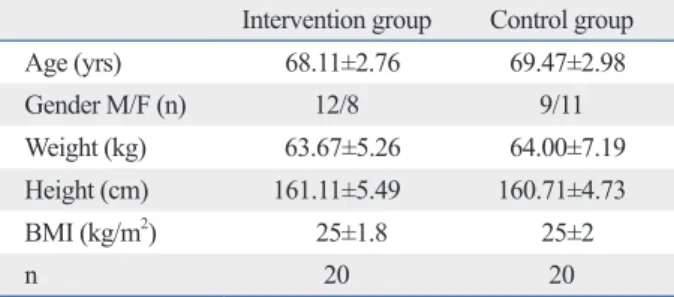
Patient characteristics are shown in Table 1.
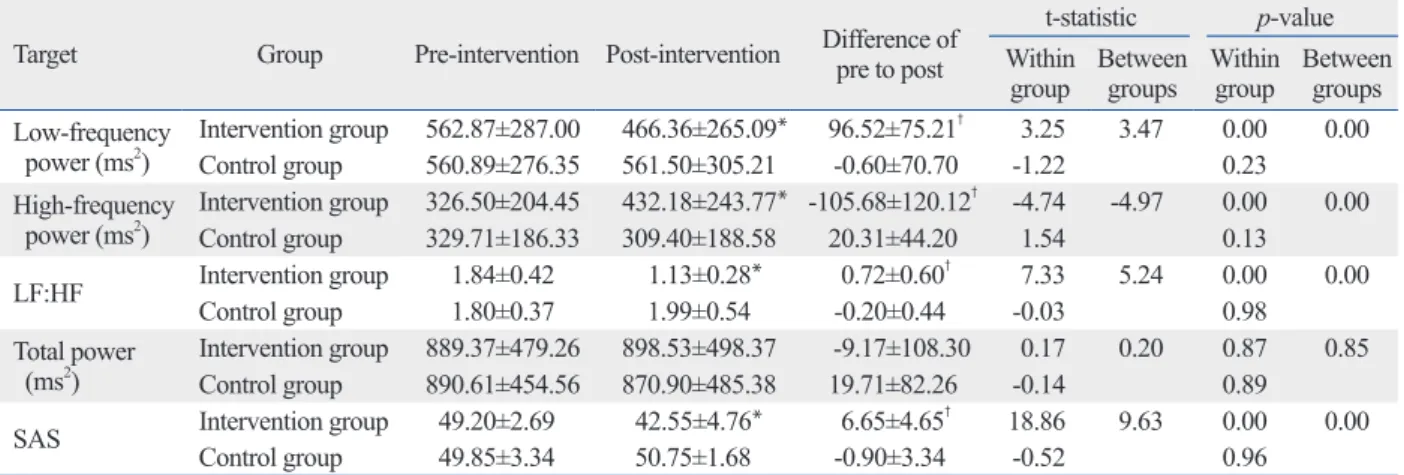
No significant differences for the mean values of total power, LF, HF, or the LF/HF ratio before the intervention were found between the 2 groups of patients. For the inter- vention group, the mean LF and LF/HF ratio decreased sig- nificantly (p<0.05 for both) after the procedure compared to before the procedure, and the mean HF power level was significantly higher after the procedure than before the pro- cedure (p<0.01). In the control group, the differences in roundings for 30 min before undergoing surgery. They were
instructed to close their eyes and relax their body. The con- trol group patients underwent routine preoperative visits where their status and severity of illness, surgery, and anes- thesia were described in detail. Patients in the control group were also administered appropriate sedating agents to en- sure adequate sleep the night before surgery. Before sur- gery, patients in the control group were also instructed to close their eyes and relax their body in quiet surroundings for 30 min, but without music.
Intraoperative psychological intervention
Intraoperative psychological intervention was administered to patients in the intervention group undergoing nerve block anesthesia, which allows the patient to be awake or partial- ly awake during the surgical procedure. Any adverse stimu- li may lead to the development of tension and fear in the patient; therefore, nurses and anesthesiologists can talk with patients to distract them from the procedure. Patients lis- tened to soft music during the surgery and were directly asked if they are uncomfortable or felt pain. In the case a pa- tient was experience discomfort, the appropriate agents were administered for relief. The operating room was quiet and free of upsetting sounds, including discussion of the pa- tient’s condition, so a comfortable environment was main- tained throughout the surgery. In the control group, only pa- tients who expressed discomfort were provided medical treatments and doctors/nurses did not speak about the pa- tient’s status in the surgery room.
Psychological interventions after surgery
Anesthetists visited patients in the intervention group twice after surgery and listened to any feelings or concerns among patients or their families, answered any questions, and in- structed them on postoperative care and treatment. In the control group, anesthetists listened to patients and their families and answered their questions during the first visit.
At the second visit, anesthetists described postoperative care and collected additional data.
Anxiety assessments
Patients in both groups completed the Self-Rating Anxiety questionnaire11,12 at their preoperative visit and again right before surgery. The Zung Self-Rating Anxiety Scale (SAS) was used to assess anxiety, which contains 20 items.11,12 Each item is scored on a self-rating scale from 1 to 4, and scores are added and multiplied by 1.25 to obtain a standard score
Table 1. Patient Characteristics (Mean±SD)
Intervention group Control group
Age (yrs) 68.11±2.76 69.47±2.98
Gender M/F (n) 12/8 9/11
Weight (kg) 63.67±5.26 64.00±7.19
Height (cm) 161.11±5.49 160.71±4.73
BMI (kg/m2) 25±1.8 25±2
n 20 20
BMI, body mass index.
Heart rate variability refers to successive fluctuating RR in- tervals (instantaneous heart rate).9,13 The frequency bands of frequency domain analysis are divided into total power, ultra- low frequency power, extremely low frequency power, LF power, and HF power. The short-term HRV spectrum shows that the HRV power spectrum can be used to monitor cardiac vagal modulation levels. LF increases when sympathetic ac- tivity is enhanced, and the LF/HF ratio can act as a quantita- tive indicator of the cardiac vagal-sympathetic balance.
In this study, the mean HF of the intervention group was higher after the procedure than before. This indicates that the activity of the parasympathetic nervous system was en- hanced. The mean LF and LF/HF ratio of the intervention group decreased significantly after the procedure compared to before. These results demonstrate that direct psychologi- cal intervention can significantly reduce the activity of the sympathetic nervous system, restore the balance of the sym- pathetic and the parasympathetic nervous system, and re- duce preoperative anxiety. These effects may also contrib- ute to patient safety throughout the perioperative period.
Additionally, pain associated emotions can affect the per- ception of pain, influence the pain-related physiological re- actions, and anxiety. All of these effects on the hypothala- mus autonomic nervous system, leading to enhancement of the somatosensory reaction to stimulation, which results in increased sensitivity to pain or the perception of increased pain.1,14 This may explain the low visual analogue pain score 6 hours after surgery in the intervention group.
The association of psychological factors with human health and disease has come under increasing scrutiny. Pa- mean values for LF, HF, total power, and LF/HF ratios of
the control patients measured at the different time points were not significant. For the intervention group, the mean change before and after the procedure was significantly larger than that of the control (p<0.01) (Table 2).
The mean SAS score of the intervention group patients decreased significantly after the procedure compared to be- fore (p<0.05), but the mean scores among control patients were essentially unchanged. Before the procedure, no sig- nificant differences in mean SAS scores between the two groups were found. However, the mean SAS score of the intervention group was significantly lower than that of the control group after the procedure (Table 2).
The mean visual analogue pain score 6 hours after sur- gery was 3.50±1.05 in the intervention group, significantly lower than the control group (4.85±1.31, p<0.01).
DISCUSSION
The main finding of this prospective, randomized, controlled clinical trial was that the mean SAS score of the intervention group was significantly lower after the intervention than be- fore. In addition, the mean HF of the intervention group was significantly higher after the procedure than before, and the mean LF and LF/HF ratio were significantly lower after the intervention than before. Between groups, the mean differ- ence between perioperative and postoperative values for LF, HF, LF/HF ratio, and SAS scores differed in the inter- vention group more than that of the control group.
Table 2. Heart Rate Variability Frequency Domain Analysis and Self-Rating Anxiety Scale (SAS) Scores (Mean±SD) Target Group Pre-intervention Post-intervention Difference of
pre to post
t-statistic p-value Within
group Between groups Within
group Between groups Low-frequency
power (ms2) Intervention group 562.87±287.00 466.36±265.09* 96.52±75.21† 3.25 3.47 0.00 0.00 Control group 560.89±276.35 561.50±305.21 -0.60±70.70 -1.22 0.23
High-frequency
power (ms2) Intervention group 326.50±204.45 432.18±243.77* -105.68±120.12† -4.74 -4.97 0.00 0.00 Control group 329.71±186.33 309.40±188.58 20.31±44.20 1.54 0.13
LF:HF Intervention group 1.84±0.42 1.13±0.28* 0.72±0.60† 7.33 5.24 0.00 0.00
Control group 1.80±0.37 1.99±0.54 -0.20±0.44 -0.03 0.98
Total power
(ms2) Intervention group 889.37±479.26 898.53±498.37 -9.17±108.30 0.17 0.20 0.87 0.85 Control group 890.61±454.56 870.90±485.38 19.71±82.26 -0.14 0.89
SAS Intervention group 49.20±2.69 42.55±4.76* 6.65±4.65† 18.86 9.63 0.00 0.00
Control group 49.85±3.34 50.75±1.68 -0.90±3.34 -0.52 0.96
LF:HF, the ratio of low-frequency power to high-frequency poer.
n=20 in each group. Pre-intervention represents data obtained before the intervention at the preoperative visit. Post-intervention represents data obtained after the intervention and 5 min before the anesthesia procedure.
*p<0.01 within group.
†p<0.01 between groups.
on target-controlled infusion of propofol requirements during com- bined spinal-epidural anaesthesia. Anaesthesia 2005;60:990-4.
5. Jlala HA, French JL, Foxall GL, Hardman JG, Bedforth NM. Ef- fect of preoperative multimedia information on perioperative anxi- ety in patients undergoing procedures under regional anaesthesia.
Br J Anaesth 2010;104:369-74.
6. Koch ME, Kain ZN, Ayoub C, Rosenbaum SH. The sedative and analgesic sparing effect of music. Anesthesiology 1998;89:300-6.
7. Soltner C, Giquello JA, Monrigal-Martin C, Beydon L. Continu- ous care and empathic anaesthesiologist attitude in the preopera- tive period: impact on patient anxiety and satisfaction. Br J An- aesth 2011;106:680-6.
8. Fortier MA, Blount RL, Wang SM, Mayes LC, Kain ZN. Analys- ing a family-centred preoperative intervention programme: a dis- mantling approach. Br J Anaesth 2011;106:713-8.
9. Bailey JR, Fitzgerald DM, Applegate RJ. Effects of constant car- diac autonomic nerve stimulation on heart rate variability. Am J Physiol 1996;270(6 Pt 2):H2081-7.
10. Faul F, Erdfelder E, Lang AG, Buchner A. G*Power 3: a flexible statistical power analysis program for the social, behavioral, and biomedical sciences. Behav Res Methods 2007;39:175-91.
11. Zung WW. A rating instrument for anxiety disorders. Psychoso- matics 1971;12:371-9.
12. Zung WW. The measurement of affects: depression and anxiety.
Mod Probl Pharmacopsychiatry 1974;7:170-88.
13. Nicolini P, Ciulla MM, De Asmundis C, Magrini F, Brugada P.
The prognostic value of heart rate variability in the elderly, chang- ing the perspective: from sympathovagal balance to chaos theory.
Pacing Clin Electrophysiol 2012;35:622-38.
14. Rainville P, Bao QV, Chrétien P. Pain-related emotions modulate experimental pain perception and autonomic responses. Pain 2005;118:306-18.
15. Mallik S, Krumholz HM, Lin ZQ, Kasl SV, Mattera JA, Rou- mains SA, et al. Patients with depressive symptoms have lower health status benefits after coronary artery bypass surgery. Circula- tion 2005;111:271-7.
16. Wang SM, Kulkarni L, Dolev J, Kain ZN. Music and preoperative anxiety: a randomized, controlled study. Anesth Analg 2002;94:
1489-94.
17. Lepage C, Drolet P, Girard M, Grenier Y, DeGagné R. Music de- creases sedative requirements during spinal anesthesia. Anesth Analg 2001;93:912-6.
18. Ayoub CM, Rizk LB, Yaacoub CI, Gaal D, Kain ZN. Music and ambient operating room noise in patients undergoing spinal anes- thesia. Anesth Analg 2005;100:1316-9.
19. Mazzeo AT, La Monaca E, Di Leo R, Vita G, Santamaria LB.
Heart rate variability: a diagnostic and prognostic tool in anesthe- sia and intensive care. Acta Anaesthesiol Scand 2011;55:797-811.
20. Tanaka M, Goyagi T, Kimura T, Nishikawa T. The effects of cer- vical and lumbar epidural anesthesia on heart rate variability and spontaneous sequence baroreflex sensitivity. Anesth Analg 2004;
99:924-9.
21. Shafqat K, Pal SK, Kumari S, Kyriacou PA. Changes in Heart Rate Variability in patients under local anesthesia. Conf Proc IEEE Eng Med Biol Soc 2007;2007:299-302.
tients fear anesthesia and surgery because of a lack of un- derstanding and may have some misconceptions regarding the surgical procedure. These emotions can lead to anxiety.
Mental stress can stimulate the sympathetic-adrenal system.
Leading to coronary artery spasm, platelet aggregation, in- creased blood viscosity, or cardiovascular complications such as myocardial ischemia and myocardial infarction. And may even lead to cardiac arrhythmias and sudden death.15
Psychological therapy and music before surgery can sig- nificantly reduce the blood levels of prednisone and natural killer cells, reduce neural hormones and immune-mediated stress, eliminate worries, reduce fear and anxiety, and en- hance patient confidence in surgery and anesthesia.16-18 Soltner, et al.7 also reported that psychological intervention and direct communication with patients by anesthetists and nurses before surgery can effectively reduce patient anxiety and improve patient satisfaction.
There were also some limitations in our study. Anesthetic drugs may affect HRV;19-21 however, we did not collect data intraoperatively or postoperatively. Some important infor- mation within this period could have been missed. Thus, further studies are needed.
In summary, perioperative psychological and music in- terventions in elderly patients can effectively reduce anxi- ety and relieve postoperative pain.
ACKNOWLEDGEMENTS
This work was supported by Liaoning Province Science Project (2011225020).
REFERENCES
1. Lautenbacher S, Huber C, Schöfer D, Kunz M, Parthum A, Weber PG, et al. Attentional and emotional mechanisms related to pain as predictors of chronic postoperative pain: a comparison with other psychological and physiological predictors. Pain 2010;151:722-31.
2. Beattie WS, Buckley DN. Frequency domain measures of heart period and postoperative ischemia. Anesthesiology 1993;79(3A):
A1249.
3. Kim SJ, Oh YJ, Kim KJ, Kwak YL, Na S. The effect of recorded maternal voice on perioperative anxiety and emergence in chil- dren. Anaesth Intensive Care 2010;38:1064-9.
4. Zhang XW, Fan Y, Manyande A, Tian YK, Yin P. Effects of music