• 검색 결과가 없습니다.

Is Human Brucellosis Endemics in Korea?

N/A
N/A
Protected

Academic year: 2022

Share "Is Human Brucellosis Endemics in Korea?"

Copied!
2
0
0

로드 중.... (전체 텍스트 보기)

전체 글

(1)

259 www.eymj.org

Brucellosis is a zoonotic disease transmitted to humans by animals infected with Brucella species.

1

It occurs worldwide, but is especially prevalent in the Mediterranean countries of Europe, North and East Africa, the Middle East, South and Cen- tral Asia, and Central and South America.

1,2

Brucella species are facultative intracellular bacteria con- sisting of aerobic gram-negative coccobacilli. Eight species of Brucella have been identified, including B. melitensis, B. abor- tus, B. suis, B. canis, B. ovis, B. neotomae, B. ceti, and B. pinnipe- dialis.

3

The three major pathogens causing brucellosis are B.

abortus, B. melitensis, and B. suis.

4

In Korea, B. abortus is the main pathogenic species of human and bovine brucellosis.

5

The diagnosis of brucellosis should be based on clinical mani- festations, a history of exposure to infected animals and posi- tive serology, because the symptoms of this disease are non- specific. The most common features are fever, chills, night sweats, headache, arthralgia, and fatigue.

4,6

In a three-year follow-up study of human brucellosis in Korea, about 80.0% of patients with brucellosis complained of clinical symptoms such as chronic fatigue and arthralgia for more than three years after treatment.

7

Many complications of systemic infections can affect organ systems.

4,6,8

Osteoarticular involvement includes spondylitis and sacroiliitis, and hematologic abnormalities are common in the course of brucellosis.

4,9

Genitourinary involvement (orchi- epididymitis, glomerulonephritis, and renal abscesses), neu- rological involvement (meningitis, encephalitis), and pulmo- nary involvement (bronchitis, interstitial pneumonitis) can also occur.

4,10

Endocarditis is relatively rare, but is a serious manifes-

tation that can lead to death.

4,11

The case fatality for brucellosis was less than 1.0% of cases.

10

Human brucellosis has been designated as a communicable disease in Korea since 2000. The first human brucellosis case in Korea was reported in 2002. Since an outbreak of human brucellosis in Jeongeup city, Jeollabuk-do province in 2003, the incidence of brucellosis has rapidly increased throughout Ko- rea.

12

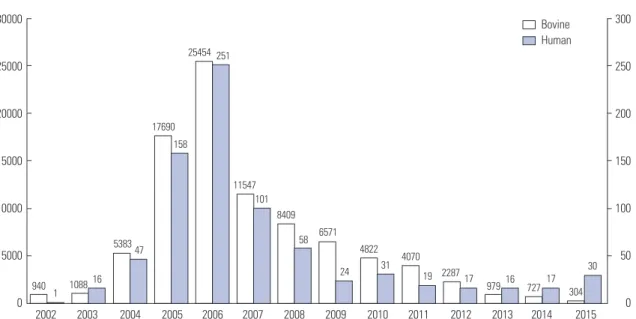
From January 2002 to October 2015, a total of 750 brucel- losis cases were reported in the “Disease Web Statistics Sys- tem” of the Korea Center for Disease Control and Prevention (Fig. 1).

13

Cases of human brucellosis increased from a single patient in 2002 to 215 patients in 2006. Significantly more males are infected with human brucellosis than females (639 patients vs. 112 patients, 85.1% vs. 14.9%). The percentage distribution of human brucellosis cases by age group was as follows: ≤19, 20–39, 40–59, and over 60 age groups had 7 cases, 97 cases, 459 cases, and 188 cases, respectively. The age-specific incidence was highest in persons 40–59 years of age (61.0%). The distri- bution of human brucellosis by occupation was as follows: farm- ers, veterinarians, and other occupations represented 57.9%, 6.1%, and 30.1% of cases, respectively.

14

The greatest incidence of brucellosis occurs in Gyeongsangbuk-do province, which has a high proportion of agricultural land. In 2006, a large num- ber of cases were reported and brucellosis emerged as an im- portant public health issue. With aggressive eradication poli- cies, human and bovine brucellosis showed a tendency to decrease rapidly.

Human brucellosis is usually associated with occupations involving animals. Livestock farmers are at highest risk, and veterinarians also have a high incidence. Employees in slaugh- terhouses and laboratory workers handling Brucella cultures also face an increased risk of infection.

Human brucellosis has a close relationship with the occur- rence of bovine brucellosis. The highest incidence of bovine brucellosis occurs in Gyeongsangbuk-do province, where many cows are raised. Bovine brucellosis, however, has de- clined in Korea since 2006. The Korea Animal Health Integrated System reported 940 heads of brucellosis in 2002, 1088 heads in 2003, 5383 heads in 2004, 17690 heads in 2005, 25454 heads pISSN: 0513-5796 · eISSN: 1976-2437

Received: November 4, 2015 Revised: November 20, 2015 Accepted: November 28, 2015

Corresponding author: Dr. Chang-Seop Lee, Department of Internal Medicine, Chonbuk National University Medical School, 567 Baekje-daero, Deokjin-gu, Jeonju 54907, Korea.

Tel: 82-63-250-2391, Fax: 82-63-254-1609, E-mail: [email protected]

•The authors have no financial conflicts of interest.

© Copyright: Yonsei University College of Medicine 2017

This is an Open Access article distributed under the terms of the Creative Com- mons Attribution Non-Commercial License (http://creativecommons.org/licenses/

by-nc/3.0) which permits unrestricted non-commercial use, distribution, and repro- duction in any medium, provided the original work is properly cited.

Yonsei Med J 2017 Jan;58(1):259-260 https://doi.org/10.3349/ymj.2017.58.1.259

Is Human Brucellosis Endemics in Korea?

Eun-Kyung Kim

1

, Joo-Hee Hwang

1

, Jeong-Hwan Hwang

1,2

, and Chang-Seop Lee

1,2

1

Department of Internal Medicine, Chonbuk National University Medical School, Jeonju;

2
Biomedical Research Institute of Chonbuk National University Hospital, Jeonju, Korea.

Letter to the Editor

(2)

260

Human Brucellosis in Korea

https://doi.org/10.3349/ymj.2017.58.1.259 in 2006, 11548 heads in 2007, 8416 heads in 2008, 6571 heads

in 2009, 4822 heads in 2010, 4070 heads in 2011, 2287 heads in 2012, 979 heads in 2013, 727 heads in 2014, and 304 heads from January to October 2015 (Fig. 1).

15

A strong governmental eradi- cation policy contributed to the rapid decrease in bovine bru- cellosis.

After the epidemic peaked in 2006, the reported number of human brucellosis cases decreased sharply. Nevertheless, around 20 human brucellosis cases have been reported each year. Thirty cases were reported from January to October 2015, which was an increase from the previous year. If this trend continues steadily, human brucellosis could become an en- demic disease in Korea.

To eradicate human and bovine brucellosis, thorough gov- ernment inspections and management are needed, including quarantine. When bovine brucellosis is eradicated, human brucellosis will also disappear. A concerted effort toward bru- cellosis management and eradication is still needed to pre- vent nationwide spread of human brucellosis.

ACKNOWLEDGEMENTS

This research was supported by a grant of the Korea Health Technology R&D Project through the Korea Health Industry Development Institute (KHIDI), funded by the Ministry of Health & Welfare, Republic of Korea (grant number : HI16C0950) and by the Fund of Biomedical Research Institute, Chonbuk National University Hospital, Jeonju, Korea.

REFERENCES

1. Corbel MJ. Brucellosis: an overview. Emerg Infect Dis 1997;3:213-21.

2. Pappas G, Papadimitriou P, Akritidis N, Christou L, Tsianos EV. The new global map of human brucellosis. Lancet Infect Dis 2006;6:

91-9.

3. Foster G, Osterman BS, Godfroid J, Jacques I, Cloeckaert A. Brucella ceti sp. nov. and Brucella pinnipedialis sp. nov. for Brucella strains with cetaceans and seals as their preferred hosts. Int J Syst Evol Microbiol 2007;57(Pt 11):2688-93.

4. Franco MP, Mulder M, Gilman RH, Smits HL. Human brucellosis.

Lancet Infect Dis 2007;7:775-86.

5. Park MY, Lee CS, Choi YS, Park SJ, Lee JS, Lee HB. A sporadic out- break of human brucellosis in Korea. J Korean Med Sci 2005;20:

941-6.

6. Rubach MP, Halliday JE, Cleaveland S, Crump JA. Brucellosis in low-income and middle-income countries. Curr Opin Infect Dis 2013;26:404-12.

7. Lee CS, Kwon KS, Baek BK, Park SW, Lee HB. A three-year follow- up study of human brucellosis in Korea. Infect Chemother 2007;

39:196-201.

8. Fiori PL, Mastrandrea S, Rappelli P, Cappuccinelli P. Brucella abor- tus infection acquired in microbiology laboratories. J Clin Micro- biol 2000;38:2005-6.

9. Mete B, Kurt C, Yilmaz MH, Ertan G, Ozaras R, Mert A, et al. Verte- bral osteomyelitis: eight years’ experience of 100 cases. Rheumatol Int 2012;32:3591-7.

10. Buzgan T, Karahocagil MK, Irmak H, Baran AI, Karsen H, Evirgen O, et al. Clinical manifestations and complications in 1028 cases of brucellosis: a retrospective evaluation and review of the litera- ture. Int J Infect Dis 2010;14:e469-78.

11. Keshtkar-Jahromi M, Boroumand M, Razavi SM, Gholamin S, Haghighat B, Hashemi MJ, et al. Brucella endocarditis, a report of 14 cases (1991-2009). J Infect 2010;61:89-92.

12. Park MS, Woo YS, Lee MJ, Shim SK, Lee HK, Choi YS, et al. The first case of human brucellosis in Korea. Infect Chemother 2003;

35:461-6.

13. Korean Centers for Disease Control and Prevention. Human bru- cellosis, Disease Web Statical system, Korea Centers for Disease Control and Prevention 2002-2015 (in Korean). [accessed on 2015 Oct 30]. Available at: http://is.cdc.go.kr/dstat/index.jsp.

14. Jang Y, Kim H, Bang HA, Lee MJ, Che NH, Lee WC. Epidemiologi- cal aspects of human brucellosis and leptospirosis outbreaks in Korea. J Clin Med Res 2011;3:199-202.

15. Animal and Plant Quarantine Agency. Human brucellosis. Korea Animal Health Integrated System. [accessed on 2015 Oct 30]. Avail- able at: http://www.kahis.go.kr.

Fig. 1. The number of human and bovine brucellosis in Korea.

30000

25000

20000

15000

10000

5000

0

300

250

200

150

100

50

2002 2003 2004 2005 2006 2007 2008 2009 0

Bovine Human

2010 2011 2012 2013 2014 2015

940 1 1088 5383

17690 158

25454 251

11547 101

8409 58 6571

24 4822

31 4070

19 2287 17 979 16

727 17 304

30 47

16

수치

Fig. 1. The number of human and bovine brucellosis in Korea.

참조

관련 문서

This study was supported by a grant of the Korean Health Technology R&D Project, Ministry of Health & Welfare, Republic of Korea.2. CT values for each area by CTAn

This work was supported by KIAT(Korea Institute for Advancement of Technology) grant funded by the Korea Government(MOTIE : Ministry of Trade, Industry and Energy) (No.N0001883,

This research was supported by a grant from the Korean Health Technology R&D Project, Ministry of Health & Welfare, Republic of Korea (study number HI13C0729 &

This study was supported by a grant of the Korean Health Technology R&D Project, Ministry of Health & Wel- fare, Republic of Korea (A 102065 ). Ann Lab

The sentence about grant number should be corrected as “This research was supported by a grant of the Korea Health Technology R&D Project through the Korea Health

* This research was supported by Institute of Information & communications Technology Planning & Evaluation(IITP) grant funded by the Korea

This work was supported by Institute of Information & communications Technology Planning & Evaluation(IITP) grant funded by the Korea government(MSIT)

This study was supported by a grant of the Korean Health Technology R&D Project, Ministry of Health & Welfare, Republic of Korea (HI06C0868) and the R&D Project,