INTRODUCTION
Ulcerative colitis (UC) is a chronic relapsing and remitting in- flammatory disease of the colon.
1Biologic therapy with tumor necrosis factor alpha (TNF-α) inhibitors, such as infliximab (IFX) and adalimumab (ADA), is currently the most effective treat- ment for inducing and maintaining clinical remission in pa- tients with moderate to severe UC, and has been reported to reduce the risk of hospitalization and surgery.
2IFX and ADA were approved for patients with UC in South Korea in 2010 and 2013, respectively. Considering the differences in the mo- lecular constructs, routes of administration, and dosing inter- vals of these two TNF-α inhibitors, there may be differences in efficacy. However, although randomized clinical trials (RCTs)
Comparison of Real-World Outcomes of Infliximab versus Adalimumab in Biologic-Naïve Korean Patients with Ulcerative Colitis: A Population-Based Study
Minkyung Han
1*, Yoon Suk Jung
2*, Jae Hee Cheon
3, and Sohee Park
41Biostatistics Collaboration Unit, Department of Biomedical Systems Informatics, Yonsei University College of Medicine, Seoul;
2Division of Gastroenterology, Department of Internal Medicine, Kangbuk Samsung Hospital, Sungkyunkwan University School of Medicine, Seoul;
3Department of Internal Medicine and Institute of Gastroenterology, Yonsei University College of Medicine, Seoul;
4Department of Biostatistics, Graduate School of Public Health, Yonsei University, Seoul, Korea.
Purpose: Data on the comparative effectiveness of infliximab (IFX) or adalimumab (ADA) in patients with ulcerative colitis (UC)
are extremely limited, especially in the Asian population. We compared clinically important outcomes [colectomy, UC-related emergency room (ER) visits, UC-related hospitalizations, and need for corticosteroids] for these two biologics in biologic-naïve Korean patients with UC.
Materials and Methods: Using National Health Insurance claims, we collected data on patients who were diagnosed with UC and
exposed to IFX or ADA between 2010 and 2016.
Results: A total of 862 new users of biologics were included, of whom 630 were treated with IFX and 232 were treated with ADA.
Over a median follow-up of 1.8 years after starting biologic therapy, there were no significant differences in the risk of colectomy [adjusted hazard ratio (aHR), 1.87; 95% confidence interval (CI), 0.30–11.63], ER visits (aHR, 1.58; 95% CI, 0.79–3.16), hospitalizations (aHR, 0.83; 95% CI, 0.59–1.17), and corticosteroid use (aHR, 1.16; 95% CI, 0.76–1.78) between IFX and ADA users. These results were stable even when only patients who used biologics for ≥6 months were analyzed. Additionally, these results were unchanged in patients treated with biologic monotherapy or combination therapy with immunomodulators.
Conclusion: In this nationwide population-based study, there was no significant difference in the risk of colectomy, ER visits, hos-
pitalizations, and corticosteroid use between IFX and ADA users. Our findings indicate that IFX and ADA have comparable effec- tiveness in biologic-naïve Korean patients with UC.
Key Words: Ulcerative colitis, infliximab, adalimumab
pISSN: 0513-5796 · eISSN: 1976-2437
Received: October 25, 2019 Revised: November 29, 2019 Accepted: December 2, 2019
Co-corresponding authors: Sohee Park, PhD, Department of Biostatistics, Grad- uate School of Public Health, Yonsei University, 50-1 Yonsei-ro, Seodaemun-gu, Seoul 03722, Korea.
Tel: 82-2-2228-1532, Fax: 82-2-392-7734, E-mail: [email protected] and Jae Hee Cheon, MD, PhD, Department of Internal Medicine and Institute of Gastroen- terology, Yonsei University College of Medicine, 50-1 Yonsei-ro, Seodaemun-gu, Seoul 03722, Korea.
Tel: 82-2-2228-1990, Fax: 82-2-393-6884, E-mail: [email protected]
*Minkyung Han and Yoon Suk Jung contributed equally to this work.
•The authors have no potential conflicts of interest to disclose.
© Copyright: Yonsei University College of Medicine 2020
This is an Open Access article distributed under the terms of the Creative Com- mons Attribution Non-Commercial License (https://creativecommons.org/licenses/
by-nc/4.0) which permits unrestricted non-commercial use, distribution, and repro- duction in any medium, provided the original work is properly cited.
Yonsei Med J 2020 Jan;61(1):48-55 https://doi.org/10.3349/ymj.2020.61.1.48
have demonstrated that IFX and ADA are superior to placebo in the treatment of UC,
3,4there have been no head-to-head comparison trials of these two agents. As such, the need to un- derstand the relative effectiveness of these two agents has re- mained unmet, and decisions on the choice of TNF-α inhibitor have primarily been based on the preferences of the patients and clinicians.
An indirect comparison meta-analysis previously suggested that IFX is more effective than ADA in inducing remission, re- sponse, and mucosal healing at 8 weeks, although these two agents exhibited comparable efficacy after 52 weeks of main- tenance treatment in patients with UC.
5Another network me- ta-analysis showed no difference in the induction and main- tenance of remission and response between IFX and ADA in patients with UC.
6Additionally, a recent network meta-analysis revealed no difference in the rates of hospitalization and colec- tomy for UC between IFX and ADA.
7However, these results are from indirect comparisons rather from direct comparisons.
Moreover, prior network meta-analysis studies are limited by a lack of head-to-head trials, a small number of registration tri- als, short follow-up (within 54 weeks), and restricted inclusion criteria in registration trials.
Although several observational studies have compared clinical outcomes between IFX and ADA in patients with UC, their results were inconsistent.
8-13Furthermore, most of the pre- vious studies on this topic were performed in Western coun- tries.
8-13Despite the increasing number of patients with UC in Asia,
14,15data on the comparative effectiveness of IFX and ADA in Asian patients are extremely scarce. Therefore, we conduct- ed a nationwide population-based study to compare the effi- cacy of IFX and ADA in biologic-naïve Korean patients with UC using a health claims administrative database. To better evalu- ate the real-world outcomes of these two biologics, we com- pared clinically important outcomes, including colectomy, emergency room (ER) visits, hospitalizations, and need for cor- ticosteroids.
MATERIALS AND METHODS
Data source
The South Korean government operates a mandatory nation- wide insurance system (National Health Insurance, NHI); there- fore, all information about health-care utilization is registered in a comprehensive database, which is operated by the Health Insurance Review and Assessment Service (HIRA). The NHI provides mandatory universal health insurance covering all forms of health-care utilization, including outpatient care, pharmaceutical services, and hospitalization. Medical institu- tions electronically submit health-care use information to en- sure reimbursement, and this information is integrated into the HIRA claims database, which covers the entire population of South Korea (approximately 51 million people). The HIRA da-
tabase contains information on all patients, including demo- graphic characteristics, ambulatory care history, principal di- agnosis, and comorbidities, according to International Classification of Diseases 10th revision (ICD-10) codes, pre- scriptions, and diagnostic or surgical procedures.
16-18The source population for this study was derived from NHI claims data from 2008 to 2016.
Patient identification and data capture
To improve the diagnostic accuracy of UC, only patients with data on both appropriate diagnostic codes and UC-related medicine prescriptions were selected.
16-18The ICD-10 codes K51.0–51.9 indicate UC. UC-related medicine prescriptions were defined as prescriptions of 5-aminosalicylic acid (ASA) for ≥1 month, immunomodulators (azathioprine or 6-mer- captopurine) at least once, and/or biologics at least once.
16-18To rule out the use of drugs for other autoimmune diseases, these medications were confined to prescriptions received from a gastroenterology clinic. During the study period, the biologics approved for the treatment of UC in South Korea were IFX, ADA, and golimumab. However, the actual use of golimumab was very rare during the study period because this biologic was approved only in May 2015. Therefore, in this study, golimumab could not be compared with IFX and ADA.
The date of UC registration in the HIRA database was con- sidered the date of diagnosis. Given that previous prevalent cases could confound the incidence rate, we set a washout pe- riod of 2 years; therefore, we were able to analyze patients with UC diagnosed from January 1, 2010, to December 31, 2016. Pa- tients in whom the first line of biologics was golimumab, those who were exposed to both IFX and ADA, and those with a his- tory of colectomy before starting biologic therapy were exclud- ed from the analysis.
The primary outcomes of interest were colectomy, ER visits, hospitalizations, and need for corticosteroids after the first use of biologics. Colectomy was identified using the procedural code. ER visits were defined as patient visits to the ER with UC as the primary diagnosis. Hospitalization was defined as admis- sion for ≥3 days in the department of gastroenterology. Finally, new corticosteroid use was defined as moderate- to high-dose corticosteroid use (≥30 mg prednisolone, ≥50 mg methylpred- nisolone, or ≥200 mg hydrocortisone) after 2 months of the first prescription of biologics.
Statistical analysis
The incidence rates of colectomy, ER visits, hospitalizations, and need for corticosteroids were calculated per 100 person- years, and 95% confidence intervals (CIs) for the incidence rate were estimated using a Poisson distribution. For each group, the crude risk of outcomes was described using the Ka- plan-Meier method and log-rank test. We used Cox proportion- al hazard models to adjust for potential confounding variables.
Baseline covariates, including sex, the period from UC diagno-
sis to first biologics use, age, region, hospital scale, and steroid use at the time of first biologics use, were adjusted as time-fixed covariates. The use periods of cumulative biologics and con- comitant medications, including 5-ASA and immunomodula- tors, were adjusted as time-dependent covariates.
We further performed a sensitivity analysis on patients who used biologics for ≥6 months and a stratified analysis based on the use of TNF-α inhibitor monotherapy or combination therapy with immunomodulators (concomitant use of immu- nomodulators). Concomitant use of immunomodulators was defined as prescriptions within 30 days before and/or after the start date of biologics. The results are presented as hazard ratios (HRs) with corresponding 95% CIs. All analyses were performed using the SAS Enterprise Guide (SAS Institute Inc., Cary, NC, USA), and p<0.05 was considered statistically significant.
Ethical considerations
All identifiable personal information in medical records was de-identified to comply with the Health Insurance Portability and Accountability Act. In addition, as the information in the HIRA database is encrypted, the database does not contain personal identifiers. The protocol of this study was approved by the Institutional Review Board of Severance Hospital, Yonsei University College of Medicine (IRB No. 4-2017-0927).
RESULTS
Patient characteristics
We identified 17167 patients who were diagnosed with UC be- tween 2010 and 2016, of whom 1125 started their first TNF-α in- hibitors during the study period. Of these 1125 patients, 57, 194, and 12 were excluded because of the use of golimumab, the use of both IFX and ADA, and a history of colectomy before the start of biologics, respectively. Ultimately, 862 patients were included in the study, of whom 630 were treated with IFX
and 232 were treated with ADA (Fig. 1). The median follow-up period after starting TNF-α inhibitors was 1.8 years (interquar- tile range, 0.8–3.3 years).
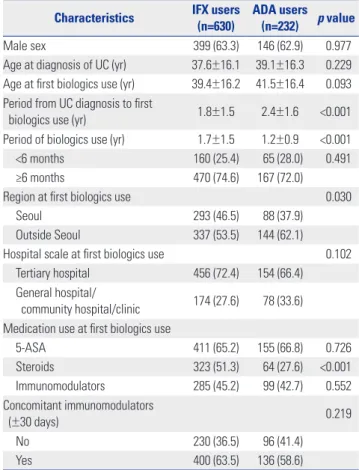
Table 1 shows the comparison of the baseline characteris- tics of IFX users and ADA users. Sex, age at UC diagnosis, and age and hospital scale at first biologics use were not different between IFX users and ADA users. The mean period from UC diagnosis to first biologics use was shorter in IFX users than in ADA users (1.8±1.5 years vs. 2.4±1.6 years, p<0.001), whereas the mean period of biologics use was longer in IFX users than in ADA users (1.7±1.5 years vs. 1.2±0.9 years, p<0.001). During the follow-up period, 429 (68.1%) of 630 IFX users continued IFX therapy, and 183 (78.9%) of 232 ADA users continued ADA therapy. The rate of steroid use at the time of first biologics use was higher in IFX users than in ADA users (51.3% vs. 27.6%,
p<0.001), whereas the rate of concomitant immunomodulatoruse was not different between IFX users and ADA users (63.5%
vs. 58.6%, p=0.219).
Comparative effectiveness of ADA vs. IFX
There were no significant differences in the cumulative proba- bilities of colectomy (p=0.459) (Fig. 2A), ER visits (p=0.086) (Fig.
2B), and hospitalizations (p=0.809) (Fig. 2C). At 1 and 3 years
Table 1. Baseline Characteristics of the Study Population Characteristics IFX users
(n=630) ADA users (n=232) p value
Male sex 399 (63.3) 146 (62.9) 0.977
Age at diagnosis of UC (yr) 37.6±16.1 39.1±16.3 0.229 Age at first biologics use (yr) 39.4±16.2 41.5±16.4 0.093 Period from UC diagnosis to first
biologics use (yr) 1.8±1.5 2.4±1.6 <0.001
Period of biologics use (yr) 1.7±1.5 1.2±0.9 <0.001
<6 months 160 (25.4) 65 (28.0) 0.491
≥6 months 470 (74.6) 167 (72.0)
Region at first biologics use 0.030
Seoul 293 (46.5) 88 (37.9)
Outside Seoul 337 (53.5) 144 (62.1)
Hospital scale at first biologics use 0.102
Tertiary hospital 456 (72.4) 154 (66.4)
General hospital/
community hospital/clinic 174 (27.6) 78 (33.6) Medication use at first biologics use
5-ASA 411 (65.2) 155 (66.8) 0.726
Steroids 323 (51.3) 64 (27.6) <0.001
Immunomodulators 285 (45.2) 99 (42.7) 0.552
Concomitant immunomodulators
(±30 days) 0.219
No 230 (36.5) 96 (41.4)
Yes 400 (63.5) 136 (58.6)
IFX, infliximab; ADA, adalimumab; UC, ulcerative colitis; 5-ASA, 5-aminosali- cylic acid.
Data are presented as a number (%) or mean±standard deviation.
Fig. 1. Flowchart of the identification of biologic-naïve patients with UC. UC, ulcerative colitis; IFX, infliximab; ADA, adalimumab.
51 million people in Korean National Health Insurance database 17167 new UC patients identified between 2010–2016
1125 UC patients used biologics
862 UC patients (630 IFX users and 232 ADA users) Exclusion (n=263)
- Patients whose first line of biologics was golimumab (n=57) - Patients who were exposed to both IFX and ADA (n=194) - Patients who had colectomy prior to first use of biologics (n=12)
after the start of the first biologics, the cumulative rates of col- ectomy were 0.7% and 1.1%, respectively, for IFX users and 0%
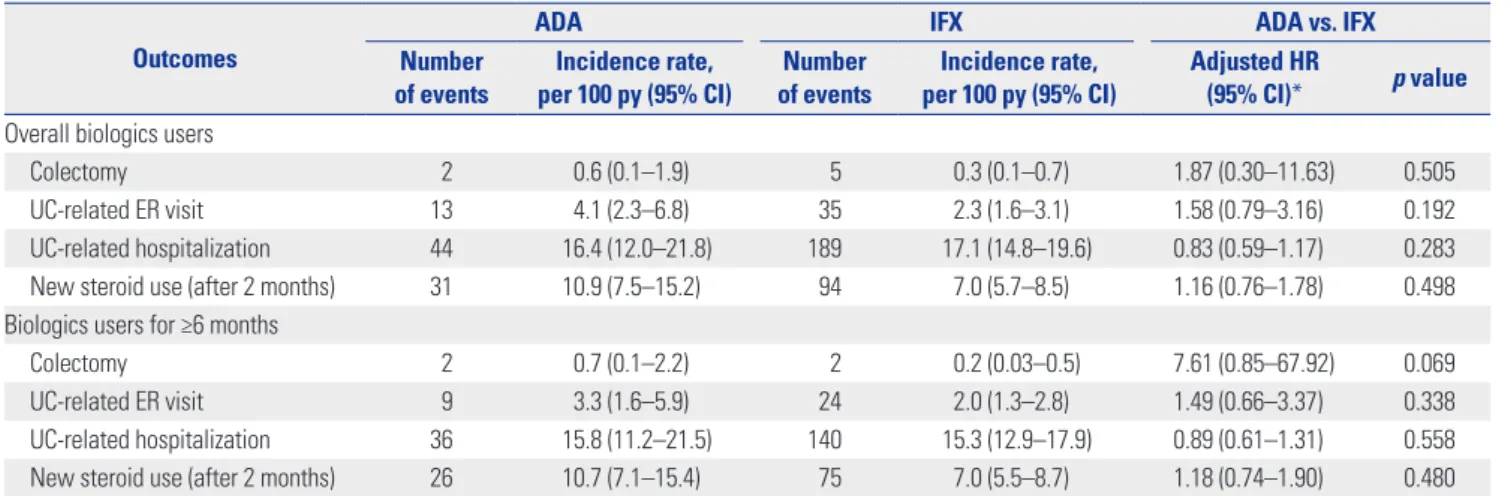
and 2.7%, respectively, for ADA users. The number of patients who underwent colectomy during the follow-up period was 5 among IFX users and 2 among ADA users. The surgical proce- dure codes for these patients were as follows: Q2671 right or left hemicolectomy (one IFX user and one ADA user), Q2672 total colectomy (three IFX users and one ADA user), and QA925 to- tal coloproctectomy with ileostomy (one IFX user). Meanwhile, the cumulative rates of ER visits at 1 and 3 years were 3.7% and 5.8%, respectively, for IFX users and 4.5% and 11.8%, respec- tively, for ADA users. For hospitalization, the cumulative rates at 1 and 3 years were 25.1% and 35.1%, respectively, for IFX us- ers and 18.5% and 32.7%, respectively, for ADA users. Even af- ter adjustment for confounding variables, there were no sig- nificant differences in the risk of colectomy (HR, 1.87; 95%
CI, 0.30–11.63), ER visits (HR, 1.58; 95% CI, 0.79–3.16), and hos-
pitalizations (HR, 0.83; 95% CI, 0.59–1.17) between the two groups (Table 2).
The cumulative probability of corticosteroid use was higher in ADA users than in IFX users (p=0.040) (Fig. 2D). However, this significant difference disappeared after adjusting for confound- ing variables (HR, 1.16; 95% CI, 0.76–1.78) (Table 2).
Sensitivity analysis and stratified analysis
In a sensitivity analysis restricted to patients who used biolog- ics for ≥6 months, we also observed no significant differences in the risk of colectomy (HR, 7.61; 95% CI, 0.85–67.92), ER vis- its (HR, 1.49; 95% CI, 0.66–3.37), hospitalizations (HR, 0.89;
95% CI, 0.61–1.31), and corticosteroid use (HR, 1.18; 95% CI, 0.74–1.90) between IFX users and ADA users (Table 2). Addi- tionally, on stratified analysis, there were no significant differ- ences in the risk of ER visits, hospitalizations, and corticoste- roid use between IFX users and ADA users with either TNF-α
1.000.75 0.50 0.25 0.00
1.00 0.75 0.50 0.25 0.00
1.00 0.75 0.50 0.25 0.00
1.00 0.75 0.50 0.25 0.00
0 1 2 3 4 5 6 7
0 1 2 3 4 5 6 7
0 1 2 3 4 5 6 7
0 1 2 3 4 5 6 7 Time (yr)
Time (yr)
Time (yr)
Time (yr) Survival rate (%)
Year 1 Year 2 Year 3 Year 4 Year 5 Year 6 IFX 99.3 99.3 98.9 98.9 98.9 98.9
ADA 100.0 97.3 97.3 97.3 - -
Overall 99.5 99.0 98.7 98.7 98.7 98.7
Survival rate (%)
Year 1 Year 2 Year 3 Year 4 Year 5 Year 6
IFX 74.9 68.4 64.9 63.5 59.6 59.6
ADA 81.5 79.2 67.3 - - -
Overall 76.6 70.9 66.1 64.7 60.7 60.7
Survival rate (%)
Year 1 Year 2 Year 3 Year 4 Year 5 Year 6 IFX 96.3 95.1 94.2 93.9 90.0 98.9
ADA 95.5 93.0 88.2 81.9 - -
Overall 96.2 94.8 93.4 92.1 88.9 87.1
Survival rate (%)
Year 1 Year 2 Year 3 Year 4 Year 5 Year 6 IFX 90.2 84.4 81.3 79.2 75.9 75.9
ADA 89.1 81.3 71.9 - - -
Overall 90.0 83.9 79.9 78.0 74.8 74.8 Log-rank test p=0.459
Log-rank test p=0.809
Log-rank test p=0.086
Log-rank test p=0.040 IFX
ADA
IFX ADA
IFX ADA
IFX ADA
Survival probabilitySurvival probability Survival probabilitySurvival probability
A
C
B
D
Fig. 2. Survival free of (A) colectomy, (B) emergency room visit, (C) hospitalization, and (D) new corticosteroid use. IFX, infliximab; ADA, adalimumab.
inhibitor monotherapy or combination therapy (Table 3).
DISCUSSION
In this nationwide population-based study of 862 biologic-na- ïve Korean patients with UC, we found that IFX and ADA were comparable in terms of the risk of colectomy, UC-related ER visits, UC-related hospitalizations, and new initiation of corti- costeroids. These results were stable even when only patients who used biologics for ≥6 months were analyzed. Additionally, these results were unchanged in patients treated with biologic monotherapy or those treated with combination therapy with immunomodulators. Our findings indicate that IFX and ADA elicit comparable effects on UC-related, clinically important,
real-world outcomes.
Most studies on the comparative outcomes of IFX and ADA in UC have been conducted in Western countries, and data on this topic in Asian countries are extremely scarce. Our results are consistent with the results from prior Western studies. Although our study could not compare the rates of induction and main- tenance of remission between IFX and ADA, several Western observational studies have reported no difference in clinical re- mission and response between these two drugs. A retrospective study performed in the United States including biologic-naïve IFX-treated (n=424) and ADA-treated (n=380) patients with UC showed no significant differences in time to remission, no rec- tal bleeding, normal stool count, and normal physician global assessment.
9In a Canadian single-center cohort study involv- ing 53 patients with UC, the responses to induction and main-
Table 3. Comparative Effectiveness of ADA vs. IFX in Biologics-Naïve Patients with UC Stratified according to Use of TNF-α Inhibitor Monotherapy and Concomitant Immunomodulatory TherapyOutcomes
TNF-α inhibitor monotherapy (n=326) TNF-α inhibitor+immunomodulatory therapy (n=536) Adjusted HR (95% CI)*
(ADA vs. IFX) p value Adjusted HR (95% CI)*
(ADA vs. IFX) p value
Overall biologics users
Colectomy -† - 3.06 (0.43–22.09) 0.267
UC-related ER visit 1.33 (0.42–4.19) 0.624 1.73 (0.73–4.13) 0.215
UC-related hospitalization 0.65 (0.36–1.19) 0.160 0.94 (0.62–1.43) 0.771
New steroid use (after 2 months) 1.07 (0.54–2.10) 0.848 1.23 (0.71–2.15) 0.459
Biologics users for ≥6 months
Colectomy -† - 8.00 (0.86–74.68) 0.068
UC-related ER visit 0.64 (0.13–3.23) 0.586 2.10 (0.79–5.58) 0.138
UC-related hospitalization 0.60 (0.29–1.23) 0.164 1.06 (0.68–1.67) 0.794
New steroid use (after 2 months) 0.94 (0.42–2.12) 0.888 1.39 (0.77–2.50) 0.270
IFX, infliximab; ADA, adalimumab; TNF-α, tumor necrosis factor-α; HR, hazard ratio; CI, confidence interval; UC, ulcerative colitis; ER, emergency room.
*Adjusted for sex, age, region, and hospital scale at first biologics use; cumulative biologics use period; medication (5-aminosalicylic acid, immunomodulators, and steroids) use; and the period from UC diagnosis to first biologics use; †Results were not estimated because of patients who underwent TNF-α inhibitor monotherapy, only one in the overall biologics user group and none in the biologics user for ≥6 months group later underwent colectomy.
Table 2. Comparative Effectiveness of ADA vs. IFX in Biologics-Naïve Patients with UC Outcomes
ADA IFX ADA vs. IFX
Number
of events Incidence rate,
per 100 py (95% CI) Number
of events Incidence rate,
per 100 py (95% CI) Adjusted HR
(95% CI)* p value Overall biologics users
Colectomy 2 0.6 (0.1–1.9) 5 0.3 (0.1–0.7) 1.87 (0.30–11.63) 0.505
UC-related ER visit 13 4.1 (2.3–6.8) 35 2.3 (1.6–3.1) 1.58 (0.79–3.16) 0.192
UC-related hospitalization 44 16.4 (12.0–21.8) 189 17.1 (14.8–19.6) 0.83 (0.59–1.17) 0.283
New steroid use (after 2 months) 31 10.9 (7.5–15.2) 94 7.0 (5.7–8.5) 1.16 (0.76–1.78) 0.498
Biologics users for ≥6 months
Colectomy 2 0.7 (0.1–2.2) 2 0.2 (0.03–0.5) 7.61 (0.85–67.92) 0.069
UC-related ER visit 9 3.3 (1.6–5.9) 24 2.0 (1.3–2.8) 1.49 (0.66–3.37) 0.338
UC-related hospitalization 36 15.8 (11.2–21.5) 140 15.3 (12.9–17.9) 0.89 (0.61–1.31) 0.558
New steroid use (after 2 months) 26 10.7 (7.1–15.4) 75 7.0 (5.5–8.7) 1.18 (0.74–1.90) 0.480
IFX, infliximab; ADA, adalimumab; py, person-years; CI, confidence interval; HR, hazard ratio; UC, ulcerative colitis; ER, emergency room.
*Adjusted for sex, age, region, and hospital scale at first biologics use; cumulative biologics use period; medication (5-aminosalicylic acid, immunomodulators, and steroids) use; and the period from UC diagnosis to first biologics use.
tenance therapy were similar between IFX and ADA.
13Re- cently, a Japanese study involving 25 biologic-naïve patients with UC also demonstrated no statistical differences in clinical response, remission, mucosal healing, and steroid-free remis- sion rates at weeks 14 and 54 between IFX users (n=10) and ADA users (n=15).
19In addition, similar to our findings, some Western studies have reported no difference in the risk of surgery, hospitaliza- tion, and steroid utilization between IFX and ADA users. In a US study conducted at two tertiary referral academic centers, there were no differences in UC-related surgery, hospitaliza- tions, or prednisone prescription within 1 year after the initia- tion of IFX (n=337) or ADA (n=82).
8An Italian population- based cohort study using health administrative databases also revealed that the risk of steroid utilization did not differ between 469 IFX and 91 ADA new users with UC.
12Furthermore, con- sistent with these results, an indirect comparison through a re- cent network meta-analysis showed no difference in the rates of UC-related hospitalization and colectomy between IFX and ADA, although only two RCTs were included in this network meta-analysis.
7However, a few Western studies showed different results from those of our study. In a US administrative claims-based study of 1400 patients with UC who were new users of TNF-α inhibitors, there were no significant differences in the risk of all-cause or UC-related hospitalization and serious infections between IFX- and ADA-treated patients; however, the need for corticosteroid use was lower in IFX-treated than in ADA-treated patients.
10In this study, the risk of surgery was low in both IFX- and ADA-treated patients, and the number of surgical events was very small, precluding meaningful analysis.
10In contrast, a nationwide population-based study of 1719 biologics-naïve patients with UC in Denmark demonstrated that the risks of sur- gery and new corticosteroid initiation were comparable among IFX users and ADA users; however, ADA was associated with a higher risk of all-cause hospitalization and serious infections, and showed a trend toward a higher risk of UC-related hospi- talization, compared with IFX.
11Although the results of these two studies are not identical, these results may suggest that IFX may be more beneficial than ADA in the treatment of UC. In line with these results, two network meta-analyses also indi- cated the superiority of IFX over ADA in patients with UC.
20,21A network meta-analysis by Danese, et al.
20showed the superior- ity of IFX over ADA in both inducing and maintaining remis- sion in UC. Recently, another network meta-analysis by Chol- apranee, et al.
21revealed that ADA was inferior to IFX in inducing mucosal healing in UC. However, the results of these network meta-analyses are indirect comparisons based on comparison trials of “IFX vs. placebo” and “ADA vs. placebo,” rather than head-to-head comparisons.
Although the reason for the difference between our findings and those from some Western studies cannot be clearly eluci- dated, there may be a few potential explanations. First, al-
though IFX and ADA have similar mechanisms of action in targeting TNF-α, there are subtle differences in pharmacoki- netics, which may explain the difference in efficacy. The dose of IFX administered intravenously is determined based on body weight, whereas ADA administered subcutaneously is a fixed-dose drug that does not take body weight into consider- ation. This may result in a difference in bioavailability. The prev- alence of obesity is relatively lower in Korea than in the United States and Europe.
22More specifically, the data from the Orga- nization for Economic Cooperation and Development showed that the prevalence of obesity defined by body mass index (BMI)
≥30 kg/m
2among individuals older than 15 years was the high- est in the United States at 38.2% and the second lowest in Ko- rea at 5.3% in 2017.
22Although there are no data on the preva- lence of obesity in Korean patients with UC, it is expected to be lower than the prevalence of obesity in US patients with inflam- matory bowel disease (IBD), reported as 18–33%.
23-25ADA, a fixed-dose drug, may be advantageous for non-obese patients, but disadvantageous for obese patients, considering only the drug effect. Indeed, a prior study reported that higher BMI in patients with IBD is predictive of dose escalation during ADA treatment.
26Additionally, a retrospective cohort study demon- strated a higher need for dose escalation due to early loss of re- sponse in obese patients with Crohn’s disease treated with ADA, but not in those treated with IFX.
27Moreover, another study observed a trend toward a lower trough level in ADA-treated patients with a BMI of >30 kg/m
2.
28The relatively lower BMI in Korean patients than in Western patients may have helped overcome the disadvantage of ADA bioavailability. Second, in our clinical practice, patients with more severe disease may have been preferentially prescribed IFX rather than ADA. This may cause bias in the results against IFX because more severe patients with a higher risk for surgery and hospitalization may be more likely to be prescribed IFX. Actually, in our study, the rate of steroid utilization at the first biologics use was higher in patients initiated on IFX than in those initiated on ADA (51.3%
vs. 27.6%). However, this factor was adjusted for in our analy- sis. Lastly, as the phenotype and genetic susceptibility of IBD differ between Western and Asian patients,
14,29the efficacy of IFX or ADA may vary depending on race and ethnicity.
This is the first nationwide population-based study to com-
pare the real-life outcomes of IFX and ADA in Korean patients
with UC. Nevertheless, our findings should be interpreted with
caution, taking into account the limitations associated with
the study design. First, this was a retrospective, claims-based,
and observational study. Accordingly, information on disease
severity and phenotypes, such as the extent of UC, were unavail-
able; thus, confounding factors that can affect clinical out-
comes could not be considered. Second, the efficacy of IFX
and ADA in clinical responses or endoscopic responses, such
as mucosal healing, could not be compared because informa-
tion on clinical and endoscopic activity was not available. Third,
safety outcomes, such as serious or opportunistic infections,
were not evaluated. Fourth, because ADA was approved for pa- tients with UC in South Korea on July 2013, there was a limita- tion in assessing the long-term outcomes of ADA. Fifth, the im- pact of dose escalation or interval shortening, which may influence clinical outcomes, was not assessed. Sixth, we did not verify the diagnostic accuracy of UC. However, considering that this study included only patients who used IFX or ADA and that these TNF-α inhibitors are approved only for UC patients with moderate to severe activity (Mayo score 6 to 12 and en- doscopy subscore ≥2) in South Korea, it seems very unlikely that non-UC patients would have been misdiagnosed as hav- ing UC. Lastly, we did not investigate factors contributing to preferences for IFX or ADA. A previous Korean study reported that the most influential reason for choosing IFX was “doctor’s presence” and that for ADA was “ease of use.”
30The study also demonstrated that having a >60-minute travel time to the hos- pital was a significant independent predictive factor for ADA preference.
30Despite these limitations, our study provides a better under- standing of the real-world outcomes of IFX and ADA in Korean patients with UC. In this administrative claims-based study, we found no significant differences in four clinically important outcomes, including colectomy, ER visits, hospitalizations, and corticosteroid use, between IFX users and ADA users. These results suggest that IFX and ADA have comparable effective- ness in biologic-naïve patients with UC. In the absence of RCTs with which to directly compare these two TNF-α inhibitors, our study suggests that for Korean patients with UC, deciding on either IFX or ADA can be based the preference of the patients and/or their clinicians.
AUTHOR CONTRIBUTIONS
Conceptualization: Yoon Suk Jung, Jae Hee Cheon. Data curation:
Minkyung Han, Yoon Suk Jung. Formal analysis: Minkyung Han. In- vestigation: Minkyung Han, Yoon Suk Jung. Methodology: Minkyung Han, Yoon Suk Jung. Project administration: Minkyung Han, Yoon Suk Jung. Resources: Minkyung Han, Yoon Suk Jung, Jae Hee Cheon, and Sohee Park. Software: Minkyung Han, Yoon Suk Jung, Jae Hee Cheon, and Sohee Park. Supervision: Minkyung Han, Yoon Suk Jung, Jae Hee Cheon, and Sohee Park. Validation: Minkyung Han, Yoon Suk Jung, Jae Hee Cheon, and Sohee Park. Visualization: Minkyung Han, Yoon Suk Jung. Writing—original draft: Yoon Suk Jung. Writing—review &
editing: Minkyung Han, Yoon Suk Jung, Jae Hee Cheon, and Sohee Park.
ORCID iDs
Minkyung Han https://orcid.org/0000-0002-5011-5557 Yoon Suk Jung https://orcid.org/0000-0002-1963-7170 Jae Hee Cheon https://orcid.org/0000-0002-2282-8904 Sohee Park https://orcid.org/0000-0001-8513-5163
REFERENCES
1. Lee SH, Kwon JE, Cho ML. Immunological pathogenesis of in-
flammatory bowel disease. Intest Res 2018;16:26-42.
2. Ooi CJ, Hilmi I, Banerjee R, Chuah SW, Ng SC, Wei SC, et al. Best practices on immunomodulators and biologic agents for ulcerative colitis and Crohn’s disease in Asia. J Gastroenterol Hepatol 2019;
34:1296-15.
3. Rutgeerts P, Sandborn WJ, Feagan BG, Reinisch W, Olson A, Jo- hanns J, et al. Infliximab for induction and maintenance therapy for ulcerative colitis. N Engl J Med 2005;353:2462-76.
4. Sandborn WJ, van Assche G, Reinisch W, Colombel JF, D'Haens G, Wolf DC, et al. Adalimumab induces and maintains clinical remis- sion in patients with moderate-to-severe ulcerative colitis. Gastro- enterology 2012;142:257-65.
5. Thorlund K, Druyts E, Mills EJ, Fedorak RN, Marshall JK. Adalim- umab versus infliximab for the treatment of moderate to severe ulcerative colitis in adult patients naïve to anti-TNF therapy: an in- direct treatment comparison meta-analysis. J Crohns Colitis 2014;
8:571-81.
6. Stidham RW, Lee TC, Higgins PD, Deshpande AR, Sussman DA, Singal AG, et al. Systematic review with network meta-analysis: the efficacy of anti-tumour necrosis factor-alpha agents for the treat- ment of ulcerative colitis. Aliment Pharmacol Ther 2014;39:660-71.
7. Mao EJ, Hazlewood GS, Kaplan GG, Peyrin-Biroulet L, Anan- thakrishnan AN. Systematic review with meta-analysis: compara- tive efficacy of immunosuppressants and biologics for reducing hospitalisation and surgery in Crohn’s disease and ulcerative coli- tis. Aliment Pharmacol Ther 2017;45:3-13.
8. Ananthakrishnan AN, Cagan A, Cai T, Gainer VS, Shaw SY, Savova G, et al. Comparative effectiveness of infliximab and adalimumab in Crohn’s disease and ulcerative colitis. Inflamm Bowel Dis 2016;
22:880-5.
9. Sandborn WJ, Sakuraba A, Wang A, Macaulay D, Reichmann W, Wang S, et al. Comparison of real-world outcomes of adalimum- ab and infliximab for patients with ulcerative colitis in the United States. Curr Med Res Opin 2016;32:1233-41.
10. Singh S, Heien HC, Sangaralingham LR, Schilz SR, Kappelman MD, Shah ND, et al. Comparative effectiveness and safety of inflix- imab and adalimumab in patients with ulcerative colitis. Aliment Pharmacol Ther 2016;43:994-1003.
11. Singh S, Andersen NN, Andersson M, Loftus EV Jr, Jess T. Compar- ison of infliximab and adalimumab in biologic-naive patients with ulcerative colitis: a nationwide Danish cohort study. Clin Gastro- enterol Hepatol 2017;15:1218-25.
12. Di Domenicantonio R, Trotta F, Cascini S, Agabiti N, Kohn A, Gas- barrini A, et al. Population-based cohort study on comparative effectiveness and safety of biologics in inflammatory bowel dis- ease. Clin Epidemiol 2018;10:203-13.
13. Gies N, Kroeker KI, Wong K, Fedorak RN. Treatment of ulcerative colitis with adalimumab or infliximab: long-term follow-up of a single-centre cohort. Aliment Pharmacol Ther 2010;32:522-8.
14. Ng WK, Wong SH, Ng SC. Changing epidemiological trends of in- flammatory bowel disease in Asia. Intest Res 2016;14:111-9.
15. Yen HH, Weng MT, Tung CC, Wang YT, Chang YT, Chang CH, et al. Epidemiological trend in inflammatory bowel disease in Tai- wan from 2001 to 2015: a nationwide populationbased study. In- test Res 2019;17:54-62.
16. Jung YS, Han M, Kim WH, Park S, Cheon JH. Incidence and clini- cal outcomes of inflammatory bowel disease in South Korea, 2011- 2014: a nationwide population-based study. Dig Dis Sci 2017;62:
2102-12.
17. Jung YS, Han M, Park S, Kim WH, Cheon JH. Cancer risk in the early stages of inflammatory bowel disease in Korean patients: a nationwide population-based study. J Crohns Colitis 2017;11:954- 62.
18. Han M, Jung YS, Cheon JH, Park S. Regional variations in the use of biologics and immunomodulators among Korean patients with inflammatory bowel diseases. J Gastroenterol Hepatol 2019;34:
1166-74.
19. Mizoshita T, Katano T, Tanida S, Hirano A, Miyaki T, Ozeki K, et al.
Prospective comparison of preference and efficacy of adalimum- ab and infliximab for treating ulcerative colitis naive to antitumor necrosis factor therapy. Medicine (Baltimore) 2017;96:e7800.
20. Danese S, Fiorino G, Peyrin-Biroulet L, Lucenteforte E, Virgili G, Moja L, et al. Biological agents for moderately to severely active ulcerative colitis: a systematic review and network meta-analysis.
Ann Intern Med 2014;160:704-11.
21. Cholapranee A, Hazlewood GS, Kaplan GG, Peyrin-Biroulet L, An- anthakrishnan AN. Systematic review with meta-analysis: com- parative efficacy of biologics for induction and maintenance of mucosal healing in Crohn’s disease and ulcerative colitis controlled trials. Aliment Pharmacol Ther 2017;45:1291-302.
22. Nam GE, Park HS. Perspective on diagnostic criteria for obesity and abdominal obesity in Korean adults. J Obes Metab Syndr 2018;
27:134-42.
23. Chandradas S, Khalili H, Ananthakrishnan A, Wayman C, Reidel W, Waalen J, et al. Does obesity influence the risk of Clostridium difficile infection among patients with ulcerative colitis? Dig Dis Sci 2018;63:2445-50.
24. Seminerio JL, Koutroubakis IE, Ramos-Rivers C, Hashash JG,
Dudekula A, Regueiro M, et al. Impact of obesity on the manage- ment and clinical course of patients with inflammatory bowel dis- ease. Inflamm Bowel Dis 2015;21:2857-63.
25. Flores A, Burstein E, Cipher DJ, Feagins LA. Obesity in inflamma- tory bowel disease: a marker of less severe disease. Dig Dis Sci 2015;60:2436-45.
26. Bultman E, de Haar C, van Liere-Baron A, Verhoog H, West RL, Kuipers EJ, et al. Predictors of dose escalation of adalimumab in a prospective cohort of Crohn’s disease patients. Aliment Pharma- col Ther 2012;35:335-41.
27. Bhalme M, Sharma A, Keld R, Willert R, Campbell S. Does weight- adjusted anti-tumour necrosis factor treatment favour obese pa- tients with Crohn’s disease? Eur J Gastroenterol Hepatol 2013;25:
543-9.
28. Bond A, Asher R, Jackson R, Sager K, Martin K, Kneebone A, et al.
Comparative analysis of the influence of clinical factors including BMI on adalimumab and infliximab trough levels. Eur J Gastro- enterol Hepatol 2016;28:271-6.
29. Ng SC, Tsoi KK, Kamm MA, Xia B, Wu J, Chan FK, et al. Genetics of inflammatory bowel disease in Asia: systematic review and meta- analysis. Inflamm Bowel Dis 2012;18:1164-76.
30. Kim ES, Kim KO, Jang BI, Lee CK, Kim HJ, Lee KM, et al. Factors contributing to the preference of Korean patients with Crohn’s dis- ease when selecting an anti-tumor necrosis factor agent (CHOICE Study). Gut Liver 2016;10:391-8.