INTRODUCTION
Schizophrenia is a devastating mental disorder and is charac- terized by several symptoms related to abnormalities in per- ception and expression, such as delusion, hallucination, and disorganized thinking.1 Although evidence on gender differ- ences in schizophrenia development is inconclusive,2 the prevalence of the disease is different between the sexes, with about a 1.4-fold higher risk in men than in women.3 The heri- tability of schizophrenia is reported to be around 80%, sug- gesting that genetic factors are strongly involved in the risk for the disorder.4 The putative susceptible genes for schizophre-
Gender-Specific Associations between
CHGB Genetic Variants and Schizophrenia in a Korean Population
Joong-Gon Shin
1,2, Jeong-Hyun Kim
2, Chul Soo Park
3, Bong-Jo Kim
3, Jae Won Kim
4, Ihn-Geun Choi
5, Jaeuk Hwang
6, Hyoung Doo Shin
1,2,7, and Sung-Il Woo
61Department of Life Science, Sogang University, Seoul;
2Research Institute for Basic Science, Sogang University, Seoul;
3Department of Psychiatry, College of Medicine, Gyeongsang National University, Jinju;
4Division of Life Science, Research Institute of Life Science, Gyeongsang National University, Jinju;
5Department of Neuropsychiatry, Hallym University Hangang Sacred Heart Hospital, Seoul;
6Department of Neuropsychiatry, Soonchunhyang University Hospital, Seoul;
7Department of Genetic Epidemiology, SNP Genetics, Inc., Seoul, Korea.
Purpose: Schizophrenia is a devastating mental disorder and is known to be affected by genetic factors. The chromogranin B (CHGB), a member of the chromogranin gene family, has been proposed as a candidate gene associated with the risk of schizo- phrenia. The secretory pathway for peptide hormones and neuropeptides in the brain is regulated by chromogranin proteins. The aim of this study was to investigate the potential associations between genetic variants of CHGB and schizophrenia susceptibility.
Materials and Methods: In the current study, 15 single nucleotide polymorphisms of CHGB were genotyped in 310 schizophre- nia patients and 604 healthy controls.
Results: Statistical analysis revealed that two genetic variants (non-synonymous rs910122; rs2821 in 3’-untranslated region) were associated with schizophrenia [minimum p=0.002; odds ratio (OR)=0.72], even after correction for multiple testing (pcorr=0.02).
Since schizophrenia is known to be differentially expressed between sexes, additional analysis for sex was performed. As a result, these two genetic variants (rs910122 and rs2821) and a haplotype (ht3) showed significant associations with schizophrenia in male subjects (pcorr=0.02; OR=0.64), whereas the significance disappeared in female subjects (p>0.05).
Conclusion: Although this study has limitations including a small number of samples and lack of functional study, our results suggest that genetic variants of CHGB may have sex-specific effects on the risk of schizophrenia and provide useful preliminary information for further study.
Key Words: Single nucleotide polymorphisms, chromogranin B, schizophrenia, gender-specific marker
pISSN: 0513-5796 · eISSN: 1976-2437
Received: September 27, 2016 Revised: December 9, 2016 Accepted: December 22, 2016
Co-corresponding authors: Dr. Hyoung Doo Shin, Department of Life Science, Sogang University, 35 Baekbeom-ro, Mapo-gu, Seoul 04107, Korea.
Tel: 82-2-705-8615, Fax: 82-2-3273-1680, E-mail: [email protected] and Dr. Sung-Il Woo, Department of Neuropsychiatry, Soonchunhyang University Hos- pital, 59 Daesagwan-ro, Yongsan-gu, Seoul 04401, Korea.
Tel: 82-2-709-9230, Fax: 82-2-795-3687, E-mail: [email protected]
•The authors have no financial conflicts of interest.
© Copyright: Yonsei University College of Medicine 2017
This is an Open Access article distributed under the terms of the Creative Com- mons Attribution Non-Commercial License (http://creativecommons.org/licenses/
by-nc/4.0) which permits unrestricted non-commercial use, distribution, and repro- duction in any medium, provided the original work is properly cited.
Yonsei Med J 2017 May;58(3):619-625 https://doi.org/10.3349/ymj.2017.58.3.619
nia are dystrobrevin-binding protein 1, neuregulin 1 (NRG1), D-amino-acid oxidase (DAOA), and regulator of G-protein sig- naling 4 (RGS4).5 Recently, chromogranin B (CHGB) has also been identified as a candidate gene influencing the risk of schizophrenia,6-10 although robust evidence has not been report- ed. In a genome-wide association study (GWAS) performed in a Japanese population, a genetic variant (microsatellite: D20S95) near CHGB was discovered as a potential genetic marker for schizophrenia development.11 In addition, our GWAS of schizo- phrenia in a Korean population (in submission) has identified three markers of CHGB that were significantly associated with schizophrenia (minimum p=3.2×10⁻⁶ at rs2821). Inspired by these results, this study performed a replication study of the as- sociation between schizophrenia development and CHGB us- ing additional single nucleotide polymorphisms (SNPs).
Accumulating evidence indicates that synaptic disturbance or damage may be important in the etiology of schizophrenia.
Granins (secretogranins/chromogranins) are a family of solu- ble proteins that are stored in and released from the secretory large dense-core vesicles of the synapse. The CHGB, also known as secretogranin I, is an acidic glycoprotein that is present in se- cretory granules of neuroendocrine cells and neurons.12 In ge- netic association studies performed in Asian populations (Jap- anese and Chinese) genetic makers in CHGB (including several non-synonymous variants of rs6133278, rs910122, rs236152, rs236153, and rs74621755) have been reported to be associat- ed with the risk of schizophrenia.9,10,13
In order to investigate potential genetic markers of CHGB for schizophrenia, we analyzed the associations of polymorphisms in CHGB with the risk of the disease in a Korean population.
MATERIALS AND METHODS
Study subjects
A total of 310 patients with schizophrenia (mean age=44.7 years;
range=23–73 years; 185 males and 125 females) were recruited from Seoul National University, Jinju Mental, Soonyoung Uni- versity, Hadong Wooridle, and Keyo Hospitals. A total of 604 healthy controls (mean age=48.79 years; range=8–84 years; 254 males and 350 females) were simultaneously recruited from an unselected population who had come in for routine health checkups in the same regional areas. Healthy controls were recruited from Seoul National University and Hallym Univer- sity Hospitals. Trained psychiatrists diagnosed schizophrenia patients based on the criteria set forth by the Diagnostic and Statistical Manual of Mental Disorders, fourth edition (DSM- IV).14 Patients with complicating diagnoses of mental retarda- tion, organic brain damage, neurological disorders, drug or al- cohol abuse, autoimmune disorders, and low comprehension skills were excluded from the study. To ensure no history and present evidence of psychiatric illness, each control subject underwent additional evaluation by trained psychiatrists us-
ing the Structured Clinical Interview from DSM-IV, non-pa- tient edition. The ethnicity of all patients and healthy controls was Korean. Informed written consent was obtained from all subjects before blood was drawn. The study protocol was ap- proved by the Institutional Review Board of each hospital.
SNP selection and genotyping
Candidate SNPs of CHGB were selected from genotype data from Japanese and Han Chinese populations in the 1000 Ge- nomes database (http://browser.1000genomes.org/index.
html) based on the following conditions: 1) minor allele fre- quency (MAF) >5%, 2) linkage disequilibrium (LD) status [LD coefficient (r2) >0.98], 3) position within the gene, and 4) ami- no acid changes. In addition, previously reported SNPs were included. A total of 15 SNPs of CHGB (rs226137, rs236139, rs236141, rs16991480, rs76791154, rs236145, rs446659, rs6085323, rs6085324, rs6133278, rs910122, rs881118, rs742711, rs74621755, rs2821) were genotyped in 310 schizo- phrenia patients and 604 healthy controls using the TaqMan assay on the ABI Prism 7900HT (Applied Biosystems, Foster City, CA, USA). Genotyping quality control was performed in 10% of the samples by duplicate checking (rate of concordance in duplicates >99.5%). Selected SNPs and their probe infor- mation are available in Supplementary Table 1 (only online).
Statistical analysis
LD was obtained using the Haploview v4.2 software from the Broad Institute (http://www.broadinstitute.org/mpg/haplo- view), with examination of Lewontin’s D’ (|D’|) and the r2 be- tween all pairs of bi-allelic loci.15 Haplotypes (hts) were estimated using the PHASE software.16 Comparison of genotype distri- butions between schizophrenia patients and healthy controls was carried out with a logistic regression model adjusted for age (continuous value) and sex (male=0, female=1) as covari- ates using SAS, version 9.4 (SAS Inc., Cary, NC, USA). The ef- fective number of independent marker loci was calculated for multiple testing corrections using SNPSpD (https://gump.
qimr.edu.au/general/daleN/SNPSpD/), a program that is based on the spectral decomposition of matrices of pair-wise LD between SNPs.17 The total sum of the tested independent marker loci in the gene was calculated as 10.9139, which was applied to correct for multiple testing (p value×10.9139).
RESULTS
Genotyping and haplotypes of CHGB polymorphisms A total of 15 CHGB genetic variants, including six non-synon- ymous SNPs (rs6085324, rs6133278, rs910122, rs881118, rs742711, and rs74621755), were selected from Asian popula- tions (Chinese and Japanese) in the 1000 Genomes database, based on the selection criteria, and were genotyped (Fig. 1A).
Detailed information about 15 investigated polymorphisms in
this study (such as allele, position, MAF, heterozygosity, and Hardy-Weinberg equilibrium) is presented in Table 1. LDs among SNPs were measured by calculating |D’| and r2 values.
Among the investigated genetic variants, one SNP (rs236137) was excluded from the LD block construction due to its low fre- quency (MAF <5%), whereas the other SNPs with MAF over 5%
were used for LD block construction (Fig. 1B). The LD block was composed of five major hts with a frequency over 5% (Fig.
1C). Since the haplotype ht5 was equivalent to rs74621755, ht5 was excluded from further statistical analysis.
Associations of CHGB SNPs and haplotypes with schizophrenia
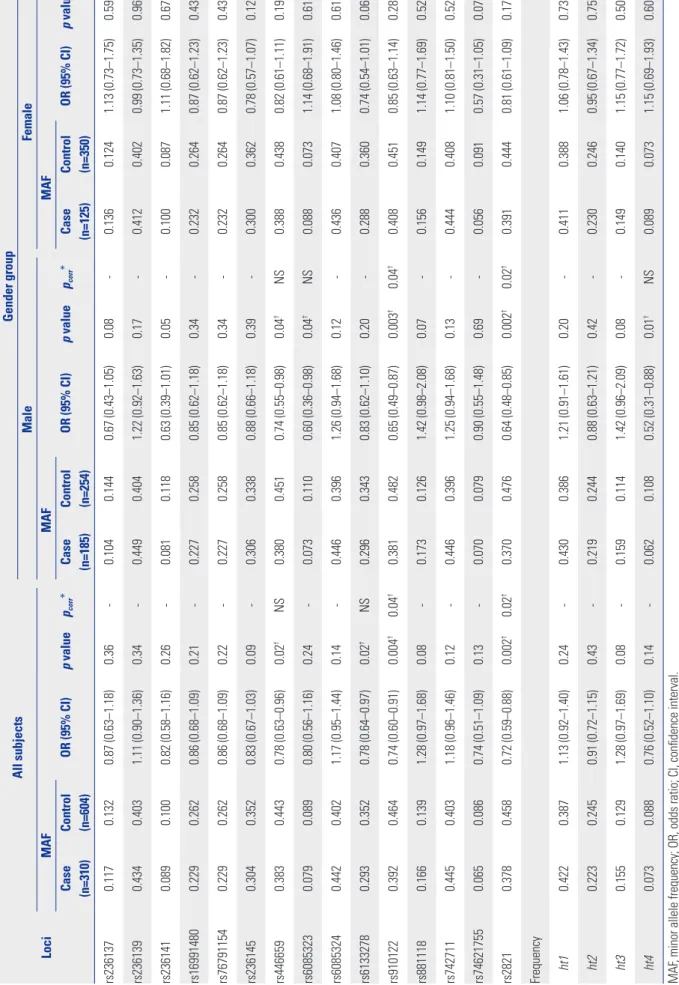
In order to investigate associations between CHGB genetic variants and schizophrenia in a Korean population, logistic regression analysis was performed. As a result, four SNPs, rs446659, rs6133278 (Asp145Asn), rs910122 (Arg178Gln), and rs2821, showed statistically significant associations with the risk of schizophrenia under the co-dominant model [minimum p=0.002 and odds ratio (OR)=0.72 at rs2821] (Table 2). Although
significance at rs446659 and rs6133278 disappeared, signifi- cant signals at rs910122 and rs2821 were retained even after correction for multiple testing (pcorr<0.05). Due to different prevalences between men and women in schizophrenia, addi- tional statistical analyses in both sexes were performed to de- termine the effect of sex on disease susceptibility. Interesting- ly, different significances in genetic associations were observed according to sex: five polymorphisms (rs236141, rs446659, rs6085323, rs910122, and rs2821) and one haplotype (ht4) showed significant associations with schizophrenia in male subjects (minimum p=0.002 and OR=0.64 at rs2821) (Table 2), even after the correction for multiple testing (minimum pcorr= 0.02 at rs2821). However, no significant association was ob- served in female subjects (p>0.05).
In silico analysis
In order to predict the functional impact of the significantly associated polymorphisms (rs446659, rs6085323, rs6133278, rs910122, and rs2821; p<0.05) (Table 2), in silico analyses were performed. Among the investigated polymorphisms, several Fig. 1. Schematic physical map of CHGB. (A) Polymorphisms of CHGB investigated in this study. Black blocks indicate coding exons; white blocks, 5’- and 3’-untranslated regions. First base of translation site is denoted as nucleotide +1. (B) LDs among CHGB polymorphisms. (C) Haplotypes (hts) of CHGB in a Korean population. CHGB, chromogranin B; LD, linkage disequilibrium.
Map of CHGB on chromosome 20p12.3 (14.03 kb) NM_001819.2
LDs among CHGB polymorphisms Haplotype of CHGB
A
B C
functional motifs were predicted on/nearby two non-synony- mous SNPs (rs6133278 and rs910122) (Table 3) using the ELM resource for functional site prediction program (http://elm.
eu.org/index.html). In particular, a motif (MOD_PIKK_1), in- cluding rs6133278 (D145N) is known as a phosphorylation site for phosphatidylinositol 3-kinase-related kinase (PIKK) family members that are recently implicated in brain development and functioning.
DISCUSSION
Schizophrenia is a severe mental disorder that affects one’s behaviors, emotions, and thinking. In addition, schizophrenia is considered to be a complex disorder affected by genetic, neurobiological, and environmental factors. Concentration of neurotransmitters (in particular, high dopamine, and low glu- tamate levels) has been considered as an important link be- tween schizophrenia and altered brain function in terms of neurobiological process.18,19 In addition, several studies have provided evidence that CHGB, a presynaptic protein that in- fluences neurotransmitter release in neuroendocrine system, is differentially regulated in several brain neurological disor- ders, including schizophrenia.20-23 Recently, genetic associa- tions on several neurotransmission related genes (Dysbindin, NRG1, DAOA, COMT, DISC1, and CHGB) with schizophrenia have been highlighted.24,25 However, the exact causes of schizo- phrenia are not yet fully understood.
Among the proteins that participate in the neurotransmitter release process, CHGB has been reported to be associated with schizophrenia. The CHGB protein, which is also known as sec- retogranin I, is a widespread constituent of large dense-core
vesicles and induces dopamine release by affecting the exocy- tosis of secretory pathway of hormones and/or neuropep- tides.26 The correlation between chromogranin and dopamine in schizophrenia has been emphasized in recent findings. A recent in vivo neuroimaging study has suggested that schizo- phrenia patients have increased synaptic dopamine concen- trations in the brain when compared with a control group.27 Al- though an in vitro study reported that dopamine release might be increased by CHGB in a dose-dependent manner,28 another study also revealed that levels of CHGB were lower in the ce- rebrospinal fluid from schizophrenia patients than from healthy controls.20 Considering these previous reports and our results, the genetic effects induced by CHGB variants on schizophre- nia in this study (minimum pcorr=0.02, OR=0.72 at rs2821) might have the possibility of being related to dopamine levels by in- fluencing neurotransmission pathway.
Post-translational processes (such as phosphorylation, meth- ylation, and glycosylation) that regulate protein function can be influenced by genetic variants, inducing an amino acid ch- ange.29,30 According to a previous report that examined changes in phosphorylation status induced by SNPs at a genome-wide level, the non-synonymous CHGB variant of rs910122 (Arg- 178Gln) was reported to be a phospho-variant affecting adja- cent CHGB phosphorylation sites by altering kinase activity.31 According to the study, the amino acid change from arginine to glutamine at CHGB rs910122 was shown to inhibit v-akt murine thymoma viral oncogene homolog kinase binding on nearby a serine residue at amino acid position 183 of CHGB.
This result suggests that the non-synonymous variation may have a cis-acting effect on subsequent amino acid phosphor- ylation of CHGB, resulting in a considerable susceptibility to schizophrenia (OR=0.65 at rs910122). In addition, other pro- Table 1. Information of CHGB Polymorphisms among Subjects Investigated in This Study (n=914)
SNP Allele Position AA
change
Genotype
MAF Heterozygosity HWE
C/C C/R R/R Patients Controls Total
rs236137 C>T Promoter 689 212 10 0.127 0.222 0.668 0.048 0.155
rs236139 C>T Promoter 304 458 147 0.414 0.485 0.438 0.362 0.243
rs236141 T>A Promoter 746 160 8 0.096 0.174 0.273 0.352 0.857
rs16991480 T>C 5’ UTR (exon 1) 513 344 57 0.251 0.376 0.294 0.574 0.947
rs76791154 A>G Intron 2 514 342 58 0.251 0.376 0.294 0.440 0.912
rs236145 C>G Intron 2 408 382 111 0.335 0.446 0.521 0.035 0.144
rs446659 C>G Intron 3 306 435 166 0.423 0.488 0.849 0.701 0.601
rs6085323 C>T Intron 3 766 140 8 0.085 0.156 0.107 0.710 0.569
rs6085324 T>A Exon 4 Ser93Thr 302 463 148 0.416 0.486 0.414 0.269 0.184
rs6133278 G>A Exon 4 Asp145Asn 421 376 115 0.332 0.444 0.890 0.012 0.032
rs910122 A>G Exon 4 Arg178Gln 288 442 178 0.439 0.493 0.742 0.970 0.719
rs881118 A>C Exon 4 Asn200His 669 219 26 0.148 0.253 0.158 0.431 0.121
rs742711 G>A Exon 4 Arg417His 297 459 148 0.418 0.486 0.335 0.323 0.187
rs74621755 G>A Exon 4 Arg500Lys 781 122 11 0.079 0.145 0.011 0.192 0.015
rs2821 C>A 3’ UTR (exon 5) 303 432 177 0.431 0.490 0.340 0.691 0.302
AA, amino acid; MAF, minor allele frequency; HWE, Hardy-Weinberg equilibrium; UTR, untranslated region; CHGB, chromogranin B.
C/C, C/R, and R/R refer to the common homozygote, heterozygote, and minor homozygote, respectively.
Table 2. Associations of CHGB Polymorphisms with Schizophrenia Loci
All subjectsGender group MaleFemale MAF OR (95% CI)p valuepcorr*MAF OR (95% CI)p valuepcorr*MAF OR (95% CI)p valueCase (n=310)Control (n=604)Case (n=185)Control (n=254)Case (n=125)Control (n=350) rs2361370.1170.1320.87 (0.63–1.18)0.36-0.1040.1440.67 (0.43–1.05)0.08-0.1360.1241.13 (0.73–1.75)0.59 rs2361390.4340.4031.11 (0.90–1.36)0.34-0.4490.4041.22 (0.92–1.63)0.17-0.4120.4020.99 (0.73–1.35)0.96 rs2361410.0890.1000.82 (0.58–1.16)0.26-0.0810.1180.63 (0.39–1.01)0.05-0.1000.0871.11 (0.68–1.82)0.67 rs169914800.2290.2620.86 (0.68–1.09)0.21-0.2270.2580.85 (0.62–1.18)0.34-0.2320.2640.87 (0.62–1.23)0.43 rs767911540.2290.2620.86 (0.68–1.09)0.22-0.2270.2580.85 (0.62–1.18)0.34-0.2320.2640.87 (0.62–1.23)0.43 rs2361450.3040.3520.83 (0.67–1.03)0.09-0.3060.3380.88 (0.66–1.18)0.39-0.3000.3620.78 (0.57–1.07)0.12 rs4466590.3830.4430.78 (0.63–0.96)0.02†NS0.3800.4510.74 (0.55–0.98)0.04†NS0.3880.4380.82 (0.61–1.11)0.19 rs60853230.0790.0890.80 (0.56–1.16)0.24-0.0730.1100.60 (0.36–0.98)0.04†NS0.0880.0731.14 (0.68–1.91)0.61 rs60853240.4420.4021.17 (0.95–1.44)0.14-0.4460.3961.26 (0.94–1.68)0.12-0.4360.4071.08 (0.80–1.46)0.61 rs61332780.2930.3520.78 (0.64–0.97)0.02†NS0.2960.3430.83 (0.62–1.10)0.20-0.2880.3600.74 (0.54–1.01)0.06 rs9101220.3920.4640.74 (0.60–0.91)0.004†0.04†0.3810.4820.65 (0.49–0.87)0.003†0.04†0.4080.4510.85 (0.63–1.14)0.28 rs8811180.1660.1391.28 (0.97–1.68)0.08-0.1730.1261.42 (0.98–2.08)0.07-0.1560.1491.14 (0.77–1.69)0.52 rs7427110.4450.4031.18 (0.96–1.46)0.12-0.4460.3961.25 (0.94–1.68)0.13-0.4440.4081.10 (0.81–1.50)0.52 rs746217550.0650.0860.74 (0.51–1.09)0.13-0.0700.0790.90 (0.55–1.48)0.69-0.0560.0910.57 (0.31–1.05)0.07 rs28210.3780.4580.72 (0.59–0.88)0.002†0.02†0.3700.4760.64 (0.48–0.85)0.002†0.02†0.3910.4440.81 (0.61–1.09)0.17 Frequency ht10.4220.3871.13 (0.92–1.40)0.24-0.4300.3861.21 (0.91–1.61)0.20-0.4110.3881.06 (0.78–1.43)0.73 ht20.2230.2450.91 (0.72–1.15)0.43-0.2190.2440.88 (0.63–1.21)0.42-0.2300.2460.95 (0.67–1.34)0.75 ht30.1550.1291.28 (0.97–1.69)0.08-0.1590.1141.42 (0.96–2.09)0.08-0.1490.1401.15 (0.77–1.72)0.50 ht40.0730.0880.76 (0.52–1.10)0.14-0.0620.1080.52 (0.31–0.88)0.01†NS0.0890.0731.15 (0.69–1.93)0.60 MAF, minor allele frequency; OR, odds ratio; CI, confidence interval. p value and OR are analyzed under the co-dominant model. Logistic analysis is adjusted by age and sex as covariates in case-control analysis and by age in gender group analysis. Haplotype 5 (ht5) is equivalent to
rs74621755. *pcorr
value after multiple testing corrections with the effective number (10.9139) of independent marker loci, †Statistical significance of p<0.05.
tein kinases of PIKKs that were predicted to phosphorylate the motif including rs6133278 (Asp145Asn) in our in silico anal- ysis (Table 3) have been reported to be associated with several neural activities, such as neuronal development and synaptic plasticity.32,33 Among the PIKKs, the mammalian target of ra- pamycin kinase signaling is related to several cognitive disor- ders, including schizophrenia.34 Considering evidence that shows different phosphorylation patterns between schizophre- nia patients and healthy controls,35 regulation of CHGB phos- phorylation sites may play a role in schizophrenia develop- ment.
Previously, several studies have reported gender-specific dif- ferences in prevalence and development of schizophrenia.3,36 Moreover, gender-specific genetic markers in schizophrenia (such as rs2812393 and rs821616 of DISC1; rs175174 of ZDH- HC8, for female patients) have been examined in recent ge- netic association studies.37,38 Including the previously reported phospho-variant rs910122,31 different genetic effects of CHGB variants on the risk of schizophrenia were also observed de- pending on sex in this study (Table 2). Furthermore, consider- ing that CHGB rs236141 with a nominal association with schizophrenia (p=0.05 and OR=0.63 in male subjects) has been found to be a gender-specific marker for blood pressure dis- ease,39 our findings suggest that CHGB could be a gender-spe- cific marker for schizophrenia development.
In other studies on Chinese and Japanese populations for the association between CHGB SNPs and schizophrenia sus- ceptibility,9,13 rs910122 was observed as a consistent associa- tion signal with schizophrenia susceptibility in a Chinese popu- lation with significance, but not in a Japanese population. The rs2821 also showed significance in Chinese and Korean schizo- phrenia patients, but not in a Japanese population (Supplemen- tary Table 2, only online). Instead, other CHGB SNPs were found to have significant signals in the Japanese patients, sug- gesting variations in CHGB may have different genetic effects depending on ethnicity.
There are study limitations of an insufficient number of sam- ples and different proportions in age range (23–73 vs. 8–84) and sex ratio (M/F=185/125 vs. 254/350) between patients and controls, respectively, as well as no functional evaluation.
Although logistic analysis of this study was adjusted by sex and age as covariates in case-control analysis and by age in
gender group analysis, we also do not rule out a possibility that the significant association signals may have resulted from the study limitations. However, considering the different incidenc- es of schizophrenia according to sex and age (such as male:
female ratio of ~1.4:1 and earlier mean age at onset for schizo- phrenia in males),2,40 further replication studies in a larger co- hort may be required.
In summary, this study replicated the association between CHGB polymorphisms and schizophrenia susceptibility. To our knowledge, this is the first study to identify the potential sex-specific association of CHGB genetic variants with schizo- phrenia. Despite study limitations, our findings may provide useful information on the genetic etiology of schizophrenia.
ACKNOWLEDGEMENTS
This study was supported by a grant of the Korea Healthcare technology R&D Project, Ministry of Health & Welfare, Repub- lic of Korea (No. A101023). This work was supported by the National Research Foundation of Korea (NRF) grant funded by the Korea government (MEST) (No. 2011-0011935 and 2009- 0093822).
REFERENCES
1. Picchioni MM, Murray RM. Schizophrenia. BMJ 2007;335:91-5.
2. Aleman A, Kahn RS, Selten JP. Sex differences in the risk of schizo- phrenia: evidence from meta-analysis. Arch Gen Psychiatry 2003;
60:565-71.
3. Ochoa S, Usall J, Cobo J, Labad X, Kulkarni J. Gender differences in schizophrenia and first-episode psychosis: a comprehensive literature review. Schizophr Res Treatment 2012;2012:916198.
4. van Os J, Kapur S. Schizophrenia. Lancet 2009;374:635-45.
5. Owen MJ, Craddock N, O’Donovan MC. Schizophrenia: genes at last? Trends Genet 2005;21:518-25.
6. Chen XW, Feng YQ, Hao CJ, Guo XL, He X, Zhou ZY, et al. DTNBP1, a schizophrenia susceptibility gene, affects kinetics of transmitter release. J Cell Biol 2008;181:791-801.
7. Gamo NJ, Duque A, Paspalas CD, Kata A, Fine R, Boven L, et al.
Role of disrupted in schizophrenia 1 (DISC1) in stress-induced prefrontal cognitive dysfunction. Transl Psychiatry 2013;3:e328.
8. Harrison PJ, Law AJ. Neuregulin 1 and schizophrenia: genetics, gene expression, and neurobiology. Biol Psychiatry 2006;60:132-40.
9. Iijima Y, Inada T, Ohtsuki T, Senoo H, Nakatani M, Arinami T. As- sociation between chromogranin B gene polymorphisms and Table 3. Motif Search Analysis of rs6133278 and rs910122
SNP (amino acid change)
Amino acid position in CHGB
Matched sequence Motif
(ELM name) Description
Including SNP site Close to SNP site rs6133278 (D145N)
137-142 - PQWSLY MOD_NEK2_2 NEK2 phosphorylation motif
137-144 - PQWSLYPS MOD_GSK3_1 GSK3 phosphorylation recognition site
143-149 PSDSQVS - MOD_PIKK_1 PIKK family members phosphorylation site
146-152 - SQVSEEV MOD_CK1_1 CK1 phosphorylation site
rs910122 (R178Q) 179-185 - GEDSSEE MOD_CK2_1 CK2 phosphorylation site
ELM, eukaryotic linear motif; SNP, single nucleotide polymorphism; CHGB, chromogranin B.
Motif search analysis is performed using the ELM resource for functional site prediction program.
schizophrenia in the Japanese population. Biol Psychiatry 2004;
56:10-7.
10. Wu S, Ma J, Xing Q, Xu Y, Meng J, Cao D, et al. Further evidence that the chromogranin B gene confers predisposition to schizophre- nia: a family-based association study in Chinese. J Neural Transm (Vienna) 2007;114:641-4.
11. Kitao Y, Inada T, Arinami T, Hirotsu C, Aoki S, Iijima Y, et al. A con- tribution to genome-wide association studies: search for suscep- tibility loci for schizophrenia using DNA microsatellite markers on chromosomes 19, 20, 21 and 22. Psychiatr Genet 2000;10:139-43.
12. Nowakowski C, Kaufmann WA, Adlassnig C, Maier H, Salimi K, Jellinger KA, et al. Reduction of chromogranin B-like immunore- activity in distinct subregions of the hippocampus from individu- als with schizophrenia. Schizophr Res 2002;58:43-53.
13. Zhang B, Tan Z, Zhang C, Shi Y, Lin Z, Gu N, et al. Polymorphisms of chromogranin B gene associated with schizophrenia in Chi- nese Han population. Neurosci Lett 2002;323:229-33.
14. American Psychiatric Association. Diagnostic and Statistical Man- ual of Mental Disorders: DSM-IV. Washington, DC: American Psychiatric Association; 1994.
15. Barrett JC, Fry B, Maller J, Daly MJ. Haploview: analysis and visual- ization of LD and haplotype maps. Bioinformatics 2005;21:263-5.
16. Stephens M, Smith NJ, Donnelly P. A new statistical method for haplotype reconstruction from population data. Am J Hum Genet 2001;68:978-89.
17. Nyholt DR. A simple correction for multiple testing for single-nu- cleotide polymorphisms in linkage disequilibrium with each oth- er. Am J Hum Genet 2004;74:765-9.
18. Seeman P, Kapur S. Schizophrenia: more dopamine, more D2 re- ceptors. Proc Natl Acad Sci U S A 2000;97:7673-5.
19. Zheng W, Wang H, Zeng Z, Lin J, Little PJ, Srivastava LK, et al. The possible role of the Akt signaling pathway in schizophrenia. Brain Res 2012;1470:145-58.
20. Landén M, Grenfeldt B, Davidsson P, Stridsberg M, Regland B, Gottfries CG, et al. Reduction of chromogranin A and B but not C in the cerebrospinal fluid in subjects with schizophrenia. Eur Neuro- psychopharmacol 1999;9:311-5.
21. Lechner T, Adlassnig C, Humpel C, Kaufmann WA, Maier H, Rein- stadler-Kramer K, et al. Chromogranin peptides in Alzheimer’s disease. Exp Gerontol 2004;39:101-13.
22. Nilsson A, Fälth M, Zhang X, Kultima K, Sköld K, Svenningsson P, et al. Striatal alterations of secretogranin-1, somatostatin, prodyn- orphin, and cholecystokinin peptides in an experimental mouse model of Parkinson disease. Mol Cell Proteomics 2009;8:1094-104.
23. Zhang K, Biswas N, Gayen JR, Miramontes-Gonzalez JP, Hightower CM, Mustapic M, et al. Chromogranin B: intra- and extra-cellular mechanisms to regulate catecholamine storage and release, in cat- echolaminergic cells and organisms. J Neurochem 2014;129:48-59.
24. Schizophrenia Working Group of the Psychiatric Genomics Con- sortium. Biological insights from 108 schizophrenia-associated ge- netic loci. Nature 2014;511:421-7.
25. Maric NP, Svrakic DM. Why schizophrenia genetics needs epi- genetics: a review. Psychiatr Danub 2012;24:2-18.
26. Taupenot L, Harper KL, O’Connor DT. The chromogranin-secreto- granin family. N Engl J Med 2003;348:1134-49.
27. Kegeles LS, Abi-Dargham A, Frankle WG, Gil R, Cooper TB, Slifs- tein M, et al. Increased synaptic dopamine function in associative regions of the striatum in schizophrenia. Arch Gen Psychiatry 2010;
67:231-9.
28. Saria A, Troger J, Kirchmair R, Fischer-Colbrie R, Hogue-Angeletti R, Winkler H. Secretoneurin releases dopamine from rat striatal slices: a biological effect of a peptide derived from secretogranin II (chromogranin C). Neuroscience 1993;54:1-4.
29. Ren J, Jiang C, Gao X, Liu Z, Yuan Z, Jin C, et al. PhosSNP for sys- tematic analysis of genetic polymorphisms that influence protein phosphorylation. Mol Cell Proteomics 2010;9:623-34.
30. Savas S, Ozcelik H. Phosphorylation states of cell cycle and DNA repair proteins can be altered by the nsSNPs. BMC Cancer 2005;5:
107.
31. Ryu GM, Song P, Kim KW, Oh KS, Park KJ, Kim JH. Genome-wide analysis to predict protein sequence variations that change phos- phorylation sites or their corresponding kinases. Nucleic Acids Res 2009;37:1297-307.
32. Langouët M, Saadi A, Rieunier G, Moutton S, Siquier-Pernet K, Fernet M, et al. Mutation in TTI2 reveals a role for triple T complex in human brain development. Hum Mutat 2013;34:1472-6.
33. Chaudhary MW, Al-Baradie RS. Ataxia-telangiectasia: future prospects. Appl Clin Genet 2014;7:159-67.
34. Gururajan A, van den Buuse M. Is the mTOR-signalling cascade disrupted in Schizophrenia? J Neurochem 2014;129:377-87.
35. Jaros JA, Martins-de-Souza D, Rahmoune H, Rothermundt M, Leweke FM, Guest PC, et al. Protein phosphorylation patterns in serum from schizophrenia patients and healthy controls. J Pro- teomics 2012;76 Spec No.:43-55.
36. Canuso CM, Pandina G. Gender and schizophrenia. Psychophar- macol Bull 2007;40:178-90.
37. Ram Murthy A, Purushottam M, Kiran Kumar HB, ValliKiran M, Krishna N, Jayramu Sriharsha K, et al. Gender-specific associa- tion of TSNAX/DISC1 locus for schizophrenia and bipolar affec- tive disorder in South Indian population. J Hum Genet 2012;57:
523-30.
38. Mukai J, Liu H, Burt RA, Swor DE, Lai WS, Karayiorgou M, et al.
Evidence that the gene encoding ZDHHC8 contributes to the risk of schizophrenia. Nat Genet 2004;36:725-31.
39. Zhang K, Rao F, Rana BK, Gayen JR, Calegari F, King A, et al. Auto- nomic function in hypertension; role of genetic variation at the catecholamine storage vesicle protein chromogranin B. Circ Car- diovasc Genet 2009;2:46-56.
40. Castle D, Sham P, Murray R. Differences in distribution of ages of onset in males and females with schizophrenia. Schizophr Res 1998;33:179-83.